fuel pressure Seat Toledo 2012 Owner's manual
[x] Cancel search | Manufacturer: SEAT, Model Year: 2012, Model line: Toledo, Model: Seat Toledo 2012Pages: 249, PDF Size: 3.6 MB
Page 67 of 249

66Controls and displays
Engine electronics control (petrol engines)⇒ page 71
Particulate filter (diesel engines)⇒ page 71
Fuel reserve⇒ page 71
Airbag system⇒ page 72
Tyre pressure⇒ page 72
Liquid level in the window washer system⇒ page 73
Turn signals (left/right)⇒ page 73
Fog lights⇒ page 73
Cruise speed⇒ page 73
Selector lever lock⇒ page 73
Main beams⇒ page 73
WARNING
● Failure to observe control lamps and warning messages can result in
serious personal injuries or damage to your vehicle.
● The engine compartment is a dangerous area! Carrying out work in
the engine compartment, i.e. checking and filling service liquids, can
lead to injury, scalding, burns and fires. Therefore the corresponding
warnings must always be observed ⇒ page 173, Engine compartment.
Handbrake
If the
warning lamp lights up, the handbrake is applied. Additionally,
driving the vehicle at speeds exceeding 6 km/h (4 mph) for at least 3 sec-
onds produces an audible warning.
The informative display indicates:
Release the handbrake!
Brake system
The warning lamp lights up if the brake fluid level falls too low or if there
is a fault in the ABS system.
The informative display indicates:
Brake fluid Instruction Manual!
Stop the vehicle, switch off the engine and check the level of the brake fluid
⇒ page 181
WARNING
● If the vehicle has to be stopped for technical reasons, park it a safe
distance away from moving traffic, switch off the engine and turn on the
hazard warning lights ⇒ page 98.
● The following indications must be taken into account when opening
the engine compartment to check the brake fluid ⇒ page 173, Engine
compartment.
Page 73 of 249
72Controls and displays
The informative display indicates: Refuel! Fuel range…km...(miles)
Note
The message on the display switches off only after refuelling and carrying
out a short journey.
Airbag system
If the warning lamp is lit up, there is a fault in the airbag system.
The informative display indicates: Airbag fault!
The airbag system availability is controlled electronically, regardless of
whether an airbag is disabled.
If the front airbag, side airbag, head protection airbag or the belt tensioner
are disabled using the diagnostics system:
● After switching on the ignition, the warning lamp lights up for around
4 seconds and flashes for another 12 seconds.
The informative display indicates:
Airbag/belt tensioner disabled! If the front passenger airbag has been disabled with the airbag switch loca-
ted in the storage compartment side:
●
When the ignition is turned on, the warning light switches on for
around 4 seconds.
● The airbag is disabled, signalled with the warning lamp which
lights up with the word placed in the centre part of the
dash panel ⇒ Fig. 24 ⇒ page 44.
WARNING
When there is a fault in the airbag system, have an inspection carried out
by an Authorised Service. Otherwise the airbags may fail to trigger in an
accident.
Tyre pressure monitoring
If the warning lamp lights up, the pressure of a tyre has decreased signif-
icantly. Check and adjust the pressure of all the tyres ⇒ page 187.
If the warning lamp flashes, there is a fault in the system.
Seek professional help.
Further information ⇒ page 192, Tyre pressure.
Note
If the battery is disconnected the warning lamp lights up when the igni-
tion is switched on. This warning lamp must switch off after covering a short
distance.
Page 158 of 249

157
Driving and the environment
Make less short journeys
Fig. 113 Fuel consump-
tion in litres per 100 km
(miles) at different tem-
peratures
In short journeys fuel consumption quantity is incomparably high.
Therefore we recommend avoiding journeys of less than 4 km (2
miles) when the engine is cold. Immediately after starting, a cold engine consumes the maximum amount
of fuel. After driving approximately one kilometre (0.62 miles), consumption
drops approximately 10 litres per 100 km (62 miles). Consumption returns
to normal only after the engine and the catalytic converter have reached op-
erating temperature.
In this context, this is also determined by the outside temperature. Fuel
consumption is different for the same journey, as shown once at +20 °C
(+68 °F) and again at -10 °C (+14 °F) ⇒ Fig. 113. Your vehicle will consume
more fuel in winter than in summer. Maintain correct tyre pressure
Maintaining correct tyre pressure saves fuel.
Always maintain correct tyre pressure. Insufficiently tyre pressure increases
rolling resistance. This leads not only to increased fuel consumption, but al-
so tyre wear and deteriorated vehicle behaviour.
Always check the tyre pressure when the tyre is
cold.
Do not carry unnecessary loads
Transporting unnecessary loads also consumes fuel.
Every additional kilo of weight increases fuel consumption. Check for un-
necessary objects in the luggage compartment.
The weight of the vehicle considerably influences fuel consumption, espe-
cially in urban traffic where frequent acceleration is required. As a general
rule, every 100 kg of weight increases consumption by approximately 1 litre
per 100 km (62 miles).
Your vehicle consumes almost 10% more fuel than the normal amount at a
speed of 100 – 120 km/h (62 – 75 mph) when a roof carrier without a load
is fitted.
Save electrical energy
An electrical current is generated with help from the alternator when the en-
gine is running. The more electrical devices there are connected to the on-
board network, the larger the quantity of fuel is required for the alternator
service. This is why electrical devices should be disconnected when they
are not required.
Safety FirstOperating instructionsPractical TipsTechnical specifications
Page 172 of 249

171
Checking and refilling levels
Checking and refilling levels Fuel
Introduction
The correct type of fuel for your vehicle is indicated on a sticker on the in-
side of the fuel tank flap, along with the tyre size and pressure. ⇒ Fig. 115
.
The scraper ⇒ Fig. 115 to remove snow and ice from windows and mirrors
⇒ page 167, Windows and exterior mirrors is located on the inside of the
fuel tank flap.
WARNING
Observe all relevant statutory regulations on transporting spare fuel can-
isters. For safety reasons, we do not recommend carrying a spare canister
in the vehicle. The canister could be damaged in an accident and fuel
may leak. Risk of fire!
CAUTION
● Never completely empty the tank! If there is an irregular fuel supply, mis-
firing can occur that can cause damage to many of the engine parts and the
exhaust system.
● If any fuel is spilt onto the paintwork of the vehicle, it should be re-
moved immediately. Risk of damage to paintwork! Refuelling
Fig. 115 Vehicle as seen from the rear right: Fuel tank flap/fuel tank flap with tank un-
screwed cap attached
Opening the tank cap
– Press the flap in the direction of the arrow 1
⇒ Fig. 115.
– Open the cover in the direction indicated by the arrow 2
.
– Hold onto the fuel tank cap with one hand and unlock it using
the ignition key, turning it anti-clockwise.
– Unscrew the tank cap anti-clockwise and place it on top of the
tank flap ⇒ Fig. 115 .
Closing the tank cap
– Screw the tank cap clockwise until it clicks into place.
– Hold onto the fuel tank cap with one hand and lock it using the
ignition key, turning it clockwise
Safety FirstOperating instructionsPractical TipsTechnical specifications
Page 175 of 249
174Checking and refilling levels
WARNING
● Never open the bonnet if you see steam, smoke or coolant escaping
from the engine compartment. Risk of scalding! Wait until no steam or
coolant can be seen before opening the bonnet.
● Switch off the engine and remove the key from the ignition.
● Engage neutral in vehicles with manual gearbox and move the selec-
tor lever to position P in vehicles with automatic gearbox.
● Apply the handbrake firmly.
● Wait for the engine to cool down.
● For safety reasons, the bonnet must always be closed when the vehi-
cle is moving. Therefore, after closing the bonnet always check that it is
properly secured.
● Should you notice that the bonnet is not safely secured when the ve-
hicle is moving, stop the vehicle immediately and close the bonnet prop-
erly. Risk of accident!
● Keep children away from the engine compartment.
● Do not touch hot engine parts. Risk of burns!
● Never spill fluids on hot engine compartments. These fluids can
cause a fire (e.g. antifreeze in coolant).
● Take care not to cause short circuits in the electrical system, especial-
ly when working on the battery.
● Never touch the radiator fan when the engine is hot. The fan may start
running suddenly!
● Do not unscrew the cap on the coolant expansion tank when the en-
gine is hot. The cooling system is under pressure!
● Protect face, hands and arms from any hot steam or hot coolant re-
leased by covering the cap with a large, thick rag when opening the ex-
pansion tank.
● Do not leave any objects, such as cloths and tools, in the engine com-
partment.WARNING (Continued)
● When working underneath the vehicle, secure it so that it cannot roll
away and support it safely on suitable supports. The hydraulic jack is not
sufficient for this purpose. Risk of injuries!
● If any tests have to be performed with the engine running, there is an
extra safety risk from rotating parts, such as the drive belt, alternator
and radiator fan, etc., and from the high-voltage ignition system. You
should also note the following:
–Never touch the electrical wiring of the ignition system.
– Keep away from moving engine parts when wearing jewellery,
loose clothing or long hair. Risk of fatal injuries! All jewellery must be
removed, hair tied back and close-fitting clothing worn.
● Observe the following additional warnings if work on the fuel system
or the electrical system is necessary.
–Always disconnect the battery from the onboard network.
– Do not smoke.
– Never work near naked flames.
– Always keep an approved fire extinguisher immediately available.
CAUTION
● When topping up fluids, make sure the correct fluid is put into the cor-
rect filler opening. Otherwise this can cause serious malfunctions or engine
damage!
● Never open the bonnet using the release catch. Risk of damage.
For the sake of the environment
Due to the environment-friendly disposal of fluids, the equipment necessary
and the knowledge required, fluids must be changed by an authorised SEAT
dealer during the service inspections of the vehicle.
Page 189 of 249

188Wheels and tyres
Note
● We recommend having all work on tyres and wheels carried out by an
authorised SEAT dealer.
● We recommend using wheels, tyres, hub caps and snow chains from the
SEAT Original Accessories programme.
Tyre useful life
Fig. 124 Side view of
tyres with tread wear in-
dicators
Tread wear indicator
The base of the side of the original tyres on your vehicle show 1.6 mm high
tread wear indicators ⇒ Fig. 124. The position of these indicators is given
on the tyre sidewalls by the letters “TWI”, triangular symbols or other sym-
bols. The useful life of the tyres depends primarily on the following factors:
Tyre pressure values
Under-inflation or over-inflation will considerably reduce the useful life of
the tyres and impair the vehicle's handling. Therefore, check the tyre pres-
sure, including the spare wheel, at least once a month and before any long
journey.
Inflation pressures for
summer tyres are listed on a sticker inside the fuel
tank flap. The pressures for winter tyres are 20 kPa (0.2 bar) above the sum-
mer values.
Always check the pressure when the tyre is cold. Do not reduce over-pres-
sure in warm tyres. The tyre pressures must be altered to suit notable
changes in the load being carried.
Driving style
Fast cornering, heavy acceleration and hard braking all increase tyre wear.
Wheel balancing
The wheels on new vehicles are balanced. Various factors encountered
when driving can cause them to become unbalanced, which results in vibra-
tion of the steering wheel.
The wheel must be rebalanced if a new tyre is fitted or if a tyre is repaired.
Incorrect wheel alignment
Incorrect front or rear wheel alignment causes excessive tyre wear, frequent-
ly on one side, and also impairs vehicle safety. If tyre wear is very irregular,
contact an Official Service.
Tyre damage
To avoid damage to tyres and wheels, only drive over kerbs or similar obsta-
cles slowly and at a right angle if possible.
Check tyres and wheels regularly for damage (punctures, cracks, blisters,
deformities, etc.). Remove any foreign objects embedded in outside of the
treads.
Page 191 of 249

190Wheels and tyres
The manufacturing date is also indicated on the tyre sidewall (possibly only
on the inner side of the wheel). DOT … 27 12…
means, for example, that the tyre was produced in the 27th week of 2012.
Follow the instructions ⇒ page 190 if you only have a temporary spare
wheel.
Tyres with directional tread pattern
The direction of rotation is indicated by the arrows on the tyre sidewall. The
direction of rotation indicated must be respected. This guarantees optimum
grip and helps avoid excessive noise, wear and aquaplaning.
In the event of a flat tyre, a spare wheel with an undetermined tread pattern
or an opposite tread pattern must be used and you must drive carefully, as
in these cases the tyres no longer offer maximum performance. Spare wheelFig. 126 Luggage com-
partment: spare wheel
The spare wheel is housed in a well under the floor panel in the luggage
compartment and is secured by a special bolt ⇒ Fig. 126.
Take out the tool box before removing the spare wheel.
The tyre pressure of the spare wheel must be checked (preferably whenever
the tyre pressure is checked – see sticker on fuel tank flap ⇒ page 188) to
ensure the spare wheel remains ready for use.
If the spare wheel is not the same size or design as the tyres that are moun-
ted on the car (for example if the car has winter tyres or tyres with direction
tread), only use the spare tyre for a short period of time in the event of
breakdown and drive with the corresponding care ⇒
.
It must be replaced as soon as possible for a wheel with a normal size and
finish.
Temporary spare wheel
If the vehicle is equipped with a temporary spare wheel, there will be a
warning sign on the rim of the wheel.
Page 194 of 249
193
Wheels and tyres
WARNING
● If the warning lamp lights up, slow down immediately and avoid
any severe braking or steering manoeuvres. Stop and check the tyres and
their pressure as soon as possible.
● Under certain conditions (e.g. sporty driving style, driving on loose
surfaces or in the winter) the warning lamp may take a while to light
up or may remain switched off.
● Despite the tyre pressure monitoring system, the driver remains re-
sponsible for maintaining the correct tyre pressure. You must therefore
check the tyre pressure often.
Note
● The tyre pressure monitoring system is not a replacement for regularly
checking the tyre pressure, as it is unable to recognise an even drop in pres-
sure.
● The tyre pressure monitoring system is unable to warn of a sudden drop
in tyre pressure, e.g. a puncture. In this case, try to stop the vehicle carefully
with no severe braking or steering manoeuvres.
● To ensure the tyre pressure monitoring system works correctly, the basic
setting must be performed every 10 000 km (6000 miles) or once a year.
Wheel bolts
The wheel bolts are matched to the rims. When installing different wheels,
e.g. to fit light alloy wheels or wheels with winter tyres, it is important to use
the correct wheel bolts with the right length and correctly shaped bolt
heads. The is essential for the secure fit of the wheels and for the proper
function of the brake system. Winter tyres
Winter tyres will significantly improve handling of the vehicle in winter road
conditions. The design of summer tyres (width, rubber compound, tread
pattern) gives less grip at temperatures below 7 °C (45 °F), on ice and snow.
This applies particularly to vehicles equipped with
wide section tyres or
high speed tyres (code letters H or V on the sidewall).
In order to preserve the performance of the vehicle as much as possible,
winter tyres must be fitted on all four wheels, the minimum depth of the
tread must be 4 mm and the maximum age must be 4 years.
You can use winter tyres of a lower speed rating if the maximum speed limit
of these tyres will not be exceeded, even if the maximum speed limit for the
vehicle is higher.
For the sake of the environment
Summer tyres should be fitted again in time, as they give better handling on
roads free of snow and ice and at temperatures over 7 °C (45 °F). Summer
tyres have a shorter braking distance, produce less rolling noise and do not
wear down as quickly. They also reduce fuel consumption.
Snow chains
Snow chains must only be used on the front wheels.
In winter road conditions, snow chains not only help to improve grip but al-
so improve the braking capacity.
For technical reasons snow chains may only be used on tyres with the fol-
lowing wheel rim/tyre combinations.
Safety FirstOperating instructionsPractical TipsTechnical specifications
Page 206 of 249

205
Self-help
– Switch the compressor off.
– When an air pressure of 2.0 – 2.5 bar cannot be reached, un-
screw the flexible pipe 5
from the tyre valve.
– Drive the vehicle approx. 10 metres forwards or backwards, so
that the sealant can “spread evenly” in the tyre.
– Screw the flexible hose from the air compressor 5
back onto
the tyre valve and repeat the inflation process.
– If the pressure is still lower than specified, the tyre is too badly
damaged. The tyre cannot be repaired using the tyre sealant kit
⇒
.
– Switch the compressor off.
– Unscrew the flexible hose 5
from the tyre valve.
When a tyre pressure of 2.0 – 2.5 bar is reached then you can con-
tinue driving at a max. speed of 80 km/h (50 mph).
Check the tyre pressure after 10 minutes of driving ⇒ page 205.
WARNING
● The flexible tyre filling hose and the air compressor may heat up dur-
ing the filling process. Risk of injury!
● Do not place the hot flexible tyre filling hose or hot air compressor on
top of flammable materials. Risk of fire!
● If the tyre cannot be inflated to a minimum pressure of 2.0 bar then
the tyre is too badly damaged. The sealing product is unable to seal the
tyre . Do not drive on and obtain professional assistance.
CAUTION
Do not use the air compressor for longer than 8 minutes at a time. Risk of
overheating! Before using the air compressor again, leave it to cool down
for several minutes.
Check after 10 minutes of driving
Check the tyre pressure after 10 minutes of driving!
If the tyre pressure is less than 1.3 bar:
– Do not drive on! The tyre cannot be sufficiently filled using
the tyre repair kit.
– See professional assistance.
If the tyre pressure is over 1.3 bar:
– Correct the tyre pressure again to the correct value (see inside
of the fuel tank flap).
– Carefully resume your journey to the nearest specialised work-
shop at a maximum speed of 80 km/h (50 mph).
Jump-starting
Introduction
If the engine fails to start because of a discharged battery, the battery can
be connected to the battery of another vehicle to start the engine. Suitable
jump leads are required.
Safety FirstOperating instructionsPractical TipsTechnical specifications
Page 213 of 249
212Fuses and bulbs
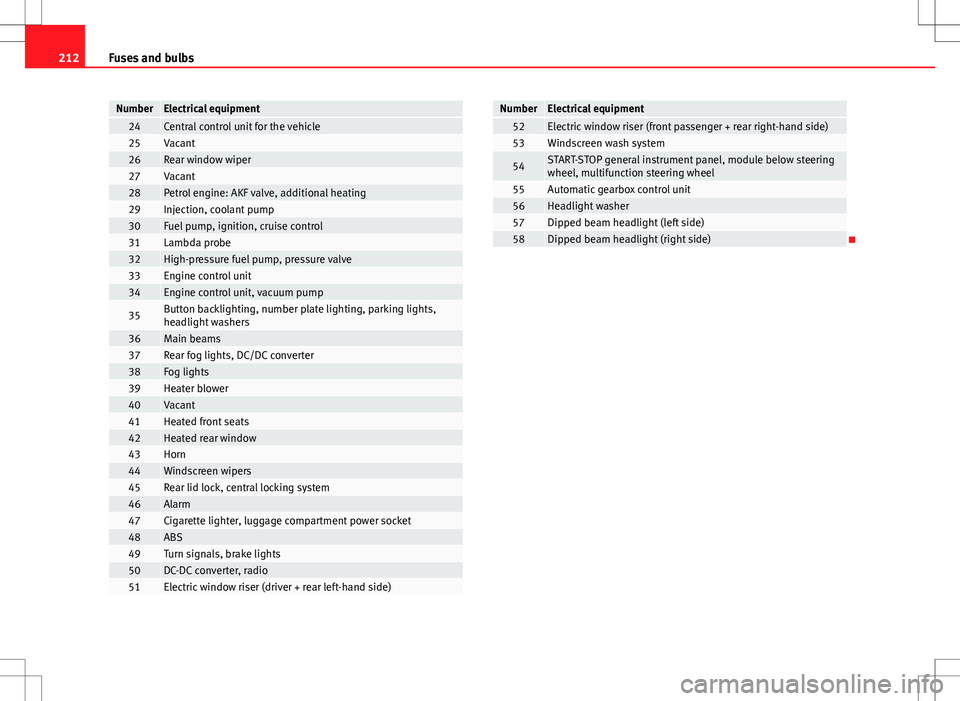
NumberElectrical equipment24Central control unit for the vehicle25Vacant26Rear window wiper27Vacant28Petrol engine: AKF valve, additional heating29Injection, coolant pump30Fuel pump, ignition, cruise control31Lambda probe32High-pressure fuel pump, pressure valve33Engine control unit34Engine control unit, vacuum pump
35Button backlighting, number plate lighting, parking lights,
headlight washers
36Main beams37Rear fog lights, DC/DC converter38Fog lights39Heater blower40Vacant41Heated front seats42Heated rear window43Horn44Windscreen wipers45Rear lid lock, central locking system46Alarm47Cigarette lighter, luggage compartment power socket48ABS49Turn signals, brake lights50DC-DC converter, radio51Electric window riser (driver + rear left-hand side)
NumberElectrical equipment52Electric window riser (front passenger + rear right-hand side)53Windscreen wash system
54START-STOP general instrument panel, module below steering
wheel, multifunction steering wheel
55Automatic gearbox control unit56Headlight washer57Dipped beam headlight (left side)58Dipped beam headlight (right side)