ESP Seat Toledo 2013 Owner's Guide
[x] Cancel search | Manufacturer: SEAT, Model Year: 2013, Model line: Toledo, Model: Seat Toledo 2013Pages: 258, PDF Size: 3.94 MB
Page 74 of 258
72Controls and displays
WARNING
If the vehicle has to be stopped for technical reasons, park it a safe dis-
tance away from moving traffic, switch off the engine and turn on the
hazard warning lights ⇒ page 101.
Coolant level and temperature
If the warning lamp (blue) is lit up, the engine has not yet reached its op-
erating temperature 1)
. Avoid high engine speeds, hard acceleration and
submitting the engine to high loads.
If the warning lamp (red) is lit up or flashing, the coolant temperature is
too high or its level is too low.
The informative display indicates:
Check coolant! Instruction Manual!
Stop the vehicle, switch off the engine, check the coolant level ⇒ page 188
and refill if necessary ⇒ page 188.
If the coolant is situated in the prescribed area, the high temperature may
be due to a fault in the cooling system fan. Check the radiator fan fuse and
replace it if necessary ⇒ page 221, Changing fuses in the engine compart-
ment.
If the warning lamp (red) remains lit up, despite both the coolant level
and the radiator fan fuse being in correct condition, stop the vehicle!
Seek professional help.
WARNING
● If the vehicle has to be stopped for technical reasons, park it a safe
distance away from moving traffic, switch off the engine and turn on the
hazard warning lights ⇒ page 101.
● Take care when opening the coolant reservoir. When the engine is
warm or hot, the system is pressurised – Danger of burns! Wait for the
engine to cool before opening the cover.
● Do not touch the fan. The fan can switch on automatically regardless
of whether the ignition is switched on.
Power steering
If the warning lamp, is lit up there is a fault in the power steering.
The power steering system functions with reduced power steering effect.
Seek professional help.
Stability Control (ESC)
If the control lamp flashes, the ESC is working.
If the warning lamp lights up on ignition the ESC system may have
switched off due to technical reasons. Turn off the ignition and turn it on
again. Upon switching on the ignition again, if the warning lamp has switch-
ed off, this means the ESC is functioning correctly again.
If the warning lamp, is lit up there is a fault in the ESC.
1)
This does not apply to vehicles equipped with an informative display.
Page 77 of 258
75
Controls and displays
Diesel particulate filter. Instruction Manual!
The engine control unit allows driving to continue in an emergency program.
When switching the ignition off and on again, the warning lamp also
lights up.
Seek professional help.
WARNING
● The particulate filter attains very high temperatures. Therefore, do
not park the vehicle in places where the exhaust pipe could come into
contact with dry grass or with highly-flammable materials. Risk of fire!
● Always adjust your speed to suit the weather, road, terrain and traffic
conditions. Never be encouraged, by the recommendations shown in the
warning lamps, to fail to respect traffic legislation.
CAUTION
While the warning lamp is lit up, the fuel consumption is high, and in
certain conditions, the engine power is reduced.
Note
● In order for the particulate filter to burn off soot in a correct manner,
avoid carrying out frequent short journeys.
● Using diesel fuel with a high sulphur count can considerably reduce the
useful life of the particulate filter. The specialised service provides informa-
tion about the countries where fuel with a high sulphur content is used.
Fuel reserve
The warning lamp lights up when approximately only 7 litres of fuel re-
main in the tank. The informative display indicates:
Refuel! Fuel range…km...(miles)
Note
The message on the display switches off only after refuelling and carrying
out a short journey.
Airbag system
If the warning lamp is lit up, there is a fault in the airbag system.
The informative display indicates: Airbag fault!
The airbag system availability is controlled electronically, regardless of
whether an airbag is disabled.
If the front airbag, side airbag, head protection airbag or the belt tensioner
are disabled using the diagnostics system:
● After switching on the ignition, the warning lamp lights up for around
4 seconds and flashes for another 12 seconds.
The informative display indicates:
Airbag/belt tensioner disabled!
Safety FirstOperating instructionsPractical TipsTechnical specifications
Page 83 of 258

81
Communication
ButtonRadioMedia (except AUX)AUXTelephone a)Navigation a)
GActivating/deactivating
voice control a)Activating/deactivating
voice control a)Activating/deactivating
voice control a)No functionb)Activating/deactivating
voice control
H TurnNext / previous preset c)Next / previous presetc)Operates on the instrument
panel menu you are inOperates on the instru-
ment panel menu you are inOperates on the instru-
ment panel menu you are in
H Press
Operates on the MFA or
confirms instrument panel
menu option depending on the menu optionOperates on the MFA or
confirms instrument panel
menu option depending on the menu optionOperates on the MFA or
confirms instrument panel
menu option depending on the menu optionOperates on the MFA or
confirms instrument panel menu option depending on the menu optionOperates on the MFA or
confirms instrument panel menu option depending on the menu option
a) Depending on the vehicle equipment.
b) In call-in-progress situation, if not Radio/Media function (except AUX).
c) Only if the instrument panel is in the Audio menu.
Multimedia AUX-IN and MDI Inputs
Fig. 40 AUX-IN input/MDI input The operating description is located in the respective Instruction Manuals of
the audio system or the navigation system.
AUX-IN Input
The AUX-IN input is located in one of the following places:
●
in the centre console between the front seats ⇒ Fig. 40 - ;
● above the storage compartment in the front centre console ⇒ Fig. 40 -
;
● in the front panel of the SEAT Media System 2.2 navigation system.
The purpose of the AUX-IN input is to connect external devices in order to
play music (i.e. iPod ®
or an mp3 player) using the factory-fitted audio sys-
tem or the navigation system.
MDI Input
The MDI input is located above the storage compartment in the front centre
console ⇒ Fig. 40 - ;
Safety FirstOperating instructionsPractical TipsTechnical specifications
Page 84 of 258
82Communication
The MDI input is composed of the USB and AUX-IN inputs.
The purpose of the MDI input is to connect external devices (i.e. iPod ®
, mp3
players or USB memories) in order to play music using the audio system or
the navigation system.
In order to connect Apple multimedia devices (such as an iPod ®
/iPhone ®
…)
the corresponding adaptor from the SEAT Original Accessories catalogue is
required.
Voice control
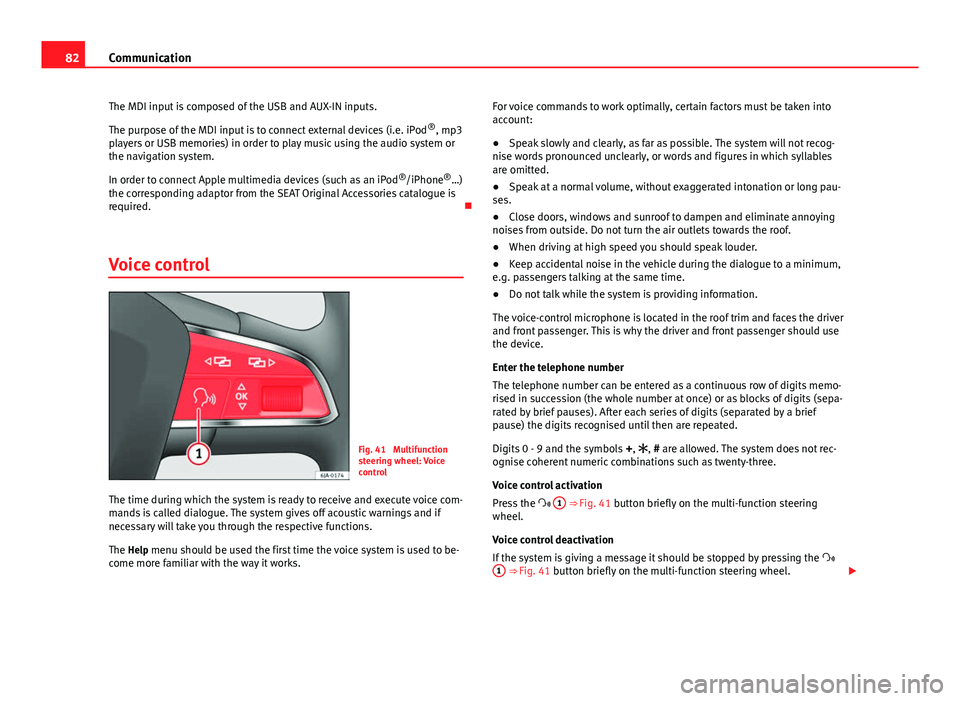
Fig. 41 Multifunction
steering wheel: Voice
control
The time during which the system is ready to receive and execute voice com-
mands is called dialogue. The system gives off acoustic warnings and if
necessary will take you through the respective functions.
The Help menu should be used the first time the voice system is used to be-
come more familiar with the way it works. For voice commands to work optimally, certain factors must be taken into
account:
●
Speak slowly and clearly, as far as possible. The system will not recog-
nise words pronounced unclearly, or words and figures in which syllables
are omitted.
● Speak at a normal volume, without exaggerated intonation or long pau-
ses.
● Close doors, windows and sunroof to dampen and eliminate annoying
noises from outside. Do not turn the air outlets towards the roof.
● When driving at high speed you should speak louder.
● Keep accidental noise in the vehicle during the dialogue to a minimum,
e.g. passengers talking at the same time.
● Do not talk while the system is providing information.
The voice-control microphone is located in the roof trim and faces the driver
and front passenger. This is why the driver and front passenger should use
the device.
Enter the telephone number
The telephone number can be entered as a continuous row of digits memo-
rised in succession (the whole number at once) or as blocks of digits (sepa-
rated by brief pauses). After each series of digits (separated by a brief
pause) the digits recognised until then are repeated.
Digits 0 - 9 and the symbols +, , # are allowed. The system does not rec-
ognise coherent numeric combinations such as twenty-three.
Voice control activation
Press the 1
⇒ Fig. 41 button briefly on the multi-function steering
wheel.
Voice control deactivation
If the system is giving a message it should be stopped by pressing the
1
⇒ Fig. 41 button briefly on the multi-function steering wheel.
Page 91 of 258
89
Opening and closing
Manual locking
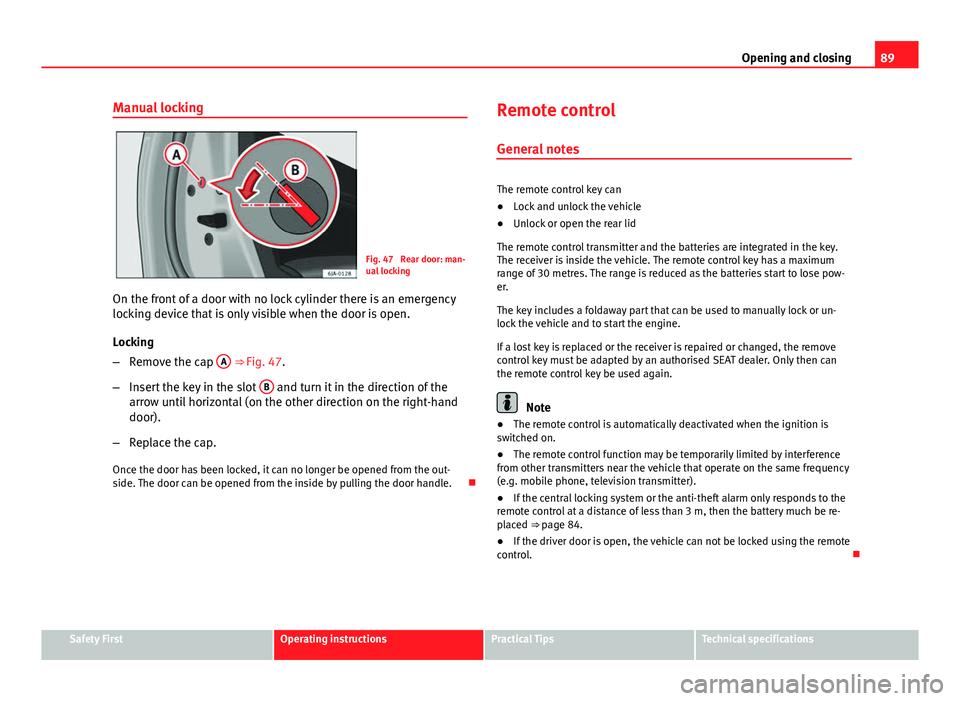
Fig. 47 Rear door: man-
ual locking
On the front of a door with no lock cylinder there is an emergency
locking device that is only visible when the door is open.
Locking
– Remove the cap A
⇒ Fig. 47.
– Insert the key in the slot B
and turn it in the direction of the
arrow until horizontal (on the other direction on the right-hand
door).
– Replace the cap.
Once the door has been locked, it can no longer be opened from the out-
side. The door can be opened from the inside by pulling the door handle. Remote control
General notes
The remote control key can
● Lock and unlock the vehicle
● Unlock or open the rear lid
The remote control transmitter and the batteries are integrated in the key.
The receiver is inside the vehicle. The remote control key has a maximum
range of 30 metres. The range is reduced as the batteries start to lose pow-
er.
The key includes a foldaway part that can be used to manually lock or un-
lock the vehicle and to start the engine.
If a lost key is replaced or the receiver is repaired or changed, the remove
control key must be adapted by an authorised SEAT dealer. Only then can
the remote control key be used again.
Note
● The remote control is automatically deactivated when the ignition is
switched on.
● The remote control function may be temporarily limited by interference
from other transmitters near the vehicle that operate on the same frequency
(e.g. mobile phone, television transmitter).
● If the central locking system or the anti-theft alarm only responds to the
remote control at a distance of less than 3 m, then the battery much be re-
placed ⇒ page 84.
● If the driver door is open, the vehicle can not be locked using the remote
control.
Safety FirstOperating instructionsPractical TipsTechnical specifications
Page 97 of 258
95
Opening and closing
Release
– Fold down the backrest of the rear seat ⇒ page 113.
– Insert the car key in the opening in the mat.
– Move it towards the arrow to release the rear lid.
– Open the rear lid.
Opening and closing electric windows Introduction
WARNING
● When locking the vehicle from the outside, make sure that nobody is
inside the vehicle, as the windows cannot be opened from the inside in
an emergency.
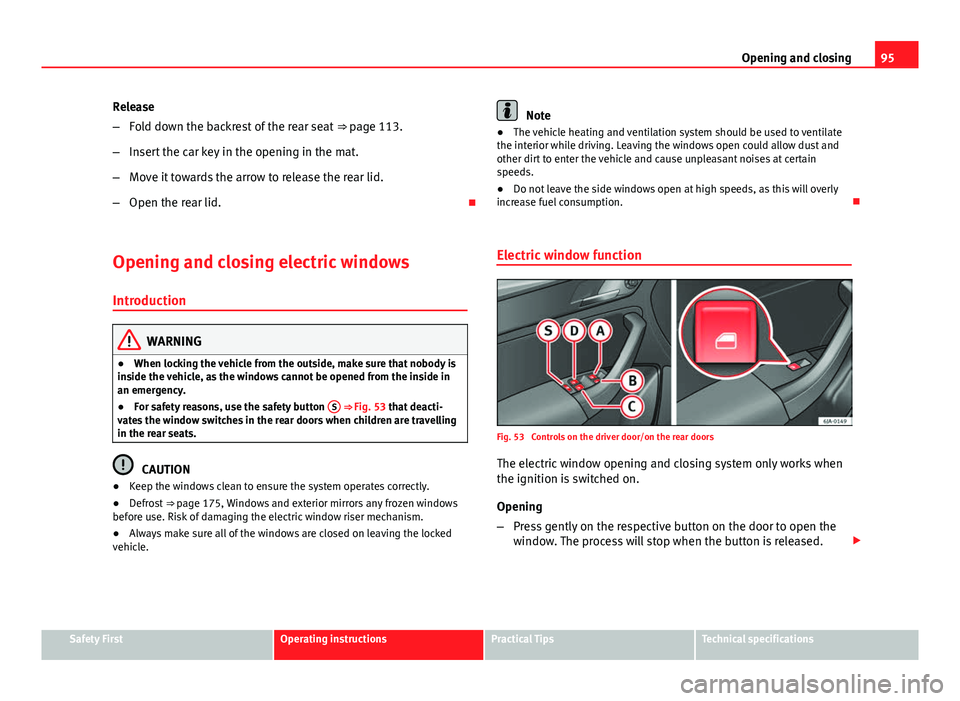
● For safety reasons, use the safety button S
⇒ Fig. 53 that deacti-
vates the window switches in the rear doors when children are travelling
in the rear seats.
CAUTION
● Keep the windows clean to ensure the system operates correctly.
● Defrost ⇒ page 175, Windows and exterior mirrors any frozen windows
before use. Risk of damaging the electric window riser mechanism.
● Always make sure all of the windows are closed on leaving the locked
vehicle.
Note
● The vehicle heating and ventilation system should be used to ventilate
the interior while driving. Leaving the windows open could allow dust and
other dirt to enter the vehicle and cause unpleasant noises at certain
speeds.
● Do not leave the side windows open at high speeds, as this will overly
increase fuel consumption.
Electric window function
Fig. 53 Controls on the driver door/on the rear doors
The electric window opening and closing system only works when
the ignition is switched on.
Opening
– Press gently on the respective button on the door to open the
window. The process will stop when the button is released.
Safety FirstOperating instructionsPractical TipsTechnical specifications
Page 98 of 258
96Opening and closing
–The driver door window can also be automatically opened by
pressing the button as far as it will go (fully open). Press the
button again to immediately stop it.
Closing
– Press the respective button gently to close the window. The
process will stop when the button is released.
Window control buttons Window button on the driver's door
Window button on the passenger door
Window button on the right rear door
Window button on the left rear door
Safety switch
Safety button
Press the safety button S
⇒ Fig. 53 to deactivate the controls on the rear
doors. Pressing the safety button S again will reactivate the controls on
the rear doors.
If the rear door controls are deactivated, the warning lamp on the safety
button S
will light up.
Note
The electric window opening mechanism is equipped with a thermostat
switch. This may overheat if the window is opened and closed repeatedly.
This causes the window to lock temporarily. Once the thermostat switch has
cooled down the window can be operated once again.
A
BCDS
Roll-back function on the electric windows
The electric windows are equipped with a roll-back system that reduces risk
of injury when closing windows.
If an obstacle is present, the closing mechanism will stop and the window
will roll back a few centimetres.
If an obstacle prevents closing for the next 10 seconds, the closing mecha-
nism will once again stop and the window will roll back another few centi-
metres.
If in the next 10 seconds you attempt to close the window after it has rolled
back the second time, only the closing mechanism will be stopped even if
the obstacle is still present. The roll-back function is still connected.
The roll-back function will only be disconnected if you once again attempt to
close the window in the following 10 seconds. In this case, the window will
close at full force
.
If you wait for a further 10 seconds, the roll-back function will be once again
connected.
Page 99 of 258
97
Lights and visibility
Lights and visibility
Lights Introduction
The location of the controls of right-hand drive cars differs slightly from the
location shown here ⇒ Fig. 54 ⇒ page 97. However, the symbols indicat-
ing the respective positions of the controls remain the same.
WARNING
Never drive with only the side lights on! The side lights are not bright
enough to illuminate the road ahead and to ensure that other road users
are able to see you. Always use your dipped beam headlights if it is dark
or if visibility is poor.
CAUTION
● Use the lights in line with local law.
● However, drivers always remain responsible for correctly adjusting and
using the lights.
Note
● An audible warning will be heard when the light control is set to and
you remove the ignition key and open the door. Once the driver door is
closed (ignition off), the audible warning will stop, whereas the side lights
will remain on to light up the stationary vehicle if necessary.
● Depending on weather conditions (cold or wet), the lights may mist up
temporarily on the inside. This is particularly the case in the event of a dif-
ference in temperature between the inside and in front of the light. By
switching on the lights, the area through which the beam of light is projec- ted will quickly be demisted, although the edges may remain misted. The
real lights and turn signals can mist up. This has no influence on the useful
life of the lighting system.
Switching lights on and off
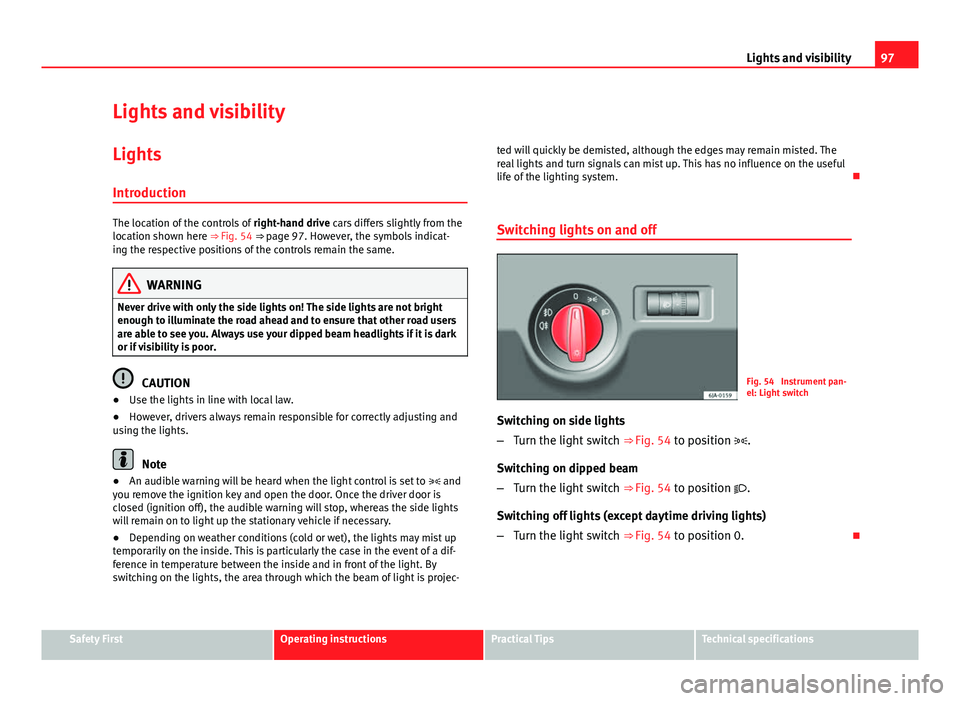
Fig. 54 Instrument pan-
el: Light switch
Switching on side lights
– Turn the light switch ⇒ Fig. 54 to position .
Switching on dipped beam
– Turn the light switch ⇒ Fig. 54 to position .
Switching off lights (except daytime driving lights)
– Turn the light switch ⇒ Fig. 54 to position 0.
Safety FirstOperating instructionsPractical TipsTechnical specifications
Page 101 of 258

99
Lights and visibility
Switching on front fog lights
– First turn the light switch ⇒ Fig. 55 to position or .
– Pull on the light switch to position 1
.
The ⇒ page 69 warning lamp lights up on the general instrument panel if
the front fog lights are switched on.
Rear fog light
Switching on the rear fog light
– First turn the light switch ⇒ Fig. 55 ⇒ page 98 to position or
.
– Pull on the light switch to position 2
.
If the vehicle is not equipped with front fog lights ⇒ page 98, the rear fog
light is switched on by turning the switch to position and pulling it to po-
sition 2
. This type of switch only has one position.
The warning lamp lights up on the general instrument panel ⇒ page 69 if
the front fog lights are switched on.
If you are towing a trailer or caravan equipped with a rear fog light on a vehi-
cle with a factory-fitted towing bracket or one installed using parts from the
original SEAT parts catalogue , only the rear fog light on the trailer or cara-
van will light up. Range control of main lights
Fig. 56 Instrument pan-
el: light range control
– Turn the control ⇒ Fig. 56 to set the lights to the required set-
ting.
Positions
The control positions roughly correspond to the following vehicle load con-
ditions. Two front occupants, luggage compartment empty.
All seats occupied, luggage compartment empty.
All seats occupied, luggage compartment fully loaded.
Driver only, luggage compartment fully loaded.
CAUTION
Always adjust the range of the lights so that:
● Your vehicle does not dazzle others, particularly oncoming traffic
● The range of the headlights is sufficient for safe driving
-
123
Safety FirstOperating instructionsPractical TipsTechnical specifications
Page 103 of 258
101
Lights and visibility
Parking lights*
Parking lights
– Switch the ignition off.
– Move the turn signal lever ⇒ Fig. 57 ⇒ page 100 up or down to
turn on the right or left-hand parking lights respectively.
Parking light on both sides
– Turn the light switch ⇒ Fig. 54 ⇒ page 97 to position and
engage the steering lock.
Note
● The parking lights only work when the ignition is switched on.
● The parking light will not come on automatically on switching the igni-
tion off if the left or right-hand turn signal is left on.
Front fog lights with CORNER function*
Front fog lights with CORNER function provide better lighting of the area
around the car when driving through a corner or parking, etc.
Front fog lights with CORNER function switch on depending on how far you
turn the steering wheel or whether or not the turn signals 1)
are switched on,
if the following conditions are met:
● the vehicle is stationary, the ignition is switched on or you are moving at
a speed less than 40 km/h (25 mph)
● The daytime driving light is switched off ●
The dipped beam is switched on
● The fog lights are switched off
● Reverse gear is not engaged
Hazard warning light switch
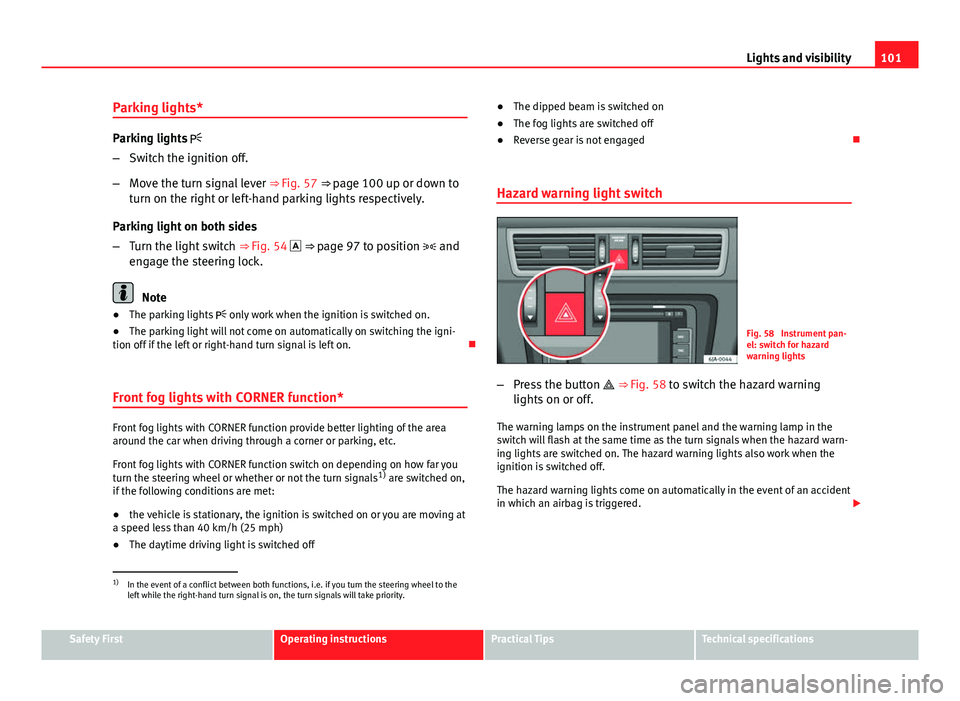
Fig. 58 Instrument pan-
el: switch for hazard
warning lights
– Press the button ⇒ Fig. 58 to switch the hazard warning
lights on or off.
The warning lamps on the instrument panel and the warning lamp in the
switch will flash at the same time as the turn signals when the hazard warn-
ing lights are switched on. The hazard warning lights also work when the
ignition is switched off.
The hazard warning lights come on automatically in the event of an accident
in which an airbag is triggered.
1)
In the event of a conflict between both functions, i.e. if you turn the steering wheel to the
left while the right-hand turn signal is on, the turn signals will take priority.
Safety FirstOperating instructionsPractical TipsTechnical specifications