ESP Seat Toledo 2013 Workshop Manual
[x] Cancel search | Manufacturer: SEAT, Model Year: 2013, Model line: Toledo, Model: Seat Toledo 2013Pages: 258, PDF Size: 3.94 MB
Page 197 of 258
195
Checking and refilling levels
Note
Despite any measures taken by the control unit, the battery could drain. e.g.
with the engine is switched off, the key is turned in the ignition for a long
period or the side lights or parking lights are switched on. The switching off
of certain electrical components does not impair driving comfort and the
driver will often not even realise.
Safety FirstOperating instructionsPractical TipsTechnical specifications
Page 198 of 258
196Wheels and tyres
Wheels and tyres
Wheels
Introduction
WARNING
● During the first 500 km (300 miles), new tyres do not give maximum
grip, therefore you should drive carefully. Risk of accident!
● Never drive with damaged tyres. Risk of accident!
● Only use wheels and tyres that been authorised by SEAT or your vehi-
cle model. Failure to do so could impair road safety. Risk of accident!
● Never exceed the maximum speed permitted for your tyres. Risk of ac-
cident due to tyre damage and loss of vehicle control.
● Under-inflated tyres are submitted to greater rolling resistance. This
means that they can overheat at high speeds. This can cause tread sepa-
ration and even tyre blow-out.
● For driving safety, tyres should be replaced at least in pairs according
to the axle and not individually. The tyres with the deepest tread should
always be used on the front wheels.
● Never fit used tyres of an unknown age or prior use.
● Tyres must be immediately changed at the very latest when they have
worn down to the tread wear indicators.
● Worn tyres reduce the necessary grip at high speeds on damp surfa-
ces. This could lead to “aquaplaning” (uncontrolled vehicle movement –
“skidding” on damp surfaces).
● Damaged wheels and tyres must be replaced immediately.
WARNING (Continued)
● Do not use summer or winter tyres that are more than 6 or 4 years old
respectively.
● Wheel bolts should be clean and screw easily. However, they must
never be treated with grease or oil.
● If the tightening torque of the wheel bolts is too low, they could loos-
en while the vehicle is moving. Risk of accident! If the tightening torque
of the wheel bolts is too high, the bolts and threads could be damaged,
leading to the permanent deforming of the rim support surfaces.
● Incorrectly handled wheel bolts could lead to a wheel coming loose
while the vehicle is moving. Risk of accident!
● The national regulations on the use of snow tyres and chains should
be observed.
CAUTION
● Where a spare wheel that is not compatible with the wheels fitted is
used, follow the instructions ⇒ page 199.
● The prescribed tightening torque for wheel bolts on steel and alloy
wheels is 120 Nm.
● Protect your tyres from coming into contact with oil, grease and fuel.
● Replace any lost valve caps immediately.
For the sake of the environment
Under-inflated tyres increases fuel consumption.
Page 201 of 258
199
Wheels and tyres
The manufacturing date is also indicated on the tyre sidewall (possibly only
on the inner side of the wheel). DOT … 27 12…
means, for example, that the tyre was produced in the 27th week of 2012.
Follow the instructions ⇒ page 199 if you only have a temporary spare
wheel.
Tyres with directional tread pattern
The direction of rotation is indicated by the arrows on the tyre sidewall. The
direction of rotation indicated must be respected. This guarantees optimum
grip and helps avoid excessive noise, wear and aquaplaning.
In the event of a flat tyre, a spare wheel with an undetermined tread pattern
or an opposite tread pattern must be used and you must drive carefully, as
in these cases the tyres no longer offer maximum performance. Spare wheel*Fig. 133 Luggage com-
partment: spare wheel
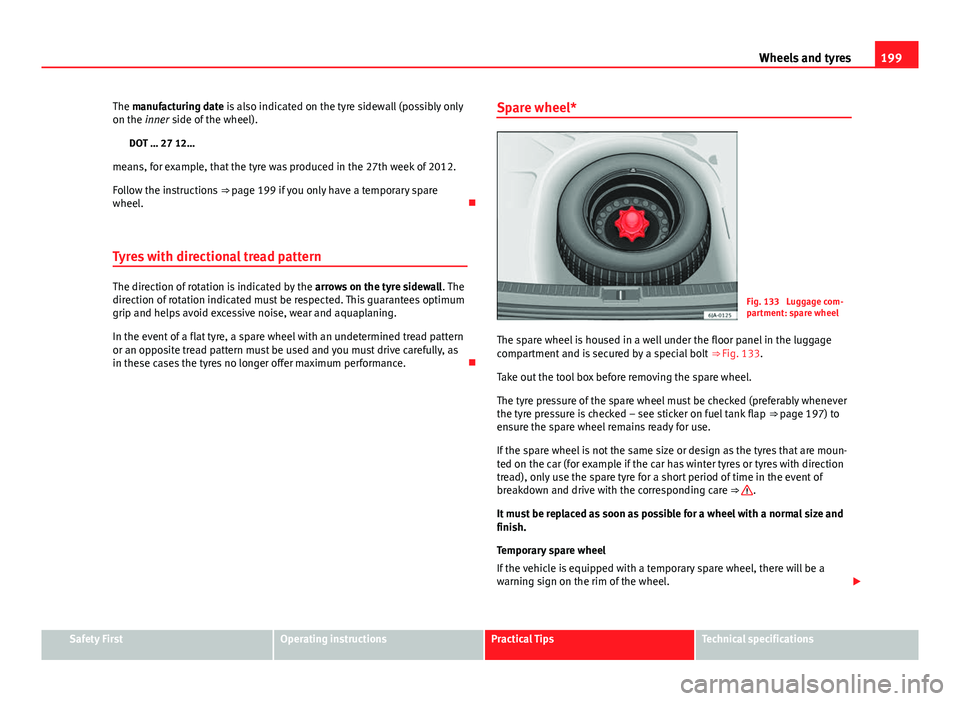
The spare wheel is housed in a well under the floor panel in the luggage
compartment and is secured by a special bolt ⇒ Fig. 133.
Take out the tool box before removing the spare wheel.
The tyre pressure of the spare wheel must be checked (preferably whenever
the tyre pressure is checked – see sticker on fuel tank flap ⇒ page 197) to
ensure the spare wheel remains ready for use.
If the spare wheel is not the same size or design as the tyres that are moun-
ted on the car (for example if the car has winter tyres or tyres with direction
tread), only use the spare tyre for a short period of time in the event of
breakdown and drive with the corresponding care ⇒
.
It must be replaced as soon as possible for a wheel with a normal size and
finish.
Temporary spare wheel
If the vehicle is equipped with a temporary spare wheel, there will be a
warning sign on the rim of the wheel.
Safety FirstOperating instructionsPractical TipsTechnical specifications
Page 202 of 258
200Wheels and tyres
Follow the instructions below when driving with this wheel fitted.
● After fitting the wheel, the warning sign must not be covered.
● Do not drive faster than 80 km/h (50 mph) with this spare wheel and
take great care during the trip. Avoid heavy acceleration, hard braking and
fast cornering.
● The tyre pressure is the same as that of the standard tyres.
● Only use this spare wheel to reach the nearest Official Service, as it is
not designed for permanent use.
WARNING
● Under no circumstances must damaged spare wheels be used.
● If the spare wheel is different in size or design to the tyres currently
fitted, never drive faster than 80 km/h (50 mph). Avoid heavy accelera-
tion, hard braking and fast cornering.
CAUTION
Follow the instructions given on the temporary spare wheel label.
Note
The tyre pressure of the spare wheel must always correspond to the highest
pressure prescribed for the model of vehicle in question.
Wheel trim
Removing
– Place the hook from the vehicle tool kit on the reinforced edge
of the wheel trim. –
Insert the box spanner through the hook, supporting it on the
tyre and remove the wheel trim.
Fitting
– First press the wheel trim onto the wheel at the cut out de-
signed for the valve. Then press the wheel trim on both sides in
the direction of the valve so that it fits correctly in place around
all the perimeter.
CAUTION
● Press down by hand, do not hit the wheel trim! Knocking it sharply, par-
ticularly at points where the wheel trim has not yet been inserted, could re-
sult in damage to the wheel trim guiding and centring elements.
● Before fitting the trim on a steel alloy wheel attached with an anti-theft
wheel bolt, make sure the bolt is in the hole in the valve area ⇒ page 211,
Anti-theft wheel bolts*.
● Where trim is fitted at a later date, ensure enough air inflow is guaran-
teed in order to cool the brake system.
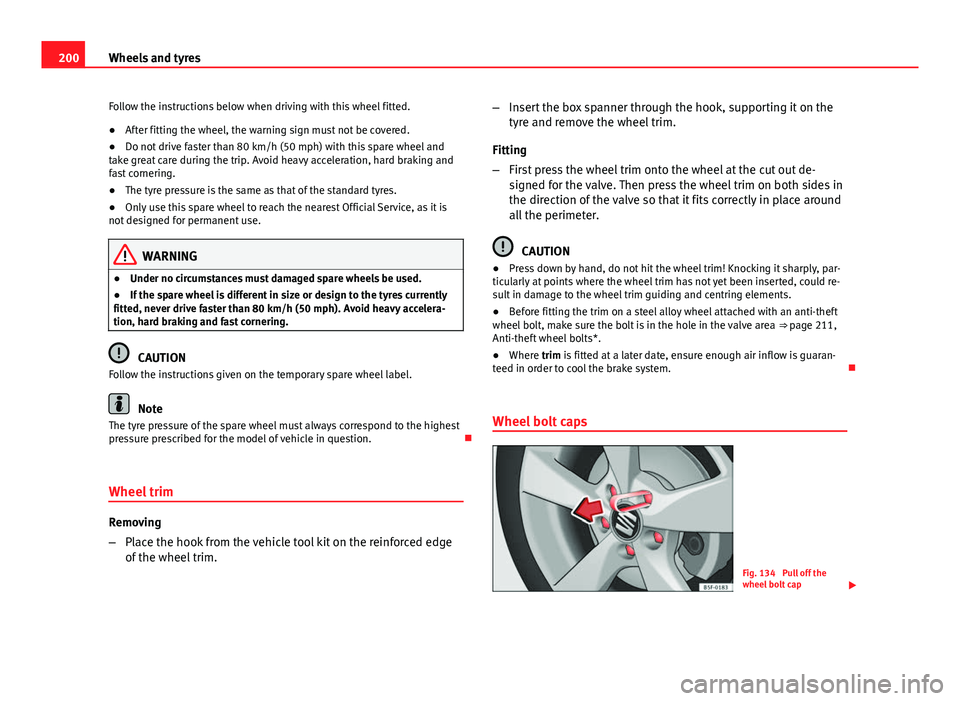
Wheel bolt caps
Fig. 134 Pull off the
wheel bolt cap
Page 204 of 258

202Wheels and tyres
WARNING
● If the warning lamp lights up, slow down immediately and avoid
any severe braking or steering manoeuvres. Stop and check the tyres and
their pressure as soon as possible.
● Under certain conditions (e.g. sporty driving style, driving on loose
surfaces or in the winter) the warning lamp may take a while to light
up or may remain switched off.
● Despite the tyre pressure monitoring system, the driver remains re-
sponsible for maintaining the correct tyre pressure. You must therefore
check the tyre pressure often.
Note
● The tyre pressure monitoring system is not a replacement for regularly
checking the tyre pressure, as it is unable to recognise an even drop in pres-
sure.
● The tyre pressure monitoring system is unable to warn of a sudden drop
in tyre pressure, e.g. a puncture. In this case, try to stop the vehicle carefully
with no severe braking or steering manoeuvres.
● To ensure the tyre pressure monitoring system works correctly, the basic
setting must be performed every 10 000 km (6000 miles) or once a year.
Wheel bolts
The wheel bolts are matched to the rims. When installing different wheels,
e.g. to fit light alloy wheels or wheels with winter tyres, it is important to use
the correct wheel bolts with the right length and correctly shaped bolt
heads. The is essential for the secure fit of the wheels and for the proper
function of the brake system. Winter tyres
Winter tyres will significantly improve handling of the vehicle in winter road
conditions. The design of summer tyres (width, rubber compound, tread
pattern) gives less grip at temperatures below +7 °C (45 °F), on ice and
snow. This applies particularly to vehicles equipped with
wide section tyres
or high speed tyres (code letters H or V on the sidewall).
In order to preserve the performance of the vehicle as much as possible,
winter tyres must be fitted on all four wheels, the minimum depth of the
tread must be 4 mm and the maximum age must be 4 years.
You can use winter tyres of a lower speed rating if the maximum speed limit
of these tyres will not be exceeded, even if the maximum speed limit for the
vehicle is higher.
For the sake of the environment
Summer tyres should be fitted again in time, as they give better handling on
roads free of snow and ice and at temperatures over +7 °C (45 °F). Summer
tyres have a shorter braking distance, produce less rolling noise and do not
wear down as quickly. They also reduce fuel consumption.
Snow chains
Snow chains must only be used on the front wheels.
In winter road conditions, snow chains not only help to improve grip but al-
so improve the braking capacity.
For technical reasons snow chains may only be used on tyres with the fol-
lowing wheel rim/tyre combinations.
Page 206 of 258

204Accessories, modifications and spare parts
Accessories, modifications and spare parts
General notes
If you wish to retrofit accessories in the vehicle, or if a part of the vehicle
has been replaced by a new part or technical modifications are required, the
following instructions must be taken into account.
● Before purchasing accessories or spare parts and before making techni-
cal modifications, always request advice from an Authorised SEAT dealer
⇒
.
● In the event that technical modifications are carried out on the vehicle,
the instructions and regulations specified by the company, SEAT, must be
observed.
No damage will be caused to the vehicle if the established procedures are
respected, which guarantees safe driving and operation. After the modifica-
tions are carried out, the vehicle will comply with the restrictions and regu-
lations of the highway code. More information can be obtained at an Au-
thorised SEAT dealer, where all jobs required can be carried out appropriate-
ly.
Vehicle improvements and modifications
The owner must store the technical documents regarding the modifications
carried out on the vehicle to be handed over to those responsible for the
processing of the end-of-life vehicle. This ensures end-of-life processing of
the vehicle, while protecting the environment.
Work done on the electrical components and software can cause disruption
in operations. Due to the interconnection of electronic components, this
disruption can also negatively influence systems that are not directly affec-
ted. This can adversely affect reliability of the vehicle, and can produce ex-
cessive wear of the parts.
Damage caused by technical modifications that are not made with the con-
sent of SEAT will be excluded from the warranty – see warranty certificate.
WARNING
● Jobs or modifications unduly carried out on your vehicle can cause
disruption to operations - Risk of accident!
● We recommend that you use only expressly authorised SEAT Original
Accessories and ® SEAT Original Spare Parts for your vehicle. The relia-
bility, safety and compatibility with your vehicle of SEAT Original Acces-
sories and ® SEAT Original Spare Parts has been checked.
● Despite the continuous observation of the market, we cannot judge
nor guarantee the suitability of other products for your vehicle, be they
authorised products or products approved by a state testing facility.
Note
SEAT Original Accessories and ® SEAT Original Spare Parts can be pur-
chased at authorised SEAT dealers where the purchased parts can also be
fitted.
Page 207 of 258
205
Accessories, modifications and spare parts
Modifications and effects of the airbag
system
In the adjustment and modification, respect the SEAT directive.
Modifications and corrections of the front bumper, doors, front seats, roof
or bodywork must be carried out at authorised SEAT workshops. Compo-
nents of the airbag system can be found in these parts of the vehicle.
WARNING
● Airbag modules must never be repaired. They must be replaced.
● Never fit components of the airbag system removed from old vehicles
or those originating from a recycling process in the vehicle.
● The modification of the suspension of the vehicle wheels, including
the use of non-permitted combinations of tyres and rims can alter the op-
eration of the airbag system and increase the risk of serious or fatal inju-
ries in an accident.
● During all jobs on the airbag system, in addition to the removal and
fitting of parts of the system in the course of other repair jobs, parts of
the airbag system can be damaged. Therefore in the event of an accident,
this may cause the airbags to activate incorrectly or not activate al all.
Safety FirstOperating instructionsPractical TipsTechnical specifications
Page 211 of 258
209
Self-help
– Lower the vehicle.
– Tighten the wheel bolts firmly in diagonal sequence with the
box spanner and then the anti-theft wheel bolt ⇒ page 209.
– Replace the hub cap and/or the bolt covers.
Note
● All bolts must be clean and turn easily.
● Never grease or oil the wheel bolts!
● Note the direction of rotation when putting on a tyre with directional
tread pattern ⇒ page 196.
After changing a wheel
Tasks that must be carried out after changing a wheel.
– Place the wheel with the defective tyre in the spare wheel well
and secure it using a special bolt ⇒ page 199.
– Put the vehicle tools back in their storage location.
– Check the tyre pressure of the newly fitted spare wheel as soon
as possible.
– Have the tightening torque of the wheel bolts checked as soon
as possible with a torque wrench.
– Have the flat tyre replaced or ask an Official Service about the
possibility of repair.
Note
● If you notice that the wheel bolts are rusty and difficult to turn when
changing a wheel, they must be replaced before having the tightening tor-
que checked.
● Drive carefully and at moderate speeds until the tightening torque of the
wheel bolts has been checked.
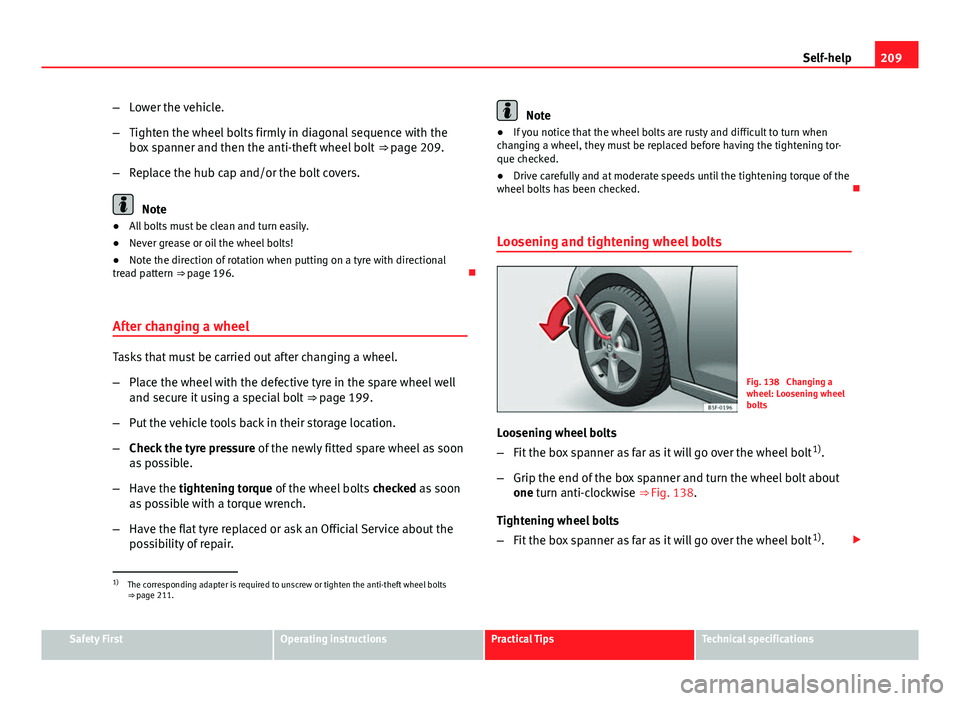
Loosening and tightening wheel bolts
Fig. 138 Changing a
wheel: Loosening wheel
bolts
Loosening wheel bolts
– Fit the box spanner as far as it will go over the wheel bolt 1)
.
– Grip the end of the box spanner and turn the wheel bolt about
one turn anti-clockwise ⇒ Fig. 138.
Tightening wheel bolts
– Fit the box spanner as far as it will go over the wheel bolt 1)
.
1)
The corresponding adapter is required to unscrew or tighten the anti-theft wheel bolts
⇒ page 211.
Safety FirstOperating instructionsPractical TipsTechnical specifications
Page 223 of 258
221
Fuses and bulbs
Changing fuses in the engine compartment
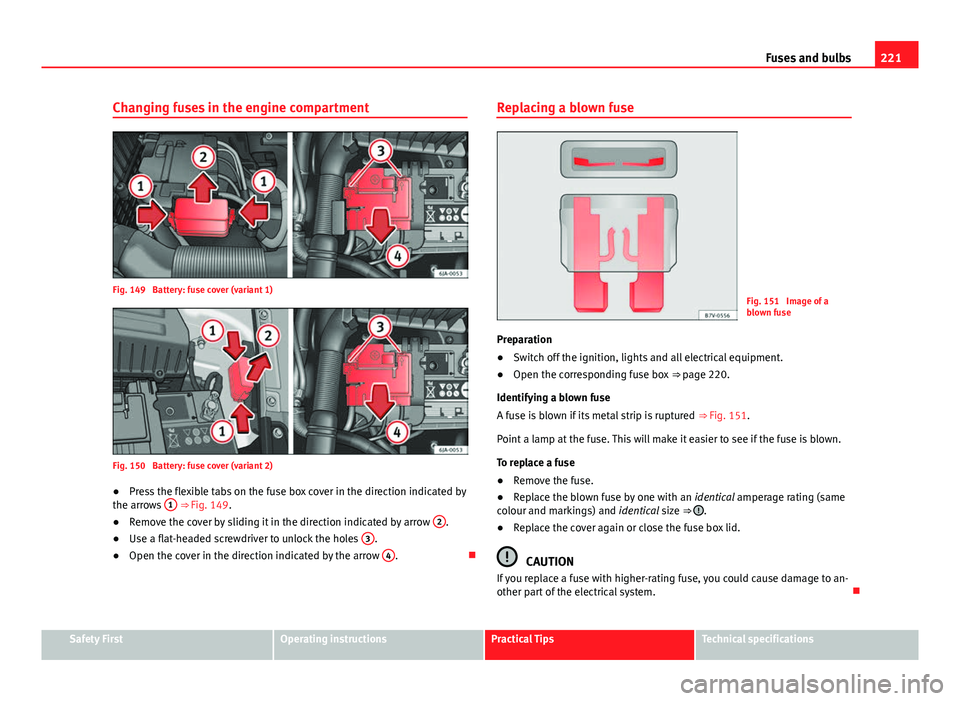
Fig. 149 Battery: fuse cover (variant 1)
Fig. 150 Battery: fuse cover (variant 2)
● Press the flexible tabs on the fuse box cover in the direction indicated by
the arrows 1
⇒ Fig. 149.
● Remove the cover by sliding it in the direction indicated by arrow 2.
● Use a flat-headed screwdriver to unlock the holes 3.
● Open the cover in the direction indicated by the arrow 4.Replacing a blown fuse
Fig. 151 Image of a
blown fuse
Preparation
● Switch off the ignition, lights and all electrical equipment.
● Open the corresponding fuse box
⇒ page 220.
Identifying a blown fuse
A fuse is blown if its metal strip is ruptured ⇒ Fig. 151.
Point a lamp at the fuse. This will make it easier to see if the fuse is blown.
To replace a fuse
● Remove the fuse.
● Replace the blown fuse by one with an identical amperage rating (same
colour and markings) and identical size ⇒
.
● Replace the cover again or close the fuse box lid.
CAUTION
If you replace a fuse with higher-rating fuse, you could cause damage to an-
other part of the electrical system.
Safety FirstOperating instructionsPractical TipsTechnical specifications
Page 224 of 258
222Fuses and bulbs
Changing bulbs
Introduction
Changing bulbs requires a certain degree of practical skill. If in doubt, we
recommend you have defective bulbs changed by a specialised service or,
in case of an emergency, seek professional assistance.
● Switch off the ignition and all of the lights before changing a bulb.
● Do not touch the glass part of the bulb with your bare hands. The finger-
prints left on the glass will vaporise as a result of the heat generated by the
bulb, causing a reduction in bulb life and condensation on the mirror sur-
face, thus reducing effectiveness.
● A bulb must only be replaced by one of the same type. The type is indi-
cated on the bulb, either on the glass part or on the base.
● There is a storage area for the bulb box in the spare wheel well or below
the carpet in the luggage compartment.
The light source used for each function is listed below:
Double headlights
H7 Long Life
H7
W5W Long Life PY21W NA P21W Super Long Life
Dipped beam:
Main beam:
Side lights:
Turn signals:
Daytime driving lights:
WARNING
● Take particular care when working on components in the engine com-
partment if the engine is warm. Risk of burns.
● Bulbs are highly sensitive to pressure. The glass can break when you
touch the bulb, causing injury.
● The high voltage element of gas discharge bulbs* (xenon light) must
be handled correctly. Otherwise, there is a risk of death.
● When changing bulbs, please take care not to injure yourself on sharp
parts in the headlight housing.
CAUTION
● Remove the ignition key before working on the electric system. Other-
wise, a short circuit could occur.
● Switch off the lights and the parking light before changing a bulb.
For the sake of the environment
Please ask your specialist retailer how to dispose of used bulbs in the prop-
er manner.
Note
● Depending on weather conditions (cold or wet), the front lights, the fog
lights, the rear lights and the turn signals may be temporarily misted. This
has no influence on the useful life of the lighting system. By switching on
the lights, the area through which the beam of light is projected will quickly
be demisted. However, the edges may continue to be misted.
● Please check at regular intervals that all lighting (especially the exterior
lighting) on your vehicle is functioning properly. This is not only in the inter-
est of your own safety, but also in that of all other road users.