ESP Seat Toledo 2013 Service Manual
[x] Cancel search | Manufacturer: SEAT, Model Year: 2013, Model line: Toledo, Model: Seat Toledo 2013Pages: 258, PDF Size: 3.94 MB
Page 162 of 258
160Driving and the environment
Make less short journeys
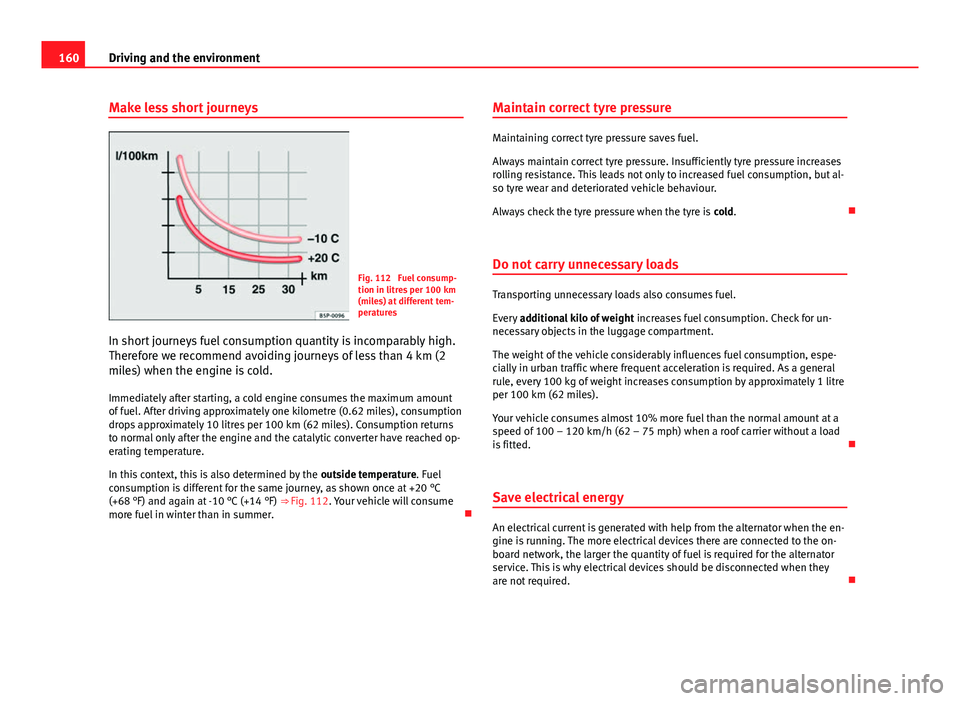
Fig. 112 Fuel consump-
tion in litres per 100 km
(miles) at different tem-
peratures
In short journeys fuel consumption quantity is incomparably high.
Therefore we recommend avoiding journeys of less than 4 km (2
miles) when the engine is cold. Immediately after starting, a cold engine consumes the maximum amount
of fuel. After driving approximately one kilometre (0.62 miles), consumption
drops approximately 10 litres per 100 km (62 miles). Consumption returns
to normal only after the engine and the catalytic converter have reached op-
erating temperature.
In this context, this is also determined by the outside temperature. Fuel
consumption is different for the same journey, as shown once at +20 °C
(+68 °F) and again at -10 °C (+14 °F) ⇒ Fig. 112. Your vehicle will consume
more fuel in winter than in summer. Maintain correct tyre pressure
Maintaining correct tyre pressure saves fuel.
Always maintain correct tyre pressure. Insufficiently tyre pressure increases
rolling resistance. This leads not only to increased fuel consumption, but al-
so tyre wear and deteriorated vehicle behaviour.
Always check the tyre pressure when the tyre is
cold.
Do not carry unnecessary loads
Transporting unnecessary loads also consumes fuel.
Every additional kilo of weight increases fuel consumption. Check for un-
necessary objects in the luggage compartment.
The weight of the vehicle considerably influences fuel consumption, espe-
cially in urban traffic where frequent acceleration is required. As a general
rule, every 100 kg of weight increases consumption by approximately 1 litre
per 100 km (62 miles).
Your vehicle consumes almost 10% more fuel than the normal amount at a
speed of 100 – 120 km/h (62 – 75 mph) when a roof carrier without a load
is fitted.
Save electrical energy
An electrical current is generated with help from the alternator when the en-
gine is running. The more electrical devices there are connected to the on-
board network, the larger the quantity of fuel is required for the alternator
service. This is why electrical devices should be disconnected when they
are not required.
Page 164 of 258

162Driving and the environment
Note
You will receive information about the modification of the headlights at an
authorised SEAT dealer.
Preventing damage to the vehicle
In order to prevent damage to the vehicle, take special care:
● on roads in poor condition
● when mounting the kerb
● when approaching very steep ramps, etc.
● with the parts of the vehicle situated on the lower part of the vehicle, i.e.
the spoiler, the exhaust pipe,
This applies especially to vehicles with a very low suspension (sport) and
when the vehicle is fully loaded.
Driving through water
Fig. 113 Driving through
water To prevent the vehicle from being damaged when driving through water (i.e.
flooded roads), please observe the following:
●
Determine the depth of the water before entering. The water can reach a
maximum height of below the door sill ⇒ Fig. 113.
● Drive at a maximum pace of walking speed. Driving at a higher speed
can cause a wave in front of the vehicle, which can cause water to enter the
engine air intake system or other parts of the vehicle.
● Never stop in the water, never reverse and never stop the engine.
● Before driving through water deactivate the START-STOP system
⇒ page 154.
WARNING
● Driving through water, dirt and mud can reduce braking capability
and prolong the braking distance – Risk of accident!
● Do not carry out any sudden or strong braking manoeuvres after driv-
ing through water.
● Clean and dry the brakes as soon as possible after driving through
water by breaking intermittently. Carry out braking in order to dry the
brakes and clean the brake discs only if traffic so permits. Do not put oth-
er drivers at risk.
CAUTION
● In the event of driving through water the parts of the vehicle can be seri-
ously damaged, such as the engine, gearbox, catalytic converter, suspen-
sion or the electrical system.
● Oncoming vehicles that drive through water can cause waves that ex-
ceed your vehicle's permitted level for driving through water.
● There may be pot-holes mud or rocks under the water that can hinder or
prevent driving through water.
● Do not drive through salt water. The salt can cause rust. All components
that are exposed to salt water must be rinsed immediately with fresh water.
Page 166 of 258
164Driving the vehicle with a trailer
Driving the vehicle with a trailer
Driving the vehicle with a trailer
Technical requirements
If your vehicle has a factory-fitted towing bracket or is equipped with a se-
lection of SEAT Original Accessories, it meets all the relevant technical and
legal requirements.
In vehicles with a towing bracket it is possible to remove the ball joint, situ-
ated (together with the special assembly instructions) in the housing for the
spare wheel in the vehicle luggage compartment ⇒ page 207, Vehicle tool
kit*.
Your vehicle is fitted with a 13-pole power socket for the electrical connec-
tion between the trailer and the vehicle. If the trailer you are going to use
has a 7-pin connector, the corresponding adaptor, acquired from the SEAT
Original Accessories Catalogue, can be used.
If a towing bracket is to be retro-fitted to the car, it must be done according
to the instructions of the towing bracket manufacturer.
Note
Any queries that may arise can be directed to an authorised SEAT dealer.
Trailer weight
Trailer weight
The combined vehicle and trailer must be balanced. To do so use the maxi-
mum permitted towing bracket load. An insufficient weight exerted by the trailer drawbar on the ball joint of the towing bracket will have a negative
impact upon the response of the vehicle-trailer assembly on the road.
Weight distribution
Distribute loads in the trailer so that heavy objects are as near to the axle as
possible. Ensure that the objects do not move.
If the towing vehicle is empty and the trailer loaded then the load distribu-
tion is incorrect. However, if these conditions cannot be avoided, drive very
slowly.
Tyre pressure values
Correct the tyre pressure in your vehicle to “total load” ⇒
page 197, Tyre
useful life.
Trailer weight
Never exceed the authorised trailer weight under any circumstances
⇒ page 233, Description of the data.
The trailer weights listed are only applicable for altitudes up to 1000 m
above sea level. Due to a lower air density the engine power decreases de-
pending on the increase in altitude, this also causes the climbing ability to
decrease, which requires a reduction of the weight of the vehicle with a
trailer by 10 % for every 1000 m increase in altitude. The weight of the as-
sembly is calculated by adding the vehicle weight (loaded) to the trailer
weight (loaded). Always drive with special care when towing a trailer.
The towed load and support load information that is displayed on the tow-
ing bracket manufacturers label are only values for the verification of the
device. The correct figures for your specific vehicle, which are usually lower
than these figures, are given in the documentation of your vehicle.
Page 168 of 258
166Driving the vehicle with a trailer
WARNING
● Adjust your speed to suit the road and traffic conditions.
● An electrical installation that is connected incorrectly or by non-spe-
cialised personnel can prevent the connection of the current to the trailer
and cause faults in the electrical system operation throughout the entire
vehicle, leading to accidents and serious injury.
● All electrical work must be carried out only by the specialised serv-
ices.
● Never directly connect the trailer electrical device to the electrical
sockets of the reverse driving lights or other sources of electrical current.
CAUTION
● Avoid corners, and sudden and sharp braking.
● Once the trailing arm has been removed, place the corresponding cover
on the hole of the fastening point. This prevents dirt from entering the hole
– see the trailer system assembly manual.
Note
● In the event of frequent journeys with a trailer, we recommend also hav-
ing the vehicle inspected in-between the service intervals.
● When connecting and disconnecting the trailer, the handbrake must be
applied.
● For technical reasons, trailers with LED reverse lights cannot be incorpo-
rated into the vehicle anti-theft alarm system.
Page 169 of 258
167
Driving the vehicle with a trailer
Towing bracket device Introduction
If the vehicle is equipped with a towing bracket device from the factory or
consisting of genuine SEAT accessories, it meets all the national technical
and legal requirements for towing.
Your vehicle is fitted with a 13-pin power socket for the electrical connection
between the trailer and the vehicle. If the towing bracket is equipped with a
7-pin connector, the corresponding available adaptor may be used as a
genuine SEAT accessory.
The towing device has a maximum vertical load of 50 kg.
WARNING
● Before driving with the ball-headed bar fitted, verify its correct as-
sembly and placement in the clamping bush.
● Do not use the ball-headed bar if it is not correctly placed and fixed in
the clamping bush.
● Do not use the towing device for towing if it is damaged or missing
parts.
● Do not modify or adapt the towing device for towing.
● Never disengage the ball-headed bar with the trailer still hitched.
CAUTION
Be careful not to damage the paint on the bumper when handling the ball-
headed bar. Description
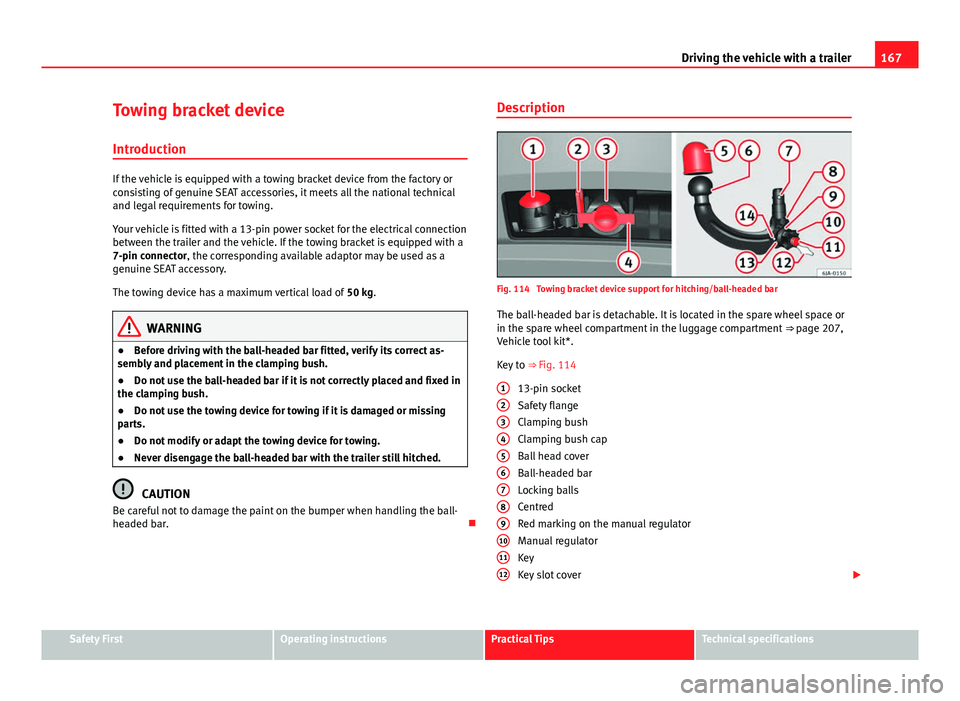
Fig. 114 Towing bracket device support for hitching/ball-headed bar
The ball-headed bar is detachable. It is located in the spare wheel space or
in the spare wheel compartment in the luggage compartment ⇒ page 207,
Vehicle tool kit*.
Key to ⇒ Fig. 114
13-pin socket
Safety flange
Clamping bush
Clamping bush cap
Ball head cover
Ball-headed bar
Locking balls
Centred
Red marking on the manual regulator
Manual regulator
Key
Key slot cover
1
23456789101112
Safety FirstOperating instructionsPractical TipsTechnical specifications
Page 184 of 258
182Checking and refilling levels
● Water allowed to collect in the fuel filter can cause engine faults.
● Your vehicle is not prepared for use of biofuel (RME) and, therefore, this
fuel must not be used for refuelling or driving. The use of biofuel (RME)
could cause serious damage to the engine or the fuel system.
Engine compartment
Introduction
Always be aware of the danger of injury and scalding as well as the risk of
accident or fire when working in the engine compartment, e.g. when check-
ing and refilling fluids. Therefore, always observe the warnings and follow
all general safety precautions. The engine compartment of any motor vehi-
cle is a potentially hazardous area .
WARNING
● Never open the bonnet if you see steam, smoke or coolant escaping
from the engine compartment. Risk of scalding! Wait until no steam or
coolant can be seen before opening the bonnet.
● Switch off the engine and remove the key from the ignition.
● Engage neutral in vehicles with manual gearbox and move the selec-
tor lever to position P in vehicles with automatic gearbox.
● Apply the handbrake firmly.
● Wait for the engine to cool down.
● For safety reasons, the bonnet must always be closed when the vehi-
cle is moving. Therefore, after closing the bonnet always check that it is
properly secured.
WARNING (Continued)
● Should you notice that the bonnet is not safely secured when the ve-
hicle is moving, stop the vehicle immediately and close the bonnet prop-
erly. Risk of accident!
● Keep children away from the engine compartment.
● Do not touch hot engine parts. Risk of burns!
● Never spill fluids on hot engine compartments. These fluids can
cause a fire (e.g. antifreeze in coolant).
● Take care not to cause short circuits in the electrical system, especial-
ly when working on the battery.
● Never touch the radiator fan when the engine is hot. The fan may start
running suddenly!
● Do not unscrew the cap on the coolant expansion tank when the en-
gine is hot. The cooling system is under pressure!
● Protect face, hands and arms from any hot steam or hot coolant re-
leased by covering the cap with a large, thick rag when opening the ex-
pansion tank.
● Do not leave any objects, such as cloths and tools, in the engine com-
partment.
● When working underneath the vehicle, secure it so that it cannot roll
away and support it safely on suitable supports. The hydraulic jack is not
sufficient for this purpose. Risk of injuries!
● If any tests have to be performed with the engine running, there is an
extra safety risk from rotating parts, such as the drive belt, alternator
and radiator fan, etc., and from the high-voltage ignition system. You
should also note the following:
–Never touch the electrical wiring of the ignition system.
– Keep away from moving engine parts when wearing jewellery,
loose clothing or long hair. Risk of fatal injuries! All jewellery must be
removed, hair tied back and close-fitting clothing worn.
● Observe the following additional warnings if work on the fuel system
or the electrical system is necessary.
–Always disconnect the battery from the on-board network.
– Do not smoke.
Page 187 of 258
185
Checking and refilling levels
serviced after a fixed interval of 1 year/15 000 km (10 000 miles)(whatever
comes first) ⇒ Booklet Maintenance Programme.
● In exceptional circumstances, if the engine oil level is too low
⇒ page 186 and you cannot obtain the oil specified for your vehicle, you
can put in a small quantity of oil conforming to the specification ACEA A2 or
ACEA A3 (petrol engines) or ACEA B3 or ACEA B4 (diesel engines) (up to 0.5
l).
Vehicles with diesel particulate filter*
The “Maintenance Programme” states whether your vehicle is fitted with a
diesel particulate filter.
Only VW 507 00 engine oil, with reduced ash formation, may be used in die-
sel engines equipped with particulate filter. Using other types of oil will
cause a higher soot concentration and reduce the life of the DPF. Therefore:
● Avoid mixing this oil with other engine oils.
● Only in exceptional circumstances, if the engine oil level is too low
⇒ page 186 and you cannot obtain the oil specified for your vehicle, you
can use a small quantity of oil (once) conforming to the VW 506 00,
VW 506 01, VW 505 00, VW 505 01 or ACEA B3/ACEA B4 specification. (up
to 0.5 l).
Oil properties
Engine typeSpecificationPetrol without flexible service in-
tervalVW 502 00/VW 504 00
Petrol with flexible service inter-
val (LongLife)VW 504 00
Engine typeSpecificationDiesel. Engines without Particu-
late filter (DPF)VW 505 01/VW 506 01/VW 507 00
Diesel. Particulate Filter Engines
(DPF).
With or without flexible service in-
terval (with and without Long-
life) a)VW 507 00
a)
Only use recommended oils, otherwise you may damage the engine.
Engine oil additives
No type of additive should be mixed with the engine oil. The deterioration
caused by these additives is not covered by the warranty.
Note
Before a long trip, we recommend finding an engine oil that conforms to the
corresponding VW specifications and recommend keeping it in the vehicle.
This way, the correct engine oil will always be available for a top-up if nee-
ded.
Safety FirstOperating instructionsPractical TipsTechnical specifications
Page 190 of 258
188Checking and refilling levels
Diesel enginesTop-up quantity (in litres)1.6 l/77 kW TDI CR6.5
CAUTION
● Anti-freeze that does not correspond to the correct specification may
particularly affect corrosion protection considerably.
● Faults caused by corrosion may lead to coolant leaks. Risk of serious en-
gine faults!
Checking coolant level
Fig. 126 Engine com-
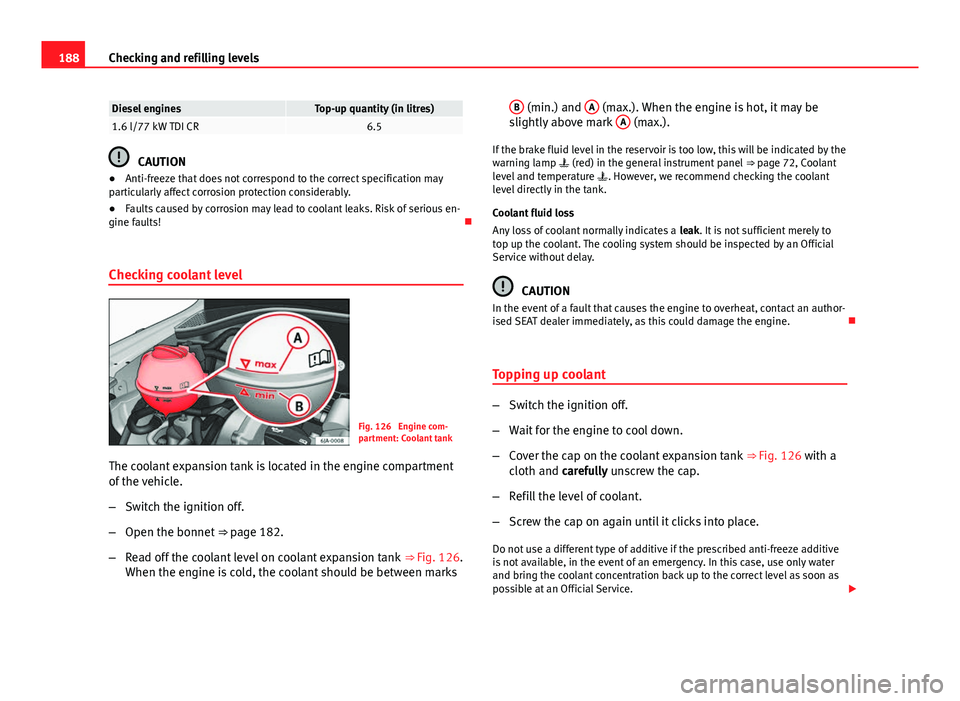
partment: Coolant tank
The coolant expansion tank is located in the engine compartment
of the vehicle.
– Switch the ignition off.
– Open the bonnet ⇒ page 182.
– Read off the coolant level on coolant expansion tank ⇒
Fig. 126.
When the engine is cold, the coolant should be between marks B
(min.) and
A (max.). When the engine is hot, it may be
slightly above mark A (max.).
If the brake fluid level in the reservoir is too low, this will be indicated by the
warning lamp (red) in the general instrument panel ⇒ page 72, Coolant
level and temperature . However, we recommend checking the coolant
level directly in the tank.
Coolant fluid loss
Any loss of coolant normally indicates a leak. It is not sufficient merely to
top up the coolant. The cooling system should be inspected by an Official
Service without delay.
CAUTION
In the event of a fault that causes the engine to overheat, contact an author-
ised SEAT dealer immediately, as this could damage the engine.
Topping up coolant
– Switch the ignition off.
– Wait for the engine to cool down.
– Cover the cap on the coolant expansion tank ⇒ Fig. 126 with a
cloth and carefully unscrew the cap.
– Refill the level of coolant.
– Screw the cap on again until it clicks into place.
Do not use a different type of additive if the prescribed anti-freeze additive
is not available, in the event of an emergency. In this case, use only water
and bring the coolant concentration back up to the correct level as soon as
possible at an Official Service.
Page 193 of 258
191
Checking and refilling levels
CAUTION
● Never mix the windscreen washing water with anti-freeze used for the
cooling system or other additives.
● If the vehicle is equipped with a headlight washer system, only mix a de-
tergent that does not damage polycarbonates with the water.
Note
On topping up the fluid, do not move the filter on the container opening, as
this could contaminate the fluid pipes and, therefore, lead to a windscreen
washer malfunction.
Battery Introduction
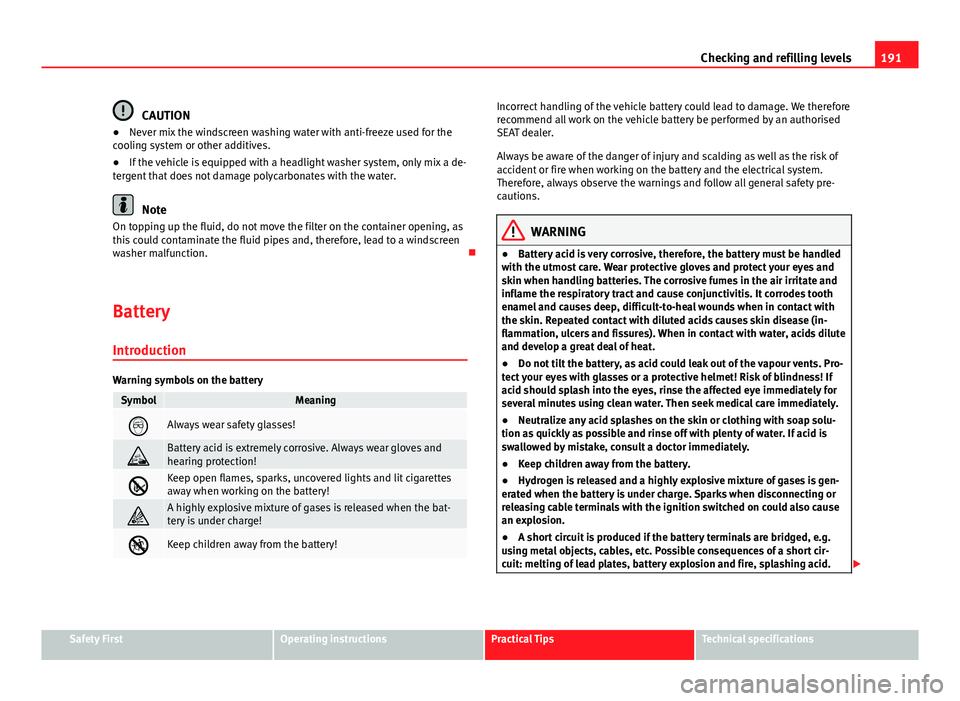
Warning symbols on the battery
SymbolMeaning
Always wear safety glasses!
Battery acid is extremely corrosive. Always wear gloves and
hearing protection!
Keep open flames, sparks, uncovered lights and lit cigarettes
away when working on the battery!
A highly explosive mixture of gases is released when the bat-
tery is under charge!
Keep children away from the battery!
Incorrect handling of the vehicle battery could lead to damage. We therefore
recommend all work on the vehicle battery be performed by an authorised
SEAT dealer.
Always be aware of the danger of injury and scalding as well as the risk of
accident or fire when working on the battery and the electrical system.
Therefore, always observe the warnings and follow all general safety pre-
cautions.
WARNING
● Battery acid is very corrosive, therefore, the battery must be handled
with the utmost care. Wear protective gloves and protect your eyes and
skin when handling batteries. The corrosive fumes in the air irritate and
inflame the respiratory tract and cause conjunctivitis. It corrodes tooth
enamel and causes deep, difficult-to-heal wounds when in contact with
the skin. Repeated contact with diluted acids causes skin disease (in-
flammation, ulcers and fissures). When in contact with water, acids dilute
and develop a great deal of heat.
● Do not tilt the battery, as acid could leak out of the vapour vents. Pro-
tect your eyes with glasses or a protective helmet! Risk of blindness! If
acid should splash into the eyes, rinse the affected eye immediately for
several minutes using clean water. Then seek medical care immediately.
● Neutralize any acid splashes on the skin or clothing with soap solu-
tion as quickly as possible and rinse off with plenty of water. If acid is
swallowed by mistake, consult a doctor immediately.
● Keep children away from the battery.
● Hydrogen is released and a highly explosive mixture of gases is gen-
erated when the battery is under charge. Sparks when disconnecting or
releasing cable terminals with the ignition switched on could also cause
an explosion.
● A short circuit is produced if the battery terminals are bridged, e.g.
using metal objects, cables, etc. Possible consequences of a short cir-
cuit: melting of lead plates, battery explosion and fire, splashing acid.
Safety FirstOperating instructionsPractical TipsTechnical specifications
Page 194 of 258
192Checking and refilling levels
WARNING (Continued)
● The following is forbidden while working on the battery: fire and open
flames, smoking and activities that could produce sparks. Avoid causing
sparks when handling cables or electrical apparatus. Risk of injury in the
event of large sparks.
● Before working on the electrical system, you must switch off the en-
gine, the ignition and all electrical components and disconnect the cable
from the negative terminal (-) of the battery. To change a bulb, simply
switch off the corresponding light.
● Never charge a frozen or thawed out battery. Risk of explosion and
acid burns! Replace a frozen battery.
● Never use the jump leads on batteries in which the electrolyte level is
too low. Risk of explosion and acid burns.
● Never use a damaged battery. Risk of explosion! Replace a damaged
battery immediately.
CAUTION
● Never disconnect the battery when the ignition is switched on, as the
electrical system (electronic components) of the vehicle could be damaged.
When disconnecting the battery from the vehicle electrical system, discon-
nect its negative terminal (-) first. Only then may the positive terminal (+) be
disconnected.
● When connecting the battery, connect the positive terminal (+) first. On-
ly then may the negative terminal (-) be connected. The battery cables must
never be connected to the wrong battery terminals. Risk of burning the elec-
trical installation.
● Make sure the battery acid does not come into contact with the body-
work. Risk of paintwork damage.
● Do not expose the battery to direct sunlight to protect it from ultraviolet
radiation. ●
If the vehicle is not used for 3 or 4 weeks, the battery could run flat. This
is because some components use electricity even in standby mode (e.g.
control units). Prevent the battery from running flat by disconnecting its
negative terminal or leave it charging at a low current.
● If you frequently use the vehicle for short trips, the battery may not fully
charge and could run flat.
For the sake of the environment
A flat battery is particularly harmful waste for the environment. It must
therefore be disposed of according to current local law.
Note
Replace a battery once it is older than 5 years.
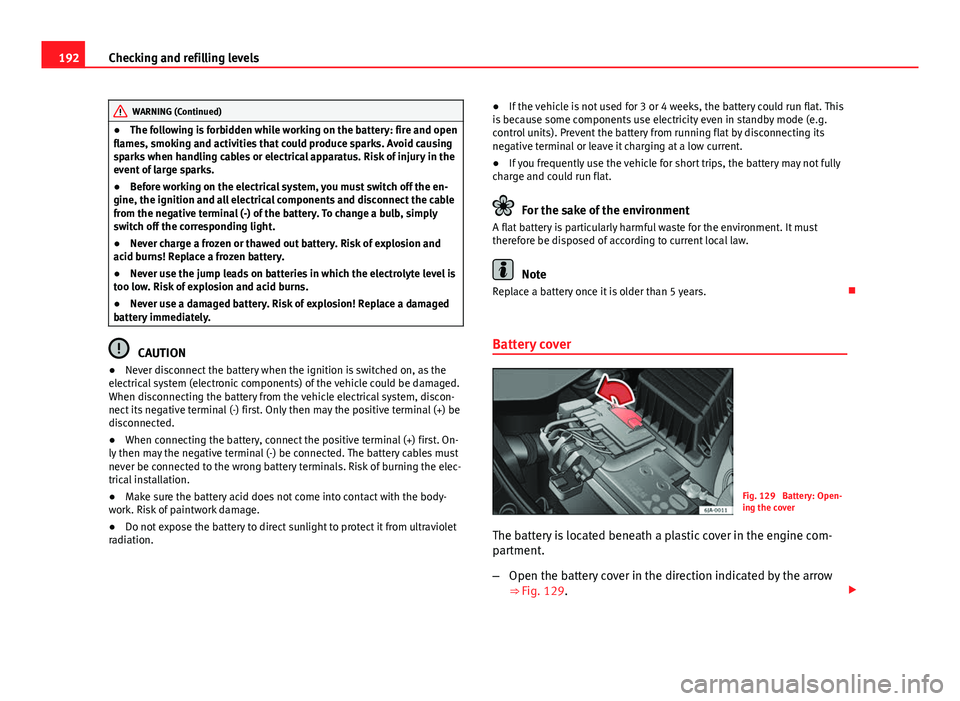
Battery cover
Fig. 129 Battery: Open-
ing the cover
The battery is located beneath a plastic cover in the engine com-
partment.
– Open the battery cover in the direction indicated by the arrow
⇒ Fig. 129.