ignition Seat Toledo 2013 Workshop Manual
[x] Cancel search | Manufacturer: SEAT, Model Year: 2013, Model line: Toledo, Model: Seat Toledo 2013Pages: 258, PDF Size: 3.94 MB
Page 156 of 258
154Driving
To recover the set speed, briefly press switch B
in RES once you have re-
leased the brake or clutch pedal.
Switching off cruise control completely
– Move knob A ⇒ Fig. 109 ⇒ page 153 to OFF.
START-STOP*
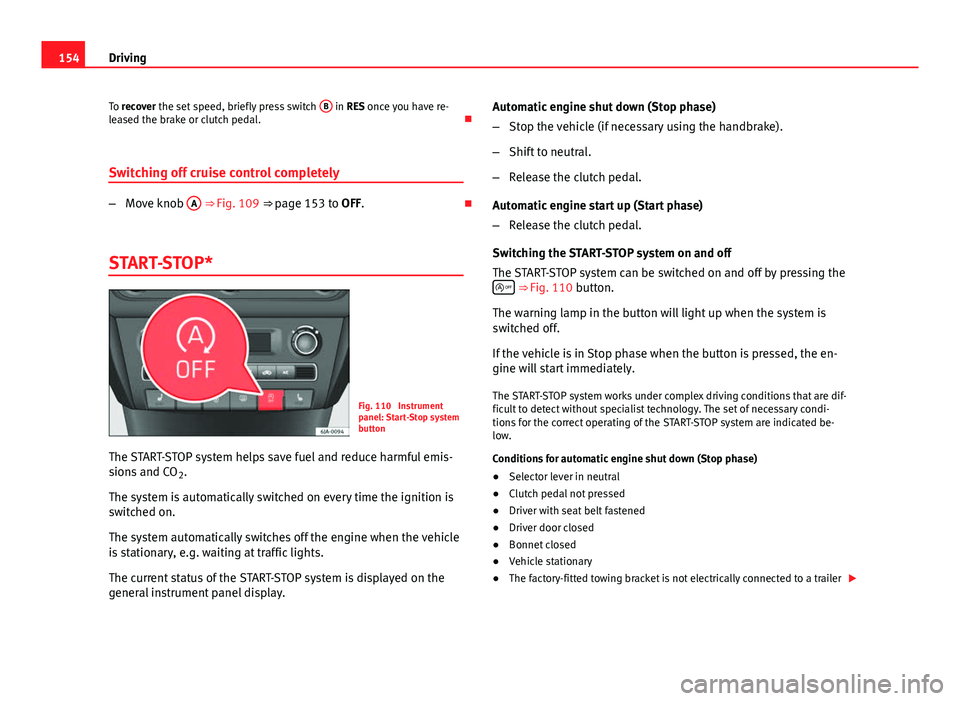
Fig. 110 Instrument
panel: Start-Stop system
button
The START-STOP system helps save fuel and reduce harmful emis-
sions and CO 2.
The system is automatically switched on every time the ignition is
switched on.
The system automatically switches off the engine when the vehicle
is stationary, e.g. waiting at traffic lights.
The current status of the START-STOP system is displayed on the
general instrument panel display. Automatic engine shut down (Stop phase)
–
Stop the vehicle (if necessary using the handbrake).
– Shift to neutral.
– Release the clutch pedal.
Automatic engine start up (Start phase)
– Release the clutch pedal.
Switching the START-STOP system on and off
The START-STOP system can be switched on and off by pressing the
⇒ Fig. 110 button.
The warning lamp in the button will light up when the system is
switched off.
If the vehicle is in Stop phase when the button is pressed, the en-
gine will start immediately.
The START-STOP system works under complex driving conditions that are dif-
ficult to detect without specialist technology. The set of necessary condi-
tions for the correct operating of the START-STOP system are indicated be-
low.
Conditions for automatic engine shut down (Stop phase)
● Selector lever in neutral
● Clutch pedal not pressed
● Driver with seat belt fastened
● Driver door closed
● Bonnet closed
● Vehicle stationary
● The factory-fitted towing bracket is not electrically connected to a trailer
Page 157 of 258
155
Driving
● Engine at operating temperature
● Vehicle's battery sufficiently charged
● Vehicle not on a very steep slope
● Engine speed below 1200 rpm
● Vehicle's battery temperature is neither too high nor too low
● Sufficient brake system pressure
● Difference between outside temperature and set interior temperature
not too great
● Vehicle speed since last time the engine started was above 3 km/h (2
mph)
● Particulate filter ⇒ page 74 not being cleaned
● Front wheels not overly turned (steering wheel turned less than three
quarters of a turn)
Conditions for engine start up (Start phase)
● Clutch pedal pressed
● Max./min. temperature set
● Windscreen defrost function switched on
● High blower speed
● START-STOP button pressed
Conditions for automatic engine start up without driver involvement
● Vehicle moving at a speed of over 3 km/h (2 mph)
● Difference between outside temperature and interior temperature is too
great
● Vehicle's battery insufficiently charged
● Insufficient brake system pressure
If the driver seat belt is unfastened for more than 30 seconds in Stop phase,
the engine must be started using the ignition key. Please observe the mes-
sages on the general instrument panel display. Warnings on the instrument panel display (valid for vehicles not fitted with
an informative display)
FAULT: START-STOPFault in the START-STOP systemSTART-STOP IMPOSSIBLEEngine cannot be automatically shut
down
START-STOP ACTIVEAutomatic engine shut down (Stop
phase)
SWITCH OFF IGNITIONSwitch the ignition offSTART MANUALLYStart the engine manually
WARNING
● If the engine is switched off, neither the brake servo or the power
steering will work.
● Do not move the vehicle when the engine is switched off.
CAUTION
Switch off the START-STOP system ⇒ page 162 before driving through a
pool of water on the road.
Note
● The battery temperature may reflect the changes in outside temperature
after several hours. If the vehicle has been stopped outside at temperatures
below zero or in direct sunlight, for example, the battery temperature may
take several hours to reach the values required for the correct operating of
the START-STOP system.
● If the Climatronic system is operating automatically, this could impair
automatic engine shut down in certain conditions.
Safety FirstOperating instructionsPractical TipsTechnical specifications
Page 159 of 258
157
Driving and the environment
New tyres
New tyres must be submitted to “running in”, given that initially their grip is
not yet at the maximum level. During approximately the first 500 km (120
miles) drive very carefully.
New brake pads
New brake pads do not yet provide maximum friction capacity. New brake
pads must be “run in” first. During approximately the first 200 km (120
miles) drive very carefully.
Catalytic converter
An exhaust gas emission control system (catalytic converter) that functions
perfectly is vitally important for vehicle operation that respects the environ-
ment.
Please observe the following indications:
● Refuel only using unleaded petrol ⇒ page 180, Unleaded petrol in pet-
rol engine vehicles.
● Do not add too much oil to the engine ⇒ page 186, Checking the en-
gine oil level;.
● Do not switch off the ignition while driving.
If you are required to drive in a country where unleaded fuel is not available
and when returning to a country where using a catalytic converter is obliga-
tory, the catalytic converter must be replaced.
WARNING
● Due to the high temperatures that the catalytic converter can reach,
the vehicle must be stopped so that the catalytic converter does not
come into contact with easily flammable material underneath the vehicle.
Risk of fire!
● Never use substances for additional underbody protection or anti-cor-
rosion for the exhaust pipes, the catalytic converter or the antithermic
screen. Risk of fire!
CAUTION
● Never completely empty the tank! An irregular fuel supply can cause ig-
nition faults, which can result in damage to a substantial amount of engine
parts and the exhaust system.
● Refuelling just once with leaded petrol disables the exhaust system!
Economical and ecological driving General notes
Fuel consumption, environmental impact and engine, brake and tyre wear
depend largely on three factors:
● personal driving style
● the conditions in which the vehicle is used
● prior technical conditions
By adopting an economical driving style and anticipating the traffic situa-
tion ahead, you can easily reduce fuel consumption by 10-15%.
Safety FirstOperating instructionsPractical TipsTechnical specifications
Page 174 of 258

172Care of the vehicle and cleaning
Care of the vehicle and cleaning
Care of the vehicle
Introduction
Regular and suitable care helps to maintain the useful life of your vehicle.
This may also be one of the requirements for upholding any warranty claims
in the event of corrosion or paint defects.
We recommend you use cleaning products from the SEAT Original Accesso-
ries programme available in SEAT dealers. Please follow the instructions for
use on the packaging.
WARNING
● Cleaning products and other materials used for car care can damage
the health if misused.
● Always keep car care materials in a safe place out of the reach of chil-
dren. Risk of poisoning!
● When washing the car during the winter season: Moisture and ice on
the brakes may affect braking efficiency. Risk of accident!
● The ignition must always be switched off when the car is washed.
Risk of accident!
● Do not clean the underside of the car or inside the wheel arches with-
out protecting your hands and arms. You may cut yourself on sharp metal
parts!
● Perfumes and air fresheners inside the vehicle may be harmful to
health at high temperatures in the interior.
CAUTION
● Check the colour stability of your clothing to avoid damaging or visibly
staining the fabric (leather), upholstery and fabric trim.
● Cleaning products containing solvents may damage the material being
cleaned.
● Do not wash the vehicle in direct sunlight. Risk of damage to paintwork.
● If washing the vehicle with a hose in winter, do not direct the jet of water
directly at the locks or at the door seals or bonnet. Risk of freezing.
● Do not use insect sponges or abrasive household sponges, etc. on pain-
ted surfaces. Risk of damage to the painted surface.
● Do not put stickers on the inner side of the window in areas where heat-
ing elements or the aerial is located. This could cause damage and, in the
case of the aerial, radio and navigation system reception faults.
● Do not clean the inner side of the window with sharp objects or corro-
sive or acidic cleaning products. Risk of damaging the heating elements or
the aerial.
● Do not attach any fragrance or air freshener to the dash panel. Risk of
damage to the dash panel.
● To avoid damaging the parking aid system sensors, spray them only
briefly at a minimum distance of 10 cm when cleaning the vehicle with a
high-pressure or steam cleaner.
● Do not clean the roof panel with a brush. Risk of damage to the panel
surface!
For the sake of the environment
● The packaging of the product used to care for your vehicle is hazardous
waste. It must be disposed of according to current local law.
● Only wash the car in special wash bays.
Page 181 of 258
179
Checking and refilling levels
Checking and refilling levels Fuel
Introduction
The correct type of fuel for your vehicle is indicated on a sticker on the in-
side of the fuel tank flap, along with the tyre size and pressure ⇒ Fig. 122
.
WARNING
Observe all relevant statutory regulations on transporting spare fuel can-
isters. For safety reasons, we do not recommend carrying a spare canister
in the vehicle. The canister could be damaged in an accident and fuel
may leak. Risk of fire!
CAUTION
● Never completely empty the tank! If there is an irregular fuel supply, mis-
firing can occur that can cause damage to many of the engine parts and the
exhaust system.
● If any fuel is spilt onto the paintwork of the vehicle, it should be re-
moved immediately. Risk of damage to paintwork! Refuelling
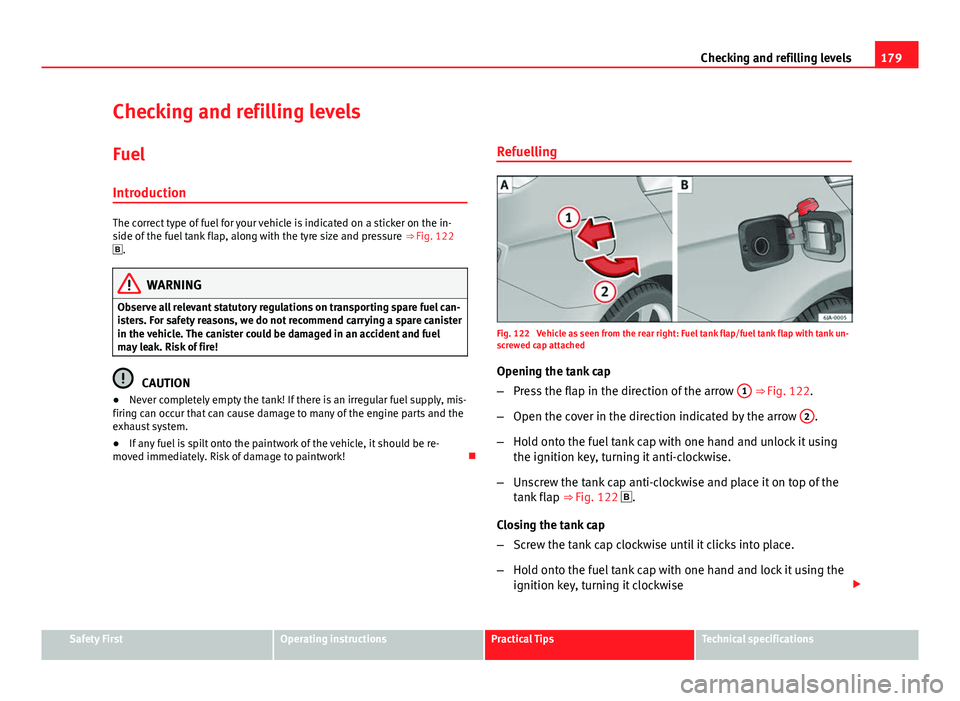
Fig. 122 Vehicle as seen from the rear right: Fuel tank flap/fuel tank flap with tank un-
screwed cap attached
Opening the tank cap
– Press the flap in the direction of the arrow 1
⇒ Fig. 122.
– Open the cover in the direction indicated by the arrow 2
.
– Hold onto the fuel tank cap with one hand and unlock it using
the ignition key, turning it anti-clockwise.
– Unscrew the tank cap anti-clockwise and place it on top of the
tank flap ⇒ Fig. 122 .
Closing the tank cap
– Screw the tank cap clockwise until it clicks into place.
– Hold onto the fuel tank cap with one hand and lock it using the
ignition key, turning it clockwise
Safety FirstOperating instructionsPractical TipsTechnical specifications
Page 183 of 258
181
Checking and refilling levels
will help to prevent corrosion, keep the fuel system clean and prevent de-
posits from building up in the engine.
If good quality petrol with metal-free additives is not available or engine
problems arise, the necessary additives must be added when refuelling
⇒
.
Not all petrol additives have been shown to be effective. The use of unsuita-
ble petrol additives may cause significant damage to the engine and the
catalytic converter. Metal additives should never be used. Metal additives
may also be contained in petrol additives for improving anti-detonation rat-
ings or octane ratings ⇒
.
SEAT recommends “genuine Volkswagen Group fuel additives for petrol en-
gines”. These additives can be bought at SEAT Authorised Services, where
information on how to use them can also be obtained.
CAUTION
● Do not refuel if the filler indicates that the fuel contains metal. LRP (lead
replacement petrol) fuels contain high concentrations of metal additives.
Using them may damage the engine!
● All SEAT vehicles with petrol engines can only run on unleaded petrol.
Refuelling just once with leaded petrol disables the exhaust system!
● Use of petrol with a lower RON to that prescribed could damage the en-
gine components.
● Fuels marked as containing metal on the garage fuel pump cannot be
used. Risk of damage to most engine parts or the exhaust system!
● The use of unsuitable additives in petrol can cause damage to most en-
gine parts or the exhaust system. Diesel fuel
Your vehicle can only run on
diesel fuel that complies with the Standard EN
590 (in Germany, also DIN 51628, in Austria also ÖNORM C 1590 , in Russia
also GOST R 52368-2005/EN 590:2004 ).
Winter driving – winter-grade diesel
In winter use diesel fuel that complies with the Standard EN 590 (in Germa-
ny, also DIN 51628, in Austria also ÖNORM C 1590, in Russia also GOST R
52368-2005/EN 590:2004). “Winter-grade diesel” still performs well at
-20 °C (-4 °F).
In countries with other weather conditions, diesel is often available that be-
haves differently with regards to the temperature. The authorised SEAT deal-
ers and petrol stations in each country will inform you on the normal diesel
fuel of the country in question.
Preheating the fuel filter
The vehicle is fitted with a glow plug system for the fuel filter. Therefore, the
reliability of the diesel is ensured at ambient temperatures of down to ap-
prox. -25 °C (-13 °F).
Fuel additives
Fuel additives, known as “thinners” (petrol or similar substances) should
not be mixed with the diesel fuel.
CAUTION
● Even one tankful of diesel fuel that does not comply with the standard
could damage engine parts, the fuel system and the exhaust system!
● If fuel different to the prescribed diesel fuel (e.g. petrol) is used by mis-
take, never start the engine or switch on the ignition! Risk of serious dam-
age to the engine! Contact an authorised SEAT dealer to clean the engine
fuel system.
Safety FirstOperating instructionsPractical TipsTechnical specifications
Page 184 of 258
182Checking and refilling levels
● Water allowed to collect in the fuel filter can cause engine faults.
● Your vehicle is not prepared for use of biofuel (RME) and, therefore, this
fuel must not be used for refuelling or driving. The use of biofuel (RME)
could cause serious damage to the engine or the fuel system.
Engine compartment
Introduction
Always be aware of the danger of injury and scalding as well as the risk of
accident or fire when working in the engine compartment, e.g. when check-
ing and refilling fluids. Therefore, always observe the warnings and follow
all general safety precautions. The engine compartment of any motor vehi-
cle is a potentially hazardous area .
WARNING
● Never open the bonnet if you see steam, smoke or coolant escaping
from the engine compartment. Risk of scalding! Wait until no steam or
coolant can be seen before opening the bonnet.
● Switch off the engine and remove the key from the ignition.
● Engage neutral in vehicles with manual gearbox and move the selec-
tor lever to position P in vehicles with automatic gearbox.
● Apply the handbrake firmly.
● Wait for the engine to cool down.
● For safety reasons, the bonnet must always be closed when the vehi-
cle is moving. Therefore, after closing the bonnet always check that it is
properly secured.
WARNING (Continued)
● Should you notice that the bonnet is not safely secured when the ve-
hicle is moving, stop the vehicle immediately and close the bonnet prop-
erly. Risk of accident!
● Keep children away from the engine compartment.
● Do not touch hot engine parts. Risk of burns!
● Never spill fluids on hot engine compartments. These fluids can
cause a fire (e.g. antifreeze in coolant).
● Take care not to cause short circuits in the electrical system, especial-
ly when working on the battery.
● Never touch the radiator fan when the engine is hot. The fan may start
running suddenly!
● Do not unscrew the cap on the coolant expansion tank when the en-
gine is hot. The cooling system is under pressure!
● Protect face, hands and arms from any hot steam or hot coolant re-
leased by covering the cap with a large, thick rag when opening the ex-
pansion tank.
● Do not leave any objects, such as cloths and tools, in the engine com-
partment.
● When working underneath the vehicle, secure it so that it cannot roll
away and support it safely on suitable supports. The hydraulic jack is not
sufficient for this purpose. Risk of injuries!
● If any tests have to be performed with the engine running, there is an
extra safety risk from rotating parts, such as the drive belt, alternator
and radiator fan, etc., and from the high-voltage ignition system. You
should also note the following:
–Never touch the electrical wiring of the ignition system.
– Keep away from moving engine parts when wearing jewellery,
loose clothing or long hair. Risk of fatal injuries! All jewellery must be
removed, hair tied back and close-fitting clothing worn.
● Observe the following additional warnings if work on the fuel system
or the electrical system is necessary.
–Always disconnect the battery from the on-board network.
– Do not smoke.
Page 188 of 258
186Checking and refilling levels
Checking the engine oil level
Fig. 125 Engine oil dip-
sticks
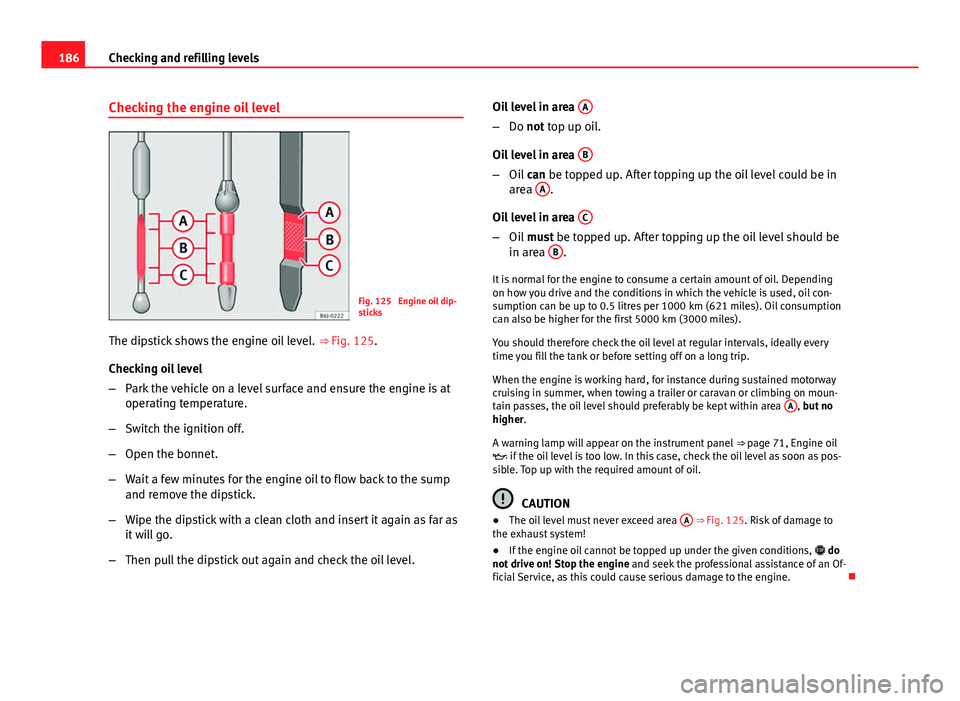
The dipstick shows the engine oil level. ⇒ Fig. 125.
Checking oil level
– Park the vehicle on a level surface and ensure the engine is at
operating temperature.
– Switch the ignition off.
– Open the bonnet.
– Wait a few minutes for the engine oil to flow back to the sump
and remove the dipstick.
– Wipe the dipstick with a clean cloth and insert it again as far as
it will go.
– Then pull the dipstick out again and check the oil level. Oil level in area
A
–
Do not top up oil.
Oil level in area B
–
Oil can be topped up. After topping up the oil level could be in
area A.
Oil level in area C
–
Oil must be topped up. After topping up the oil level should be
in area B.
It is normal for the engine to consume a certain amount of oil. Depending
on how you drive and the conditions in which the vehicle is used, oil con-
sumption can be up to 0.5 litres per 1000 km (621 miles). Oil consumption
can also be higher for the first 5000 km (3000 miles).
You should therefore check the oil level at regular intervals, ideally every
time you fill the tank or before setting off on a long trip.
When the engine is working hard, for instance during sustained motorway
cruising in summer, when towing a trailer or caravan or climbing on moun-
tain passes, the oil level should preferably be kept within area A
, but no
higher.
A warning lamp will appear on the instrument panel ⇒ page 71, Engine oil
if the oil level is too low. In this case, check the oil level as soon as pos-
sible. Top up with the required amount of oil.
CAUTION
● The oil level must never exceed area A ⇒ Fig. 125. Risk of damage to
the exhaust system!
● If the engine oil cannot be topped up under the given conditions, do
not drive on! Stop the engine and seek the professional assistance of an Of-
ficial Service, as this could cause serious damage to the engine.
Page 190 of 258
188Checking and refilling levels
Diesel enginesTop-up quantity (in litres)1.6 l/77 kW TDI CR6.5
CAUTION
● Anti-freeze that does not correspond to the correct specification may
particularly affect corrosion protection considerably.
● Faults caused by corrosion may lead to coolant leaks. Risk of serious en-
gine faults!
Checking coolant level
Fig. 126 Engine com-
partment: Coolant tank
The coolant expansion tank is located in the engine compartment
of the vehicle.
– Switch the ignition off.
– Open the bonnet ⇒ page 182.
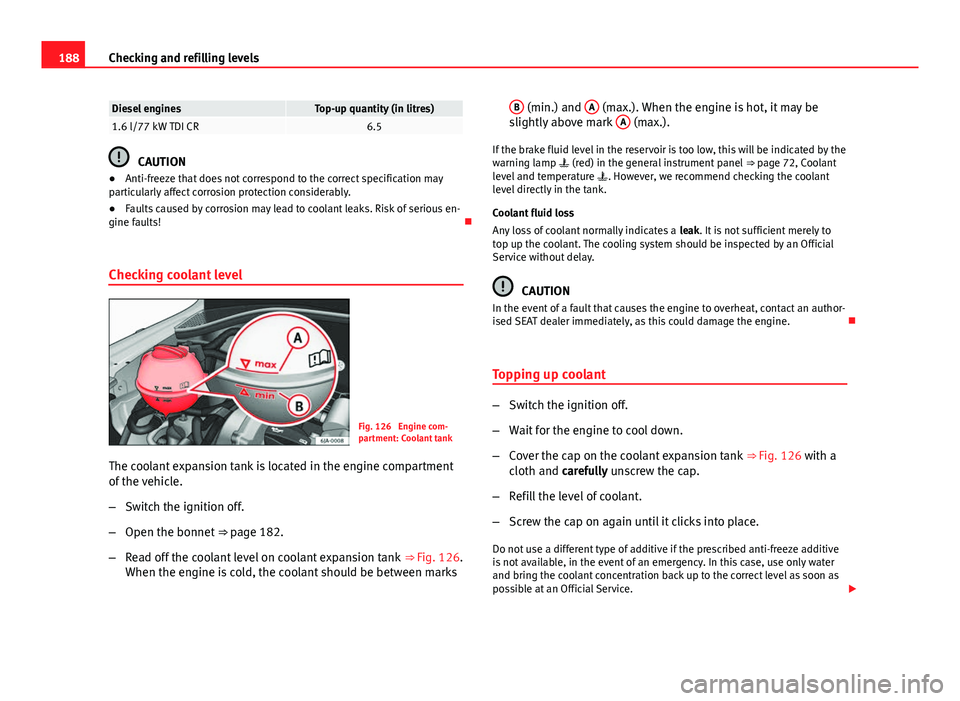
– Read off the coolant level on coolant expansion tank ⇒
Fig. 126.
When the engine is cold, the coolant should be between marks B
(min.) and
A (max.). When the engine is hot, it may be
slightly above mark A (max.).
If the brake fluid level in the reservoir is too low, this will be indicated by the
warning lamp (red) in the general instrument panel ⇒ page 72, Coolant
level and temperature . However, we recommend checking the coolant
level directly in the tank.
Coolant fluid loss
Any loss of coolant normally indicates a leak. It is not sufficient merely to
top up the coolant. The cooling system should be inspected by an Official
Service without delay.
CAUTION
In the event of a fault that causes the engine to overheat, contact an author-
ised SEAT dealer immediately, as this could damage the engine.
Topping up coolant
– Switch the ignition off.
– Wait for the engine to cool down.
– Cover the cap on the coolant expansion tank ⇒ Fig. 126 with a
cloth and carefully unscrew the cap.
– Refill the level of coolant.
– Screw the cap on again until it clicks into place.
Do not use a different type of additive if the prescribed anti-freeze additive
is not available, in the event of an emergency. In this case, use only water
and bring the coolant concentration back up to the correct level as soon as
possible at an Official Service.
Page 191 of 258
189
Checking and refilling levels
Always top up with unused coolant.
Never fill the coolant tank above mark A
(max.) ⇒ Fig. 126 Excess coolant
is forced out of the cooling system through the overpressure valve in the fill-
er cap of the expansion tank when the engine heats up.
WARNING
● The anti-freeze additive and, therefore, the entire coolant, are a
health hazard. Avoid touching the coolant. Coolant fumes are also a
health hazard. Store the coolant additive in a safe place out of the reach
of children. Risk of poisoning!
● If splashed into eyes, rinse immediately with clean water and seek
immediate medical advice.
● Seek immediate medical advice if the coolant is accidentally inges-
ted.
CAUTION
If the engine oil cannot be topped up under the given conditions, do not
drive on. We recommend contacting an authorised SEAT dealer, as this can
damage the engine.
Radiator fan
The radiator is driven by an electric motor and controlled according to the
temperature of the coolant.
After the engine has been stopped and the ignition switched off, the radia-
tor fan may continue running for around 10 minutes. Brake fluid
Checking brake fluid level
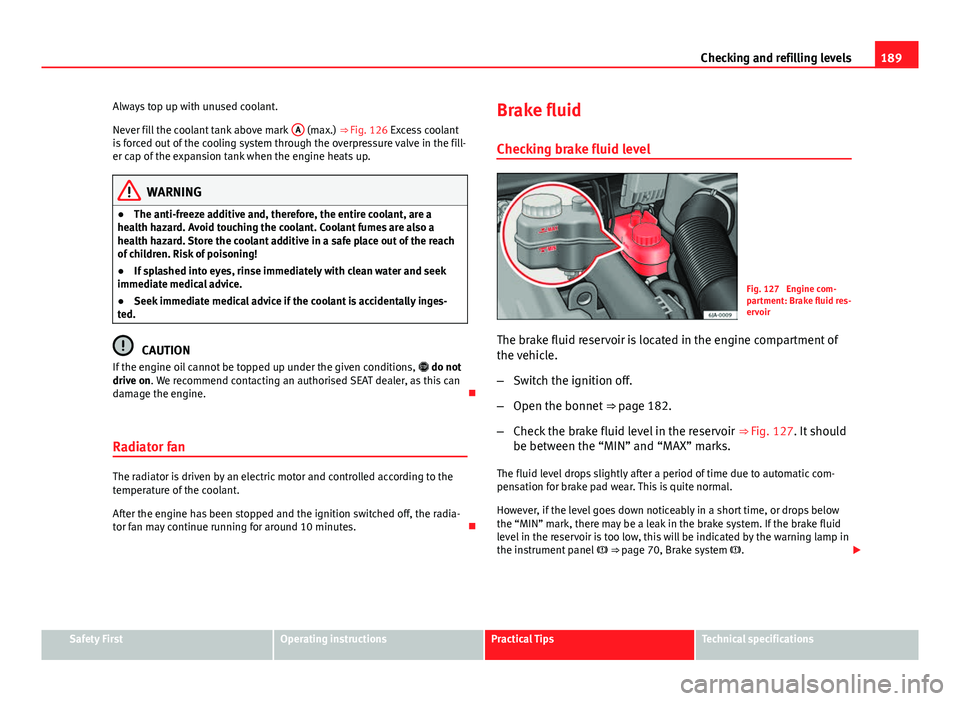
Fig. 127 Engine com-
partment: Brake fluid res-
ervoir
The brake fluid reservoir is located in the engine compartment of
the vehicle.
– Switch the ignition off.
– Open the bonnet ⇒ page 182.
– Check the brake fluid level in the reservoir ⇒ Fig. 127. It should
be between the “MIN” and “MAX” marks.
The fluid level drops slightly after a period of time due to automatic com-
pensation for brake pad wear. This is quite normal.
However, if the level goes down noticeably in a short time, or drops below
the “MIN” mark, there may be a leak in the brake system. If the brake fluid
level in the reservoir is too low, this will be indicated by the warning lamp in
the instrument panel
⇒ page 70, Brake system .
Safety FirstOperating instructionsPractical TipsTechnical specifications