warning Seat Toledo 2014 Repair Manual
[x] Cancel search | Manufacturer: SEAT, Model Year: 2014, Model line: Toledo, Model: Seat Toledo 2014Pages: 200, PDF Size: 4.37 MB
Page 80 of 200
Operation
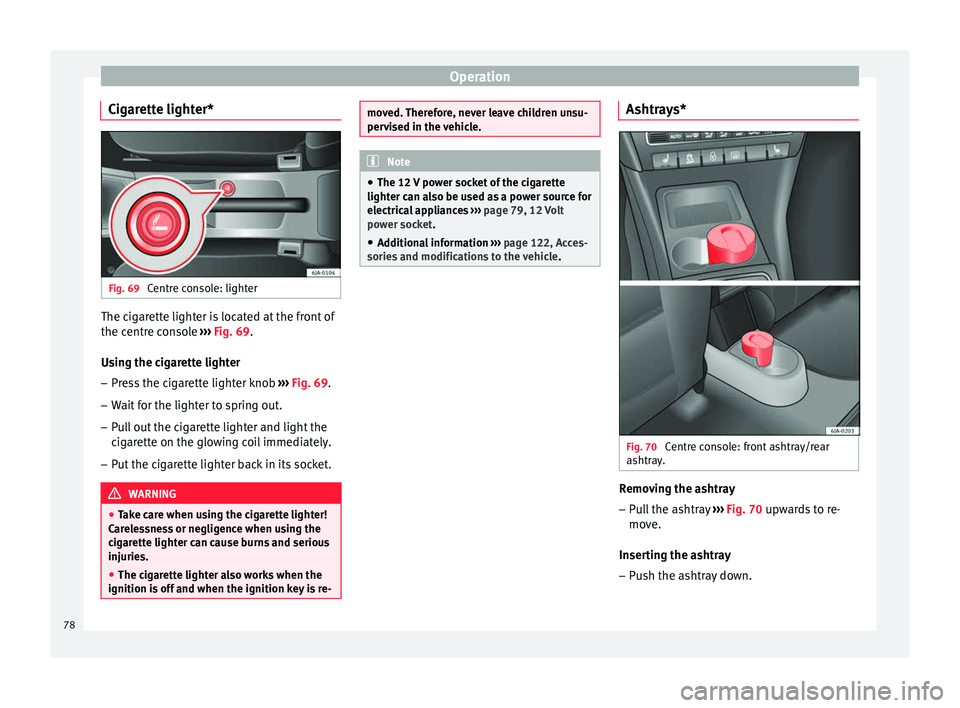
Cigarette lighter* Fig. 69
Centre console: lighter The cigarette lighter is located at the front of
the centre console
››› Fig. 69 .
U s
ing the cigarette lighter
– Press the cigarette lighter knob ››› Fig. 69.
– Wait
for the lighter to spring out.
– Pull out the cigarette lighter and light the
cigarette on the glowing coil immediately.
– Put the cigarette lighter back in its socket. WARNING
● Take care when using the cigarette lighter!
Carelessness or negligence when using the
cigarette lighter can cause burns and serious
injuries.
● The cigarette lighter also works when the
ignition is off and when the ignition key is re- moved. Therefore, never leave children unsu-
pervised in the vehicle.
Note
● The 12 V power socket of the cigarette
lighter can also be used as a power source for
electrical appliances ››› page 79, 12 Volt
power socket .
● Ad dition
al information ››› page 122, Acces-
sories and modifications to the vehicle . Ashtrays*
Fig. 70
Centre console: front ashtray/rear
ashtray. Removing the ashtray
– Pull the ashtray ››› Fig. 70 upwards to re-
mo v
e.
Inserting the ashtray
– Push the ashtray down.
78
Page 81 of 200

Transport and practical equipment
WARNING
Never put flammable materials in the ashtray.
Risk of fire! CAUTION
Never hold onto the ashtray by the lid when
removing it. Risk of breaking the lid. 12 Volt power socket
Fig. 71
Centre console: 12 V power socket. The 12 V power socket is located at the front
of the centre console
›››
Fig. 71 .
U s
ing the power socket
– Open the cover or remove the cigarette
lighter concealing the socket.
– Insert the plug of the electrical appliance
into the socket. Additional information
››› page 122, Acces-
sories and modifications to the vehicle . WARNING
● Improper use of the sockets or electrical
appliances can cause a fire and lead to burns
and other serious injuries.
● Never leave children unsupervised in the
vehicle. The 12 V power socket is also func-
tional when the ignition is switched off and
the key is removed.
● Should the connected appliance overheat,
immediately switch it off and disconnect it
from the socket. CAUTION
● The 12 V power socket can only be used to
power appliances with a power rating of up to
120 watts.
● Never exceed the maximum permitted pow-
er, as this could cause damage to the vehicle
electrical installation.
● With the engine switched off, however, the
vehicle battery will drain. Risk of discharging
the battery!
● Only use suitable plugs so as not to dam-
age the power socket.
● Only use appliances that have been tested
for electromagnetic compatibility in compli-
ance with current regulations.
● Before switching the ignition on or off, un-
plug the appliances from the power socket to protect them from any damage caused by
fluctuations in voltage.
● Follow the instructions for use of connected
appliances! Multimedia compartment
Fig. 72
Front centre console: multimedia
compartment. The multimedia compartment is in the stor-
age compartment of the front centre console
››› Fig. 72 .
The c omp
artment can be used to hold mobile
phones, mp3 players or similar devices. WARNING
Never use the multimedia compartment as an
ashtray or to store flammable materials. Risk
of fire! 79
Technical specifications
Advice
Operation
Safety
Page 82 of 200
Operation
Storage compartment for
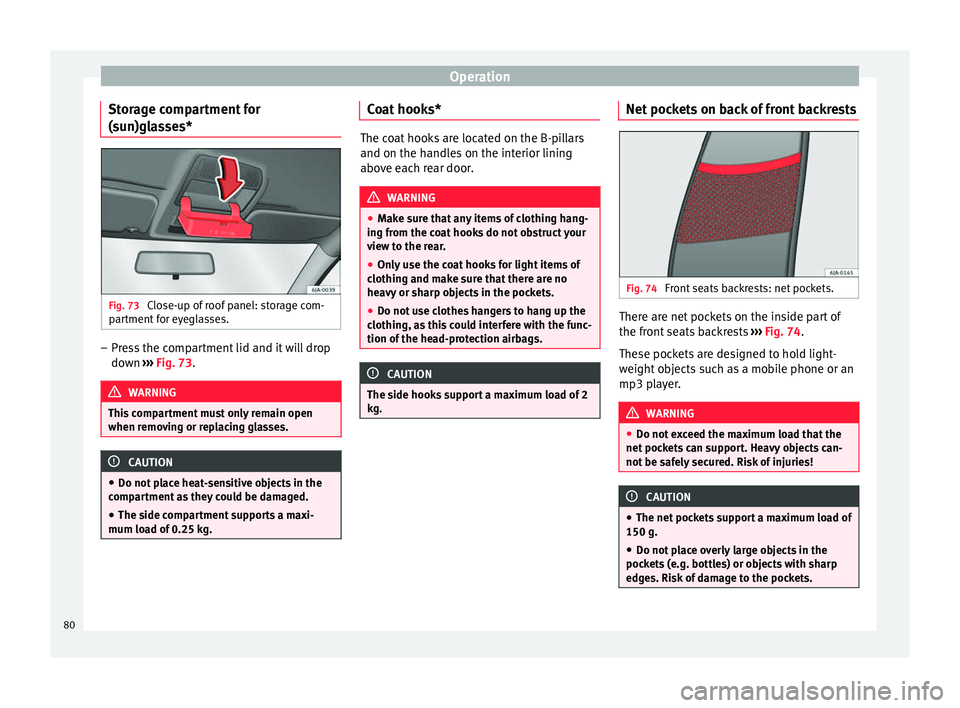
(sun)glasses* Fig. 73
Close-up of roof panel: storage com-
partment for eyeglasses. –
Press the compartment lid and it will drop
down ››› Fig. 73 . WARNING
This compartment must only remain open
when removing or replacing glasses. CAUTION
● Do not place heat-sensitive objects in the
compartment as they could be damaged.
● The side compartment supports a maxi-
mum load of 0.25 kg. Coat hooks*
The coat hooks are located on the B-pillars
and on the handles on the interior lining
above each rear door.
WARNING
● Make sure that any items of clothing hang-
ing from the coat hooks do not obstruct your
view to the rear.
● Only use the coat hooks for light items of
clothing and make sure that there are no
heavy or sharp objects in the pockets.
● Do not use clothes hangers to hang up the
clothing, as this could interfere with the func-
tion of the head-protection airbags. CAUTION
The side hooks support a maximum load of 2
kg. Net pockets on back of front backrests
Fig. 74
Front seats backrests: net pockets. There are net pockets on the inside part of
the front seats backrests
››› Fig. 74 .
The se poc
kets are designed to hold light-
weight objects such as a mobile phone or an
mp3 player. WARNING
● Do not exceed the maximum load that the
net pockets can support. Heavy objects can-
not be safely secured. Risk of injuries! CAUTION
● The net pockets support a maximum load of
150 g.
● Do not place overly large objects in the
pockets (e.g. bottles) or objects with sharp
edges. Risk of damage to the pockets. 80
Page 83 of 200

Transport and practical equipment
Storage compartments in centre
console Fig. 75
Centre console: storage compartment Open storage compartment in centre console
››› Fig. 75 .
St or
age compartment in front door Fig. 76
Storage compartment in door trim. There is a bottle carrier in part
B
››› Fig. 76
of the storage compartment in the front door. WARNING
Only use part A
››› Fig. 76 of the compart-
ment in the fr
ont door to store objects that do
not protrude from it so as not obstruct the de-
ployment area of the side airbags. Storage compartment in luggage
compartment*
Fig. 77
Luggage compartment: storage com-
partment The lid from the side storage compartment
can be removed to increase the size of the
boot.
– Hold onto the top of the lid and pull it out
in the direction indicated by the arrow
››› Fig. 77 . CAUTION
● The compartments are designed to hold
small objects with a total weight of 1.5 kg.
● Make sure you do not damage the storage
compartment or the boot trim when using the
compartment. Storing objects
Loading the luggage compartment All luggage and other loose objects must be
safely secured in the luggage compartment.
Unsecured objects which shift back and forth
could impair the driving safety or driving
characteristics of the vehicle by shifting the
centre of gravity.
– Distribute the load evenly in the luggage
compartment.
– Place heavy objects as far forward as possi-
ble in the luggage compartment.
– Place the heavy objects first.
– Secure heavy objects to the fastening rings
››› page 82 . WARNING
● Loose luggage and other objects in the lug-
gage compartment could cause serious inju-
ries. » 81
Technical specifications
Advice
Operation
Safety
Page 84 of 200
Operation
●
Always stow objects in the luggage com-
partment and secure them on the fastening
rings.
● Use suitable straps to secure heavy ob-
jects.
● During sudden manoeuvres or accidents,
loose objects can be thrown forward, injuring
vehicle occupants or passers-by. This in-
creased risk of injury will be further increased
if a loose object is struck by an inflating air-
bag. If this happens, objects may shoot out-
ward like a missile. Risk of fatal injury.
● Please note that the centre of gravity may
shift when transporting heavy objects; this
may affect vehicle handling and lead to an ac-
cident. Therefore, it is essential to adjust
your speed and driving style accordingly, to
avoid accidents.
● Never exceed the allowed axle weights or
allowed maximum weight. If said weights are
exceeded, the driving characteristics of the
vehicle may change, leading to accidents, in-
juries and damage to the vehicle.
● Never leave your vehicle unattended, espe-
cially when the rear lid is open. Children
could climb into the luggage compartment,
closing the door behind them; they will be
trapped and run the risk of death.
● Never allow children to play in or around
the vehicle. Close and lock all the doors and
rear lid when you leave the vehicle. Before
you lock the vehicle, make sure that there are
no adults or children in the vehicle. Note
● Air circulation in the vehicle helps reduce
fogging of the windows. Used air escapes
through ventilation slits in the side trim of
the luggage compartment. Ensure that the
ventilation slots are never covered.
● Straps for securing the load to the fasten-
ing rings are commercially available. Fastening rings*
There can be four fastening rings in the lug-
gage compartment for fastening luggage and
other objects.
–
Always use suitable and undamaged straps
to secure luggage and other objects to the fastening rings ››› in Loading the lug-
gage compartment on page 81.
– Pull up the fastening rings to attach the
straps.
During a collision or an accident, even small
and light objects can build up so much ener-
gy that they can cause very severe injuries.
The amount of kinetic “energy” depends on
the speed of the vehicle and the weight of
the object. The most significant factor, how-
ever, is the speed of the vehicle.
Example: An object weighing 4.5 kg is lying
unsecured in the vehicle. During a frontal col-
lision at a speed of 50 km/h (31 mph), this object generates a force corresponding to 20
times its weight. That means that the effec-
tive weight of the object increases to approxi-
mately 90 kg. You can imagine the severity of
the injuries which might be sustained if this
“object” strikes an occupant as it flies
through the interior of the vehicle. This in-
creased risk of injury will be further increased
if a loose object is struck by an inflating air-
bag.
WARNING
● If pieces of baggage or other objects are se-
cured to the fastening rings with inappropri-
ate or damaged retaining cords, injuries
could result in the event of braking manoeu-
vres or accidents.
● Never secure a child seat on the fastening
rings. Luggage compartment
Introduction Please observe the following points to ensure
the vehicle handles well at all times:
– Distribute the load as evenly as possible.
– Place heavy objects as far forward in the
luggage compartment as possible.
– Secure luggage using the fastening rings or
retaining net ›››
page 83.
82
Page 85 of 200
Transport and practical equipment
During an accident, even small and light ob-
jects can have so much kinetic energy that
they can cause very severe injuries. The
amount of kinetic energy depends on the
speed of the vehicle and the weight of the
object. However, the speed of the vehicle is
the most important factor.
Example: An unsecured object weighing 4.5
kg produces energy corresponding to 20
times its weight in a frontal collision at 50
km/h (31 mph). This means that its weight
reaches around 90 kg. You can imagine the
severity of the injuries that might be sus-
tained if this “projectile” strikes an occupant
as it flies through the vehicle interior. WARNING
● Store objects in the luggage compartment
and secure to the fastening points.
● In an accident or sudden manoeuvre, loose
objects in the interior can be flung forward
and possibly injure vehicle occupants or oth-
ers. This risk is even greater if the flying ob-
jects hit a triggering airbag. In this case, any
rebounding objects could injure vehicle occu-
pants. Risk of fatal injuries!
● Take into account that transporting heavy
objects changes the centre of gravity that
could also cause changes in vehicle handling.
Risk of accident! Therefore, always adjust
your speed and driving style to suit these cir-
cumstances. ●
Securing the load to the rings using unsuit-
able or damaged straps could lead to injuries
in the event of an accident or sudden braking
manoeuvre. Secure suitable straps safely to
the rings to ensure this does not happen.
● Position the load so it cannot move forward
during a sudden braking manoeuvre. Risk of
injuries!
● If transporting sharp or dangerous objects
in the space provided when the rear seats are
folded, ensure the safety of the occupant of
the remaining rear seat ››› page 8.
● If the r
ear seat located alongside a folded
seat is occupied, ensure safety, for example,
by placing the load so that it stops the seat
from folding backward in the event of being
hit from behind.
● Never drive with the rear lid open or half-
closed, exhaust gases may penetrate into the
interior of the vehicle. Danger of poisoning!
● Never exceed the allowed axle loads or al-
lowed maximum weight. Risk of accident!
● Never transport passengers in the luggage
compartment! CAUTION
Make sure sharp objects stored in the boot
cannot not damage the rear window heating
filaments. Note
Tyre pressure must be adapted to suit the
load ››› page 144, Life cycle of tyres . Category N1 vehicles
Category N1 vehicles with no protection grille
must use a retaining set compliant with
Standard EN 12195 (1 – 4) to secure the
load.
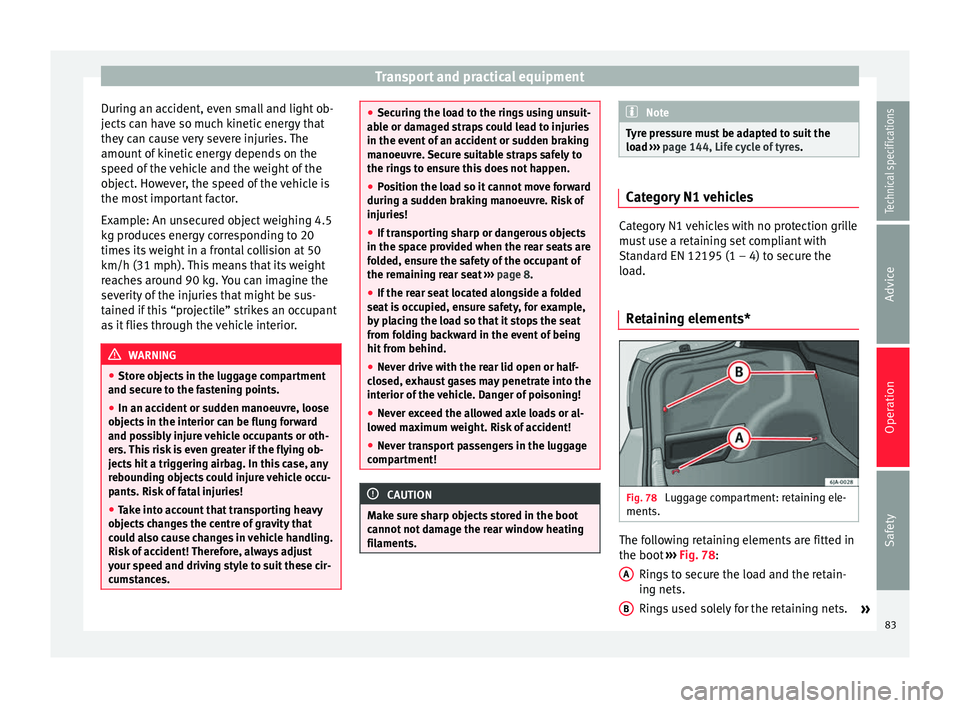
Retaining elements* Fig. 78
Luggage compartment: retaining ele-
ments. The following retaining elements are fitted in
the boot
›››
Fig. 78 :
Rin g
s to secure the load and the retain-
ing nets.
Rings used solely for the retaining nets. »
A B
83
Technical specifications
Advice
Operation
Safety
Page 86 of 200
Operation
CAUTION
The rings support a maximum load of 3.5 kN
(350 kg). Note
The front ring B is below the folding back-
rest of the rear seats ››› Fig. 78. Hook*
Fig. 79
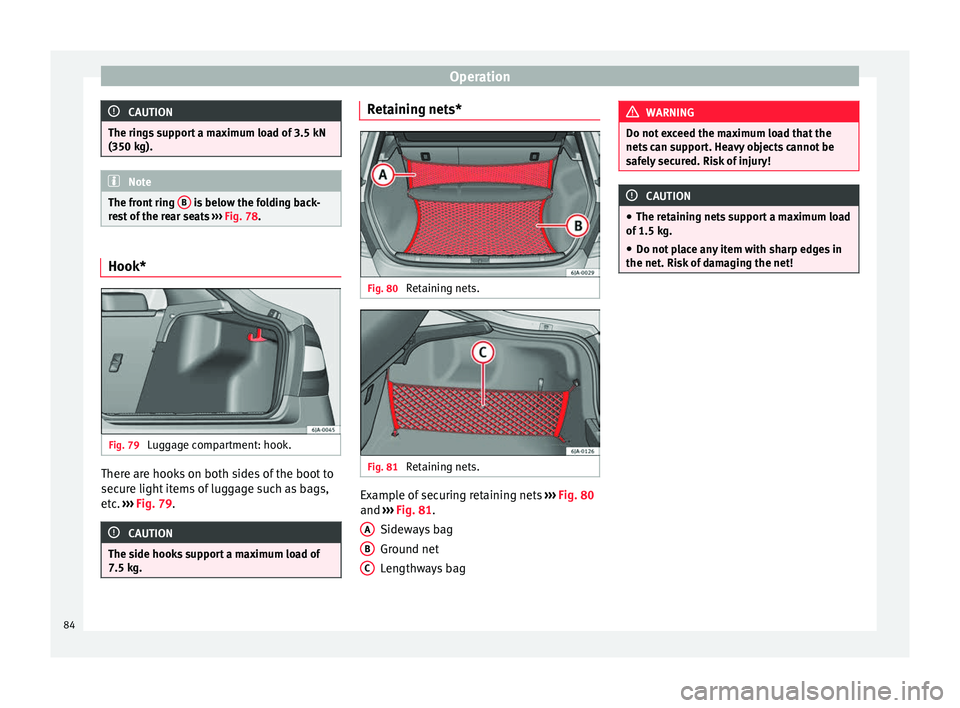
Luggage compartment: hook. There are hooks on both sides of the boot to
secure light items of luggage such as bags,
etc.
›››
Fig. 79 . CAUTION
The side hooks support a maximum load of
7.5 kg. Retaining nets*
Fig. 80
Retaining nets. Fig. 81
Retaining nets. Example of securing retaining nets
››› Fig. 80
and ››› Fig. 81 .
Sidew a
ys bag
Ground net
Lengthways bag
A B
C WARNING
Do not exceed the maximum load that the
nets can support. Heavy objects cannot be
safely secured. Risk of injury! CAUTION
● The retaining nets support a maximum load
of 1.5 kg.
● Do not place any item with sharp edges in
the net. Risk of damaging the net! 84
Page 87 of 200

Transport and practical equipment
Rear shelf Fig. 82
Remove the shelf. Fig. 83
Remove the shelf. The shelf can be removed if a large load is to
be transported.
Removing the shelf
–
Remove the straps from the shelf 1›››
Fig. 82 . –
Remo ve the shelf from its housing
2 by
knocking it gently from underneath be-
tween the supports.
Fitting the shelf – Place the shelf on the side supports on the
trim.
– Adjust the shelf supports 3
››› Fig. 83 to fit
the s up
ports 2 in the trim.
– Fit into place by knocking the top of the
shelf gently between the supports.
– Attach the straps 1 to the tray.
WARNING
Do not place objects on the rear shelf that
could endanger the vehicle occupants in case
of a sudden braking manoeuvre or an acci-
dent. CAUTION
● The rear shelf supports a maximum load of
1 kg.
● If handled incorrectly, the tray could bend
on closing the rear lid and become damaged
or damage the trim. Follow the instructions
below:
– The shelf supports 3
››› Fig. 83 must be
sec ur
ely in place in the trim supports 2 .
– The size of the load must not exceed the
height of the shelf. –
When open, the shelf must not be bent
against the shelf seal.
– There must be no objects in the space be-
tween the open shelf and the backrest of
the rear seat. Note
The shelf will lift when the rear lid is opened. Roof rack*
Introduction WARNING
● The load on the roof carrier must be proper-
ly secured. Risk of accident!
● Always secure the load using retaining
straps that are in good condition.
● Distribute the load evenly.
● When transporting heavy or large objects
on the roof, any change in normal vehicle be-
haviour due to a change in the centre of gravi-
ty or increased wind resistance must be taken
into account. Risk of accident! For this rea-
son, speed and driving style must be adjus-
ted for the situation.
● Avoid sudden manoeuvres and braking.
● Adjust your driving style to suit visibility,
the weather and road and traffic conditions. » 85
Technical specifications
Advice
Operation
Safety
Page 89 of 200

Heating and air conditioning
Heating and air conditioning Heating and air conditioning General notes The power of the heating depends on the
temperature of the coolant. Therefore, maxi-
mum power is only obtained when the en-
gine has reached operating temperature.
The temperature and humidity of the air in-
side the vehicle decrease when the cooling
system is turned on. This therefore increases
the comfort of all vehicle occupants when
outside temperatures and humidity are high.
It also helps prevent the windows from mist-
ing over during cold periods of the year.
The air recirculation system can be switched
on temporarily to increase the cooling effect.
Keep the air intake slots in front of the wind-
screen clear of ice, snow or leaves to ensure
unimpaired heating and cooling.
When the air conditioning is on,
condensa-
tion can drip from the evaporator in the air
c oo
ling system and form a pool underneath
the vehicle. This is normal and does not indi-
cate a leak! WARNING
● All windows must be clear of ice, snow and
condensation for driving safety. Therefore, make sure you familiarise yourself with the
correct use of heating and ventilation, win-
dow demisting and defrosting and cooling.
●
Never use the air recirculation system for
too long, as it prevents fresh air from enter-
ing the vehicle and used air can cause tired-
ness, reduce your attention span and cause
the windows to mist over. This increases the
risk of an accident. Switch off the air recircu-
lation system as soon as the windows begin
to mist over. Note
● Used air escapes through ventilation slots
in the rear of the luggage compartment.
● Smoking is not recommended while the air
recirculation system is in use, as the smoke
drawn from the interior of the vehicle settles
in the evaporator of the air conditioning sys-
tem. This causes a persistent, unpleasant
smell while the system is running that is
time-consuming and expensive (evaporator
replacement) to eliminate.
● To ensure proper functioning, never cover
the air outlets. Economic use of the air conditioning
system
When the air conditioning is switched on, the
compressor consumes engine power and has
influence on fuel consumption.If the vehicle interior has overheated due to
excessive solar radiation, it is best to open
the windows or doors to allow the hot air to
escape.
While in motion, the air conditioning should
not be switched on if the windows are open.
If the interior temperature can be reached
without switching on the air conditioning, the
fresh air mode should be used.
For the sake of the environment
Saving fuel reduces emissions. Faults
If the air conditioning does not work at out-
side temperatures above +5 °C (+41 °F) then
the system is faulty. This may be due to one
of the following reasons:
● One of the fuses has blown. Check the fuse
and replace if necessary ›››
page 163.
● The air conditioning compressor has
switched off temporarily because of in-
creased engine coolant temperature
››› page 31 .
If
you cannot repair the fault yourself or
where cooling power continues to drop,
switch off the system. Contact a specialised
service.
87
Technical specifications
Advice
Operation
Safety
Page 92 of 200
Operation
Note
● Controls A
››› Fig. 86 ››› page 88, B ,
C and button
1 .
● Air vents 4 ››› page 88.
● We r
ecommend you leave the air vents 3
››› page 88 in the open position. Air recirculation
Air recirculation prevents unpleasant smells,
e.g. when passing through a tunnel or in
queuing traffic, from entering the interior.
Switching on air recirculation mode
– Press button
1
›››
Fig. 86 ›
›
›
page 88
and the lamp in the button will illuminate.
Switching off air recirculation mode
– Press button
1
›››
Fig. 86 ›
›
›
page 88
again and the lamp in the button will
switch off.
If air vent C
›››
Fig. 86 ›
›
›
page 88 is in posi-
tion , air recirculation mode switches off
automatically. Press the button to switch
air recirculation mode back on in this posi-
tion. WARNING
Read and observe the safety warnings ››› in
General notes on page 87. Air conditioning (manual)*
General notes The air cooling system only works if
A/C but-
ton 2
›››
Fig. 87 ›
›
›
page 90 is pressed and
under following conditions:
● The engine is running,
● The outside temperature is above +2 °C
(+36 °F),
● The blower control is in position 1–4.
When the cooling system is on and under cer-
tain conditions, air can be blown from the
vents at a temperature of approximately
+5 °C (+41 °F). In the event of prolonged, ir-
regular distribution of the air flow from the
outlets and significant differences in temper-
ature, e.g. on leaving the vehicle, sensitive
people may catch cold. Note
A visit to the specialised service once a year
is recommended to clean the air conditioning
system. Operation
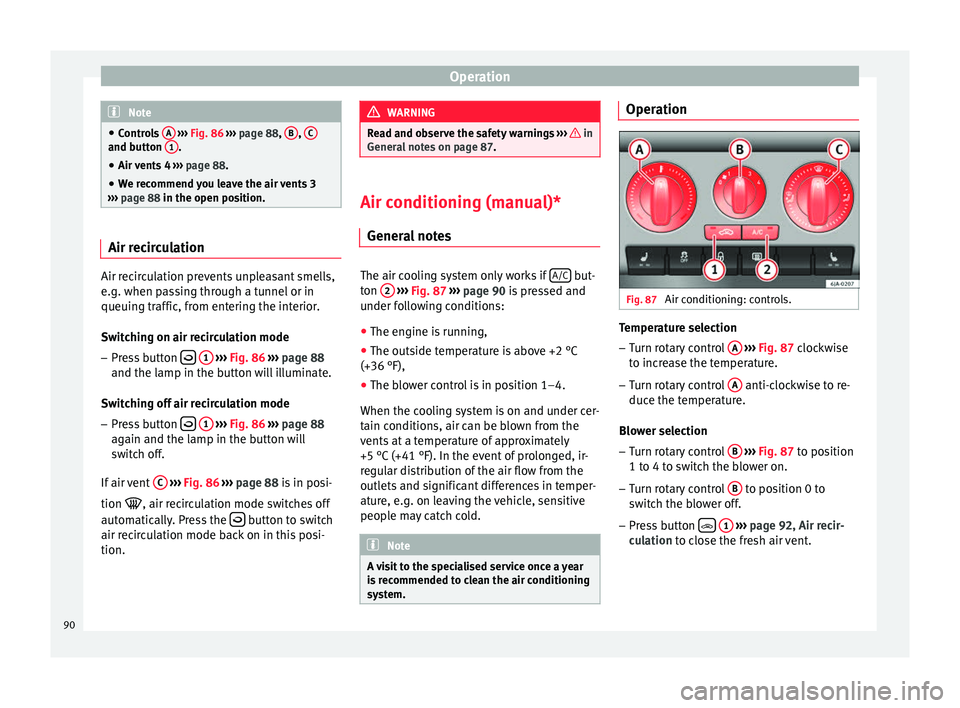
Fig. 87
Air conditioning: controls. Temperature selection
– Turn rotary control A
››› Fig. 87 clockwise
t o inc
rease the temperature.
– Turn rotary control A anti-clockwise to re-
duce the temperature.
Blower selection
– Turn rotary control B
››› Fig. 87 to position
1 t o 4 t
o switch the blower on.
– Turn rotary control B to position 0 to
switch the blower off.
– Press button
1
››› page 92, Air recir-
culation to close the fresh air vent.
90