warning Seat Toledo 2014 Workshop Manual
[x] Cancel search | Manufacturer: SEAT, Model Year: 2014, Model line: Toledo, Model: Seat Toledo 2014Pages: 200, PDF Size: 4.37 MB
Page 64 of 200
Operation
Switching on dipped beam – Turn the light switch ››› Fig. 45 to position
.
Sw it
ching off lights (except daytime driving
lights)
– Turn the light switch ››› Fig. 45 to position
0.
Ran
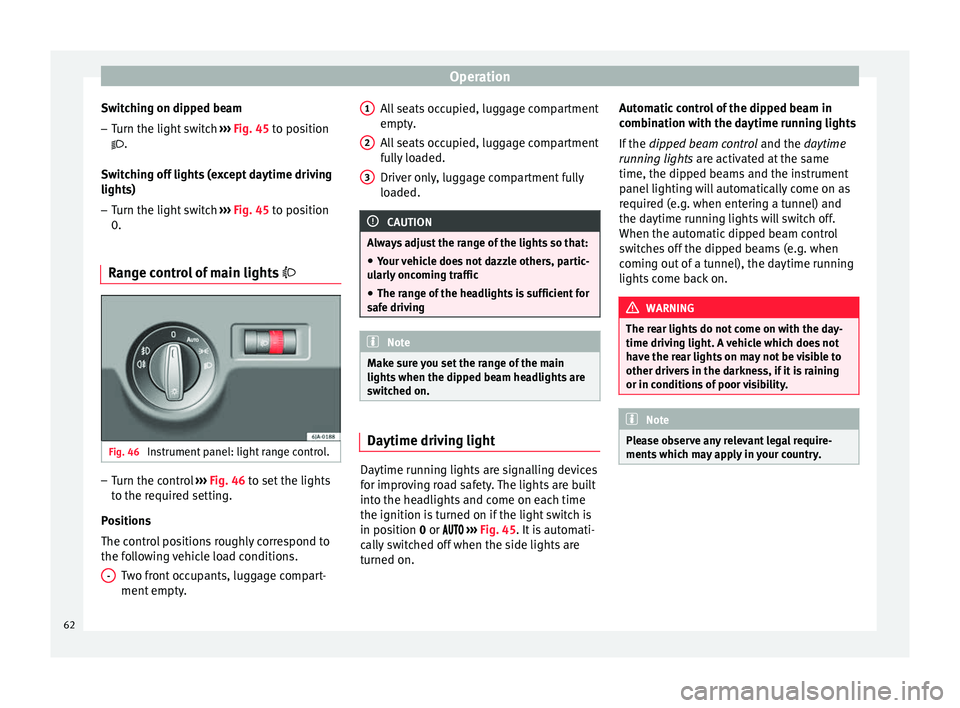
ge control of main lights Fig. 46
Instrument panel: light range control. –
Turn the control ››› Fig. 46 to set the lights
t o the r
equired setting.
Positions
The control positions roughly correspond to
the following vehicle load conditions. Two front occupants, luggage compart-
ment empty.
- All seats occupied, luggage compartment
empty.
All seats occupied, luggage compartment
fully loaded.
Driver only, luggage compartment fully
loaded.
CAUTION
Always adjust the range of the lights so that:
● Your vehicle does not dazzle others, partic-
ularly oncoming traffic
● The range of the headlights is sufficient for
safe driving Note
Make sure you set the range of the main
lights when the dipped beam headlights are
switched on. Daytime driving light
Daytime running lights are signalling devices
for improving road safety. The lights are built
into the headlights and come on each time
the ignition is turned on if the light switch is
in position
0
or ›
››
Fig. 45. It is automati-
cally switched off when the side lights are
turned on. 1 2
3 Automatic control of the dipped beam in
combination with the daytime running lights
If the
dipped beam control and the
daytime
r
unning lights are activated at the same
time, the dipped beams and the instrument
panel lighting will automatically come on as
required (e.g. when entering a tunnel) and
the daytime running lights will switch off.
When the automatic dipped beam control
switches off the dipped beams (e.g. when
coming out of a tunnel), the daytime running
lights come back on. WARNING
The rear lights do not come on with the day-
time driving light. A vehicle which does not
have the rear lights on may not be visible to
other drivers in the darkness, if it is raining
or in conditions of poor visibility. Note
Please observe any relevant legal require-
ments which may apply in your country. 62
Page 66 of 200

Operation
CAUTION
Do not cover the windscreen light sensor with
stickers or similar objects; this could impair
operation. Front fog lights*
Fig. 48
Instrument panel: light switch. Switching on front fog lights
– First turn the light switch ›››
Fig. 48 to posi-
tion , or
.
– Pull on the light switch to position 1 .
The ›››
page 32 warning lamp lights up on
the g ener
al instrument panel if the front fog
lights are switched on. Front fog lights with cornering
function* 3 Not valid for vehicles fitted with Full-LED lights
Fr ont
fog lights with cornering function pro-
vide better lighting of the area around the car
when driving through a corner or parking,
etc.
Front fog lights with cornering function
switch on depending on how far you turn the
steering wheel or whether or not the turn sig-
nals 1)
are switched on, if the following condi-
tions are met:
● The vehicle is stationary, the ignition is
switched on or you are moving at a speed of
less than 40 km/h (25 mph);
● The daytime driving light is switched off
● The dipped beam is switched on
● The fog lights are switched off
● Reverse gear is not engaged Rear fog light Switching on the rear fog light
– First turn the light switch ››› Fig. 48
››› page 64 to position
, or .
– Pull on the light switch to position 2 .
If the vehicle is not equipped with front fog
lights ››› page 64, the rear fog light is switch-
ed on b y
turning the switch to position or
and pulling it to position 2 . This type of
switch only has one position.
The ››› page 32
warning lamp lights up on
the g ener
al instrument panel if the rear fog
lights are switched on.
If you are towing a trailer or caravan equip-
ped with a rear fog light on a vehicle with a
factory-fitted towing bracket or one installed
using parts from the original SEAT parts
catalogue
, only the rear fog light on the trail-
er or caravan will light up. 1)
In the event of a conflict between both functions,
i.e. if you turn the steering wheel to the left while the
right-hand turn signal is on, the turn signals will take
priority.
64
Page 67 of 200

Lights and visibility
“Coming Home”/“Leaving Home”*
function This function makes it possible, under poor
visibility conditions, to automatically turn on
the lights for a brief period of time after the
vehicle has been parked or when approach-
ing the vehicle.
The function is automatically turned on if the
following conditions are met:
● The light switch is in position
››› page 63
.
● The v
isibility around the vehicle is reduced.
● The ignition is switched off.
To turn on this function, switch on the head-
light flasher prior to exiting the vehicle.
The light is adjusted according to the data re-
corded by the light sensor that is installed
between the windscreen and the inside rear
view mirror.
The function automatically turns on the side
lights and headlights, the lighting for the en-
try area on the exterior mirrors and the num-
ber plate light.
“Coming Home” function
The light is automatically switched on when
the driver door is opened (for 60 seconds af-
ter the ignition is switched off). The lights is switched off when all the doors
and the boot lid are closed.
If a door or the boot lid remains open, the
light will switch off after 60 seconds.
“Leaving Home” function
The light is automatically switched on when
the vehicle is unlocked using the remote con-
trol.
The light is switched off after 10 seconds or
when the vehicle is locked.
Hazard warning light switch Fig. 49
Instrument panel: switch for hazard
warning lights. –
Press the button ››› Fig. 49 to switch the
h az
ard warning lights on or off.
The warning lamps on the instrument panel
and the warning lamp on the switch will flash at the same time as the turn signals when
the hazard warning lights are switched on.
The hazard warning lights also work when
the ignition is switched off.
The hazard warning lights come on automati-
cally in the event of an accident in which an
airbag is triggered.
Note
Switch on the hazard warning lights to warn
other road users, for example:
● When reaching the tail end of a traffic jam
● if the vehicle has a technical fault or you
are involved in an emergency situation. Parking lights*
Parking lights
– Switch the ignition off.
– Move the turn signal lever ›››
Fig. 47
››› page 63 up or down to turn on the right
or l ef
t-hand parking lights respectively.
Parking light on both sides – Turn the light switch ›››
Fig. 45
››
› page 61 to position and eng age the
steering lock. »
65
Technical specifications
Advice
Operation
Safety
Page 70 of 200

Operation
Note
In the event of a drop in voltage in the on-
board systems, the heated rear window
switches off automatically to ensure enough
power to control the engine ››› page 143, Au-
tomatic disconnection of electrical equip-
ment. Sun visors
Fig. 54
Driver's sun visor. Fig. 55
Front passenger's sun visor. The sun visors for the driver and the front
passenger can be pulled out of their central
supports and turned towards the doors in the
direction of arrow
1
››› Fig. 54 and 2 ›››
Fig. 55 respectively.
The s trip A is to store small objects such as
notepaper, etc.
The front passenger sun visor includes a van-
ity mirror B with a cover. The cover is
opened by sliding it in the direction indicated
by arrow 3
››› Fig. 55 . WARNING
Do not turn sun visors with attached objects
such as ball-pens, etc. toward the head pro-
tection airbag triggering zone on the side
windows. The head protection airbags could
injure occupants if triggered. Windscreen wipers and
windscreen washers
Introduction The windscreen wipers and windscreen
washers only work when the ignition is
switched on.
The speed of the automatic wipe in case of
rain is automatically adjusted according to
the intensity of the rainfall.The rear window is wiped once if the wind-
screen wipers are switched on and reverse
gear is engaged.
Fill the windscreen washer fluid
››› page 139. WARNING
● Make sure the blades ››› page 162 are in
perfect condition for good visibility and safe
driving.
● In cold conditions, you should not use the
wash/wipe system unless you have warmed
the windscreen with the heating and ventila-
tion system. The windscreen washer fluid
could otherwise freeze on the windscreen and
obscure your view of the road. CAUTION
● During winter, always check that the wind-
screen wiper blades are not frozen to the
glass before each trip or before switching on
the ignition. If you switch on the windscreen
wipers when the wiper blades are frozen to
the glass, this could damage both the wiper
blades and the wiper motor.
● If the ignition is switched off when the
windscreen wipers are on, they will start op-
erating in the same mode when the ignition
is switched back on. The wiper blades may be
frozen to the glass at low temperatures when
the ignition is switched off.
● Carefully separate the frozen wipers from
the windscreen or rear window. 68
Page 72 of 200

Operation
Switching off the wipers – Move the lever to position 0
››› Fig. 56 . WARNING
The rain sensor may not detect enough rain
to switch on the wipers.
● If necessary, switch on the wipers manually
when water on the windscreen obstructs visi-
bility. Note
Do not put stickers on the windscreen in front
of the rain sensor*. This may cause sensor
disruption or faults. Headlight washer system*
The headlight washers operate briefly if the
dipped headlights or headlights are on and
the lever is moved to position
5
›››
Fig. 56 .
The he a
dlight washer system also operates
every 10 windscreen wash cycles.
Clean off stubborn dirt (insects, etc.) from the
headlights at regular intervals, for instance
when filling the fuel tank. Please observe the
following indications ›››
page 126, Head-
lights.
To en
sure the system works properly in win-
ter, keep the nozzle holders free of snow and
remove any ice with a de-icer spray. CAUTION
Never pull on the nozzle holders. Risk of
damage to the system! Rear vision mirrors
Interior rear vision mirror with manual
anti-dazzle adjustment Basic settings
– Push the lever at the bottom of the mirror
forward.
Rear vision mirror anti-dazzle setting – Pull the lever at the bottom of the mirror to-
wards you.
Exterior mirrors Fig. 57
Door interior: adjuster knob. Before beginning any journey, adjust the rear
view mirrors for a good rear visibility.
Heated rear vision mirrors*
–
Turn the knob to position
›
›› Fig. 57
.
Electrical adjustment of the left-hand
exterior mirror*
– Turn the knob to position ›
›› Fig. 57. The
mirror movements are the same as those of
the knob.
Electrical adjustment of the right-hand
exterior mirror*
– Turn the knob to position ››› Fig. 57. The
mirror mo
vements are the same as those of
the knob. WARNING
● Convex (wide-angle) rear vision mirrors give
a larger field of vision. However, they make
objects appear smaller and further away than
they really are. For this reason, you should
not rely on these rear vision mirrors for judg-
ing the distance of vehicle behind.
● If possible, use the interior rear vision mir-
ror to estimate distances to vehicles behind
you. Note
● Exterior mirrors are only heated when the
engine is running. 70
Page 73 of 200

Seats and head restraints
●
Do not touch the exterior mirrors when the
heating system is running.
● If the electrical adjustment should ever fail
to operate, the rear vision mirrors can be ad-
justed by hand by pressing the edge of the
mirror glass.
● Visit the technical service in the event of a
fault in the electrical rear vision mirror ad-
justment system. Seats and head restraints
Adjusting seats and head
restraints
Introduction Set the driver seat in such a way that the
pedals can be fully depressed with your legs
slightly bent.
Set the driver seat backrest so that you can
reach the upper point of the steering wheel
with your arms slightly bent.
The correct seat position is very important
for:
●
reaching all of the controls safely and
quickly,
● a relaxed posture that will not produce fati-
gue,
● maximum protection from the seat belts
and airbag system WARNING
● Adjust the driver seat only when the vehi-
cle is stationary. Risk of accident!
● Be careful when adjusting the front seats!
Careless and uncontrolled adjustment can
cause injuries. ●
The backrests must not be reclined too far
back while driving. This could limit the effect
of the seat belts and the airbag system. Risk
of injury!
● Never transport more than the permitted
amount of people in your vehicle.
● Every occupant in the vehicle must properly
fasten and wear the seat belt belonging to
his or her seat. Children must be protected
with an appropriate child restraint system
››› page 24, Transporting children safety.
● The front seats, head restraints and seat
belts must always be adjusted to the size of
the vehicle occupant to provide you and your
passengers with the greatest possible protec-
tion.
● Your feet should remain in the footwell
while the vehicle is moving; never rest them
on the dash panel, on the window or on the
seat! This also applies to passengers. An in-
correct sitting position exposes you to an in-
creased risk of injury in case of a sudden
braking or an accident. If the airbag is trig-
gered, you could sustain severe injuries due
to an incorrect sitting position!
● It is important for the driver and front pas-
senger to keep a distance of at least 25 cm
from the steering wheel and dash panel. Fail-
ure to respect the minimum distance means
that the airbag will not protect you. Risk of
fatal injury if triggered!
● Objects must not be placed in the footwell,
as they could move to the area of the pedals
in the event of a braking manoeuvre or
change of direction. This would prevent the » 71Technical specifications
Advice
Operation
Safety
Page 75 of 200

Seats and head restraints
– To lower the head restraint, press button
A
››› Fig. 59 while pushing the head re-
s tr
aint downward.
Fitting and removing head restraints on front
seats
– Push the head restraint up as far as it will
go.
– Press catch A
››› Fig. 59 and remove the
he a
d restraint.
– To refit, insert the head restraint into the
holes in the backrest, pushing it down until
it engages.
Fitting and removing head restraints on rear
seats
– Push the head restraint up as far as it will
go.
– Press catch 1
››› Fig. 59 while pressing on
the c at
ch in hole 2 with a max. 5 mm flat-
headed screwdriver and remove the head
restraint.
– To refit, insert the head restraint into the
holes in the backrest, pushing it down until
it engages.
For maximum head restraint protection, ad-
just the head restraint so that its upper edge
is at the same level as the top of your head.
The head restraint must be adjusted in line
with the height of users. Correct adjustment of the head restraint, together with the seat
belts, ensure effective passenger protection
››› page 6 . WARNING
● Badly adjusted head restraints increase the
risk of injuries in the event of an accident.
● Never drive with the head restraints re-
moved. Risk of injuries!
● If the seats are in use, never drive with the
rear head restraints in their out-of-use posi-
tion. Seat functions
Heated front seats* Fig. 60
Heated front seats. The cushion and backrest of the front seats
can be heated electrically. Press the
or
››› Fig. 60 button to switch
on and a dju
st the heated front seats.
Press once to connect the heating at maxi-
mum force.
Press the button again to reduce the force of
the heating and switch it off. The force is indi-
cated by the number of warning lamps lit on
the button. WARNING
Do not use the heated seat if your perception
of pain and/or temperature or that of your
passenger is limited, e.g. due to medication,
paralysis or chronic illness (e.g. diabetes). It
could cause burns on the back, buttocks and
legs that are difficult to heal. If you still want
to use the heated seat, take frequent breaks
on long journeys so that the body can recover
from the trip. Ask your doctor about your par-
ticular situation. CAUTION
● To avoid damaging the heating elements,
do not kneel on the seat or apply sharp pres-
sure at a single point to the seat cushion or
backrest.
● Do not use the heated seats if nobody is
sitting on them or if there are items attached
to or lying on them, such as a child seat or a
bag, etc. This could lead to a fault in the seat
heating elements.
● Do not clean the seats with anything damp
››› page 127.
» 73
Technical specifications
Advice
Operation
Safety
Page 77 of 200

Seats and head restraints
Folding the rear backrest Fig. 63
Unlocking the backrest. Folding
– Before folding the rear seats, adjust the po-
sition of the front seats so that the rear
seats are not damaged. When the front
seats are adjusted to the rear position,
their head restraints should be removed
before folding the backrests on the rear
seats. Store the removed head restraints in such a way that they cannot be soiled or
damaged.
– Insert the seat belt latch plate into hole A ›››
Fig. 63 located on the corresponding
s ide of
the vehicle – safety position.
– Press the lock button B to unlock the
backrest and fold it forward.
Returning to the initial position
– Where the head restraint has been re-
moved, insert it into the backrest when par-
tially raised.
– Push the backrest backwards to its original
position until the lock button engages –
check that it is locked by pulling on the
backrest ››› .
– Make sure the red protruding part C is not
visible. WARNING
● Once the backrests have been lifted, the
seat belts and their buckles must be in their
initial position – ready for use.
● The backrests must be safely locked to en-
sure any items in the boot cannot move
around the interior of the vehicle in the event
of a sudden braking manoeuvre. Risk of inju-
ries!
● Make sure the rear backrests are correctly
locked. Only then will the three-point auto-
matic seat belt on the rear central seat work
correctly. CAUTION
Take care when handling the rear backrests
so as not to damage the seat belts. The seat
belt must never be left behind the lifted back-
rest. 75
Technical specifications
Advice
Operation
Safety
Page 78 of 200
Operation
Transport and practical
equipment Practical equipment Passenger side glove compartment Fig. 64
Instrument panel: passenger side
glove compartment. Fig. 65
Storage: cooling control. Opening and closing passenger side glove
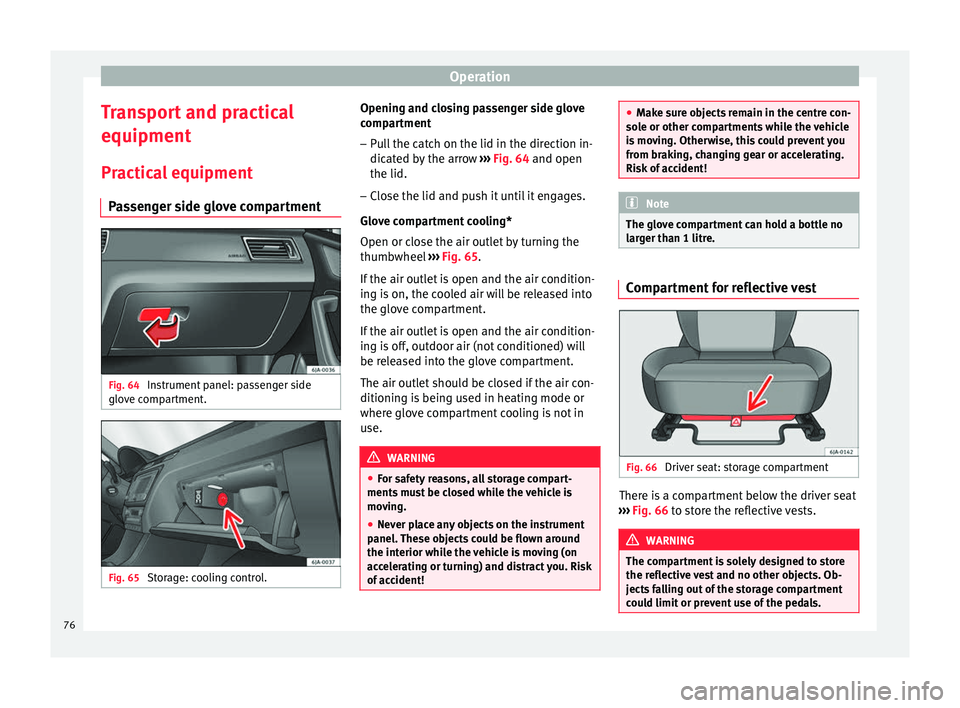
compartment
– Pull the catch on the lid in the direction in-
dicated by the arrow ››› Fig. 64
and open
the lid.
– Clo
se the lid and push it until it engages.
Glove compartment cooling*
Open or close the air outlet by turning the
thumbwheel ››› Fig. 65.
If the air outl
et is open and the air condition-
ing is on, the cooled air will be released into
the glove compartment.
If the air outlet is open and the air condition-
ing is off, outdoor air (not conditioned) will
be released into the glove compartment.
The air outlet should be closed if the air con-
ditioning is being used in heating mode or
where glove compartment cooling is not in
use. WARNING
● For safety reasons, all storage compart-
ments must be closed while the vehicle is
moving.
● Never place any objects on the instrument
panel. These objects could be flown around
the interior while the vehicle is moving (on
accelerating or turning) and distract you. Risk
of accident! ●
Make sure objects remain in the centre con-
sole or other compartments while the vehicle
is moving. Otherwise, this could prevent you
from braking, changing gear or accelerating.
Risk of accident! Note
The glove compartment can hold a bottle no
larger than 1 litre. Compartment for reflective vest
Fig. 66
Driver seat: storage compartment There is a compartment below the driver seat
››› Fig. 66 to store the reflective vests. WARNING
The compartment is solely designed to store
the reflective vest and no other objects. Ob-
jects falling out of the storage compartment
could limit or prevent use of the pedals. 76
Page 79 of 200

Transport and practical equipment
CAUTION
The compartment is solely designed to store
the reflective vest and no other objects, since
there is a risk of damaging the storage com-
partment. Front seat storage compartments
There is a storage pocket on the rear part of
the backrest of the front seats.
These pockets are designed to hold maps,
magazines, etc.
WARNING
Do not place heavy objects in the pockets.
Risk of injury! CAUTION
Do not place overly large objects in the pock-
ets (e.g. bottles) or objects with sharp edges.
Risk of damage to the pockets and the up-
holstery. Drink holder in centre console
Fig. 67
Centre console: drink holder Front drink holder in the centre console
Rear drink holder in the centre console
WARNING
● Do not put hot drinks in the drink holders.
They could spill while the vehicle is moving.
Risk of scalding! A
B ●
Do not use cups or glasses made of fragile
materials (e.g. glass or china). These could
cause injury in the event of an accident. CAUTION
Avoid putting open drinks containers in the
drink holder while the vehicle is moving.
They could spill (e.g. on braking) and cause
damage to the electrical equipment or the
seat covers. Drink holder in the rear armrest
Fig. 68
Rear seats armrest: drink holder Two drinks can be placed in the drink holder.
Use the detachable parts
A and
B ›››
Fig. 68 to change the size of the holes.
– Remo
ve part A or
B in the direction indi-
cated by the arrow and replace in the re-
quired position in the drink holder.
77
Technical specifications
Advice
Operation
Safety