ignition SKODA CITIGO 2012 1.G Owner's Manual
[x] Cancel search | Manufacturer: SKODA, Model Year: 2012, Model line: CITIGO, Model: SKODA CITIGO 2012 1.GPages: 157, PDF Size: 3.9 MB
Page 9 of 157
Using the system
Cockpit
Overview
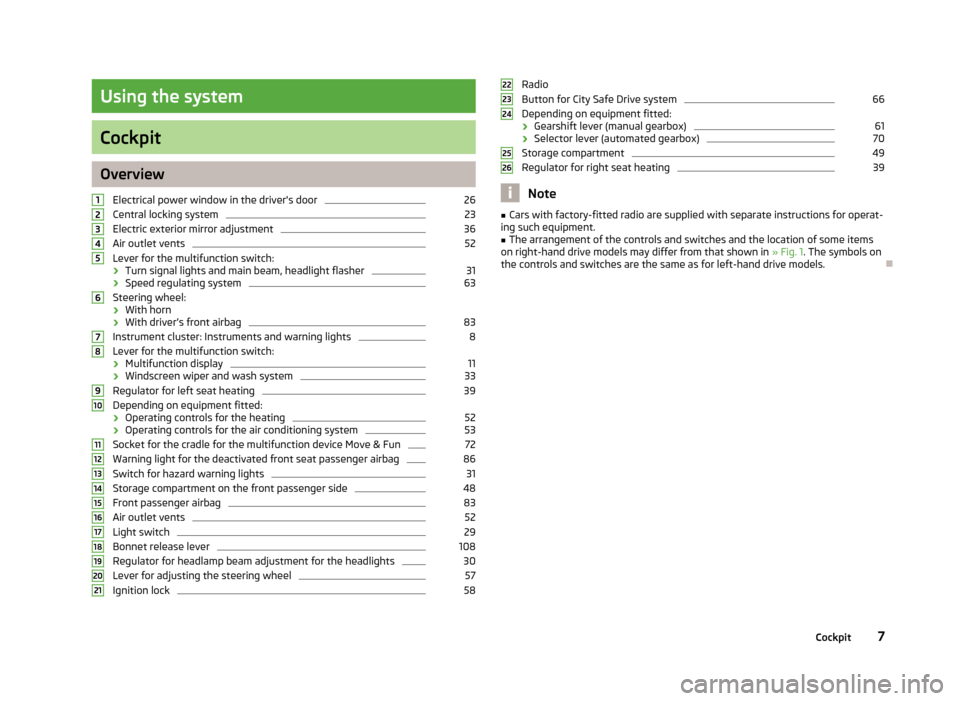
Electrical power window in the driver's door 26
Central locking system 23
Electric exterior mirror adjustment 36
Air outlet vents 52
Lever for the multifunction switch:
› Turn signal lights and main beam, headlight flasher 31
› Speed regulating system 63
Steering wheel:
› With horn
› With driver’s front airbag 83
Instrument cluster: Instruments and warning lights 8
Lever for the multifunction switch:
› Multifunction display 11
› Windscreen wiper and wash system 33
Regulator for left seat heating 39
Depending on equipment fitted:
› Operating controls for the heating 52
› Operating controls for the air conditioning system 53
Socket for the cradle for the multifunction device Move & Fun 72
Warning light for the deactivated front seat passenger airbag 86
Switch for hazard warning lights 31
Storage compartment on the front passenger side 48
Front passenger airbag 83
Air outlet vents 52
Light switch 29
Bonnet release lever 108
Regulator for headlamp beam adjustment for the headlights 30
Lever for adjusting the steering wheel 57
Ignition lock 581
2
3
4
5
6
7
8
9
10
11
12
13
14
15
16
17
18
19
20
21 Radio
Button for
City Safe Drive system 66
Depending on equipment fitted:
› Gearshift lever (manual gearbox) 61
› Selector lever (automated gearbox) 70
Storage compartment 49
Regulator for right seat heating 39
Note
■ Cars with factory-fitted radio are supplied with separate instructions for operat-
ing such equipment. ■ The arrangement of the controls and switches and the location of some items
on right-hand drive models may differ from that shown in » Fig. 1. The symbols on
the controls and switches are the same as for left-hand drive models. Ð 22
23
24
25
26
7
Cockpit
Page 11 of 157
›
With service interval display
» page 10
› With multifunction display
» page 11
Reset button for the display of the daily trip counter
(trip) » page 10
Fuel gauge » page 9
Engine revolutions counter » page 9
Adjust button for the clock » page 12. ÐSpeedometer
First read and observe the introductory information and safety warn-
ings on page 8.
The speed is shown in km/h or mph and km/h depending on the vehicle.
ÐFuel gauge
Fig. 4
Fuel gauge Fig. 5
Fuel gauge - CNG 3
4
5
6
ä
First read and observe the introductory information and safety warn-
ings on page 8.
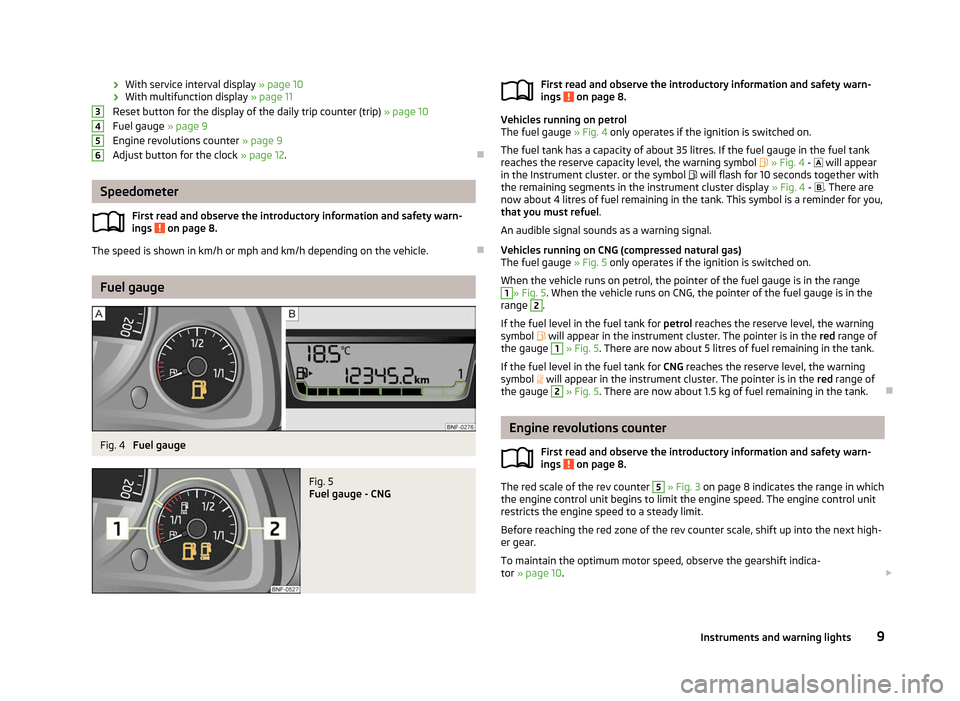
Vehicles running on petrol
The fuel gauge
» Fig. 4 only operates if the ignition is switched on.
The fuel tank has a capacity of about 35 litres. If the fuel gauge in the fuel tank
reaches the reserve capacity level, the warning symbol » Fig. 4 - will appear
in the Instrument cluster. or the symbol will flash for 10 seconds together with
the remaining segments in the instrument cluster display » Fig. 4 - . There are
now about 4 litres of fuel remaining in the tank. This symbol is a reminder for you,
that you must refuel .
An audible signal sounds as a warning signal.
Vehicles running on CNG (compressed natural gas)
The fuel gauge » Fig. 5 only operates if the ignition is switched on.
When the vehicle runs on petrol, the pointer of the fuel gauge is in the range 1
» Fig. 5. When the vehicle runs on CNG, the pointer of the fuel gauge is in the
range 2
.
If the fuel level in the fuel tank for petrol reaches the reserve level, the warning
symbol will appear in the instrument cluster. The pointer is in the red range of
the gauge 1
» Fig. 5. There are now about 5 litres of fuel remaining in the tank.
If the fuel level in the fuel tank for CNG reaches the reserve level, the warning
symbol will appear in the instrument cluster. The pointer is in the red range of
the gauge 2
» Fig. 5. There are now about 1.5
kg of fuel remaining in the tank. Ð Engine revolutions counter
First read and observe the introductory information and safety warn-
ings on page 8.
The red scale of the rev counter 5
» Fig. 3 on page 8 indicates the range in which
the engine control unit begins to limit the engine speed. The engine control unit
restricts the engine speed to a steady limit.
Before reaching the red zone of the rev counter scale, shift up into the next high-
er gear.
To maintain the optimum motor speed, observe the gearshift indica-
tor » page 10. £
ä
ä 9
Instruments and warning lights
Page 12 of 157
Avoid high engine speeds during the running-in period and before the engine has
warmed up to the operating temperature . For the sake of the environment
Shifting to a higher gear in good time helps to lower fuel consumption, minimises
operating noise levels, protects the environment and contributes to a longer life
and reliability of the engine. ÐCounter for distance driven
First read and observe the introductory information and safety warn-
ings on page 8.
The distance which you have driven with your vehicle is shown in kilometres (km).
In some countries the measuring unit
“mile” is used.
Reset button
To toggle between the odometer and the daily trip counter, briefly press the but-
ton 3
» Fig. 2 on page
8 or » Fig. 3 on page 8.
To reset the display of the daily trip counter, press button 3
for longer.
Daily trip counter (trip)
The daily trip counter indicates the distance which you have driven since it was
last reset - in steps of 100 metres or 1/10 of a mile.
Odometer
The odometer indicates the total distance in kilometres or miles which the vehicle
has been driven. ÐService Interval Display
First read and observe the introductory information and safety warn-
ings on page 8.
Before the next service interval, the message
appears for some seconds and
the remaining kilometres are indicated after switching on the ignition.
At the time of the service, an acoustic signal will sound and the message
ap-
pears for a few seconds after switching on the ignition. ä
ä Resetting Service Interval Display
The ŠKODA specialist garage:
› Resets the memory of the display after the appropriate inspection
› Adds an entry to the Service Schedule
› Affixes the sticker with the entry of the following service interval to the side of
the dashboard on the driver's side Note
■ Information is retained in the Service Interval Display even after the vehicle bat-
tery is disconnected. ■ If the instrument cluster is exchanged after a repair, the correct values must be
entered in the counter for the Service Interval Display. This work is carried out by
a ŠKODA specialist garage. ■ For more information on the service intervals » Service Plan. Ð Recommended gear
First read and observe the introductory information and safety warn-
ings on page 8.
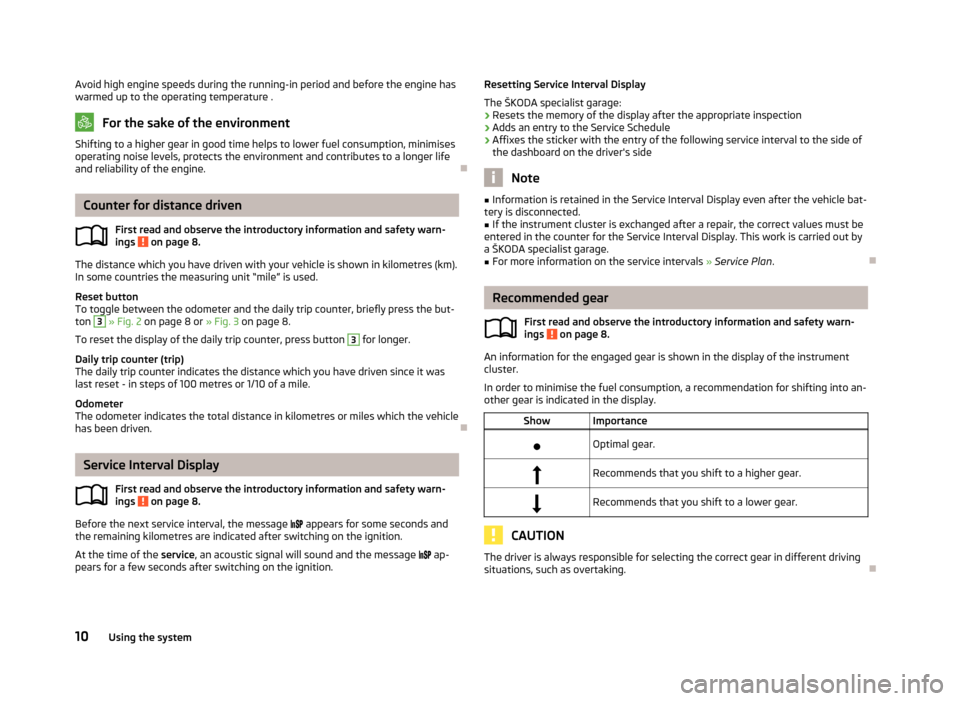
An information for the engaged gear is shown in the display of the instrument
cluster.
In order to minimise the fuel consumption, a recommendation for shifting into an-
other gear is indicated in the display.
Show Importance
Optimal gear.
Recommends that you shift to a higher gear.
Recommends that you shift to a lower gear. CAUTION
The driver is always responsible for selecting the correct gear in different driving
situations, such as overtaking. Ð
ä
10 Using the system
Page 13 of 157
Multifunction display (onboard computer)
ä
Introduction
This chapter contains information on the following subjects:
Memory 11
Operation 12
Digital clock 12
Multifunction display details 12
Warning against excessive speeds 13
The multifunction display can only be operated when the ignition is switched on.
After the ignition is switched on, the function displayed is the one which you last
selected before switching off the ignition.
The multi-functional indicator appears in the display » Fig. 6 on page 11. WARNING
■ Concentrate fully at all times on your driving! As the driver you are fully re-
sponsible for the operation of your vehicle.
■ Do not only rely upon the information given on the outside temperature dis-
play that there is no ice on the road. Even at temperatures around +4 °C, black
ice may still be on the road surface – warning, drive with care! Note
In certain national versions the displays appear in the Imperial system of meas-
ures. Ð Memory
Fig. 6
Multifunction display
First read and observe the introductory information and safety warn-
ings on page 11.
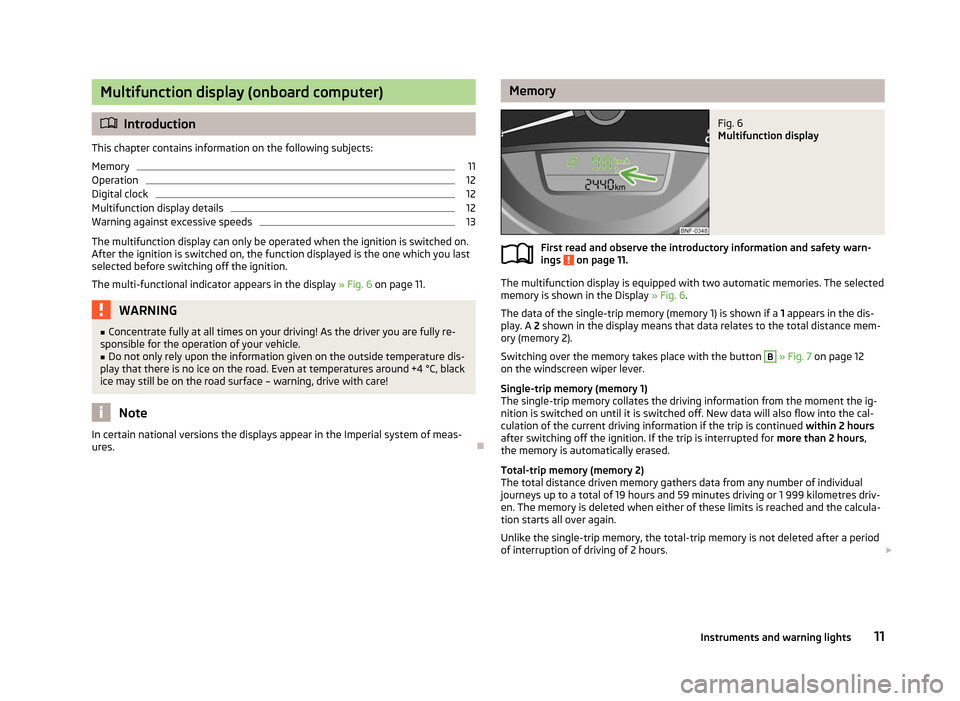
The multifunction display is equipped with two automatic memories. The selected
memory is shown in the Display » Fig. 6.
The data of the single-trip memory (memory 1) is shown if a 1 appears in the dis-
play. A 2 shown in the display means that data relates to the total distance mem-
ory (memory
2).
Switching over the memory takes place with the button B
» Fig. 7 on page 12
on the windscreen wiper lever.
Single-trip memory (memory 1)
The single-trip memory collates the driving information from the moment the ig-
nition is switched on until it is switched off. New data will also flow into the cal-
culation of the current driving information if the trip is continued within 2 hours
after switching off the ignition. If the trip is interrupted for more than 2 hours,
the memory is automatically erased.
Total-trip memory (memory 2)
The total distance driven memory gathers data from any number of individual
journeys up to a total of 19 hours and 59
minutes driving or 1 999 kilometres driv-
en. The memory is deleted when either of these limits is reached and the calcula-
tion starts all over again.
Unlike the single-trip memory, the total-trip memory is not deleted after a period
of interruption of driving of 2 hours. £
ä
11
Instruments and warning lights
Page 16 of 157
If you wish to change the set speed limit, it is changed in 5 km/h intervals (e.g. the
accepted speed of 47
km/h increases to 50 km/h or decreases to 45 km/h).
› Confirm the speed limit that was set by pressing button B
again, or wait ap-
prox. 5 seconds until the setting is saved automatically (the value stops flash-
ing).
Change or delete speed limit
› With button A
» Fig. 7
on page 12, choose the menu point Warning against ex-
cessive speeds .
› Pressing the button B
deletes the speed limit.
› Pressing the button B
activates the ability to change the speed limit.
If the set speed limit is exceeded, an audible signal will sound as a warning. At
the same time the message Warning against excessive speeds appears on the
display with the set limit value.
The set speed limit value remains stored even after switching off the ignition. ÐWarning lights
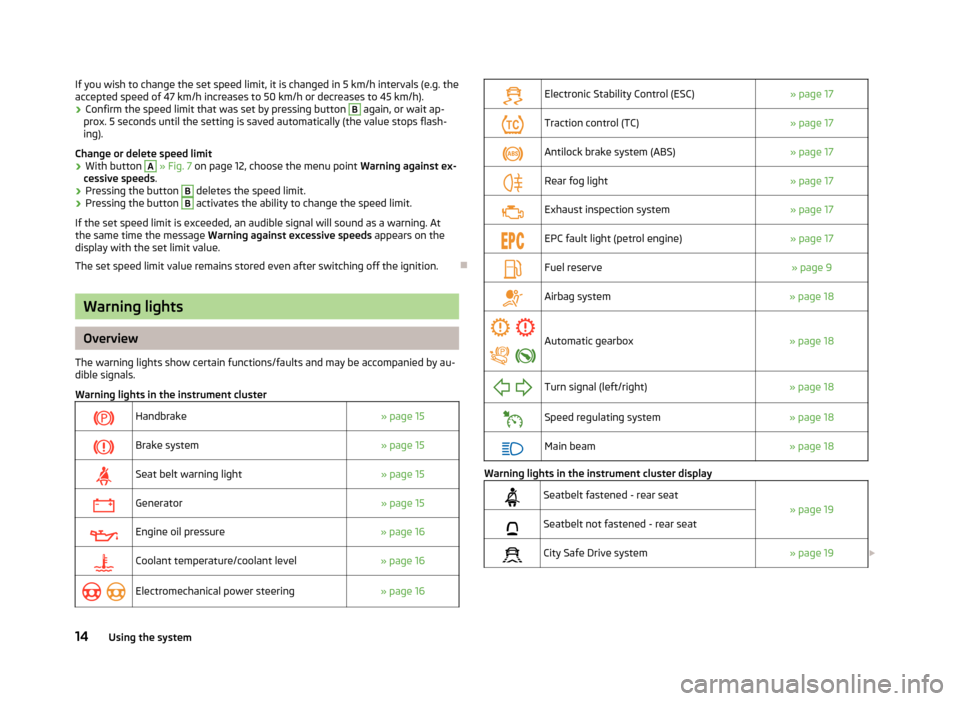
Overview
The warning lights show certain functions/faults and may be accompanied by au-
dible signals.
Warning lights in the instrument cluster
Handbrake
» page 15
Brake system
» page 15
Seat belt warning light
» page 15
Generator
» page 15
Engine oil pressure
» page 16
Coolant temperature/coolant level
» page 16
Electromechanical power steering
» page 16
Electronic Stability Control (ESC)
» page 17
Traction control (TC)
» page 17
Antilock brake system (ABS)
» page 17
Rear fog light
» page 17
Exhaust inspection system
» page 17
EPC fault light (petrol engine)
» page 17
Fuel reserve
» page 9
Airbag system
» page 18
Automatic gearbox
» page 18
Turn signal (left/right)
» page 18
Speed regulating system
» page 18
Main beam
» page 18 Warning lights in the instrument cluster display
Seatbelt fastened - rear seat
» page 19
Seatbelt not fastened - rear seat
City Safe Drive system
» page 19£14
Using the system
Page 17 of 157
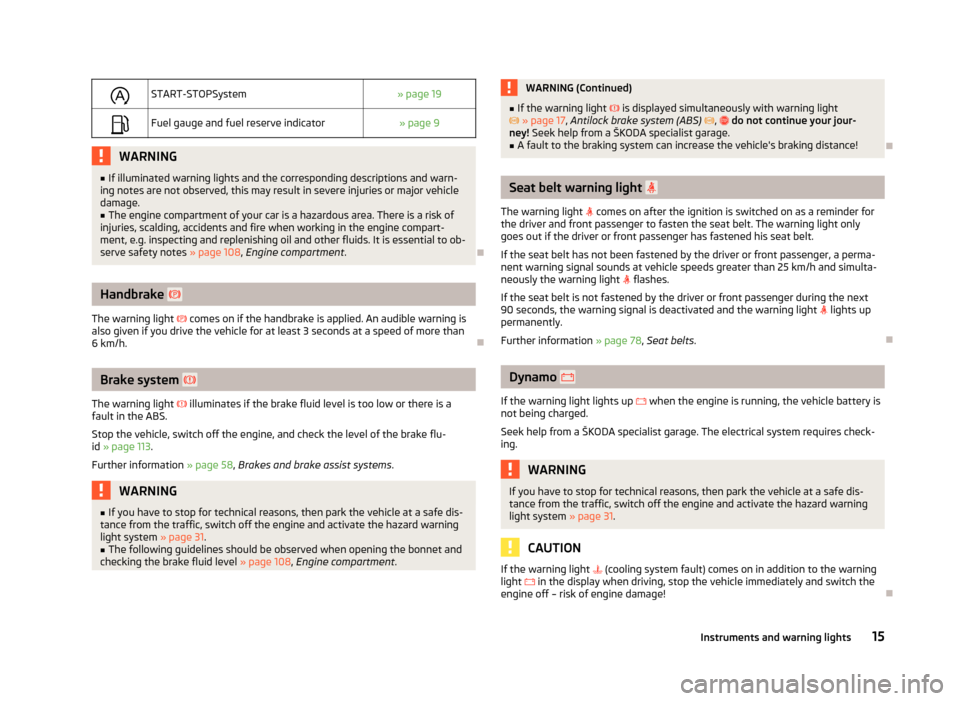
START-STOPSystem
» page 19
Fuel gauge and fuel reserve indicator
» page 9WARNING
■ If illuminated warning lights and the corresponding descriptions and warn-
ing notes are not observed, this may result in severe injuries or major vehicle
damage.
■ The engine compartment of your car is a hazardous area. There is a risk of
injuries, scalding, accidents and fire when working in the engine compart-
ment, e.g. inspecting and replenishing oil and other fluids. It is essential to ob-
serve safety notes »
page 108, Engine compartment . ÐHandbrake
The warning light comes on if the handbrake is applied. An audible warning is
also given if you drive the vehicle for at least 3
seconds at a speed of more than
6 km/h. ÐBrake system
The warning light illuminates if the brake fluid level is too low or there is a
fault in the ABS.
Stop the vehicle, switch off the engine, and check the level of the brake flu-
id » page 113.
Further information » page 58, Brakes and brake assist systems. WARNING
■ If you have to stop for technical reasons, then park the vehicle at a safe dis-
tance from the traffic, switch off the engine and activate the hazard warning
light system » page 31.
■ The following guidelines should be observed when opening the bonnet and
checking the brake fluid level » page 108, Engine compartment . WARNING (Continued)
■ If the warning light is displayed simultaneously with warning light
» page 17, Antilock brake system (ABS) , do not continue your jour-
ney! Seek help from a
ŠKODA specialist garage.
■ A fault to the braking system can increase the vehicle's braking distance! Ð Seat belt warning light
The warning light comes on after the ignition is switched on as a reminder for
the driver and front passenger to fasten the seat belt. The warning light only
goes out if the driver or front passenger has fastened his seat belt.
If the seat belt has not been fastened by the driver or front passenger, a perma-
nent warning signal sounds at vehicle speeds greater than 25
km/h and simulta-
neously the warning light flashes.
If the seat belt is not fastened by the driver or front passenger during the next
90 seconds, the warning signal is deactivated and the warning light lights up
permanently.
Further information » page 78, Seat belts. Ð Dynamo
If the warning light lights up when the engine is running, the vehicle battery is
not being charged.
Seek help from a ŠKODA
specialist garage. The electrical system requires check-
ing. WARNING
If you have to stop for technical reasons, then park the vehicle at a safe dis-
tance from the traffic, switch off the engine and activate the hazard warning
light system » page 31. CAUTION
If the warning light (cooling system fault) comes on in addition to the warning
light in the display when driving, stop the vehicle immediately and switch the
engine off – risk of engine damage! Ð
15
Instruments and warning lights
Page 18 of 157
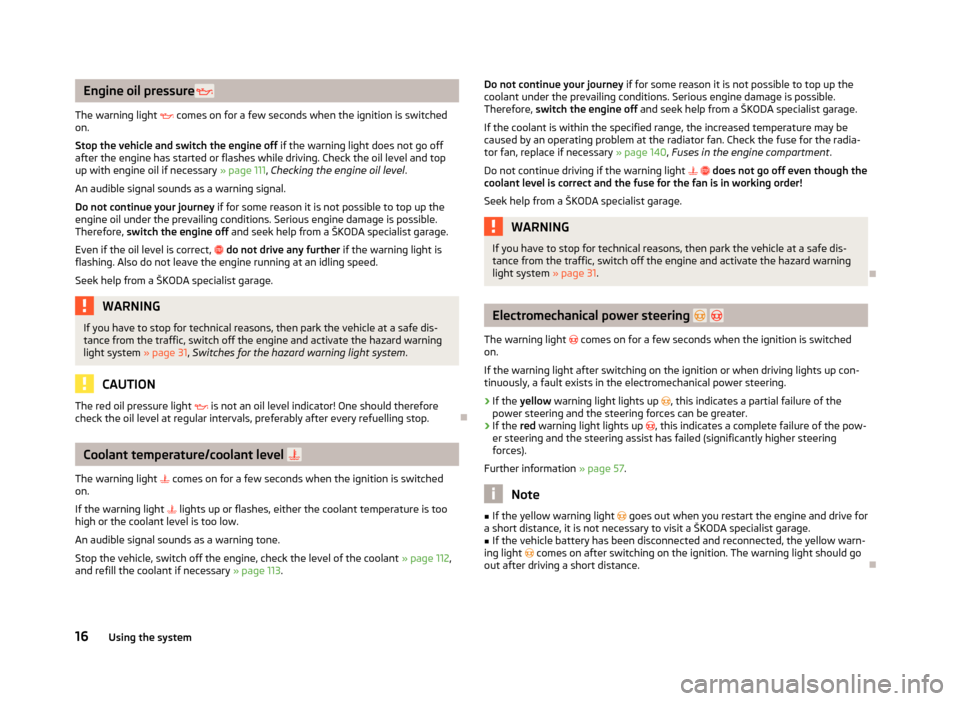
Engine oil pressure
The warning light comes on for a few seconds when the ignition is switched
on.
Stop the vehicle and switch the engine off if the warning light does not go off
after the engine has started or flashes while driving. Check the oil level and top
up with engine oil if necessary » page 111, Checking the engine oil level .
An audible signal sounds as a warning signal.
Do not continue your journey if for some reason it is not possible to top up the
engine oil under the prevailing conditions. Serious engine damage is possible.
Therefore, switch the engine off and seek help from a
ŠKODA specialist garage.
Even if the oil level is correct, do not drive any further if the warning light is
flashing. Also do not leave the engine running at an idling speed.
Seek help from a ŠKODA specialist garage. WARNING
If you have to stop for technical reasons, then park the vehicle at a safe dis-
tance from the traffic, switch off the engine and activate the hazard warning
light system » page 31, Switches for the hazard warning light system .CAUTION
The red oil pressure light is not an oil level indicator! One should therefore
check the oil level at regular intervals, preferably after every refuelling stop. ÐCoolant temperature/coolant level
The warning light comes on for a few seconds when the ignition is switched
on.
If the warning light lights up or flashes, either the coolant temperature is too
high or the coolant level is too low.
An audible signal sounds as a warning tone.
Stop the vehicle, switch off the engine, check the level of the coolant » page 112,
and refill the coolant if necessary » page 113. Do not continue your journey
if for some reason it is not possible to top up the
coolant under the prevailing conditions. Serious engine damage is possible.
Therefore, switch the engine off and seek help from a
ŠKODA specialist garage.
If the coolant is within the specified range, the increased temperature may be
caused by an operating problem at the radiator fan. Check the fuse for the radia-
tor fan, replace if necessary » page 140, Fuses in the engine compartment .
Do not continue driving if the warning light does not go off even though the
coolant level is correct and the fuse for the fan is in working order!
Seek help from a ŠKODA specialist garage. WARNING
If you have to stop for technical reasons, then park the vehicle at a safe dis-
tance from the traffic, switch off the engine and activate the hazard warning
light system » page 31. Ð Electromechanical power steering
The warning light comes on for a few seconds when the ignition is switched
on.
If the warning light after switching on the ignition or when driving lights up con-
tinuously, a fault exists in the electromechanical power steering.
› If the
yellow warning light lights up , this indicates a partial failure of the
power steering and the steering forces can be greater.
› If the
red warning light lights up , this indicates a complete failure of the pow-
er steering and the steering assist has failed (significantly higher steering
forces).
Further information » page 57. Note
■ If the yellow warning light goes out when you restart the engine and drive for
a short distance, it is not necessary to visit a
ŠKODA specialist garage.
■ If the vehicle battery has been disconnected and reconnected, the yellow warn-
ing light comes on after switching on the ignition. The warning light should go
out after driving a short distance. Ð
16 Using the system
Page 19 of 157
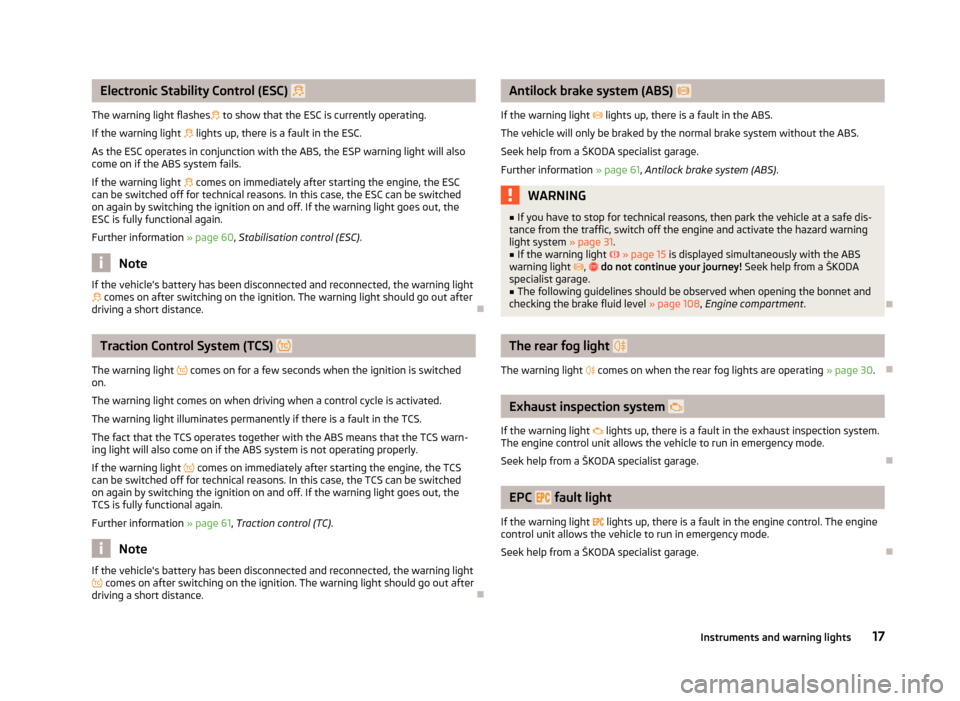
Electronic Stability Control (ESC)
The warning light flashes to show that the ESC is currently operating.
If the warning light lights up, there is a fault in the ESC.
As the ESC operates in conjunction with the ABS, the ESP warning light will also
come on if the ABS system fails.
If the warning light comes on immediately after starting the engine, the ESC
can be switched off for technical reasons. In this case, the ESC can be switched
on again by switching the ignition on and off. If the warning light goes out, the
ESC is fully functional again.
Further information » page 60, Stabilisation control (ESC) .Note
If the vehicle's battery has been disconnected and reconnected, the warning light comes on after switching on the ignition. The warning light should go out after
driving a short distance. ÐTraction Control System (TCS)
The warning light comes on for a few seconds when the ignition is switched
on.
The warning light comes on when driving when a control cycle is activated.
The warning light illuminates permanently if there is a fault in the TCS.
The fact that the TCS operates together with the ABS means that the TCS warn-
ing light will also come on if the ABS system is not operating properly.
If the warning light
comes on immediately after starting the engine, the TCS
can be switched off for technical reasons. In this case, the TCS can be switched
on again by switching the ignition on and off. If the warning light goes out, the
TCS is fully functional again.
Further information » page 61, Traction control (TC) .Note
If the vehicle's battery has been disconnected and reconnected, the warning light comes on after switching on the ignition. The warning light should go out after
driving a short distance. Ð Antilock brake system (ABS)
If the warning light lights up, there is a fault in the ABS.
The vehicle will only be braked by the normal brake system without the ABS.
Seek help from a
ŠKODA specialist garage.
Further information » page 61, Antilock brake system (ABS) . WARNING
■ If you have to stop for technical reasons, then park the vehicle at a safe dis-
tance from the traffic, switch off the engine and activate the hazard warning
light system » page 31.
■ If the warning light » page 15 is displayed simultaneously with the ABS
warning light , do not continue your journey! Seek help from a
ŠKODA
specialist garage. ■ The following guidelines should be observed when opening the bonnet and
checking the brake fluid level » page 108, Engine compartment .Ð The rear fog light
The warning light comes on when the rear fog lights are operating » page 30.Ð Exhaust inspection system
If the warning light lights up, there is a fault in the exhaust inspection system.
The engine control unit allows the vehicle to run in emergency mode.
Seek help from a
ŠKODA specialist garage. Ð EPC
fault light
If the warning light
lights up, there is a fault in the engine control. The engine
control unit allows the vehicle to run in emergency mode.
Seek help from a ŠKODA specialist garage. Ð
17
Instruments and warning lights
Page 20 of 157
Airbag system
Monitoring the airbag system
The warning light comes on for a few seconds when the ignition is switched
on.
There is a fault in the system if the warning light does not go out or flashes while
driving » . This also applies if the warning light does not come on when the ig-
nition is switched on.
The functionality of the airbag system is also monitored electronically when one
airbag has been switched off.
The following situation applies if the front or side airbag or belt tensioner have
been switched off using the vehicle system tester:
› The warning light
lights up for around 4
seconds after switching on the igni-
tion and then flashes approximately another 12 seconds in 2 second intervals.
The following situation applies if the airbag has been switched off using the
key switch for the airbag in the front passenger storage compartment:
› The warning light
comes on for a few seconds when the ignition is switched
on;
› The deactivated airbag is indicated by the illumination of the warning light
in the middle of the dash panel » page 86, Key switch for
the front seat passenger airbag. WARNING
If there is a fault, have the airbag system checked immediately by a ŠKODA
specialist garage. Otherwise, there is a risk of the airbag not being activated in
the event of an accident. ÐAutomatic gearbox
Warning light
Do not continue your journey if the warning light lights up and an acoustic sig-
nal sounds. Switch off the engine and seek assistance from a
ŠKODA specialist
garage.
Warning light
If the warning light lights up and no gear can be selected, switch the ignition
on and off. If the warning light lights up after you switch on the ignition, seek as-
sistance from a ŠKODA specialist garage. If the warning light
or warning light lights up and an acoustic signal sounds,
this means that the automatic gearbox has overheated. Stop and allow the trans-
mission to cool down or drive more quickly than 20
km/h (12 mph).
If the warning light lights up again, switch off the vehicle, shut off the engine
and allow the gearbox to cool down.
Warning light
If the warning light lights up, operate the brake pedal.
Warning light
If the warning light lights up, operate the handbrake.
Further information » page 69, Automatic gearbox AGB . WARNING
If you have to stop for technical reasons, then park the vehicle at a safe dis-
tance from the traffic, switch off the engine and activate the hazard warning
light system » page 31. Ð Turn signal system
Either the left or right warning light flashes depending on the position of the
turn signal lever.
If a turn signal light fails, the warning light flashes at twice its normal rate.
Switching off the hazard warning light system is switched on will cause all of the
turn signal lights as well as both warning lights to flash.
Further information » page 31, Turn signal and main beam lever .Ð Speed regulating system
The warning light comes on when the cruise control is operating » page 63.Ð Main beam
The warning light comes on when the main beam or headlight flasher are se-
lected » page 29. Ð
18 Using the system
Page 21 of 157
Safety belt fastened/not fastened (belt status display) - Rear
seat
/
After switching on the ignition, the belt status warning lights up for the rear
seats in the instrument panel display for 30 seconds and indicates whether any
rear seat passengers have fastened their seat belts. The belt status indicator will
then light up when the passenger on the rear seat fastens or unfastens the seat
belt (when the ignition is switched on or during the journey).
If the warning light , is switched on, the passenger on the rear seat has their
seat belt on.
If the warning light , is switched on, the passenger on the rear seat does not
have their seat belt on.
If a seat belt is unfastened on the rear seat during the journey at a speed of more
than 25
km/h, an acoustic signal will sound, and the belt status indicator for the
rear seats will flash for around 30 seconds.
Further information » page 78, Seat belts. ÐCity Safe Drive
If the City Safe Drive system is currently slowing the vehicle down automatically,
the warning light will flash quickly .
If the
City Safe Drive system is not currently available, or if there is a system fault,
the warning light will flash slowly .
When the City Safe Drive system is switched off while the vehicle is travelling at a
speed between 5–30 km/h (3-19 mph), the warning light will light up in the
instrument cluster display.
If the City Safe Drive system is switched on, the warning light in the instrument
cluster display will light up for around 5 seconds.
Further information » page 66, City Safe Drive. ÐSTART STOP
If the START STOP system is active, the warning light will light up .
If the
START STOP system is active, but automatic engine shut down is not possi-
ble, the warning light will light up . When the warning light flashes
the
START STOP system will not be available.
Further information » page 65, START/STOP . Ð 19
Instruments and warning lights