Temp SKODA CITIGO 2013 1.G Service Manual
[x] Cancel search | Manufacturer: SKODA, Model Year: 2013, Model line: CITIGO, Model: SKODA CITIGO 2013 1.GPages: 176, PDF Size: 10.54 MB
Page 134 of 176
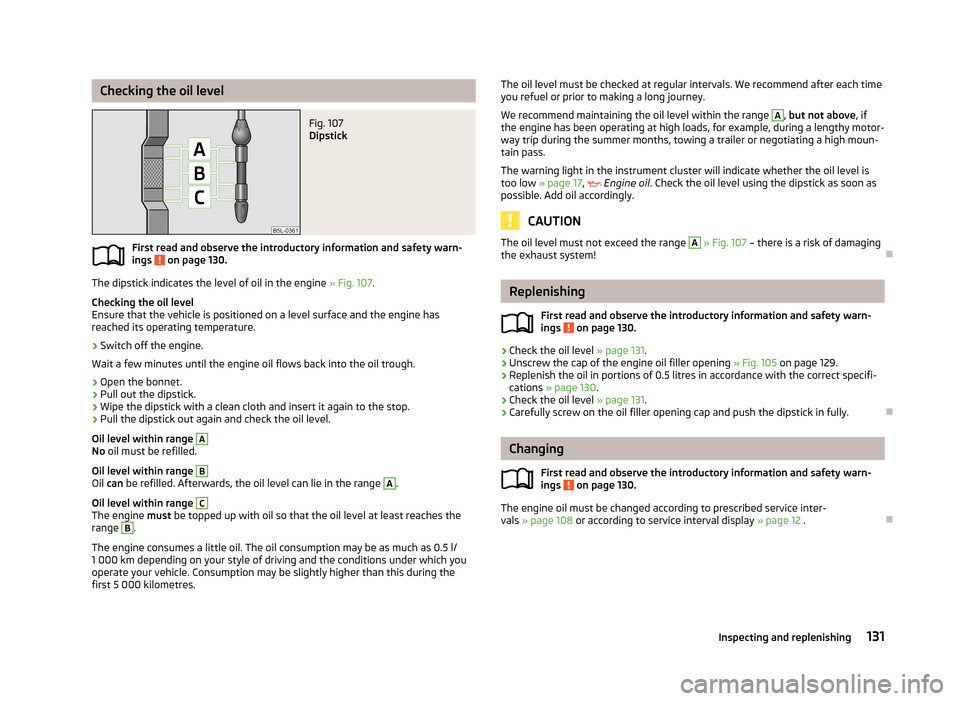
Checking the oil levelFig. 107
Dipstick
First read and observe the introductory information and safety warn-
ings on page 130.
The dipstick indicates the level of oil in the engine » Fig. 107.
Checking the oil level
Ensure that the vehicle is positioned on a level surface and the engine has reached its operating temperature.
›
Switch off the engine.
Wait a few minutes until the engine oil flows back into the oil trough.
›
Open the bonnet.
›
Pull out the dipstick.
›
Wipe the dipstick with a clean cloth and insert it again to the stop.
›
Pull the dipstick out again and check the oil level.
Oil level within range
A
No oil must be refilled.
Oil level within range
B
Oil can be refilled. Afterwards, the oil level can lie in the range
A
.
Oil level within range
C
The engine must be topped up with oil so that the oil level at least reaches the
range
B
.
The engine consumes a little oil. The oil consumption may be as much as 0.5 l/
1 000 km depending on your style of driving and the conditions under which you
operate your vehicle. Consumption may be slightly higher than this during the
first 5 000 kilometres.
The oil level must be checked at regular intervals. We recommend after each time
you refuel or prior to making a long journey.
We recommend maintaining the oil level within the range A
, but not above , if
the engine has been operating at high loads, for example, during a lengthy motor-
way trip during the summer months, towing a trailer or negotiating a high moun- tain pass.
The warning light in the instrument cluster will indicate whether the oil level is too low » page 17 , Engine oil . Check the oil level using the dipstick as soon as
possible. Add oil accordingly.
CAUTION
The oil level must not exceed the range A » Fig. 107 – there is a risk of damaging
the exhaust system!
Replenishing
First read and observe the introductory information and safety warn-
ings
on page 130.
›
Check the oil level » page 131.
›
Unscrew the cap of the engine oil filler opening » Fig. 105 on page 129.
›
Replenish the oil in portions of 0.5 litres in accordance with the correct specifi-
cations » page 130 .
›
Check the oil level » page 131.
›
Carefully screw on the oil filler opening cap and push the dipstick in fully.
Changing
First read and observe the introductory information and safety warn-ings
on page 130.
The engine oil must be changed according to prescribed service inter-
vals » page 108 or according to service interval display » page 12 .
131Inspecting and replenishing
Page 139 of 176
Air bubbles can influence the colour of the indicator. For this reason carefully
knock on the indicator before carrying out the check.
› Black colour – electrolyte level is correct.
› Colourless or light yellow colour – electrolyte level too low, the battery must be
replaced.
Vehicles with a START-STOP system are fitted with a battery control unit for checking the energy level for the recurring engine start.
We recommend that you have the acid level checked regularly by a specialist ga-
rage, especially in the following cases.
› High external temperatures.
› Longer day trips.
› After each charge.
CAUTION
For technical reasons, on vehicles with the description “AGM”, the electrolyte lev-
el cannot be checked.
Note
The battery acid level is also checked regularly by a specialist garage as part of
the inspection service.
Operation in winter
First read and observe the introductory information and safety warn-
ings
on page 134.
The vehicle battery only has a proportion of the starting power in lower tempera-
tures. A discharged vehicle battery may already freeze at temperatures just be-
low 0 °C .
We therefore recommend that you have the battery checked and, if necessary, re-
charged by a specialist garage before the start of the winter.
Charging
First read and observe the introductory information and safety warn-ings
on page 134.
A properly charged vehicle battery is essential for reliably starting the engine.
› Switch off the ignition and all of the electrical components.›Only when performing a “quick-charge”, disconnect both battery cables (first
“negative”, then “positive”).›
Attach the terminal clamps of the charger to the battery terminals (red = “posi- tive”, black = “negative”).
›
Plug the mains cable of the charger into the power socket and switch on thedevice.
›
After charging has been successful: Switch off the charger and remove themains cable from the power socket.
›
Only then disconnect the charger's terminal clamps.
›
Reconnect the cables to the battery (first “positive”, then “negative”).
It is not necessary to disconnect the cables of the battery if you recharge the ve-
hicle battery using low amperages (for example from a mini-charger). Refer to the
instructions of the charger manufacturer .
A charging current of 0.1 multiple of the total vehicle battery capacity (or lower) must be used until full charging is achieved.
It is necessary to disconnect both cables before charging the battery with high
amperages, known as “ rapid charging”.
The vent plugs of the vehicle battery should not be opened for charging.
WARNING“Quick-charging” the vehicle battery is dangerous and requires a special
charger and specialist knowledge.
CAUTION
On vehicles with the START/STOP system, the pole terminal of the charger must
not be connected directly to the negative terminal of the vehicle battery, but only
to the engine earth » page 152, Jump-starting in vehicles with the START-STOP
system .
Note
We therefore recommend that vehicle batteries be rapid charged by a specialist
garage.
136General Maintenance
Page 141 of 176
Wheels
Tyres and wheel rims
Introduction
This chapter contains information on the following subjects:
Service life of tyres
139
New tyres
140
Unidirectional tyres
141
Spare wheel
141
Full wheel trim
142
Wheel bolts
142
Wheel bolts
143WARNING■ The national legal regulations must be observed for the use of tyres.■Observe the national legal regulations relating to the use of snow chains
and the maximum vehicle speed with snow chains.WARNINGThe following instructions for the use of tyres must be observed.■For the first 500 km, new tyres do not yet provide optimum grip, and appro-
priate care should therefore be taken when driving – risk of accident!■
Only use radial tyres of the same type, size (rolling circumference) and tread
pattern on all four wheels.
■
For reasons of driving safety, do not replace tyres individually.
■
Never exceed the maximum permissible load bearing capacity for fitted
tyres – risk of accident!
■
Never exceed the maximum permissible speed for fitted tyres – risk of acci-
dent!
■
Incorrect wheel alignment at the front or rear impairs handling – risk of acci-
dent!
WARNING (Continued)■ Unusual vibrations or pulling of the vehicle to one side could be a sign of
tyre damage. If there is any doubt that a wheel is damaged, immediately re-
duce your speed and stop! If no external damage is evident, drive slowly and
carefully to the nearest specialist garage to have the vehicle checked.■
Only use tyres or wheel rims that have been approved by ŠKODA for your
model of vehicle. Failure to observe this instruction may impair the road safety
of your vehicle – risk of accident!
WARNINGObserve the following information regarding tyre damage and wear.■Never use tyres if you do not know anything about the condition and age.■
Never drive with damaged tyres – risk of accident!
■
Immediately replace damaged wheel rims or tyres.
■
You must have your tyres replaced with new ones at the latest when the
wear indicators have been worn down.
■
Worn tyres impair necessary adhesion to the road surface, particularly at
high speeds on wet roads. This could lead to “aquaplaning” (uncontrolled ve- hicle movement – “swimming” on a wet road surface).
WARNINGObserve the following information regarding the tyre inflation pressure.■The tyre control display does not absolve the driver of the responsibility to
ensure the correct tyre inflation pressure. Check the tyre inflation pressure at
regular intervals.■
Insufficient or excessive inflation pressure impairs handling – risk of acci-
dent!
■
If the inflation pressure is too low, the tyre will have to overcome a higher
rolling resistance. This will cause a significant increase in the temperature of
the tyre, especially at higher speeds. This can result in tread separation and a
tyre blowout.
138General Maintenance
Page 144 of 176
545 kg
615 kg
630 kg
650 kg
Speed symbol
This indicates the maximum permissible vehicle speed with fitted tyres in each
category.
150 km/h
160 km/h
170 km/h
180 km/h
190 km/h
200 km/h
210 km/h
CAUTION
The information about the load index and the speed symbol is listed in your vehi-
cle documents.
Unidirectional tyres
First read and observe the introductory information and safety warn-
ings
on page 138.
The direction of rotation of the tyres is marked by arrows on the wall of the tyre.
The indicated direction of rotation must be adhered to in order to ensure the op- timal characteristics of these tyres.
These characteristics mainly relate to the following: › Increased driving stability.
› Reduced risk of aquaplaning.
› Reduced tyre noise and tyre wear.
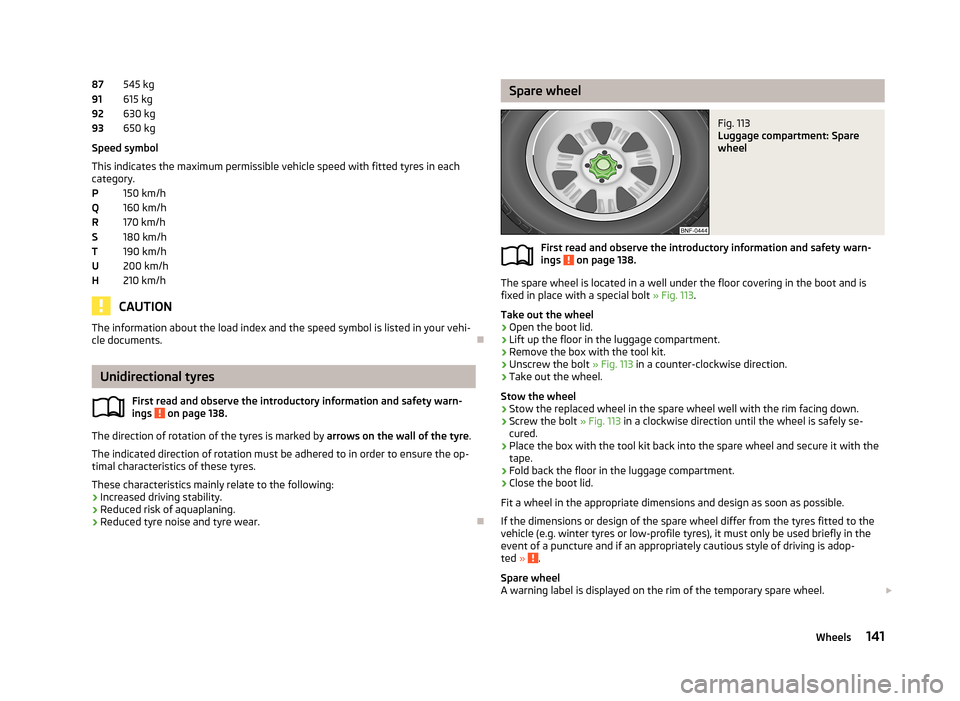
87919293PQRSTUHSpare wheelFig. 113
Luggage compartment: Spare
wheel
First read and observe the introductory information and safety warn-
ings on page 138.
The spare wheel is located in a well under the floor covering in the boot and is
fixed in place with a special bolt » Fig. 113.
Take out the wheel
›
Open the boot lid.
›
Lift up the floor in the luggage compartment.
›
Remove the box with the tool kit.
›
Unscrew the bolt » Fig. 113 in a counter-clockwise direction.
›
Take out the wheel.
Stow the wheel
›
Stow the replaced wheel in the spare wheel well with the rim facing down.
›
Screw the bolt » Fig. 113 in a clockwise direction until the wheel is safely se-
cured.
›
Place the box with the tool kit back into the spare wheel and secure it with the
tape.
›
Fold back the floor in the luggage compartment.
›
Close the boot lid.
Fit a wheel in the appropriate dimensions and design as soon as possible.
If the dimensions or design of the spare wheel differ from the tyres fitted to the
vehicle (e.g. winter tyres or low-profile tyres), it must only be used briefly in the
event of a puncture and if an appropriately cautious style of driving is adop-
ted »
.
Spare wheel
A warning label is displayed on the rim of the temporary spare wheel.
141Wheels
Page 145 of 176
Please note the following if you intend to use the temporary spare wheel.› The warning label must not be covered after installing the wheel.
› Be particularly observant when driving.
› The inflation pressure for the temporary spare wheel is identical to the maxi-
mum inflation pressure for the standard tyres.
› Only use this temporary spare wheel to reach the nearest specialist garage, as it
is not intended for long-term use.WARNING■ Never use the temporary spare wheel if it is damaged.■If the dimensions or design of the temporary spare wheel differ from the fit-
ted tyres, never drive faster than 80 km/h (or 50 mph).■
Avoid accelerating at full throttle, sharp braking and fast cornering.
CAUTION
Observe the instructions on the warning sign of the temporary spare wheel.
Full wheel trim
First read and observe the introductory information and safety warn-
ings
on page 138.
Pulling off
›
Hook the clamp found in the vehicle tool kit into the reinforced edge of the wheel trim.
›
Push the wheel wrench through the clamp, support on the tyre and pull off the
wheel trim.
Installing
›
Press the wheel trim onto the wheel rim at the designated valve opening.
›
Then press the trim into the wheel rim until its entire circumference locks cor- rectly in place.
CAUTION■ Use the pressure of your hand only, do not strike the full wheel trim. Avoid
heavy impacts when the trim has not yet been inserted into the wheel rim. This
could cause damage to the guide and centring elements of the trim.■
When using the anti-theft wheel bolt, ensure that it is in the hole in the valve
area » page 148 , Securing wheels against theft .
■
If wheel trims are retrofitted it must be ensured that an adequate flow of air is
assured to cool the brake system.
Wheel bolts
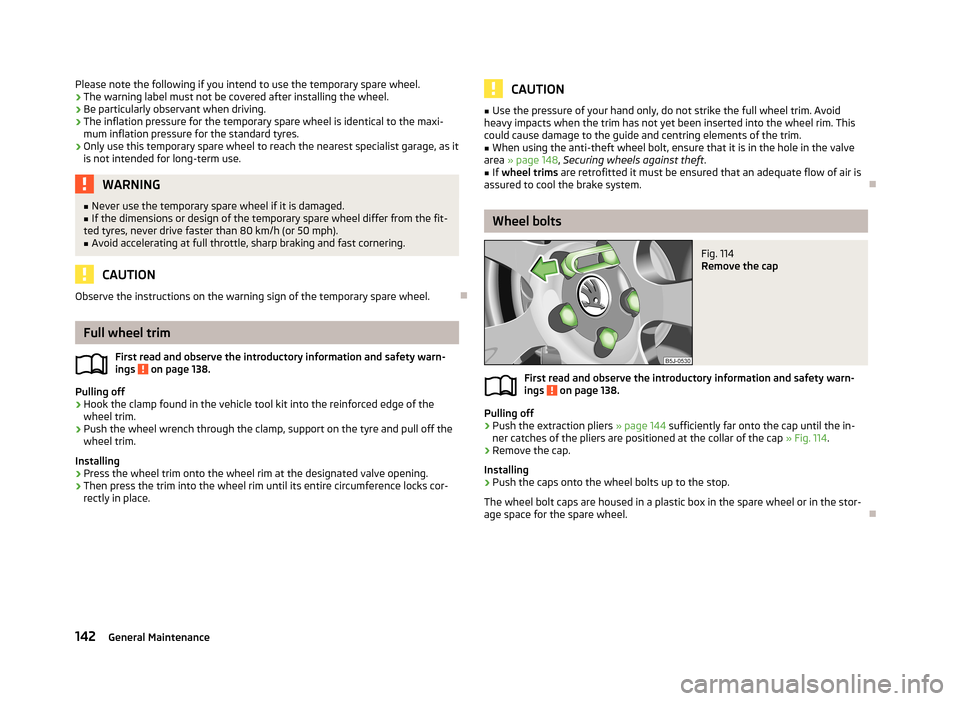
Fig. 114
Remove the cap
First read and observe the introductory information and safety warn-
ings on page 138.
Pulling off
›
Push the extraction pliers » page 144 sufficiently far onto the cap until the in-
ner catches of the pliers are positioned at the collar of the cap » Fig. 114.
›
Remove the cap.
Installing
›
Push the caps onto the wheel bolts up to the stop.
The wheel bolt caps are housed in a plastic box in the spare wheel or in the stor-
age space for the spare wheel.
142General Maintenance
Page 146 of 176
Wheel boltsFirst read and observe the introductory information and safety warn-ings
on page 138.
Wheels and wheel bolts are matched to each other in terms of design. Each time
you fit other wheels rims, e.g. light alloy wheel rims or wheels with winter tyres,
you must also use the matching wheel bolts with the correct length and dome
shape. The right fastening of wheels depends on this.
Winter operation
Introduction
This chapter contains information on the following subjects:
Winter tyres
143
Snow chains
143
Winter tyres
First read and observe the introductory information given on page 143.
Fitting winter tyres will significantly improve the handling of your vehicle when
driving in wintry road conditions. Summer tyres have less grip on ice, snow and at
temperatures below 7 °C. This is especially true of wide tyres or high-speed tyres .
In order to achieve the best possible handling properties, winter tyres must be fit-
ted on all 4 wheels, the minimum tread depth must be 4 mm and tyres must be
no older than 4 years.
Winter tyres of a lower speed category can be used provided that the permissible
maximum speed of these tyres is not exceeded even if the possible maximum speed of the vehicle is higher.
For the sake of the environmentFit the summer tyres on again in good time as they provide better handling prop-
erties, a shorter braking distance, less tyre noise, and reduced tyre wear on roadswhich are free of snow and ice as well as at temperatures above 7 °C. The fuel
consumption is also lower.
Snow chains
First read and observe the introductory information given on page 143.
When driving in wintry road conditions, snow chains improve not only traction,
but also the braking performance.
Snow chains must only be mounted on the front wheels.
For technical reasons, it is only permissible to fit snow chains with the following wheel/tyre combinations.
Tyre sizeRim165/70 R145J x 14 ET 35
Only fit snow chains with links and locks not larger than 15 mm.
Remove the full wheel trims before installing the snow chains.
CAUTION
■
The chains must be removed when driving on roads which are free of snow.
They adversely affect the handling of your vehicle, damage the tyres and are rap-
idly destroyed.■
Remove the full wheel trims before installing the snow chains.
143Wheels
Page 151 of 176
Securing wheels against theftFig. 119
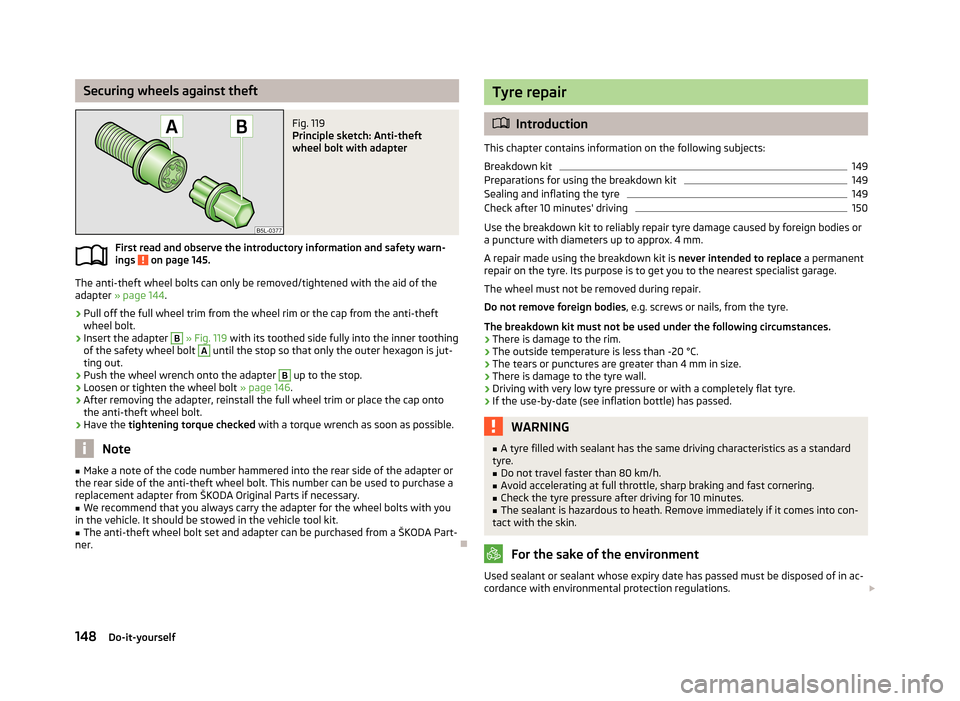
Principle sketch: Anti-theft
wheel bolt with adapter
First read and observe the introductory information and safety warn-
ings on page 145.
The anti-theft wheel bolts can only be removed/tightened with the aid of the
adapter » page 144 .
›
Pull off the full wheel trim from the wheel rim or the cap from the anti-theft
wheel bolt.
›
Insert the adapter
B
» Fig. 119 with its toothed side fully into the inner toothing
of the safety wheel bolt
A
until the stop so that only the outer hexagon is jut-
ting out.
›
Push the wheel wrench onto the adapter
B
up to the stop.
›
Loosen or tighten the wheel bolt » page 146.
›
After removing the adapter, reinstall the full wheel trim or place the cap onto
the anti-theft wheel bolt.
›
Have the tightening torque checked with a torque wrench as soon as possible.
Note
■
Make a note of the code number hammered into the rear side of the adapter or
the rear side of the anti-theft wheel bolt. This number can be used to purchase a
replacement adapter from ŠKODA Original Parts if necessary.■
We recommend that you always carry the adapter for the wheel bolts with you
in the vehicle. It should be stowed in the vehicle tool kit.
■
The anti-theft wheel bolt set and adapter can be purchased from a ŠKODA Part-
ner.
Tyre repair
Introduction
This chapter contains information on the following subjects:
Breakdown kit
149
Preparations for using the breakdown kit
149
Sealing and inflating the tyre
149
Check after 10 minutes' driving
150
Use the breakdown kit to reliably repair tyre damage caused by foreign bodies or
a puncture with diameters up to approx. 4 mm.
A repair made using the breakdown kit is never intended to replace a permanent
repair on the tyre. Its purpose is to get you to the nearest specialist garage.
The wheel must not be removed during repair.Do not remove foreign bodies , e.g. screws or nails, from the tyre.
The breakdown kit must not be used under the following circumstances. › There is damage to the rim.
› The outside temperature is less than -20 °C.
› The tears or punctures are greater than 4 mm in size.
› There is damage to the tyre wall.
› Driving with very low tyre pressure or with a completely flat tyre.
› If the use-by-date (see inflation bottle) has passed.
WARNING■
A tyre filled with sealant has the same driving characteristics as a standard
tyre.■
Do not travel faster than 80 km/h.
■
Avoid accelerating at full throttle, sharp braking and fast cornering.
■
Check the tyre pressure after driving for 10 minutes.
■
The sealant is hazardous to heath. Remove immediately if it comes into con-
tact with the skin.
For the sake of the environment
Used sealant or sealant whose expiry date has passed must be disposed of in ac- cordance with environmental protection regulations. 148Do-it-yourself
Page 154 of 176
WARNING■A discharged vehicle battery may already freeze at temperatures just below
0 °C. If the battery is frozen, do not jump start with the battery of another ve- hicle – there is a risk of explosion.■
Pay attention to the warning instructions relating to working in the engine
compartment » page 127, Engine compartment .
■
The non-insulated parts of the terminal clamps must never touch each other
– there is a risk of short circuit.
■
The jump-start cable connected to the positive terminal of the battery must
not come into contact with electrically conducting parts of the vehicle – there
is a risk of short circuit.
■
Do not clamp the jump-start cable to the negative terminal of the dis-
charged battery. There is the risk of detonating gas seeping out the battery
being ignited by the strong spark which results from the engine being started.
■
Route the jump-start cables so that they cannot be caught by any rotating
parts in the engine compartment.
■
Do not bend over the battery – there is a risk of caustic burns.
■
The vent screws of the battery cells must be tightened firmly.
■
Keep any sources of ignition (naked flame, lit cigarettes, etc.) away from the
battery – there is a risk of explosion.
■
Never jump-start vehicle batteries with insufficient acid levels – risk of ex-
plosion and chemical burns.
CAUTION
■ There must not be any contact between the two vehicles otherwise current
may flow as soon as the negative terminals are connected.■
The discharged battery must be properly connected to the system of the vehi-
cle.
■
We recommend you buy jump-start cables from a car battery specialist.
Jump-starting using the battery from another vehicleFig. 121
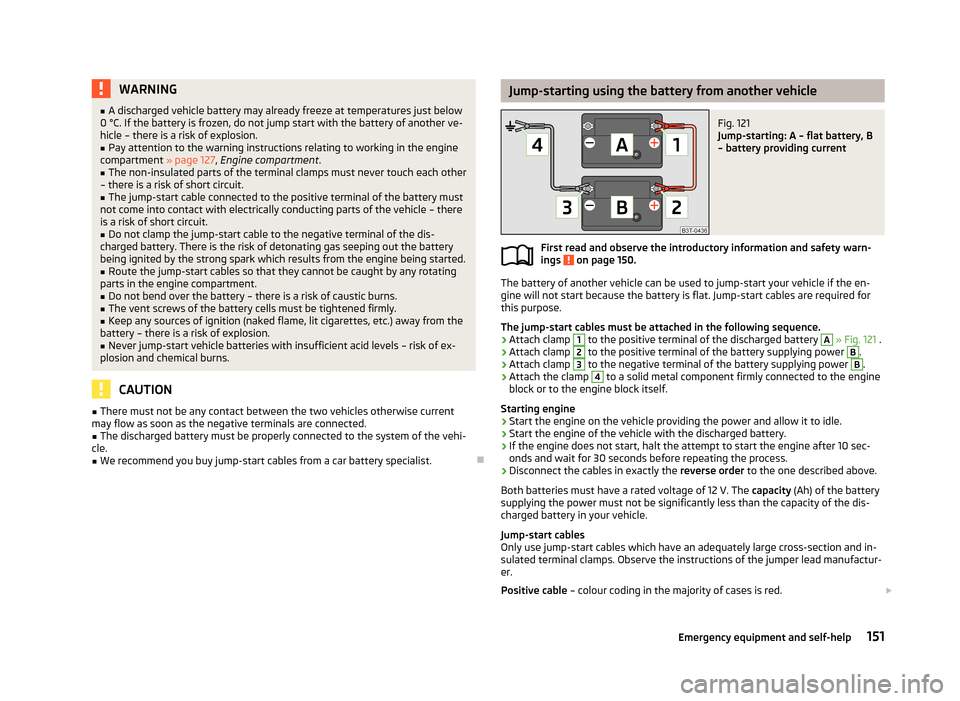
Jump-starting: A – flat battery, B
– battery providing current
First read and observe the introductory information and safety warn-
ings on page 150.
The battery of another vehicle can be used to jump-start your vehicle if the en-
gine will not start because the battery is flat. Jump-start cables are required for
this purpose.
The jump-start cables must be attached in the following sequence.
›
Attach clamp
1
to the positive terminal of the discharged battery
A
» Fig. 121 .
›
Attach clamp
2
to the positive terminal of the battery supplying power
B
.
›
Attach clamp
3
to the negative terminal of the battery supplying power
B
.
›
Attach the clamp
4
to a solid metal component firmly connected to the engine
block or to the engine block itself.
Starting engine
›
Start the engine on the vehicle providing the power and allow it to idle.
›
Start the engine of the vehicle with the discharged battery.
›
If the engine does not start, halt the attempt to start the engine after 10 sec- onds and wait for 30 seconds before repeating the process.
›
Disconnect the cables in exactly the reverse order
to the one described above.
Both batteries must have a rated voltage of 12 V. The capacity (Ah) of the battery
supplying the power must not be significantly less than the capacity of the dis-
charged battery in your vehicle.
Jump-start cables
Only use jump-start cables which have an adequately large cross-section and in-
sulated terminal clamps. Observe the instructions of the jumper lead manufactur-
er.
Positive cable – colour coding in the majority of cases is red.
151Emergency equipment and self-help
Page 155 of 176
Negative cable – colour coding in the majority of cases is black.
Jump-starting in vehicles with the START-STOP system
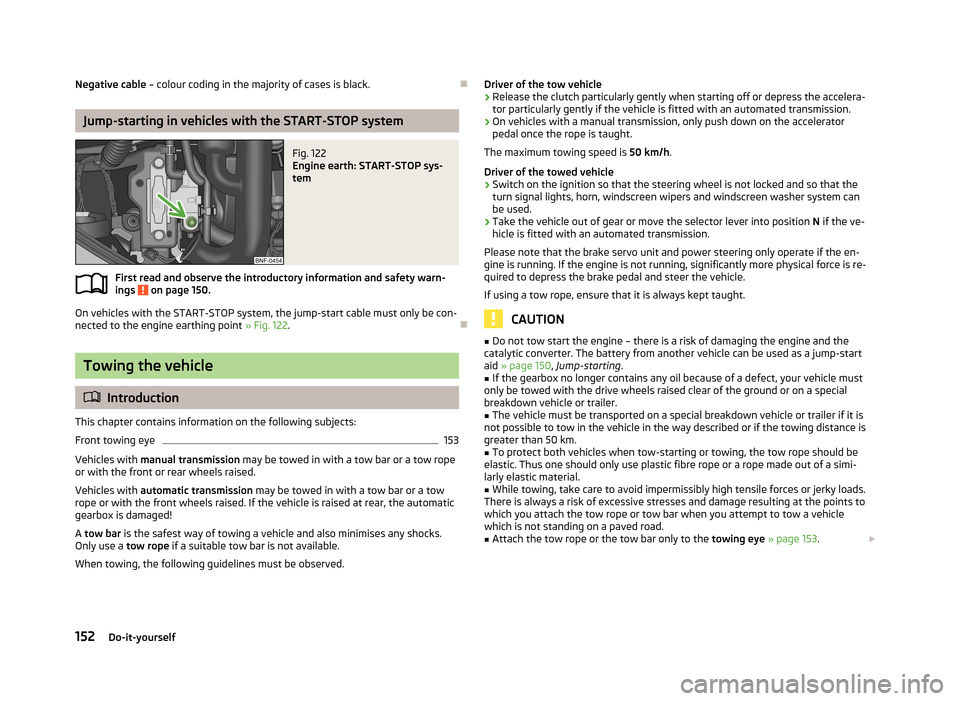
Fig. 122
Engine earth: START-STOP sys-
tem
First read and observe the introductory information and safety warn- ings on page 150.
On vehicles with the START-STOP system, the jump-start cable must only be con-
nected to the engine earthing point » Fig. 122.
Towing the vehicle
Introduction
This chapter contains information on the following subjects:
Front towing eye
153
Vehicles with manual transmission may be towed in with a tow bar or a tow rope
or with the front or rear wheels raised.
Vehicles with automatic transmission may be towed in with a tow bar or a tow
rope or with the front wheels raised. If the vehicle is raised at rear, the automatic
gearbox is damaged!
A tow bar is the safest way of towing a vehicle and also minimises any shocks.
Only use a tow rope if a suitable tow bar is not available.
When towing, the following guidelines must be observed.
Driver of the tow vehicle›Release the clutch particularly gently when starting off or depress the accelera-
tor particularly gently if the vehicle is fitted with an automated transmission.›
On vehicles with a manual transmission, only push down on the accelerator pedal once the rope is taught.
The maximum towing speed is 50 km/h.
Driver of the towed vehicle
›
Switch on the ignition so that the steering wheel is not locked and so that the turn signal lights, horn, windscreen wipers and windscreen washer system can
be used.
›
Take the vehicle out of gear or move the selector lever into position N if the ve-
hicle is fitted with an automated transmission.
Please note that the brake servo unit and power steering only operate if the en-
gine is running. If the engine is not running, significantly more physical force is re-
quired to depress the brake pedal and steer the vehicle.
If using a tow rope, ensure that it is always kept taught.
CAUTION
■ Do not tow start the engine – there is a risk of damaging the engine and the
catalytic converter. The battery from another vehicle can be used as a jump-start
aid » page 150 , Jump-starting .■
If the gearbox no longer contains any oil because of a defect, your vehicle must
only be towed with the drive wheels raised clear of the ground or on a special
breakdown vehicle or trailer.
■
The vehicle must be transported on a special breakdown vehicle or trailer if it is
not possible to tow in the vehicle in the way described or if the towing distance is greater than 50 km.
■
To protect both vehicles when tow-starting or towing, the tow rope should be
elastic. Thus one should only use plastic fibre rope or a rope made out of a simi-
larly elastic material.
■
While towing, take care to avoid impermissibly high tensile forces or jerky loads.
There is always a risk of excessive stresses and damage resulting at the points to
which you attach the tow rope or tow bar when you attempt to tow a vehicle which is not standing on a paved road.
■
Attach the tow rope or the tow bar only to the towing eye » page 153 .
152Do-it-yourself
Page 156 of 176
Note■We recommend using a tow rope from ŠKODA Original Accessories, which is
available from a ŠKODA Partner.■
Towing another vehicle requires a certain amount of practice. Both drivers
should be familiar with the particular points about towing a vehicle. Unskilled
drivers should not attempt to tow in another vehicle or to be towed in.
■
When towing, respect the national legal provisions, especially those which re-
late to the identification of the towing vehicle and the vehicle being towed.
■
The tow rope must not be twisted as it may in certain circumstances result in
the front towing eye being unscrewed out of your vehicle.
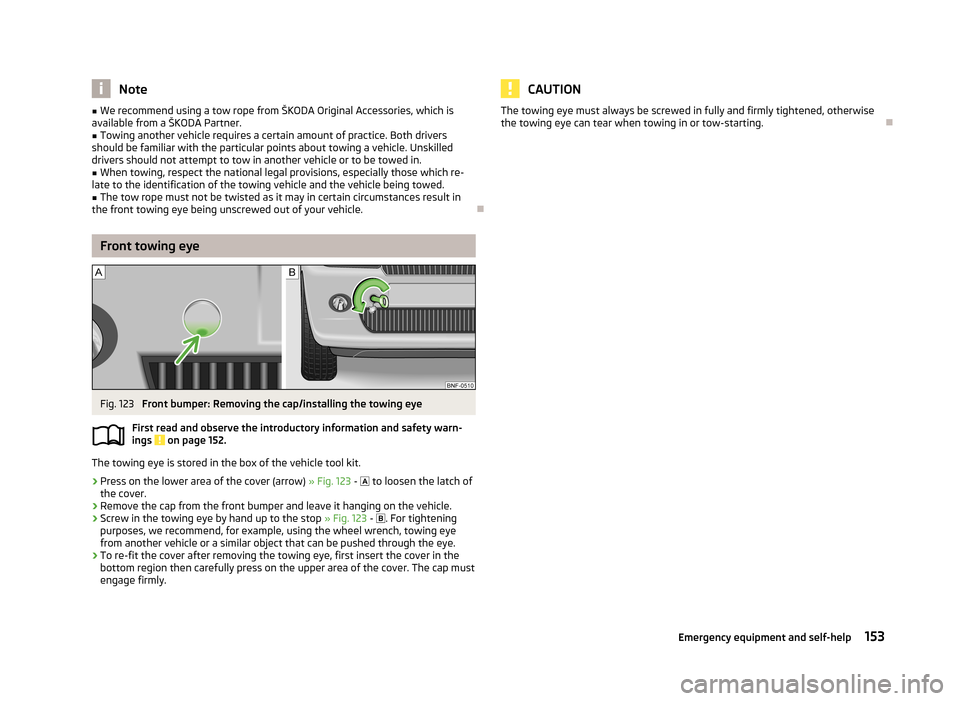
Front towing eye
Fig. 123
Front bumper: Removing the cap/installing the towing eye
First read and observe the introductory information and safety warn- ings
on page 152.
The towing eye is stored in the box of the vehicle tool kit.
›
Press on the lower area of the cover (arrow) » Fig. 123 -
to loosen the latch of
the cover.
›
Remove the cap from the front bumper and leave it hanging on the vehicle.
›
Screw in the towing eye by hand up to the stop » Fig. 123 -
. For tightening
purposes, we recommend, for example, using the wheel wrench, towing eye
from another vehicle or a similar object that can be pushed through the eye.
›
To re-fit the cover after removing the towing eye, first insert the cover in the
bottom region then carefully press on the upper area of the cover. The cap must
engage firmly.
CAUTIONThe towing eye must always be screwed in fully and firmly tightened, otherwise
the towing eye can tear when towing in or tow-starting.
153Emergency equipment and self-help