technical data SKODA FABIA 2006 2.G / 5J Owner's Manual
[x] Cancel search | Manufacturer: SKODA, Model Year: 2006, Model line: FABIA, Model: SKODA FABIA 2006 2.G / 5JPages: 258, PDF Size: 44.86 MB
Page 204 of 258
Inspecting and Replenishing203
Using the systemSafetyDriving TipsGeneral MaintenanceBreakdown assistanceTechnical Data
•Oil is toxic! Store old oil in a safe place out of the reach of children and unauthorized persons until you dispose of it properly.
Caution
You must not pour any additives into th e engine oil - risk of engine damage! Damage, which results from such product, are excluded from the warranty.
For the sake of the environment
•You must on no account pour oil into the ground or into the sewage system.
•In view of the problems involved in properly disposing of old oil, the mate- rial, equipment and the knowledge required for such work, we recommend that you have the oil and oil filter change ca rried out by your Škoda Service Partner.
Note
After your skin has come in contact with the oil, you must thoroughly wash your skin.
Cooling system
Coolant
The job of the coolant is to cool the engine.
The cooling system does not require an y maintenance under normal operating conditions. The coolan t consists of water with a concentration of coolant addi- tive of 40 %. This mixture not only provid es antifreeze protection down to -25°C but also protects the cooling and heat ing system from corrosion. It also
prevents the formation of scale and significantly increases the boiling point of the coolant.
You must therefore not reduce the concentration of antifreeze agent in the coolant by adding water, also not duri ng the summer months or in countries with a warm climate. The concentration of coolant additive in the coolant must be at least 40%.
You can increase the amount of antifreeze in the coolant if a higher concentra- tion of antifreeze is necessary for clim atic reasons but only up to 60% (anti- freeze protection down to approx. -40° C). The antifreeze protection tails off above that concentration.
Vehicles exported to co untries with a cold climate (e.g. Sweden, Norway, Finland) are already factory-filled with a coolant which offers antifreeze protec-tion down to about -35°C. In these countries the concentration of coolant addi- tive should be at least 50 %.
Coolant
The cooling system is filled at the works with coolant (purple in colour), which complies with the specification TL-VW 774 F.
We recommend that you use the antifreeze agent - G12 PLUS (purple in colour).
We recommend that you contact your Šk oda Service Partner if you have any questions regarding the coolant or if you wish to fill up with a different coolant.
Your Škoda Service Partner can also supp ly you with the correct coolant addi- tives.
Caution
•Other coolant additives may cause operational problems which, in particular, involves significantly reducing the anticorrosion effect.
•Any faults or problems resulting from corrosion may cause a loss of coolant and, as a consequence of th is, result in major engine damage.
WARNING (continued)
NKO A05Fabia 20.book Page 203 Tuesday, September 26, 2006 8:38 AM
Page 206 of 258
Inspecting and Replenishing205
Using the systemSafetyDriving TipsGeneral MaintenanceBreakdown assistanceTechnical Data
The coolant which you use for replenishing the system, must comply with one specific specification ⇒page 203, “Coolant”. Do not use an alternative additive if the coolant additive G12 PLUS is not available in exceptional cases. Just top up the system with water and as soon as possible arrange adjustment to correct the mixing ratio of water and coolant a dditive again by a specialist garage.
Only use fresh coolant for topping up the system.
Do not fill up over the “MAX” marking! Excess coolant which is heated up is forced out of the cooling system through the pressure relief valve in the cap of the coolant compensation bottle.
Wait until the engine has cooled down for a system which has suffered a major loss of coolant before pouring in cool ant. This is necessary to avoid engine damage.
WARNING
•The cooling system is pressurized! Do not open the cap of the coolant expansion bottle if the engine is still hot - risk of scalding!
•The coolant additive and thus all of the coolant is harmful to your health. Avoid contact with the coolan t. Coolant vapours are also harmful to the health. It is important, therefore, to always safely store any coolant additive in its original container out of the reach of children - risk of poisoning!
•If any splashes of coolant get into your eyes, rinse out your eyes immediately with clear water and cont act a doctor as soon as possible.
•You should also consult a doctor without delay if you have inadvert- ently swallowed coolant.
Caution
Do not continue your journey if for some reason it is not possible under the conditions prevailing to top up with coolant. Switch the engine off and obtain professional assistance from a specialist garage, otherwise it could lead to severe engine damage.
For the sake of the environment
Do not re-use coolant if it is necessary to drain the coolant in the system. It should be collected and disposed of in compliance with environmental protec- tion regulations.
Radiator fan
The radiator fan may switch on suddenly.
The radiator fan is driven by an electr ic motor and controlled by a thermostat according to the coolant temperature.
The radiator fan may continue running fo r up to 10 minutes after the engine has been switched off - even if the ignition is also off. It may also switch on suddenly after a certain time, if:
•the coolant temperature has risen beca use of an accumulation of heat or
•the warm engine compartment is heated up additionally by strong sunlight.
WARNING
You must therefore be aware when working in the engine compartment that the fan may switch on suddenly - risk of injury!
NKO A05Fabia 20.book Page 205 Tuesday, September 26, 2006 8:38 AM
Page 208 of 258
Inspecting and Replenishing207
Using the systemSafetyDriving TipsGeneral MaintenanceBreakdown assistanceTechnical Data
WARNING
•Using old brake fluid can result in severe stress on the brakes because of the formation of vapour bubbles in the brake system. This greatly impairs the braking efficiency and thus also the safety of your vehicle.
•Brake fluid is toxic! It must therefore be kept safely in closed original containers and well away from children and unauthorized persons.
Caution
Brake fluid damages the paintwork of the vehicle.
For the sake of the environment
In view of the problems involved with prop er disposal of brake fluid, the special tools and the professional knowledge required, we recommend you have the brake fluid replaced by a Škoda Service Partner.
Battery
Working on the battery
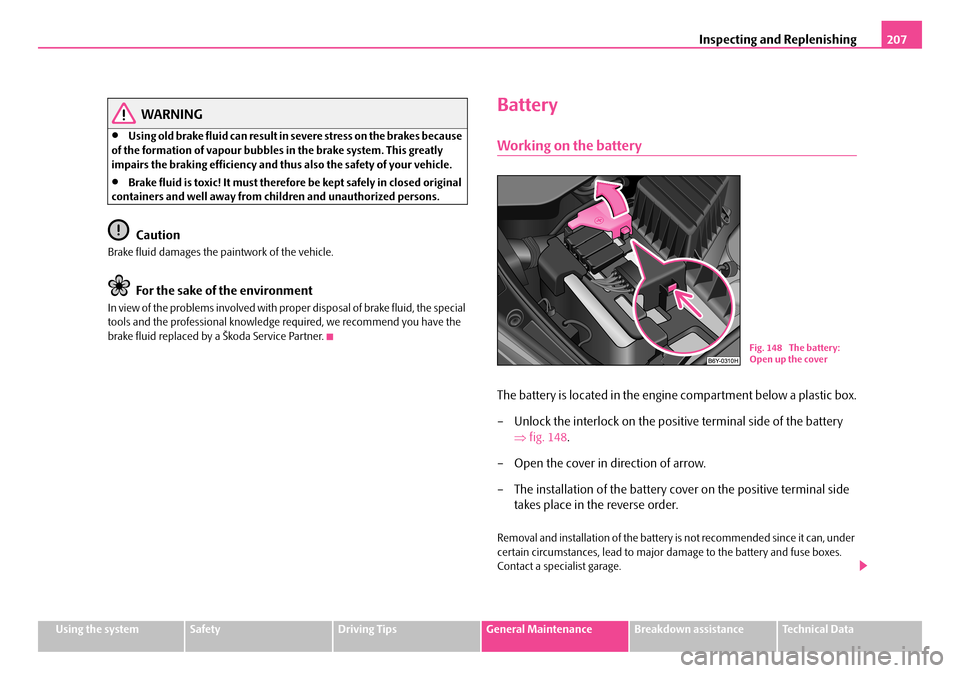
The battery is located in the engine compartment below a plastic box.
– Unlock the interlock on the positi ve terminal side of the battery
⇒ fig. 148.
– Open the cover in direction of arrow.
– The installation of the battery co ver on the positive terminal side
takes place in the reverse order.
Removal and installation of the battery is not recommended since it can, under certain circumstances, lead to major da mage to the battery and fuse boxes. Contact a specialist garage.
Fig. 148 The battery: Open up the cover
NKO A05Fabia 20.book Page 207 Tuesday, September 26, 2006 8:38 AM
Page 210 of 258
Inspecting and Replenishing209
Using the systemSafetyDriving TipsGeneral MaintenanceBreakdown assistanceTechnical Data
Note
•Please also refer to the guidelines ⇒page 210, “Disconnecting and recon- necting the battery”, also after connecting the battery.
Battery with a charge level in dicator, the so-called magic
eye*
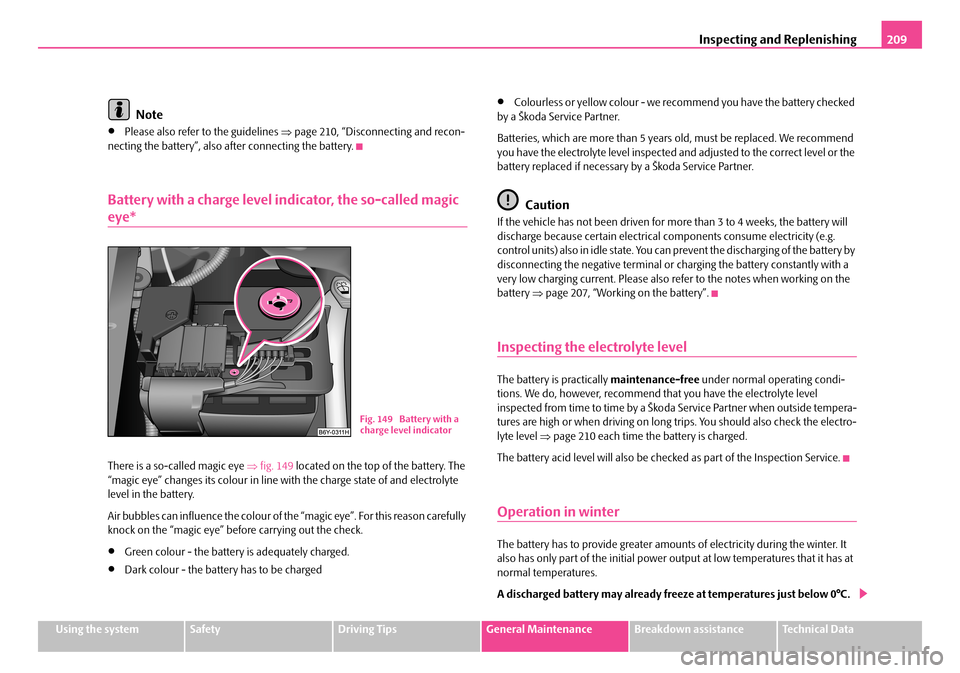
There is a so-called magic eye ⇒fig. 149 located on the top of the battery. The “magic eye” changes its colour in line with the charge state of and electrolyte level in the battery.
Air bubbles can influence the colour of the “magic eye”. For this reason carefully knock on the “magic eye” before carrying out the check.
•Green colour - the battery is adequately charged.
•Dark colour - the battery has to be charged
•Colourless or yellow colour - we recommend you have the battery checked by a Škoda Service Partner.
Batteries, which are more than 5 years old, must be replaced. We recommend you have the electrolyte level inspected and adjusted to the correct level or the battery replaced if necessary by a Škoda Service Partner.
Caution
If the vehicle has not been driven for more than 3 to 4 weeks, the battery will discharge because certain electrical components consume electricity (e.g. control units) also in idle state. You can prevent the discharging of the battery by disconnecting the negative terminal or charging the battery constantly with a very low charging current. Please also refer to the notes when working on the battery ⇒page 207, “Working on the battery”.
Inspecting the electrolyte level
The battery is practically maintenance-free under normal operating condi- tions. We do, however, recommend th at you have the electrolyte level inspected from time to time by a Škod a Service Partner when outside tempera- tures are high or when driving on long trips. You should also check the electro- lyte level ⇒page 210 each time the battery is charged.
The battery acid level will also be chec ked as part of the Inspection Service.
Operation in winter
The battery has to provide greater amounts of electricity during the winter. It also has only part of the initial power ou tput at low temperatures that it has at normal temperatures.
A discharged battery may already freez e at temperatures just below 0°C.
Fig. 149 Battery with a charge level indicator
NKO A05Fabia 20.book Page 209 Tuesday, September 26, 2006 8:38 AM
Page 212 of 258
Inspecting and Replenishing211
Using the systemSafetyDriving TipsGeneral MaintenanceBreakdown assistanceTechnical Data
We recommend having the vehicle checked by a Škoda Service Partner to ensure full functionality of all electrical systems.
Replacing the battery
You should only replace a battery with a new battery of the same capacity, voltage (12 V), amperage and of the same size. Škoda Service Partners have a range of suitable batteries available.
We recommend that you only have an ol d battery disposed of by your Škoda Service Partner since it does require special disposal.
For the sake of the environment
Batteries contain poisonous substances su ch as sulphuric acid and lead. They must be disposed of in accordance with local environmental protection regula- tions and on no account as domestic waste.
Windshield washer system
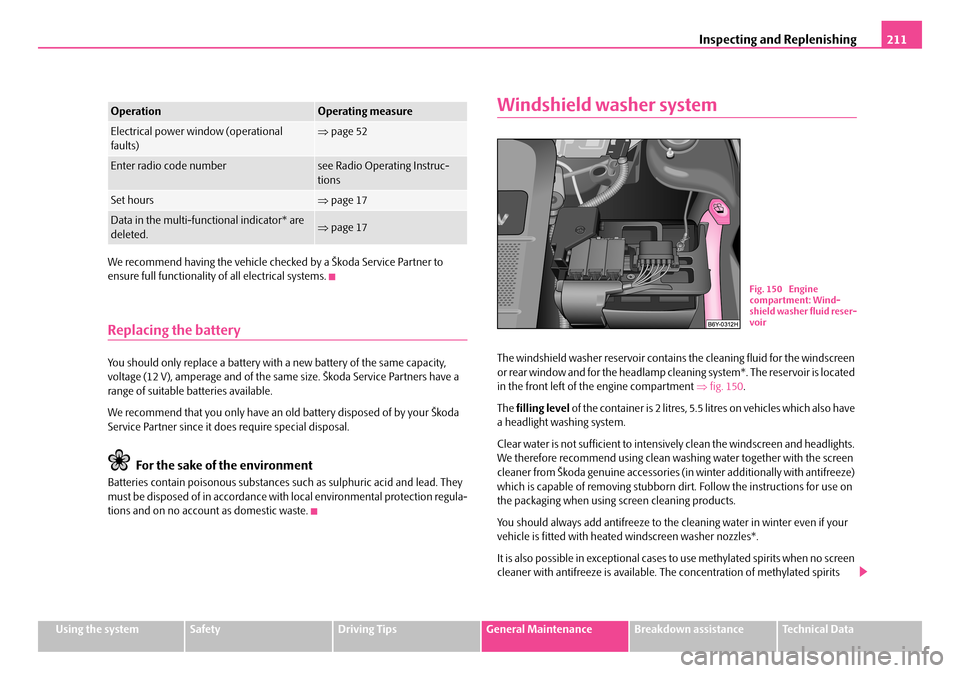
The windshield washer reservoir contains the cleaning fluid for the windscreen or rear window and for the headlamp clea ning system*. The reservoir is located in the front left of the engine compartment ⇒fig. 150.
The filling level of the container is 2 litres, 5.5 litres on vehicles which also have a headlight washing system.
Clear water is not sufficient to intensiv ely clean the windscreen and headlights. We therefore recommend using clean washing water together with the screen cleaner from Škoda genuine accessories (i n winter additionally with antifreeze) which is capable of removing stubborn dirt. Follow the instructions for use on the packaging when using screen cleaning products.
You should always add antifreeze to the cleaning water in winter even if your vehicle is fitted with heated windscreen washer nozzles*.
It is also possible in exceptional cases to use methylated spirits when no screen cleaner with antifreeze is available. The concentration of methylated spirits
OperationOperating measure
Electrical power window (operational faults)⇒ page 52
Enter radio code numbersee Radio Operating Instruc- tions
Set hours⇒ page 17
Data in the multi-functional indicator* are deleted.⇒ page 17
Fig. 150 Engine compartment: Wind-shield washer fluid reser-voir
NKO A05Fabia 20.book Page 211 Tuesday, September 26, 2006 8:38 AM
Page 214 of 258
Wheels and Tyres213
Using the systemSafetyDriving TipsGeneral MaintenanceBreakdown assistanceTechnical Data
Wheels and Tyres
Wheels
General comments
•New tyres do not offer optimal grip at first and should therefore be run in for about 500 km at a moderate speed and an appropriately cautious style of driving. You will also profit from longer tyre life.
•The tread depth of new tyres may differ because of design features and the configuration of the tread (depending on the type of tyre and the manufac- turer).
•Drive over curbs on the side of the road and other such obstacles slowly and, where possible, at a right angles in order to avoid damage to tyres and wheel trims.
•Inspect your tyres from time to time for damage (punctures, cuts, splits and bulges). Remove foreign bodi es from the tyre profile.
•Damage to tyres and wheels is frequently not visible. Unusual vibrations or pulling of the vehicle to one side could be a sign of tyre damage. Please reduce your speed immediately an d stop if you suspect that a wheel is damaged. Inspect the tyres for signs of damage (bulges, splits, etc.) If no visible damage is present, please drive at an appropriately slow speed and carefully to the nearest specialist garage in order to have your vehicle inspected.
•Also protect your tyres from contact with oil, grease and fuel.
•Immediately replace any dust caps of the valves which have got lost.
•Mark wheels before removing them so that their previous direction of running can be maintained when mounted them again.
•Always store wheels or tyres which been removed in a cool, dry and, where possible, dark place. Tyres which are not fixed to a wheel trim should be stored upright.
Unidirectional tyres*
The direction of rotation of the tyres is marked by arrows on the wall of the tyre. This indicates the direction of rotation of the tyre, and it is essential that the tyres are fitted on to run in this direction. Only then are the tyres able to provide the optimal properties in terms of grip, low noise, wear-and-tear and aquaplaning.
Further information concerning th e use of unidirectional tyres ⇒page 218.
WARNING
•New tyres during the first 500 km do not offer optimal grip and should therefore be run appropriately - risk of accident!
•Never drive with damaged tyres - risk of accident!
Note
Please observe the various differing legal requirements regarding tyres.
NKO A05Fabia 20.book Page 213 Tuesday, September 26, 2006 8:38 AM
Page 216 of 258
Wheels and Tyres215
Using the systemSafetyDriving TipsGeneral MaintenanceBreakdown assistanceTechnical Data
Wear indicators
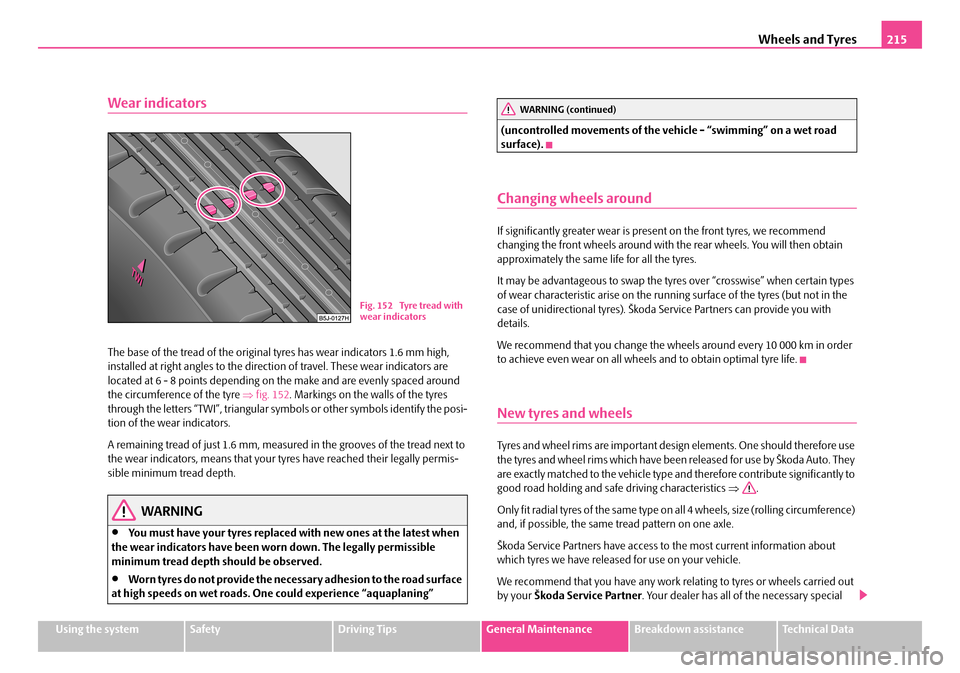
The base of the tread of the original tyres has wear indicators 1.6 mm high, installed at right angles to the direction of travel. These wear indicators are located at 6 - 8 points depending on th e make and are evenly spaced around the circumference of the tyre ⇒fig. 152. Markings on the walls of the tyres through the letters “TWI”, triangular symbols or other symbols identify the posi-tion of the wear indicators.
A remaining tread of just 1.6 mm, measured in the grooves of the tread next to the wear indicators, means that your ty res have reached their legally permis- sible minimum tread depth.
WARNING
•You must have your tyres replaced with new ones at the latest when the wear indicators have been wo rn down. The legally permissible minimum tread depth should be observed.
•Worn tyres do not provide the necessary adhesion to the road surface at high speeds on wet roads. One could experience “aquaplaning”
(uncontrolled movements of the vehicle - “swimming” on a wet road surface).
Changing wheels around
If significantly greater wear is present on the front tyres, we recommend changing the front wheels around with the rear wheels. You will then obtain approximately the same life for all the tyres.
It may be advantageous to swap the tyres over “crosswise” when certain types of wear characteristic aris e on the running surface of the tyres (but not in the case of unidirectional tyres). Škoda Se rvice Partners can provide you with details.
We recommend that you change the wheels around every 10 000 km in order to achieve even wear on all wheels and to obtain optimal tyre life.
New tyres and wheels
Tyres and wheel rims are important design elements. One should therefore use the tyres and wheel rims which have been released for use by Škoda Auto. They are exactly matched to the vehicle type an d therefore contribute significantly to good road holding and safe driving characteristics ⇒.
Only fit radial tyres of the same type on all 4 wheels, size (rolling circumference) and, if possible, the same tread pattern on one axle.
Škoda Service Partners have access to the most current information about which tyres we have released for use on your vehicle.
We recommend that you have any work relating to tyres or wheels carried out by your Škoda Service Partner. Your dealer has all of the necessary special
Fig. 152 Tyre tread with wear indicators
WARNING (continued)
NKO A05Fabia 20.book Page 215 Tuesday, September 26, 2006 8:38 AM
Page 218 of 258
Wheels and Tyres217
Using the systemSafetyDriving TipsGeneral MaintenanceBreakdown assistanceTechnical Data
used in exceptional cases and only th en when adopting an appropriately cautious style of driving.
•Do not, where possible, replace individual tyres but at least replace them on both wheels of a given axle at the same time. Always fit the tyres with the deeper tread depth to the front wheels.
For the sake of the environment
Old tyres must be disposed of in conf ormity with the appropriate regulations.
Note
It is not normally possible to fit wheels from other models of cars for technical reasons. This may also apply in certain circumstances to the wheels of the same type of vehicle.
Wheel bolts
Wheels and wheel bolts are matched to each other in terms of design. Each time you fit other wheels - e.g. light allo y wheels or wheels with winter tyres - you must therefore also use the matching wheel bolts of the correct length and shape of spherical cap. This is essentia l to ensure that the wheels are tightly fitted and that the brake system operates properly.
If you retrofit wheel trims (or have this done), please also ensure that an adequate flow of air remains assured for cooling the brake system.
The Škoda Service Partners are instructed in the technical possibilities which exist regarding converting or retrofitting wheels, tyres and wheel trim.
WARNING
•In case of incorrect treatment of th e wheel bolts, the wheel can loosen when the car is moving - risk of accident!
•The wheel bolts must be clean and must turn easily. However, they must never be treated with grease or oil.
•If the wheel bolts are tightened to a too low tightening torque, the rim can lossen when the car is moving - risk of accident! A tightening torque which is too high can damage the bolts and threads and this can result in permanent deformation of the contact surfaces on the rims.
Caution
The prescribed tightening torque of the wheel bolts for steel and light alloy wheels is 120 Nm.
Winter tyres
The handling of your vehi cle will be significantly improved when driving on wintry roads if you fit winter tyres. Summer tyres do not offer the same grip on ice, snow and at temperatures below 7 °C because of their construction (width, rubber blend, tread pattern). This applie s in particular to vehicles which are equipped with low-profile tyres or high-speed tyres (code index H, V or W on wall of tyre).
Winter tyres must be mounted on all four wheels to obtain the best handling characteristics.
You must only fit those types of winter ty re which are approved for your vehicle. The permissible sizes of winter tyres are stated in your vehicle documents. Approvals may differ becaus e of national legislation.
Please remember that the tyres should be inflated to 20 kPa (0.2 bar) more than is the case for summer tyres ⇒page 214.
WARNING (continued)
NKO A05Fabia 20.book Page 217 Tuesday, September 26, 2006 8:38 AM
Page 220 of 258
Wheels and Tyres219
Using the systemSafetyDriving TipsGeneral MaintenanceBreakdown assistanceTechnical Data
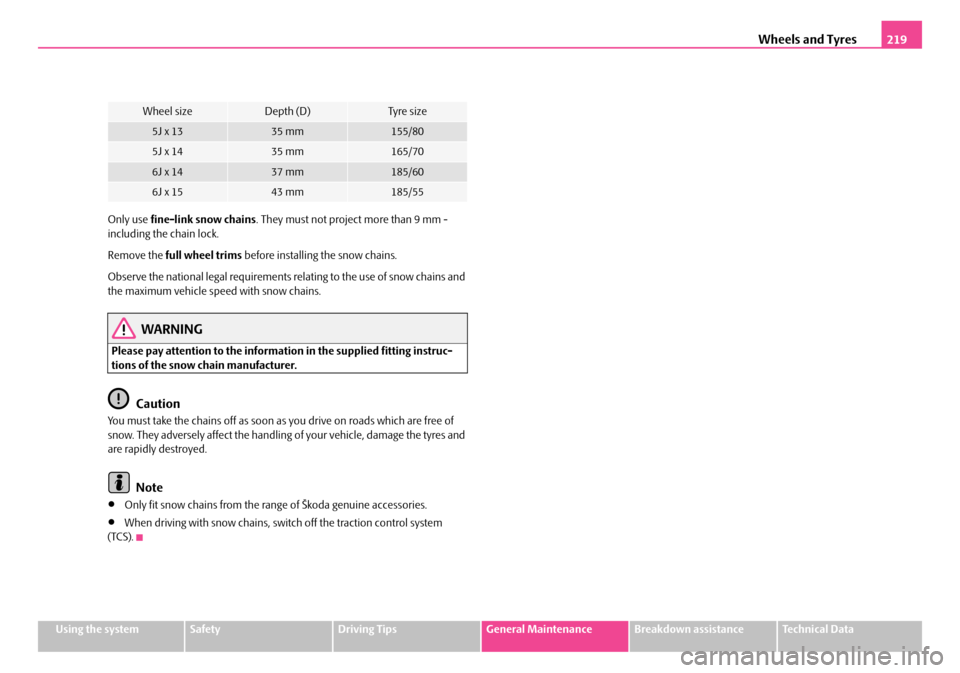
Only use fine-link snow chains. They must not project more than 9 mm - including the chain lock.
Remove the full wheel trims before installing the snow chains.
Observe the national legal requirements relating to the use of snow chains and the maximum vehicle speed with snow chains.
WARNING
Please pay attention to the information in the supplied fitting instruc-tions of the snow chain manufacturer.
Caution
You must take the chains off as soon as you drive on roads which are free of snow. They adversely affect the handling of your vehicle, damage the tyres and are rapidly destroyed.
Note
•Only fit snow chains from the ra nge of Škoda genuine accessories.
•When driving with snow chains, switch off the traction control system (TCS).
Wheel sizeDepth (D)Tyre s iz e
5J x 1335 mm155/80
5J x 1435 mm165/70
6J x 1437 mm185/60
6J x 1543 mm185/55
NKO A05Fabia 20.book Page 219 Tuesday, September 26, 2006 8:38 AM
Page 222 of 258
Breakdown assistance221
Using the systemSafetyDriving TipsGeneral MaintenanceBreakdown assistanceTechnical Data
Breakdown assistance
Breakdown assistance
First-aid box* and Warning triangle*
The first-aid box must be stored in such a way that it is immediately ready to hand.
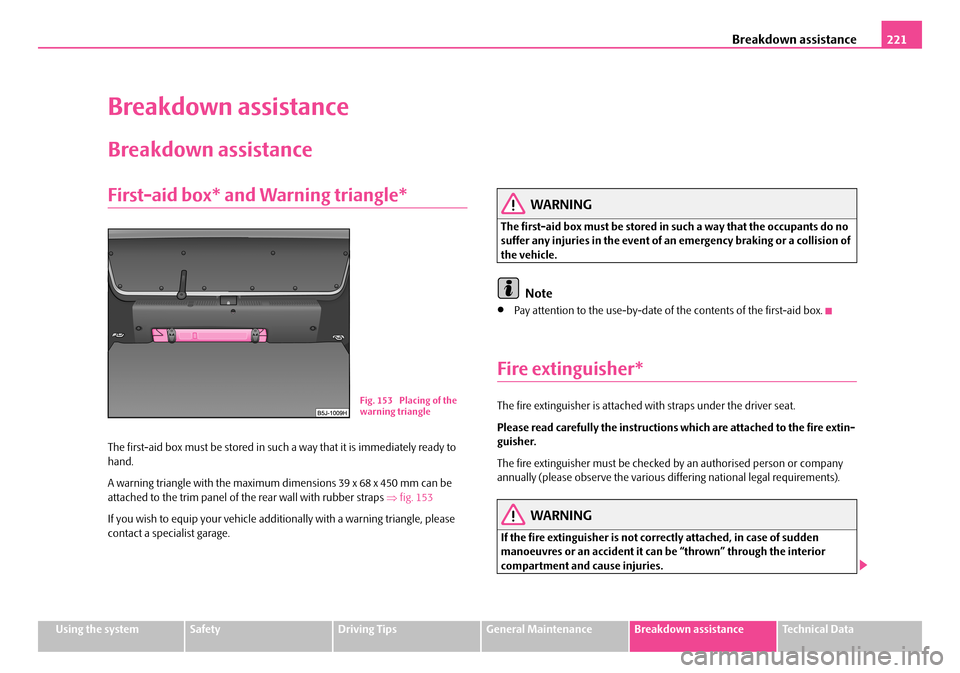
A warning triangle with the maximum dimensions 39 x 68 x 450 mm can be attached to the trim panel of the rear wall with rubber straps ⇒fig. 153
If you wish to equip your vehicle additionally with a warning triangle, please contact a specialist garage.
WARNING
The first-aid box must be stored in such a way that the occupants do no suffer any injuries in the event of an emergency braking or a collision of the vehicle.
Note
•Pay attention to the use-by-date of the contents of the first-aid box.
Fire extinguisher*
The fire extinguisher is attached with straps under the driver seat.
Please read carefully the instructions which are attached to the fire extin- guisher.
The fire extinguisher must be checked by an authorised person or company annually (please observe th e various differing national legal requirements).
WARNING
If the fire extinguisher is not correctly attached, in case of sudden manoeuvres or an accident it can be “thrown” through the interior compartment and cause injuries.
Fig. 153 Placing of the warning triangle
NKO A05Fabia 20.book Page 221 Tuesday, September 26, 2006 8:38 AM