technical data SKODA FABIA 2006 2.G / 5J Owners Manual
[x] Cancel search | Manufacturer: SKODA, Model Year: 2006, Model line: FABIA, Model: SKODA FABIA 2006 2.G / 5JPages: 258, PDF Size: 44.86 MB
Page 184 of 258
Towing a trailer183
Using the systemSafetyDriving TipsGeneral MaintenanceBreakdown assistanceTechnical Data
If the needle of the coolant temperatur e gauge moves into the right-hand area or even the red area of the scale, reduce your speed immediately. Stop and switch off the engine if the warning light in the instrument cluster begins flashing. Wait a few minutes and check th e level of coolant in the coolant expan- sion bottle ⇒page 204, “Inspecting the coolant level”.
Please refer to the following guidelines ⇒page 30, “Coolant tempera- ture/coolant level ”.
The coolant temperature can be reduced by switching on the heating.
Any increase in the cooling effect of the coolant fan through shifting down a gear and increasing the engine speed is not possible since the fan speed is inde- pendent of the engine speed. One should also not drop a gear for this reason when towing a trailer as long as the engine can manage the slope without any drop in speed.
NKO A05Fabia 20.book Page 183 Tuesday, September 26, 2006 8:38 AM
Page 186 of 258
Taking care of your vehicle and cleaning the vehicle185
Using the systemSafetyDriving TipsGeneral MaintenanceBreakdown assistanceTechnical Data
General Maintenance
Taking care of your vehicle and cleaning the vehicle
General
Proper care retains the value of your vehicle.
Regular and proper care retains the value of your vehicle. It may also be one of the requirements for the acceptance of warranty claims relating to corrosion damage and paint defects on the bodywork.
We recommend using a preservative fr om Škoda genuine accessories offered by your Škoda dealer. Please follow th e instructions for use on the package.
WARNING
•Care products may be harmful to your health if not used according to the instructions.
•Always store care products in a safe place, out of the reach of children - risk of poisoning!
For the sake of the environment
•Always select environmen tally-friendly products when purchasing vehicle care products.
•Do not dispose of residues of care products in domestic waste.
Care of the exterior of vehicle
Washing the vehicle
Frequent washing protects your vehicle.
The best protection for your vehicle ag ainst harmful environmental influences is frequent washing and wax treatment. How often you should wash your vehicle depends on a wide range of factors, such as:
•Frequency of use,
•The parking situation (garage, below trees etc.),
•Season of the year,
•Weather conditions,
•Environmental influences.
The longer insect residues, bird dropping s, tree sap, road and industrial dust, tar, soot particles, road salt and other aggressive deposits remain adhering to the paintwork of your vehicle, the more detrimental their destructive effect can be. High temperatures, such as those caus ed by intensive sun's rays, accentuate this caustic effect.
It may therefore be necessary, in ce rtain circumstances, to wash the car once a week . It may also be sufficient, however, to wash the car once a month followed by approp riate wax treatment.
It is essential to also thoroughly wash the underside of your vehicle at the end of the winter road salting and gritting period.
NKO A05Fabia 20.book Page 185 Tuesday, September 26, 2006 8:38 AM
Page 188 of 258
Taking care of your vehicle and cleaning the vehicle187
Using the systemSafetyDriving TipsGeneral MaintenanceBreakdown assistanceTechnical Data
For the sake of the environment
Only wash your vehicle at washing bays specifically reserved for this purpose. This ensures that no water which may be contaminated by oil flows into the sewage system. It is not even permitted to wash your vehicle in certain areas except at such specific washing bays.
Washing with a high-pressure cleaner
When you wash your vehicle with a high -pressure cleaner, it is essential to comply with the instructions for use of the cleaning equipment. This applies in particular to the pressure used and to the spraying distance. Maintain a suffi- ciently large distance to soft materials su ch as rubber hoses or insulation mate- rial.
On no account use circular spray nozzles or so-called dirt cutters!
WARNING
It is particularly important that you do not clean tyres with circular spray jets. Damage may occur even at a rela tively large spraying distance and if sprayed only for a short time.
Caution
The water containing wax must be no hotter than 60°C, otherwise the vehicle can be damaged.
Wax treatment
Good wax treatment is an effective wa y of protecting the paintwork from harmful environmental influences and minor mechanical damage.
The vehicle must be treated with a high-q uality hard wax polish at the latest, when no more drops form on the clean paintwork.
A new layer of a high-quality hard wax po lish can be applied to the clean body- work after it has dried thoroughly. Even if you use a wax preserver regularly we still recommend that you treat the paintwork of the vehicle at least twice a year with hard wax.
Caution
Never apply wax to the windows.
Polishing
Polishing is only necessary if the paintwork of your vehicle has become unat-tractive and if it is no longer possibl e to achieve a gloss with wax preservers.
You must treat the paintwork with a wax preserver if the polish you use does not contain any preserving elements ⇒page 187, “Wax treatment”.
We recommend using a preservative fr om Škoda genuine accessories offered by your Škoda dealer.
Caution
•You must not treat mat painted parts or plastic with polishing products or hard wax.
•Do not polish the paintwork of the ve hicle in a dusty environment, other- wise the paintwork can be scratched.
NKO A05Fabia 20.book Page 187 Tuesday, September 26, 2006 8:38 AM
Page 190 of 258
Taking care of your vehicle and cleaning the vehicle189
Using the systemSafetyDriving TipsGeneral MaintenanceBreakdown assistanceTechnical Data
The headlight lenses
Please do not use any aggressive cleaning or chemical solvent products - risk of damage to the plastic lenses Please use soap and clean warm water.
Caution
Never wipe the headlights dry and do not use any sharp objects for cleaning the plastic lenses, this may result in da mage to the protective paintwork and consequently in formation of cracks on the headlight lenses, e.g through effect of chemical products.
Door and window seals
The rubber seals on the doors, boot lid, bonnet and windows remain supple and last longer if you trea t them from time to time with a rubber care product (e.g. with a silicone-free oil in the spray). You also avoid premature wear of the seals and prevent leakages in this way. It is also easier to open the doors. Rubber seals which are well cared for also do not stick together in cold winter weather.
Locks
We recommend that you use the spray fr om Škoda original accessories with regreasing and anticorrosive effect for de-icing locks.
Note
When washing your vehicle, ensure that as little water as possible gets into the locks.
Wheels
Steel wheels
You should also thoroughly wash the wheels and wheel trims when giving your vehicle its regular wash. This prevents an y brake dust, dirt and road salt from sticking to the wheel hubs. You can remo ve stubborn brake abrasion adhering to the wheels with an industrial cleane r. Touch up any damage to the paintwork on the wheels before rust is able to form.
Light alloy wheels
Regular care of light alloy wheels is necessary in order to retain their decorative appearance over long periods. It is particularly important to remove any road salt and brake abrasion from light alloy wheels every two weeks, otherwise the surface will suffer. Wash thoroughly and th en treat the wheels with a protective product for light alloy wheels which does not contain any acidic components. You should provide the wheel hubs with a hard wax layer every three months. You must not use any products which ca use abrasion when treating the wheel hubs. Any damage to the paint layer on the wheel hubs must be touched up immediately.
We recommend using a preservative fr om Škoda genuine accessories offered by your Škoda dealer.
WARNING
One should remember when cleaning the wheels that moisture, ice and road salt may adversely affect brakin g efficiency - risk of an accident!
Note
Severe layers of dirt on the wheels can also result in wheel imbalance. This may show itself in the form of a wheel vibrat ion which is transmitted to the steering wheel which, in certain circumstance s, can cause premature wear of the steering. This means it is necessary to remove the dirt.
NKO A05Fabia 20.book Page 189 Tuesday, September 26, 2006 8:38 AM
Page 192 of 258
Taking care of your vehicle and cleaning the vehicle191
Using the systemSafetyDriving TipsGeneral MaintenanceBreakdown assistanceTechnical Data
Care of the interior of vehicle
Plastic parts, artificial leather and cloths
You can clean plastic parts and artificial leather with a moist cloth. You should only treat such parts with special solvent-free plastic cleaning and care products it does prove to be adequate.
Upholstery cloth and cloth trim on th e doors, luggage compartment cover, headliner etc. are best treated with spec ial cleaning products, using if necessary a dry foam and a soft sponge or brush.
We recommend using a cleaning prod uct from Škoda genuine accessories offered by your Škoda dealer.
Caution
Solvent-free cleaners attack the material and can damage it.
Fabric covers of elec trically heated seats
Do not clean the seat covers moist as this may result in damage to the seat heating system.
Clean such covers using special agents, for example dry foam.
Natural leather
Natural leather requires quite particular care and attention.
Leather should be treated from time to time according the following
guidelines depending on how much it is used.
Normal cleaning
– Clean soiled areas of the leather with slightly moistened cotton or
woollen cloth.
Severe soiling
– Clean severely soiled areas with a cloth dipped in a mild soapy
solution (2 spoonfuls of natura l soap to 1 litre of water).
– Ensure that the leather is not soak ed through at any point and that
no water gets into the stitching of the seams.
– Dry off the leather with a soft, dry cloth.
Removing stains
– Remove fresh stains which are water-based (e.g. coffee, tea,
juices, blood etc.) with an absorbent cloth or household paper or
use the cleaner from the care set for a stain which has already dried
in.
– Remove fresh stains on a fat base (e.g. butter, mayonnaise, choc-
olate etc.) with an absorbent cloth or household cleaning paper or
with the cleaner from the care set if the stain has not yet penetrated
into the surface.
– Use a grease dissolver for grease stains which have dried in.
–Eliminate special stains (e.g. ball-point pens, felt pen, nail varnish,
dispersion paint, shoe cream etc.) with a special stain remover
suitable for leather.
Leather care
– Treat the leather every six months with the leather care product
available from Škoda Service Partners.
NKO A05Fabia 20.book Page 191 Tuesday, September 26, 2006 8:38 AM
Page 194 of 258
Fuel193
Using the systemSafetyDriving TipsGeneral MaintenanceBreakdown assistanceTechnical Data
Fuel
Petrol
Grades of petrol
There are various grades of petrol. Please read the brochure “Technical Data” in order to know which grade of petrol your vehicle requires. You will also find the same information affixed to the inside of the fuel filler flap of your vehicle ⇒ page 195, fig. 140.
A distinction is made between unleaded and leaded petrol. All Škoda vehicles with petrol engines are equipped with a catalytic converter and must therefore be only driven with unleaded petrol. Unleaded petrol complies with the standard EN 228 .
The individual grades of petrol are distinguished by their octane number (RON). Please adopt the following procedure if the grade of petrol which you normally use is not be availabl e in exceptional circumstances:
•Engines which need unleaded premium petrol 95 RON can also be run on unleaded regular petrol 91 RON. This does, however, result in a slight loss in performance.
•Engines which need unleaded premium plus petrol 98 RON can also be run on unleaded regular petrol 95 RON. Th is does, however, result in a slight loss in performance. You can in exceptional circumstances also use unleaded regular petrol of 91 RON in the event that neither unleaded premium petrol of 98 RON nor 95 RON is available. Refuel as soon as possible with unleaded premium plus of 98 RON or unleaded premium petrol of 95 RON.
If, in an emergency, the only fuel av ailable is one which has a lower octane number than that required by the engine then only drive at medium engine speeds and lower engine loadings.
You can make unlimited use of fuel which has a higher octane number than that required by the engine. There will, however, be no advantages gained by this in terms of engine performance and fuel consumption!
The handling, performance and life of yo ur engine are determined to a signifi- cant extent by the quality of the fu el. Do not use any petrol additives. Use a fuel complying with the standard.
You can find further info rmation on refuelling ⇒page 195.
Caution
•Filling the tank even only once with leaded petrol will result in the catalytic converter being destroyed.
•Operating the engine with petrol of a low octane number than that required can result in engine damage at high revolutions or severe engine loading.
Diesel
Diesel fuel
Your vehicle can be operated with diesel fuel, which complies with the standard EN 590.
It is prohibited to use biofuel (RME) and diesel fuel mixture.
Fuel additives
You must not use fuel additives, so-called “flow improvers” (petrol and similar products) in diesel fuel.
NKO A05Fabia 20.book Page 193 Tuesday, September 26, 2006 8:38 AM
Page 196 of 258
Fuel195
Using the systemSafetyDriving TipsGeneral MaintenanceBreakdown assistanceTechnical Data
Refuelling
Opening the fuel filler cap
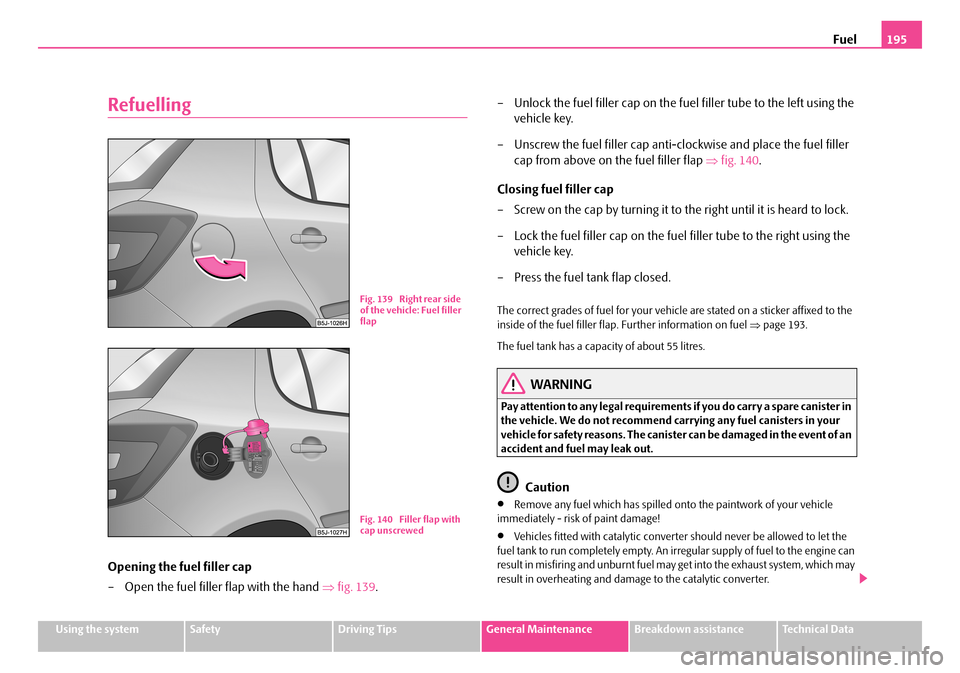
– Open the fuel filler flap with the hand ⇒fig. 139.
– Unlock the fuel filler cap on the fuel filler tube to the left using the
vehicle key.
– Unscrew the fuel filler cap anti-clockwise and place the fuel filler
cap from above on the fuel filler flap ⇒fig. 140.
Closing fuel filler cap
– Screw on the cap by turning it to the right until it is heard to lock.
– Lock the fuel filler cap on the fuel filler tube to the right using the
vehicle key.
– Press the fuel tank flap closed.
The correct grades of fuel for your vehicl e are stated on a sticker affixed to the inside of the fuel filler flap. Further information on fuel ⇒page 193.
The fuel tank has a capa city of about 55 litres.
WARNING
Pay attention to any legal requirements if you do carry a spare canister in the vehicle. We do not recommend ca rrying any fuel canisters in your vehicle for safety reasons. The canister can be damaged in the event of an accident and fuel may leak out.
Caution
•Remove any fuel which has spilled onto the paintwork of your vehicle immediately - risk of paint damage!
•Vehicles fitted with cata lytic converter should never be allowed to let the fuel tank to run completely empty. An irregular supply of fuel to the engine can result in misfiring and unburnt fuel ma y get into the exhaust system, which may result in overheating and dama ge to the catalytic converter.
Fig. 139 Right rear side of the vehicle: Fuel filler flap
Fig. 140 Filler flap with cap unscrewed
NKO A05Fabia 20.book Page 195 Tuesday, September 26, 2006 8:38 AM
Page 198 of 258
Inspecting and Replenishing197
Using the systemSafetyDriving TipsGeneral MaintenanceBreakdown assistanceTechnical Data
Inspecting and Replenishing
Engine compartment
Bonnet remote release
Bonnet remote release
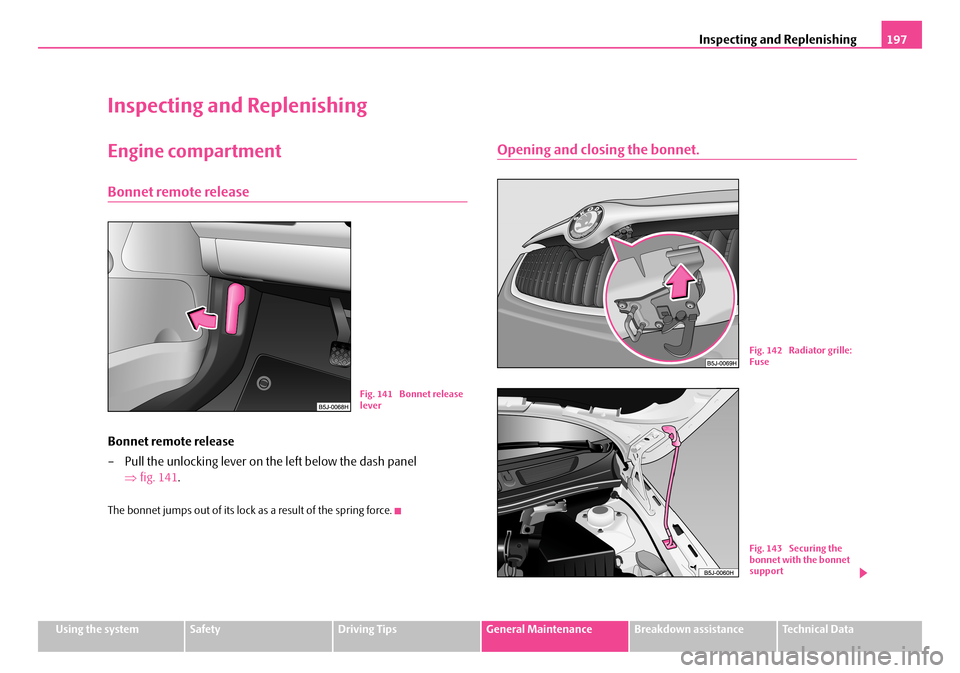
– Pull the unlocking lever on the left below the dash panel
⇒ fig. 141.
The bonnet jumps out of its lock as a result of the spring force.
Opening and closing the bonnet.
Fig. 141 Bonnet release lever
Fig. 142 Radiator grille: Fuse
Fig. 143 Securing the bonnet with the bonnet support
NKO A05Fabia 20.book Page 197 Tuesday, September 26, 2006 8:38 AM
Page 200 of 258
Inspecting and Replenishing199
Using the systemSafetyDriving TipsGeneral MaintenanceBreakdown assistanceTechnical Data
•Never spill oil and other fluids over the hot engine. Such fluids (e.g. the antifreeze contained in the coolant) may ignite!
•Avoid short circuits in the electrical system - particularly on the battery.
•Never place your hand into the radiator fan as long as the engine is still warm. The fan might suddenly start running!
•Never open the cap of the coolant expansion bottle as long as the engine is still warm. The co oling system is pressurized!
•Cover over the cap of the coolant expansion reservoir with a large cloth when opening it as protection for your face, hands and arms from hot steam or hot coolant.
•Do not let objects, such as e.g cleaning cloth or tools lie in the engine compartment.
•If you wish to work under the vehicle, you must secure the vehicle from rolling away and support it with suitable supporting blocks: the car jack is not sufficient for this - risk of injury!
•In cases where it be necessary to carry out inspection work when the engine is running there is an additional risk from rotating parts (e.g. the V-ribbed belt, alternator, radiator fan) and from the high-voltage igni- tion system. Please observe in addition the following:
− Never touch the electrical cables of the ignition system.
− Absolutely avoid any jewellery, loose items of clothing or long hair from getting into the rotating part s of the engine - Hazard! Therefore remove any jewellery beforehand, tie up your hair and wear tight fitting clothing.
•Please also comply with the warnin g instructions stated below when carrying out any essential work on th e fuel system or on the electrical system:
− Always separate the car battery from the electrical system.
− Do not smoke.
− Never carry out any work close to naked flames.
− Always keep a working fire extinguisher at hand.
Caution
When replenishing fluids in the engine, always ensure that the fluids are on no account mixed up. This may result in ma jor operating problems and also vehicle damage!
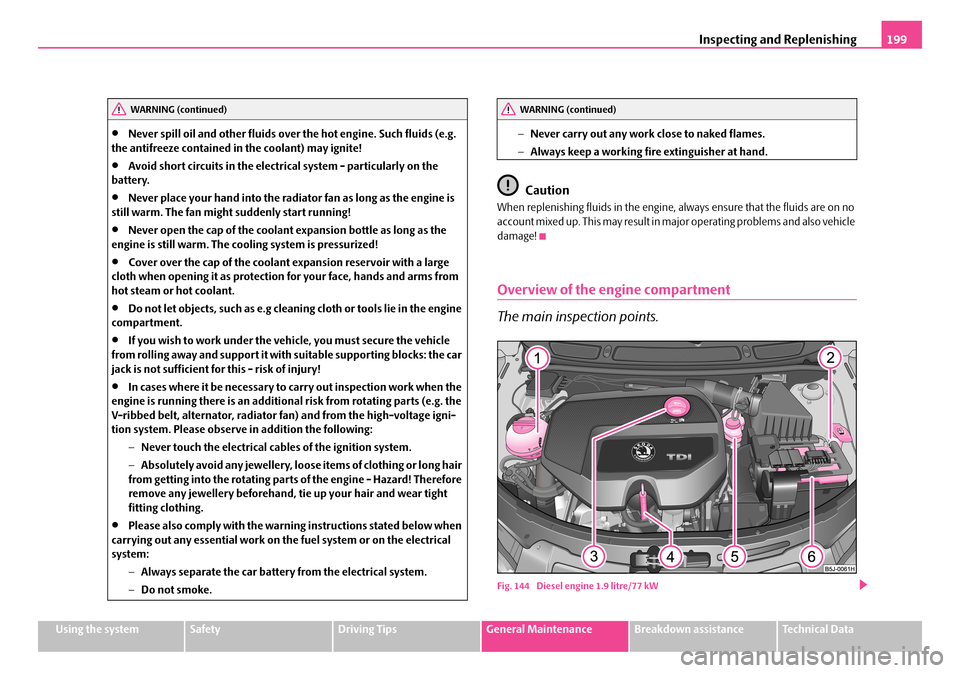
Overview of the engine compartment
The main inspection points.
Fig. 144 Diesel engine 1.9 litre/77 kW
WARNING (continued)WARNING (continued)
NKO A05Fabia 20.book Page 199 Tuesday, September 26, 2006 8:38 AM
Page 202 of 258
Inspecting and Replenishing201
Using the systemSafetyDriving TipsGeneral MaintenanceBreakdown assistanceTechnical Data
Note
•Before a long drive we recommend that you purchase and carry with you engine oil which complies with the specif ication for your vehicle. Consequently, you will always have the correct engine oil for refilling.
•We recommend using a preservative fr om the Škoda original accessories offered by your Škoda dealer.
•For further information - see Service shedule.
Check engine oil level
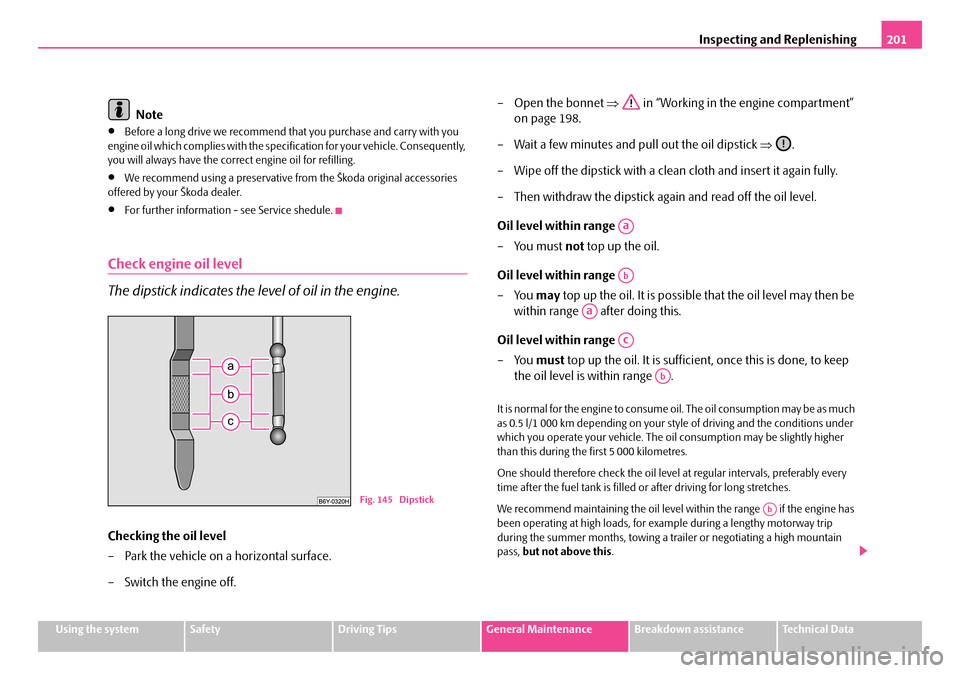
The dipstick indicates the level of oil in the engine.
Checking the oil level
– Park the vehicle on a horizontal surface.
– Switch the engine off.
– Open the bonnet ⇒ in “Working in the engine compartment”
on page 198.
– Wait a few minutes and pull out the oil dipstick ⇒.
– Wipe off the dipstick with a clean cloth and insert it again fully.
– Then withdraw the dipstick again and read off the oil level.
Oil level within range
– You must not top up the oil.
Oil level within range
– You may top up the oil. It is possible that the oil level may then be
within range after doing this.
Oil level within range
– You must top up the oil. It is sufficient, once this is done, to keep
the oil level is within range .
It is normal for the engine to consume oil. The oil consumption may be as much as 0.5 l/1 000 km depending on your style of driving and the conditions under which you operate your vehicle. The oi l consumption may be slightly higher than this during the first 5 000 kilometres.
One should therefore check the oil level at regular intervals, preferably every time after the fuel tank is filled or after driving for long stretches.
We recommend maintaining the oil level within the range if the engine has been operating at high loads, for ex ample during a lengthy motorway trip during the summer months, towing a tr ailer or negotiating a high mountain pass, but not above this.
Fig. 145 Dipstick
Aa
Ab
Aa
Ac
Ab
Ab
NKO A05Fabia 20.book Page 201 Tuesday, September 26, 2006 8:38 AM