engine SKODA FABIA 2006 2.G / 5J Owner's Manual
[x] Cancel search | Manufacturer: SKODA, Model Year: 2006, Model line: FABIA, Model: SKODA FABIA 2006 2.G / 5JPages: 258, PDF Size: 44.86 MB
Page 2 of 258
Introduction
You have opted for a Škoda - our sincere thanks for your confidence in us.
Your new Škoda offers you a vehicle fe aturing the most modern engineering and a wide range of equipment which
you will undoubtedly wish to use to the full during your daily motoring. That is why, we recommend that you read
this Owner's Manual attentively to enable you to become fami liar with your car and all that it offers as quickly as
possible.
Please do not hesitate to contact your Škoda Service Pa rtner or importer should you have any further questions
regarding any problems which may arise or your vehicle. He will be ready at any time to receive your questions,
suggestions and criticisms.
Any national legal provisions which vary from the inform ation contained in this Owner's Manual take precedence
over the information contained herein.
We wish you much pleasure with your Šk oda and pleasant motoring at all times.
Yo u r Škoda Auto
NKO A05Fabia 20.book Page 1 Tuesday, September 26, 2006 8:38 AM
Page 6 of 258
Contents5
Contents
Layout of this Owner's Manual
(explanations). . . . . . . . . . . . . . . . . . . . . . . . . .
Using the system. . . . . . . . . . . . . . . . . . . . . .
Cockpit. . . . . . . . . . . . . . . . . . . . . . . . . . . . . . . . . . . . . . . . General view . . . . . . . . . . . . . . . . . . . . . . . . . . . . . . . . .
Instruments and Indicator/Warning Lights. . . General view of the instrument cluster . . . . . . . . . Engine revolutions counter . . . . . . . . . . . . . . . . . . . . Coolant temperature gauge* . . . . . . . . . . . . . . . . . . Fuel gauge* . . . . . . . . . . . . . . . . . . . . . . . . . . . . . . . . . . Counter for distance driven . . . . . . . . . . . . . . . . . . . Service Interval Display . . . . . . . . . . . . . . . . . . . . . . . Digital clock . . . . . . . . . . . . . . . . . . . . . . . . . . . . . . . . . . Multi-functional indicato r (onboard computer)* Information display* . . . . . . . . . . . . . . . . . . . . . . . . . . Auto Check Control . . . . . . . . . . . . . . . . . . . . . . . . . . . Warning lights . . . . . . . . . . . . . . . . . . . . . . . . . . . . . . . .
Unlocking and locking . . . . . . . . . . . . . . . . . . . . . . . . Key . . . . . . . . . . . . . . . . . . . . . . . . . . . . . . . . . . . . . . . . . . Locking . . . . . . . . . . . . . . . . . . . . . . . . . . . . . . . . . . . . . . Child safety lock . . . . . . . . . . . . . . . . . . . . . . . . . . . . . . Central locking system* . . . . . . . . . . . . . . . . . . . . . . . Remote control* . . . . . . . . . . . . . . . . . . . . . . . . . . . . . . Anti-theft alarm system* . . . . . . . . . . . . . . . . . . . . . . Interior monitor* and Towing protection* . . . Power windows* . . . . . . . . . . . . . . . . . . . . . . . . . . . . . Electric sliding/tilting roof* . . . . . . . . . . . . . . . . . . . .
Lights and Visibility . . . . . . . . . . . . . . . . . . . . . . . . . . . Lights . . . . . . . . . . . . . . . . . . . . . . . . . . . . . . . . . . . . . . . . Interior lighting . . . . . . . . . . . . . . . . . . . . . . . . . . . . . . .
Visibility . . . . . . . . . . . . . . . . . . . . . . . . . . . . . . . . . . . . . Windshield wiper and wash system . . . . . . . . . . . . Rear mirror . . . . . . . . . . . . . . . . . . . . . . . . . . . . . . . . . .
Seats and Stowage. . . . . . . . . . . . . . . . . . . . . . . . . . . . Front seats . . . . . . . . . . . . . . . . . . . . . . . . . . . . . . . . . . . Head restraints . . . . . . . . . . . . . . . . . . . . . . . . . . . . . . . Heating the front seats* . . . . . . . . . . . . . . . . . . . . . . . Rear seats . . . . . . . . . . . . . . . . . . . . . . . . . . . . . . . . . . . . Pedals . . . . . . . . . . . . . . . . . . . . . . . . . . . . . . . . . . . . . . . luggage compartment . . . . . . . . . . . . . . . . . . . . . . . . The roof rack* . . . . . . . . . . . . . . . . . . . . . . . . . . . . . . . . Front cup holder . . . . . . . . . . . . . . . . . . . . . . . . . . . . . Rear cup holder* . . . . . . . . . . . . . . . . . . . . . . . . . . . . . Note holder . . . . . . . . . . . . . . . . . . . . . . . . . . . . . . . . . . Ashtray* . . . . . . . . . . . . . . . . . . . . . . . . . . . . . . . . . . . . . Cigarette lighter* and power sockets* . . . . . . . . . . Storage compartments . . . . . . . . . . . . . . . . . . . . . . . .
Heating and air conditioning system. . . . . . . . . Heating . . . . . . . . . . . . . . . . . . . . . . . . . . . . . . . . . . . . . . Climatic (semi-automatic air conditioning system)* . . . . . . . . . . . . . . . . . . . . . . . . . . . . . . . . . . . . . Climatronic (automatic air conditioning)* . . . . . .
Starting-off and Driving. . . . . . . . . . . . . . . . . . . . . . . Setting steering wheel position* . . . . . . . . . . . . . . . Ignition lock . . . . . . . . . . . . . . . . . . . . . . . . . . . . . . . . . . Starting the engine . . . . . . . . . . . . . . . . . . . . . . . . . . . Switching off the engine . . . . . . . . . . . . . . . . . . . . . . . Shifting (manual gearbox) . . . . . . . . . . . . . . . . . . . . . Handbrake . . . . . . . . . . . . . . . . . . . . . . . . . . . . . . . . . . . Parking aid* . . . . . . . . . . . . . . . . . . . . . . . . . . . . . . . . . . Cruise control system (CCS)* . . . . . . . . . . . . . . . . . .
Automatic gearbox . . . . . . . . . . . . . . . . . . . . . . . . . . . 6-speed automatic gearbox* . . . . . . . . . . . . . . . . . .
Communication . . . . . . . . . . . . . . . . . . . . . . . . . . . . . . Operating the radio . . . . . . . . . . . . . . . . . . . . . . . . . . . Radio and mobile phone operation . . . . . . . . . . . . Universal telephone preinstallation with voice control* . . . . . . . . . . . . . . . . . . . . . . . . . . . . . . . . . . . . . Inserting the mobile phone and adapter . . . . . . . Mobile phone operation . . . . . . . . . . . . . . . . . . . . . . Voice commands . . . . . . . . . . . . . . . . . . . . . . . . . . . . . Enter PIN code . . . . . . . . . . . . . . . . . . . . . . . . . . . . . . . Select number . . . . . . . . . . . . . . . . . . . . . . . . . . . . . . . Repeat last call . . . . . . . . . . . . . . . . . . . . . . . . . . . . . . . Phone voice phonebook* . . . . . . . . . . . . . . . . . . . . . Bluetooth™* . . . . . . . . . . . . . . . . . . . . . . . . . . . . . . . . . Mobile phones and two-way radio systems . . . . . Input AUX-IN* . . . . . . . . . . . . . . . . . . . . . . . . . . . . . . . CD changer* . . . . . . . . . . . . . . . . . . . . . . . . . . . . . . . . .
Safety . . . . . . . . . . . . . . . . . . . . . . . . . . . . . . . . . . . . . .
Passive Safety . . . . . . . . . . . . . . . . . . . . . . . . . . . . . . . . . Basic information . . . . . . . . . . . . . . . . . . . . . . . . . . . . Correct seated position . . . . . . . . . . . . . . . . . . . . . . .
Seat belts. . . . . . . . . . . . . . . . . . . . . . . . . . . . . . . . . . . . . . Why seat belts? . . . . . . . . . . . . . . . . . . . . . . . . . . . . . . The physical principle of a frontal collision . . . . . Important safety information regarding the use of seat belts . . . . . . . . . . . . . . . . . . . . . . . . . . . . . . . . . . . . How are seat belts correctly fastened? . . . . . . . . . Belt tensioner . . . . . . . . . . . . . . . . . . . . . . . . . . . . . . . .
Airbag system. . . . . . . . . . . . . . . . . . . . . . . . . . . . . . . . . Description of the airbag system . . . . . . . . . . . . . . . Front airbags . . . . . . . . . . . . . . . . . . . . . . . . . . . . . . . . . Side airbags* . . . . . . . . . . . . . . . . . . . . . . . . . . . . . . . . .
8
9
11 11
13 13 14141415161717212326
38 38 4041414748495053
56 56 61
63 6467
69 69 717273757579818182828384
91 91
94 98
103 103 104105106107107108109
112 112
118 118 119
120 121122123124124125125128129130131
133
133 133 135
138 138 139
140 141143
144 144 146148
NKO A05Fabia 20.book Page 5 Tuesday, September 26, 2006 8:38 AM
Page 7 of 258
Contents6
Head airbags* . . . . . . . . . . . . . . . . . . . . . . . . . . . . . . . . Deactivating an airbag . . . . . . . . . . . . . . . . . . . . . . . .
Transporting children safely . . . . . . . . . . . . . . . . . . What you should know about transporting children! . . . . . . . . . . . . . . . . . . . . . . . . . . . . . . . . . . . . . Child seat . . . . . . . . . . . . . . . . . . . . . . . . . . . . . . . . . . . . Attaching a child seat using the “ISOFIX” system* Attaching child seat using the “Top Tether” system
Driving Tips. . . . . . . . . . . . . . . . . . . . . . . . . . . . . .
Intelligent Technology . . . . . . . . . . . . . . . . . . . . . . . . Electronic stability programme (ESP)* . . . . . . . . . . Brakes . . . . . . . . . . . . . . . . . . . . . . . . . . . . . . . . . . . . . . . Brake booster . . . . . . . . . . . . . . . . . . . . . . . . . . . . . . . . Antilock brake system (ABS)* . . . . . . . . . . . . . . . . . . Brake Assist* . . . . . . . . . . . . . . . . . . . . . . . . . . . . . . . . . Electrohydraulic power steering . . . . . . . . . . . . . . . Tyre inflation pressure-control system* . . . . . . . . .
Driving and the Environment. . . . . . . . . . . . . . . . . The first 1 500 kilometres and then afterwards . . Catalytic converter . . . . . . . . . . . . . . . . . . . . . . . . . . . . Driving in an economical and environmentally conscious manner . . . . . . . . . . . . . . . . . . . . . . . . . . . . Environmental compatibility . . . . . . . . . . . . . . . . . . . Motoring abroad . . . . . . . . . . . . . . . . . . . . . . . . . . . . . Avoiding damage to your vehicle . . . . . . . . . . . . . .
Towing a trailer. . . . . . . . . . . . . . . . . . . . . . . . . . . . . . . . Towing a trailer . . . . . . . . . . . . . . . . . . . . . . . . . . . . . . .
General Maintenance. . . . . . . . . . . . . . .
Taking care of your ve hicle and cleaning the vehicle . . . . . . . . . . . . . . . . . . . . . . . . . . . . . . . . . . . . . . . . General . . . . . . . . . . . . . . . . . . . . . . . . . . . . . . . . . . . . . . Care of the exterior of vehicle . . . . . . . . . . . . . . . . . Care of the interior of vehicle . . . . . . . . . . . . . . . . . .
Fuel . . . . . . . . . . . . . . . . . . . . . . . . . . . . . . . . . . . . . . . . . . . Petrol . . . . . . . . . . . . . . . . . . . . . . . . . . . . . . . . . . . . . . . . Diesel . . . . . . . . . . . . . . . . . . . . . . . . . . . . . . . . . . . . . . . Refuelling . . . . . . . . . . . . . . . . . . . . . . . . . . . . . . . . . . . .
Inspecting and Replenishing . . . . . . . . . . . . . . . . . Engine compartment . . . . . . . . . . . . . . . . . . . . . . . . . Engine oil . . . . . . . . . . . . . . . . . . . . . . . . . . . . . . . . . . . . Cooling system . . . . . . . . . . . . . . . . . . . . . . . . . . . . . . . Brake fluid . . . . . . . . . . . . . . . . . . . . . . . . . . . . . . . . . . . Battery . . . . . . . . . . . . . . . . . . . . . . . . . . . . . . . . . . . . . . Windshield washer system . . . . . . . . . . . . . . . . . . . .
Wheels and Tyres . . . . . . . . . . . . . . . . . . . . . . . . . . . . . Wheels . . . . . . . . . . . . . . . . . . . . . . . . . . . . . . . . . . . . . .
Accessories, changes and replacement of parts. . . . . . . . . . . . . . . . . . . . . . . . . . . . . . . . . . . . . . . . . . . Accessories and replacement parts . . . . . . . . . . . . Technical changes . . . . . . . . . . . . . . . . . . . . . . . . . . . .
Breakdown assistance . . . . . . . . . . . . .
Breakdown assistance . . . . . . . . . . . . . . . . . . . . . . . . First-aid box* and Warning triangle* . . . . . . . . . . . Fire extinguisher* . . . . . . . . . . . . . . . . . . . . . . . . . . . . Vehicle tool kit . . . . . . . . . . . . . . . . . . . . . . . . . . . . . . . Tyre repair kit* . . . . . . . . . . . . . . . . . . . . . . . . . . . . . . . Spare wheel* . . . . . . . . . . . . . . . . . . . . . . . . . . . . . . . . . Changing a wheel . . . . . . . . . . . . . . . . . . . . . . . . . . . . Jump-starting . . . . . . . . . . . . . . . . . . . . . . . . . . . . . . . . Tow-starting and towing vehicle . . . . . . . . . . . . . . .
Fuses and light bulbs . . . . . . . . . . . . . . . . . . . . . . . . . Electric fuses . . . . . . . . . . . . . . . . . . . . . . . . . . . . . . . . . Bulbs . . . . . . . . . . . . . . . . . . . . . . . . . . . . . . . . . . . . . . . .
Technical Data . . . . . . . . . . . . . . . . . . . . . . . . .
General . . . . . . . . . . . . . . . . . . . . . . . . . . . . . . . . . . . . . . . Identification data . . . . . . . . . . . . . . . . . . . . . . . . . . . .
Index . . . . . . . . . . . . . . . . . . . . . . . . . . . . . . . . . . . . . . .
150 152
155
155 159163164
165
165 165 168169169170170171
173 173 174
175 179179180
181 181
185
185 185 185191
193 193 193195
197 197 200203206207211
213 213
220 220 220
221
221 221 221222222223223229231
235 235 239
247
247 247
249
NKO A05Fabia 20.book Page 6 Tuesday, September 26, 2006 8:38 AM
Page 14 of 258
Instruments and Indicator/Warning Lights13
Using the systemSafetyDriving TipsGeneral MaintenanceBreakdown assistanceTechnical Data
Instruments and Indicator/Warning Lights
General view of the instrument cluster
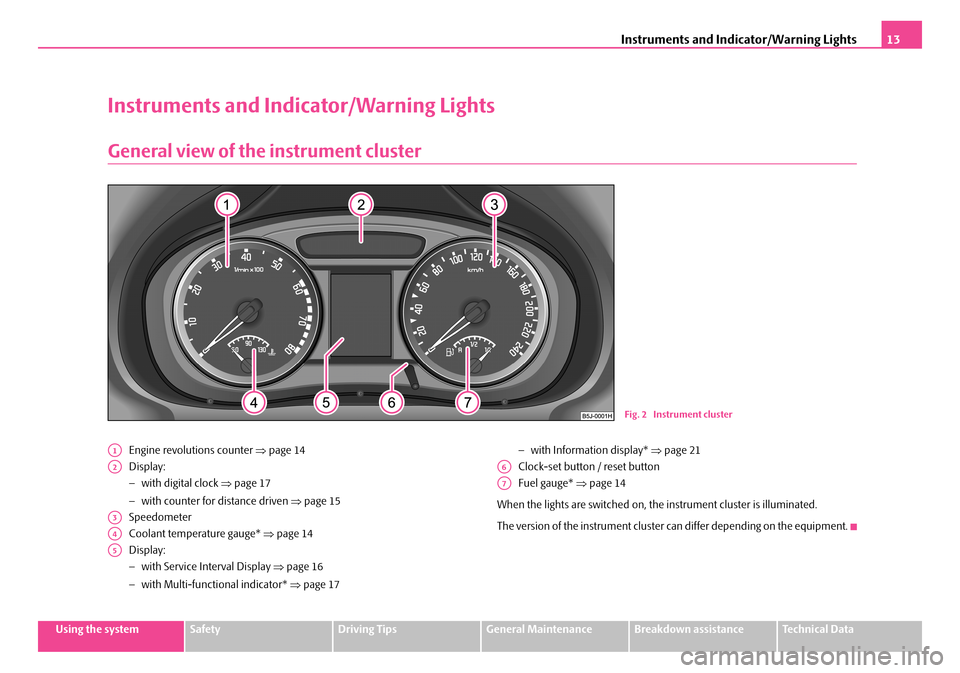
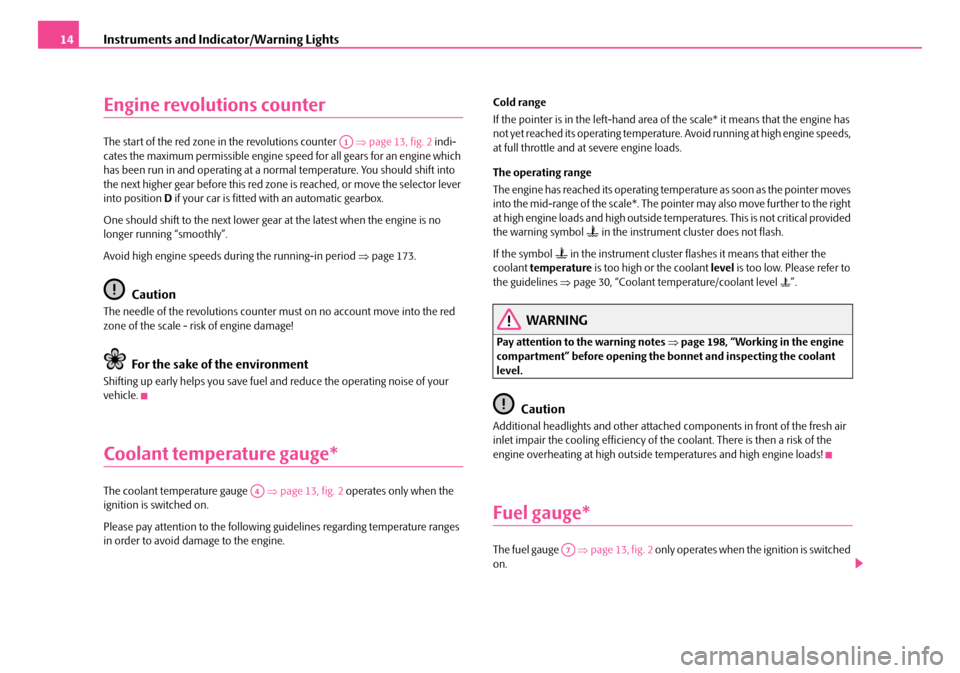
Engine revolutions counter ⇒page 14
Display:
− with digital clock ⇒page 17
− with counter for distance driven ⇒page 15
Speedometer
Coolant temperature gauge* ⇒page 14
Display:
− with Service Interval Display ⇒page 16
− with Multi-functional indicator* ⇒page 17
− with Information display* ⇒page 21
Clock-set button / reset button
Fuel gauge* ⇒page 14
When the lights are switched on, th e instrument cluster is illuminated.
The version of the instrument cluster can differ depending on the equipment.
Fig. 2 Instrument cluster
A1
A2
A3
A4
A5
A6
A7
NKO A05Fabia 20.book Page 13 Tuesday, September 26, 2006 8:38 AM
Page 15 of 258
Instruments and Indicator/Warning Lights14
Engine revolutions counter
The start of the red zone in the revolutions counter ⇒page 13, fig. 2 indi- cates the maximum permissible engine speed for all gears for an engine which has been run in and operating at a normal temperature. You should shift into the next higher gear before this red zone is reached, or move the selector lever into position D if your car is fitted with an automatic gearbox.
One should shift to the next lower gear at the latest when the engine is no longer running “smoothly”.
Avoid high engine speeds du ring the running-in period ⇒page 173.
Caution
The needle of the revolutions counter must on no account move into the red zone of the scale - risk of engine damage!
For the sake of the environment
Shifting up early helps yo u save fuel and reduce the operating noise of your vehicle.
Coolant temperature gauge*
The coolant temperature gauge ⇒page 13, fig. 2 operates only when the ignition is switched on.
Please pay attention to the following gu idelines regarding temperature ranges in order to avoid damage to the engine.
Cold range
If the pointer is in the left-hand area of the scale* it means that the engine has not yet reached its operating temperature. Avoid running at high engine speeds, at full throttle and at severe engine loads.
The operating range
The engine has reached its operating temp erature as soon as the pointer moves into the mid-range of the scale*. The pointer may also move further to the right at high engine loads and high outside temp eratures. This is not critical provided the warning symbol in the instrument cluster does not flash.
If the symbol in the instrument cluster flashes it means that either the coolant temperature is too high or the coolant level is too low. Please refer to the guidelines ⇒page 30, “Coolant temperature/coolant level ”.
WARNING
Pay attention to the warning notes ⇒page 198, “Working in the engine compartment” before opening the bonnet and inspecting the coolant level.
Caution
Additional headlights and other attached components in front of the fresh air inlet impair the cooling efficiency of th e coolant. There is then a risk of the engine overheating at hi gh outside temperatures and high engine loads!
Fuel gauge*
The fuel gauge ⇒page 13, fig. 2 only operates when the ignition is switched on.
A1
A4
A7
NKO A05Fabia 20.book Page 14 Tuesday, September 26, 2006 8:38 AM
Page 21 of 258
Instruments and Indicator/Warning Lights20
The outside temperature appears in the display when the ignition is switched on.
The correct outside temperature will be indicated with a delay of 5 minutes. If the vehicle is stationary (or driven at a very low speed) the temperature indi- cated may be slightly higher than the actual outside temperature because of heat radiated by the engine.
If the outside temperature drops below +4 °C, a snow flake symbol (warning signal for ice on the road) appears wi th the outside temperature indicator ⇒ page 19, fig. 7 and a warning signal* sounds for 10 seconds.
WARNING
Do not only rely upon the information given on the outside temperature display that there is no ice on the road. Please note that black ice may also be present on the road surface ev en at temperatures around +4 °C - warning, drive with care!
Note
The outside temperature is not indicating when showing navigation data (guid-ance to the destination). It must be ca lled up over the menu (valid for vehicles which have a navigation and information display).
Range
The estimated range in kilometres is shown on the display. It indicates the distance you can still drive with your vehicle based on the present level of fuel in the tank for the same style of driving. The readout is shown in steps of 10 km.
The fuel consumption for the last 50 km is taken as a basis for calculating the range. If you drive in a more econom ical manner from this moment on, the range will be increased accordingly.
You first drive 50 km if the readout is reset (after disconnecting the battery) before a new readout for the range is displayed.
Current fuel consumption
The current fuel consumption level is show n in the display in litres/100 km. This information can help you to adapt your st yle of driving to the fuel consumption you wish to achieve.
The display appears in litres/hour if the vehicle is stationary or driving at a low speed.
Average fuel consumption
The average fuel consumption since the memory was last erased is shown in the display in litres/100 km ⇒page 18. This information can help you to adapt your style of driving to the fuel consumption you wish to achieve.
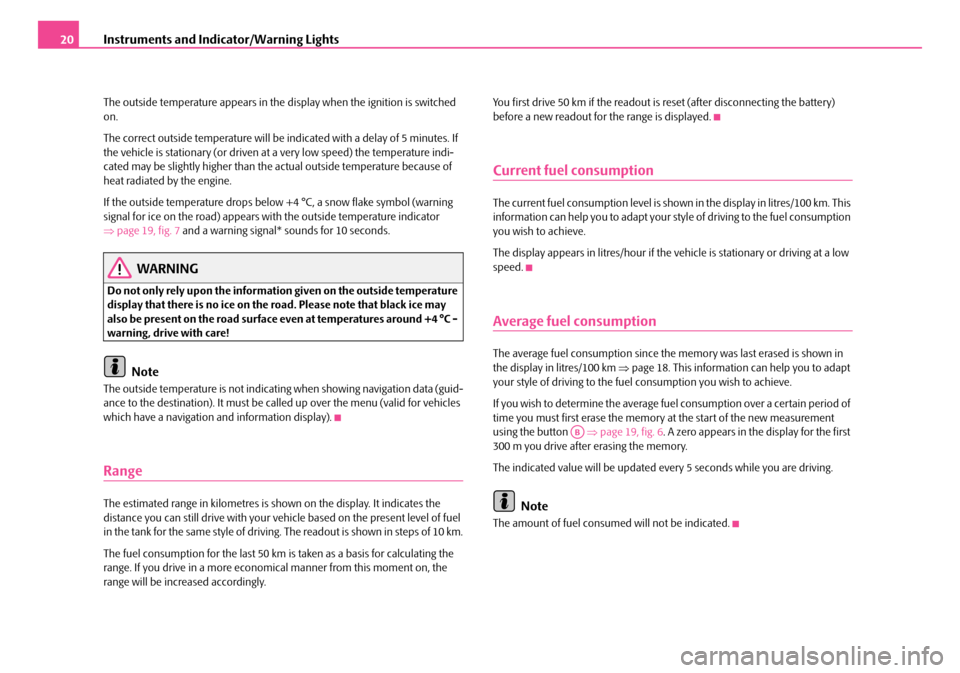
If you wish to determine the average fuel consumption over a certain period of time you must first erase the memory at the start of the new measurement using the button ⇒page 19, fig. 6. A zero appears in the display for the first 300 m you drive after erasing the memory.
The indicated value will be updated every 5 seconds while you are driving.
Note
The amount of fuel consum ed will not be indicated.
AB
NKO A05Fabia 20.book Page 20 Tuesday, September 26, 2006 8:38 AM
Page 25 of 258
Instruments and Indicator/Warning Lights24
Operational faults, urgent repairs, service work or other information appear in the display of the instrument cluster. The displays are shown with a red or yellow light symbol depending on the priority of the message.
The red symbols indicate danger (priority 1) while the yellow symbols indicate a warning (priortity 2). Information for the driver may also appear in addition to the symbols ⇒page 26.
Investigate the displayed faults as soon as possible. If several operational faults exist at the same time, the symbols will appear one after the other and light up each for about 10 seconds.
The error messages are displayed and stored in the menu VEH. STATUS.
There is at least one error message to be read when the term VEH. STATUS is flashing in the main menu. The display will show STATUS 1/2 (for example) if a number of error messages are displayed. This display indicates that the first of a total of two error messages should be displayed.
Actuate the rocker switch , to call up the individual error messages.
If a fault occurs, a warning signal will also sound in addition to the symbol and text in the display:
•Priority 1 - three warning signals,
•Priority 2 - one warning signal.
Red symbols
A red symbol signals danger.
Proceed as follows if a red symbol is displayed:
– Stop the vehicle.
– Switch the engine off.
– Investigate the function indicated.
– Obtain professional assistance.
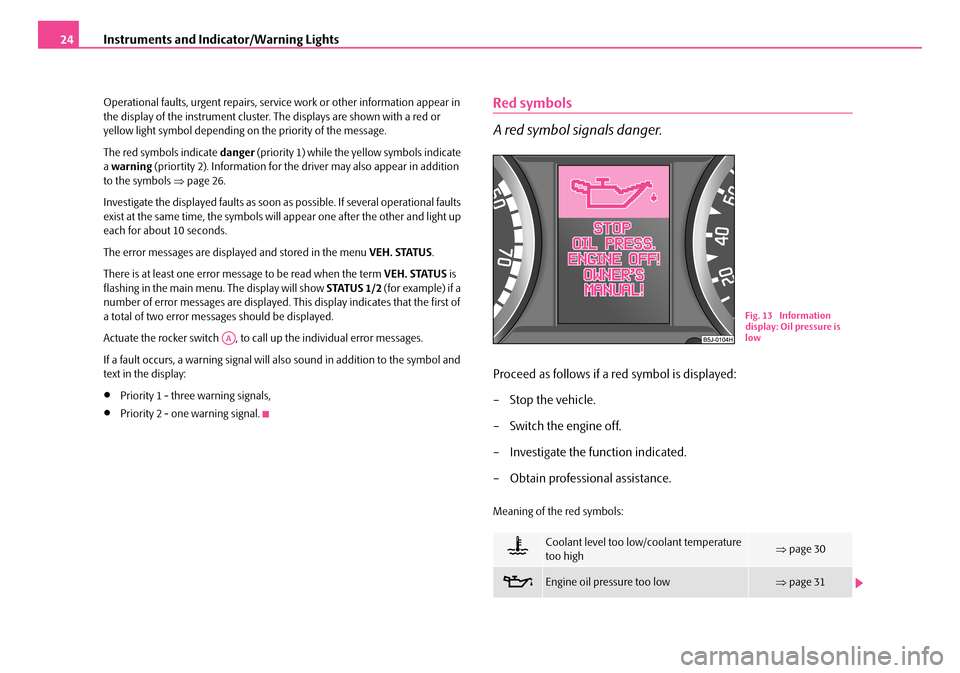
Meaning of the red symbols:
AA
Coolant level too low/coolant temperature too high⇒ page 30
Engine oil pressure too low⇒page 31
Fig. 13 Information display: Oil pressure is low
NKO A05Fabia 20.book Page 24 Tuesday, September 26, 2006 8:38 AM
Page 26 of 258
Instruments and Indicator/Warning Lights25
Using the systemSafetyDriving TipsGeneral MaintenanceBreakdown assistanceTechnical Data
Three successive warning signals will sound if a red symbol appears.
If several operational faults of priority 1 exist, the symbols appear one after the other and are each illumi nated for about 5 seconds.
Ye l l o w s y m b o l s
A yellow symbol signals a warning.
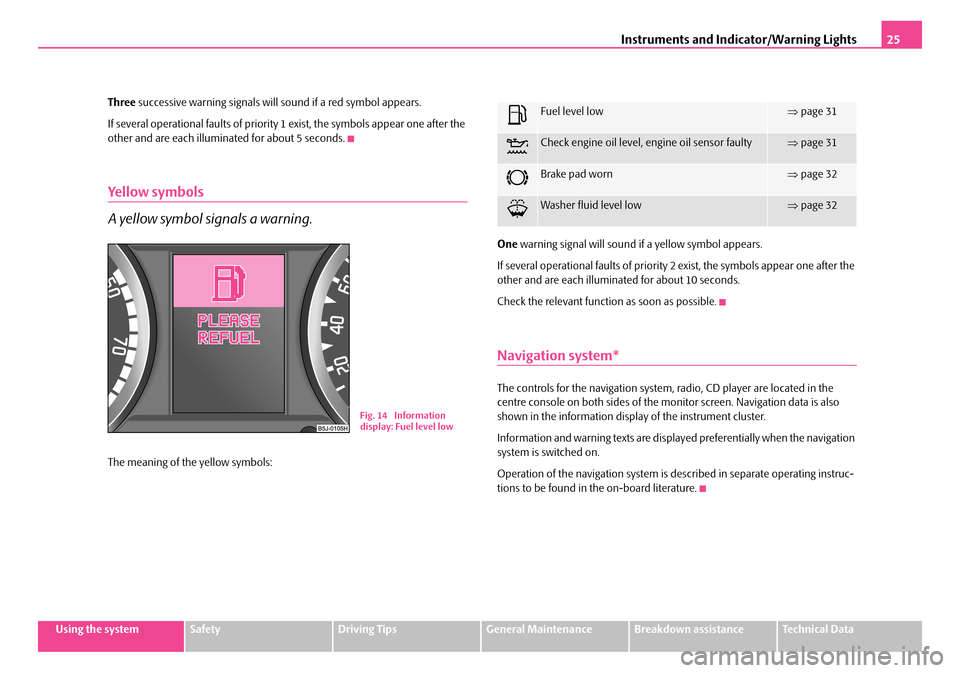
The meaning of the yellow symbols:
One warning signal will sound if a yellow symbol appears.
If several operational faults of priority 2 exist, the symbols appear one after the other and are each illuminated for about 10 seconds.
Check the relevant function as soon as possible.
Navigation system*
The controls for the navigation system, radio, CD player are located in the centre console on both sides of the mo nitor screen. Navigation data is also shown in the information display of the instrument cluster.
Information and warning texts are displaye d preferentially when the navigation system is switched on.
Operation of the navigation system is described in separate operating instruc- tions to be found in the on-board literature.
Fig. 14 Information display: Fuel level low
Fuel level low⇒ page 31
Check engine oil level, engine oil sensor faulty⇒page 31
Brake pad worn⇒page 32
Washer fluid level low⇒page 32
NKO A05Fabia 20.book Page 25 Tuesday, September 26, 2006 8:38 AM
Page 28 of 258
Instruments and Indicator/Warning Lights27
Using the systemSafetyDriving TipsGeneral MaintenanceBreakdown assistanceTechnical Data
WARNING
•If you do not pay attention to the warning lights coming on and the corresponding descriptions and warning notes, this may result in severe body injuries or major vehicle damage.
•The engine compartment of your car is a hazardous area. There is a risk of injuries, scalding, accidents and fire when working in the engine compartment, e.g. inspecting and replenishing oil and other fluids. It is also essential to observe all warnings ⇒page 198.
Note
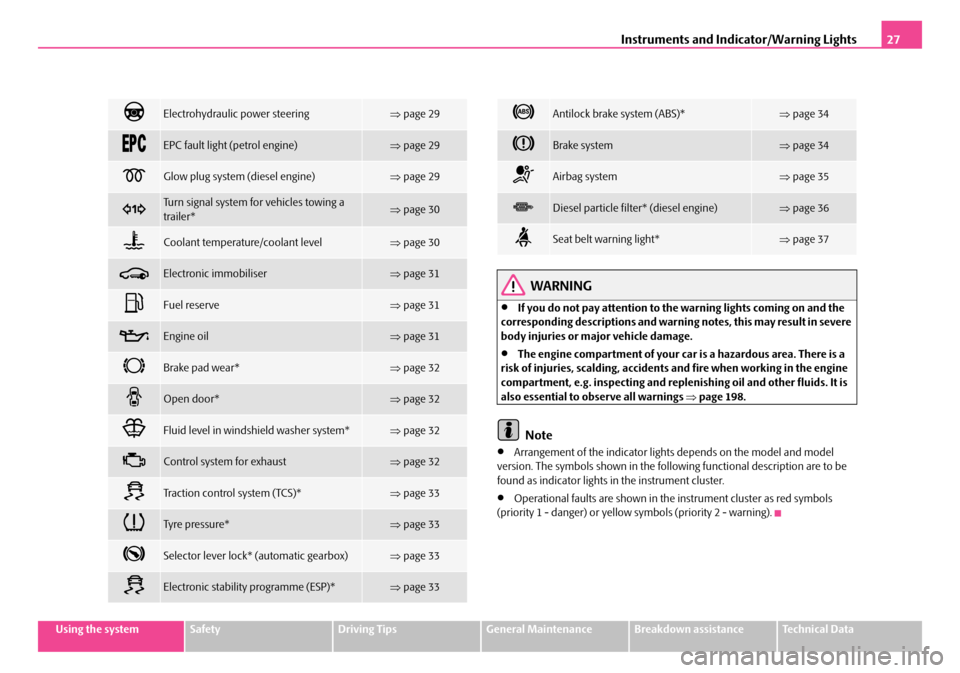
•Arrangement of the indicator lights depends on the model and model version. The symbols shown in the following functional description are to be found as indicator lights in the instrument cluster.
•Operational faults are shown in the instrument cluster as red symbols (priority 1 - danger) or yellow symbols (priority 2 - warning).
Electrohydraulic power steering⇒ page 29
EPC fault light (petrol engine)⇒page 29
Glow plug system (diesel engine)⇒page 29
Turn signal system for vehicles towing a trailer*⇒ page 30
Coolant temperature/coolant level⇒page 30
Electronic immobiliser⇒page 31
Fuel reserve⇒page 31
Engine oil⇒page 31
Brake pad wear*⇒page 32
Open door*⇒page 32
Fluid level in windshield washer system*⇒page 32
Control system for exhaust⇒page 32
Traction control system (TCS)*⇒page 33
Tyre pressure*⇒page 33
Selector lever lock* (automatic gearbox)⇒page 33
Electronic stability programme (ESP)*⇒page 33
Antilock brake system (ABS)*⇒page 34
Brake system⇒page 34
Airbag system⇒page 35
Diesel particle filter* (diesel engine)⇒page 36
Seat belt warning light*⇒page 37
NKO A05Fabia 20.book Page 27 Tuesday, September 26, 2006 8:38 AM
Page 29 of 258

Instruments and Indicator/Warning Lights28
Turn signal system
Either the left or right indicator light flashes depending on the position of the turn signal lever.
The indicator light flashes at twice its normal rate if a turn signal light fails. This does not apply when towing a trailer.
Switching off the hazard warning light system is switched on will cause all of the turn signal lights as well as both indicator lights to flash.
Further information about the turn signal system ⇒page 60.
Main beam
The indicator light comes on when the main beam is selected or also when the headlight flasher is operated.
Further information about the main beam ⇒page 60.
Low beam
The indicator light comes on when low beam is selected ⇒page 56.
Rear fog light
The warning light comes on when the rear fog lights are operating ⇒ page 58.
Alternator
The warning light comes on after the ignition has been switched on. It should go out after the engine has started.
If the warning light does not go out after the engine has started, or comes on when driving, drive to the nearest specialist garage. The vehicle battery will be discharged in this case so switch off all non-essential electrical components.
The following text will be displayed in the information display*:
ALTERNATOR WORKSHOP!
Caution
If the warning light comes on when driving and in addition the warning light (cooling system fault) also comes on in display, you must then stop the car immediately and switch the engine off - risk of engine damage!
Fog lights*
The warning light comes on when the fog lights are operating ⇒page 58.
Cornering lights*
If the warning light flashes for 1 minute while driving or after switching on the ignition and a warning signal sounds, a fault is confirmed.
Further information ⇒page 57.
NKO A05Fabia 20.book Page 28 Tuesday, September 26, 2006 8:38 AM