engine SKODA FABIA 2010 2.G / 5J Workshop Manual
[x] Cancel search | Manufacturer: SKODA, Model Year: 2010, Model line: FABIA, Model: SKODA FABIA 2010 2.G / 5JPages: 244, PDF Size: 29.53 MB
Page 146 of 244
Driving and the Environment
145
Using the system
Safety
Driving Tips
General Maintenance
Breakdown assistance
Technical Data
Driving and the EnvironmentThe first 1 500 kilometres and then afterwardsA new engine The engine has to be run in du
ring the first 1 500 kilometres.
Up to 1 000 kilometres– Do not drive faster than 3/4 of the maximum speed of the gear in use, that is 3/4 of
the maximum permissi
ble engine speed.
– Do not use full throttle.– Avoid high engine revolutions.– Do not tow a trailer.From 1 000 up to 1 500 kilometres– Increase the power output of the engine
gradually
up to the full speed of the gear
engaged, that is up to the maxi
mum permissible engine revolutions.
During the first operating hours the engine ha
s higher internal friction than later until
all of the moving parts have harmonized. Th
e driving style which you adopt during the
first approx.1 500 kilometres plays a decisive
part in the success of running in your
vehicle. You should not drive at unnecessarily
high engine revolutions
even after the
running-in period is complete
. The maximum permissible en
gine speed is marked by
the beginning of the red zone on the scale of the revolutions counter. Shift up into the next higher gear on a vehi
cle fitted with manual gear
box before the red zone is
reached. During acceleration
(depressing the accelerator)
exceptionally
high engine
speeds are automatically reduced, yet the engine is not protected against too high engine speeds which are caused by incorrectly shifting down the gears resulting in a sudden increase of the engine speeds above the permitted maximum revolutions which can lead to engine damage. For a vehicle fitted with a manual gearbox the
converse situation also applies: Do not
drive at engine revolutions which are
too low
. Shift down as soon as the engine is no
longer running smoothly.
Caution
All the speed and engine revolution figures ap
ply only when the engine is at its normal
operating temperature. Never rev up an engine which is cold, neither when the vehicle is stationary nor when driving in individual gears.
For the sake of the environment
Not driving at unnecessari
ly high engine revolutions and
shifting to a higher gear as
early as possible are ways to minimise fuel consumption, operating noise levels as well as protects the environment and contributes
to a longer life and reliability of the
engine.New tyresNew tyres have to be “run in” since they do
not offer optimal grip at first. You should
take account of this fact for the first 500
kilometres and drive pa
rticularly carefully.
New brake padsAllow for the fact that new brake pads do no
t achieve their full braking efficiency until
approximately 200 kilometres. New brake pads must be first “run in” before they develop their optimal friction force. You ca
n, however, compensate for this slightly
reduced braking force by increasing the pressure on the brake pedal. This guideline also applies to any new brake pads installed at a future date.During the running-in pe
riod, you should avoi
d excessive stre
sses on the brakes. This
includes, for example, violent braking, part
icularly from very high speeds, and also
when crossing mountain passes.
s3j8.a.book Page 145 Tuesday, April 20, 2010 1:10 PM
Page 147 of 244
Driving and the Environment
146
Catalytic converterProper operation of the emission cont
rol system (catalytic converter) is
of major significance for driving your vehicle in an environmentally conscious way.Please refer to the following guidelines: – For vehicles with petrol engine only refuel with unleaded petrol
page 162,
“Grades of petrol”.
– Never run the fuel tank completely empty.– Do not switch off the ignition while you are driving the vehicle.– Do not pour too much oil into the engine
page 168, “Replenishing engine oil”.
– Do not tow-start the vehicle over a distance of more than 50 metres
page 193,
“Tow-starting a vehicle”.
If you drive your vehicle in a country in
which unleaded petrol is not available, you
must have the catalytic converter replaced la
ter when driving the ve
hicle into a country
in which use of a catalyti
c converter is mandatory.
WARNING
In view of the high temperatures which may be produced in the catalytic
converter, one should always park a vehicle in such a way that the catalytic converter cannot come into contact with easily flammable materials below the vehicle - a risk of fire!
Never use additional underbody protection or corrosion-protection agents
for the exhaust pipes, catalytic converters or heat shields. Such substances might ignite when driving - risk of fire!
Caution
On vehicles fitted with a catalytic converte
r, never let the fuel tank run completely
empty. An irregular fuel supply can result in poor ignition or misfiring. Unburnt fuel may get into the exhaust system an
d damage the cata
lytic converter.
Filling the tank even only once with le
aded petrol will resu
lt in the catalytic
converter being destroyed.
If you detect misfir
ing, a drop in performance or
irregular engine running when
driving, reduce your speed immediately and have the vehicle inspected by the nearest specialist garage. The symptoms described ma
y be caused by a fault in the ignition
system. Unburnt fuel may get into the exhaust system and damage the catalytic converter.
For the sake of the environment
Even if the exhaust system is operating pr
operly, a sulphur-like exhaust odour may be
produced under certain oper
ating conditions of the en
gine. This de
pends on the
sulphur content of the fuel. It is often sufficient to refuel with unleaded premium-grade petrol of a different brand or at a different filling station.Driving in an economical and environmentally conscious mannerGeneral Your personal style of driving is a major factor.Your fuel consumption, any pollution of
the environmental and the wear-and-tear to
the engine, brakes and tyres, depend essentially on three factors:
your personal style of driving;
the conditions under which
your vehicle is operated;
technical aspects.
You can easily improve your fuel economy by
10 - 15 percent by driving in an econom-
ical way with foresight. This section is intended to provide you with a number of tips on how to protect the environment and at the same time save money. The fuel consumption can naturally also be
influenced by factors which are beyond the
driver's control. It is, for example, normal
for the fuel consumption to increase in
winter and under worsened cond
itions such as poor road conditions, towing a trailer,
etc. The technical requirements for low fuel usage and economic efficiency of the vehicle have already been built into the vehicle at the works. Special attention has been given to minimising negative
effects on the environment. It is
necessary to take note of the
s3j8.a.book Page 146 Tuesday, April 20, 2010 1:10 PM
Page 149 of 244
Driving and the Environment
148
Reducing idling Idling also costs fuel.It is worthwhile switching off the engine in
a traffic jam or when waiting at a level
crossing or at traffic lights with a lengthy red phase. Even after just 30 - 40 seconds you will have saved more fuel th
an that is needed when you start the engine up again.
If an engine is only idling it takes much
longer for it to reach its normal operating
temperature. Wear-and-tear and pollutant emis
sions, though, are particularly high in
the warming-up phase. This is why you should drive off right after starting the engine. Do avoid high engine revolu
tions at this time, however.
Regular servicing A poorly tuned engine consumes an unnecessarily high amount of fuel.Having your vehicle serviced regularly at a specialist garge enables you to satisfy
one
of the requirements for economical motoring even before you set off on your journey. Keeping your vehicle properly serviced not on
ly has a positive effect on the safety of
your vehicle and maintaining its value, but also saves on
fuel
.
A poorly tuned engine can result in a fu
el consumption which
is 10% higher than
normal. The foreseen maintenance work should be
undertaken exactly according to the
Service schedule by a specialist garage. Also check the
oil level
after refueling.
Oil consumption
is dependent to a consider-
able extent on the load and speed of the en
gine. Oil consumption co
uld be as high as
0.5 litres/1 000 km depending on your style of driving. It is quite normal that a new engine has a
higher oil consumption
at first, and reaches
its lowest level only after a certain running in time. It is therefore not possible to correctly assess the oil consumption of a new
vehicle until after yo
u have driven about
5 000 km.
For the sake of the environment
You can achieve additional
improvements in your fuel economy by using high-
lubricity oils.
Check the ground below your vehicle at regular intervals to detect any leakages in
good time. Please have your vehicle inspec
ted by a specialist garge if you find any
stains caused by oil or other fluids on the floor.Avoid driving short distances Short distances result in an above-average high fuel consumption.– Avoid driving a distance of no more
than 4 km if th
e engine is cold.
The engine and catalytic converter mu
st first have reached their optimal
operating
temperature
in order to effectively reduce fuel consumption and pollutant emissions.
The cold engine vehicle cons
umes approx. 15 - 20 litres/100 km of fuel immediately
after starting. Fuel co
nsumption drops to 10 litres/100
km after just 1 kilometre. The
engine reaches its operating temperat
ure (outside temperature and engine
dependent) only after about
4 to 10
kilometres and the fuel consumption then stabi-
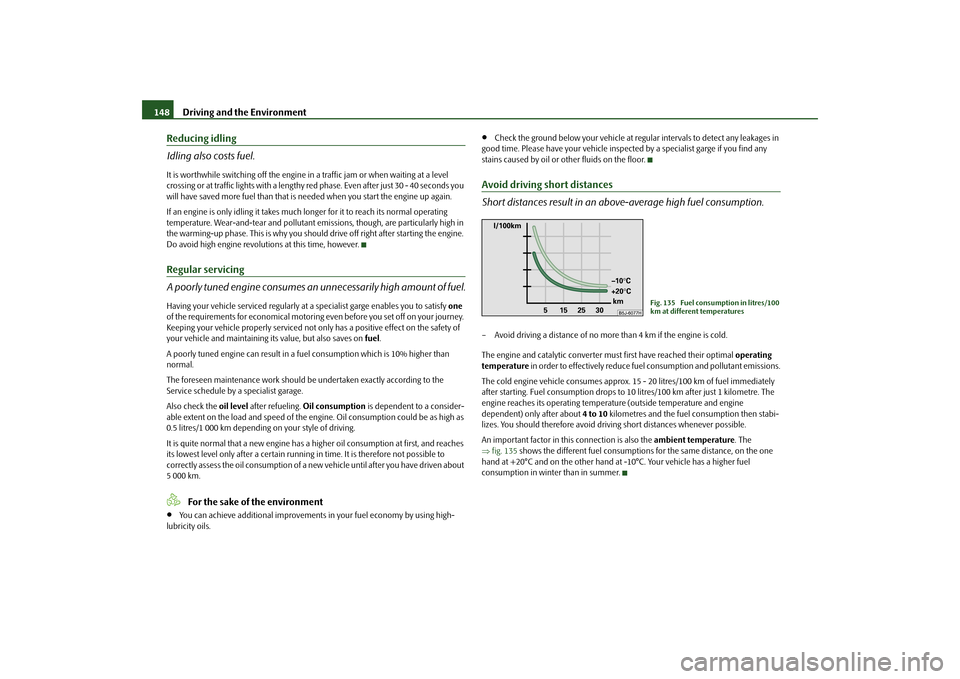
lizes. You should therefore avoid driving short distances whenever possible. An important factor in this connection is also the
ambient temperature
. The
fig. 135
shows the different fuel consumptions for the same distance, on the one
hand at +20°C and on the other hand at
-10°C. Your vehicle has a higher fuel
consumption in winter than in summer.
Fig. 135 Fuel consumption in litres/100 km at different temperatures
s3j8.a.book Page 148 Tuesday, April 20, 2010 1:10 PM
Page 150 of 244
Driving and the Environment
149
Using the system
Safety
Driving Tips
General Maintenance
Breakdown assistance
Technical Data
Checking tyre inflation pressures Tyres which are correctly inflated save fuel.Always ensure that your tyres are inflated to the correct pressure at all times. The rolling resistance will be increased if the tyre filling pressure is too low. This will not only increase fuel consumption but also tyre we
ar and the driving behaviour will worsen.
Always check the inflation pr
essure of the tyres when
cold
.
Do not drive with
winter tyres
all year round for this costs about 10 % more fuel.
Winter tyres are also louder.No unnecessary ballast Transporting ballast costs fuel.The fact that every kilogram of extra
weight
increases your fuel consumption means
that it is worth taking a look in the luggage compartment to avoid transporting any unnecessary ballast. It is particularly in town traffic, when one
is accelerating quite often, that the vehicle
weight will have a significant effect upon
the fuel consumption. A rule of thumb here
is that an increase in weight of 100 kilograms will cause an increase in fuel consump- tion of about 1 litre/100 kilometres. You may frequently also leave a
roof rack fitted
on just out of convenience, although
you no longer need it. The increased aerodyna
mic drag of your vehi
cle causes it to use
about 1 l more fuel than normal at a speed of 100 - 120 km/h, even when you are not carrying a load on the roof.Saving electricity Generating electricity costs fuel.– Switch off electrical components as
soon as you no longer need them.
When the engine is running, th
e alternator generates and supp
lies electrical power. If
more electrical components of the electrical system are switched on, more fuel is needed to operate the alternator.
Keeping a log of your fuel consumptionIf you really wish to keep a close check on your
fuel consumption
, it is best to enter
the figures in a logbook. This does not take much time but is a very worthwhile exer-cise. It enables you to detect any change (p
ositive and negative) at an early stage and
to take any appropriate action. If you find that your fuel
consumption is too high, you should reflect on how, where
and in what conditions you have driven
the vehicle since you last refuelled.
Environmental compatibilityEnvironmental protection has played a major role in the design, selection of materials and manufacture of your new Škoda. Particular emphasis has been paid to a number of aspects, including: Design measures
Joints designed to
be easily detached.
Simplified disassembly due to the modular structure system.
Improved purity of differ
ent classes of materials.
Identification of all plastic parts in
accordance with VDA Recommendation°260.
Reduced fuel consumption
and exhaust emission CO
2.
Minimum fuel leakage during accidents.
Reduced noise.
Choice of materials
Extensive use of re
cyclable material.
Air conditioning filled with CFC-free refrigerant.
No cadmium.
No asbestos.
Reduction in the “vaporisation” of plastics.
Manufacture
Solvent-free cavity protection.
s3j8.a.book Page 149 Tuesday, April 20, 2010 1:10 PM
Page 151 of 244
Driving and the Environment
150
Solvent-free protection of the vehicle for
transportation from the production plant
to the customer.
The use of solvent-free adhesives.
No CFCs used in the production process.
Without use of mercury.
Use of water-soluble paints.
Trade-in and recycling of old cars Škoda Auto meets the requirements of the brand and its products regarding environ- ment and ressource protection. All new Škoda
vehicles can be utilized up to 95% and
always
11) be returned. In a lot of countries sufficient trade-in networks have been
created, where you can trade-in your vehicle.
After you trade-in your vehicle, you will
receive a confirmation stating the recycling
in accordance with environmental regula-
tions. Vehicles with special built-on types Technical documents regarding changes carried
out on the vehicle must be kept by the
vehicle user, in order to hand over later to the old car user. This ensures the recycling in accordance with en
vironmental regulations.
Motoring abroadGeneral Other circumstances may exist abroad.It is also possible, in certai
n countries, that the
Škoda Service Partner network is limited
or has not been established yet. This is
the reason why obtaining certain spare parts
may be somewhat complicated and specialist
garage personnel may only be able to
make limited repairs. Škoda
Auto in the Czech Republic and relevant importers are
happy to provide information
about technical aspects of the vehicle, required mainte-
nance work and possibilities for getting repairs done.
Unleaded petrolA vehicle fitted with a petrol engine must
always be refuelled
with unleaded petrol
page 146. The automobile associations can provide you with information regarding the locations of filling stations which offer unleaded petrol.HeadlightsThe low beam of your headligh
ts is set asymmetrically. It illuminates the side of the
road on which you are driving to a greater ex
tent. If you drive abroad on the other side
of the road, you will da
zzle oncoming traffic.
Halogen projector headlights The adaptation of the headlights (valid for vehicles which are designed for driving on the left and on the right) must be performe
d by switching over a bezel by a specialist
garage. Halogen headlight When using Halogen headlights, it is necessary to stick a sticker over a certain part of the headlights in order to prevent the dazzling of oncoming traffic. You can purchase headlight stickers from
the range of the Škoda original parts.
Note
You can obtain further information regardin
g masking over or converting the head-
lights from your specialist garage.Avoiding damage to your vehicleWhen driving on poor roads and lanes or when driving over kerbstones, steep ramps etc., you must pay particular attention to
ensuring that any low-slung parts of the
vehicle, such as spoiler and exhaust,
do not touch the ground and get damaged.
This particularly applies to models with a lowered suspension (sport suspension) and also when your vehicle is fully laden.
11)Subject to fulfilment of the national legal requirements.s3j8.a.book Page 150 Tuesday, April 20, 2010 1:10 PM
Page 152 of 244
Driving and the Environment
151
Using the system
Safety
Driving Tips
General Maintenance
Breakdown assistance
Technical Data
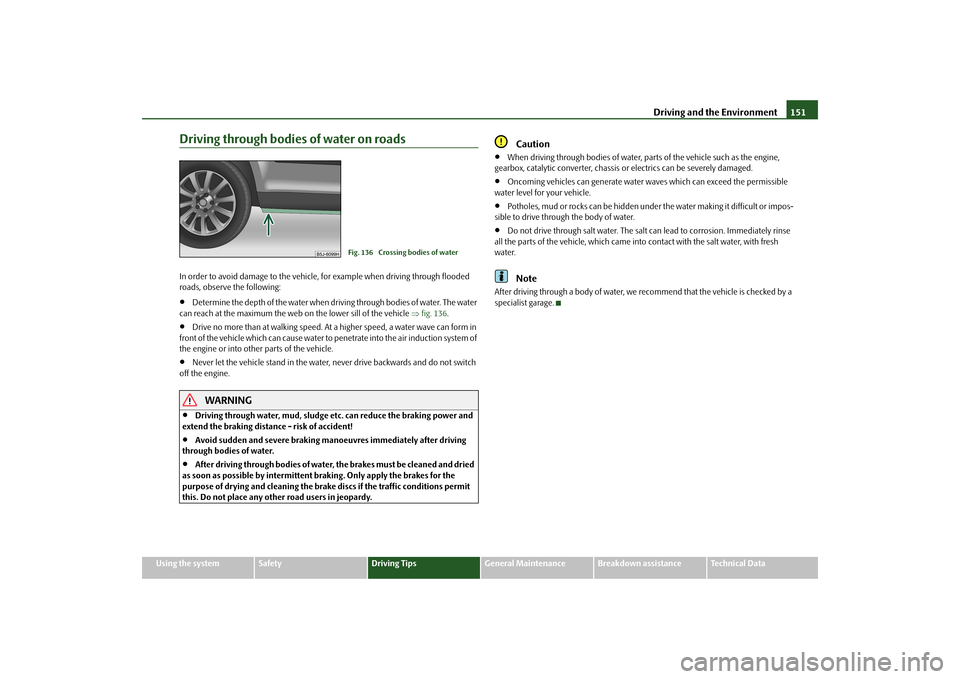
Driving through bodies of water on roadsIn order to avoid damage to the vehicle,
for example when driving through flooded
roads, observe the following:
Determine the depth of the water when driv
ing through bodies of water. The water
can reach at the maximum the web on
the lower sill of the vehicle
fig. 136
.
Drive no more than at walking speed. At a higher speed, a water wave can form in
front of the vehicle which can
cause water to penetrate into the air induction system of
the engine or into other parts of the vehicle.
Never let the vehicle stand in the water, never drive backwards and do not switch
off the engine.
WARNING
Driving through water, mud, sludge etc. can reduce the braking power and
extend the braking distance - risk of accident!
Avoid sudden and severe braking manoeuvres immediately after driving
through bodies of water.
After driving through bodies of water, the brakes must be cleaned and dried
as soon as possible by intermittent braking. Only apply the brakes for the purpose of drying and cleaning the brake discs if the traffic conditions permit this. Do not place any other road users in jeopardy.
Caution
When driving through bodies of water, pa
rts of the vehicle such as the engine,
gearbox, catalytic converter, chassis
or electrics can be severely damaged.
Oncoming vehicles can gene
rate water waves which ca
n exceed the permissible
water level for your vehicle.
Potholes, mud or rocks can be
hidden under the water making it difficult or impos-
sible to drive through the body of water.
Do not drive through salt water. The salt
can lead to corrosion. Immediately rinse
all the parts of the vehicle, which came into
contact with the salt water, with fresh
water.
Note
After driving through a body of water, we
recommend that the vehicle is checked by a
specialist garage.
Fig. 136 Crossing bodies of water
s3j8.a.book Page 151 Tuesday, April 20, 2010 1:10 PM
Page 153 of 244
Towing a trailer
152
Towing a trailerTo w i n g a t r a i l e rTechnical requirements The towing device must satisfy certain technical requirements.Your vehicle is designed primarily for tr
ansporting persons and luggage. It can,
however, also be used for towing a traile
r - provided certain technical equipment is
fitted. If your vehicle has been eq
uipped with a towing device
from Škoda Original Accesso-
ries, then the towing device satisfies all technical and legal requirements. Your vehicle is fitted with a 13-pin power so
cket for the electrical connection between
the vehicle and trailer. If the tr
ailer which you wish to tow has a
7-pin connector
, you
can use a suitable adapter
12) from Škoda original accessories.
This work must be carried out in accordance
with the manufacturer's specifications if
a towing device is retrofitted. Specialist garages are familiar with details re
lating to retrofitting a towing device and
for any necessary modifications to the cooling system.
WARNING
We recommend that you have the towing device from Škoda original accesso-ries installed by a specialist garage. He
is familiar with all the relevant details
relating to retrofitting such equipment. There is a risk of an accident if the towing device is not properly fitted!General Maintenance There are a number of points to pay attention to when towing a trailer.Trailer load The permissible trailer load must
on no account be exceeded.
You can negotiate appropriately steeper inclin
es and descents if you do not make full
use of the permissible trailer load. The trailer loads specified only apply for
altitudes
up to 1 000 metres above mean sea
level. On petrol engines without forced indu
ction, the engine power output drops with
increasing height due to a lowering of air pr
essure and thus the ability to climb, this
means that the trailer load must be reduced by 10% for every further increase of 1 000 metres in height above sea le
vel. The towed weight is the weight of the (laden) vehicle
and the (laden) trailer together. One should ta
ke this into account before driving up to
higher altitudes. Petrol engines with forced induction use an air pressure correction method, so that their power output does
not depend on the he
ight above sea level.
The trailer and drawbar load information on the type plate of the towing device are merely test data for the towing device
The data relating to your vehicle, which
is often less than this test data, can be found in your vehicle registration docu- ments. Distribution of the load Distribute the load in the trailer in such a
way that any heavy items are located as close
as possible to the axle. Secure th
e items to preven
t them slipping.
Tyre pressure Correct the tyre inflation pressure on yo
ur vehicle for that of “fully laden”,
page 178.
The inflation pressure of the tyres fitted to
the trailer adjust in accordance with the
manufacturer's recommendation. Exterior mirrors You have to have additional ex
terior mirrors fitted if you are not able to see the traffic
behind the trailer with the standard rear-view mirrors. Both exterior mirrors should be attached to folding arms. Adjust the mirrors so that they provide you with an adequate field of view to the rear. Headlights Before starting off with a hitched trailer, al
so check the setting of the headlights. Alter
the setting as necessary with the aid of the headlight beam adjuster
page 51.
12)In some countries the adapter is supplied with the towing device.s3j8.a.book Page 152 Tuesday, April 20, 2010 1:10 PM
Page 154 of 244

Towing a trailer
153
Using the system
Safety
Driving Tips
General Maintenance
Breakdown assistance
Technical Data
Detachable ball head The ball rod is detachable on
vehicles with towing devi
ce and suppliable from Škoda
original accessories. It is stowed together with separate fitting instructions in the spare wheel well in the luggage compartment of the vehicle.
Note
We recommend that you also have your
vehicle inspected between service inter-
vals if you tow a trailer frequently.
The handbrake on the towing vehicle must be put on when coupling and decou-
pling the trailer.
Keep the mechanism of the ball head of
the towing device clean and take proper
care of it with a suitable preservative.Driving Tips Particular caution is required when towing a trailer.– Do not, as far as possible, drive with
your vehicle unladen and the trailer laden.
– Do not make full use of the legal maximum speeds. This applies in particular to
downhill sections.
– Apply the brakes in good time.– Keep a check on the coolant temperature gauge if the outside temperature is high. Distribution of weight The distribution of the weight
is very poor if your vehicle
is unladen and the trailer is
laden. Maintain a particularly low speed if you cannot avoid driving with this combina- tion. Driving speed Do not drive faster than 80 km/h for safety
reasons. This also a
pplies for countries in
which higher speeds are allowed. The fact that the driving stability of the
vehicle + trailer comb
ination reduces with
increasing speed means that the legally allo
wed speed should not be used when there
are unfavourable road, weather or wind cond
itions as well as on downhill sections.
You must always reduce your speed immediat
ely as soon as you detect even just the
slightest swaying
of the trailer. On no account attempt to stop the trailer from
“swaying” by accelerating. Apply the brakes in good time! If
the trailer is fitted with a
trailer brake
, apply the
brakes gently at first and then brake firmly. This will avoid brake jolts resulting from the trailer wheels locking. Shift down gears in good time before negotiating a downhill section to allow the engine to also act as a brake. Engine overheating Please keep a check on the coolant temperature gauge if you have to negotiate a lengthy slope in a low gear at a high engi
ne speed when the outside temperature is
very high
page 16.
If the needle of the coolant temperature gauge moves into the right-hand area or even the red area of the scale, reduce your speed immediately. Stop and switch off the engine if the warning light
in the instrument cluster begins flashing. Wait a few
minutes and check the level of coolant in the coolant expansion bottle
page 170,
“Inspecting the coolant level”. Please refer to the following guidelines
page 29, “Coolant temperature/coolant
quantity
”.
The coolant temperature can be reduced by switching on the heating.Any increase in the cooling effect of the coolant fan through shifting down a gear and increasing the engine speed is not possible
since the fan speed is independent of the
engine speed. One should also not drop a gear
for this reason when towing a trailer as
long as the engine can manage th
e slope without any drop in speed.
s3j8.a.book Page 153 Tuesday, April 20, 2010 1:10 PM
Page 160 of 244
Taking care of your vehicle and cleaning the vehicle
159
Using the system
Safety
Driving Tips
General Maintenance
Breakdown assistance
Technical Data
Underbody protectionThe underside of your vehicle is protected for life against chemical and mechanical influences. One cannot, however, complete
ly rule out damage to the
protective layer
when
driving so we recommend that you inspect the protective layer on the underside of your vehicle and on the
chassis at certain intervals - this is best done at the beginning
and end of the winter - and to touch up any damaged areas. Specialist garages have suitable
spray products
available as well
as the necessary
equipment and are familiar with the instructions for use. Therefore, we recommend you have such touch-up work or additional
corrosion protection measures carried out
by a specialist garage.
WARNING
Never use additional underbody protection or corrosion-protection agents for the exhaust pipes, catalytic converters, di
esel particle filter or heat shields.
When the engine reaches its operating
temperature, these substances might
ignite - risk of fire!Protection of hollow spacesAll the cavities of your vehicle which are at risk from corrosion are protected for life by a layer of
protective wax
applied in the factory.
This wax protection does not require to be inspected or re-treated. Please remove any small amount of wax which flows out of the cavities at high temperatures with a plastic scraper and clean the spot using petroleum cleaner.
WARNING
Safety and environmental pr
otection regulations should observed when using
petroleum cleaner to remove wax - a risk of fire!
Engine compartmentGood corrosion protection is very importan
t, particularly in winter when one often
drives over its salt-strewn roads. One should therefore clean the entire engine compartment before and after the salt spread
ing period, in order to prevent the salt
from being destructive. Specialist garages have the cleaning agen
ts recommended by the manufacturer and
also the required equipment.
WARNING
It is necessary to observ
e the guidelines given in the chapter before working
on the engine compartment
page 166.
Let the engine cool down before cleaning the engine compartment.Caution
Engine cleaning may be only be un
dertaken when the ignition is off.
It is recommended to cover the generator before washing the engine compart-
ment.
For the sake of the environment
The dirty water produced by washing the engine has washed away petrol, and residues of grease and oil and should therefore be
cleaned by an oil separator. This is why
engine washing should only be undertaken in garages or at filling stations (when these are fitted with the required equipment).Care of the interior of vehiclePlastic parts, artificial leather and clothsYou can clean plastic parts and artificial le
ather with a moist cloth. You should only
treat such parts with special
solvent-free plastic cleaning and care products
it does
prove to be adequate.
s3j8.a.book Page 159 Tuesday, April 20, 2010 1:10 PM
Page 163 of 244
Fuel
162
FuelPetrolGrades of petrolYour vehicle can only be operated with
unleaded petrol
, which complies with the
standard
EN 228
. The individual grades of petrol
are distinguished by their octane
number (RON). On the inside of the fuel
filler flap, you will find the information
regarding the RON required by your engine
page 163.
Prescribed fuel - unleaded petrol 95/91 RON Use unleaded petrol
95 RON. You can also use unleaded petrol
91 RON, but this leads
to a slight loss in performance. If, in case of necessity, the vehicle must
be refuelled with petrol of a lower octane
number than the one prescribed, you must co
ntinue driving at me
dium engine speeds
and low engine load. Driving at high engine speeds or a high engine load can severely damage the engine! Refuel as soon as possib
le with petrol of the prescribed octane
number. Prescribed fuel - unleaded petrol min. 95 RON Use unleaded petrol
95 RON.
In case of necessity, you can refuel with petrol
91 RON
if petrol
95 RON
is not avail-
able. You must continue driving at medium
engine speeds and minimum engine load.
Driving at high engine speeds or a high engine load can severely damage the engine! Refuel as soon as possib
le with petrol of the prescribed octane number.
Even in case of necessity, you must not
use petrol of a lower octane number than
91,
otherwise the engine can be severely damaged! You can find further information on refuelling
page 163, “Refuelling”.
Unleaded petrol with higher octane number You can make unlimited use of unleaded pe
trol which has a higher octane number
than the one prescribed.
On vehicles with prescribed unleaded petrol
95/91 RON
, the use of petrol with a
higher octane number than
95 does not result in a noticeable power increase or a
lower fuel consumption. On vehicles with prescribed unleaded petrol
min. 95 RON
, the use of petrol with a
higher octane number than
95 does not result in a power increase or a lower fuel
consumption.
Caution
All Škoda vehicles with petrol engines are equipped with a catalytic converter and
must be only driven with unleaded petrol. Fi
lling the tank even only once with leaded
petrol will result in the cata
lytic converter being destroyed!
Only use unleaded petrol which
complies with the standard
EN 228
.
If you use petrol with a lower octane num
ber than the one prescribed, the engine
can be severely damaged!
Note
The handling, performance and life of your
engine are determined to a significant
extent by the quality of the fuel. Do not use any petrol additives.DieselDiesel fuelYour vehicle can only be operated with
diesel fuel
, which complies with the standard
EN 590
(standard
DIN 51628
in Germany, standard
ÖNORM C 1590
in Austria).
Fuel additives You must not use fuel additives, so-called “flow improvers” (petrol and similar prod- ucts) in diesel fuel. You can find information on refuelling
page 163, “Refuelling”.
s3j8.a.book Page 162 Tuesday, April 20, 2010 1:10 PM