engine SKODA FABIA 2010 2.G / 5J Repair Manual
[x] Cancel search | Manufacturer: SKODA, Model Year: 2010, Model line: FABIA, Model: SKODA FABIA 2010 2.G / 5JPages: 244, PDF Size: 29.53 MB
Page 164 of 244
Fuel
163
Using the system
Safety
Driving Tips
General Maintenance
Breakdown assistance
Technical Data
Caution
Therefore, your vehicle can only be operated with diesel fuel which complies with
the standard
EN 590
(standard
DIN 51628
in Germany, standard
ÖNORM C 1590
in
Austria). Filling the tank even only once wi
th diesel fuel which does not comply with
the standard, can result in damage to the engine parts, the lubrication system, the fuel and exhaust system.
If by mistake you have refuelled with a different fuel other than the diesel fuel
which complies to the above mentioned standards (e.g. petrol), do not start the engine or switch on the ignition! This can result in
severe engine damage! Contact a specialist
garage and have the fuel sy
stem of the engine cleaned.
Water which has collected in the fuel fi
lter can result in engine problems.
Your vehicle is not adapted for use of biofue
l (RME), therefore this fuel must not be
refuelled and driven. The use of biofuel (RME) can lead to damage to the engine or the fuel system.Operation in winterWinter-grade diesel fuel A different grade of diesel fuel is available at
filling stations in winter than during the
summer. Using “summer-grade diesel fuel” at temperatures below 0°C can result in operational problems because th
e diesel becomes viscous as a result of paraffin sepa-
ration. It is therefore the case that the standard
EN 590
(standard
DIN 51628
in Germany,
standard
ÖNORM C 1590
in Austria) is the diesel fuel class prescribed for certain
periods of the year which can also be purc
hased at the correspond
ing time during the
year. “Winter-grade diesel fuel” will still operate properly even at a temperature of - 20°C. It is often the case in countries with different climatic conditions that diesel fuels avail- able have a different temperature characte
ristic. The authorised Škoda Service Part-
ners and filling stations in the country concer
ned will be able to provide you with infor-
mation regarding the diesel fuels available. Prewarming fuel The vehicle is fitted with a fuel filter prewarming system. This secures operation of a vehicle using diesel fuel down to an environmental temperature of -25°C.
Caution
It is not permitted to add the various fuel
additives on the market, including petrol, to
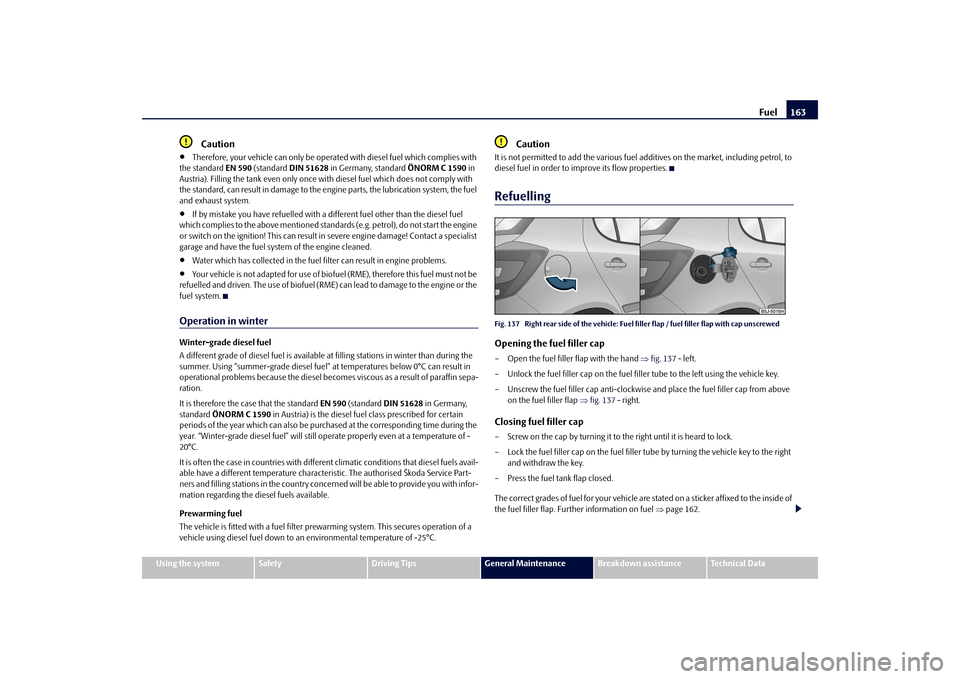
diesel fuel in order to improve its flow properties.RefuellingFig. 137 Right rear side of the vehicle: Fuel
filler flap / fuel filler
flap with cap unscrewed
Opening the fuel filler cap– Open the fuel filler flap with the hand
fig. 137
- left.
– Unlock the fuel filler cap on the fuel fi
ller tube to the left using the vehicle key.
– Unscrew the fuel filler ca
p anti-clockwise and place the fuel filler cap from above
on the fuel filler flap
fig. 137
- right.
Closing fuel filler cap– Screw on the cap by turning it to the right until it is heard to lock. – Lock the fuel filler cap on the fuel filler tube by turning the vehicle key to the right
and withdraw the key.
– Press the fuel tank flap closed. The correct grades of fuel for your vehicle are stated on a sticker affixed to the inside of the fuel filler flap. Further information on fuel
page 162.
s3j8.a.book Page 163 Tuesday, April 20, 2010 1:10 PM
Page 165 of 244
Fuel
164
WARNING
Pay attention to any legal requirements if you do carry a spare canister in the vehicle. We do not recommend carrying any fuel canisters in your vehicle for safety reasons. The canister can be damaged
in the event of an accident and fuel
may leak out.
Caution
Remove any fuel which has spilled onto th
e paintwork of your vehicle immediately
- risk of paint damage!
On vehicles fitted with a catalytic converte
r, never let the fuel tank run completely
empty. An irregular supply of fuel to the engine can result in misfiring and unburnt fuel may get into the exhaust system, which may
result in overheating and damage to the
catalytic converter.
Make sure that the valve is not pressed into the filler tube when inserting the pump
nozzle into the filler tube.
Otherwise you are unintentiona
lly filling up the volume,
which in case of heat can caus
e an expansion of the fuel. This can lead to an overflow
of fuel or damage to parts of the fuel reservoir.
The fuel tank is full just as soon as th
e pump nozzle switches off for the first time,
provided the nozzle has been operated prop
erly. Do not continue refuelling - other-
wise the expansion volume is filled up.
Note
The fuel tank has a
capacity of about
45 litres
, containing a reserve of
7litres
.
s3j8.a.book Page 164 Tuesday, April 20, 2010 1:10 PM
Page 166 of 244
Inspecting and replenishing
165
Using the system
Safety
Driving Tips
General Maintenance
Breakdown assistance
Technical Data
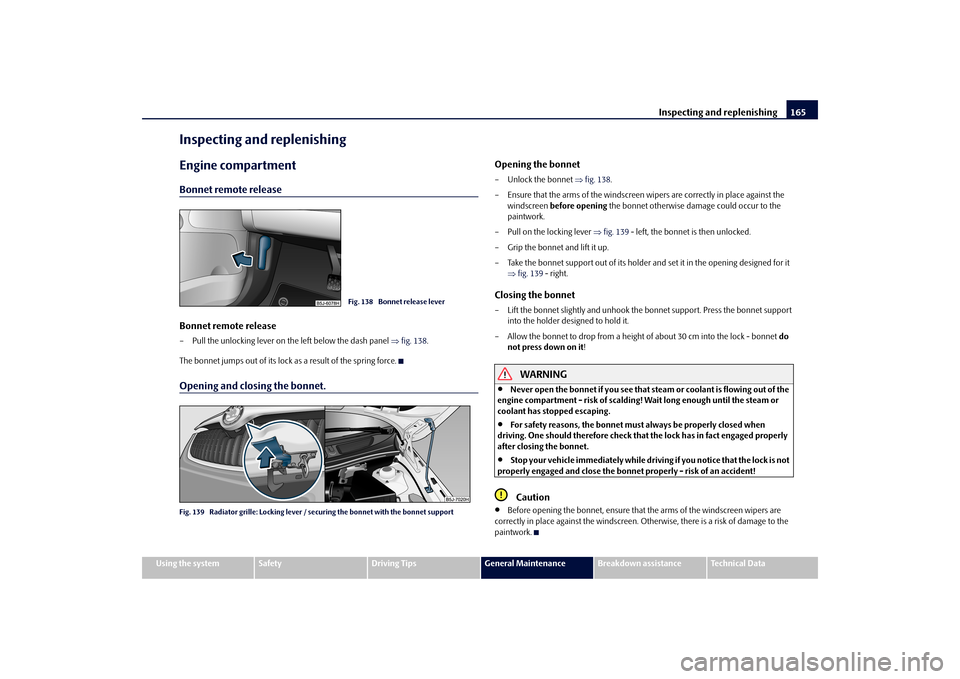
Inspecting and replenishingEngine compartmentBonnet remote releaseBonnet remote release– Pull the unlocking lever on the left below the dash panel
fig. 138
.
The bonnet jumps out of its lock as a result of the spring force.Opening and closing the bonnet.Fig. 139 Radiator grille: Locking lever / se
curing the bonnet with the bonnet support
Opening the bonnet– Unlock the bonnet
fig. 138
.
– Ensure that the arms of the windscreen wipers are correctly in place against the
windscreen
before opening
the bonnet otherwise damage could occur to the
paintwork.
– Pull on the locking lever
fig. 139
- left, the bonnet is then unlocked.
– Grip the bonnet and lift it up.– Take the bonnet support out of its holder and set it in the opening designed for it
fig. 139
- right.
Closing the bonnet– Lift the bonnet slightly and unhook the bonnet support. Press the bonnet support
into the holder designed to hold it.
– Allow the bonnet to drop from a height
of about 30 cm into the lock - bonnet
do
not press down on it
!
WARNING
Never open the bonnet if you see that steam or coolant is flowing out of the
engine compartment - risk of scalding!
Wait long enough until the steam or
coolant has stopped escaping.
For safety reasons, the bonnet must always be properly closed when
driving. One should therefore check that
the lock has in fact engaged properly
after closing the bonnet.
Stop your vehicle immediately while driving if you notice that the lock is not
properly engaged and close the bonnet
properly - risk of an accident!
Caution
Before opening the bonnet, ensure that the arms of the windscreen wipers are
correctly in place against the windscreen. Othe
rwise, there is a risk of damage to the
paintwork.
Fig. 138 Bonnet release lever
s3j8.a.book Page 165 Tuesday, April 20, 2010 1:10 PM
Page 167 of 244
Inspecting and replenishing
166
Working in the engine compartment Particular care is required when carrying out any work in the engine compartment!There is a risk of injuries, scalding, acci
dents and fire when working in the engine
compartment, e.g. inspecting and replenishing oil and other fluids. For this reason, it is essential to comply with the warning instructions stated below and with the general applicable rules of safe
ty. The engine compartment of your car
is a hazardous area
.
WARNING
Never open the bonnet if
you see that steam or coolant is flowing out of the
engine compartment - risk of scalding!
Wait long enough until the steam or
coolant has stopped escaping.
Switch off the engine and pull out the ignition key.
Apply the handbrake firmly.
If your vehicle is fitted with a manual
gearbox, move the gearshift lever into
Neutral, or if it is fitted with automatic gearbox, move the selector lever into position P.
Allow the engine to cool down.
Keep children clear of the engine compartment.
Do not touch any hot engine parts - risk of burns!
Never spill oil and other fluids over the hot engine. Such fluids (e.g. the anti-
freeze contained in the wash liquid) may ignite!
Avoid short circuits in the electrical system - particularly on the battery.
Never place your hand into the radiator fan as long as the engine is still
warm. The fan might suddenly start running!
Never open the cap of the coolant expans
ion bottle as long as the engine is
still warm. The cooling
system is pressurized!
Cover over the cap of the coolant expansion reservoir with a large cloth
when opening it as protection for your
face, hands and arms from hot steam or
hot coolant.
Do not let objects, such as e.g cleaning cloth or tools lie in the engine
compartment.
If you wish to work under the vehicl
e, you must secure the vehicle from
rolling away and support it with suitable supporting blocks: the car jack is not sufficient for this - risk of injury!
In cases where it be necessary to carry out inspection work when the engine
is running there is an additional risk fr
om rotating parts (e.g. the V-ribbed belt,
alternator, radiator fan) and from the high-voltage ignition system. Please observe in addition the following:
Never touch the electrical cabl
es of the ignition system.
Absolutely avoid any jewellery, loose it
ems of clothing or long hair from
getting into the rotating parts of the
engine - Hazard! Therefore remove any
jewellery beforehand, tie up your hair and wear tight fitting clothing.
Please also comply with the warnin
g instructions st
ated below when
carrying out any essential work on the fu
el system or on th
e electrical system:
Always separate the car battery from the electrical system. Do not smoke. Never carry out any work close to naked flames. Always keep a working fire
extinguisher at hand.
Caution
When replenishing fluids in the engine, always
ensure that the fluids are on no account
mixed up. This may result in major oper
ating problems and also vehicle damage!
WARNING (continued)
s3j8.a.book Page 166 Tuesday, April 20, 2010 1:10 PM
Page 168 of 244
Inspecting and replenishing
167
Using the system
Safety
Driving Tips
General Maintenance
Breakdown assistance
Technical Data
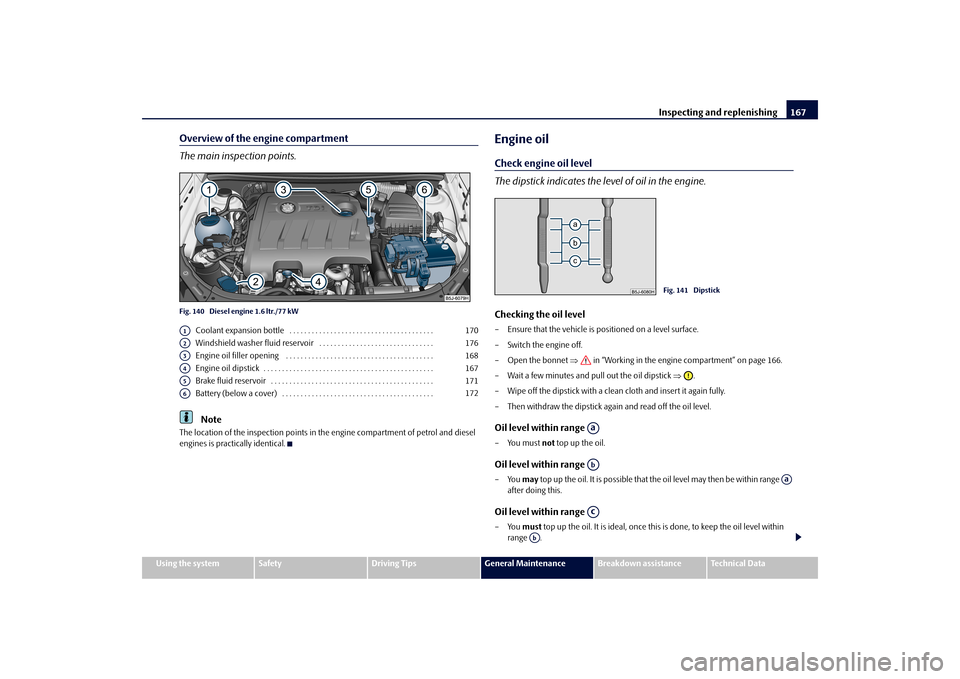
Overview of the engine compartment The main inspection points.Fig. 140 Diesel engine 1.6 ltr./77 kW
Coolant expansion bottle . . . . . . . . . . . . . . . . . . . . . . . . . . . . . . . . . . . . . . . Windshield washer fluid reservoir . . . . . . . . . . . . . . . . . . . . . . . . . . . . . . . Engine oil filler opening . . . . . . . . . . . . . . . . . . . . . . . . . . . . . . . . . . . . . . . .Engine oil dipstick . . . . . . . . . . . . . . . . . . . . . . . . . . . . . . . . . . . . . . . . . . . . . . Brake fluid reservoir . . . . . . . . . . . . . . . . . . . . . . . . . . . . . . . . . . . . . . . . . . . . Battery (below a cover) . . . . . . . . . . . . . . . . . . . . . . . . . . . . . . . . . . . . . . . . .Note
The location of the inspection points in th
e engine compartment of petrol and diesel
engines is practically identical.
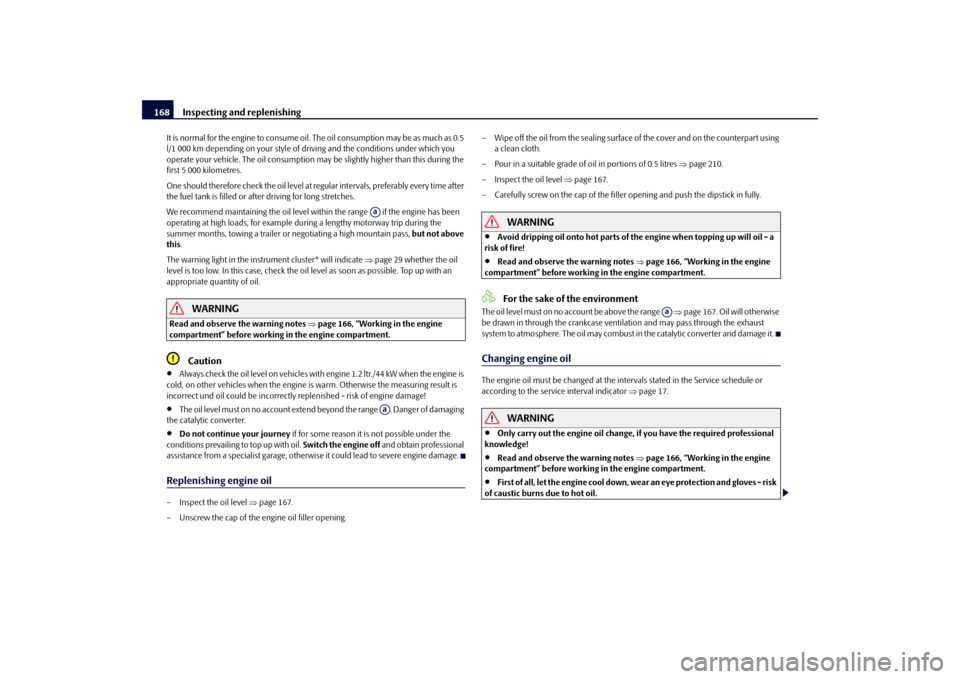
Engine oilCheck engine oil level The dipstick indicates the le
vel of oil in the engine.
Checking the oil level– Ensure that the vehicle is po
sitioned on a level surface.
– Switch the engine off.– Open the bonnet
in “Working in the engine compartment” on page 166.
– Wait a few minutes and pull out the oil dipstick
.
– Wipe off the dipstick with a clea
n cloth and insert it again fully.
– Then withdraw the dipstick again and read off the oil level.Oil level within range –You must
not
top up the oil.
Oil level within range –You
may
top up the oil. It is possible that the oil level may then be within range
after doing this.
Oil level within range –You
must
top up the oil. It is ideal, once this
is done, to keep the oil level within
range .
A1
170
A2
176
A3
168
A4
167
A5
171
A6
172
Fig. 141 Dipstick
AaAb
Aa
Ac
Ab
s3j8.a.book Page 167 Tuesday, April 20, 2010 1:10 PM
Page 169 of 244
Inspecting and replenishing
168
It is normal for the engine to consume oil.
The oil consumption may be as much as 0.5
l/1 000 km depending on your style of driving and the conditions under which you operate your vehicle. The oil
consumption may be slightly hi
gher than this during the
first 5 000 kilometres. One should therefore check the oil level at regular intervals, preferably every time after the fuel tank is filled or after driving for long stretches. We recommend maintaining the oil level within the range if the engine has been operating at high loads, for example duri
ng a lengthy motorway trip during the
summer months, towing a trailer or
negotiating a high mountain pass,
but not above
this
.
The warning light in the instrument cluster* will indicate
page 29 whether the oil
level is too low. In this case, check the oil
level as soon as possible. Top up with an
appropriate quantity of oil.
WARNING
Read and observe the warning notes
page 166, “Working in the engine
compartment” before working in the engine compartment.
Caution
Always check the oil level on vehicles with engine 1.2 ltr./44 kW when the engine is
cold, on other vehicles when the engine is warm. Otherwise the measuring result is incorrect und oil could be incorrectly
replenished - risk of engine damage!
The oil level must on no account extend
beyond the range . Danger of damaging
the catalytic converter.
Do not continue your journey
if for some reason it is not possible under the
conditions prevailing to top up with oil.
Switch the engine off
and obtain professional
assistance from a specialist garage, otherwise it could lead to severe engine damage.Replenishing engine oil– Inspect the oil level
page 167.
– Unscrew the cap of the engine oil filler opening.
– Wipe off the oil from the sealing surface of the cover and on the counterpart using
a clean cloth.
– Pour in a suitable grade of oi
l in portions of 0.5 litres
page 210.
– Inspect the oil level
page 167.
– Carefully screw on the cap of the filler opening and push the dipstick in fully.
WARNING
Avoid dripping oil onto hot parts of the engine when topping up will oil - a
risk of fire!
Read and observe the warning notes
page 166, “Working in the engine
compartment” before working in the engine compartment.
For the sake of the environment
The oil level must on no account be above the range
page 167. Oil will otherwise
be drawn in through the cr
ankcase ventilation and may
pass through the exhaust
system to atmosphere. The oil may combust
in the catalytic conv
erter and damage it.
Changing engine oilThe engine oil must be changed at the intervals stated in the Service schedule or according to the service interval indicator
page 17.
WARNING
Only carry out the engine oil change, if you have the required professional
knowledge!
Read and observe the warning notes
page 166, “Working in the engine
compartment” before working in the engine compartment.
First of all, let the engine cool down, we
ar an eye protection and gloves - risk
of caustic burns due to hot oil.
AaAa
Aa
s3j8.a.book Page 168 Tuesday, April 20, 2010 1:10 PM
Page 170 of 244
Inspecting and replenishing
169
Using the system
Safety
Driving Tips
General Maintenance
Breakdown assistance
Technical Data
Caution
You must not pour any additives into the en
gine oil - risk of engine damage! Damage,
which results from such product,
are excluded from the warranty.
For the sake of the environment
You must on no account pour oil into
the ground or into the sewage system.
In view of the problems involved in prop
erly disposing of old oil, the necessary
special tools and the knowledge required for such work, we recommend that you have the oil and oil filter change carried out
by an authorised Škoda Service Partner.
Note
After your skin has come in contact with th
e oil, you must thoroughly wash your skin.
Cooling systemCoolant The job of the coolant is to cool the engine.The cooling system does not require any maintenance under normal operating condi- tions. The coolant consists of water with a
concentration of coolant additive of 40 %.
This mixture not only provides
antifreeze protection down to -25°C but also protects
the cooling and heating system from corrosion.
It also prevents the formation of scale
and significantly increases the boiling point of the coolant. You must therefore not reduce the concentration of antifreeze agent in the coolant by adding water, also not during the summer mo
nths or in countries with a warm climate.
The concentration of coolant additive in the coolant must be at least 40%. You can increase the amount of antifreeze in the coolant if a higher concentration of antifreeze is necessary for climatic reasons
but only up to 60% (antifreeze protection
down to approx. -40°C). The antifreeze prot
ection tails off above that concentration.
Vehicles exported to countries with a cold
climate (e.g. Sweden, Norway, Finland) are
already factory-filled with a coolant which offers antifreeze protection down to about -35°C. In these countries the concentration of coolant additive should be at least 50%.
Coolant The cooling system is factory-
filled with coolant (purple in colour), which complies
with the specification TL-VW 774 G. We recommend that you use the coolant addi
tive G13 (purple in colour) for topping
up the system. We recommend that you contact your Škoda
Service Partner if yo
u have any questions
regarding the coolant or if you wish
to fill up with a different coolant.
A specialist garage can also supply
you with the correct coolant additives.
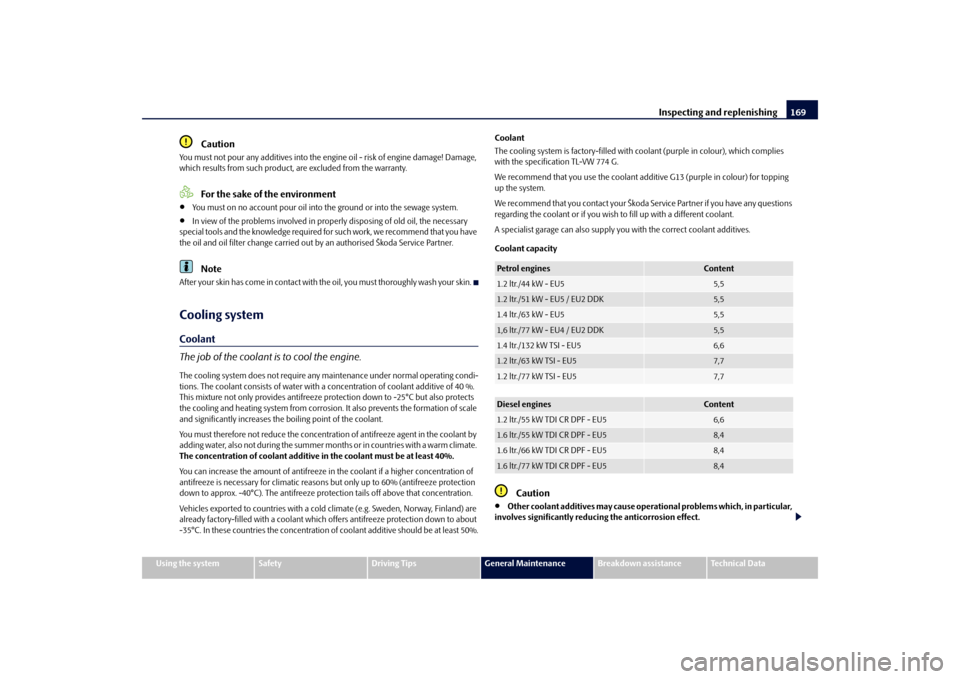
Coolant capacity
Caution
Other coolant additives may cause operational problems which, in particular,
involves significantly reduci
ng the anticorrosion effect.
Petrol engines
Content
1.2 ltr./44 kW - EU5
5,5
1.2 ltr./51 kW - EU5 / EU2 DDK
5,5
1.4 ltr./63 kW - EU5
5,5
1,6 ltr./77 kW - EU4 / EU2 DDK
5,5
1.4 ltr./132 kW TSI - EU5
6,6
1.2 ltr./63 kW TSI - EU5
7,7
1.2 ltr./77 kW TSI - EU5
7,7
Diesel engines
Content
1.2 ltr./55 kW TDI CR DPF - EU5
6,6
1.6 ltr./55 kW TDI CR DPF - EU5
8,4
1.6 ltr./66 kW TDI CR DPF - EU5
8,4
1.6 ltr./77 kW TDI CR DPF - EU5
8,4
s3j8.a.book Page 169 Tuesday, April 20, 2010 1:10 PM
Page 171 of 244
Inspecting and replenishing
170
Any faults or problems resulting from corrosion may cause a loss of coolant
and, as a consequence of this,
result in major engine damage.
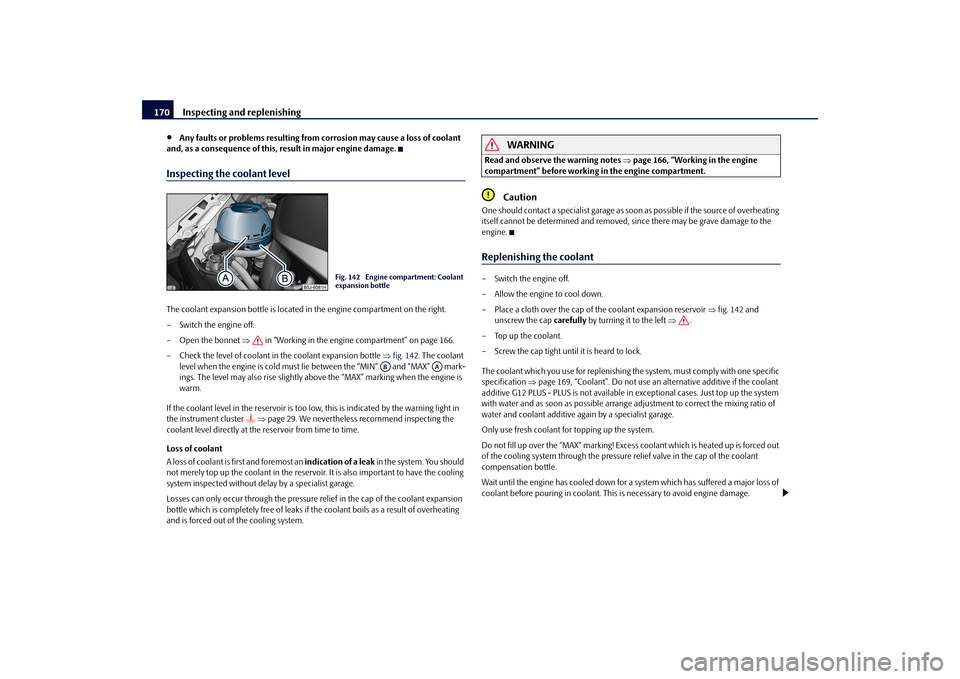
Inspecting the coolant levelThe coolant expansion bottle
is located in the engine compartment on the right.
– Switch the engine off.– Open the bonnet
in “Working in the engine compartment” on page 166.
– Check the level of coolant in the coolant expansion bottle
fig. 142
. The coolant
level when the engine is cold must lie between the “MIN” and “MAX” mark- ings. The level may also rise slightly ab
ove the “MAX” marking when the engine is
warm.
If the coolant level in the reservoir is too lo
w, this is indicated by the warning light in
the instrument cluster
page 29. We nevertheless recommend inspecting the
coolant level directly at the reservoir from time to time. Loss of coolant A loss of coolant is first and foremost an
indication of a leak
in the system. You should
not merely top up the coolant in the reservoir.
It is also important to have the cooling
system inspected without delay by a specialist garage. Losses can only occur through
the pressure relief in the cap of the coolant expansion
bottle which is completely free of leaks if
the coolant boils as a
result of overheating
and is forced out of the cooling system.
WARNING
Read and observe the warning notes
page 166, “Working in the engine
compartment” before working in the engine compartment.
Caution
One should contact a specialist garage as s
oon as possible if the source of overheating
itself cannot be determined and removed,
since there may be grave damage to the
engine.Replenishing the coolant– Switch the engine off. – Allow the engine to cool down.– Place a cloth over the cap of the coolant expansion reservoir
fig. 142
and
unscrew the cap
carefully
by turning it to the left
.
–Top up the coolant.– Screw the cap tight until it is heard to lock. The coolant which you use for replenishing the system, must comply with one specific specification
page 169, “Coolant”. Do not use an al
ternative additive if the coolant
additive G12 PLUS - PLUS is not available in
exceptional cases. Just top up the system
with water and as soon as possible arrange
adjustment to correct
the mixing ratio of
water and coolant additive again by a specialist garage. Only use fresh coolant for topping up the system.Do not fill up over the “MAX” marking! Excess
coolant which is heated up is forced out
of the cooling system through the pressure relief valve in the cap of the coolant compensation bottle. Wait until the engine has cooled down for a
system which has suffered a major loss of
coolant before pouring in coolant. This
is necessary to avoid engine damage.
Fig. 142 Engine compartment: Coolant expansion bottle
AB
AA
s3j8.a.book Page 170 Tuesday, April 20, 2010 1:10 PM
Page 172 of 244
Inspecting and replenishing
171
Using the system
Safety
Driving Tips
General Maintenance
Breakdown assistance
Technical Data
WARNING
The cooling system is pressurized!
Do not open the cap of the coolant
expansion bottle if the engine is still hot - risk of scalding!
The coolant additive and thus all of the coolant is harmful to your health.
Avoid contact with the coolant. Coolant
vapours are also harmful to the health.
It is important, therefore, to always safely store any coolant additive in its orig-inal container out of the reach of children - risk of poisoning!
If any splashes of coolant get into yo
ur eyes, rinse out your eyes immedi-
ately with clear water and contact a doctor as soon as possible.
You should also consult a doctor without delay if you have inadvertently
swallowed coolant.
Caution
Do not continue your journey if for some reason it is not possible under the conditions prevailing to top up with coolant. Switch the engine off
and obtain
professional assistance from a specialist garage, otherwise it could lead to severe engine damage.
For the sake of the environment
Do not re-use coolant if it is necessary to
drain the coolant in the system. It should be
collected and disposed of in compliance
with environmental protection regulations.
Radiator fan The radiator fan may switch on suddenly.The radiator fan is driven by an electr
ic motor and controlled by a thermostat
according to the coolant temperature. The radiator fan may continue running for up
to 10 minutes after the engine has been
switched off - even if the igni
tion is also off. It may also
switch on suddenly after a
certain time, if
the coolant temperature has risen beca
use of an accumulation of heat or
the warm engine compartment is heated
up additionally by strong sunlight.
WARNING
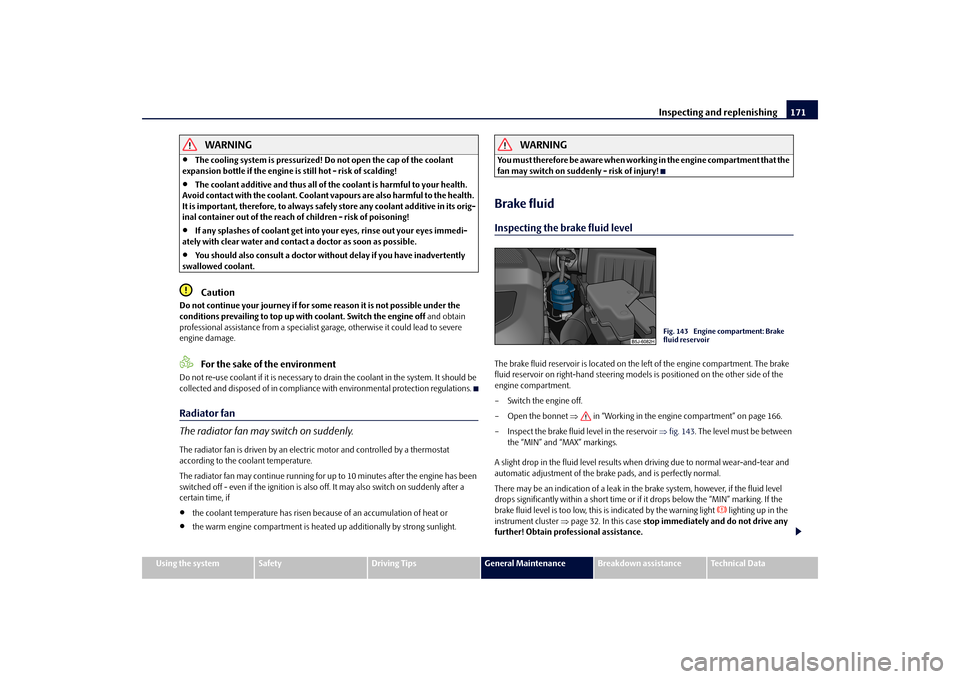
You must therefore be aware when working in the engine compartment that the fan may switch on suddenly - risk of injury!Brake fluidInspecting the brake fluid levelThe brake fluid reservoir is located on the
left of the engine compartment. The brake
fluid reservoir on right-hand steering models is positioned on the other side of the engine compartment. – Switch the engine off.– Open the bonnet
in “Working in the engine compartment” on page 166.
– Inspect the brake fluid level in the reservoir
fig. 143
. The level must be between
the “MIN” and “MAX” markings.
A slight drop in the fluid level results when driving due to normal wear-and-tear and automatic adjustment of the brak
e pads, and is perfectly normal.
There may be an indication of a leak in the brake system, however, if the fluid level drops significantly within a short time or if it drops below the “MIN” marking. If the brake fluid level is too low, this
is indicated by the warning light
lighting up in the
instrument cluster
page 32. In this case
stop immediately and do not drive any
further! Obtain professional assistance.
Fig. 143 Engine compartment: Brake fluid reservoir
s3j8.a.book Page 171 Tuesday, April 20, 2010 1:10 PM
Page 173 of 244
Inspecting and replenishing
172
WARNING
Read and observe the warning notes
page 166, “Working in the engine
compartment” before working in the engine compartment.
If the fluid level has dropped below the MIN marking, do not drive any
further - risk of accident! Obtain professional assistance.Replacing brake fluidBrake fluid absorbs moisture. This causes the fluid to absorb moisture from the surrounding air over a period of time. Excessive water in the brake fluid may be the cause of corrosion in the brake system. The
water content also lowers the boiling point
of the brake fluid. One may only use new brake fluid approved
by Škoda Auto. The brake fluid must
comply with one of the following standards or specifications:
VW 501 14,
FMVSS 116 DOT4,
DIN ISO 4925 CLASS 4.
We recommend that you have the brake fluid replaced by an
authorised Škoda
Service Partner
as part of an Inspection Service.
WARNING
Using old brake fluid can result in severe
stress on the brakes because of the
formation of vapour bubbles in the br
ake system. This greatly impairs the
braking efficiency and thus also the safety of your vehicle.
Brake fluid is toxic! It must therefor
e be kept safely in closed original
containers and well away from children and unauthorized persons.
Caution
Brake fluid damages the paintwork of the vehicle.
For the sake of the environment
In view of the problems involved with proper
disposal of brake fluid, the special tools
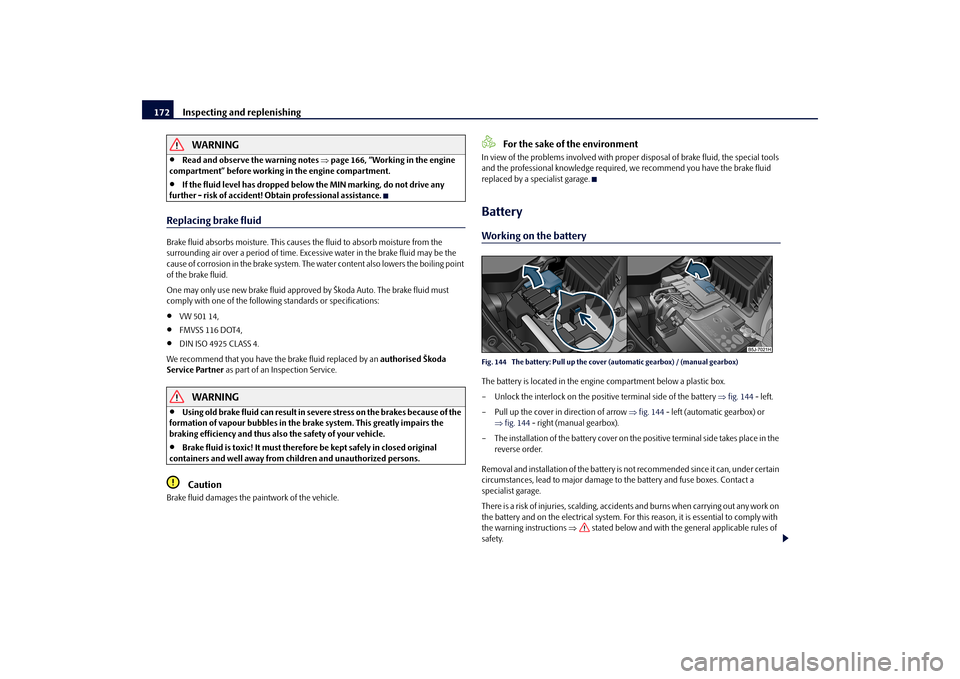
and the professional knowledge required, we recommend you have the brake fluid replaced by a specialist garage.BatteryWorking on the batteryFig. 144 The battery: Pull up the cove
r (automatic gearbox) / (manual gearbox)
The battery is located in the engi
ne compartment below a plastic box.
– Unlock the interlock on the positive terminal side of the battery
fig. 144
- left.
– Pull up the cover in direction of arrow
fig. 144
- left (automatic gearbox) or
fig. 144
- right (manual gearbox).
– The installation of the battery cover on th
e positive terminal side takes place in the
reverse order.
Removal and installation of the battery is
not recommended since it can, under certain
circumstances, lead to ma
jor damage to the battery and fuse boxes. Contact a
specialist garage. There is a risk of injuries, scalding, accidents and burns when carrying out any work on the battery and on the electrical system. For th
is reason, it is essential to comply with
the warning instructions
stated below and with the general applicable rules of
safety.
s3j8.a.book Page 172 Tuesday, April 20, 2010 1:10 PM