jack points SKODA FABIA 2014 2.G / 5J Owner's Manual
[x] Cancel search | Manufacturer: SKODA, Model Year: 2014, Model line: FABIA, Model: SKODA FABIA 2014 2.G / 5JPages: 197, PDF Size: 13.56 MB
Page 13 of 197

WARNING (Continued)■The lock tongue should only be inserted into the lock which is the correct
one for your seat. Wrong use of the safety belt will reduce its capacity to
protect and the risk of injury increases.■
The slot of the belt tongue must not be blocked otherwise the belt
tongue will not lock in place properly.
■
Many layers of clothing and loose clothing (e. g. a winter coat over a jack-
et) do not allow you to be correctly seated and impairs proper operation of
the seat belts.
■
It is prohibited to use clamps or other objects to adjust seat belts (e. g. for
shortening the belts for smaller persons).
■
The seat belts for the rear seats can only fulfil their function reliably
when the seat backrests are correctly locked into position » page 66.
WARNINGInformation on the care and maintenance of the safety belts■The belt webbing must always be kept clean. Soiled belts may impair
proper operation of the inertia reel » page 134, Seat belts .■
The seat belts must not be removed or changed in any way. Do not at-
tempt to repair the seat belts yourself.
■
Check the condition of all the seat belts on a regular basis. If any damage
to the seat belts, seat belt connections, inertia reel or the lock is detected,
the seat belt concerned must be replaced by a specialist garage.
■
Damaged seat belts which have been subjected to stress in an accident
and were therefore stretched, must be replaced - this is best done by a
specialist garage. The anchorage points of the belts must also be inspec-
ted. The anchorage points for the belts should also be checked.
Note
The national legal requirements must be observed when using seat belts.The physical principle of a frontal collisionFig. 4
Driver without a fastened seat belt/rear seat passenger without a
fastened seat belt
Read and observe
on page 10 first.
As soon as the vehicle is moving, so-called kinetic energy (the energy of mo-
tion) is produced both in terms of the car as well as in terms of the occupants.
The magnitude of this kinetic energy depends essentially on the speed at
which the vehicle is travelling and on the weight of the vehicle including the
occupants. The greater the speed and weight increase, the greater the
amount of energy which has to be absorbed in the event of an accident.
The speed of the vehicle is the most important factor. Doubling the speed of
the vehicle from 25 km/h up to 50 km/hour increases the kinetic energy four
times.
The notion that it is possible to support your body with your hands in a minor
accident is incorrect. Even in a collision at only a low speed, the forces acting
on the body are such that it is no longer possible to support your body.
Even if you only drive at a speed of 30 km/h to 50 km/h, the forces that your body is exposed to in the event of an accident can exceed a ton (1000 kg).
For example, a person's weight of 80 kg “increases” at 50 km/h to 4.8 tons (4800 kg).
In the event of a frontal collision, occupants of the car not wearing a seat belt
are thrown forward and strike parts of the interior of the car, such as the
steering wheel, dash panel, windscreen in ways which cannot be control-
led » Fig. 4 -
. In certain circumstances you could even be thrown out of the
vehicle, which could cause life threatening or even fatal injuries.
11Seat belts
Page 78 of 197
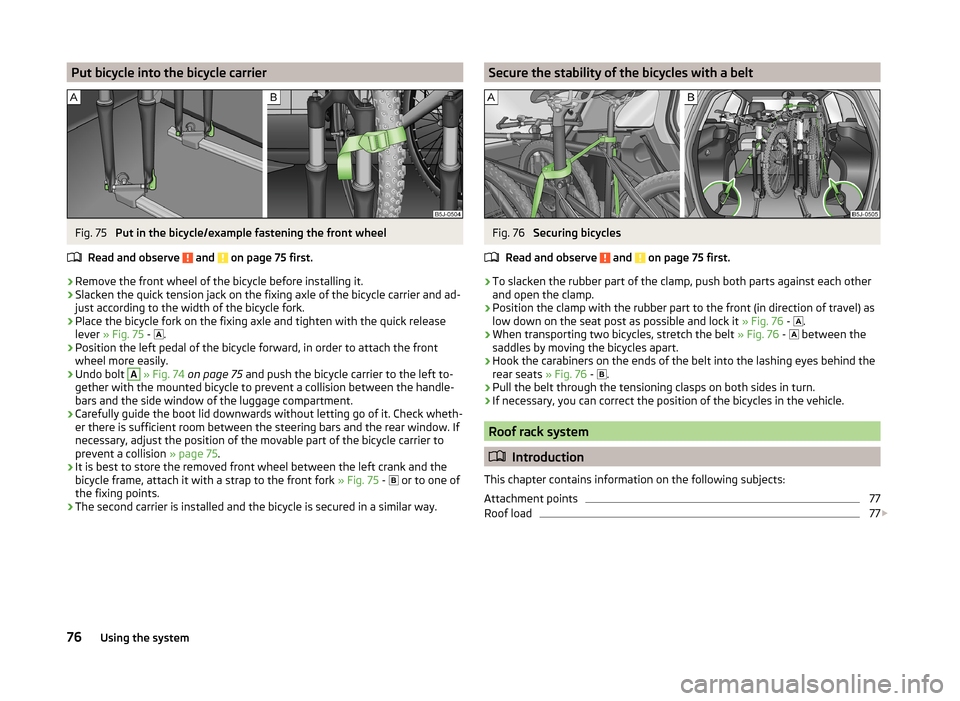
Put bicycle into the bicycle carrierFig. 75
Put in the bicycle/example fastening the front wheel
Read and observe
and on page 75 first.
›
Remove the front wheel of the bicycle before installing it.
›
Slacken the quick tension jack on the fixing axle of the bicycle carrier and ad-
just according to the width of the bicycle fork.
›
Place the bicycle fork on the fixing axle and tighten with the quick release
lever » Fig. 75 -
.
›
Position the left pedal of the bicycle forward, in order to attach the front
wheel more easily.
›
Undo bolt
A
» Fig. 74 on page 75 and push the bicycle carrier to the left to-
gether with the mounted bicycle to prevent a collision between the handle-
bars and the side window of the luggage compartment.
›
Carefully guide the boot lid downwards without letting go of it. Check wheth-
er there is sufficient room between the steering bars and the rear window. If
necessary, adjust the position of the movable part of the bicycle carrier to
prevent a collision » page 75.
›
It is best to store the removed front wheel between the left crank and the
bicycle frame, attach it with a strap to the front fork » Fig. 75 -
or to one of
the fixing points.
›
The second carrier is installed and the bicycle is secured in a similar way.
Secure the stability of the bicycles with a beltFig. 76
Securing bicycles
Read and observe
and on page 75 first.
›
To slacken the rubber part of the clamp, push both parts against each other
and open the clamp.
›
Position the clamp with the rubber part to the front (in direction of travel) as
low down on the seat post as possible and lock it » Fig. 76 -
.
›
When transporting two bicycles, stretch the belt
» Fig. 76 -
between the
saddles by moving the bicycles apart.
›
Hook the carabiners on the ends of the belt into the lashing eyes behind the
rear seats » Fig. 76 -
.
›
Pull the belt through the tensioning clasps on both sides in turn.
›
If necessary, you can correct the position of the bicycles in the vehicle.
Roof rack system
Introduction
This chapter contains information on the following subjects:
Attachment points
77
Roof load
77
76Using the system
Page 162 of 197
WARNING (Continued)■Secure the base plate of the lifting jack with suitable means to prevent
possible moving. A soft and slippery ground under the base plate may move
the lifting jack, causing the vehicle to fall down. It is therefore always nec-
essary to place the lifting jack on a solid surface or use a wide and stable
base. Use a non-slip base (e.g. a rubber foot mat) if the surface is smooth,
such as cobbled stones, tiled floor, etc.■
Only attach the lifting jack to the attachment points provided for this pur-
pose.
■
Always raise the vehicle with the doors closed.
■
Never position any body parts, such as arms or legs under the vehicle,
while the vehicle is raised with a lifting jack.
■
Never start the engine with the vehicle sitting on the raised jack – there
is a risk of injury.
WARNINGInformation on the wheel bolts■The wheel bolts must be clean and must turn easily. Never treat them
with grease or oil.■
The prescribed tightening torque of the wheel bolts for steel and light al-
loy wheels is 120 Nm.
■
If the wheel bolts are tightened to a too low tightening torque, the rim
can come loose when the car is moving – risk of accident! A tightening tor-
que which is too high can damage the bolts and threads and this can result
in permanent deformation of the contact surfaces on the rim.
■
In case of incorrect treatment of the wheel bolts, the wheel can loosen
when the car is moving – risk of accident!
Note
The national legal requirements must be observed when changing a wheel.
Preparation
Read and observe
on page 159 first.
Always change a wheel on a level surface as far as possible.
The following steps must be carried out before actually changing the wheel:
›
Have all the occupants get out. The passengers should not stand on the
road (instead they should remain behind a crash barrier, for instance) while
the wheel is being changed.
› Switch off the engine.›Move the gearshift lever into
Neutral or move the selector lever for the auto-
matic gearbox into position P.›
Apply the handbrake firmly.
›
Uncouple any trailer.
›
Remove the vehicle tool kit » page 159 and the spare wheel » page 155 ,
Spare and back-up wheel from the boot.
Changing a wheel
Read and observe
on page 159 first.
›
Remove the full wheel trim » page 156 or caps » page 156 .
›
First of all slacken the anti-theft wheel bolt and then the other wheel
bolts » page 161 .
›
Jack up the vehicle until the wheel that needs changing is clear of the
ground » page 161 .
›
Unscrew the wheel bolts and place them on a clean surface (cloth, paper,
etc.).
›
Remove the wheel carefully.
›
Attach the spare wheel and slightly screw on the wheel bolts.
›
Lower the vehicle.
›
Tighten the opposite wheel bolts alternately (cross-wise) with the wheelwrench. Tighten the anti-theft wheel bolt last » page 161.
›
Reinstall the wheel trim/wheel trim cap or the caps.
Note
■
All bolts must be clean and must turn easily.■Under no circumstances grease or oil the wheel bolts!■
When fitting unidirectional tyres, ensure that the direction of rotation is cor-
rect » page 154 , Unidirectional tyres .
Subsequent steps
Read and observe
on page 159 first.
The following steps must also be performed after changing the wheel.
›
Stow and attach the replaced wheel in the spare wheel well using a special
screw » page 155 , Spare and back-up wheel .
›
Stow the tool kit in the space provided and secure using the strap.
›
Check the tyre pressure on the installed spare wheel as soon as possible.
160Do-it-yourself
Page 163 of 197
›Have the
tightening torque of the wheel bolts checked with a torque
wrench as soon as possible.›
Change the damaged wheel or consult a specialist garage about repair possi-
bilities.
Note
■ If it is determined that the wheel bolts are corroded and difficult to turn
when changing the wheel, the bolts must be replaced before checking the
tightening torque.■
Drive cautiously and only at a moderate speed until the tightening torque
has been checked.
Loosening/tightening wheel bolts
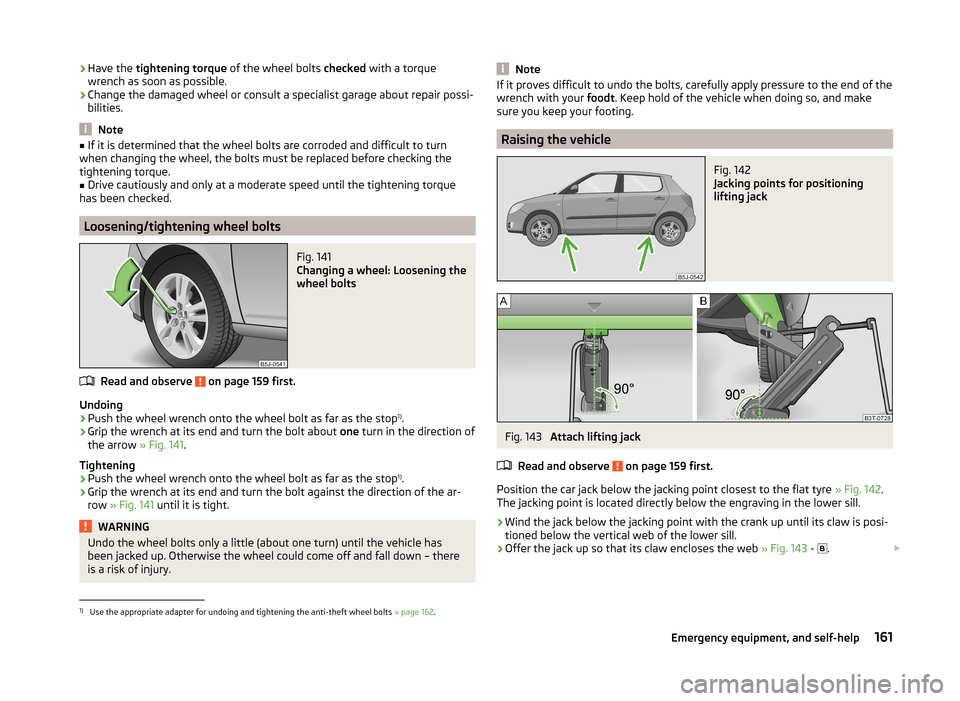
Fig. 141
Changing a wheel: Loosening the
wheel bolts
Read and observe on page 159 first.
Undoing
›
Push the wheel wrench onto the wheel bolt as far as the stop 1)
.
›
Grip the wrench at its end and turn the bolt about one turn in the direction of
the arrow » Fig. 141.
Tightening
›
Push the wheel wrench onto the wheel bolt as far as the stop 1)
.
›
Grip the wrench at its end and turn the bolt against the direction of the ar-
row » Fig. 141 until it is tight.
WARNINGUndo the wheel bolts only a little (about one turn) until the vehicle has
been jacked up. Otherwise the wheel could come off and fall down – there
is a risk of injury.NoteIf it proves difficult to undo the bolts, carefully apply pressure to the end of the
wrench with your foodt. Keep hold of the vehicle when doing so, and make
sure you keep your footing.
Raising the vehicle
Fig. 142
Jacking points for positioning
lifting jack
Fig. 143
Attach lifting jack
Read and observe
on page 159 first.
Position the car jack below the jacking point closest to the flat tyre » Fig. 142.
The jacking point is located directly below the engraving in the lower sill.
›
Wind the jack below the jacking point with the crank up until its claw is posi-
tioned below the vertical web of the lower sill.
›
Offer the jack up so that its claw encloses the web » Fig. 143 -
.
1)
Use the appropriate adapter for undoing and tightening the anti-theft wheel bolts
» page 162.
161Emergency equipment, and self-help
Page 164 of 197
›Support the base plate of the jack with its full area resting on level ground
and ensure that the jack is located in a vertical position at the point where
the claw encloses the web » Fig. 143 -
.›
Continue turning up the jack until the wheel is just about lifted off the
ground.
WARNING■ Only raise the vehicle at the jacking points.■Choose a flat and firm surface for jacking the vehicle.
Securing wheels against theft
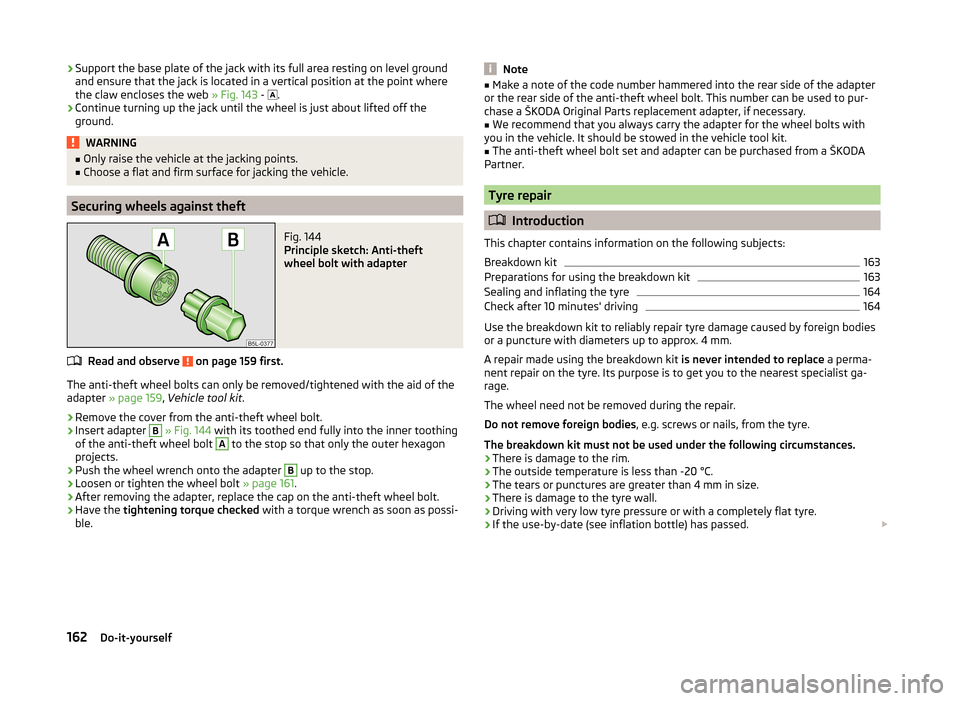
Fig. 144
Principle sketch: Anti-theft
wheel bolt with adapter
Read and observe on page 159 first.
The anti-theft wheel bolts can only be removed/tightened with the aid of the
adapter » page 159 , Vehicle tool kit .
›
Remove the cover from the anti-theft wheel bolt.
›
Insert adapter
B
» Fig. 144 with its toothed end fully into the inner toothing
of the anti-theft wheel bolt
A
to the stop so that only the outer hexagon
projects.
›
Push the wheel wrench onto the adapter
B
up to the stop.
›
Loosen or tighten the wheel bolt » page 161.
›
After removing the adapter, replace the cap on the anti-theft wheel bolt.
›
Have the tightening torque checked with a torque wrench as soon as possi-
ble.
Note■ Make a note of the code number hammered into the rear side of the adapter
or the rear side of the anti-theft wheel bolt. This number can be used to pur-
chase a ŠKODA Original Parts replacement adapter, if necessary.■
We recommend that you always carry the adapter for the wheel bolts with
you in the vehicle. It should be stowed in the vehicle tool kit.
■
The anti-theft wheel bolt set and adapter can be purchased from a ŠKODA
Partner.
Tyre repair
Introduction
This chapter contains information on the following subjects:
Breakdown kit
163
Preparations for using the breakdown kit
163
Sealing and inflating the tyre
164
Check after 10 minutes' driving
164
Use the breakdown kit to reliably repair tyre damage caused by foreign bodies
or a puncture with diameters up to approx. 4 mm.
A repair made using the breakdown kit is never intended to replace a perma-
nent repair on the tyre. Its purpose is to get you to the nearest specialist ga-
rage.
The wheel need not be removed during the repair.
Do not remove foreign bodies , e.g. screws or nails, from the tyre.
The breakdown kit must not be used under the following circumstances. › There is damage to the rim.
› The outside temperature is less than -20 °C.
› The tears or punctures are greater than 4 mm in size.
› There is damage to the tyre wall.
› Driving with very low tyre pressure or with a completely flat tyre.
› If the use-by-date (see inflation bottle) has passed.
162Do-it-yourself
Page 190 of 197
Refuelling136
Unleaded petrol136
fuel consumption177
Fuel consumption109
Fuses Assignment
168
Changing168
Colour coding168
G
Gear Recommended gear
28
Gearbox Display messages
34
Gear changing Gear stick
104
General view Cockpit
25
Glow plug system Warning light
39
GSM92
H
Handbrake
104
Hazard warning light system59
Head airbag17
Headlight cleaning system Headlight cleaning system
63
Headlights171
Driving abroad113
Headlight cleaning system63
Head restraint68
Storing in the seat squabs68
Heating Deicing the windows
87
Exterior mirrors64
Operating86
Operation86
Rear window61
Recirculated air mode87
Seats66
Heating and air conditioning84
Hill hold control114
Horn25
I
Ignition
102
Ignition lock102
Immobilizer101
Individual settings locking
46
unlocking46
Inertia reel13
Instrument cluster26
Overview26
see instrument cluster26
Interior monitor50
ISOFIX22
J
Jack
159
Maintenance132
Jacking points Raise vehicle
161
Jump-starting164, 165
L
Light Beam adjustment
56
Cockpit59
Headlight flash57
Lights55
Cockpit60
Daylight running56
Fog lights58
Foglights with the CORNER function58
Halogen projector headlights with cornering light function
57
Hazard warning light system59
Low beam lights56
Main beam lights57
Parking lights56, 59
Rear fog light58
Replacing bulbs170
Switching on and off56
Tourist lights58
Turn signals57
warning lights35
Lock Central locking system
47
Locking Emergency locking
45
Remote control48
without central locking45
Locking and unlocking from the inside47
Low beam lights56
Luggage compartment Class N1 vehicles
69
Lighting61
Retractable luggage compartment cover (Fabia Estate)
71
Variable loading floor72
M
Main beam
57
Maintenance111
Decorative films131
Manual air conditioning Recirculated air mode
89
Manual gear changing see Gear changing
104
MAXI DOT Main menu
33
see MAXI DOT display33
Settings34
MAXI DOT display33
maximum allowable weights
176
188Index