lock SKODA OCTAVIA 2006 Owner´s Manual
[x] Cancel search | Manufacturer: SKODA, Model Year: 2006, Model line: OCTAVIA, Model: SKODA OCTAVIA 2006Pages: 218, PDF Size: 5.48 MB
Page 55 of 218
Switching off operating control
›
Place the rotary knob into the position
.
Folding-in both of the exterior mirrors with the rotary knob
› Place the rotary knob into the position
.
The mirrors are folded back into the driving position after the rotary knob is
turned from the position to a different one.
It is only possible to fold in both exterior mirrors when the ignition is switched on
and at a speed of up to 15
km/h.
Folding-in both of the exterior mirrors using the remote control key
› If all of the windows are closed, press and hold the lock button 3
» Fig. 13 on
page 30 on the radio remote control for approx. 2
seconds.
The exterior mirrors are folded back into the driving position after opening the
door or switching on the ignition.
Tilting surface of front passenger exterior mirror
On vehicles fitted with the memory function for the driver seat, the surface of the
mirror tilts down slightly when the reverse gear is engaged and the rotary knob is
in the position » Fig. 39. This provides an aid in seeing the kerb of the pavement
when parking the car.
The mirror returns into its initial position, after the rotary knob is moved out of
the position and put into another position or if the speed is more than 15 km/h.
Memory function for exterior mirrors
On vehicles fitted with a memory function for the driver seat, the relevant setting
for the exterior mirrors is also stored automatically when the seat position is stor-
ed » page 55. WARNING
■ Convex (curved outward) exterior mirrors increase the field of vision. They
do, however, make objects appear smaller in the mirror. These mirrors are
therefore only of limited use for estimating distances to the following vehi-
cles.
■ Whenever possible use the interior mirror for estimating the distances to
the following vehicles. CAUTION
Never mechanically fold in or fold back the exterior mirrors with the fold-in func-
tion by hand as this will damage the electric drive. Note
■ If the exterior mirrors were folded in using the rotary knob, they can only be fol-
ded back into the driving position using the rotary knob. ■ If the exterior mirrors were folded in using the remote control key and if the ro-
tary knob was in the fold-in position before the ignition was switched on, the mir-
rors will remain in the fold-in position the next time the ignition is switched on.
The mirrors are folded back into the driving position after the rotary knob is
turned from the position to a different one.
■ Do not touch the surface of the exterior mirrors if the exterior mirror heater is
switched on. ■ If the power setting function fails at any time, the exterior mirrors can be set by
hand by pressing on the edge of the mirror surface. ■ Contact your ŠKODA specialist garage if there is a fault with the power setting
of the exterior mirrors. Ð Automatic dimming exterior mirror on the driver's side
The exterior mirror on the driver's side is dimmed together with the interior mir-
ror. If the automatic dimming is switched on, the mirror dims automatically de-
pending on the light striking the mirror from the rear.
After the reverse gear is engaged, the mirror always moves back into the normal
(not dimmed) position. Note
■ Automatic mirror dimming operates only properly if the sun screen for the rear
window is not in use or the light striking the rear of the interior rear-view mirror is
not affected by other objects. ■ Do not affix any stickers in front of the light sensor, so that they do not impair
the automatic dimming function or put it out of operation. ■ If the automatic interior mirror dimming is switched off, the exterior mirror dim-
ming is also switched off. Ð 53
Lights and visibility
Page 57 of 218
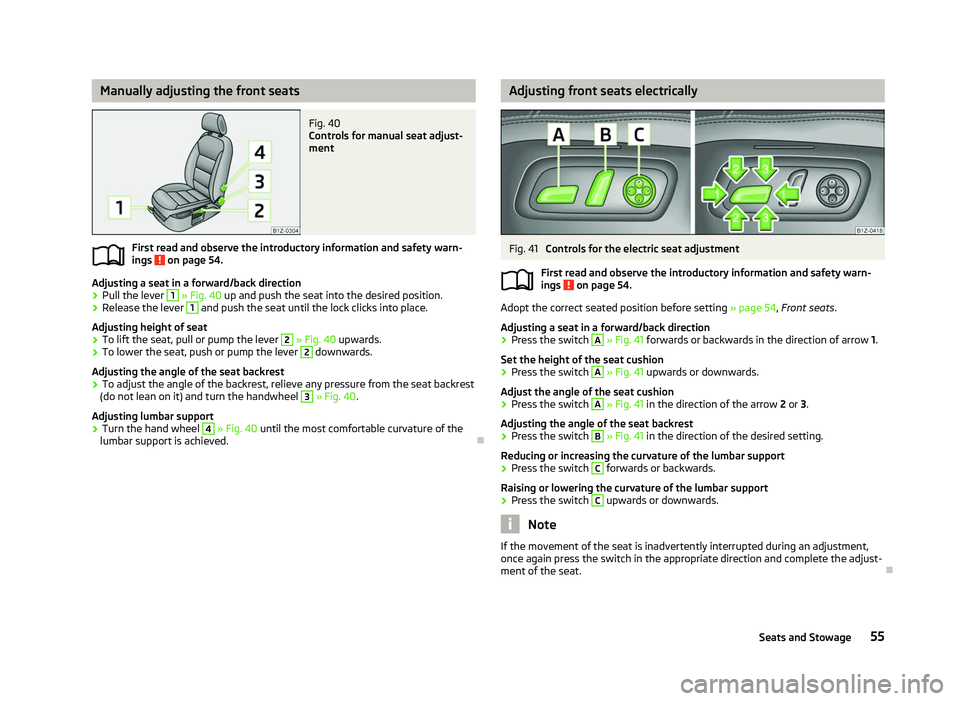
Manually adjusting the front seats
Fig. 40
Controls for manual seat adjust-
ment
First read and observe the introductory information and safety warn-
ings on page 54.
Adjusting a seat in a forward/back direction
›
Pull the lever 1
» Fig. 40 up and push the seat into the desired position.
› Release the lever 1
and push the seat until the lock clicks into place.
Adjusting height of seat
› To lift the seat, pull or pump the lever 2
» Fig. 40 upwards.
› To lower the seat, push or pump the lever 2
downwards.
Adjusting the angle of the seat backrest
› To adjust the angle of the backrest, relieve any pressure from the seat backrest
(do not lean on it) and turn the handwheel 3
» Fig. 40.
Adjusting lumbar support
› Turn the hand wheel 4
» Fig. 40
until the most comfortable curvature of the
lumbar support is achieved. Ð
ä Adjusting front seats electrically
Fig. 41
Controls for the electric seat adjustment
First read and observe the introductory information and safety warn-
ings on page 54.
Adopt the correct seated position before setting
» page 54, Front seats.
Adjusting a seat in a forward/back direction
› Press the switch A
» Fig. 41
forwards or backwards in the direction of arrow 1.
Set the height of the seat cushion
› Press the switch A
»
Fig. 41
upwards or downwards.
Adjust the angle of the seat cushion
› Press the switch A
»
Fig. 41
in the direction of the arrow 2 or 3.
Adjusting the angle of the seat backrest
› Press the switch B
»
Fig. 41
in the direction of the desired setting.
Reducing or increasing the curvature of the lumbar support
› Press the switch C
forwards or backwards.
Raising or lowering the curvature of the lumbar support
› Press the switch C
upwards or downwards.
Note
If the movement of the seat is inadvertently interrupted during an adjustment,
once again press the switch in the appropriate direction and complete the adjust-
ment of the seat. Ð
ä
55
Seats and Stowage
Page 60 of 218
Head restraints
ä
Introduction
This chapter contains information on the following subjects:
Adjusting, removing and installing a head restraint 58
Middle rear head restraint 58
Best protection is achieved if the top edge of the head restraint is at the same
level as the upper part of your head.
The position of the front and rear outer head restraints is adjustable in height.
The middle rear head restraint is adjustable in two positions.
The head restraints must be adjusted to match the size of the seat occupant. Cor-
rectly adjusted head restraints together with the seat belts offer effective protec-
tion for the occupants » page 122, Correct seated position .WARNING
■ The head restraints must be correctly adjusted in order to offer effective
protection for the occupants in the event of an accident. ■ Never drive with the head restraints removed - risk of injury.
■ If the rear seats are occupied, the rear head restraint must not be in the
lower position. ÐAdjusting, removing and installing a head restraint
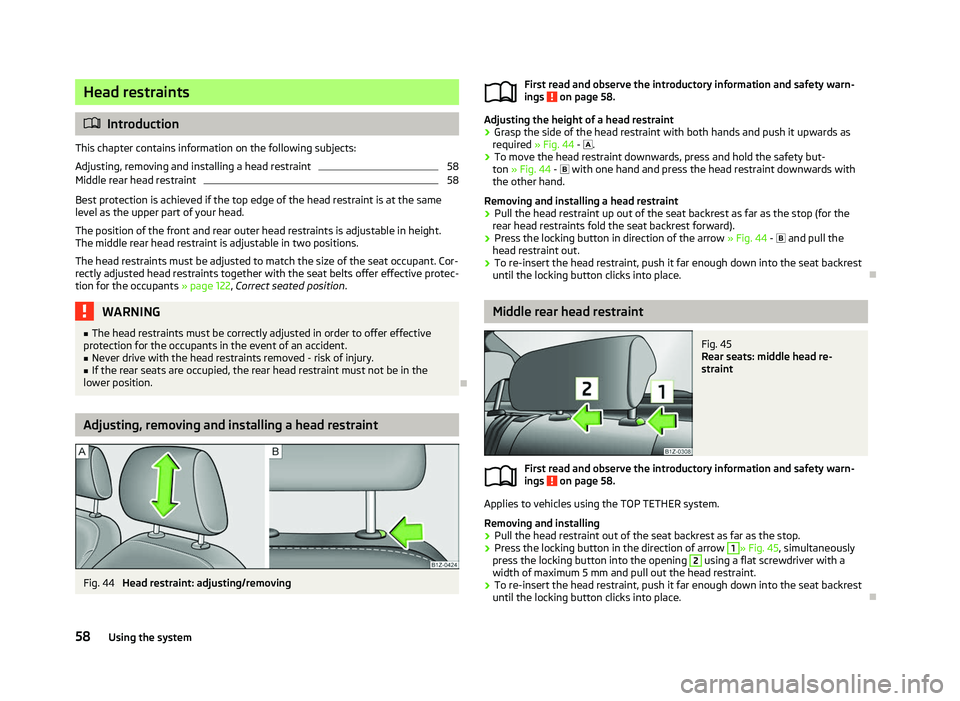
Fig. 44
Head restraint: adjusting/removing First read and observe the introductory information and safety warn-
ings on page 58.
Adjusting the height of a head restraint
› Grasp the side of the head restraint with both hands and push it upwards as
required » Fig. 44 - .
› To move the head restraint downwards, press and hold the safety but-
ton » Fig. 44 - with one hand and press the head restraint downwards with
the other hand.
Removing and installing a head restraint
› Pull the head restraint up out of the seat backrest as far as the stop (for the
rear head restraints fold the seat backrest forward).
› Press the locking button in direction of the arrow
» Fig. 44 - and pull the
head restraint out.
› To re-insert the head restraint, push it far enough down into the seat backrest
until the locking button clicks into place. Ð Middle rear head restraint
Fig. 45
Rear seats: middle head re-
straint
First read and observe the introductory information and safety warn-
ings on page 58.
Applies to vehicles using the TOP TETHER system.
Removing and installing
› Pull the head restraint out of the seat backrest as far as the stop.
› Press the locking button in the direction of arrow 1
» Fig. 45
, simultaneously
press the locking button into the opening 2
using a flat screwdriver with a
width of maximum 5 mm and pull out the head restraint.
› To re-insert the head restraint, push it far enough down into the seat backrest
until the locking button clicks into place. Ð
ä
ä
58 Using the system
Page 61 of 218
Rear seats
Folding the seat backrest forwards
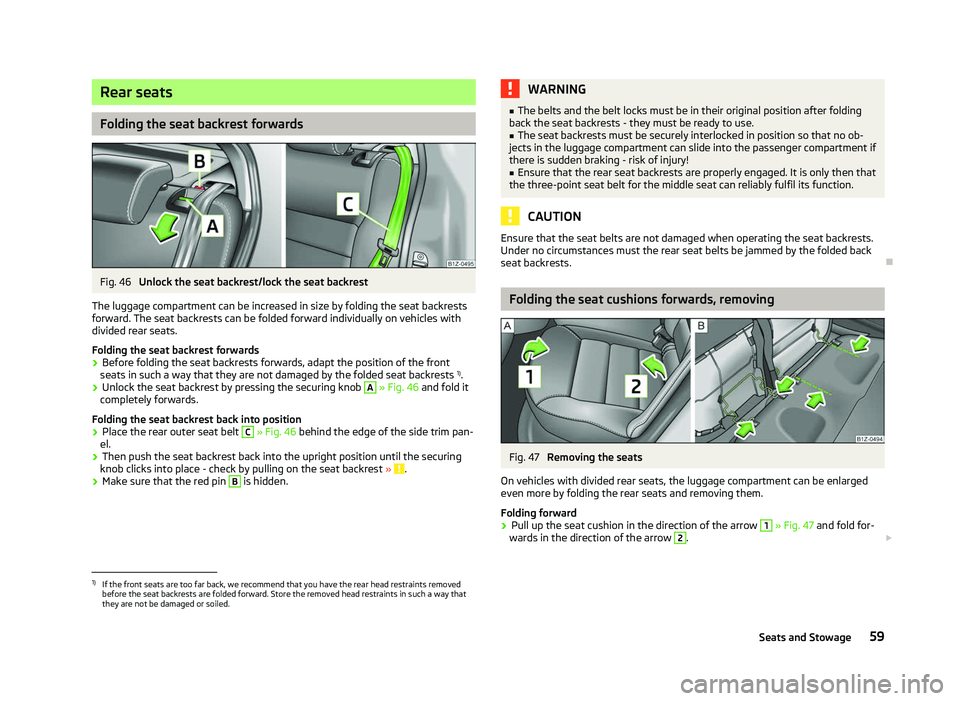
Fig. 46
Unlock the seat backrest/lock the seat backrest
The luggage compartment can be increased in size by folding the seat backrests
forward. The seat backrests can be folded forward individually on vehicles with
divided rear seats.
Folding the seat backrest forwards
› Before folding the seat backrests forwards, adapt the position of the front
seats in such a way that they are not damaged by the folded seat backrests 1)
.
› Unlock the seat backrest by pressing the securing knob A
» Fig. 46
and fold it
completely forwards.
Folding the seat backrest back into position
› Place the rear outer seat belt C
» Fig. 46 behind the edge of the side trim pan-
el.
› Then push the seat backrest back into the upright position until the securing
knob clicks into place - check by pulling on the seat backrest » .
› Make sure that the red pin B
is hidden. WARNING
■ The belts and the belt locks must be in their original position after folding
back the seat backrests - they must be ready to use.
■ The seat backrests must be securely interlocked in position so that no ob-
jects in the luggage compartment can slide into the passenger compartment if
there is sudden braking - risk of injury! ■ Ensure that the rear seat backrests are properly engaged. It is only then that
the three-point seat belt for the middle seat can reliably fulfil its function. CAUTION
Ensure that the seat belts are not damaged when operating the seat backrests.
Under no circumstances must the rear seat belts be jammed by the folded back
seat backrests. Ð Folding the seat cushions forwards, removing
Fig. 47
Removing the seats
On vehicles with divided rear seats, the luggage compartment can be enlarged
even more by folding the rear seats and removing them.
Folding forward
› Pull up the seat cushion in the direction of the arrow 1
» Fig. 47 and fold for-
wards in the direction of the arrow 2
.
£1)
If the front seats are too far back, we recommend that you have the rear head restraints removed
before the seat backrests are folded forward. Store the removed head restraints in such a way that
they are not be damaged or soiled.
59
Seats and Stowage
Page 67 of 218
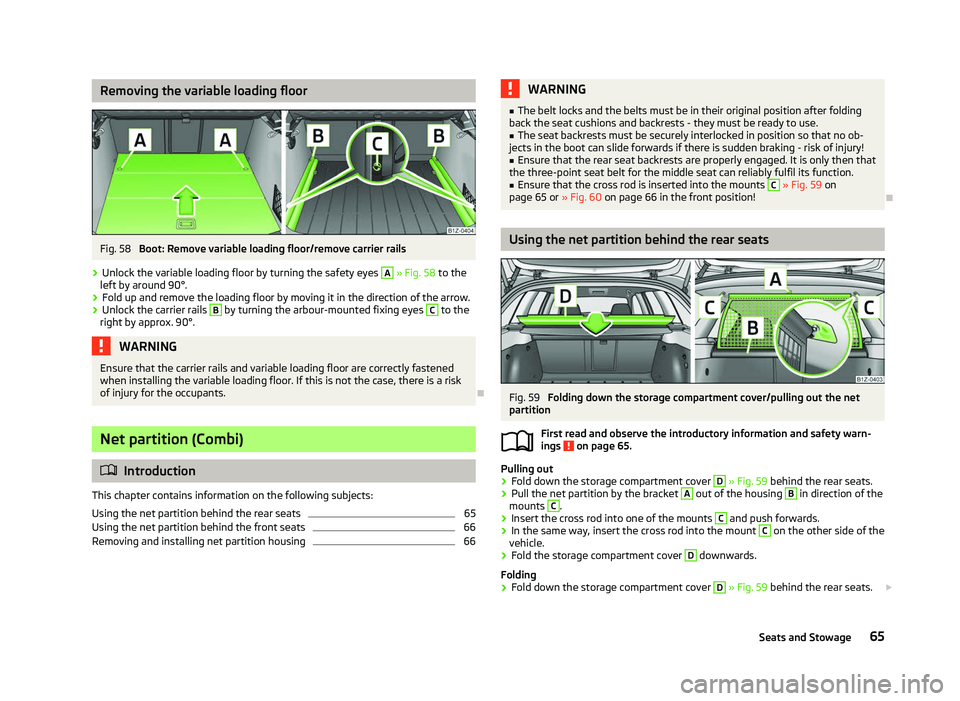
Removing the variable loading floor
Fig. 58
Boot: Remove variable loading floor/remove carrier rails
› Unlock the variable loading floor by turning the safety eyes A
» Fig. 58
to the
left by around 90°.
› Fold up and remove the loading floor by moving it in the direction of the arrow.
› Unlock the carrier rails B
by turning the arbour-mounted fixing eyes C
to the
right by approx. 90°. WARNING
Ensure that the carrier rails and variable loading floor are correctly fastened
when installing the variable loading floor. If this is not the case, there is a risk
of injury for the occupants. ÐNet partition (Combi)
ä
Introduction
This chapter contains information on the following subjects:
Using the net partition behind the rear seats 65
Using the net partition behind the front seats 66
Removing and installing net partition housing 66 WARNING
■ The belt locks and the belts must be in their original position after folding
back the seat cushions and backrests - they must be ready to use.
■ The seat backrests must be securely interlocked in position so that no ob-
jects in the boot can slide forwards if there is sudden braking - risk of injury!
■ Ensure that the rear seat backrests are properly engaged. It is only then that
the three-point seat belt for the middle seat can reliably fulfil its function. ■ Ensure that the cross rod is inserted into the mounts C
» Fig. 59 on
page 65 or » Fig. 60 on page 66 in the front position! Ð Using the net partition behind the rear seats
Fig. 59
Folding down the storage compartment cover/pulling out the net
partition
First read and observe the introductory information and safety warn-
ings on page 65.
Pulling out
› Fold down the storage compartment cover D
» Fig. 59 behind the rear seats.
› Pull the net partition by the bracket A
out of the housing B
in direction of the
mounts C
.
› Insert the cross rod into one of the mounts C
and push forwards.
› In the same way, insert the cross rod into the mount C
on the other side of the
vehicle.
› Fold the storage compartment cover D
downwards.
Folding
› Fold down the storage compartment cover D
» Fig. 59 behind the rear seats.
£
ä
65
Seats and Stowage
Page 70 of 218
The full permissible roof load cannot be used if a roof rack system with a lower
load carrying capacity is used. In this case, the roof rack system must only be loa-
ded up to the maximum weight limit specified in the fitting instructions.
ÐCup holder
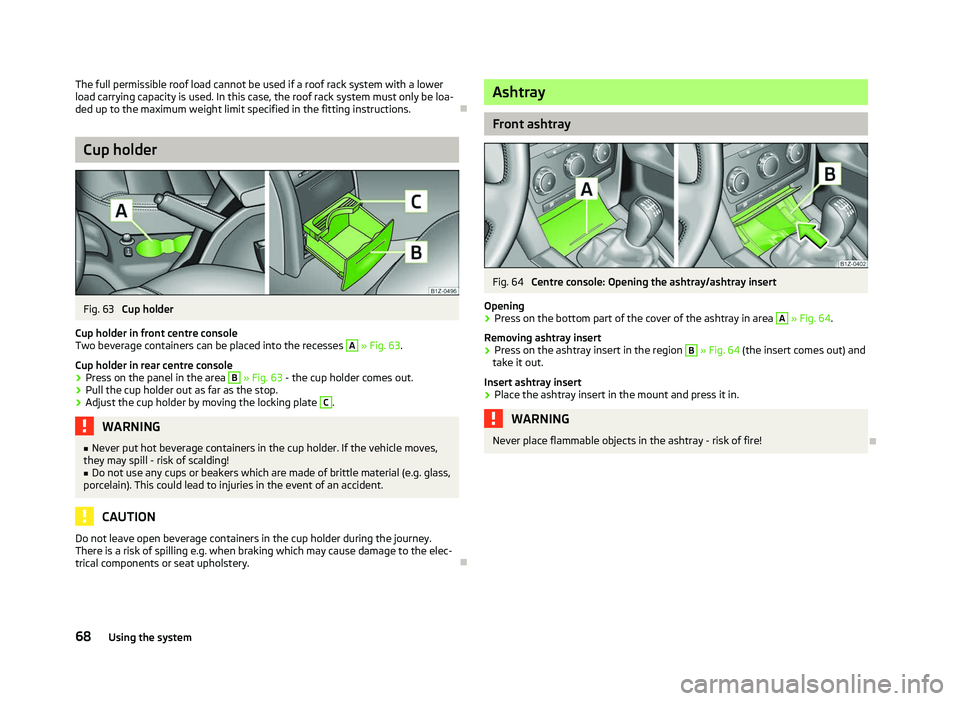
Fig. 63
Cup holder
Cup holder in front centre console
Two beverage containers can be placed into the recesses A
» Fig. 63.
Cup holder in rear centre console
› Press on the panel in the area B
» Fig. 63 - the cup holder comes out.
› Pull the cup holder out as far as the stop.
› Adjust the cup holder by moving the locking plate C
.
WARNING
■ Never put hot beverage containers in the cup holder. If the vehicle moves,
they may spill - risk of scalding!
■ Do not use any cups or beakers which are made of brittle material (e.g. glass,
porcelain). This could lead to injuries in the event of an accident. CAUTION
Do not leave open beverage containers in the cup holder during the journey.
There is a risk of spilling e.g. when braking which may cause damage to the elec-
trical components or seat upholstery. Ð Ashtray
Front ashtray
Fig. 64
Centre console: Opening the ashtray/ashtray insert
Opening
› Press on the bottom part of the cover of the ashtray in area A
» Fig. 64
.
Removing ashtray insert
› Press on the ashtray insert in the region B
» Fig. 64
(the insert comes out) and
take it out.
Insert ashtray insert
› Place the ashtray insert in the mount and press it in. WARNING
Never place flammable objects in the ashtray - risk of fire! Ð
68 Using the system
Page 76 of 218
A bottle holder is located in the area B
» Fig. 76 of the storage compartment for
the front doors. WARNING
Use the area A
» Fig. 76 of the storage compartment only for storing objects
which do not project so that the effectiveness of the side airbag is not im-
paired. ÐStowage compartment below front passenger seat
Fig. 77
Front passenger seat: Stowage
compartment
› To open the lid, pull the handle
» Fig. 77.
› When closing the lid, hold the handle until the compartment is closed. WARNING
The storage compartment must always be closed when driving for safety rea-
sons. CAUTION
The storage compartment is designed for storing small objects of up to 1.5 kg. in
weight. Ð Front armrest with storage compartment
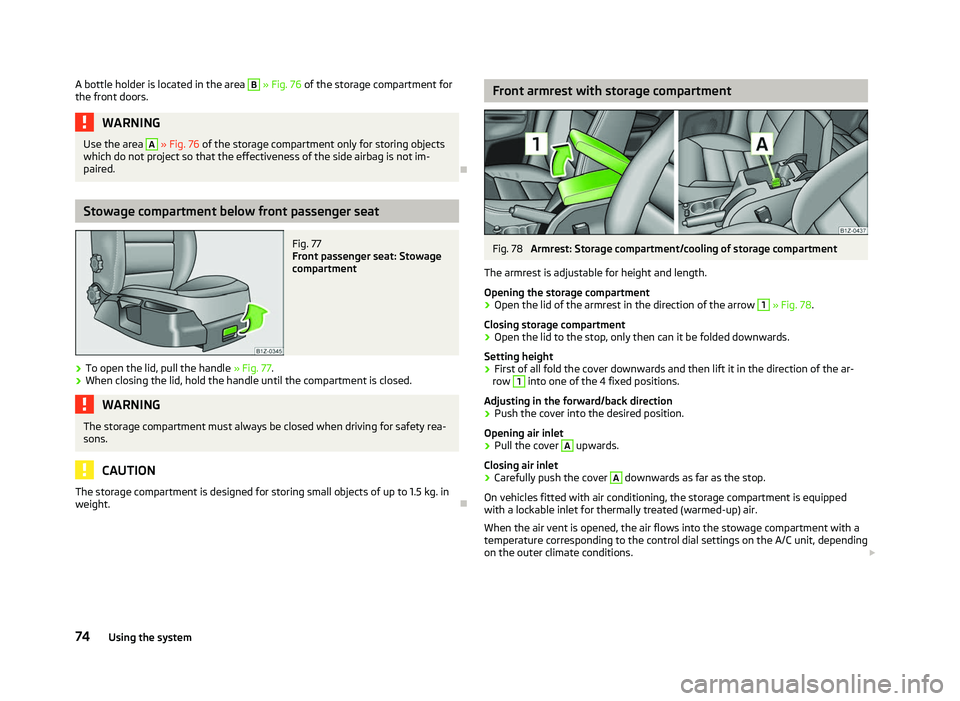
Fig. 78
Armrest: Storage compartment/cooling of storage compartment
The armrest is adjustable for height and length.
Opening the storage compartment
› Open the lid of the armrest in the direction of the arrow 1
» Fig. 78.
Closing storage compartment
› Open the lid to the stop, only then can it be folded downwards.
Setting height
› First of all fold the cover downwards and then lift it in the direction of the ar-
row 1
into one of the 4 fixed positions.
Adjusting in the forward/back direction
› Push the cover into the desired position.
Opening air inlet
› Pull the cover A
upwards.
Closing air inlet
› Carefully push the cover A
downwards as far as the stop.
On vehicles fitted with air conditioning, the storage compartment is equipped
with a lockable inlet for thermally treated (warmed-up) air.
When the air vent is opened, the air flows into the stowage compartment with a
temperature corresponding to the control dial settings on the A/C unit, depending
on the outer climate conditions. £
74 Using the system
Page 77 of 218
The air inlet in the storage compartment is connected to position
through ad-
justment of the control dial for air distribution. This setting causes the maximum
amount of air to flow into the storage compartment (depending on the rotary reg-
ulator position for the fan).
The storage compartment can, for example, be used to temper drinks cans, etc.
If you do not use the air inlet in the storage compartment, the inlet should al-
ways be kept closed. Note
Push the armrest cover all the way back to the stop before applying the hand-
brake. ÐRear armrest with storage compartment
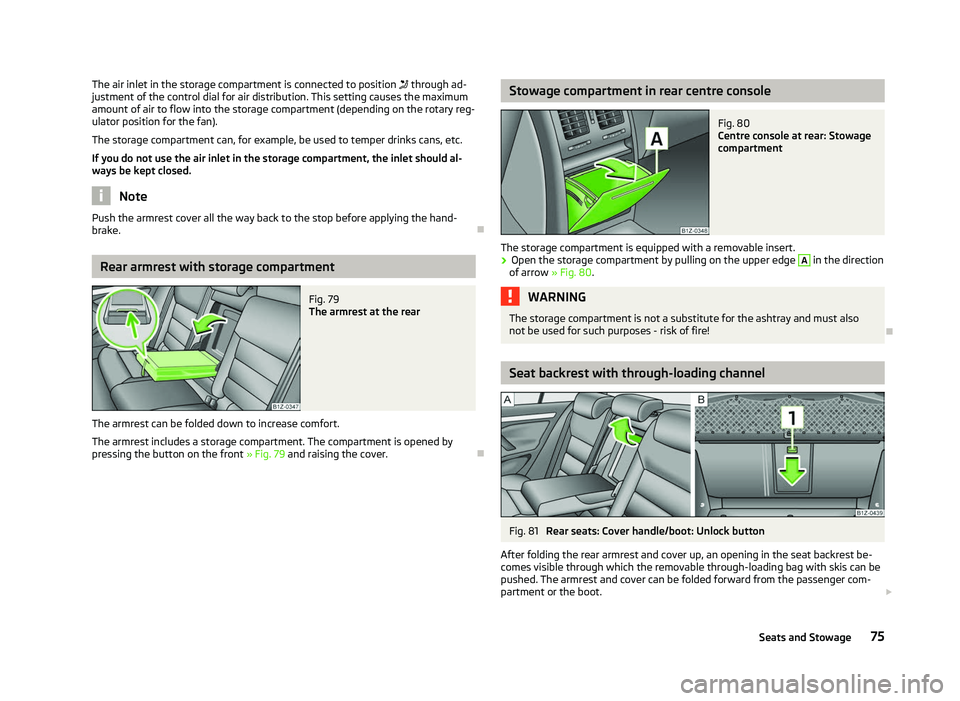
Fig. 79
The armrest at the rear
The armrest can be folded down to increase comfort.
The armrest includes a storage compartment. The compartment is opened by
pressing the button on the front » Fig. 79 and raising the cover. Ð Stowage compartment in rear centre console
Fig. 80
Centre console at rear: Stowage
compartment
The storage compartment is equipped with a removable insert. › Open the storage compartment by pulling on the upper edge A
in the direction
of arrow » Fig. 80 . WARNING
The storage compartment is not a substitute for the ashtray and must also
not be used for such purposes - risk of fire! Ð Seat backrest with through-loading channel
Fig. 81
Rear seats: Cover handle/boot: Unlock button
After folding the rear armrest and cover up, an opening in the seat backrest be-
comes visible through which the removable through-loading bag with skis can be
pushed. The armrest and cover can be folded forward from the passenger com-
partment or the boot. £
75
Seats and Stowage
Page 78 of 218
Opening from the passenger compartment
›
You can fold down the armrest at the loop
» page 60.
› Pull the handle upwards to the stop
» Fig. 81 - and fold the cover down.
Opening from the boot
› Push the unlock button 1
» Fig. 81
- down and fold the cover (including the
armrest) forwards.
Closing
› Fold the cover and armrest upwards to the stop - the lid must click into place.
Ensure that the armrest is always locked into place after closing. This is apparent
as the red field above the unlocking button 1
» Fig. 81
- is not visible from the
luggage compartment. WARNING
The through-loading channel is only intended for transporting skis that are
placed in a properly secured, removable through-loading bag » page 76.ÐRemovable through-loading bag
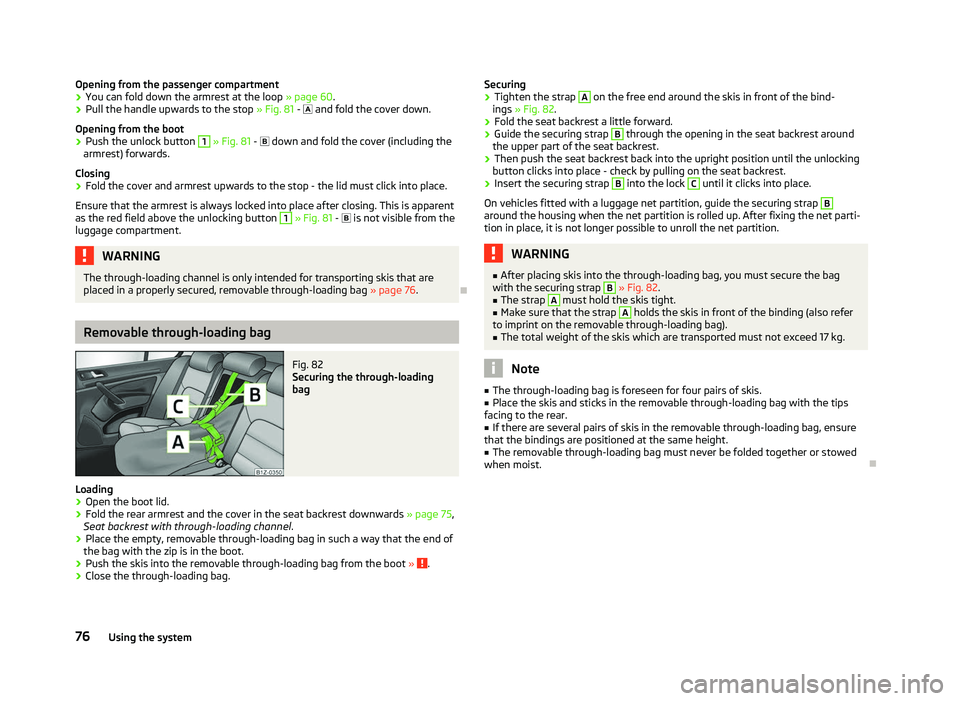
Fig. 82
Securing the through-loading
bag
Loading › Open the boot lid.
› Fold the rear armrest and the cover in the seat backrest downwards
» page 75,
Seat backrest with through-loading channel .
› Place the empty, removable through-loading bag in such a way that the end of
the bag with the zip is in the boot.
› Push the skis into the removable through-loading bag from the boot
» .
› Close the through-loading bag. Securing
›
Tighten the strap A
on the free end around the skis in front of the bind-
ings » Fig. 82 .
› Fold the seat backrest a little forward.
› Guide the securing strap B
through the opening in the seat backrest around
the upper part of the seat backrest.
› Then push the seat backrest back into the upright position until the unlocking
button clicks into place - check by pulling on the seat backrest.
› Insert the securing strap B
into the lock C
until it clicks into place.
On vehicles fitted with a luggage net partition, guide the securing strap B
around the housing when the net partition is rolled up. After fixing the net parti-
tion in place, it is not longer possible to unroll the net partition.
WARNING
■ After placing skis into the through-loading bag, you must secure the bag
with the securing strap B
» Fig. 82.
■ The strap A
must hold the skis tight.
■ Make sure that the strap A
holds the skis in front of the binding (also refer
to imprint on the removable through-loading bag).
■ The total weight of the skis which are transported must not exceed 17 kg. Note
■ The through-loading bag is foreseen for four pairs of skis.
■ Place the skis and sticks in the removable through-loading bag with the tips
facing to the rear.
■ If there are several pairs of skis in the removable through-loading bag, ensure
that the bindings are positioned at the same height.
■ The removable through-loading bag must never be folded together or stowed
when moist. Ð
76 Using the system
Page 79 of 218
Side compartment in the luggage compartment
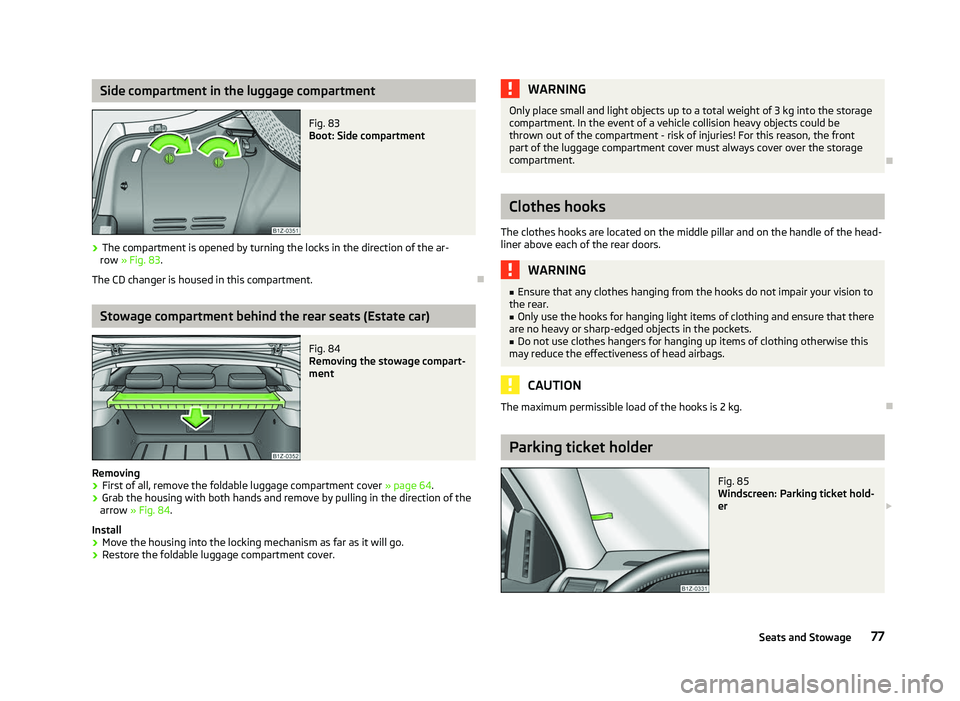
Fig. 83
Boot: Side compartment
› The compartment is opened by turning the locks in the direction of the ar-
row » Fig. 83.
The CD changer is housed in this compartment. ÐStowage compartment behind the rear seats (Estate car)
Fig. 84
Removing the stowage compart-
ment
Removing
› First of all, remove the foldable luggage compartment cover
» page 64.
› Grab the housing with both hands and remove by pulling in the direction of the
arrow » Fig. 84 .
Install
› Move the housing into the locking mechanism as far as it will go.
› Restore the foldable luggage compartment cover. WARNING
Only place small and light objects up to a total weight of 3 kg into the storage
compartment. In the event of a vehicle collision heavy objects could be
thrown out of the compartment - risk of injuries! For this reason, the front
part of the luggage compartment cover must always cover over the storage
compartment. Ð Clothes hooks
The clothes hooks are located on the middle pillar and on the handle of the head-
liner above each of the rear doors. WARNING
■ Ensure that any clothes hanging from the hooks do not impair your vision to
the rear.
■ Only use the hooks for hanging light items of clothing and ensure that there
are no heavy or sharp-edged objects in the pockets.
■ Do not use clothes hangers for hanging up items of clothing otherwise this
may reduce the effectiveness of head airbags. CAUTION
The maximum permissible load of the hooks is 2 kg. Ð Parking ticket holder
Fig. 85
Windscreen: Parking ticket hold-
er £
77
Seats and Stowage