lock SKODA OCTAVIA TOUR 2010 1.G / (1U) Columbus Navigation System Manual
[x] Cancel search | Manufacturer: SKODA, Model Year: 2010, Model line: OCTAVIA TOUR, Model: SKODA OCTAVIA TOUR 2010 1.G / (1U)Pages: 207, PDF Size: 12.63 MB
Page 106 of 207

Seat belts105
Using the system
Safety
Driving Tips
General Maintenance
Breakdown assistance
Technical Data
– Slowly pull the belt webbing at the tongue
of the lock over your chest and pelvis
.
– Insert the tongue of the lock into the seat belt buckle belonging to the seat until it is heard to lock in place.
– Pull on the belt to check that it has also reliably engaged in the lock.
Each three-point seat belt is equipped with an inertia reel. This inertia reel offers you
complete freedom of movement if the belt is unreeled slowly. If the brakes are applied
suddenly, the inertia reel will block. It also blocks the belts when the car accelerates,
when driving uphill and when cornering.
Expectant mothers must also wear the seat belt .
WARNING
The shoulder part of the seat belt must never run across your neck but must
run approximately over the middle of the shoulder and fit snugly against the
chest. The lap part of the belt must run across the hip and must never be routed
across the stomach. It must always fit snugly page 104, fig. 111 . Adjust the
belt webbing as required.
The lap part of the belt should be positioned as low as possible at the pelvis
of an expectant mother in order to avoid exerting any pressure on the lower
abdomen.
Always ensure that the webbing of the seat belts is properly routed. Seat
belts which are not correctly adjusted ca n themselves cause injuries even in
minor accidents.
A seat belt which is hanging too loose can result in injuries as your body is
moved forward by the kinetic energy produced in an accident and is then
suddenly held firm by the belt.
Only insert the lock tongue into the lock which is the correct one for your
seat. This will affect the protection which the belt offers and increase the risk of
an injury.
Seat belt height adjusterThe seat belt height adjuster makes it possible for you to adapt the routing of the three-
point seat belt in the area of the shoulder to match your body size.
– In order to adjust the height, press on the upper seat belt deflection and push it into the desired direction up or down so th at the shoulder part of the belt is posi-
tioned approximately across th e middle of your shoulder page 104, fig. 111 .
– Then pull firmly on the belt to ensure that the seat belt height adjuster has correctly
locked in place.
WARNING
Adjust the height of the belt in such a way that the shoulder part of the belt is
positioned approximately across the middle of your shoulder - on no account
across your neck.
Note
It is also possible to adapt the routing of the belt webbing at the front seats by adjusting
the height of the seat.
Fig. 113 Front seat: Seat belt
height adjuster
s2rc.book Page 105 Thursday, April 22, 2010 10:58 AM
Page 107 of 207

Seat belts
106
Taking seat belts off– Press the red button in the belt lock fig. 114 . The spring force causes the tongue
of the lock to jump out.
– Guide the belt back with your hand to en able the inertia reel to wind up the belt
webbing more easily.
A plastic knob in the belt webbing holds the be lt tongue in a position which is easy to
get hold of.Three-point seat belt with the Interlock System*A three-point safety belt with the Interlock System is used on some vehicles instead of
a pelvic belt.
If the backrest of the rear seats is not secured, the retractor blocks and the seat belt
cannot be reeled down.Rear middle three-point safety belt with safety lock for a child seat*In order to attach a child seat the rear middle three-point safety belt with the blocking,
the so-called child safety locks, can be used.
Switching child safety lock on– Attach the child safety seat with the three-point seat belt (self-retracting) as stated
in the manufacturer's instructions.
– Reel up the shoulder part of the belt comp letely. When the belt is reeled up, this
can be detected by a “clicking” noise.
– After fixing the child seat in place, let th e belt freely reel up. Now the belt can no
longer be reeled down.
– Check if the safety lock is activated by pulling on the belt.Switching child safety lock off– By pressing the button in the lock of the safety belt, the blocking is unblocked and
afterwards the safety belt starts to reel up.
– After fully reeling up the belt, you can freely reel it down again.The pelvic belt*
Fig. 114 Releasing lock tongue
from belt lock
Fig. 115 Fasten pelvic belt
s2rc.book Page 106 Thursday, April 22, 2010 10:58 AM
Page 108 of 207

Seat belts107
Using the system
Safety
Driving Tips
General Maintenance
Breakdown assistance
Technical Data
The rear middle seat is fitted with a pelvic be
lt. The lock part of the two-point pelvic belt
is operated in the same way as for a three-point safety belt. An unused pelvic belt
should be stowed away together with the lock for safety reasons.
Extending the pelvic belt– Hold the lock tongue at right angles to the belt webbing and pull through the
desired amount of belt webbing fig. 116 .Shortening the pelvic belt– Pull on the free end of the belt.
– Fix the excess belt length by thre ading it through the plastic slider.
The adjustment of the belt length is facili tated by simultaniously pressing the belt
tongue and the belt cover lengthwise.
WARNING
The pelvic belt must always sit firmly ac ross the pelvis; tighten the belt webbing
if necessary.
Belt tensionersSafety for the driver and front passenger wearing their seat belts is enhanced by the
belt tensioners fitted to the inertia reels of the front three-point seat belts, in addition
to the protection afforded by the airbag system.
The three-point seat belts are automatically te nsioned in the event of a frontal collision
of a certain severity. The belt tensioners can also be deployed if the seat belts are not
fastened.
The belt tensioner is deployed in the event of a frontal collision of major severity. A
powder charge is ignited in the inertia re els during deployment. The belt webbing is
pulled into the inertia reels by a mechanical system and the belt is tensioned.
Belt tensioners are not activated in the even t of minor frontal collisions, side and rear-
end collisions, in the case of a rollover an d also not in accidents in which no major
forces are produced from the front.
WARNING
Any work on the system including removal and installation of system
components because of other repair work, must only be carried out by a
specialist garage.
The protective function of the system is only adequate for a single accident.
If the belt tensioners have been deployed, it is then necessary to replace the
entire system.
The Owner's Manual must also be handed over to the new owner if the
vehicle is sold.Note
Smoke is generated when the belt tensione rs are deployed. This is not an indica-
tion of a fire in the vehicle.
It is essential to pay attent ion to relevant safety regulations if the vehicle or indi-
vidual parts of the system are scrapped. Specialist garages are familiar with these regu-
lations and will be able to provide you with detailed information in this respect.
When disposing of vehicle or parts of the system, it is important to comply with the
national legal requirements.
Fig. 116 Extending the pelvic
belt
s2rc.book Page 107 Thursday, April 22, 2010 10:58 AM
Page 110 of 207

Airbag system109
Using the system
Safety
Driving Tips
General Maintenance
Breakdown assistance
Technical Data
In the case of a
violent side crash , the side airbag* is depl oyed on the side of the
vehicle on which the collision occurs.
In certain accident situ ations, the front as well as the side airbags are deployed at the
same time.
The airbags are not deployed in the case of minor frontal and side collisions, in the
case of rear-end collisi ons and vehicle rollover.
Deployment factors
It is not possible to state globally which deployment conditions apply to the airbag
system in every situation as the circumstances which exist in the case of accidents vary
greatly. An important role in this case, for ex ample, is played by factors such as the type
of object against which the vehicle impacts (h ard, soft), the angle of impact, the vehicle
speed etc.
A decisive factor for the deployment of the airbags is the deceleration which occurs
during a collision. The control unit analyses the nature of the collision and activates the
relevant restraint system. If the vehicle deceleration which occurs and is measured
during the collision remains below the prescribed reference values specified in the
control unit, the airbags are no t deployed although the vehicle may well suffer severe
damage to the bodywork as a consequence of the accident.
The airbags are not deployed if:
ignition is switched off;
a minor frontal collision;
a minor side collision;
a rear-end collision;
Rollover of the vehicle.Note
A grey white, non harmful gas is released when airbag is inflated. This is perfectly
normal and is not an indicati on of a fire in the vehicle.
The dash panel must be replaced after the front passenger airbag has been
deployed.
In the event of an accident in which the airbags are deployed:
the interior lighting comes on (if the swit ch for the interior light is in the door
contact position),
the hazard warning li ght is switched on;
All the doors are unlocked.
Front airbagsDescription of the front airbags
The airbag system is not a su bstitute for the seat belt!The front airbag for the driver is housed in the steering wheel fig. 117 . The front
airbag for the front passenger* is housed in the dash panel above the storage
Fig. 117 Driver airbag in the
steering wheelFig. 118 Front passenger airbag
in the dash panel
s2rc.book Page 109 Thursday, April 22, 2010 10:58 AM
Page 122 of 207

Transporting children safely121
Using the system
Safety
Driving Tips
General Maintenance
Breakdown assistance
Technical Data
Attaching a child seat using the “ISOFIX” systemThere are two locking eyes between the rear exterior seat backrest and the surface of
the seat itself on both sides for fixing the ISOFIX system child seat in place. One can
mount a child safety seat using the ISOFIX system quickly, easily and reliably. The
installation must be carried out according to the supplied instructions. The seat must
click into place audi bly when installing.Install child seat– Insert the mounting funnels onto the lock ing eyes between the seat backrest and
the seat cushion fig. 132 .
– Push the notched arms of the child seat in to the locking eyes until they are heard
to lock in place fig. 133. –
Pull on both sides of the child seat!
One can mount a child safety seat using the “ISOFIX” system quickly, easily and reli-
ably. Please pay close attention to instruct ions from the manufacturer of the child
safety seat when installing and removing the seat.
Child seats fitted with the “ISOFIX” system can only be mounted and fixed in a vehicle
fitted with an “ISOFIX” system when these child seats have been released for this type
of vehicle according to the ECE-R 44 standard.
You can obtain child seats with the “ISOFIX” attachment system from specialist garages
who will also installed it as well.
Complete installation instructions are enclosed with the child safety seat.
WARNING
The locking eyes have just been deve loped for child safety seats which use
the “ISOFIX” system. You should therefore never attach other child safety seats,
seat belts or objects to the locking eyes - hazard!
Ask a specialist garage whether a child seat which you bought for another
vehicle is recommended for use in your vehicle before using a child seat with
“ISOFIX” system.
Certain child seats which use the “ISO FIX” system can be attached with
standard three-point seat belts. Please pay close attention to instructions from
the manufacturer of the child safety seat when installing and removing the
seat.Note
Child seats which use the “ISOFIX” system are currently available for children
weighing from 9 up to 18 kg. This correspond s to an age range of from 9 months to 4
years.
Fig. 132 Locking eyes (ISOFIX
system)Fig. 133 The ISOFIX child seat is
pushed into the mounting
funnels
s2rc.book Page 121 Thursday, April 22, 2010 10:58 AM
Page 124 of 207
Intelligent Technology123
Using the system
Safety
Driving Tips
General Maintenance
Breakdown assistance
Technical Data
Driving TipsIntelligent TechnologyElectronic stability programme (ESP)*GeneralGeneral
The ESP aids you in maintaining control of your vehicle in situations in which the
vehicle is driving at its dynamic limits, such as entering a curve fast. The risk of skidding
is reduced and your vehicle thus offers greater driving stability depending on the
conditions of the road surface. The system operates at all speeds.
The following systems are integrated into the electronic stability programme:
Electronic Differential Lock (EDL),
Traction control system (TCS),
Antilock brake system (ABS),
Brake Assist.
Operating principle
The ESP switches on automatically when the engine is started and then conducts a self-
test. The ESP control unit processes data from the individual systems. It also processes additional measurement data which are supplied by highly sensitive sensors: the rota-
tional velocity of the vehicle about its vert
ical axis, the lateral acceleration of the
vehicle, the braking pressure and the steering angle.
The direction which the driver wishes to take is determined based on the steering
angle and the speed of the vehicle and is co nstantly compared with the actual behav-
iour of the vehicle. If differences exist, such as the vehi cle beginning to skid, the ESP will
automatically brake the appropriate wheel.
The car is stabilised again by the forces wh ich take effect when the wheel is braked.
Intervention into the brake system takes place primarily on the outer front wheel of a
vehicle which tends to oversteer (tendency for the rear of the vehicle to break away)
while occurs this is on the inner rear wh eel of a vehicle which tends to understeer
(tendency to shift out of the curve). This braking control cycle is accompanied by
noises.
The ESP operates in combination with the ABS page 126, “Antilock brake system
(ABS)*”. If there is a fault in the ABS system, the ESP also does not operate.
The ESP warning light lights up in the instrument cluster when there is a fault on the
ESP page 31.
Switching off
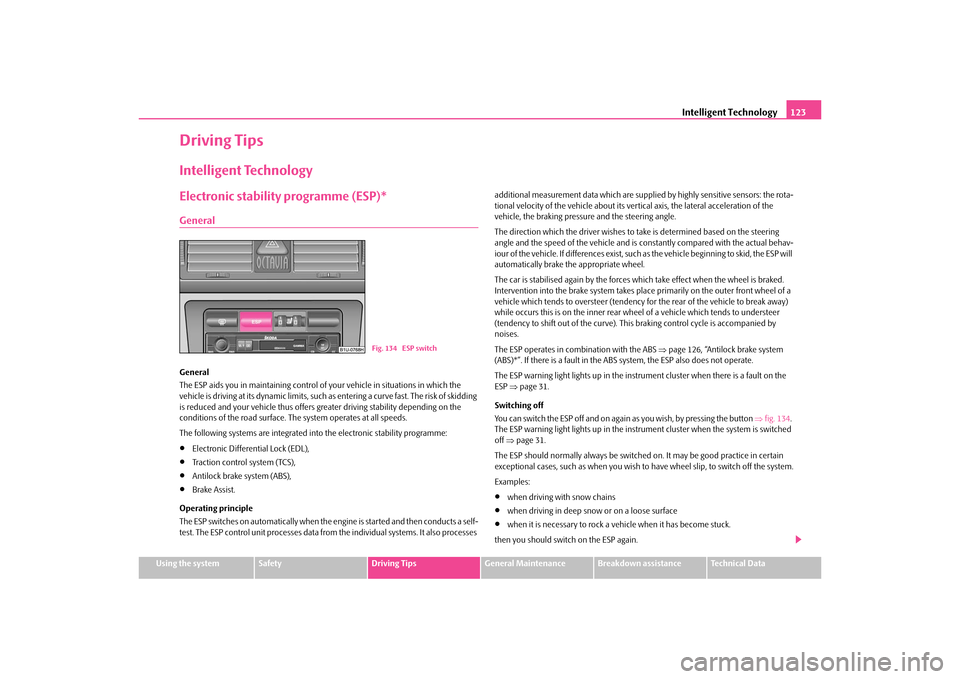
You can switch the ESP off and on agai n as you wish, by pressing the button fig. 134 .
The ESP warning light lights up in the instrument cluster when the system is switched
off page 31.
The ESP should normally always be switched on. It may be good practice in certain
exceptional cases, such as when you wish to have wheel slip, to switch off the system.
Examples:
when driving with snow chains
when driving in deep snow or on a loose surface
when it is necessary to rock a vehicle when it has become stuck.
then you should switch on the ESP again.
Fig. 134 ESP switch
s2rc.book Page 123 Thursday, April 22, 2010 10:58 AM
Page 125 of 207

Intelligent Technology
124WARNING
It is also not possible for the ESP to overcome the physical limits of the vehicle.
Even if a vehicle fitted with ESP you should still always adapt your style of
driving to the condition of the road surface and the traffic situation. This partic-
ularly applies when driving on slippery and wet roads. The increased safety
offered must not tempt you to take greater risks than otherwise - risk of an acci-
dent!
Note
All four wheels must be fitted with the same tyres in order to achieve problem-free
operation of the ESP. Differing rolling circum ferences of the tyres can lead to an unde-
sirable reduction in the engine output.
Changes to vehicle (e.g. on engine, on th e brakes, on chassis or another combina-
tion of tyres and wheels) can influence the function of the ESP page 166, “Accesso-
ries, changes and replacement of parts”.
Electronic Differential Lock (EDL)*
The electronic differential lock prev ents an individual wheel from slip-
ping.Vehicles fitted with ABS* can be equipped with electronic differential lock (EDL).
General
The EDL makes it much easier, and sometimes at all possible, to start off, accelerate
and climb a steep hill when the conditions of the road surface are unfavourable.
Operating principle
The EDL is activated automaticall y, that is without any action on the part of the driver.
It monitors the speeds of the driven wheels with the aid of the ABS sensors. Should
only one drive wheel begin spinning on a slippery surface there will be an appreciable
difference in the speed of the driven wheels. The EDL function brakes the slipping
wheel and the differential transmits a greate r driving force to the other driven wheel.
This control process is also accompanied by noises. Overheating of the brakes
The EDL switches off automatica
lly if unusually severe stresses exist in order to avoid
excessive heat generation in the disc brak e on the wheel which is being braked. The
vehicle can continue to be driven and has the same characteristics as a vehicle not
fitted with EDL.
The EDL switches on again automatically as soon as the brake has cooled down.
WARNING
Carefully depress the accelerator when accelerating on uniformly slippery
road surfaces, such as ice and snow. Th e driven wheels might still spin despite
the EDL and affect the stability of the vehicle - risk of an accident!
You should always adapt your style of driving to the condition of road
surface and to the traffic situation even when your vehicle is fitted with EDL.
The increased safety offered must not tempt you to take greater risks than
otherwise - risk of an accident!Note
If the ABS warning light comes on, this may also indicate a fault in the EDL. Please
have the vehicle inspected as soon as possible by a specialist garage.
Changes to vehicle (e.g. on engine, on the brakes, on chassis or another combina-
tion of tyres and wheels) can influence the function of the EDL page 166, “Accesso-
ries, changes and replacement of parts”.
s2rc.book Page 124 Thursday, April 22, 2010 10:58 AM
Page 126 of 207

Intelligent Technology125
Using the system
Safety
Driving Tips
General Maintenance
Breakdown assistance
Technical Data
Traction control system (TCS)
The traction control system prevents the driven wheels from spinning
when accelerating.General
The TCS makes it much easier, and sometimes at all possible, to start off, accelerate
and climb a steep hill when the conditions of the road surface are unfavourable.
Operating principle
The TCS switches on automatically when th e engine is started and then conducts a
self-test. The system monitors the speeds of the driven wheels with the aid of the ABS
sensors. If the wheels are spinning, the force transmitted to the road surface is auto-
matically adapted by reducing the engine speed. The system operates at all speeds.
The TCS operates in combination with the ABS page 126, “Antilock brake system
(ABS)*”. The TCS will not function if a fault exists in the ABS system.
The TCS warning light lights up in the instru ment cluster when there is a fault on the
TCS page 31.
Switching off
You can switch the TCS off and on again as you wish by pressing the button fig. 135 .
The TCS warning light lights up in the instru ment cluster when the system is switched
off page 31.
The TCS should normally always be switched on. It may be good practice in certain
exceptional cases, such as when you wish to have wheel slip, to switch off the system. Examples:
when driving with snow chains
when driving in deep snow or on a loose surface
when it is necessary to rock a vehicle when it has become stuck.
then you should switch on the TCS again.
WARNING
You should always adjust your style of driving to the conditions of the road
surface and the traffic situation. The increased safety offered must not tempt
you to take greater risks than otherwise - risk of an accident!
Note
All four wheels must be fitted with the same tyres in order to achieve problem-free
operation of the TCS. Differing rolling circumferences of the tyres can lead to an unde-
sirable reduction in the engine output.
Changes to vehicle (e.g. on engine, on the brakes, on chassis or another combina-
tion of tyres and wheels) can influence the function of the TCS page 166, “Accesso-
ries, changes and replacement of parts”.
BrakesWhat has a negative effect on braking efficiency?Wear-and-tear
Wear-and-tear to the brake pa ds is greatly dependent on the operating conditions of
the vehicle and your style of driving. Particularly if you drive a great deal in towns and
over short distances or if you adopt a sporty style of driving, it may be necessary to
have the thickness of the brake pads insp ected at a specialist garage between the
service inspections.
Wet roads or road salt
There may be a certain delay before the brakes take full effect un der certain conditions
such as when driving through water, during heavy rain showers or after the vehicle has
been washed in an automatic vehicle wash , since the brake discs and brake pads may
Fig. 135 TCS switch
s2rc.book Page 125 Thursday, April 22, 2010 10:58 AM
Page 127 of 207

Intelligent Technology
126
be moist or even have a coatin g of ice on them in winter. Yo u s h o u l d d r y t h e b r a k e s a s
soon as possible by applying and releasing the brakes several times.
There also may be a certain delay before the full braking efficiency is available when
driving on roads which have been treated wi th road salt if you have not used the
brake s for s ome cons ide ra bl e time be foreha nd . T he la yer of s alt on the brake di scs a nd
brake pads must first be rubbed off when you apply the brakes.
Corrosion
Corrosion on the brake discs and dirt on th e bake pads occur if the vehicle has been
parked for a long period an d if you do not make much use of the braking system.
We recommend cleaning the brak e discs by firmly applying the brakes at a fairly high
speed if you do not make much use of the braking system or if surface corrosion is
present .
Faults in the brake surface
If you notice that the braking distance ha s suddenly become longer and that the brake
pedal can be depressed further, it is possible that a brake circuit of the dual-circuit
brake system has failed. Drive, in such cases, to the nearest specialist garage without
delay in order to have the problem rectified. Drive at a reduced speed while on your
way to the dealer and adapt your style of driving to the higher brake pedal pressure
required.
Low brake fluid level
An insufficient level of brake fluid may result in problems in the brake system. The level
of the brake fluid is monitored electronically page 31, “Brake system ”.
WARNING
Only apply the brakes for the purpose of drying and cleaning the brake discs
if the traffic conditions permit this. Do not place any other road users in jeop-
ardy.
When retrospectively mounting a front spoiler, solid wheel hubs etc. one
must ensure that the air supply to the front wheel brakes is not reduced other-
wise the braking system could run too hot.
Allow for the fact that new brake pads do not achieve their full braking effi-
ciency until approximately 200 kilometres. New brake pads must be first “run
in” before they develop their optimal friction force. You can, however, compensate for this slightly reduced br
aking force by increasing the pressure
on the brake pedal. This guideline also applies to any new brake pads installed
at a future date.
Caution
Never allow the brakes to rub by applying slight pressure if you do not wish to
brake the vehicle. This causes the brakes to overheat and can also result in a longer
braking distance and excessive wear.
Before negotiating a steep downhill section, reduce your speed, shift down into the
next lower gear. This enables you to make full use of the braking power of the vehicle
and reduces the strain on the brakes. Any additional braking should be done intermit-
tently, not continuously.
Brake boosterThe brake booster boosts the pressure whic h you generate with the brake pedal. The
necessary pressure is only genera ted when the engine is running.
WARNING
Never switch off the engine befo re the vehicle is stationary.
The brake booster only operates when the engine is running. Greater phys-
ical effort for braking is required when en gine is switched off. Because if you do
not stop as normal, this can cause an accident and severe injuries.
Antilock brake system (ABS)*ABS prevents the wheels locking when braking.General
The ABS contributes significan tly to enhancing the active safety of your vehicle.
Compared to a vehicle not fitted with the ABS brake system, you are able to retain
optimal steering ability even during a full br ake application on a slippery road surface
because the wheels do not lock up.
WARNING (continued)
s2rc.book Page 126 Thursday, April 22, 2010 10:58 AM
Page 128 of 207

Intelligent Technology127
Using the system
Safety
Driving Tips
General Maintenance
Breakdown assistance
Technical Data
You must not expect, however, that the br
aking distance will be shorter under all
circumstances as a result of the ABS. The braking distance for example on gravel and
fresh snow, when you should anyway be driving slowly and cautiously, will be longer.
Operating principle
The brake pressure will be reduced on a wheel which is rotating at a speed which is too
low for the speed of the vehicle and tending to lock. This control cycle is noticeable
from a pulsating movement of the brake pedal which is accompanied by noises.
This is consciously intended to provide the driver with the information that the wheels
are tending to lock (ABS control range) . You must always keep the brake pedal
depressed to enable the ABS to optimally control the brake application in this braking
range. Never interrupt the application of the brakes!
WARNING
The ABS can also not overcome the physical limits of your vehicle. Please do
not forget this, particularly when driving on icy or wet road surfaces. If the ABS
is operating within the control range, adapt your speed immediately to the
conditions of the road surface and the traffic situation. The increased safety
offered by the ABS must not tempt you to take greater risks than otherwise -
risk of an accident!
The normal braking system is still fully functional if there is an ABS fault.
Visit a specialist garage as quickly as poss ible and adjust your style of driving to
take account of the ABS fault in the meantime since you will not know the
extent of the fault and in how far the braking efficiency is affected.Note
A warning light comes on if a fault occurs in the ABS system page 30.
Changes to vehicle (e.g. on engine, on th e brakes, on chassis or another combina-
tion of tyres and wheels) can in fluence the function of the ABS page 166, “Accesso-
ries, changes and replacement of parts”.
Brake Assist*During a severe brake application (e.g. if a hazard exists), the Brake Assist increases the
braking force and thus makes it possible to rapidly produce the pressure required in
the brake system.
The majority of drivers do a pply the brakes in good time in dangerous situations, but
do not depress the brake pedal with suffi cient pressure. Consequently, it is not
possible for the vehicle to achieve its maximum deceleration and the vehicle covers a
greater distance than necessary.
The Brake Assist is activated by the very qu ick operation of the brake pedal. In such
cases, a much greater braking pressure exists than during a normal brake application.
This makes it possible, even with a relatively low resistance of the brake pedal, to
produce an adequate pressure in the brake system in the shortest possible time, which
is required for maximum dece leration of the vehicle. You must apply the brake pedal
firmly and hold it in this position in or der to achieve the shortest possible braking
distance.
The Brake Assist is able to help you achi eve a shorter braking distance in emergency
situations by rapidly producing the pressure required in the brake system. It fully
exploits the attributes of the ABS. After you release the brake pedal, the function of the
Brake Assist is automatically switched off and the brakes operate in the normal way.
WARNING
The Brake Assist is also not able to overcome the physical limits of your
vehicle in terms of the braking distance required.
Adapt your speed to the conditions of the road surface and to the traffic
situation.
The increased safety offered by the Brake Assist must not tempt you to take
a greater safety risk than otherwise.
s2rc.book Page 127 Thursday, April 22, 2010 10:58 AM