lock SKODA RAPID 2013 1.G Service Manual
[x] Cancel search | Manufacturer: SKODA, Model Year: 2013, Model line: RAPID, Model: SKODA RAPID 2013 1.GPages: 226, PDF Size: 15.16 MB
Page 124 of 226
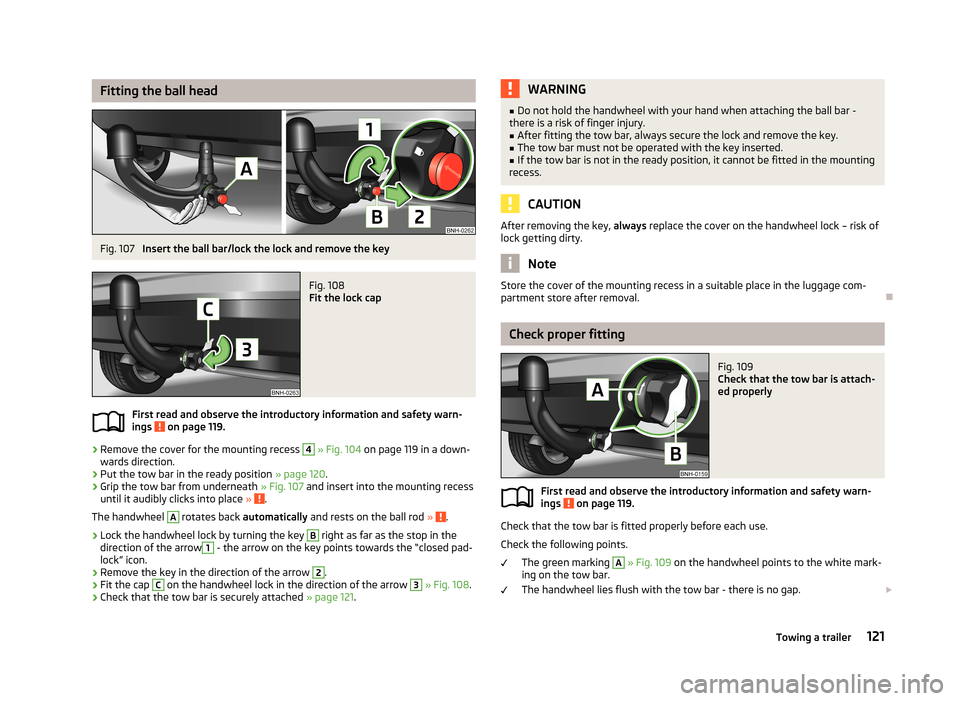
Fitting the ball headFig. 107
Insert the ball bar/lock the lock and remove the key
Fig. 108
Fit the lock cap
First read and observe the introductory information and safety warn-
ings on page 119.
›
Remove the cover for the mounting recess
4
» Fig. 104 on page 119 in a down-
wards direction.
›
Put the tow bar in the ready position » page 120.
›
Grip the tow bar from underneath » Fig. 107 and insert into the mounting recess
until it audibly clicks into place » .
The handwheel
A
rotates back automatically and rests on the ball rod » .
›
Lock the handwheel lock by turning the key
B
right as far as the stop in the
direction of the arrow
1
- the arrow on the key points towards the “closed pad-
lock” icon.
›
Remove the key in the direction of the arrow
2
.
›
Fit the cap
C
on the handwheel lock in the direction of the arrow
3
» Fig. 108 .
›
Check that the tow bar is securely attached » page 121.
WARNING■
Do not hold the handwheel with your hand when attaching the ball bar -
there is a risk of finger injury.■
After fitting the tow bar, always secure the lock and remove the key.
■
The tow bar must not be operated with the key inserted.
■
If the tow bar is not in the ready position, it cannot be fitted in the mounting
recess.
CAUTION
After removing the key, always replace the cover on the handwheel lock – risk of
lock getting dirty.
Note
Store the cover of the mounting recess in a suitable place in the luggage com-
partment store after removal.
Check proper fitting
Fig. 109
Check that the tow bar is attach-
ed properly
First read and observe the introductory information and safety warn-
ings on page 119.
Check that the tow bar is fitted properly before each use.
Check the following points. The green marking
A
» Fig. 109 on the handwheel points to the white mark-
ing on the tow bar.
The handwheel lies flush with the tow bar - there is no gap.
121Towing a trailer
Page 125 of 226
The handwheel is locked and the key is removed.
The cap B
is on the handwheel.
The tow bar does not come out of the mounting recess even after heavy
“shaking”.WARNINGDo not use the towing device unless the tow bar has been properly locked!
Removing the ball head
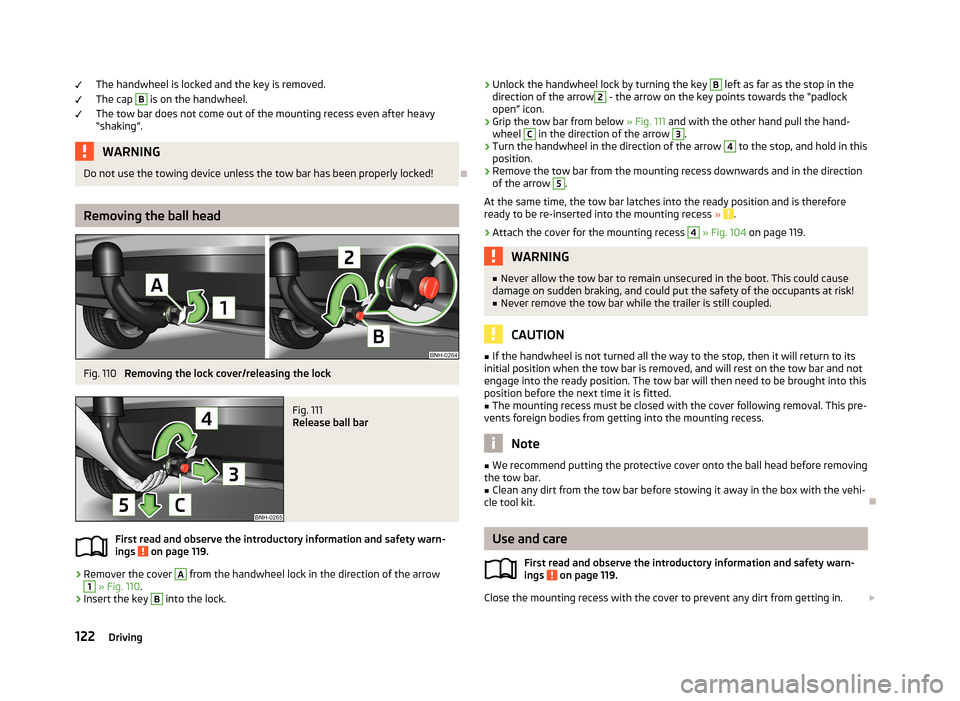
Fig. 110
Removing the lock cover/releasing the lock
Fig. 111
Release ball bar
First read and observe the introductory information and safety warn-
ings on page 119.
›
Remover the cover
A
from the handwheel lock in the direction of the arrow
1
» Fig. 110 .
›
Insert the key
B
into the lock.
›
Unlock the handwheel lock by turning the key B left as far as the stop in the
direction of the arrow2 - the arrow on the key points towards the “padlock
open” icon.›
Grip the tow bar from below » Fig. 111 and with the other hand pull the hand-
wheel
C
in the direction of the arrow
3
.
›
Turn the handwheel in the direction of the arrow
4
to the stop, and hold in this
position.
›
Remove the tow bar from the mounting recess downwards and in the direction
of the arrow
5
.
At the same time, the tow bar latches into the ready position and is therefore
ready to be re-inserted into the mounting recess »
.
›
Attach the cover for the mounting recess
4
» Fig. 104 on page 119.
WARNING■
Never allow the tow bar to remain unsecured in the boot. This could cause
damage on sudden braking, and could put the safety of the occupants at risk!■
Never remove the tow bar while the trailer is still coupled.
CAUTION
■ If the handwheel is not turned all the way to the stop, then it will return to its
initial position when the tow bar is removed, and will rest on the tow bar and not
engage into the ready position. The tow bar will then need to be brought into this position before the next time it is fitted.■
The mounting recess must be closed with the cover following removal. This pre-
vents foreign bodies from getting into the mounting recess.
Note
■ We recommend putting the protective cover onto the ball head before removing
the tow bar.■
Clean any dirt from the tow bar before stowing it away in the box with the vehi-
cle tool kit.
Use and care
First read and observe the introductory information and safety warn-
ings
on page 119.
Close the mounting recess with the cover to prevent any dirt from getting in.
122Driving
Page 127 of 226
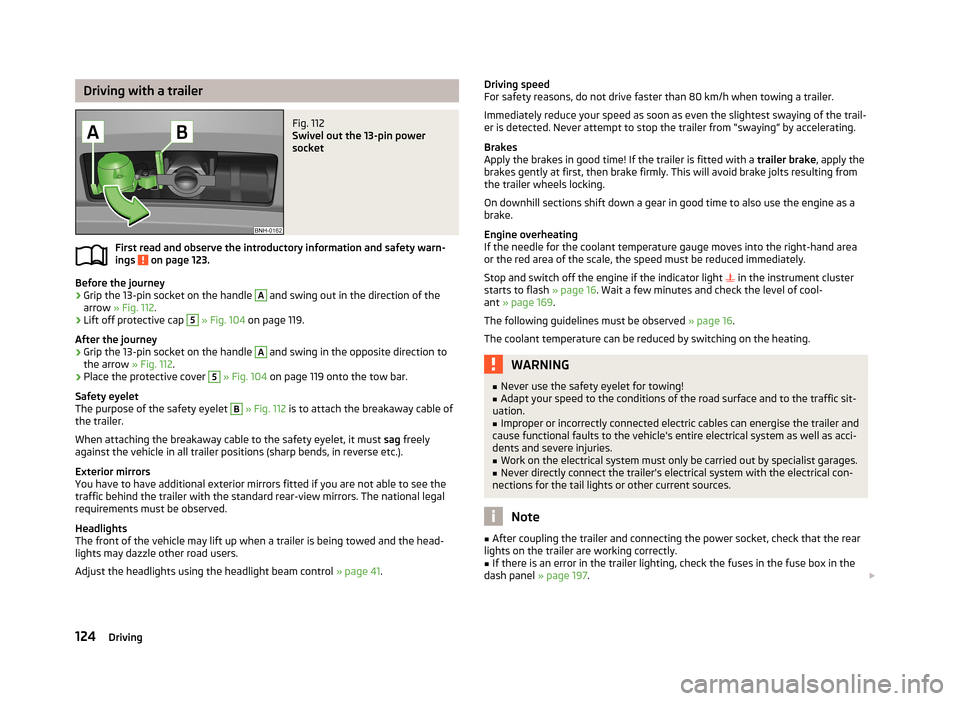
Driving with a trailerFig. 112
Swivel out the 13-pin power
socket
First read and observe the introductory information and safety warn-
ings on page 123.
Before the journey
›
Grip the 13-pin socket on the handle
A
and swing out in the direction of the
arrow » Fig. 112 .
›
Lift off protective cap
5
» Fig. 104 on page 119.
After the journey
›
Grip the 13-pin socket on the handle
A
and swing in the opposite direction to
the arrow » Fig. 112.
›
Place the protective cover
5
» Fig. 104 on page 119 onto the tow bar.
Safety eyelet
The purpose of the safety eyelet
B
» Fig. 112 is to attach the breakaway cable of
the trailer.
When attaching the breakaway cable to the safety eyelet, it must sag freely
against the vehicle in all trailer positions (sharp bends, in reverse etc.).
Exterior mirrors
You have to have additional exterior mirrors fitted if you are not able to see the
traffic behind the trailer with the standard rear-view mirrors. The national legal requirements must be observed.
Headlights
The front of the vehicle may lift up when a trailer is being towed and the head-
lights may dazzle other road users.
Adjust the headlights using the headlight beam control » page 41.
Driving speed
For safety reasons, do not drive faster than 80 km/h when towing a trailer.
Immediately reduce your speed as soon as even the slightest swaying of the trail-
er is detected. Never attempt to stop the trailer from “swaying” by accelerating.
Brakes
Apply the brakes in good time! If the trailer is fitted with a trailer brake, apply the
brakes gently at first, then brake firmly. This will avoid brake jolts resulting from
the trailer wheels locking.
On downhill sections shift down a gear in good time to also use the engine as a brake.
Engine overheating
If the needle for the coolant temperature gauge moves into the right-hand area
or the red area of the scale, the speed must be reduced immediately.
Stop and switch off the engine if the indicator light
in the instrument cluster
starts to flash » page 16. Wait a few minutes and check the level of cool-
ant » page 169 .
The following guidelines must be observed » page 16.
The coolant temperature can be reduced by switching on the heating.WARNING■ Never use the safety eyelet for towing!■Adapt your speed to the conditions of the road surface and to the traffic sit-
uation.■
Improper or incorrectly connected electric cables can energise the trailer and
cause functional faults to the vehicle's entire electrical system as well as acci-
dents and severe injuries.
■
Work on the electrical system must only be carried out by specialist garages.
■
Never directly connect the trailer's electrical system with the electrical con-
nections for the tail lights or other current sources.
Note
■ After coupling the trailer and connecting the power socket, check that the rear
lights on the trailer are working correctly.■
If there is an error in the trailer lighting, check the fuses in the fuse box in the
dash panel » page 197.
124Driving
Page 128 of 226
■Contact between the breakaway cable and the safety eyelet can result in me-
chanical wear on the surface protection of the eyelet. Such wear does not impair
the functioning of the safety eyelet and does not constitute a fault. It is excluded from the warranty coverage.■
If you tow a trailer frequently, you should also have your vehicle inspected be-
tween service intervals.
■
The handbrake on the towing vehicle must be applied when coupling and un-
coupling the trailer.
Anti-theft alarm system
First read and observe the introductory information and safety warn-
ings
on page 123.
When the vehicle is locked, the alarm is activated when the electrical connection
to the trailer is interrupted.
Always switch off the anti-theft alarm system before a trailer is coupled or uncou- pled » page 36 .
Conditions for including a trailer in the anti-theft alarm system. The vehicle is factory-fitted with an anti-theft alarm system and towing de-
vice.
The trailer is electrically connected to the towing vehicle via the trailer sock-
et.
The electrical system of the vehicle and trailer is functional.
The vehicle is locked with the vehicle key and the anti-theft alarm system is
activated.
Note
For technical reasons, trailers with rear LED lights cannot be connected to the an-
ti-theft alarm system.
125Towing a trailer
Page 130 of 226
›Adjust the mirrors, the front seat and head restraint to your body size.
› Advise your passengers to adjust the head restraints to their body size.
› Protect children in suitable child seats with correctly fastened seat
belts » page 142 , Transporting children safely .
› Adopt the correct seated position
» page 127. Tell your passengers to assume
the correct seated position.
› Correctly fasten the seat belt. Also inform passengers to fasten the seat belt
correctly » page 130 .
What influences the driving safety?
First read and observe the introductory information and safety warn-ings
on page 126.
The driver is fully responsible for himself and his occupants. If your driving safety
is effected, you place yourself and the oncoming traffic at risk.
The following guidelines must therefore be observed. › Do not become distracted from concentrating on the traffic situation, e.g. by
your passengers or mobile phone calls.
› Never drive when your driving ability is impaired, e.g. due to medication, alcohol
or drugs.
› Keep to the traffic regulations and the permissible speed limit.
› Always adjust the driving speed to the road, traffic and weather conditions.
› Take regular breaks on long journeys – at least every two hours.
Correct seated position
Introduction
This chapter contains information on the following subjects:
Correct seated position for the driver
128
Correct seated position for the front passenger
128
Correct seated position for the passengers in the rear seats
128
Examples of incorrect seated positions
129WARNINGGeneral information■The front seats and head restraints must be adjusted to match the body
size at all times and the seat belt must always be fastened properly to provide the most effective levels of protection to the passengers.■
If the occupant adopts an incorrect seated position, he is exposed to life-
threatening injuries, in case he is hit by a deployed airbag.
■
If the occupants on the rear seats are not sitting upright, the risk of injury is
increased due to incorrect routing of the seat belt.
■
The seat backrests must not be tilted too far back when driving, as this will
impair the function of the seat belts and of the airbag system – risk of injury!
WARNINGInformation for the driver■Always assume the correct seated position before setting off and do not
change this position while driving. Also advise your passengers to adopt the
correct seated position and not to change this position while the car is mov-
ing.■
Maintain a distance of at least 25 cm to the steering wheel. Not maintaining
this minimum distance will mean that the airbag system will not be able to
properly protect you - hazard!
■
When driving, hold the steering wheel with both hands firmly on the outer
edge in the 9 o'clock and 3 o'clock position. Never hold the steering wheel in
the 12 o'clock position or in any other way (e.g. in the middle or inner edge of
the steering wheel). In such cases, you could severely injure the arms, hands
and head when the driver airbag is deployed.
■
Ensure that there are no objects in the driver's footwell as they may get
caught behind the pedals when driving or applying the braking. You would then no longer be able to operate the clutch, brake or accelerate.
127Passive Safety
Page 134 of 226
WARNINGObserve the following instructions for the proper use of the seat belts.■Never use one seat belt to secure two persons (including children). The
seatbelt must not be placed over a child who is sitting on the lap of another
passenger.■
The lock tongue should only be inserted into the lock which is the correct
one for your seat. Wrong use of the safety belt will reduce its capacity to pro-
tect and the risk of injury increases.
■
The slot of the belt tongue must not be blocked, otherwise the belt tongue
will not lock in place properly.
■
Many layers of clothing and loose clothing (e. g. a winter coat over a jacket)
do not allow you to be correctly seated and impairs proper operation of the
seat belts.
■
It is prohibited to use clamps or other objects to adjust seat belts (e. g. for
shortening the belts for smaller persons).
■
The seat belts for the rear seats can only fulfil their function reliably when
the seat backrests are correctly locked into position » page 55.
WARNINGObserve the following instructions for proper maintenance of the seat belts.■The belt webbing must always be kept clean. Soiled belt webbing may im-
pair proper operation of the inertia reel » page 159.■
The seat belts must not be removed or changed in any way. Do not attempt
to repair the seat belts yourself.
■
Check the condition of all the seat belts on a regular basis. If any damage to
the seat belts, seat belt connections, inertia reel or the lock is detected, the
relevant seat belt must be replaced by a specialist garage.
■
Damaged seat belts which have been subjected to stress in an accident and
were therefore stretched, must be replaced – this is best done by a specialist
garage. The anchorage points of the belts must also be inspected. The an-
chorage points for the belts should also be checked.
Note
The national legal requirements must be observed when using seat belts.
The physical principle of a frontal collisionFig. 115
Driver without a fastened seat belt/rear passenger without a fas-
tened seat belt
First read and observe the introductory information and safety warn-ings
on page 130.
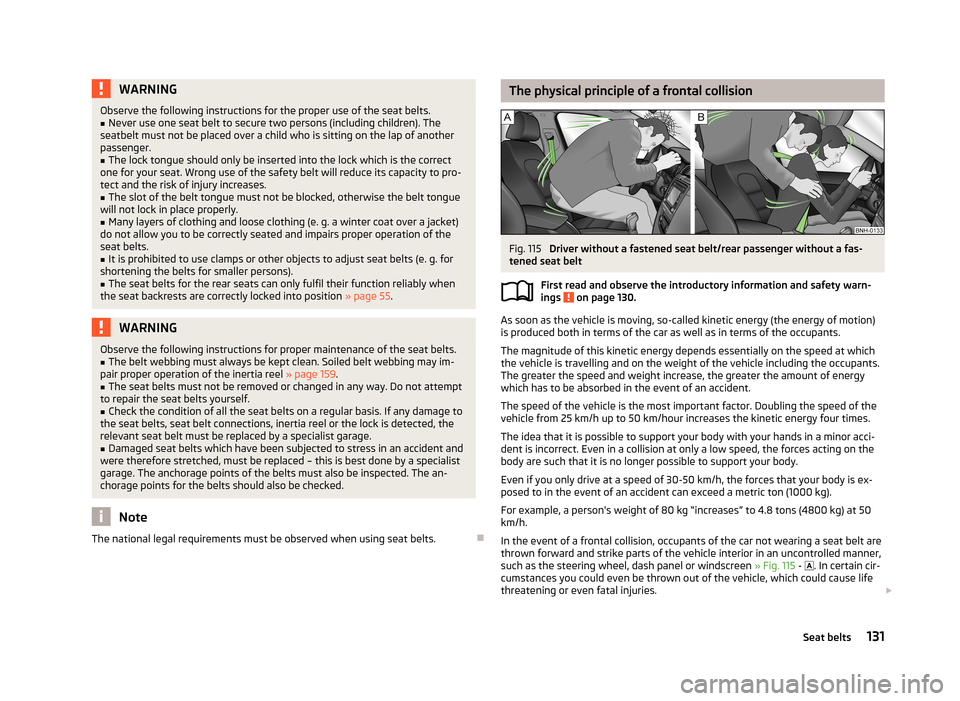
As soon as the vehicle is moving, so-called kinetic energy (the energy of motion)
is produced both in terms of the car as well as in terms of the occupants.
The magnitude of this kinetic energy depends essentially on the speed at which
the vehicle is travelling and on the weight of the vehicle including the occupants.
The greater the speed and weight increase, the greater the amount of energy
which has to be absorbed in the event of an accident.
The speed of the vehicle is the most important factor. Doubling the speed of the
vehicle from 25 km/h up to 50 km/hour increases the kinetic energy four times.
The idea that it is possible to support your body with your hands in a minor acci-dent is incorrect. Even in a collision at only a low speed, the forces acting on the
body are such that it is no longer possible to support your body.
Even if you only drive at a speed of 30-50 km/h, the forces that your body is ex-
posed to in the event of an accident can exceed a metric ton (1000 kg).
For example, a person's weight of 80 kg “increases” to 4.8 tons (4800 kg) at 50
km/h.
In the event of a frontal collision, occupants of the car not wearing a seat belt are thrown forward and strike parts of the vehicle interior in an uncontrolled manner,such as the steering wheel, dash panel or windscreen » Fig. 115 -
. In certain cir-
cumstances you could even be thrown out of the vehicle, which could cause life
threatening or even fatal injuries.
131Seat belts
Page 135 of 226
It is also important that rear passengers fasten their seat belts, as they could oth-
erwise be thrown through the vehicle in an uncontrolled manner in the event of
an accident.
Rear seat passengers who have not fastened their seat belts are a danger not
only to themselves but also to those seated at the front » Fig. 115 – .
Fastening and unfastening seat belts
Fig. 116
Fastening/unfastening the seat belt
Fig. 117
Routing of belt webbing over the shoulders and the lap belt/Rout-
ing of belt webbing for an expectant mother
First read and observe the introductory information and safety warn-
ings on page 130.
Fasten
›
Correctly adjust the front seat and head restraint 1)
before fastening the seat
belt » page 53 .
›
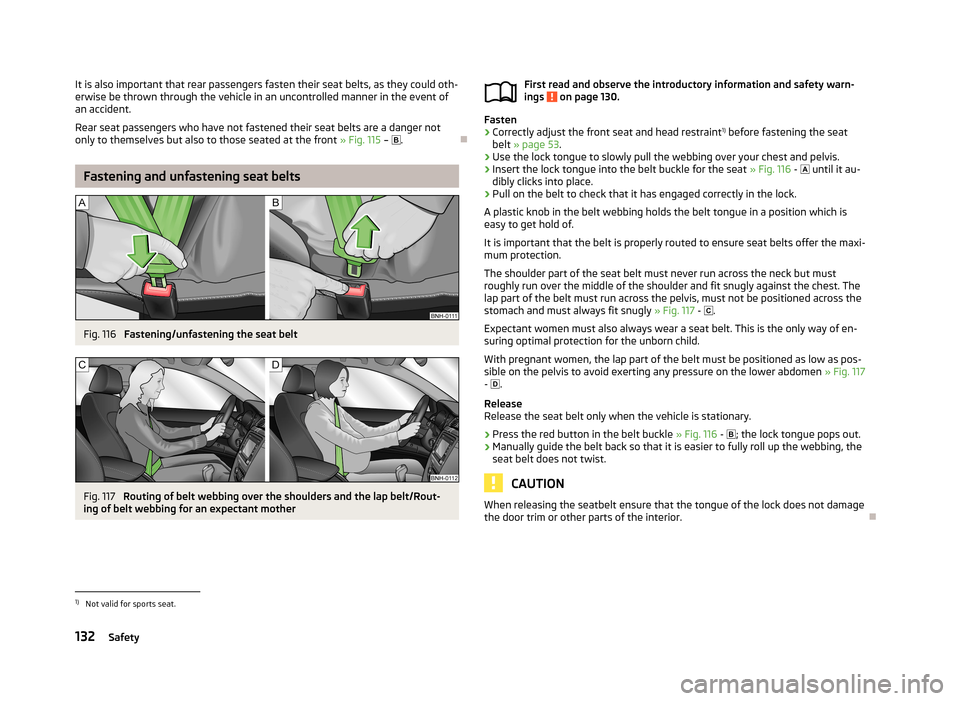
Use the lock tongue to slowly pull the webbing over your chest and pelvis.
›
Insert the lock tongue into the belt buckle for the seat » Fig. 116 - until it au-
dibly clicks into place.
›
Pull on the belt to check that it has engaged correctly in the lock.
A plastic knob in the belt webbing holds the belt tongue in a position which is
easy to get hold of.
It is important that the belt is properly routed to ensure seat belts offer the maxi- mum protection.
The shoulder part of the seat belt must never run across the neck but must
roughly run over the middle of the shoulder and fit snugly against the chest. The
lap part of the belt must run across the pelvis, must not be positioned across the
stomach and must always fit snugly » Fig. 117 -
.
Expectant women must also always wear a seat belt. This is the only way of en-
suring optimal protection for the unborn child.
With pregnant women, the lap part of the belt must be positioned as low as pos- sible on the pelvis to avoid exerting any pressure on the lower abdomen » Fig. 117
-
.
Release
Release the seat belt only when the vehicle is stationary.
›
Press the red button in the belt buckle » Fig. 116 -
; the lock tongue pops out.
›
Manually guide the belt back so that it is easier to fully roll up the webbing, the
seat belt does not twist.
CAUTION
When releasing the seatbelt ensure that the tongue of the lock does not damage
the door trim or other parts of the interior.
1)
Not valid for sports seat.
132Safety
Page 136 of 226
Belt height adjustment on the front seatsFig. 118
Front seat: Seat belt height ad-
juster
First read and observe the introductory information and safety warn-
ings on page 130.
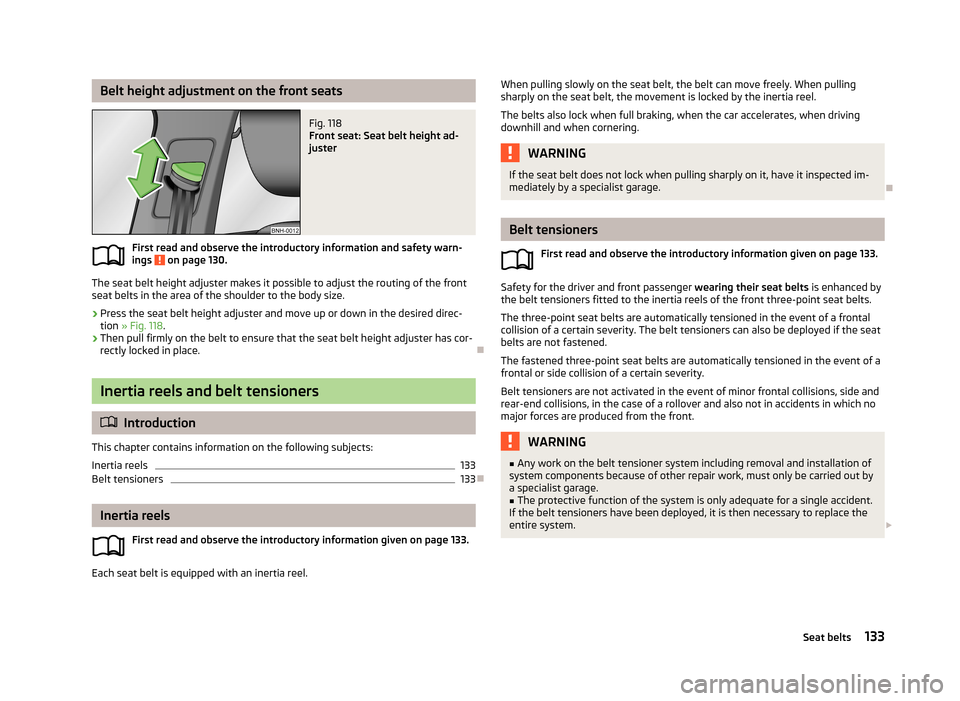
The seat belt height adjuster makes it possible to adjust the routing of the front
seat belts in the area of the shoulder to the body size.
›
Press the seat belt height adjuster and move up or down in the desired direc- tion » Fig. 118 .
›
Then pull firmly on the belt to ensure that the seat belt height adjuster has cor-
rectly locked in place.
Inertia reels and belt tensioners
Introduction
This chapter contains information on the following subjects: Inertia reels
133
Belt tensioners
133
Inertia reels
First read and observe the introductory information given on page 133.
Each seat belt is equipped with an inertia reel.
When pulling slowly on the seat belt, the belt can move freely. When pulling
sharply on the seat belt, the movement is locked by the inertia reel.
The belts also lock when full braking, when the car accelerates, when driving
downhill and when cornering.WARNINGIf the seat belt does not lock when pulling sharply on it, have it inspected im- mediately by a specialist garage.
Belt tensioners
First read and observe the introductory information given on page 133.
Safety for the driver and front passenger wearing their seat belts is enhanced by
the belt tensioners fitted to the inertia reels of the front three-point seat belts.
The three-point seat belts are automatically tensioned in the event of a frontal
collision of a certain severity. The belt tensioners can also be deployed if the seat
belts are not fastened.
The fastened three-point seat belts are automatically tensioned in the event of a frontal or side collision of a certain severity.
Belt tensioners are not activated in the event of minor frontal collisions, side andrear-end collisions, in the case of a rollover and also not in accidents in which no
major forces are produced from the front.
WARNING■ Any work on the belt tensioner system including removal and installation of
system components because of other repair work, must only be carried out by
a specialist garage.■
The protective function of the system is only adequate for a single accident.
If the belt tensioners have been deployed, it is then necessary to replace the
entire system.
133Seat belts
Page 139 of 226
In certain accident situations, the several airbags may be deployed simultaneous-
ly.
The airbags are not deployed in the case of minor frontal and side collisions, rear-
end collisions, tilting of the vehicle and vehicle rollover.
Deployment factors
It is not possible to generally determine which deployment conditions apply to the airbag system in every situation. An important role is played by factors such as the type of object that the vehicle hits (hard/soft), the impact angle, vehicle
speed etc.
A decisive factor for the deployment of the airbags is the deceleration which oc- curs. The control unit analyses the nature of the collision and activates the rele-
vant restraint system.
If the vehicle deceleration which occurs and is measured during the collision re-
mains below the prescribed reference values specified in the control unit, the air-
bags are not deployed although the vehicle may well suffer severe damage to thebodywork as a consequence of the accident.
The following airbags will be deployed in the event of a severe frontal collision.
› Driver’s front airbag.
› Front passenger airbag.
The following airbags will be deployed in the event of a severe side collision.
› Front side airbag on the side of the accident.
› Head airbags on the side of the accident.
In the event of an accident in which the airbags are deployed:
› the interior lighting comes on (if the switch for the interior light is in the door
contact position),
› the hazard warning light is switched on;
› all the doors are unlocked;
› the fuel supply to the engine is interrupted.
Airbag overview
Introduction
This chapter contains information on the following subjects:
Front airbags
137
Side airbags
138
Head airbags
139
136Safety
Page 148 of 226
Fastening systems
Introduction
This chapter contains information on the following subjects:
Anchor eyelets for the ISOFIX system
145
Use of child seats with the ISOFIX system
145
Anchor eyelets for the TOP TETHER system
146
Anchor eyelets for the ISOFIX system
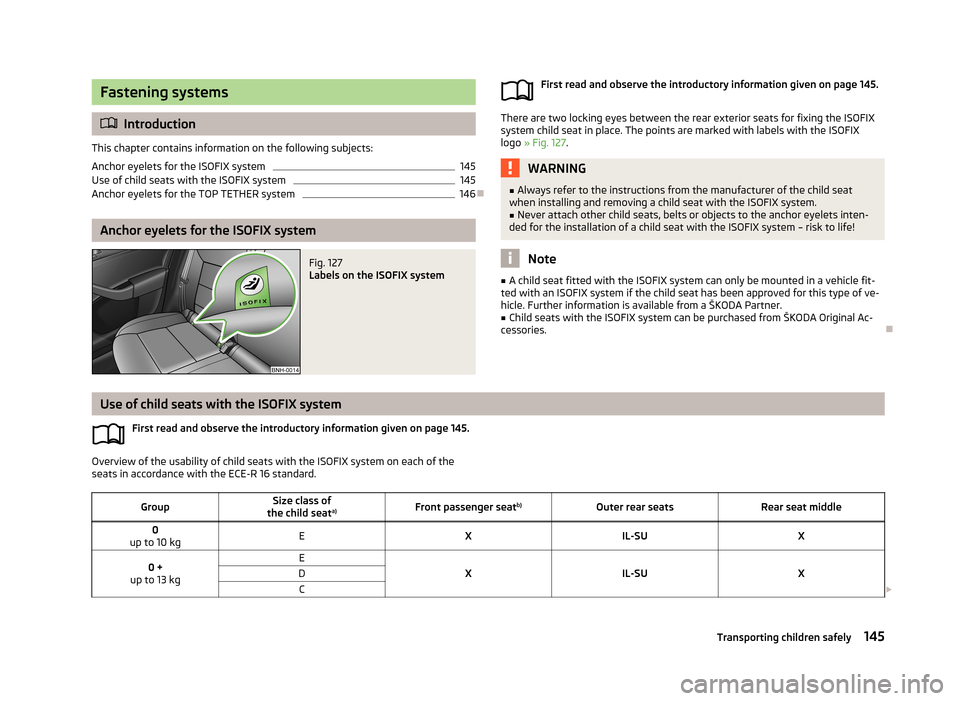
Fig. 127
Labels on the ISOFIX system
First read and observe the introductory information given on page 145.
There are two locking eyes between the rear exterior seats for fixing the ISOFIX
system child seat in place. The points are marked with labels with the ISOFIX logo » Fig. 127 .
WARNING■
Always refer to the instructions from the manufacturer of the child seat
when installing and removing a child seat with the ISOFIX system.■
Never attach other child seats, belts or objects to the anchor eyelets inten-
ded for the installation of a child seat with the ISOFIX system – risk to life!
Note
■ A child seat fitted with the ISOFIX system can only be mounted in a vehicle fit-
ted with an ISOFIX system if the child seat has been approved for this type of ve-
hicle. Further information is available from a ŠKODA Partner.■
Child seats with the ISOFIX system can be purchased from ŠKODA Original Ac-
cessories.
Use of child seats with the ISOFIX system
First read and observe the introductory information given on page 145.
Overview of the usability of child seats with the ISOFIX system on each of the
seats in accordance with the ECE-R 16 standard.
GroupSize class of
the child seat a)Front passenger seat b)Outer rear seatsRear seat middle0
up to 10 kgEXIL-SUX0 +
up to 13 kgE
XIL-SUX
DC 145Transporting children safely