cooling SKODA RAPID SPACEBACK 2014 1.G User Guide
[x] Cancel search | Manufacturer: SKODA, Model Year: 2014, Model line: RAPID SPACEBACK, Model: SKODA RAPID SPACEBACK 2014 1.GPages: 204, PDF Size: 27.11 MB
Page 149 of 204

ReplenishingRead and observe
and on page 144 first.
›
Unscrew the cap of the engine oil filler opening » Fig. 126 on page 143 .
›
Replenish the oil in portions of 0.5 litres in accordance with the correct speci-
fications » page 144 .
›
Check the oil level » page 145.
›
Screw the lid of the engine oil filler closed carefully.
›
Pull the dipstick out as far as the stop.
Coolant
Introduction
This chapter contains information on the following subjects:
Checking the coolant level
147
Replenishing
147
The coolant provides cooling for the motor.
It consists of water and coolant additive with additives that protect the cooling
system against corrosion and prevents furring.
The coolant additive level in the coolant must be at least 40%.
The coolant additive may be increased to a maximum of 60%.
The correct mixing ratio of water and coolant additive is to be checked if nec- essary by a specialist garage or is to be restored if necessary.
The description of the coolant is shown in the coolant expansion reser-
voir » Fig. 129 on page 147 .
WARNINGThe engine compartment of your car is a hazardous area. The following
warning instructions must be followed at all times when working in the en- gine compartment » page 141.■
The coolant is harmful to health.
■
Avoid contact with the coolant.
■
Coolant vapours are harmful to health.
■
Never open the end cover of the coolant expansion reservoir while the
engine is still warm. The cooling system is pressurised!
WARNING (Continued)■ When opening the end cover of the coolant expansion reservoir, cover it
with a cloth to protect your face, hands and arms from hot steam or hot
coolant.■
If any coolant splashes into your eyes, immediately rinse out your eyes
with clear water and contact a doctor as soon as possible.
■
Always keep the coolant in the original container, safe from people who
are not completely independent, especially children - there is a danger of
poisoning!
■
If coolant is swallowed, consult a doctor immediately.
■
Never spill operating fluids over the hot engine - risk of fire.
CAUTION
■ Do not continue if for some reason it is not possible to fill with coolant un-
der the current circumstances! Switch off the engine and seek assistance from
a specialist garage.■
If the expansion tank is empty, do not top up with coolant. The system could
ventilate - there is a risk of engine damage,
not continue! Switch off the en-
gine and seek assistance from a specialist garage.
■
The concentration of coolant additive in the coolant must never be under
40%.
■
Over 60% of coolant additive in the coolant reduces the antifreeze protec-
tion and cooling effect.
■
A coolant additive that does not comply with the correct specification can
significantly reduce the corrosion protection of the cooling system.
■
Any faults resulting from corrosion may cause a loss of coolant and can con-
sequently result in major engine damage!
■
Do not fill the coolant above the mark
A
. » Fig. 129 on page 147
■
If an error occurs, leading to the engine overheating, the help of a professio-
nal garage is to be sought - there is a risk of serious engine damage occurring.
■
Additional headlights and other attached components in front of the air inlet
impair the cooling efficiency of the coolant.
■
Never cover the radiator - there is a risk of the engine overheating.
146General Maintenance
Page 150 of 204
Checking the coolant levelFig. 129
Coolant expansion reservoir
Read and observe and on page 146 first.
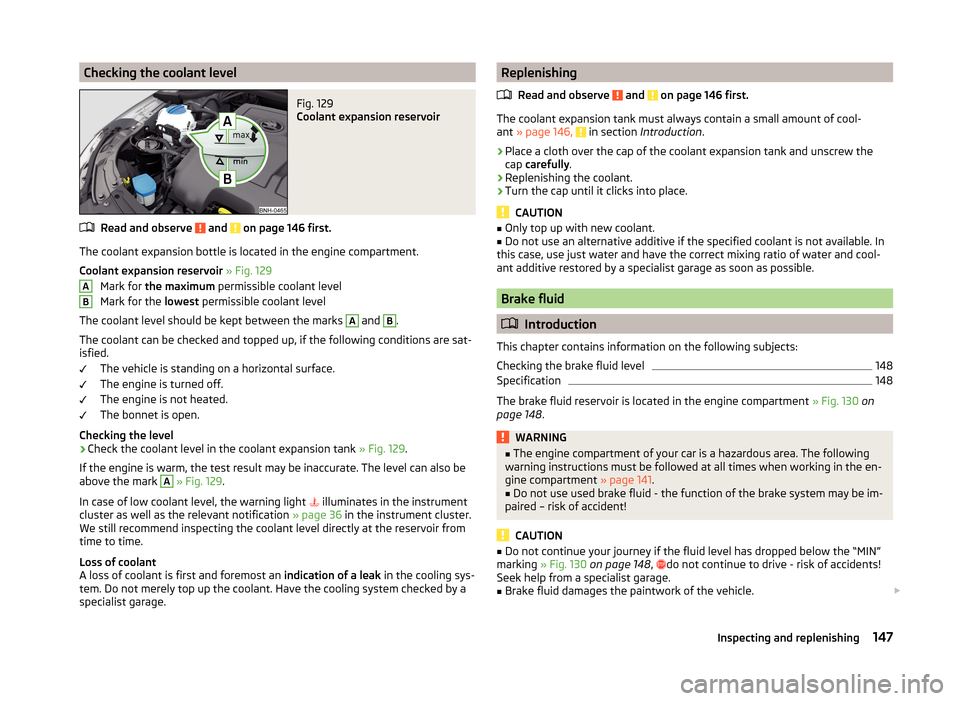
The coolant expansion bottle is located in the engine compartment.
Coolant expansion reservoir » Fig. 129
Mark for the maximum permissible coolant level
Mark for the lowest permissible coolant level
The coolant level should be kept between the marks
A
and
B
.
The coolant can be checked and topped up, if the following conditions are sat-
isfied.
The vehicle is standing on a horizontal surface.
The engine is turned off.
The engine is not heated.
The bonnet is open.
Checking the level
›
Check the coolant level in the coolant expansion tank » Fig. 129.
If the engine is warm, the test result may be inaccurate. The level can also be
above the mark
A
» Fig. 129 .
In case of low coolant level, the warning light illuminates in the instrument
cluster as well as the relevant notification » page 36 in the instrument cluster.
We still recommend inspecting the coolant level directly at the reservoir from
time to time.
Loss of coolant
A loss of coolant is first and foremost an indication of a leak in the cooling sys-
tem. Do not merely top up the coolant. Have the cooling system checked by a
specialist garage.
ABReplenishing
Read and observe
and on page 146 first.
The coolant expansion tank must always contain a small amount of cool-
ant » page 146, in section Introduction .
›
Place a cloth over the cap of the coolant expansion tank and unscrew the
cap carefully .
›
Replenishing the coolant.
›
Turn the cap until it clicks into place.
CAUTION
■
Only top up with new coolant.■Do not use an alternative additive if the specified coolant is not available. In
this case, use just water and have the correct mixing ratio of water and cool-
ant additive restored by a specialist garage as soon as possible.
Brake fluid
Introduction
This chapter contains information on the following subjects:
Checking the brake fluid level
148
Specification
148
The brake fluid reservoir is located in the engine compartment » Fig. 130 on
page 148 .
WARNING■
The engine compartment of your car is a hazardous area. The following
warning instructions must be followed at all times when working in the en-
gine compartment » page 141.■
Do not use used brake fluid - the function of the brake system may be im-
paired – risk of accident!
CAUTION
■ Do not continue your journey if the fluid level has dropped below the “MIN”
marking » Fig. 130 on page 148 , do not continue to drive - risk of accidents!
Seek help from a specialist garage.■
Brake fluid damages the paintwork of the vehicle.
147Inspecting and replenishing
Page 177 of 204
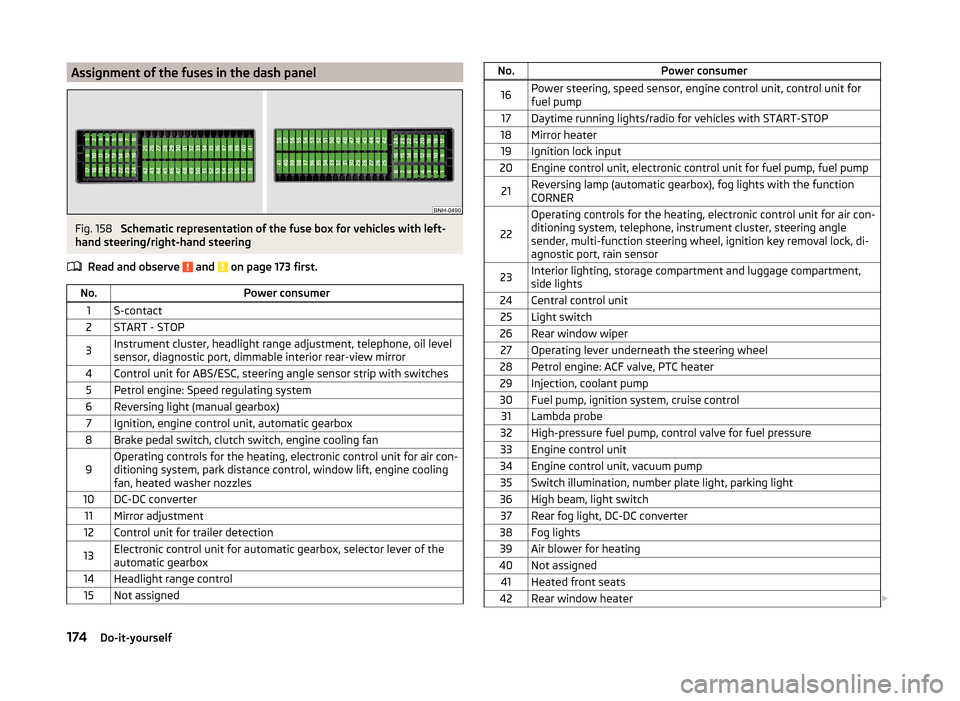
Assignment of the fuses in the dash panelFig. 158
Schematic representation of the fuse box for vehicles with left-
hand steering/right-hand steering
Read and observe
and on page 173 first.
No.Power consumer1S-contact2START - STOP3Instrument cluster, headlight range adjustment, telephone, oil level
sensor, diagnostic port, dimmable interior rear-view mirror4Control unit for ABS/ESC, steering angle sensor strip with switches5Petrol engine: Speed regulating system6Reversing light (manual gearbox)7Ignition, engine control unit, automatic gearbox8Brake pedal switch, clutch switch, engine cooling fan9Operating controls for the heating, electronic control unit for air con-
ditioning system, park distance control, window lift, engine cooling
fan, heated washer nozzles10DC-DC converter11Mirror adjustment12Control unit for trailer detection13Electronic control unit for automatic gearbox, selector lever of the
automatic gearbox14Headlight range control15Not assignedNo.Power consumer16Power steering, speed sensor, engine control unit, control unit for
fuel pump17Daytime running lights/radio for vehicles with START-STOP18Mirror heater19Ignition lock input20Engine control unit, electronic control unit for fuel pump, fuel pump21Reversing lamp (automatic gearbox), fog lights with the function
CORNER
22
Operating controls for the heating, electronic control unit for air con-
ditioning system, telephone, instrument cluster, steering angle
sender, multi-function steering wheel, ignition key removal lock, di-
agnostic port, rain sensor23Interior lighting, storage compartment and luggage compartment,
side lights24Central control unit25Light switch26Rear window wiper27Operating lever underneath the steering wheel28Petrol engine: ACF valve, PTC heater29Injection, coolant pump30Fuel pump, ignition system, cruise control31Lambda probe32High-pressure fuel pump, control valve for fuel pressure33Engine control unit34Engine control unit, vacuum pump35Switch illumination, number plate light, parking light36High beam, light switch37Rear fog light, DC-DC converter38Fog lights39Air blower for heating40Not assigned41Heated front seats42Rear window heater 174Do-it-yourself
Page 194 of 204

Climatronicair distribution control90
Operating elements92
Clothes hook79
Cockpit 12-Volt power outlet
76
Ashtray76
Cigarette lighter75
General view29
Lights63
storage compartments73
useful equipment73
COMING HOME62
compartments73
Components of the puncture repair kits165
Computer See multifunction display
43
convenience turn signal60
Coolant146
Checking147
Information messages36
Replenishing147
Temperature gauge32
Warning light36
Cooling system cost-effective use
93
malfunctions93
CORNER See Fog lights with CORNER function
61
Correct seated position9
Driver9
Front passenger10
Instructions11
Rear seats11
Counter for distance driven33
cruise control operation
115
operation description116
Cruise control system Warning light
41
Cruise Control System115
Cup holders74
D
DAY LIGHT See Daytime running lights
59
Daytime running lights59
Dazzle see sun screen of the panoramic roof
65
De-icing windows
134
Deactivating an airbag20
Decorative films134
Defrosting rear window64
Delayed locking of the boot lid see boot lid
55
Departure angle184
Diesel refer to Fuel
140
Diesel fuel Operation in winter
140
Diesel particle filter Information notices
38
Warning light38
Digital Clock Time
33
Dipstick145
Disconnecting and reconnecting vehicle battery
151
Display31
Compass points47
Coolant temperature32
Fuel supply32
Gear changes43
Service intervals47
Display a low temperature42
Display of the second speed33
Disposal Acceptance and recycling of used vehicles
131
Distance driven33
Door Child safety lock
53
Closing51
Emergency locking171
Opening51
Warning light for open door36
Door open Warning light
36
Double-sided floor covering85
Driving Driving through water
111
Emissions182
Fuel consumption182
Maximum speed185
off made-up roads111
Driving in Brake linings
111
the engine111
Tyres111
Driving off made-up roads111
Driving through water111
E
Economical driving Tips
111
EDL114
Electrical power windows Button in the passenger door
56
Buttons in the driver's door56
Electronic Differential Lock (EDL)114
Electronic immobilizer104
Electronic Stability Control (ESC)113
Emergency Changing a wheel
160
Hazard warning light system62
Jump-starting166, 167
Locking the door without a locking cylinder171
Selector lever-unlocking171
Towing the vehicle168
191Index