technical data SKODA ROOMSTER 2010 1.G User Guide
[x] Cancel search | Manufacturer: SKODA, Model Year: 2010, Model line: ROOMSTER, Model: SKODA ROOMSTER 2010 1.GPages: 231, PDF Size: 12.91 MB
Page 22 of 231
Instruments and warning lights21
Using the system
Safety
Driving Tips
General Maintenance
Breakdown assistance
Praktik
Technical Data
Note
The amount of fuel consumed will not be indicated.RangeThe estimated range in kilometres is shown on the display. It indicates the distance you
can still drive with your vehicle based on th e present level of fuel in the tank for the
same style of driving.
The readout is shown in steps of 10 km. After lighting up of the indicator light for the
fuel reserve the display is shown in steps of 5 km.
The fuel consumption for the last 50 km is taken as a basis for calculating the range. If
you drive in a more economical manner fr om this moment on, the range will be
increased accordingly.
If the memory is set to zero (after disconnecting the battery), th e fuel consumption of
10 ltr./100 km is calculated for the range; afterwards the value is adapted accordingly
to the style of driving.Distance drivenThe distance driven since the memory was last erased appears in the display
page 19. If you wish to calculate the distance driven as of a particular time, you must
erase the memory at this moment in time by pressing the button on the windshield
wiper lever page 19, fig. 18 .
The maximum distance indicated in both swit ch positions is 1.999 kilometres, on vehi-
cles which are fitted with information display* it is 9.999 kilometres. The indicator is set
back to null if this period is exceeded.Average speedThe average speed since the memory was last erased is shown in the display in
km/hour page 19. If you wish to determine the average speed over a certain period
of time, you must erase the memory at the start of the new measurement by pressing
the button on the windshield wiper lever page 19, fig. 18 .
A zero appears in the display for the first 100 m you drive after erasing the memory. The indicated value will be updated every 5 seconds while you are driving.
Current speed*The current speed which is identical to the display of the speedometer, is indicated on
the display
page 15, fig. 15 .Warning against excessive speeds*This function enables you to set a speed limit, e.g. if you drive in town. A text in the
display is intended to draw your attention to the fact that you have exceeded the set
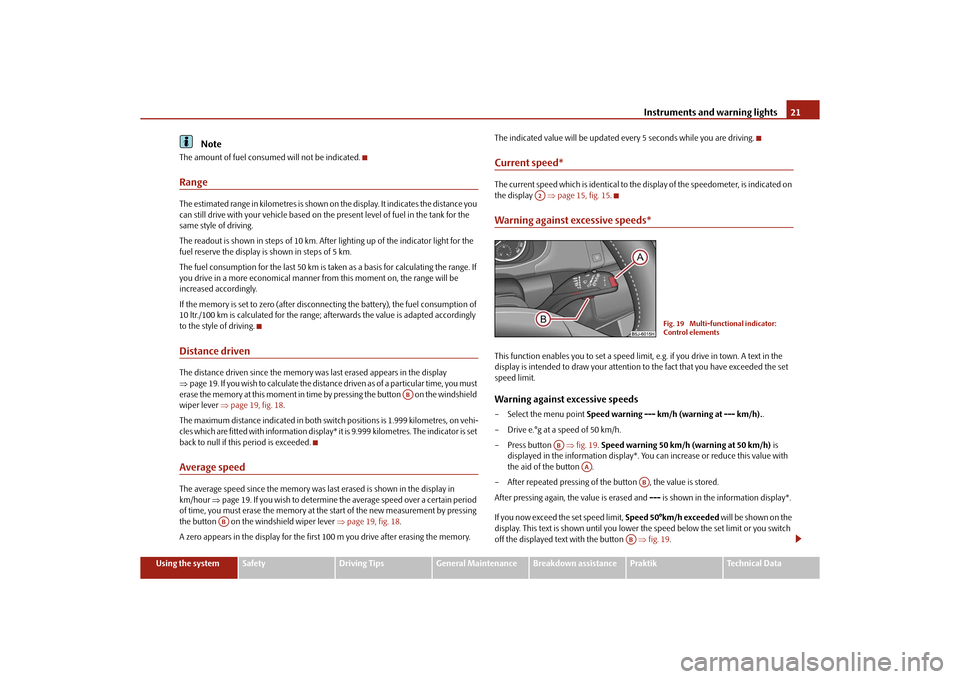
speed limit.Warning against excessive speeds– Select the menu point Speed warning --- km/h (warning at --- km/h). .
– Drive e.°g at a speed of 50 km/h.
– Press button fig. 19 . Speed warning 50 km/h (warning at 50 km/h) is
displayed in the information display*. You can increase or reduce this value with
the aid of the button .
– After repeated pressing of th e button , the value is stored.
After pressing again, the value is erased and --- is shown in the information display*.
If you now exceed the set speed limit, Speed 50°km/h exceeded will be shown on the
display. This text is shown until you lower the speed below the set limit or you switch
off the displayed text with the button fig. 19.
AB
AB
A2
Fig. 19 Multi-functional indicator:
Control elements
AB
AA
AB
AB
s16g.4.book Page 21 Wednesda y, February 10, 2010 3:53 PM
Page 24 of 231
Instruments and warning lights23
Using the system
Safety
Driving Tips
General Maintenance
Breakdown assistance
Praktik
Technical Data
Note
If warning messages are shown in the information display page 23, these
messages can be confirmed with the button on the windshield wiper lever in order
to call up the main menu.
If you do not activate the information display at that moment, the menu shifts to
one level higher every 10 seconds.
The operation of the factory-fitted radio* or the navigation system* is described in
separate operating instructions to be found in the on-board literature.
Door, luggage compartment door and bonnet ajar warningThe door, luggage compartment and bonnet ajar warning lights up if at least one door,
the luggage compartment or bonnet are not closed. The symbol indicates which door
is still open or whether the luggage compartment door or bonnet is not closed.
The symbol goes out as soon as the doors, luggage compartment door and bonnet are
completely closed.
A warning signal sounds if the car is driven at a speed of more than 6km/hour and if
the engine or the luggage compartment door is open.Auto Check ControlCar stateThe Auto Check Control carries out a chec k of certain functions and vehicle compo-
nents. The check is performed constantly when the ignition is switched on, both when
the vehicle is stationary, as well as when driving.
Some operational faults, urgent repairs, service work or other information appear in
the display of the instrument cluster. The di splays are shown with a red or yellow light
symbol depending on the priority of the message.
The red symbols indicate danger (priority 1) while the yellow symbols indicate a
warning (priortity 2). Information for the driver may also appear in addition to the
symbols page 25. Shown in the menu
Vehicle status, if there is at least one error message. After selecting
this menu the first of the error messages is displayed. Several error messages are
shown on the display under the message e.g. 1/3 . This indicates that the first of a total
of three error messages is displayed. The respective messages are displayed one after
the other in an interval of 5 seconds. Check as soon as possible the displayed error
messages.
As long as the operational faults are not rectified, the symbols are always indicated
again. After the first display, the symbol s are indicated without information for the
driver.
If a fault occurs, a warning signal will also so und in addition to the symbol and text in
the display:
Priority 1 - three warning signals
Priority 2 - one warning signal
Red symbols
A red symbol signals danger.– Bring the vehicle to a stop.
– Switch the engine off.
– Investigate the function indicated.
– Obtain professional assistance.
Meaning of the red symbols:
Three successive warning signals will sound if a red symbol appears.
AB
Engine oil pressure too low
page 28
Overheated clutches of the automatic gear-
box DSG*
page 94
s16g.4.book Page 23 Wednesda y, February 10, 2010 3:53 PM
Page 26 of 231
Instruments and warning lights25
Using the system
Safety
Driving Tips
General Maintenance
Breakdown assistance
Praktik
Technical Data
Warning lightsOverview
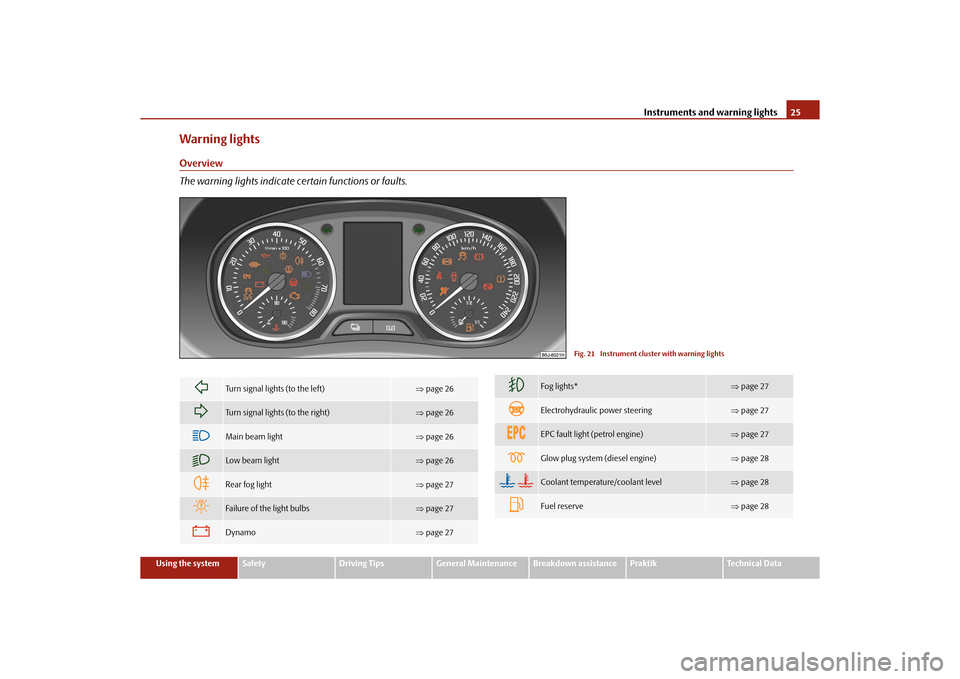
The warning lights indicate certain functions or faults.
Fig. 21 Instrument cluster with warning lights
Turn signal lights (to the left)
page 26
Turn signal lights (to the right)
page 26
Main beam light
page 26
Low beam light
page 26
Rear fog light
page 27
Failure of the light bulbs
page 27
Dynamo
page 27
Fog lights*
page 27
Electrohydraulic power steering
page 27
EPC fault light (petrol engine)
page 27
Glow plug system (diesel engine)
page 28
Coolant temperature/coolant level
page 28
Fuel reserve
page 28
s16g.4.book Page 25 Wednesda y, February 10, 2010 3:53 PM
Page 28 of 231
Instruments and warning lights27
Using the system
Safety
Driving Tips
General Maintenance
Breakdown assistance
Praktik
Technical Data
Rear fog light
The warning light
comes on when the rear fog lights are operating page 48.
Bulb failure
The warning light
comes on if a bulb is faulty:
up to 2 seconds after the ignition is switched on;
when switching on the defective light bulb.
The following text e.g will be displayed in the information display*: Check front right dipped beam!
The rear side lights and the licence plate li ghting require several light bulbs. The indi-
cator light
only lights up if all light bulbs of the licence plate lighting or the parking
light (in one rear light unit) are defective. Check regularly the function of the light
bulbs.
Alternator
The warning light
comes on after the ignition has been switched on. It should go
out after the engine has started.
If the warning light does not go out after the engine has started, or comes on when
driving, drive to the nearest specialist garage. The vehicle battery will be discharged in
this case so switch off all non- essential electrical components.
Caution
If the warning light
comes on when driving and in addition the warning light
(cooling system fault) also comes on in di splay, you must then stop the car immedi-
ately and switch the engine off - risk of engine damage!
Fog lights*
The warning light
comes on when the fog lights are operating page 48.
Electrohydraulic power steering
The warning light
comes on for a few seconds when the ignition is switched on.
If the warning light after switching on the ignition or when driving lights up continu-
ously, a fault exists in the electrohydraulic power steering. The power steering operates
with reduced steering assist or is completely without function.
Further information page 137.
WARNING
Contact your specialist garage if the power steering is defective.
Note
If the yellow warning light
goes out after starting the engine again and a short
drive, it is not necessary to visit a specialist garage.
If the battery has been di sconnected and reconnected, the yellow warning light
comes on after switching on the ignition. The warning light must go out after driving a
short distance.
There is no power-assisted steering su pport when the vehicle is being towed
without the engine running or when the powe r-assisted steering is defect. The vehicle
is fully steerable however. There is however increased force required to turn the
steering wheel.
EPC fault light
(petrol engine)
The
(Electronic Power Control) warning light comes on for a few seconds when the
ignition is switched on.
If the warning light
flashes after starting the engine or flashes while driving, a fault
exists in the engine control system. The engine management system selects an emer-
gency programme which enables you to drive to the nearest specialist garage by
adopting a gentle style of driving.
The following text will be displayed in the information display*:
Engine fault: Workshop!
s16g.4.book Page 27 Wednesda y, February 10, 2010 3:53 PM
Page 30 of 231
Instruments and warning lights29
Using the system
Safety
Driving Tips
General Maintenance
Breakdown assistance
Praktik
Technical Data
3 peeps sound as an additional warning signal.
Do not continue your journey
if for some reason it is not possible under the condi-
tions prevailing to top up with oil. Keep the engine switched off and obtain profes-
sional assistance from a specialist garage, otherwise it could lead to severe engine
damage.
Do not drive any further if the warning light flashes even if the oil is at the correct
level. Do not run the engine not at idling speed either. Contact the nearest specialist
garage to obtain professional assistance.
The following text will be displayed in the information display*:
Oil Pressure Engine off! Owner's manual!
The warning light
lights up yellow* (oil quantity too low)
If the warning light lights up yellow, the quantity of oil in the engine is probably too low.
Check as soon as possible the oil level or top up page 163 with engine oil.
A peep sounds as an additional warning signal.
The following text will be displayed in the information display*: Check oil level!
The warning light will go out if the bonnet is le ft open for more than 30 seconds. If no
engine oil has been replenished, the warning light will come on again after driving
about 100 km.
The warning light
flashes yellow* (engine oil level sensor faulty)
A fault on the engine oil level sensor is indicated additionally by an audible signal and
the warning light coming on several times after the ignition has been switched on.
In this case have the engine inspected without delay by a specialist garage.
The following text will be displayed in the information display*:
Oil sensor Workshop!
WARNING
If you must stop for technical reasons, then park the vehicle at a safe
distance from the traffic and switch off the engine and switch on the hazard
warning light system page 49.
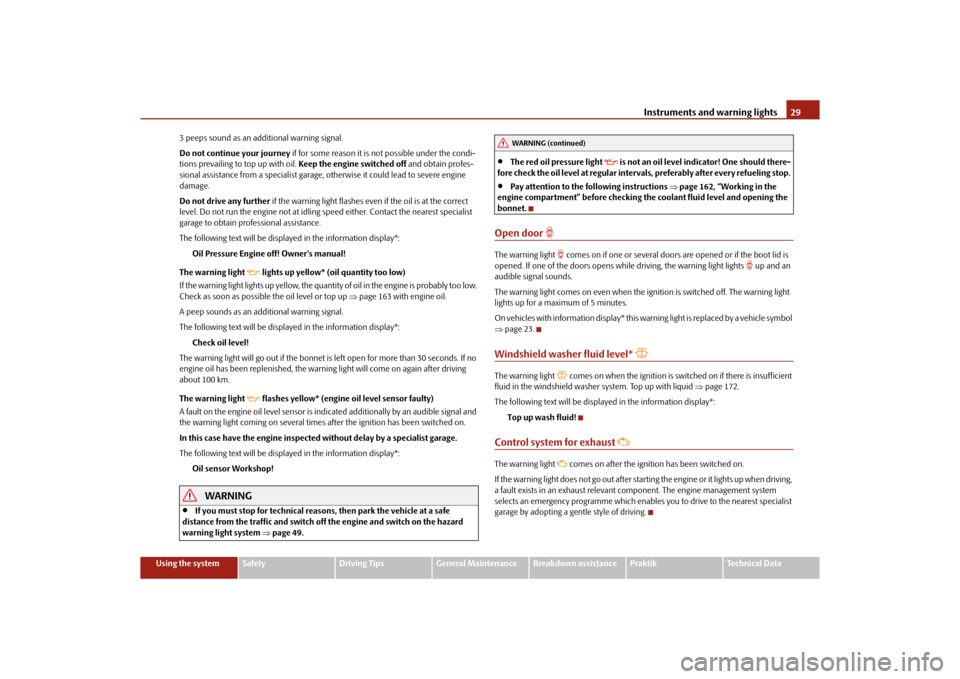
The red oil pressure light
is not an oil level indicator! One should there-
fore check the oil level at regular interval s, preferably after every refueling stop.
Pay attention to the following instructions page 162, “Working in the
engine compartment” before checking the coolant fluid level and opening the
bonnet.
Open door
The warning light
comes on if one or several doors are opened or if the boot lid is
opened. If one of the doors opens whil e driving, the warning light lights
up and an
audible signal sounds.
The warning light comes on even when the ignition is switched off. The warning light
lights up for a maximum of 5 minutes.
O n v e h i c l e s w i t h i n f o r m a t i o n d i s p l a y * t h i s w a rning light is replaced by a vehicle symbol
page 23.
Windshield washer fluid level*
The warning light
comes on when the ignition is swit ched on if there is insufficient
fluid in the windshield washer system. Top up with liquid page 172.
The following text will be displayed in the information display*: Top up wash fluid!
Control system for exhaust
The warning light
comes on after the ignition has been switched on.
If the warning light does not go out after starting the engine or it lights up when driving,
a fault exists in an exhaust relevant co mponent. The engine management system
selects an emergency programme which enables you to drive to the nearest specialist
garage by adopting a ge ntle style of driving.
WARNING (continued)
s16g.4.book Page 29 Wednesda y, February 10, 2010 3:53 PM
Page 32 of 231
Instruments and warning lights31
Using the system
Safety
Driving Tips
General Maintenance
Breakdown assistance
Praktik
Technical Data
Note
If the battery has been disconnected and reconnected, the warning light
comes on
after switching on the ignition. The warning light must go out after driving a short
distance.
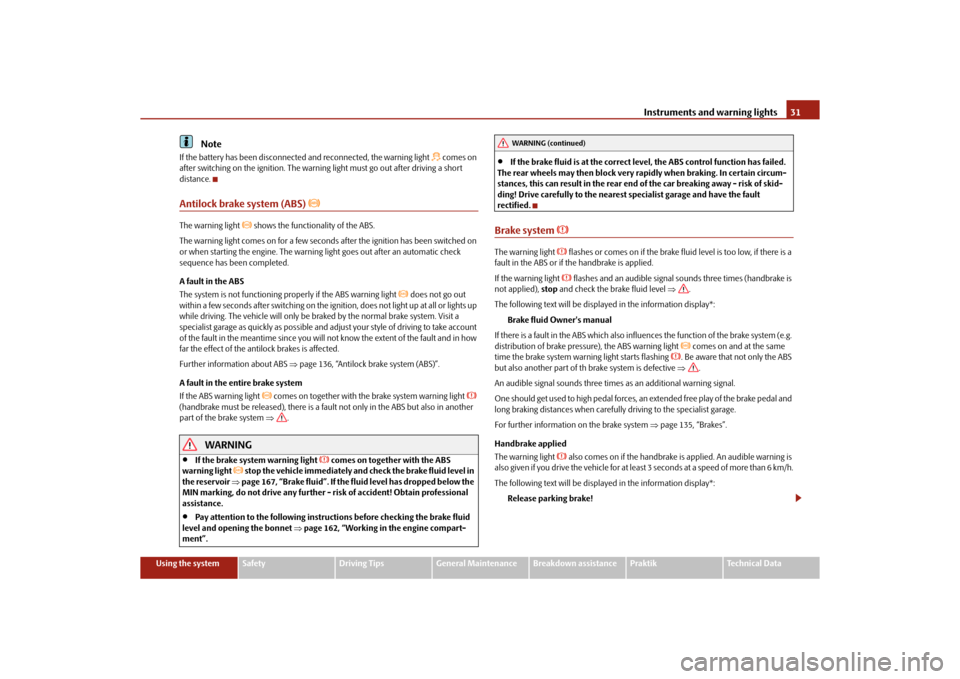
Antilock brake system (ABS)
The warning light
shows the functionality of the ABS.
The warning light comes on for a few seconds after the ignition has been switched on
or when starting the engine. The warning light goes out after an automatic check
sequence has been completed.
A fault in the ABS
The system is not functioning properly if the ABS warning light
does not go out
within a few seconds after switching on the ignition, does not light up at all or lights up
while driving. The vehicle will only be br aked by the normal brake system. Visit a
specialist garage as quickly as possible and adjust your style of driving to take account
of the fault in the meantime since you will not know the extent of the fault and in how
far the effect of the antilock brakes is affected.
Further information about ABS page 136, “Antilock brake system (ABS)”.
A fault in the entire brake system
If the ABS warning light
comes on together with the brake system warning light
(handbrake must be released), there is a fa ult not only in the ABS but also in another
part of the brake system .
WARNING
If the brake system warning light
comes on together with the ABS
warning light
stop the vehicle immediately and check the brake fluid level in
the reservoir page 167, “Brake fluid”. If the fluid level has dropped below the
MIN marking, do not drive any further - risk of accident! Obtain professional
assistance.
Pay attention to the following instruct ions before checking the brake fluid
level and opening the bonnet page 162, “Working in the engine compart-
ment”.
If the brake fluid is at the correct leve l, the ABS control function has failed.
The rear wheels may then block very rapi dly when braking. In certain circum-
stances, this can result in the rear end of the car breaking away - risk of skid-
ding! Drive carefully to the nearest specialist garage and have the fault
rectified.
Brake system
The warning light
flashes or comes on if the brake fluid level is too low, if there is a
fault in the ABS or if the handbrake is applied.
If the warning light flashes and an audible signal so unds three times (handbrake is
not applied), stop and check the brake fluid level .
The following text will be displayed in the information display*: Brake fluid Owner's manual
If there is a fault in the ABS which also infl uences the function of the brake system (e.g.
distribution of brake pressure), the ABS warning light
comes on and at the same
time the brake system warn ing light starts flashing
. Be aware that not only the ABS
but also another part of th brake system is defective .
An audible signal sounds three times as an additional warning signal.
One should get used to high pedal forces, an extended free play of the brake pedal and
long braking distances when carefully driving to the specialist garage.
For further information on the brake system page 135, “Brakes”.
Handbrake applied
The warning light
also comes on if the handbrake is applied. An audible warning is
also given if you drive the vehicle for at least 3 seconds at a speed of more than 6 km/h.
The following text will be displayed in the information display*:
Release parking brake!
WARNING (continued)
s16g.4.book Page 31 Wednesda y, February 10, 2010 3:53 PM
Page 34 of 231
Instruments and warning lights33
Using the system
Safety
Driving Tips
General Maintenance
Breakdown assistance
Praktik
Technical Data
WARNING
If you do not pay attention to the warning light coming on and the corre-
sponding descriptions and warning notes, this may result in injuries or major
vehicle damage.
Always adjust your speed to suit we ather, road, region and traffic condi-
tions. The route indicated by the warnin g light must not tempt you to disregard
the national regulations for road traffic.Caution
As long as the warning light
lig hts up, one m us t ta ke i nto acco unt an i ncrea se d fue l
consumption and in certain circumstan ces a power reduction of the engine.
Note
Further information about diesel particle filter page 139, “Diesel particle filter*
(diesel engine)”.Seat belt warning light*
The warning light
comes on after the ignition is sw itched on as a reminder for the
driver and front passenger to fasten the seat belt. The warning light only goes out if the
driver or front passenger has fastened his seat belt.
If the seat belt has not been fastened by the driver or front passenger, a permanent
warning signal sounds at vehicle speeds gr eater than 20 km/h and simultaneously the
warning light
flashes.
If the seat belt is not fastened by the dr iver or front passenger during the next 90
seconds, the warning signal is deactivated and the warning light
lights up perma-
nently.
In case of a load on the front passenger se at e.g. a bag (this is not recommended for
safety reasons) the warning light
indicates that the seat belt is not fastened.
Further information on the seat belts page 113, “Why seat belts?”.
s16g.4.book Page 33 Wednesda y, February 10, 2010 3:53 PM
Page 36 of 231
Unlocking and locking35
Using the system
Safety
Driving Tips
General Maintenance
Breakdown assistance
Praktik
Technical Data
For the sake of the environment
Dispose of a used battery in accord ance with environmental regulations.
Note
Pay attention to the correct pola rity when changing the battery.
The replacement battery must have the same specification as the original battery.
If it is still not be possible to unlock or lock the vehicle with the remote control even
after replacing the battery this means that the system has to be synchronised
page 41.
Electronic immobiliser
The electronic immobiliser prevents the vehicle being operated by an
unauthorised person.An electronic chip is integrated in the he ad of the key. The immobiliser is deactivated
with the aid of this chip when the key is in serted in the ignition lock. The electronic
immobiliser is automatically activated when you withdraw the ignition key from the
lock.
Note
It is only possible to start the engine of your car with a Genuine Škoda key with the
matching code.LockingValid for vehicles without a central locking system:Locking from outside
The securing knob will move upwards or downwards in the door when unlocking or
locking. Locking from inside
All closed vehicle doors are locked by pressi
ng in the securing knobs from the inside.
The doors cannot be opened from the outside when the securing knobs have been
pressed in. The vehicle d oors can be opened from the inside as follows:
the door is unlocked by actuating the door-opening lever;
The door opens upon actuating the door-opening lever again.Note
The opened door cannot be locked with the securing knob. This prevents the
possibility of forgetting the key in the locked vehicle.
The opened doors at the rear and the fron t passenger door are locked by pressing
in the securing knob and slamming the door closed.
Please refer to the safety guidelines in “Description” on page 36.
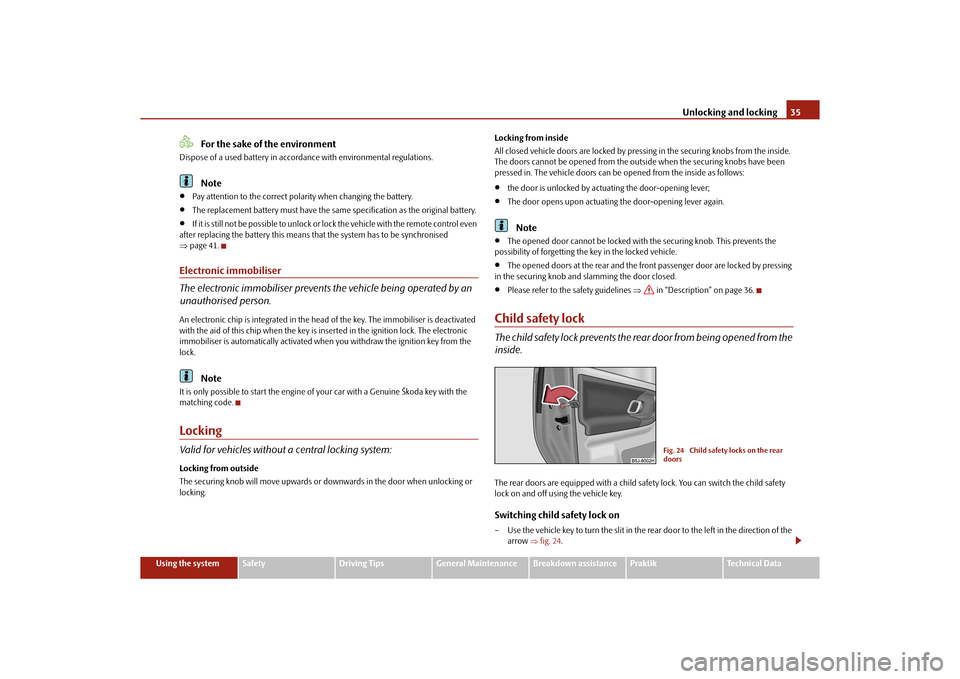
Child safety lockThe child safety lock prev ents the rear door from being opened from the
inside.The rear doors are equipped with a child safe ty lock. You can switch the child safety
lock on and off using the vehicle key.Switching child safety lock on– Use the vehicle key to turn the slit in the rear door to the left in the direction of the
arrow fig. 24 .
Fig. 24 Child safety locks on the rear
doors
s16g.4.book Page 35 Wednesda y, February 10, 2010 3:53 PM
Page 38 of 231
Unlocking and locking37
Using the system
Safety
Driving Tips
General Maintenance
Breakdown assistance
Praktik
Technical Data
cator light in the driver's door flashes. It is
not possible to open the doors with the door
handle ei the r fro m the ins id e or from the outsi de. T hi s a cts as an ef fe cti ve dete rrent for
attempts to break into your vehicle.
You can deactivate the safe securing system by locking twice within 5 seconds.
The safe securing system is again activated the next time the vehicle is unlocked and
locked again.
If the vehicle is locked and the safe securing system is deactivated, you can open the
vehicle from the inside by pulling on the d oor opening lever. The door is unlocked and
opened at the same time.
WARNING
If the vehicle is locked from the outside and the safe securing system is acti-
vated, there must not be any person and animals in the vehicle as it is then not
possible to open either a door or a window from the inside. The locked doors
make it more difficult for rescuers to get into the vehicle in an emergency -
hazard!
Note
The anti-theft alarm system* is also activated with the deactivated safe securing
system when locking the vehicle. The interior monitor* is however not activated.Unlocking the vehicle using the key
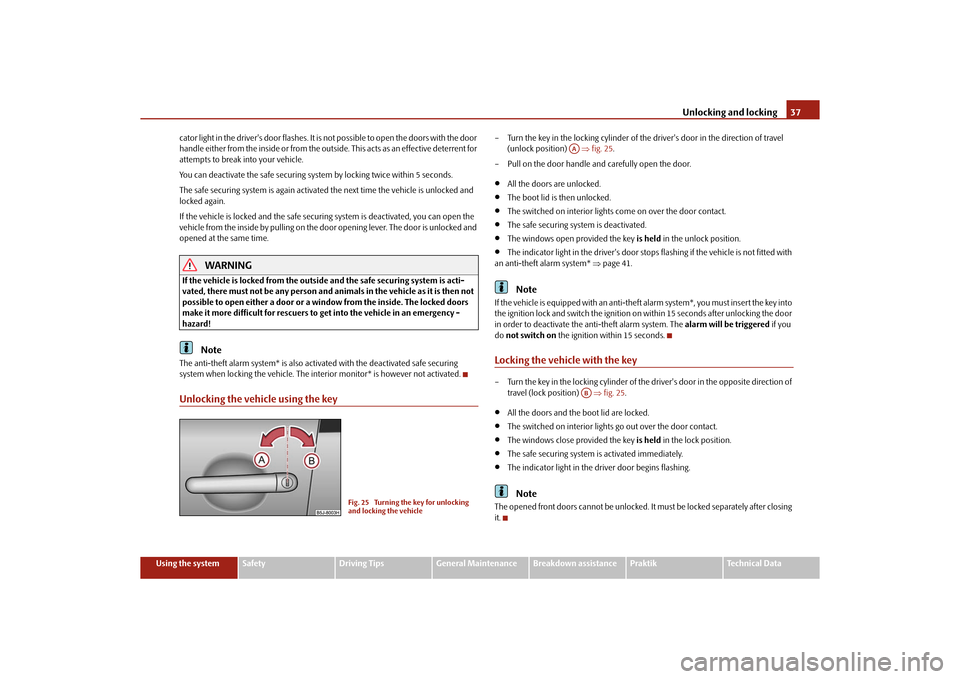
– Turn the key in the locking cylinder of the driver's door in the direction of travel
(unlock position) fig. 25 .
– Pull on the door handle and carefully open the door.
All the doors are unlocked.
The boot lid is then unlocked.
The switched on interior lights come on over the door contact.
The safe securing system is deactivated.
The windows open provided the key is held in the unlock position.
The indicator light in the driver's door stops flashing if the vehicle is not fitted with
an anti-theft alarm system* page 41.Note
If the vehicle is equipped with an anti-theft alarm system*, you must insert the key into
the ignition lock and switch the ignition on within 15 seconds after unlocking the door
in order to deactivate the anti-theft alarm system. The alarm will be triggered if you
do not switch on the ignition within 15 seconds.Locking the vehicle with the key– Turn the key in the locking cylinder of the driver's door in the opposite direction of
travel (lock position) fig. 25 .
All the doors and the boot lid are locked.
The switched on interior lights go out over the door contact.
The windows close provided the key is held in the lock position.
The safe securing system is activated immediately.
The indicator light in the dr iver door begins flashing.Note
The opened front doors cannot be unlocked. It must be locked separately after closing
it.
Fig. 25 Turning the key for unlocking
and locking the vehicle
AAAB
s16g.4.book Page 37 Wednesda y, February 10, 2010 3:53 PM
Page 40 of 231
Unlocking and locking39
Using the system
Safety
Driving Tips
General Maintenance
Breakdown assistance
Praktik
Technical Data
the door handle. If the child safety lock is activated (only on the rear doors), first of all
it is necessary to pull once on the inner door
handle and then open the door from the
outside.
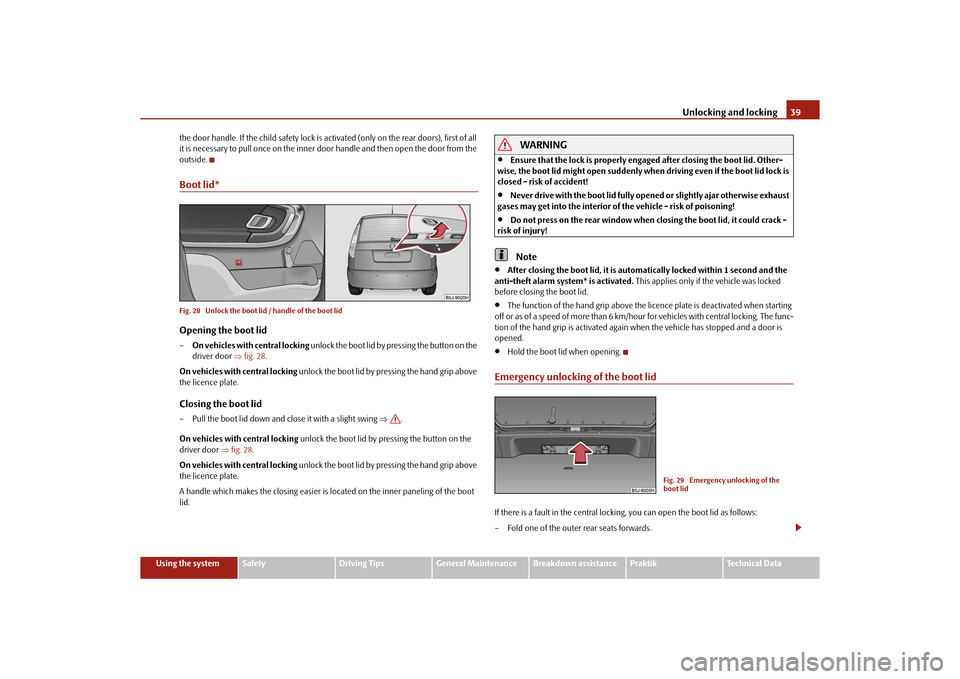
Boot lid*Fig. 28 Unlock the boot lid / handle of the boot lidOpening the boot lid– On vehicles with central locking unlock the boot lid by pressing the button on the
driver door fig. 28 .
On vehicles with central locking unlock the boot lid by pressing the hand grip above
the licence plate.Closing the boot lid– Pull the boot lid down and close it with a slight swing .
On vehicles with central locking unlock the boot lid by pressing the button on the
driver door fig. 28 .
On vehicles with central locking unlock the boot lid by pressing the hand grip above
the licence plate.
A handle which makes the closing easier is located on the inner paneling of the boot
lid.
WARNING
Ensure that the lock is properly enga ged after closing the boot lid. Other-
wise, the boot lid might open suddenly when driving even if the boot lid lock is
closed - risk of accident!
Never drive with the boot lid fully open ed or slightly ajar otherwise exhaust
gases may get into the interior of the vehicle - risk of poisoning!
Do not press on the rear window when closing the boot lid, it could crack -
risk of injury!Note
After closing the boot lid, it is automatically locked within 1 second and the
anti-theft alarm system* is activated. This applies only if the vehicle was locked
before closing the boot lid.
The function of the hand grip above the licence plate is deactivated when starting
off or as of a speed of more than 6 km/hour for vehicles with central locking. The func-
tion of the hand grip is ac tivated again when the vehicle has stopped and a door is
opened.
Hold the boot lid when opening.
Emergency unlocking of the boot lidIf there is a fault in the central locking, you can open the boot lid as follows:
– Fold one of the outer rear seats forwards.
Fig. 29 Emergency unlocking of the
boot lid
s16g.4.book Page 39 Wednesda y, February 10, 2010 3:53 PM