technical data SKODA ROOMSTER 2010 1.G Owner's Guide
[x] Cancel search | Manufacturer: SKODA, Model Year: 2010, Model line: ROOMSTER, Model: SKODA ROOMSTER 2010 1.GPages: 231, PDF Size: 12.91 MB
Page 62 of 231
Seats and Storage61
Using the system
Safety
Driving Tips
General Maintenance
Breakdown assistance
Praktik
Technical Data
Note
The outer seats are not replac eable alternatively. In the rear area the left seat is
marked with the letter L and the right seat with the letter R.
Please refer to the following guidelines page 111.
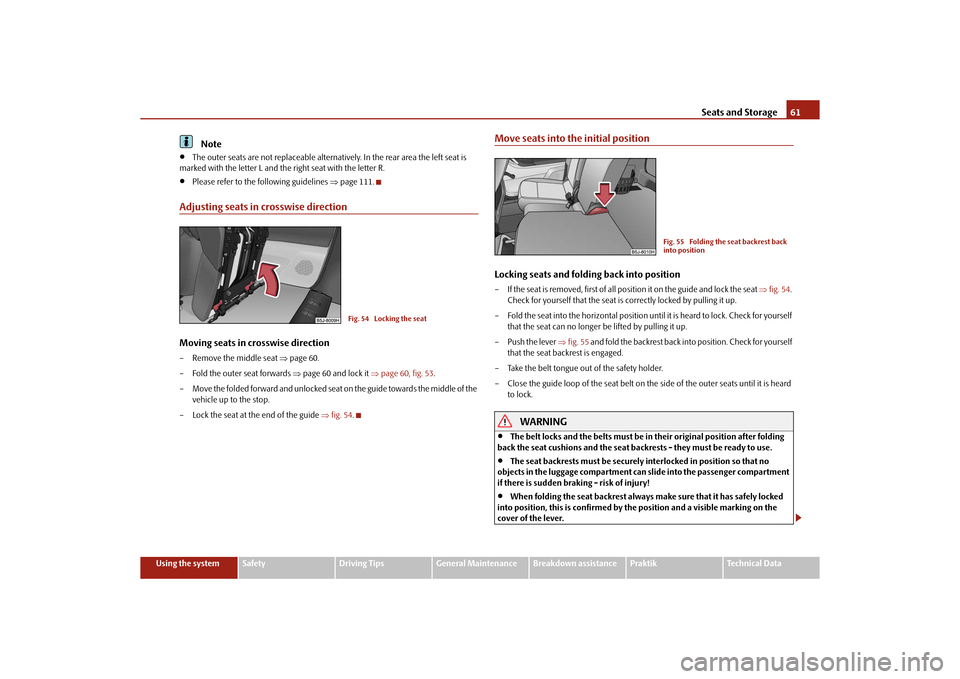
Adjusting seats in crosswise directionMoving seats in crosswise direction– Remove the middle seat page 60.
– Fold the outer seat forwards page 60 and lock it page 60, fig. 53 .
– Move the folded forward and unlocked seat on the guide towards the middle of the vehicle up to the stop.
– Lock the seat at the end of the guide fig. 54 .
Move seats into the initial positionLocking seats and folding back into position– If the seat is removed, first of all position it on the guide and lock the seat fig. 54 .
Check for yourself that the seat is correctly locked by pulling it up.
– Fold the seat into the horizontal position until it is heard to lock. Check for yourself that the seat can no longer be lifted by pulling it up.
– Push the lever fig. 55 and fold the backrest back in to position. Check for yourself
that the seat backrest is engaged.
– Take the belt tongue out of the safety holder.
– Close the guide loop of the seat belt on the side of the outer seats until it is heard to lock.
WARNING
The belt locks and the belts must be in their original position after folding
back the seat cushions and the seat backrests - they must be ready to use.
The seat backrests must be securely interlocked in position so that no
objects in the luggage compartment can slide into the passenger compartment
if there is sudden braking - risk of injury!
When folding the seat backrest always make sure that it has safely locked
into position, this is confirmed by the position and a visible marking on the
cover of the lever.
Fig. 54 Locking the seat
Fig. 55 Folding the seat backrest back
into position
s16g.4.book Page 61 Wednesda y, February 10, 2010 3:53 PM
Page 64 of 231
Seats and Storage63
Using the system
Safety
Driving Tips
General Maintenance
Breakdown assistance
Praktik
Technical Data
WARNING
Stow the objects in the luggage compartment and attach them to the
lashing eyes.
Loose objects in the passenger compartment can be thrown forward during
a sudden manoeuvre or in case of an accident and can injure the occupants or
other oncoming traffic. This risk is still increased, if the objects which are flying
around are hit by a deployed airbag. In this case, the objects which are thrown
back can injure the occupants - hazard.
Please note that the handling properti es of your vehicle may be affected
when transporting heavy objects as a result of the displacement of the centre of
gravity. The speed and style of driv ing must be adjusted accordingly.
The items carried in the luggage compar tment should be stowed in such a
way that no objects are able to slip fo rward if there are any sudden driving or
braking manoeuvres undertaken - risk of injury!
When transporting fastened objects which are sharp and dangerous in the
luggage compartment enlarged by folding the rear seats forward or removing
the rear seats, ensure the safety of the passengers transported on the other rear
seats page 111, “Correct seated position fo r the occupants on the rear seats”.
If the rear seats next to the folded forward seat are occupied, ensure
maximum safety, e.g. by placing the goods to be transported in such a way that
a folding back of the seat is prev ented in case of a rear collision.
Never drive with the boot lid fully open ed or slightly ajar otherwise exhaust
gases may get into the interior of the vehicle - risk of poisoning!
On no account exceed the permissible axle loads and the permissible gross
weight of the vehicle - risk of accident!
Never transport occupants in the luggage compartment.Caution
Please ensure that the heating elements of the rear window heater are not damaged
as a result of objects sliding in this area.
Note
Tyre pressure must be adjusted to the load page 173, fig. 143.
The circulation of air in the vehicle help s to prevent the windows from misting up.
The used air streams out through the air venting slits which are located under the
bumper in the luggage compartment. Check fo r yourself that the air venting slits are
not covered.
Vehicles of category N1On vehicles of the category N1, which are no t fitted with a protective grille, a lashing
set which complies with the standard EN 12195 (1 - 4) must be used for fastening the
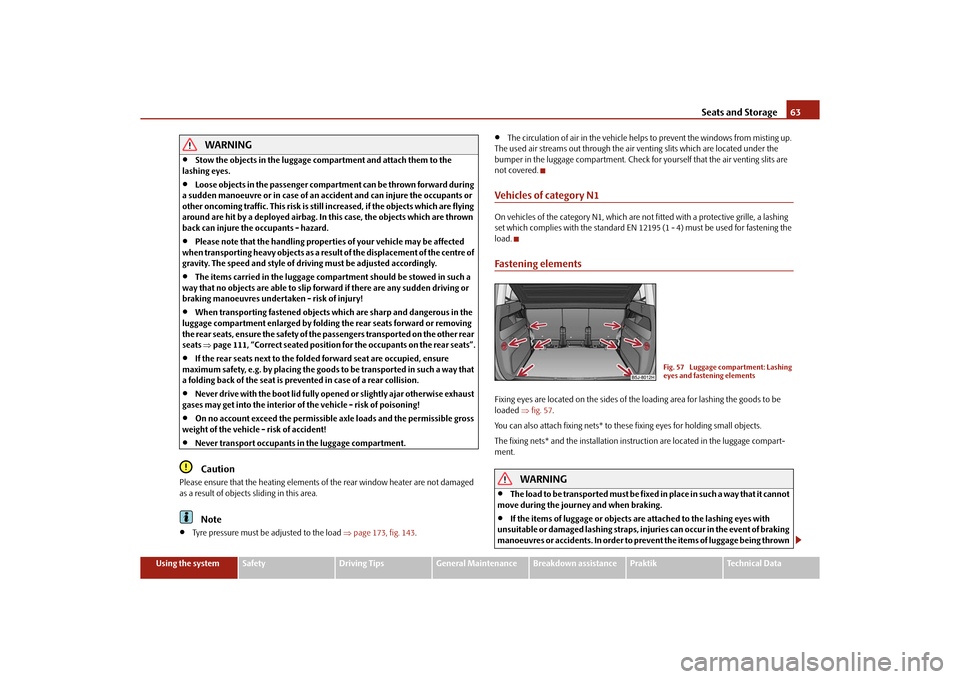
load.Fastening elementsFixing eyes are located on th e sides of the loading area for lashing the goods to be
loaded fig. 57 .
You can also attach fixing nets* to these fixing eyes for holding small objects.
The fixing nets* and the installation inst ruction are located in the luggage compart-
ment.
WARNING
The load to be transported must be fixed in place in such a way that it cannot
move during the journey and when braking.
If the items of luggage or objects are attached to the lashing eyes with
unsuitable or damaged lashing straps, inju ries can occur in the event of braking
manoeuvres or accidents. In order to prevent the items of luggage being thrown
Fig. 57 Luggage compartment: Lashing
eyes and fastening elements
s16g.4.book Page 63 Wednesday, February 10, 2010 3:53 PM
Page 66 of 231
Seats and Storage65
Using the system
Safety
Driving Tips
General Maintenance
Breakdown assistance
Praktik
Technical Data
The luggage compartment cover
You can use the luggage compartment cover behind the head
restraints for storing light and soft items.Fig. 60 Removal of the luggage compartmen t cover / Luggage compartment cover in the
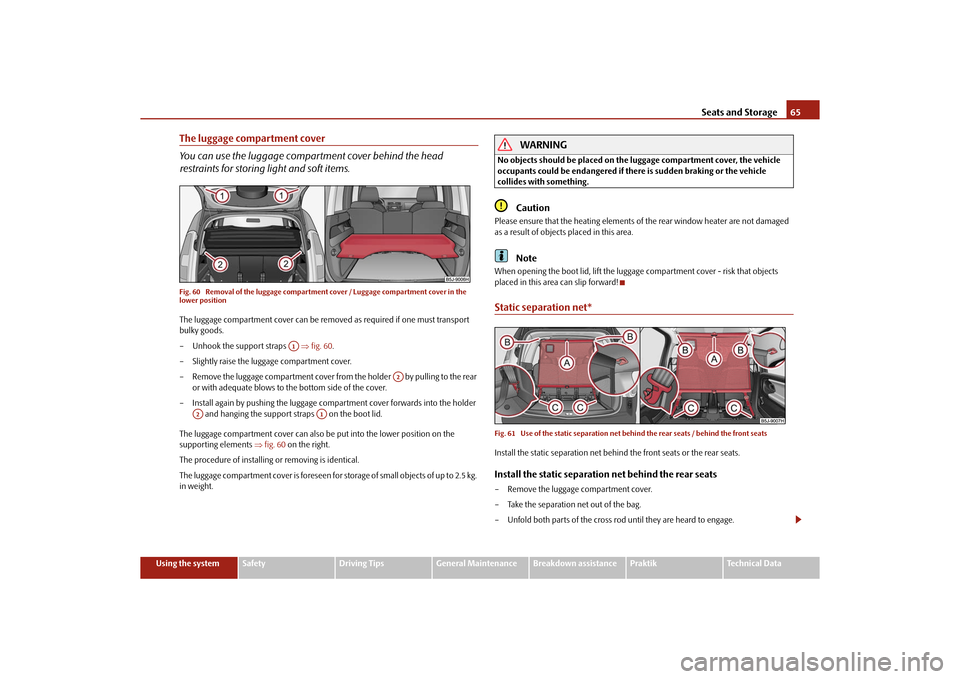
lower positionThe luggage compartment cover can be removed as required if one must transport
bulky goods.
– Unhook the support straps fig. 60 .
– Slightly raise the luggage compartment cover.
– Remove the luggage compartment cover from the holder by pulling to the rear or with adequate blows to th e bottom side of the cover.
– Install again by pushing the luggage compartment cover forwards into the holder and hanging the support straps on the boot lid.
The luggage compartment cover can also be put into the lower position on the
supporting elements fig. 60 on the right.
The procedure of installing or removing is identical.
The luggage compartment cover is foreseen for storage of small objects of up to 2.5 kg.
in weight.
WARNING
No objects should be placed on the luggage compartment cover, the vehicle
occupants could be endangered if th ere is sudden braking or the vehicle
collides with something.
Caution
Please ensure that the heating elements of the rear window heater are not damaged
as a result of objects placed in this area.
Note
When opening the boot lid, lift the luggage compartment cover - risk that objects
placed in this area can slip forward!Static separation net*Fig. 61 Use of the static separation net be hind the rear seats / behind the front seatsInstall the static separation net behind the front seats or the rear seats.Install the static separation net behind the rear seats– Remove the luggage compartment cover.
– Take the separation net out of the bag.
– Unfold both parts of the cross rod until they are heard to engage.
A1
A2
A2
A1
s16g.4.book Page 65 Wednesday, February 10, 2010 3:53 PM
Page 68 of 231
Seats and Storage67
Using the system
Safety
Driving Tips
General Maintenance
Breakdown assistance
Praktik
Technical Data
WARNING
Pay attention when installing that the ca rrier rails and the variable loading floor
are correctly fixed, otherwise the occupants are at risk.
Note
If the variable loading floor* is installed, no flexible storage compartment or fixing net*
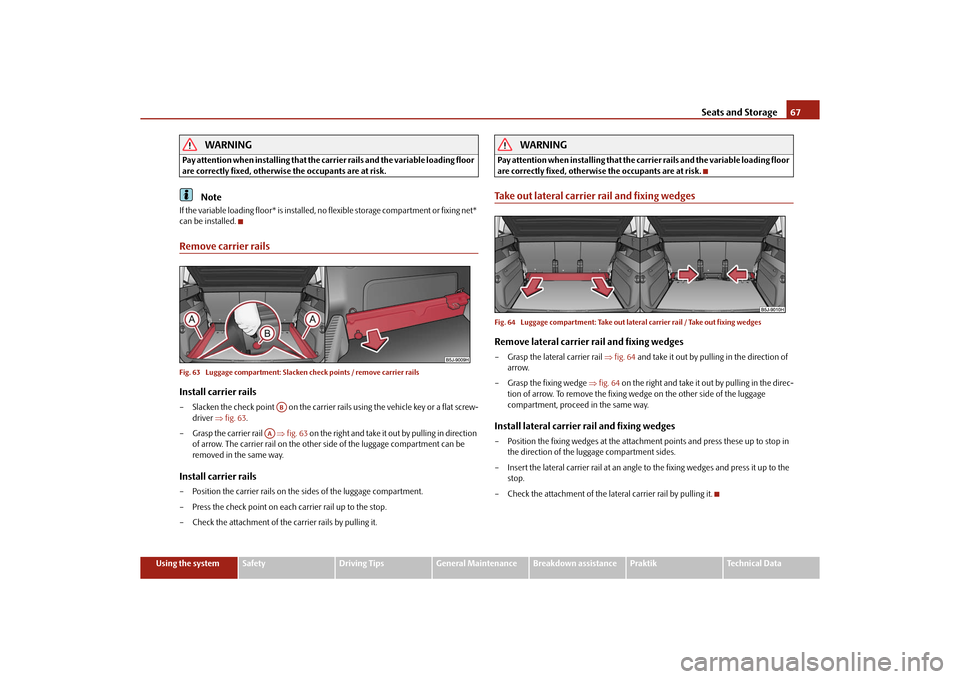
can be installed.Remove carrier railsFig. 63 Luggage compartment: Slacken check points / remove carrier railsInstall carrier rails– Slacken the check point on the carrier rails using the vehicle key or a flat screw-
driver fig. 63 .
– Grasp the carrier rail fig. 63 on the right and take it out by pulling in direction
of arrow. The carrier rail on the other side of the luggage compartment can be
removed in the same way.Install carrier rails– Position the carrier rails on the sides of the luggage compartment.
– Press the check point on each carrier rail up to the stop.
– Check the attachment of the carrier rails by pulling it.
WARNING
Pay attention when installing that the ca rrier rails and the variable loading floor
are correctly fixed, otherwis e the occupants are at risk.Take out lateral carrier rail and fixing wedgesFig. 64 Luggage compartment: Take out lateral carrier rail / Take out fixing wedgesRemove lateral carrier rail and fixing wedges– Grasp the lateral carrier rail fig. 64 and take it out by pulling in the direction of
arrow.
– Grasp the fixing wedge fig. 64 on the right and take it out by pulling in the direc-
tion of arrow. To remove the fixing wedge on the other side of the luggage
compartment, proceed in the same way.Install lateral carrier rail and fixing wedges– Position the fixing wedges at the attachme nt points and press these up to stop in
the direction of the luggage compartment sides.
– Insert the lateral carrier rail at an angle to the fixing wedges and press it up to the
stop.
– Check the attachment of the late ral carrier rail by pulling it.
AB
AA
s16g.4.book Page 67 Wednesday, February 10, 2010 3:53 PM
Page 70 of 231
Seats and Storage69
Using the system
Safety
Driving Tips
General Maintenance
Breakdown assistance
Praktik
Technical Data
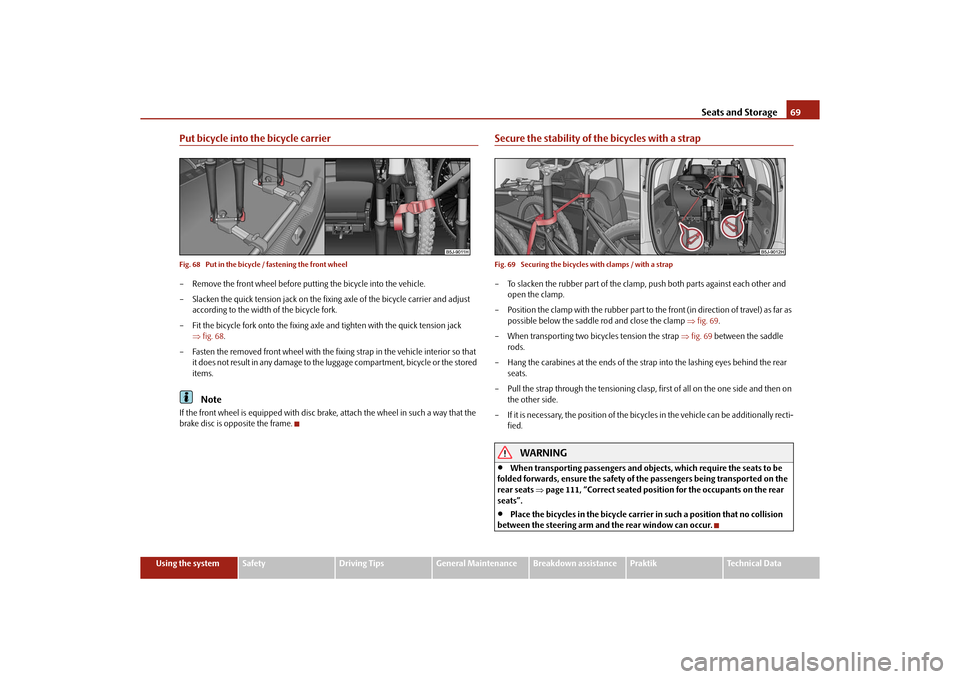
Put bicycle into the bicycle carrierFig. 68 Put in the bicycle / fastening the front wheel– Remove the front wheel before putti ng the bicycle into the vehicle.
– Slacken the quick tension jack on the fixi ng axle of the bicycle carrier and adjust
according to the width of the bicycle fork.
– Fit the bicycle fork onto the fixing axle and tighten with the quick tension jack
fig. 68 .
– Fasten the removed front wheel with the fixing strap in the vehicle interior so that it does not result in any damage to the luggage compartment, bicycle or the stored
items.
Note
If the front wheel is equipped with disc brak e, attach the wheel in such a way that the
brake disc is opposite the frame.
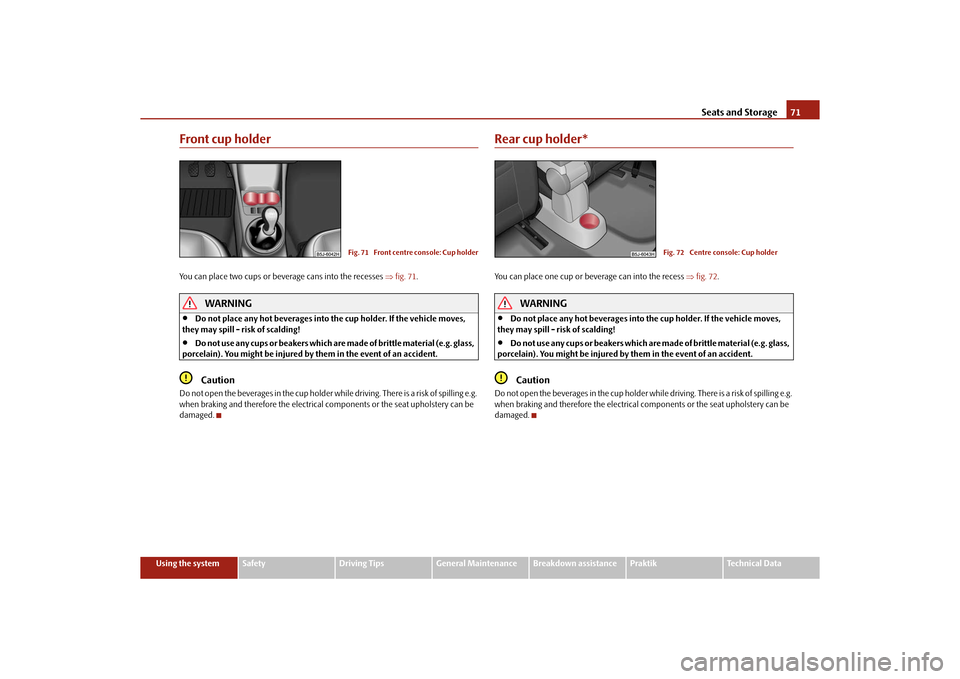
Secure the stability of the bicycles with a strapFig. 69 Securing the bicycles with clamps / with a strap– To slacken the rubber part of the clamp, push both parts against each other and
open the clamp.
– Position the clamp with the rubber part to the front (in direction of travel) as far as possible below the saddle rod and close the clamp fig. 69 .
– When transporting two bi cycles tension the strap fig. 69 between the saddle
rods.
– Hang the carabines at the ends of the strap into the lashing eyes behind the rear seats.
– Pull the strap through the tensioning clasp, first of all on the one side and then on the other side.
– If it is necessary, the position of the bicycles in the vehicle can be additionally recti- fied.
WARNING
When transporting passengers and objects, which require the seats to be
folded forwards, ensure the safety of the passengers being transported on the
rear seats page 111, “Correct seated position for the occupants on the rear
seats”.
Place the bicycles in the bicycle carrier in such a position that no collision
between the steering arm and the rear window can occur.
s16g.4.book Page 69 Wednesda y, February 10, 2010 3:53 PM
Page 72 of 231
Seats and Storage71
Using the system
Safety
Driving Tips
General Maintenance
Breakdown assistance
Praktik
Technical Data
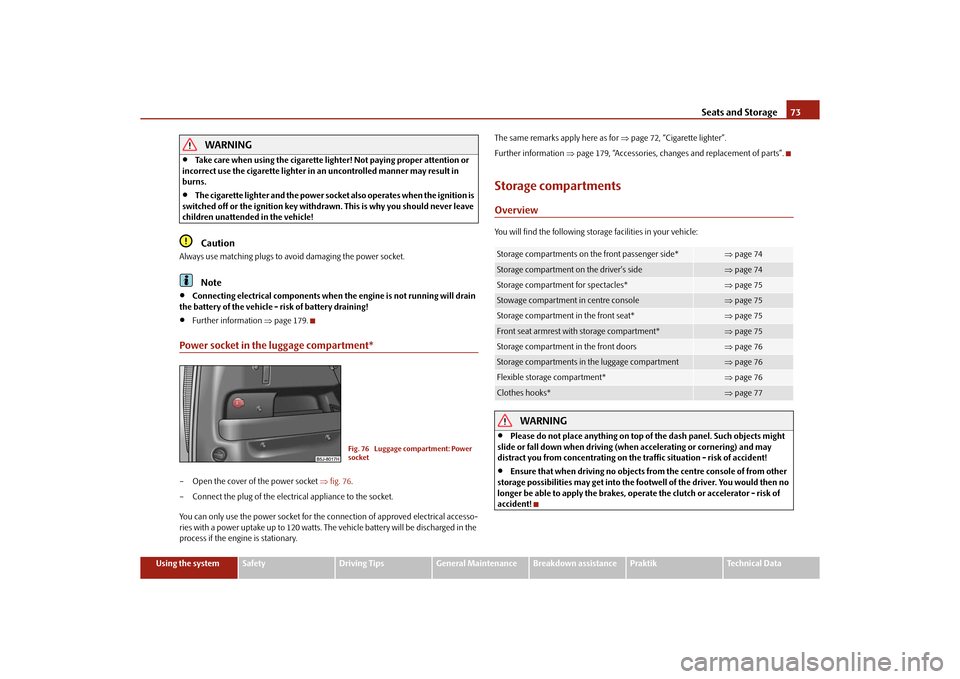
Front cup holderYou can place two cups or beverage cans into the recesses fig. 71 .
WARNING
Do not place any hot beverages into th e cup holder. If the vehicle moves,
they may spill - risk of scalding!
Do not use any cups or beakers which are made of brittle material (e.g. glass,
porcelain). You might be injured by them in the event of an accident.Caution
Do not open the beverages in the cup holder whil e driving. There is a risk of spilling e.g.
when braking and therefore the electrical components or the seat upholstery can be
damaged.
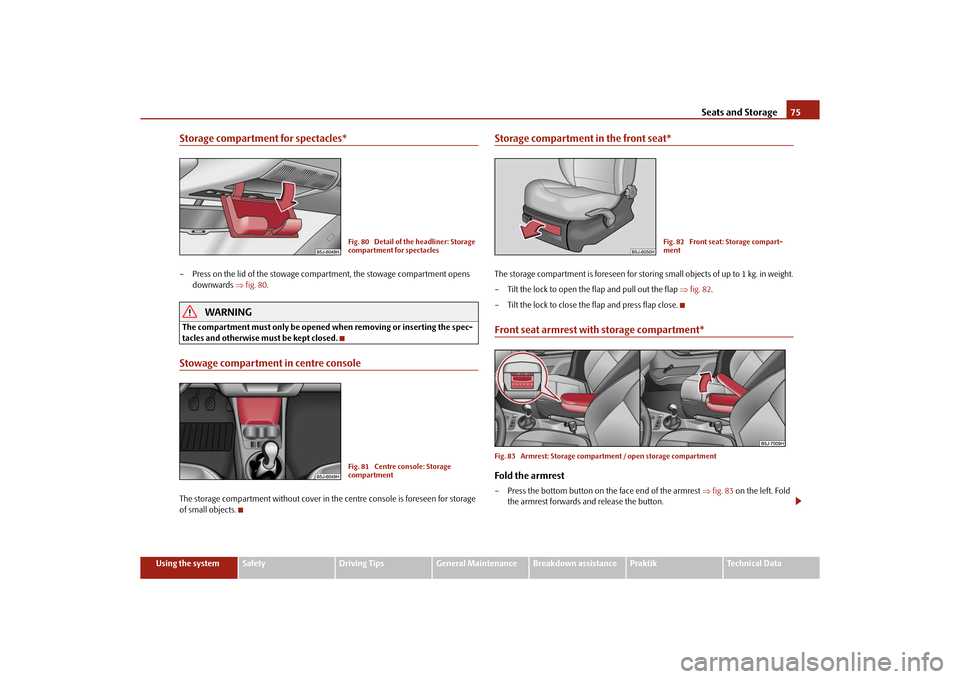
Rear cup holder*You can place one cup or beverage can into the recess fig. 72 .
WARNING
Do not place any hot beverages into th e cup holder. If the vehicle moves,
they may spill - risk of scalding!
Do not use any cups or beakers which are made of brittle material (e.g. glass,
porcelain). You might be injured by them in the event of an accident.Caution
Do not open the beverages in the cup holder whil e driving. There is a risk of spilling e.g.
when braking and therefore the electrical components or the seat upholstery can be
damaged.
Fig. 71 Front centre console: Cup holder
Fig. 72 Centre console: Cup holder
s16g.4.book Page 71 Wednesda y, February 10, 2010 3:53 PM
Page 74 of 231
Seats and Storage73
Using the system
Safety
Driving Tips
General Maintenance
Breakdown assistance
Praktik
Technical Data
WARNING
Take care when using the cigarette ligh ter! Not paying proper attention or
incorrect use the cigarette lighter in an uncontrolled manner may result in
burns.
The cigarette lighter and the power socket also operates when the ignition is
switched off or the ignition key withdrawn. This is why you should never leave
children unattended in the vehicle!Caution
Always use matching plugs to avoid damagi ng the power socket.
Note
Connecting electrical components when the engine is not running will drain
the battery of the vehicle - risk of battery draining!
Further information page 179.
Power socket in the luggage compartment*– Open the cover of the power socket fig. 76 .
– Connect the plug of the electrical appliance to the socket.
You can only use the power socket for the connection of approved electrical accesso-
ries with a power uptake up to 120 watts. The vehicle battery will be discharged in the
process if the engine is stationary. The same remarks apply here as for
page 72, “Cigarette lighter”.
Further information page 179, “Accessories, changes and replacement of parts”.
Storage compartmentsOverviewYou will find the following storag e facilities in your vehicle:
WARNING
Please do not place anything on top of the dash panel. Such objects might
slide or fall down when driving (whe n accelerating or cornering) and may
distract you from concentrating on the traffic situation - risk of accident!
Ensure that when driving no objects from the centre console of from other
storage possibilities may get into the fo otwell of the driver. You would then no
longer be able to apply the brakes, oper ate the clutch or accelerator - risk of
accident!
Fig. 76 Luggage compartment: Power
socket
Storage compartments on the front passenger side*
page 74
Storage compartment on the driver's side
page 74
Storage compartment for spectacles*
page 75
Stowage compartment in centre console
page 75
Storage compartment in the front seat*
page 75
Front seat armrest with storage compartment*
page 75
Storage compartment in the front doors
page 76
Storage compartments in the luggage compartment
page 76
Flexible storage compartment*
page 76
Clothes hooks*
page 77
s16g.4.book Page 73 Wednesda y, February 10, 2010 3:53 PM
Page 76 of 231
Seats and Storage75
Using the system
Safety
Driving Tips
General Maintenance
Breakdown assistance
Praktik
Technical Data
Storage compartment for spectacles*– Press on the lid of the stowage comp artment, the stowage compartment opens
downwards fig. 80 .
WARNING
The compartment must only be opened when removing or inserting the spec-
tacles and otherwise must be kept closed.Stowage compartment in centre consoleThe storage compartment without cover in the centre console is foreseen for storage
of small objects.
Storage compartment in the front seat*The storage compartment is foreseen for storing small objects of up to 1 kg. in weight.
– Tilt the lock to open the flap and pull out the flap fig. 82 .
– Tilt the lock to close the flap and press flap close.Front seat armrest with storage compartment*Fig. 83 Armrest: Storage compartment / open storage compartmentFold the armrest– Press the bottom button on the face end of the armrest fig. 83 on the left. Fold
the armrest forwards and release the button.
Fig. 80 Detail of the headliner: Storage
compartment for spectaclesFig. 81 Centre console: Storage
compartment
Fig. 82 Front seat: Storage compart-
ment
s16g.4.book Page 75 Wednesda y, February 10, 2010 3:53 PM
Page 78 of 231
Seats and Storage77
Using the system
Safety
Driving Tips
General Maintenance
Breakdown assistance
Praktik
Technical Data
– Press the upper corners to the inside
and release the storage compartment by
pulling upwards.
– Take it out by pulling toward s the middle of the vehicle.
Installing– Insert both ends of the flexible storage compartment into the openings of the right
side trim panel of the luggage compartment and push it downwards until it locks.Clothes hooks*The clothes hooks are located on the handle of the headliner above each of the rear
doors.
WARNING
Ensure that any clothes hanging from the hooks do not impair your vision to
the rear.
Use the hooks for hanging only light item s of clothing and ensure that there
are no heavy or sharp-edge d objects in the pockets.
The maximum permissable load of the hooks is 2 kg.
Do not use clothes hangers for hanging up items of clothing otherwise this
will interfere with the protection offered by the head airbag*.
s16g.4.book Page 77 Wednesda y, February 10, 2010 3:53 PM
Page 80 of 231
Heating and air conditioning system79
Using the system
Safety
Driving Tips
General Maintenance
Breakdown assistance
Praktik
Technical Data
HeatingUsing the system
The heating system delivers air into the interior of the vehicle and
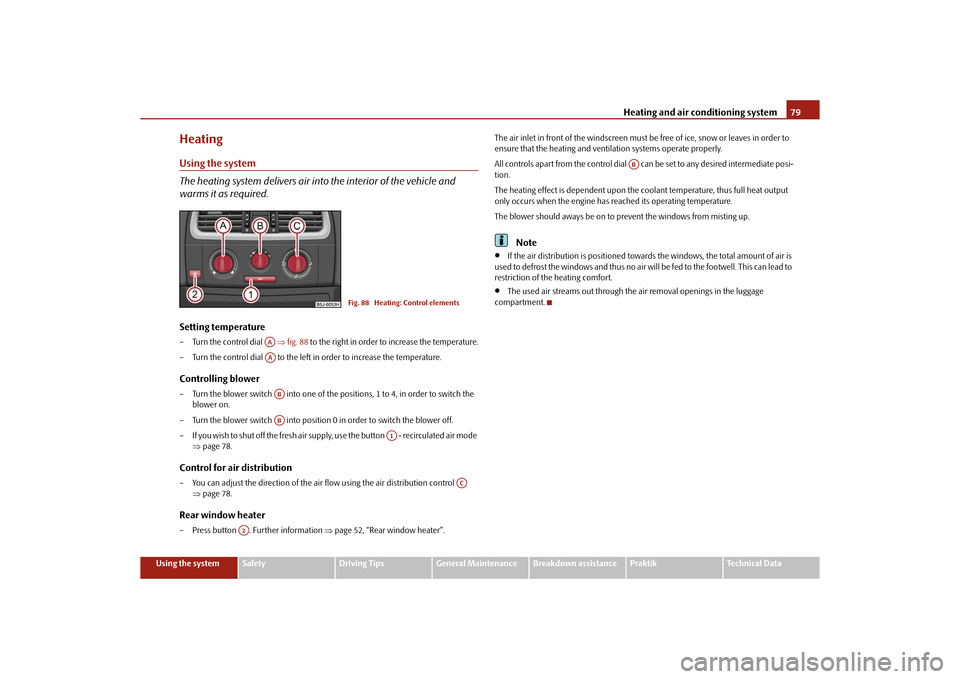
warms it as required.Setting temperature– Turn the control dial fig. 88 to the right in order to increase the temperature.
– Turn the control dial to the left in order to increase the temperature.Controlling blower– Turn the blower switch into one of the po sitions, 1 to 4, in order to switch the
blower on.
– Turn the blower switch into position 0 in order to switch the blower off.
– If you wish to shut off the fresh air supply , use the button - recirculated air mode
page 78.Control for air distribution– You can adjust the direction of the air flow using the air distribution control
page 78.Rear window heater– Press button . Further information page 52, “Rear window heater”. The air inlet in front of the windscreen must be free of ice, snow or leaves in order to
ensure that the heating and ventilation systems operate properly.
All controls apart from the control dial
can be set to any desired intermediate posi-
tion.
The heating effect is dependent upon the c oolant temperature, thus full heat output
only occurs when the engine has reached its operating temperature.
The blower should aways be on to prevent the windows from misting up.
Note
If the air distribution is positioned toward s the windows, the total amount of air is
used to defrost the windows and thus no air will be fed to the footwell. This can lead to
restriction of the heating comfort.
The used air streams out through the air removal openings in the luggage
compartment.
Fig. 88 Heating: Control elements
AAAAABAB
A1
AC
A2
AB
s16g.4.book Page 79 Wednesda y, February 10, 2010 3:53 PM