technical data SKODA ROOMSTER 2010 1.G Workshop Manual
[x] Cancel search | Manufacturer: SKODA, Model Year: 2010, Model line: ROOMSTER, Model: SKODA ROOMSTER 2010 1.GPages: 231, PDF Size: 12.91 MB
Page 102 of 231
Communication101
Using the system
Safety
Driving Tips
General Maintenance
Breakdown assistance
Praktik
Technical Data
The buttons apply for the respective operating mode of the current radio or navigation
system.
Note
The loudspeakers in the vehicle are matched to a power output of the radio and
navigation system of 4x 20°W.
For the equipment sound system*, the loudspeakers are matched to a power
output of the amplifier of 4x40°W + 6x20 W.
Mobile phones and tw o-way radio systemsThe installation of a mobile phone and two-way radio system in a vehicle should be
carried out by a specialist garage.
Mobile phones send and receive radio waves during a conversation as well as in
standby mode. Radio waves can be harmful to the human body if their frequency
exceeds certain limit values.
Škoda Auto permits the operation of mobile phones and two-way radio systems with
a professionally installed external aerial and a maximum transmission power of up to
10 watts.
It is essential that you inform a specialist garage about the possibilites to assemble and
operate mobile phones and two-way radio sets which have a power output of more
than 10 W. They will inform you which technical possibilities exist for retrofitting
mobile phones.
When using a mobille phone inside the vehicl e, which is not inserted into the phone
adapter, and thus has no connection to the external aerial, the electromagnetic radia-
tion can exceed the current limit value. We therefore recommend to operate a mobile
phone in the vehicle only when it is conne cted to an external aerial via the phone
adapter. This improves the quality of the connection.
Operation of mobile phones or two-way ra dio systems may interfere with functioning
of the electronic systems of your vehicle. The reasons for this may be:
no external aerial,
external aerial incorrectly installed,
transmission power gr eater than 10 watts.
WARNING
If a mobile phone or a two-way radio system is operated in the vehicle
without using a special external aerial or an external aerial which has been
incorrectly installed, this can increase the strength of the electromagnetic field
in the interior of the vehicle.
Please concentrate fully at all times on your driving!
You must not install two-way radio systems, mobile phones or mounts on
the covers of the airbags or within the immediate deployment range of airbags.
This might result in injuries to the occupants in the event of an accident.
Never leave a mobile phone on a seat, on the dash panel or in another area,
from which it can be thrown during a sudden braking manoeuver, an accident
or a collision. In this case, the occupants of the vehicle might be injured.Note
Observe the country-specific regulations for the use of mobile phones in vehicles.Universal telephone preinstallation GSM II*IntroductionThe universal telephone preinstallation GSM II is a built-in “handsfree-system”, it
provides a voice operated convenience mode via the multifunction steering wheel* or
the navigation system*.
All communication between a telephone and the handsfree-system of your vehicle
can only be established with the help of the Bluetooth
® technology. The adapter*
serves only for charging the telephone and fo r transmitting the signal to the external
aerial of the vehicle.
a)On vehicles which are equipped with the universal telephone prei nstallation GSM II, pressing the button only allows to operate the telephone.
A1
s16g.4.book Page 101 Wednesday, February 10, 2010 3:53 PM
Page 104 of 231
Communication103
Using the system
Safety
Driving Tips
General Maintenance
Breakdown assistance
Praktik
Technical Data
During the connecting procedur
e, no other mobile phone may be connected with the
hands-free system.
Up to four mobile phones can be paired to the hands-free system, whereby only one
mobile phone can communicate with the hands-free system.
Connection with an already paired mobile phone
After switching on the ignition, the connect ion is automatically established for the
already paired mobile phone
11). Check on the mobile unit if the automatic connection
was established.
Ending the connection
By withdrawing the ignition key.
By disconnecting the device in the information display.
By disconnecting the device in the mobile phone.
Solving connection problems
If the system announces No paired phone found , check the operating state of the
telephone:
Is the telephone switched on?
Is the PIN code entered?
Is Bluetooth
® active?
Is the visibility of the mobile phone active?
Was the telephone already paired with the handsfree-system?
WARNING
In the event of air transport, the Bluetooth
® function of the handsfree-system
must be switched off by a specialist garage!
Note
Not valid for all mobile phones which enable a communication via Bluetooth
®.
You can ask at an authorised Škoda Service Partner if your telephone is compatible
with the universal telephone preinstallation GSM II.
Please operate your mobile phone exclusiv ely with a suitable adapter in order to
keep a low radiation in the vehicle.
Inserting the mobile phone into the adapter ensures an optimal sending and
receiving power and offers at the same ti me the advantage of the battery charging.
The range of the Bluetooth
® connection to the handsfree-system is restricted to
the vehicle interior. The range is dependent on local factors, e.g. obstacles between the
devices and mutual interferences with other de vices. If your mobile phone is e.g. in a
jacket pocket, this can lead to diffic ulties when establishing the Bluetooth
® connection
with the handsfree-system or the data transfer.
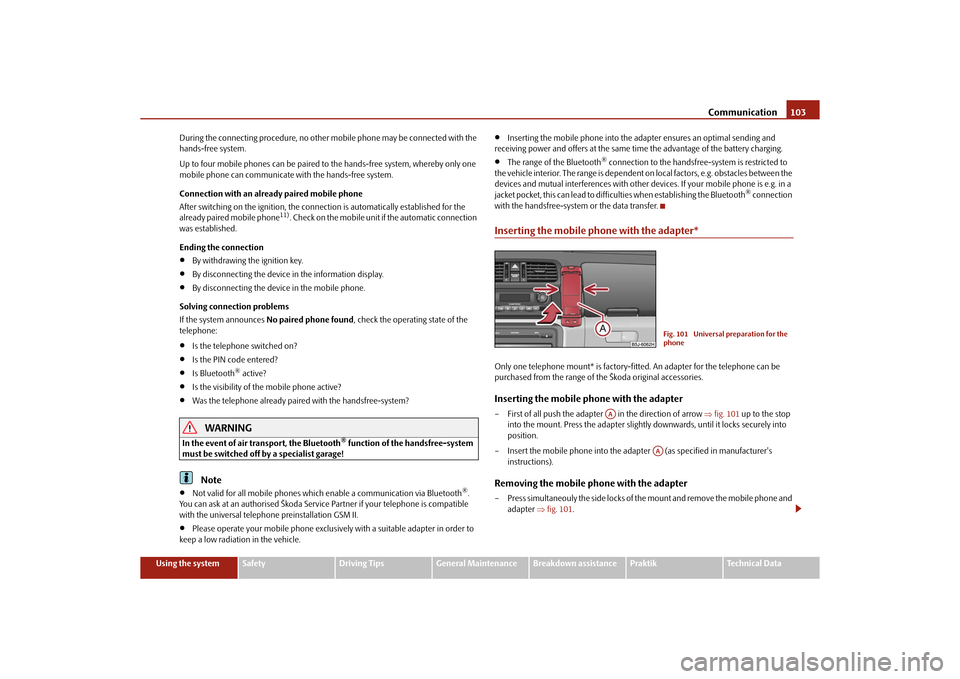
Inserting the mobile phone with the adapter*Only one telephone mount* is factory-fitted. An adapter for the telephone can be
purchased from the range of the Škoda original accessories.Inserting the mobile phone with the adapter– First of all push the adapter in the direction of arrow fig. 101 up to the stop
into the mount. Press the adapter slightly downwards, until it locks securely into
position.
– Insert the mobile phone into the adapter (as specified in manufacturer's instructions).Removing the mobile phone with the adapter– Press simultaneouly the side locks of the mount and remove the mobile phone and adapter fig. 101 .
Fig. 101 Universal preparation for the
phone
AA
AA
s16g.4.book Page 103 Wednesda y, February 10, 2010 3:53 PM
Page 106 of 231
Communication105
Using the system
Safety
Driving Tips
General Maintenance
Breakdown assistance
Praktik
Technical Data
The buttons operate the functions for the operating mode of the current telephone.
Operate the telephone via the information display*The display of texts in the menu
Te l e p h o n e is possible in the following languages:
Czech, English, German, French, Italian, Spanish, Russian, Portuguese.
In the menu Te l e p h o n e you can select the following menu points:
Phone book
Dial number
Call register
Voice mailbox
Bluetooth
Settings
Back
Phone book
In the menu point Phone book is the list of the loaded contacts from the telephone
memory and the SIM card of the mobile phone. In the phone phonebook there are 2
500 free memory locations available.
Dial number
In the menu point Dial number, you can write any telephone number. Select in
sequence the desired digits with the aid of the handwheel and confirm it by pressing the handwheel. You can select the numbers 0 - 9
, the symbols +,
, # and the func-
tions Delete, Call, Cancel .
Call register
In the menu point Call register, you can select the following menu points:
Missed calls
Received calls
Last calls
Voice mailbox
In the menu Voice mailbox , it is possible to set the number of the voice mailbox and
then dial the number.
Bluetooth
In the menu Bluetooth you can select the following menu points:
User - the overview of the stored users
New user - Search for new telephones which are in the reception range
Visibility - Switching on the visibility of the telephone unit for other devices
Media player
Active device
Paired devices
Search
Phone name - the possibility to change the name of the telephone unit (pre-set
SKODA UHV)
Button
Action
Operation
press briefly
Accept call, end call, entry in the main menu of the telephone, list of the dialed numbers, deactivate voice control
press button for a long
time
Activate voice control
(PTT button - Push to talk), reject call
turn upwards
Increase volume
turn downwards
Decrease volume
A1A1A1A1
s16g.4.book Page 105 Wednesda y, February 10, 2010 3:53 PM
Page 108 of 231
Communication107
Using the system
Safety
Driving Tips
General Maintenance
Breakdown assistance
Praktik
Technical Data
row of digits (complete number)
, in the form of order of digits (separation through a
brief voice pause) or through individually spoken digits. After each order of digits
(separation through brief voice pause) all of the digits detected up to now are repeated
by the system.
The digits 0 - 9 , symbols +,
, # are permitted. The system detects no continuous digit
combinations such as twenty-three, but only individually spoken digits (two, three).
Call name– Press the PTT button.
– Give the command CALL XZY after the signal tone.
Example for calling the name from the phone bookMusic playback via Bluetooth
®
The universal telephone preinstallation GSM II makes it possible to play back music via
Bluetooth
® from the devices such as MP3 player, mobile phone or notebook.
In order to enable the music playback via Bluetooth
®, it is necessary to connect the
device with the handsfree-system in the menu Phone - Bluetooth - Media player .
The operation of the music pl ayback from the connected de vice can be performed via
the handsfree-system with the voice control page 106 or directly via the connected
device.
Note
The device to be connected must support the Bluetooth
® profile A2DP, see Owner's
manual of the device to be connected.
Inputs AUX-IN* and MDI*The input AUX-IN is located below the armres t* of the front seats and is marked with
.
The input MDI is located in the front belo w the front passenger storage compartment.
The inputs AUX-IN and MDI connect the ex ternal audio sources (e.g. iPod or MP3
player) and play back music from these devi ces via your radio* or navigation system*
installed in the factory.
The description of the operation can be found in the relevant Owner's Manual of your
radio* or your navigation*.Note
The loudspeakers in the vehicle are matched to a power output of the radio and
navigation system of 4x 20°W.
For the equipment sound system*, the loudspeakers are matched to a power
output of the amplifier of 4x40°W + 6x20 W.
Voice command
Announcement
CALL XYZ
“ Say home, work, mobile ”
e.g. WORK
“XYZ work is dialed. ”
s16g.4.book Page 107 Wednesda y, February 10, 2010 3:53 PM
Page 110 of 231
Passive Safety109
Using the system
Safety
Driving Tips
General Maintenance
Breakdown assistance
Praktik
Technical Data
SafetyPassive SafetyBasic informationDriving the safe way
Passive safety measures reduce the risk of injury in accident situations.In this section you will find important info rmation, tips and notes on the subject of
passive safety in your vehicle. We have combined everything here which you should
be familiar with, for example, regarding seat belts, airbags, child seats and safety of
children. It is therefore important, in partic ular, to comply with the notes and warnings
in this section for your own interest and in the interest of those travelling with you.
WARNING
This chapter contains important information on how to use the vehicle for
the driver and his occupants. You will find further information on safety, which
concerns you and those travelling with you, in the following chapters of this
Owner's Manual.
The complete on-board literature should always be in the vehicle. This
applies in particular, if you rent out or sell the vehicle.
Safety equipment
The safety equipment is part of the occupant protection and it can
reduce the risk of injuries in accident situations.“Do not put at risk” your safety and the safety of those travelling with you . In the event
of an accident, the safety equipment can redu ce the risk of injuries. The following list
contains part of the safety equipment in your vehicle:
three-point seat belts for all the seats;
belt force limiters for front seats;
belt tensioners for front seats;
seat belt height adjusters for front seats;
front airbags for the driver and the front passenger*;
side airbags*;
head airbags*;
anchoring points for child seat using the “ISOFIX” system;
anchoring points for child seat using the “Top Tether” system;
head restraints adjustable for height;
adjustable steering column.
The specified safety equipment works togeth er, in order to optimally protect you and
those travelling with you in accident situat ions. The safety equipment does not protect
you or the people travelling with you, if you or your occupants adopt an incorrect
seated position or the equipment is not correctly adjusted or used.
For this reason you will be provided with information on why this equipment is very
important, how it protects you and the occupants, what should be observed when
using the equipment and how you and the peop le travelling with you can make full use
of the existing safety equipment. This Owner's Manual contains important warning
notes, which you and those travelling with you should pay attention to in order to
reduce a risk of injury.
Safety concerns everybody!
Before setting off
The driver is always fully responsibl e for his occupants and for the oper-
ating safety of the vehicle.For your own safety and the safety of the pe ople travelling with you, please pay atten-
tion to the following points before setting off.
Ensure that the lighting and the turn signal system are functioning properly.
Inspect the tyre inflation pressure.
s16g.4.book Page 109 Wednesda y, February 10, 2010 3:53 PM
Page 112 of 231
Passive Safety111
Using the system
Safety
Driving Tips
General Maintenance
Breakdown assistance
Praktik
Technical Data
correctly fastened in order to provide an optimal protection for you and your
occupants.
The driver must maintain a distance of
at least 25 cm to the steering wheel
page 110, fig. 104 . Not maintaining this minimum distance will mean that
the airbag system will not be able to properly protect you - hazard!
When driving, hold the st eering wheel with both hands firmly on the outer
edge in the 9 o'clock and 3 o'clock po sition. Never hold the steering wheel
firmly in the 12 o'clock position or in another way (e.g. in the middle of the
steering wheel or at the inner steering wheel edge). In such cases, injuries to the
arms, the hands and the head can occur when the driver airbag is deployed.
The seat backrests must not be angled too far back when driving otherwise
this will affect proper operation of the se at belts and of the airbag system - risk
of injury!
Ensure that there are no objects in the footwell as any objects may get
behind the pedals during a driving or braking manoeuvre. You would then no
longer be able to operate the clutch, to brake or accelerate.
Correct seated position for the front passenger
The fro n t p assen ger must mai n tai n a d i stan ce of a t l ea st 25 c m from th e
dash panel so that the airbag offers him the greatest possible safety it is
deployed.For the safety of the front passenger and to reduce the risk of injury in the event of an
accident, we recommend the following setting.
Adjust the front passenger seat as far as possible to the rear.
Adjust the head restraint so that the top edge of the head restraint is at the same
level as the upper part of your head page 110, fig. 104 on the right.
Fasten the seat belt correctly page 115, “How are seat belts correctly fastened?”.
In exceptional cases the front pass enger airbag can be deactivated page 124,
“Deactivating airbags”.
Adjusting the passenger seat page 57, “Adjusting the front seats”.
WARNING
The front seats and the head restraints must always be adjusted to match
the body size of the seat occupant as well as the seat belts must always be
correctly fastened in order to provide an optimal protection for you and your
occupants.
The front passenger must maintain a distance of at least 25 cm to the dash
panel. Not maintaining this minimum distance will mean that the airbag
system will not be able to properly protect you - hazard!
Always keep your feet in the footwel l when the vehicle is being driven -
never place your feet on the instrument panel, out of the window or on the
surfaces of the seats. You will be exposed to increased risk of injury if it becomes
necessary to apply the brake or in the ev ent of an accident. If an airbag is
deployed, you may suffer fatal injuries wh en adopting an incorrect seated posi-
tion!
The seat backrests must not be angled too far back when driving otherwise
this will affect proper operation of the se at belts and of the airbag system - risk
of injury!
Correct seated position for the occupants on the rear seats
Occupants on the rear seats must sit upright, keep the feet in the foot-
well and must have their se at belts correctly fastened.To reduce the risk of injury in the event of a sudden braking manoeuvre or an accident,
the occupants on the rear seats must observe the following.
Adjust the head restraints so that the top edge of the head restraints is at the same
level as the upper part of your head page 110, fig. 104 on the right.
Fasten the seat belt correctly page 115, “How are seat belts correctly fastened?”.
If you are transporting page 126, “Transporting children safely” children in the
vehicle, please use a suitable child restraint system.
WARNING
The head restraints must always be adjusted to match the body size, in order
to offer an optimal protection for you and your occupants.
WARNING (continued)
s16g.4.book Page 111 Wednesda y, February 10, 2010 3:53 PM
Page 114 of 231
Seat belts113
Using the system
Safety
Driving Tips
General Maintenance
Breakdown assistance
Praktik
Technical Data
Seat beltsWhy seat belts?It is a proven fact that seat belt s offer good protection in accidents fig. 105 . Thus
wearing a seat belt is a legal requirement in most countries.
Seat belts which have been correctly fasten ed and adjusted hold the occupants of the
car in the correct seated position fig. 105 . The belts reduce the kinetic energy
(energy of motion) to a considerable exte nt. They also prevent uncontrolled move-
ments which, in turn, may well result in severe injuries.
The occupants of a vehicle who have fastened and correctly adjusted their seat belt,
profit to a major extent from the fact that the kinetic energy is optimally absorbed by
the belts. The structure of the front end of the vehicle and other passive safety meas-
ures, such as the airbag system, also cont ribute to reducing the kinetic energy. The
energy produced is thus absorbed and there is less risk of injury.
Accident statistics prove that seat belts which are fastened and properly adjusted
reduce the risk of an injury and enhance the chance of survival in a major accident
page 113.
It is important that you pay attention to safety measures, particularly when trans-
porting children in the vehicle page 126, “Transporting children safely”.
WARNING
Fasten your seat belt each time before setting off, also when driving in town!
This also applies to the people seated at the rear - risk of injury!
Expectant women must also always wear a seat belt. This is the only way of
ensuring optimal protection for the unborn child page 115, “Fastening
three-point seat belts”.
It is important for the belt webbing to be properly routed if the seat belts are
to offer the maximum protection. You can see a description of how safety belts
should be fitted properly on the next pages.Note
Please comply with any differing legal requirements when using the seat belts.The physical principle of a frontal collisionFig. 106 The driver is catapulted forward if not wearing a belt / The rear seat occupant is cata-
pulted forward if not wearing a beltThe physical principle of a frontal a ccident can be explained quite simply:
Motion energy, so-called kinetic energy, is produced as soon as the vehicle is moving,
both for the vehicle and its occupants. The magnitude of this kinetic energy depends
essentially on the speed at which the vehicl e is travelling and on the weight of the
vehicle and the occupants. The greater the speed and weight increase, the greater the
amount of energy which has to be ab sorbed in the event of an accident.
Fig. 105 Driver wearing seat belt
WARNING (continued)
s16g.4.book Page 113 Wednesda y, February 10, 2010 3:53 PM
Page 116 of 231
Seat belts115
Using the system
Safety
Driving Tips
General Maintenance
Breakdown assistance
Praktik
Technical Data
How are seat belts correctly fastened?Fastening three-point seat belts
Fasten your seat belt before starting!Fig. 107 Routing of belt webbing over the sh oulders and the lap belt / Routing of belt
webbing for an expectant mother– Correctly adjust the seat and the head restraint before fastening your seat belt
page 110, “Correct seated position”.
– Slowly pull the belt webbing at the tongue of the lock over your chest and pelvis
.
– Insert the tongue of the lock into the seat belt buckle belonging to the seat until it is heard to lock in place.
– Pull on the belt to check that it has also reliably engaged in the lock.
Each three-point seat belt is equipped with an inertia reel. This inertia reel offers you
complete freedom of movement if the belt is unreeled slowly. If the brakes are applied
suddenly, the inertia reel will block. The belts also block when the car accelerates,
when driving downhill and when cornering.
Expectant mothers must also wear the seat belt .
WARNING
The shoulder part of the seat belt must never run across your neck but must
run approximately over the middle of the shoulder and fit snugly against the chest. The lap part of the belt must r
un across the hip and must never be routed
across the stomach. It must always fit snugly fig. 107 . Adjust the belt webbing
as required.
The lap part of the belt should be posi tioned as low as possible at the pelvis
of an expectant mother in order to avoid exerting any pressure on the lower
abdomen.
Always ensure that the webbing of the seat belts is properly routed. Seat
belts which are not correctl y adjusted can themselves cause injuries even in
minor accidents.
A seat belt which is hanging too loose can result in injuries as your body is
moved forward by the kinetic energy pr oduced in an accident and is then
suddenly held firm by the belt.
Only insert the lock tongue into the lock which is the correct one for your
seat. This will affect the protection which the belt offers and increase the risk of
an injury.
Seat belt height adjuster on the front seatsThe seat belt height adjuster makes it possible for you to adapt the routing of the front
three-point seat belt in the area of the shoulder to match your body size.
– To adjust the belt height press the heig ht adjuster and move it up or down
fig. 108 .
WARNING (continued)
Fig. 108 Front seat: Seat belt height
adjuster
s16g.4.book Page 115 Wednesda y, February 10, 2010 3:53 PM
Page 118 of 231
Seat belts117
Using the system
Safety
Driving Tips
General Maintenance
Breakdown assistance
Praktik
Technical Data
The fastened three-point seat belts are automatically tensioned in the event of a frontal
or side collision of a certain severity. The belts tensioners are also deployed if the seat
belts are not fastened.
Belt tensioners are not activated in the event of minor frontal collisions, side and rear-
end collisions, in the case of a rollover and also not in accidents in which no major
forces are produced from the front.
WARNING
Any work on the belt tightener system,
including removal and installation of
system components because of other repair work, must only be carried out by
a specialist garage.
The protective function of the system is only adequate for a single accident.
If the belt tensioners have been deployed, it is then necessary to replace the
entire system.
The Owner's Manual must also be handed over to the new owner if the
vehicle is sold.Note
Smoke is generated when the belt tensioners are deployed. This is not an indica-
tion of a fire in the vehicle.
It is essential to pay attent ion to relevant safety regulations if the vehicle or indi-
vidual parts of the system are scrapped. Specialist garages are familiar with these regu-
lations and will be able to provide you with detailed information in this respect.
When disposing of vehicle or parts of the system, it is important to comply with the
national legal requirements.
s16g.4.book Page 117 Wednesda y, February 10, 2010 3:53 PM
Page 120 of 231
Airbag system119
Using the system
Safety
Driving Tips
General Maintenance
Breakdown assistance
Praktik
Technical Data
When are the airbags deployed?The airbag system is designed in such a way that the driver and the front passenger
airbag* are deployed in the event of a frontal collision of major severity.
In the case of a violent side crash , the side airbag* in the front seat and the head
airbag* on the side on which the collision occurs are deployed.
It is also possible under certain special accident situations that the front as well as the
side airbags and head airbags* are deployed at the same time.
The airbags are not deployed in the case of minor frontal and side collisions, rear-end
collisions, tilting of the ve hicle and vehicle rollover.
Deployment factors
It is not possible to state globally which deployment conditions apply to the airbag
system in every situation as the circumstances which exist in the case of accidents vary
greatly. An important role in this case, for ex ample, is played by factors such as the type
of object against which the vehicle impacts (h ard, soft), the angle of impact, the vehicle
speed etc.
A decisive factor for the deployment of the airbags is the deceleration which occurs
during a collision. The control unit analyses the nature of the collision and activates the
relevant restraint system. If the vehicle deceleration which occurs and is measured
during the collision remains below the prescribed reference values specified in the
control unit, the airbags are no t deployed although the vehicle may well suffer severe
damage to the bodywork as a consequence of the accident.
The airbags are not deployed if:
ignition is switched off;
a minor frontal collision;
a minor side collision;
a rear-end collision;
Rollover of the vehicle.Note
A grey white or red, non harmful gas is released when airbag is inflated. This is
perfectly normal and is not an indi cation of a fire in the vehicle.
In the event of an accident in which the airbags are deployed:
the interior lighting comes on (if the swit ch for the interior light is in the door
contact position),
the hazard warning li ght is switched on;
All the doors are unlocked.
Front airbagsDescription of the front airbags
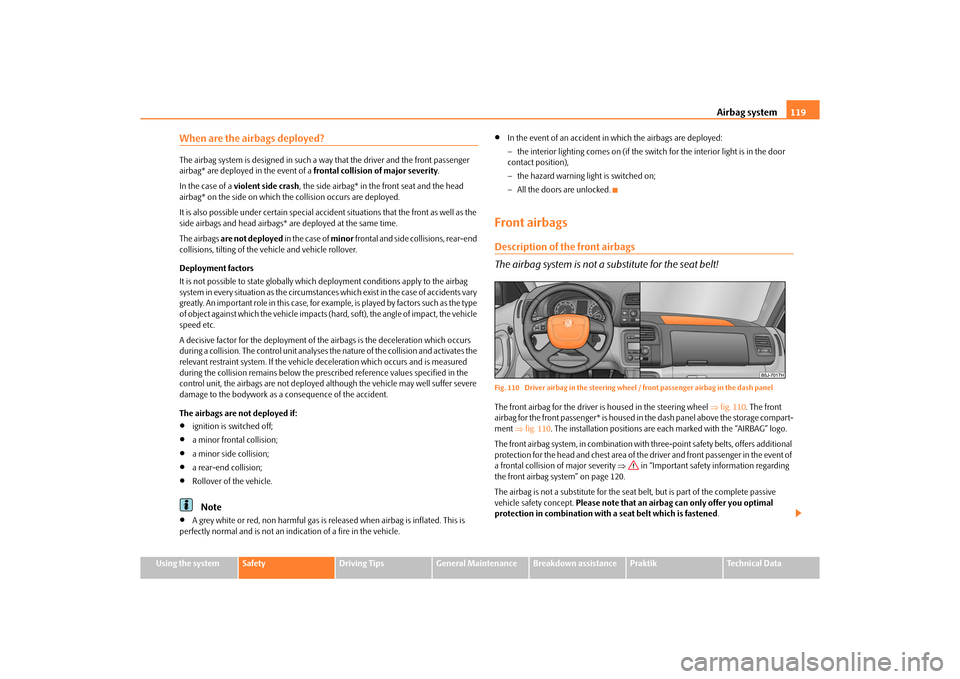
The airbag system is not a su bstitute for the seat belt!Fig. 110 Driver airbag in the steering wheel / front passenger airbag in the dash panelThe front airbag for the driver is housed in the steering wheel fig. 110 . The front
airbag for the front passenger* is housed in the dash panel above the storage compart-
ment fig. 110 . The installation positi ons are each marked with the “AIRBAG” logo.
The front airbag system, in combination with three-point safety belts, offers additional
protection for the head and chest area of the driver and front passenger in the event of
a frontal collision of major severity in “Important safety information regarding
the front airbag system” on page 120.
The airbag is not a substitute for the seat belt, but is part of the complete passive
vehicle safety concept. Please note that an airbag can only offer you optimal
protection in combination with a seat belt which is fastened .
s16g.4.book Page 119 Wednesday, February 10, 2010 3:53 PM