light SKODA ROOMSTER 2010 1.G Manual Online
[x] Cancel search | Manufacturer: SKODA, Model Year: 2010, Model line: ROOMSTER, Model: SKODA ROOMSTER 2010 1.GPages: 231, PDF Size: 12.91 MB
Page 139 of 231
Intelligent Technology
138
You will place great stresses on the power steering system if the steering is turned to
full lock when the vehicle is stationary. Turn ing the steering to full lock in such a situa-
tion will be accompanied by noises.
It is still possible to fully steer the vehicle if the power steering fails or if the engine is
not running (vehicle being towed in). The only difference is that greater physical effort
is required.
It is possible that the hydraulic pump of the power steering will not run due to the low
vehicle network voltage if the battery has gone flat and the engine must started with
the help off jump leads. This condition will be indicated by lighting up of the warning
light.
The power steering operates again if the ba ttery is charged to a specific range when
engine is running. It also op erates again, if the engine can be started with its own
battery.
If there is a fault in the power steering, the warning light lights up in the instrument
cluster
page 25.
Caution
Do not leave the steering at full lock fo r more than 15 seconds when the engine is
running - risk of damaging the power steering!
Note
Have the steering inspected as soon as possible by a specialist garage if there is a leak
or fault in the system.
Tyre pressure monitoring system*The tyre pressure monitoring system compares with the aid of the ABS sensors the
speed and also the rolling circumference of the individual wheels. If the tyre inflation
pressure is significantly changed and thus the rolling circumference of a wheel, the
warning light
lights up in the instrument cluster page 30. The tyre pressure moni-
toring system functions late or too sensitively if:
the structure of the tyre is damaged,
the vehicle is loaded to one side or with a load on the roof,
the wheels of an axle are loaded heavily (e.g. when towing a trailer or when driving
uphill or downhill),
the vehicle is operated in unfavourable wi nter conditions or on an unfirm ground,
snow chains or emergency wheel are mounted,
the driver has a sporty style of driving (with sharp acceleration and high speed
when cornering).
Basic setting of the system
After changing the tyre inflation pressures or after changing one or several wheels, a
basic setting of the system mu st be carried out as follows.
Inflate all tyres to the specified inflation pressure page 173.
Switch on the ignition.
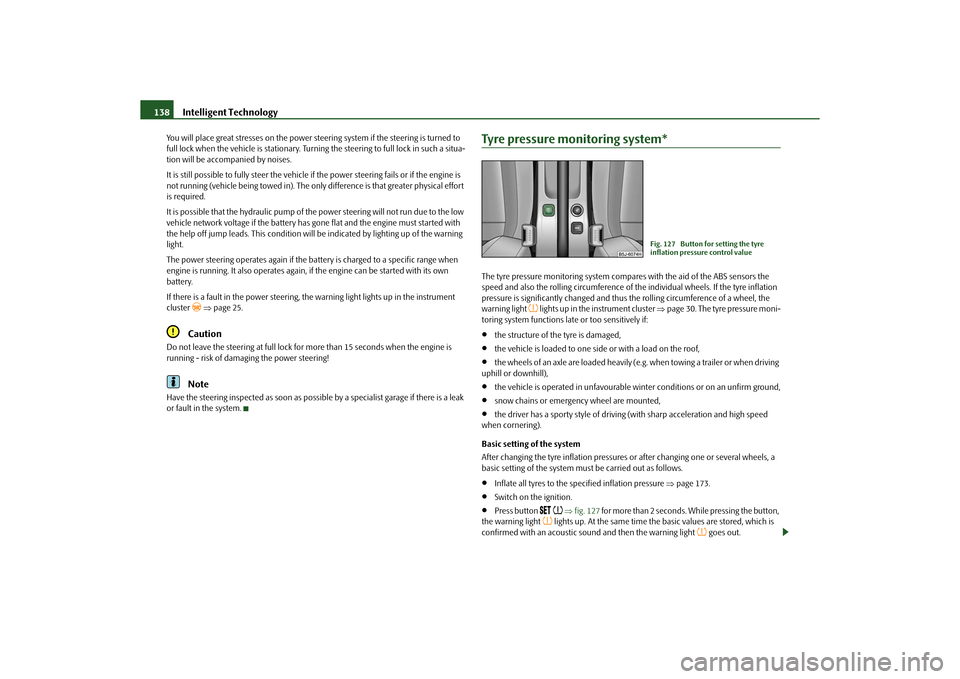
Press button
fig. 127 for more than 2 seconds. While pressing the button,
the warning light
lights up. At the same time the basic values are stored, which is
confirmed with an acoustic sound and then the warning light
goes out.
Fig. 127 Button for setting the tyre
inflation pressure control value
s16g.4.book Page 138 Wednesda y, February 10, 2010 3:53 PM
Page 140 of 231
Intelligent Technology139
Using the system
Safety
Driving Tips
General Maintenance
Breakdown assistance
Praktik
Technical Data
If the warning light
does not go out after the basic setting, there is a fault in the
system. Have the vehicle inspected by your nearest specialist garage.
Functional description
After the basic setting of the system the “adaptation” of the tyre inflation pressures and
then the tyre pressure control in the individual tyres are performed.
Warning light
lights up
If the tyre inflation pressure of at least one wheel is insufficiently inflated in comparison
to the stored basic value, the warning light
lights up. Inflate all tyres to the
specified inflation pressure page 173, “Tyre life” and then perform a basic setting of
the system.
Warning light
flashes
If the warning light flashes, there is a system fault. Have the vehicle inspected by your
nearest specialist garage.
WARNING
When the warning light
lights up, immediately reduce the speed and
avoid sudden steering and brake manoeuvr es. Please stop the vehicle without
delay at the nearest possible stop and in spect the tyres and their inflation pres-
sures.
The driver is responsible for the correct tyre inflation pressures. For this
reason, the tyre inflation pressu res must be checked regularly.
Under certain circumstances (e.g. sporty style of driving, wintry or unpaved
roads) the warning light
can be delayed or does not light up at all.
The tyre pressure monitoring system does not take away the responsibility
from the driver for the correct tyre inflation pressure.Note
The tyre pressure monitoring system:
does not replace the regular tyre inflatio n pressure control, because the system
cannot detect an even pressure loss;
cannot warn in case of very rapid tyre inflation pressure loss, e.g. in case of sudden
tyre damage. In this case ca refully bring the vehicle to a standstill without sudden
steering movements and without sharp braking.
Diesel particle filter* (diesel engine)In the diesel particle filter the resu lting soot particles are collected and
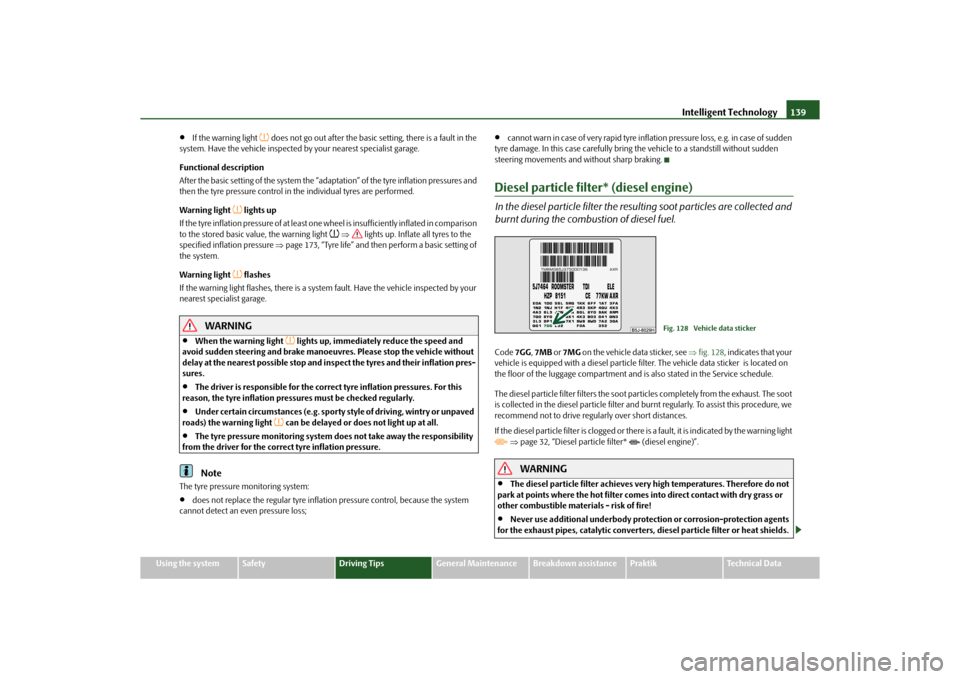
burnt during the combustion of diesel fuel.Code 7GG, 7MB or 7MG on the vehicle data sticker, see fig. 128 , indicates that your
vehicle is equipped with a diesel particle fi lter. The vehicle data sticker is located on
the floor of the luggage compartment and is also stated in the Service schedule.
The diesel particle filter filters the soot particles completely from the exhaust. The soot
is collected in the diesel particle filter and burnt regularly. To assist this procedure, we
recommend not to drive regu larly over short distances.
If the diesel particle filter is clogged or there is a fault, it is indicated by the warning light
page 32, “Diesel particle filter* (diesel engine)”.
WARNING
The diesel particle filter achieves very high temp eratures. Therefore do not
park at points where the hot filter comes into direct contact with dry grass or
other combustible materials - risk of fire!
Never use additional underbody protection or corrosion-protection agents
for the exhaust pipes, catalytic converters, diesel particle filter or heat shields.
Fig. 128 Vehicle data sticker
s16g.4.book Page 139 Wednesday, February 10, 2010 3:53 PM
Page 142 of 231

Driving and the Environment141
Using the system
Safety
Driving Tips
General Maintenance
Breakdown assistance
Praktik
Technical Data
Driving and the EnvironmentThe first 1 500 kilometres and then afterwardsA new engine
The engine has to be run in during the first 1 500 kilometres.Up to 1 000 kilometres– Do not drive faster than 3/4 of the maximum speed of the gear in use, that is 3/4 of
the maximum permissi ble engine speed.
– Do not use full throttle.
– Avoid high engine revolutions.
– Do not tow a trailer.From 1 000 up to 1 500 kilometres– Increase the power output of the engine gradually up to the full speed of the gear
engaged, that is up to the maxi mum permissible engine revolutions.
During the first operating hours the engine ha s higher internal friction than later until
all of the moving parts have harmonized. Th e driving style which you adopt during the
first approx.1 500 kilometres plays a decisive part in the success of running in your
vehicle.
You should not drive at unnecessarily high engine revolutions even after the
running-in period is complete . The maximum permissible en gine speed is marked by
the beginning of the red zone on the scale of the revolutions counter. Shift up into the
next higher gear on a vehi cle fitted with manual gear box before the red zone is
reached. During acceleration (depressing the accelerator) exceptionally high engine
speeds are automatically reduced, yet the engine is not protected against too high
engine speeds which are caused by incorrectly shifting down the gears resulting in a
sudden increase of the engine speeds above the permitted maximum revolutions
which can lead to engine damage.
For a vehicle fitted with a manual gearbox the converse situation also applies: Do not
drive at engine revolutions which are too low. Shift down as soon as the engine is no
longer running smoothly.
Caution
All the speed and engine revolution figures ap ply only when the engine is at its normal
operating temperature. Never rev up an engine which is cold, neither when the vehicle
is stationary nor when driving in individual gears.
For the sake of the environment
Not driving at unnecessari ly high engine revolutions and shifting to a higher gear as
early as possible are ways to minimise fuel consumption, operating noise levels as well
as protects the environment and contributes to a longer life and reliability of the
engine.New tyresNew tyres have to be “run in” since they do not offer optimal grip at first. You should
take account of this fact for the first 500 kilometres and drive particularly carefully.New brake padsAllow for the fact that new brake pads do no t achieve their full braking efficiency until
approximately 200 kilometres. New brake pads must be first “run in” before they
develop their optimal friction force. You ca n, however, compensate for this slightly
reduced braking force by increasing the pressure on the brake pedal.
This guideline also applies to any new brake pads installed at a future date.
During the running-in pe riod, you should avoid excessive stresses on the brakes. This
includes, for example, violent braking, part icularly from very high speeds, and also
when crossing mountain passes.
s16g.4.book Page 141 Wednesda y, February 10, 2010 3:53 PM
Page 144 of 231
Driving and the Environment143
Using the system
Safety
Driving Tips
General Maintenance
Breakdown assistance
Praktik
Technical Data
guidelines given in this chapter in order to
make best use of these characteristics and
to maintain their effectiveness.
Looking ahead when driving
A vehicle's highest fuel consumption occurs it accelerates.Avoid accelerating and braking unnecessarily. If you drive with forsight you will not
need to brake so often and will also then not have to accelerate so much. Let your
vehicle coast to a stop, for example, if this is possible, when you see that the next set of
traffic lights is at red.Shifting gears and saving energy
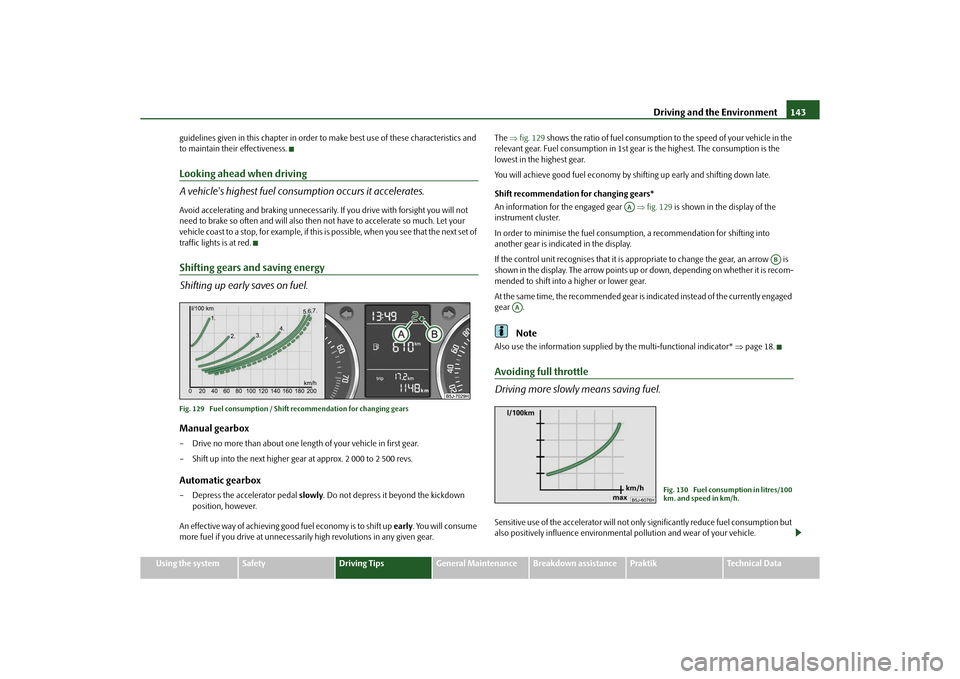
Shifting up early saves on fuel.Fig. 129 Fuel consumption / Shift recommendation for changing gearsManual gearbox– Drive no more than about one length of your vehicle in first gear.
– Shift up into the next higher gear at approx. 2 000 to 2 500 revs.Automatic gearbox– Depress the accelerator pedal slowly. Do not depress it beyond the kickdown
position, however.
An effective way of achieving good fuel economy is to shift up early. You will consume
more fuel if you drive at unnecessaril y high revolutions in any given gear. The
fig. 129 shows the ratio of fuel consumption to the speed of your vehicle in the
relevant gear. Fuel consumption in 1st gear is the highest. The consumption is the
lowest in the highest gear.
You will achieve good fuel economy by shif ting up early and shifting down late.
Shift recommendation for changing gears*
An information for the engaged gear fig. 129 is shown in the display of the
instrument cluster.
In order to minimise the fuel consumptio n, a recommendation for shifting into
another gear is indicated in the display.
If the control unit recognises that it is appropriate to change the gear, an arrow is
shown in the display. The arrow points up or down, depending on whether it is recom-
mended to shift into a higher or lower gear.
At the same time, the recommended gear is indicated instead of the currently engaged
gear .
Note
Also use the information supplied by the multi-functional indicator* page 18.Avoiding full throttle
Driving more slowly means saving fuel.Sensitive use of the accelerator will not only significantly reduce fuel consumption but
also positively influence environmenta l pollution and wear of your vehicle.
AA
AB
AA
Fig. 130 Fuel consumption in litres/100
km. and speed in km/h.
s16g.4.book Page 143 Wednesday, February 10, 2010 3:53 PM
Page 145 of 231
Driving and the Environment
144
You should avoid exploiting the top speed of your vehicle wherever possible. Fuel
consumption, pollutant emissions and vehicle noises increase disproportionally at
high speeds.
The page 143, fig. 130 shows the ratio of fuel consumption to the speed of your
vehicle. You will cut your fuel consumption by half if you only make use three-quarters
of the possible top speed of your vehicle.Reducing idling
Idling also costs fuel.It is worthwhile switching off the engine in a traffic jam or when waiting at a level
crossing or at traffic lights with a lengthy red phase. Even after just 30 - 40 seconds you
will have saved more fuel th an that is needed when you start the engine up again.
If an engine is only idling it takes much longer for it to reach its normal operating
temperature. Wear-and-tear and pollutant emis sions, though, are particularly high in
the warming-up phase. This is why you should drive off right after starting the engine.
Do avoid high engine revolu tions at this time, however.Regular servicing
A poorly tuned engine consumes an unnecessarily high amount of fuel.Having your vehicle serviced regularly at a specialist garge enables you to satisfy one
of the requirements for economical motoring even before you set off on your journey.
Keeping your vehicle properly serviced not on ly has a positive effect on the safety of
your vehicle and maintaining its value, but also saves on fuel.
A poorly tuned engine can result in a fu el consumption which is 10% higher than
normal.
The foreseen maintenance work should be undertaken exactly according to the
Service schedule by a specialist garage.
Also check the oil level after refueling. Oil consumption is dependent to a consider-
able extent on the load and speed of the en gine. Oil consumption could be as high as
0.5 litres/1 000 km depending on your style of driving.
It is quite normal that a new engine has a higher oil consumption at first, and reaches
its lowest level only after a certain running in time. It is therefore not possible to correctly assess the oil consumption of a ne
w vehicle until after you have driven about
5 000 km.
For the sake of the environment
You can achieve additional improvements in your fuel economy by using high-
lubricity oils.
Check the ground below your vehicle at regular intervals to detect any leakages in
good time. Please have your vehicle inspec ted by a specialist garge if you find any
stains caused by oil or other fluids on the floor.
Avoid driving short distances
Short distances result in an above-average high fuel consumption.– Avoid driving a distance of no more than 4 km if the engine is cold.
The engine and catalytic converter mu st first have reached their optimal operating
temperature in order to effectively reduce fuel consumption and pollutant emissions.
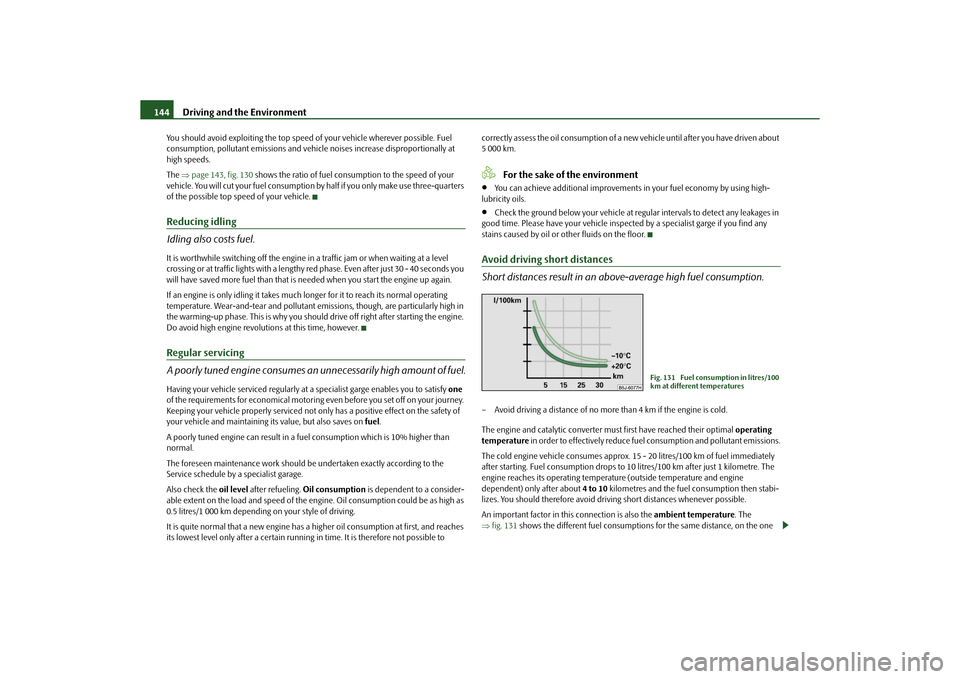
The cold engine vehicle cons umes approx. 15 - 20 litres/100 km of fuel immediately
after starting. Fuel co nsumption drops to 10 litres/100 km after just 1 kilometre. The
engine reaches its operating temperat ure (outside temperature and engine
dependent) only after about 4 to 10 kilometres and the fuel consumption then stabi-
lizes. You should therefore avoid driving short distances whenever possible.
An important factor in this connection is also the ambient temperature. The
fig. 131 shows the different fuel consumptions for the same distance, on the one
Fig. 131 Fuel consumption in litres/100
km at different temperatures
s16g.4.book Page 144 Wednesda y, February 10, 2010 3:53 PM
Page 147 of 231

Driving and the Environment
146
Reduction in the “vaporisation” of plastics.
Manufacture
Solvent-free cavity protection.
Solvent-free protection of the vehicle for transportation from the production plant
to the customer.
The use of solvent-free adhesives.
No CFCs used in the production process.
Without use of mercury.
Use of water-soluble paints.
Trade-in and recycling of old cars
Škoda Auto meets the requirements of the brand and its products regarding environ-
ment and ressource protection. All new Škoda vehicles can be utilized up to 95% and
always
12) be returned. In a lot of countries sufficient trade-in networks have been
created, where you can trade-in your vehicle. After you trade-in your vehicle, you will
receive a confirmation stating the recycling in accordance with environmental regula-
tions.
Vehicles with special built-on types
Technical documents regarding changes carried out on the vehicle must be kept by the
vehicle user, in order to hand over later to the old car user. This ensures the recycling
in accordance with en vironmental regulations.
Motoring abroadGeneral
Other circumstances may exist abroad.It is also possible, in certai n countries, that the Škoda Service Partner network is limited
or has not been established yet. This is the reason why obtaining certain spare parts
may be somewhat complicated and specialist garage personnel may only be able to
make limited repairs. Škoda Auto in the Czech Republic and relevant importers are happy to provide information about technical
aspects of the vehicle, required mainte-
nance work and possibilities for getting repairs done.
Unleaded petrolA vehicle fitted with a petrol engine must always be refuelled with unleaded petrol
page 142. The automobile associations can provide you with information regarding
the locations of filling stations which offer unleaded petrol.HeadlightsThe low beam of your headligh ts is set asymmetrically. It illuminates the side of the
road on which you are driving to a greater ex tent. If you drive abroad on the other side
of the road, you will da zzle oncoming traffic.
Halogen projector headlights
The adaptation of the headlights (valid for vehicles which are designed for driving on
the left and on the right) must be performe d by switching over a bezel by a specialist
garage.
Halogen headlight
When using Halogen headlights, it is necessary to stick a sticker over a certain part of
the headlights in order to prevent the dazzling of oncoming traffic.
You can purchase headlight stickers from the range of the Škoda original parts.
Note
You can obtain further information regardin g masking over or converting the head-
lights from your specialist garage.Avoiding damage to your vehicleWhen driving on poor roads and lanes or when driving over kerbstones, steep ramps
etc., you must pay particular attention to ensuring that any low-slung parts of the
vehicle, such as spoiler and exhaust, do not touch the ground and get damaged.
12)Subject to fulfilment of the national legal requirements.s16g.4.book Page 146 Wednesday, February 10, 2010 3:53 PM
Page 149 of 231
Towing a trailer
148
Towing a trailerTo w i n g a t r a i l e rTechnical requirements
The towing device must satisfy certain technical requirements.Your vehicle is designed primarily for tr ansporting persons and luggage. It can,
however, also be used for towing a traile r - provided certain technical equipment is
fitted.
If your vehicle has been equipped with a towing device from Škoda Original Accesso-
ries, then the towing device satisfies all technical and legal requirements.
Your vehicle is fitted with a 13-pin power socket for the electrical connection between
the vehicle and trailer. If the tr ailer which you wish to tow has a 7-pin connector, you
can use a suitable adapter
13) from Škoda original accessories.
This work must be carried out in accordance with the manufacturer's specifications if
a towing device is retrofitted.
Specialist garages are familiar with details re lating to retrofitting a towing device and
for any necessary modifications to the cooling system.
WARNING
We recommend that you have the towing device from Škoda original accesso-
ries installed by a specialist garage. He is familiar with all the relevant details
relating to retrofitting such equipment. There is a risk of an accident if the
towing device is not properly fitted!General Maintenance
There are a number of points to pay attention to when towing a trailer.Trailer load
The permissible trailer load must on no account be exceeded. You can negotiate appropriately steeper inclin
es and descents if you do not make full
use of the permissible trailer load.
The trailer loads specified only apply for altitudes up to 1 000 metres above mean sea
level. On petrol engines without forced indu ction, the engine power output drops with
increasing height due to a lowering of air pr essure and thus the ability to climb, this
means that the trailer load must be reduced by 10% for every further increase of 1 000
metres in height above sea le vel. The towed weight is the weight of the (laden) vehicle
and the (laden) trailer together. One should ta ke this into account before driving up to
higher altitudes. Petrol engines with forced induction use an air pressure correction
method, so that their power output does not depend on the height above sea level.
The trailer and drawbar load information on the type plate of the towing device
are merely test data for the towing device The data relating to your vehicle, which
is often less than this test data, can be found in your vehicle registration docu-
ments.
Distribution of the load
Distribute the load in the trailer in such a way that any heavy items are located as close
as possible to the axle. Secure th e items to prevent them slipping.
Tyre pressure
Correct the tyre inflation pressure on yo ur vehicle for that of “fully laden”, page 173.
The inflation pressure of the tyres fitted to the trailer adjust in accordance with the
manufacturer's recommendation.
Exterior mirrors
You have to have additional ex terior mirrors fitted if you are not able to see the traffic
behind the trailer with the standard rear-view mirrors. Both exterior mirrors should be
attached to folding arms. Adjust the mirrors so that they provide you with an adequate
field of view to the rear.
Headlights
Before starting off with a hitched trailer, al so check the setting of the headlights. Alter
the setting as necessary with the aid of the headlight beam adjuster page 49.13)In some countries the adapter is supplied with the towing device.s16g.4.book Page 148 Wednesda y, February 10, 2010 3:53 PM
Page 150 of 231
Towing a trailer149
Using the system
Safety
Driving Tips
General Maintenance
Breakdown assistance
Praktik
Technical Data
Detachable ball head
The ball rod is detachable on vehicles with towing devi
ce and suppliable from Škoda
original accessories. It is stowed together with separate fitting instructions in the spare
wheel well in the luggage compartment of the vehicle.
Note
We recommend that you also have your vehicle inspected between service inter-
vals if you tow a trailer frequently.
The handbrake on the towing vehicle must be put on when coupling and decou-
pling the trailer.
Driving Tips
Particular caution is required when towing a trailer.– Do not, as far as possible, drive with your vehicle unladen and the trailer laden.
– Do not make full use of the legal maximum speeds. This applies in particular to downhill sections.
– Apply the brakes in good time.
– Keep a check on the coolant temperature gauge if the outside temperature is high.
Distribution of weight
The distribution of the weight is very poor if your vehicle is unladen and the trailer is
laden. Maintain a particularly low speed if you cannot avoid driving with this combina-
tion.
Driving speed
Do not drive faster than 80 km/h for safety reasons. This also applies for countries in
which higher speeds are allowed.
The fact that the driving stability of the vehicle + trailer combination reduces with
increasing speed means that the legally allo wed speed should not be used when there
are unfavourable road, weather or wind cond itions, particularly near accident black
spots. You must always reduce your speed immediat
ely as soon as you detect even just the
slightest swaying of the trailer. On no account attempt to stop the trailer from
“swaying” by accelerating.
Apply the brakes in good time! If the trailer is fitted with a trailer brake, apply the
brakes gently at first and then brake firmly. This will avoid brake jolts resulting from the
trailer wheels locking. Shift down gears in good time before negotiating a downhill
section to allow the engine to also act as a brake.
Engine overheating
Please keep a check on the coolant temperature gauge if you have to negotiate a
lengthy slope in a low gear at a high engi ne speed when the outside temperature is
very high page 16.
If the needle of the coolant temperature gauge moves into the right-hand area or even
the red area of the scale, reduce your speed immediately. Stop and switch off the
engine if the warning light
in the instrument cluster begins flashing. Wait a few
minutes and check the level of coolant in the coolant expansion bottle page 166,
“Inspecting the coolant level”.
Please refer to the following guidelines page 28, “Coolant temperature/ Coolant
quantity ”.
The coolant temperature can be reduced by switching on the heating.
Any increase in the cooling effect of the coolant fan through shifting down a gear and
increasing the engine speed is not possible since the fan speed is independent of the
engine speed. One should also not drop a gear for this reason when towing a trailer as
long as the engine can manage th e slope without any drop in speed.
s16g.4.book Page 149 Wednesda y, February 10, 2010 3:53 PM
Page 153 of 231

Taking care of your vehicle and cleaning the vehicle
152
There are no particular points to note be fore washing your vehicle in an automatic
vehicle wash system other than the usua l precautionary measures (closing the
windows, unscrewing the aerial, etc.).
If you have any particular attached parts fitted to your car - such as spoiler, roof rack
system, two-way radio aerial - it is best to first of all consult the operator of the car
wash plant.
It is important to degrease the lips of the windscreen wiper rubbers after passing
through the automatic vehicle wash system.Washing vehicle by handIt is important to first soften the dirt with plenty of water and rinse it off as thoroughly
as possible before washin g your vehicle by hand.
One should then clean the vehicle using a soft washing sponge, washing glove or a
washing brush and only slight pressure. Work from the top to the bottom - beginning
with the roof. Only place slight pressure on the vehicle paintwork during cleaning Only
use a car shampoo for stubborn dirt.
Wash out the sponge or washing glove thoroughly at short intervals.
Clean wheels, door sills and similar parts last. Use a second sponge for such areas.
Rinse off the vehicle well after giving it a wash and dry it off using a chamois leather.
WARNING
The ignition should always be switched off when you wash your vehicle -
risk of accident!
Protect your hands and arms from sharp-edged metal parts when you are
cleaning the underfloor, the inside of the wheel housings or the wheel trims -
risk of cuts.Caution
Do not wash your vehicle in bright sunlight - risk of paint damage.
Ensure that the jet of water is not aimed di rectly at the locking cylinders or at the
door and panel joints if you spray your vehi cle in winter down with a hose - risk of
freezing.
Do not use any insect sponges, rough kitc hen sponges or similar cleaning products
- risk of damage to the surface of paintwork.For the sake of the environment
Only wash your vehicle at wa shing bays specifically reserved for this purpose. This
ensures that no water which may be contaminated by oil flows into the sewage system.
It is not even permitted to wash your vehicl e in certain areas except at such specific
washing bays.Washing with a high-pressure cleanerWhen you wash your vehicle with a high-press ure cleaner, it is essential to comply with
the instructions for use of the cleaning equi pment. This applies in particular to the
pressure used and to the spraying distance . Maintain a sufficiently large distance to
soft materials such as rubber hoses or insulation material.
On no account use circular spray nozzles or so-called dirt cutters.
WARNING
It is particularly important that you do not clean tyres with circular spray jets.
Damage may occur even at a relatively la rge spraying distance and if sprayed
only for a short time.
Caution
The water containing wax must be no hotter than 60°C, otherwise the vehicle can be
damaged.Wax treatmentGood wax treatment is an effective way of protecting the paintwork from harmful envi-
ronmental influences and minor mechanical damage.
The vehicle must be treated with a high-quali ty hard wax polish at the latest, when no
more drops form on the clean paintwork.
s16g.4.book Page 152 Wednesda y, February 10, 2010 3:53 PM
Page 154 of 231

Taking care of your vehicle and cleaning the vehicle153
Using the system
Safety
Driving Tips
General Maintenance
Breakdown assistance
Praktik
Technical Data
A new layer of a high-quality
hard wax polish can be applied to the clean bodywork
after it has dried thoroughly. Even if you use a wax preserver regularly we still recom-
mend that you treat the paintwork of the ve hicle at least twice a year with hard wax.
Caution
Never apply wax to the windows.PolishingPolishing is only necessary if the paintwork of your vehicle has become unattractive
and if it is no longer possible to achieve a gloss with wax preservers.
You must treat the paintwork with a wax pr eserver if the polish you use does not
contain any preserving elements page 152, “Wax treatment”.
We recommend using a preserva tive from Škoda genuine accessories offered by your
Škoda dealer.
Caution
You must not treat mat painted parts or plas tic with polishing products or hard wax.
Do not polish the paintwork of the vehicle in a dusty environment, otherwise the
paintwork can be scratched.
Chrome partsFirst clean the chrome parts with a damp clot ch and then polish them with a soft, dry
cloth. If it does not prove to be adequate, use a chrome care product from Škoda orig-
inal accessories.
Caution
Do not polish the chrome parts in a du sty environment, otherwise they can be
scratched.
Paint damageSlight damage to paintwork such as scratches, scuffs or traces of chip damage must be
treated immediately before any corrosion can result. You can of course have this work
carried out by a specialist garage.
Specialist garages have a range of matching touch-up pens or spray cans available in
the colour of your vehicle.
The paint number of the original paintwork of your vehicle is indicated on the vehicle
data sticker page 205.
Any corrosion which has already have formed must be removed thoroughly. Apply a
corrosion protection primer and then the paint to the affected point. You can of
course have this work carried out by a specialist garage.Plastic partsExternal plastic parts are cleaned by normal washing. Plastic parts and synthetic
leather can also be treated with special solvent-free plastic cleaning agents if a
damp cloth is not sufficient. Paint care pr oducts are not suitable for plastic parts.
Caution
Solvent-free cleaners attack the material and can damage it.WindowsOnly use a plastic ice scraper for removing snow and ice from the windows and
mirrors. You should not move the ice scraper forward and backward but in one direc-
tion on the window which you are cleaning in order to avoid any damage to the surface
of the glass.
You can best remove residues of rubber, oil, grease, wax or silicone by using a special
window cleaner or a special silicone remover.
You should also clean the windows regularly from the inside.
Do not use window leathers which you have us ed to polish the vehicle body to dry off
the windows. Residues of preservatives in the window leather can dirty the window
and reduce visibility.
s16g.4.book Page 153 Wednesda y, February 10, 2010 3:53 PM