light SKODA ROOMSTER 2010 1.G Manual PDF
[x] Cancel search | Manufacturer: SKODA, Model Year: 2010, Model line: ROOMSTER, Model: SKODA ROOMSTER 2010 1.GPages: 231, PDF Size: 12.91 MB
Page 119 of 231

Airbag system
118
Airbag systemDescription of the airbag systemGeneral information on the airbag systemThe front airbag system is complementary to the three-point seat belts and offers addi-
tional protection for the head and chest area of the driver and passenger in the event
of a frontal collision.
In the event of a side collision, the side airb ags reduce the risk of injury to the occu-
pants to the part of their body facing the side of the accident.
The airbag system is only functional af ter the ignition has been switched on.
The operational readiness of the airbag syst em is monitored electronically. The airbag
indicator light comes on for a few seconds each time the ignition is switched on.
The airbag system (according to vehicle equipment) consists of:
an electronic control unit;
the front airbags for the driver and front passenger page 119;
the side airbags page 121;
head airbags page 123;
an airbag indicator light in the instrument cluster page 32;
a front passenger airbag switch* page 125;
an indicator light for a switched off fron t seat passenger airbag* in the middle of
the dash panel page 125.
A fault in the airbag system exists if:
the airbag indicator light does not light up when the ignition is switched on;
the airbag indicator light does not go out after about 3 seconds after the ignition is
switched on;
the airbag indicator light goes out and come s on again after the ignition is switched
on;
the airbag indicator light comes on or flickers when driving;
an airbag indicator light showing a switched-off front passenger airbag* in the
middle of the dash panel flashes.
WARNING
To enable the occupants of a vehicle to be protected with the greatest
possible effect when the airbag is deployed, the front seats must be
page 110, “Correct seated position” correctly adjusted to match the body
size of the occupant.
If you do not fasten the seat belts when driving, lean too far forward or
adopt an incorrect seated position, you are exposing yourself to increased risk
of injury in the event of an accident.
Have the airbag system checked immediat ely by a specialist garage if a fault
exists. Otherwise, there is a risk of the airbag not being activated in the event of
an accident.
No modifications of any kind may be made to parts of the airbag system.
It is prohibited to manipulate individual parts of the airbag system as this
might result in the airbag being deployed.
The protective function of the airbag system is sufficient for only one acci-
dent. The airbag system must then be re placed if the airbag has been deployed.
The airbag system needs no maintenance during its working life.
If you sell your car, please hand over the complete vehicle documentation to
the new owener. Please note that the documents relating to the possibility of
deactivating the front passenger airbag are also part of the vehicle documents!
If the vehicle or individual parts of the airbag system are scrapped, it is
essential to observe the relevant safety precautions. Specialist garages are
familiar with these regulations.
When disposing of vehicle or parts of the airbag system, it is important to
comply with the national legal requirements.
s16g.4.book Page 118 Wednesda y, February 10, 2010 3:53 PM
Page 120 of 231
Airbag system119
Using the system
Safety
Driving Tips
General Maintenance
Breakdown assistance
Praktik
Technical Data
When are the airbags deployed?The airbag system is designed in such a way that the driver and the front passenger
airbag* are deployed in the event of a frontal collision of major severity.
In the case of a violent side crash , the side airbag* in the front seat and the head
airbag* on the side on which the collision occurs are deployed.
It is also possible under certain special accident situations that the front as well as the
side airbags and head airbags* are deployed at the same time.
The airbags are not deployed in the case of minor frontal and side collisions, rear-end
collisions, tilting of the ve hicle and vehicle rollover.
Deployment factors
It is not possible to state globally which deployment conditions apply to the airbag
system in every situation as the circumstances which exist in the case of accidents vary
greatly. An important role in this case, for ex ample, is played by factors such as the type
of object against which the vehicle impacts (h ard, soft), the angle of impact, the vehicle
speed etc.
A decisive factor for the deployment of the airbags is the deceleration which occurs
during a collision. The control unit analyses the nature of the collision and activates the
relevant restraint system. If the vehicle deceleration which occurs and is measured
during the collision remains below the prescribed reference values specified in the
control unit, the airbags are no t deployed although the vehicle may well suffer severe
damage to the bodywork as a consequence of the accident.
The airbags are not deployed if:
ignition is switched off;
a minor frontal collision;
a minor side collision;
a rear-end collision;
Rollover of the vehicle.Note
A grey white or red, non harmful gas is released when airbag is inflated. This is
perfectly normal and is not an indi cation of a fire in the vehicle.
In the event of an accident in which the airbags are deployed:
the interior lighting comes on (if the swit ch for the interior light is in the door
contact position),
the hazard warning li ght is switched on;
All the doors are unlocked.
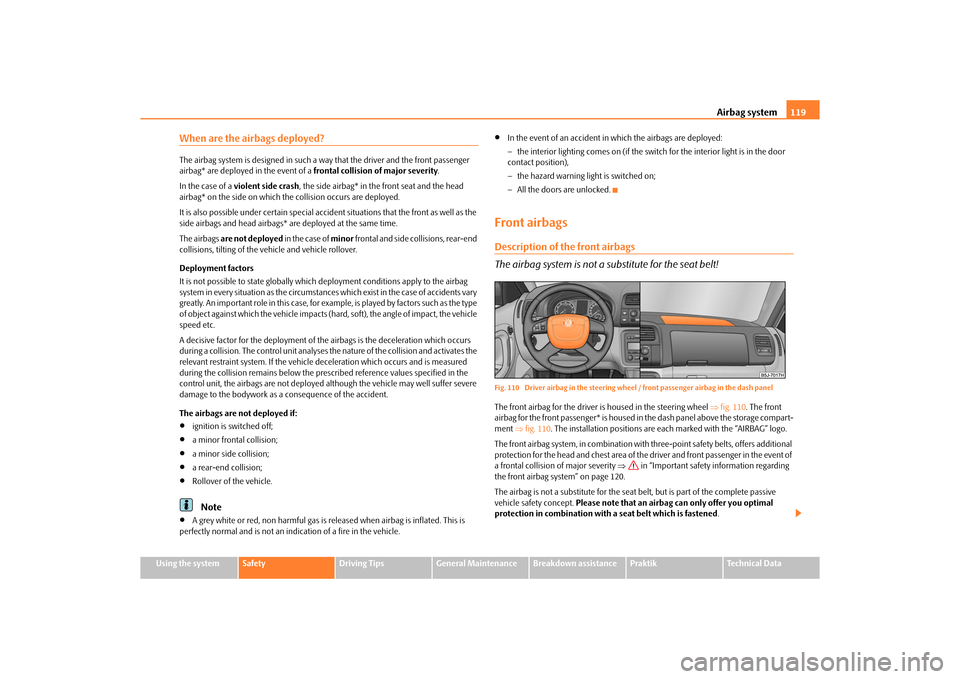
Front airbagsDescription of the front airbags
The airbag system is not a su bstitute for the seat belt!Fig. 110 Driver airbag in the steering wheel / front passenger airbag in the dash panelThe front airbag for the driver is housed in the steering wheel fig. 110 . The front
airbag for the front passenger* is housed in the dash panel above the storage compart-
ment fig. 110 . The installation positi ons are each marked with the “AIRBAG” logo.
The front airbag system, in combination with three-point safety belts, offers additional
protection for the head and chest area of the driver and front passenger in the event of
a frontal collision of major severity in “Important safety information regarding
the front airbag system” on page 120.
The airbag is not a substitute for the seat belt, but is part of the complete passive
vehicle safety concept. Please note that an airbag can only offer you optimal
protection in combination with a seat belt which is fastened .
s16g.4.book Page 119 Wednesday, February 10, 2010 3:53 PM
Page 123 of 231
Airbag system
122
Function of the side airbags
Risk of injury to the upper part of the body is reduced by fully inflated
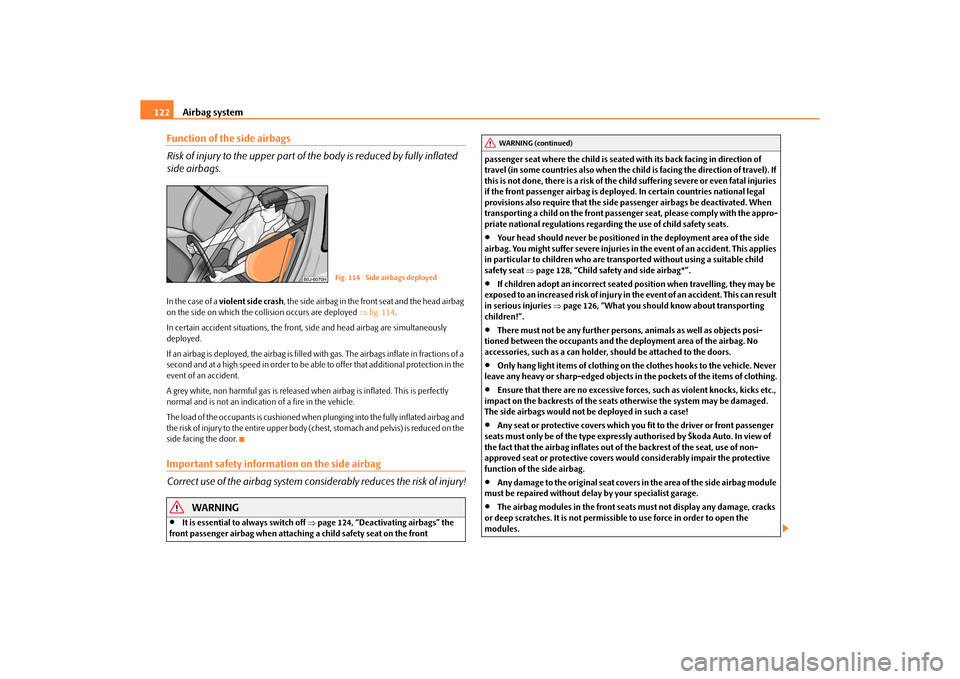
side airbags.In the case of a violent side crash , the side airbag in the front seat and the head airbag
on the side on which the collision occurs are deployed fig. 114 .
In certain accident situations, the front, side and head airbag are simultaneously
deployed.
If an airbag is deployed, the airbag is filled with gas. The airbags inflate in fractions of a
second and at a high speed in order to be able to offer that additional protection in the
event of an accident.
A grey white, non harmful gas is released when airbag is inflated. This is perfectly
normal and is not an indicati on of a fire in the vehicle.
The load of the occupants is cushioned when plunging into the fully inflated airbag and
the risk of injury to the entire upper body (chest, stomach and pelvis) is reduced on the
side facing the door.Important safety information on the side airbag
Correct use of the airbag system cons iderably reduces the risk of injury!
WARNING
It is essential to always switch off page 124, “Deactivating airbags” the
front passenger airbag when attachin g a child safety seat on the front passenger seat where the child is seated
with its back facing in direction of
travel (in some countries also when the chil d is facing the direction of travel). If
this is not done, there is a risk of the ch ild suffering severe or even fatal injuries
if the front passenger airbag is deploy ed. In certain countries national legal
provisions also require that the side passenger airbags be deactivated. When
transporting a child on the front passenger seat, please comply with the appro-
priate national regulations regarding the use of child safety seats.
Your head should never be positioned in the deployment area of the side
airbag. You might suffer severe injuries in the event of an accident. This applies
in particular to children who are transported without using a suitable child
safety seat page 128, “Child safety and side airbag*”.
If children adopt an incorrect seated position when travelling, they may be
exposed to an increased risk of injury in the event of an accident. This can result
in serious injuries page 126, “What you should know about transporting
children!”.
There must not be any further persons, animals as well as objects posi-
tioned between the occupants and the deployment area of the airbag. No
accessories, such as a can holder, should be attached to the doors.
Only hang light items of clothing on the clothes hooks to the vehicle. Never
leave any heavy or sharp-ed ged objects in the pockets of the items of clothing.
Ensure that there are no excessive forc es, such as violent knocks, kicks etc.,
impact on the backrests of the seats otherwise the system may be damaged.
The side airbags would not be deployed in such a case!
Any seat or protective covers which you fit to the driver or front passenger
seats must only be of the type expressly authorised by Škoda Auto. In view of
the fact that the airbag inflates out of the backrest of the seat, use of non-
approved seat or protective covers would considerably impair the protective
function of the side airbag.
Any damage to the original seat covers in the area of the side airbag module
must be repaired without delay by your specialist garage.
The airbag modules in the front seats must not display any damage, cracks
or deep scratches. It is not permissible to use force in order to open the
modules.
Fig. 114 Side airbags deployed
WARNING (continued)
s16g.4.book Page 122 Wednesda y, February 10, 2010 3:53 PM
Page 125 of 231
Airbag system
124
Important safety information on the head airbag
Correct use of the airbag system cons iderably reduces the risk of injury!
WARNING
It is essential to always switch off page 124 the front passenger airbag
when attaching a child safety seat on th e front passenger seat where the child is
seated with its back facing in direction of travel (in some countries also when
the child is facing the direction of travel). If this is not done, there is a risk of the
child suffering severe or even fatal inju ries if the front passenger airbag is
deployed. In certain countries national legal provisions also require that the
side or head passenger airbags be deac tivated. When transporting a child on
the front passenger seat, pl ease comply with the appropriate national regula-
tions regarding the use of child safety seats.
There must not be any objects in the deployment area of the head airbags
which might prevent the airbag s from inflating properly.
Only hang light items of clothing on the clothes hooks to the vehicle. Never
leave any heavy or sharp-edged objects in the pockets of the items of clothing.
In addition, it is not permitted to use clothes hangers for hanging up items of
clothing.
There must not be any other persons (e .g. children) or animals between the
car occupant and the deployment area of the head airbag. In addition, none of
the occupants should lean their head out of the window when driving, or
extend their arms and hands out of the window.
The sun visors must not be swivelled to the side windows into the deploy-
ment area of the head airbags if any ob jects, such as ball-point pens etc. are
attached to them. This might result in injuries to the occupants if the head
airbag is deployed.
Installing impermissible accessories in the area of the head airbags may
considerably impair the protection offered by the head airbag in the event of it
being deployed. When the deployed head airbag is inflated, parts of the acces-
sories fitted may in certain circumstances be thrown into the interior of the car
and cause injuries to the occupants page 179.
Any work on the head airbag system including installing and removing
system components because of other repair work (e.g. removing headliner)
must only be carried out by a specialist garage.
Deactivating airbagsDeactivating airbags
If any airbags have been deactivated, switch them on again as soon as
possible so that they are able to ag ain provide their proper protection.There is the technical means installed within your vehicle to switch off the front, side*
or head* airbag (take out of commission).
This is why you should have the deactivation of the airbags carried out by a specialist
garage.
On vehicles equipped with the switch for deactivation of the airbags, you can deacti-
vate the front passenger airbag by means of this switch page 125.
Deactivation of airbags is envisaged only for particular instances, such as if:
Yo u m u s t i n exceptional cases use a child seat on the front passenger seat where
the child is seated with its back to the direction of travel (in some countries this must
be in the direction of travel due to other legal regulations applying) page 126,
“Important safety information regarding the use of child safety seats”;
you are not able to maintain the distance of at least 25 cm between middle of
steering wheel and chest, despite the driver seat being correctly adjusted;
special attachments are required in the area of the steering wheel because of a
physical disability;
you have installed other seats (e.g. orthopaedic seats without side airbags).
Monitoring the airbag system
The functionality of the airbag system is al so monitored electronically when one airbag
has been switched off.
If the airbag was switched off using diagnostic equipment:
The airbag indicator light lights up for 3 seconds each time the ignition is switched
on and then flashes after that for about 12 seconds.
If the airbag was switched off using the airbag switch* on the side of the dash
panel:
the airbag indicator light in the instrume nt cluster comes on for about 3 seconds
each time the igniti on is switched on;
s16g.4.book Page 124 Wednesda y, February 10, 2010 3:53 PM
Page 126 of 231
Airbag system125
Using the system
Safety
Driving Tips
General Maintenance
Breakdown assistance
Praktik
Technical Data
switching off the airbag is indicated in the middle of the dash panel on the right by
the lighting up of the indicator light in the display
fig. 117 .
Note
A specialist garage will be able to advise you whether national legislation in your
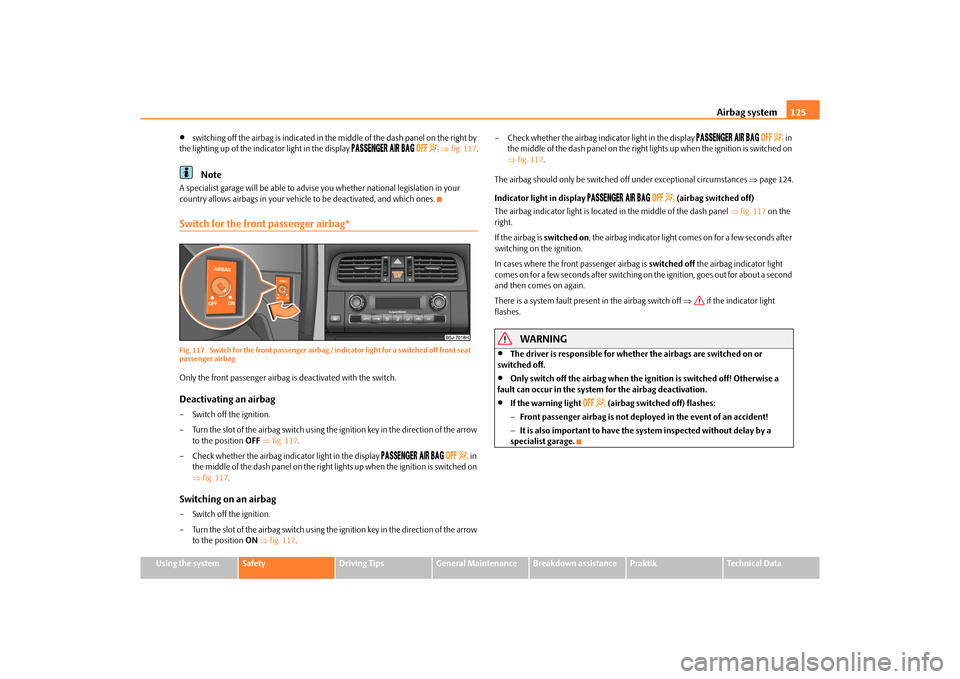
country allows airbags in your vehicl e to be deactivated, and which ones.Switch for the front passenger airbag*Fig. 117 Switch for the front passenger airbag / indicator light for a switched off front seat
passenger airbagOnly the front passenger airbag is deactivated with the switch.Deactivating an airbag– Switch off the ignition.
– Turn the slot of the airbag switch using the ignition key in the direction of the arrow
to the position OFF fig. 117 .
– Check whether the airbag indicator light in the display
in
the middle of the dash panel on the right lights up when the ignition is switched on
fig. 117 .
Switching on an airbag– Switch off the ignition.
– Turn the slot of the airbag switch using the ignition key in the direction of the arrow
to the position ON fig. 117 . – Check whether the airbag indicator light in the display
in
the middle of the dash panel on the right lights up when the ignition is switched on
fig. 117 .
The airbag should only be switched off under exceptional circumstances page 124.
Indicator light in display
(airbag switched off)
The airbag indicator light is located in the middle of the dash panel fig. 117 on the
right.
If the airbag is switched on, the airbag indicator light comes on for a few seconds after
switching on the ignition.
In cases where the front passenger airbag is switched off the airbag indicator light
comes on for a few seconds after switching on the ignition, goes out for about a second
and then comes on again.
There is a system fault present in the airbag switch off if the indicator light
flashes.
WARNING
The driver is responsible for whethe r the airbags are switched on or
switched off.
Only switch off the airbag when the ignition is switched off! Otherwise a
fault can occur in the system for the airbag deactivation.
If the warning light
(airbag switched off) flashes:
Front passenger airbag is not deployed in the event of an accident!
It is also important to have the system inspected without delay by a
specialist garage.
s16g.4.book Page 125 Wednesda y, February 10, 2010 3:53 PM
Page 134 of 231
Intelligent Technology133
Using the system
Safety
Driving Tips
General Maintenance
Breakdown assistance
Praktik
Technical Data
Driving TipsIntelligent TechnologyElectronic stability programme (ESP)*GeneralGeneral
The ESP aids you in maintaining control of your vehicle in situations in which the
vehicle is driving at its dynamic limits, such as entering a curve fast. The risk of skidding
is reduced and your vehicle thus offers greater driving stability depending on the
conditions of the road surface. The system operates at all speeds.
The following systems are integrated into the electronic stability programme:
Electronic Differential Lock (EDL);
Traction control system (TCS);
Antilock brake system (ABS);
Brake Assist;
Uphill Start Assist
Operating principle
The ESP switches on automati cally when the engine is started and then conducts a
self-test. The ESP control unit processes data from the individual systems. It also proc-
esses additional measurement data which are supplied by highly sensitive sensors: the
rotational velocity of the vehicle about its ve rtical axis, the lateral acceleration of the
vehicle, the braking pressure and the steering angle.
The direction which the driver wishes to take is determined based on the steering
angle and the speed of the vehicle and is co nstantly compared with the actual behav-
iour of the vehicle. If differences exist, such as the vehicle beginning to skid, the ESP will
automatically brake the appropriate wheel.
The car is stabilised again by the forces wh ich take effect when the wheel is braked.
Intervention into the brake system takes place primarily on the outer front wheel of a
vehicle which tends to oversteer (tendency fo r the rear of the vehicle to break away) while occurs this is on the inner rear wh
eel of a vehicle which tends to understeer
(tendency to shift out of the curve). This braking control cycle is accompanied by
noises.
If the ESP helps to stabilise the vehicle (f or example when applying and releasing a
braking force to an individual wheel), then the indicator light
flashes quickly.
The ESP system cannot be switched off, only the TCS system can be switched off by
pressing the button page 134, fig. 126. The warning light
page 30 lights up if
the TCS system is switched off.
The warning light
lights up permanently if there is a fault in the ESP system.
The fact that the ESP system operates together with the ABS means that the ESP
warning light will also come on if the ABS system is not operating properly.
If the warning light comes on immediately after starting the engine, the ESP system
can be switched off for technical reasons. In this case, the ESP system can be switched
on again by switching the igni tion on and off. If the warning light goes out, the ESP
system is fully functional again.
WARNING
It is also not possible for the ESP to overcome the physical limits of the vehicle.
Even if a vehicle fitted with ESP you should still always adapt your style of
driving to the condition of the road surfac e and the traffic situation. This partic-
ularly applies when driving on slippery and wet roads. The increased safety
offered must not tempt you to take greater risks than otherwise - risk of an acci-
dent!
Note
All four wheels must be fitted with the same tyres in order to achieve problem-free
operation of the ESP. Differing rolling circum ferences of the tyres can lead to an unde-
sirable reduction in the engine output.
s16g.4.book Page 133 Wednesda y, February 10, 2010 3:53 PM
Page 135 of 231
Intelligent Technology
134
Changes to vehicle (e.g. on engine, on th e brakes, on chassis or another combina-
tion of tyres and wheels) can influence the function of the ESP page 179, “Accesso-
ries, changes and replacement of parts”.
Traction control system (TCS)*
The traction control system prevents the driven wheels from spinning
when accelerating.General
The TCS makes it much easier, and sometimes at all possible, to start off, accelerate and
climb a steep hill when the conditions of the road surface are unfavourable.
Operating principle
The TCS switches on automatically when th e engine is started and then conducts a
self-test. The system monitors the speeds of the driven wheels with the aid of the ABS
sensors. If the wheels are spinning, the force transmitted to the road surface is auto-
matically adapted by reducing the engine speed. The system operates at all speeds.
The TCS operates in combination with the ABS page 136, “Antilock brake system
(ABS)”. The TCS will not function if a fault exists in the ABS system.
Switching off
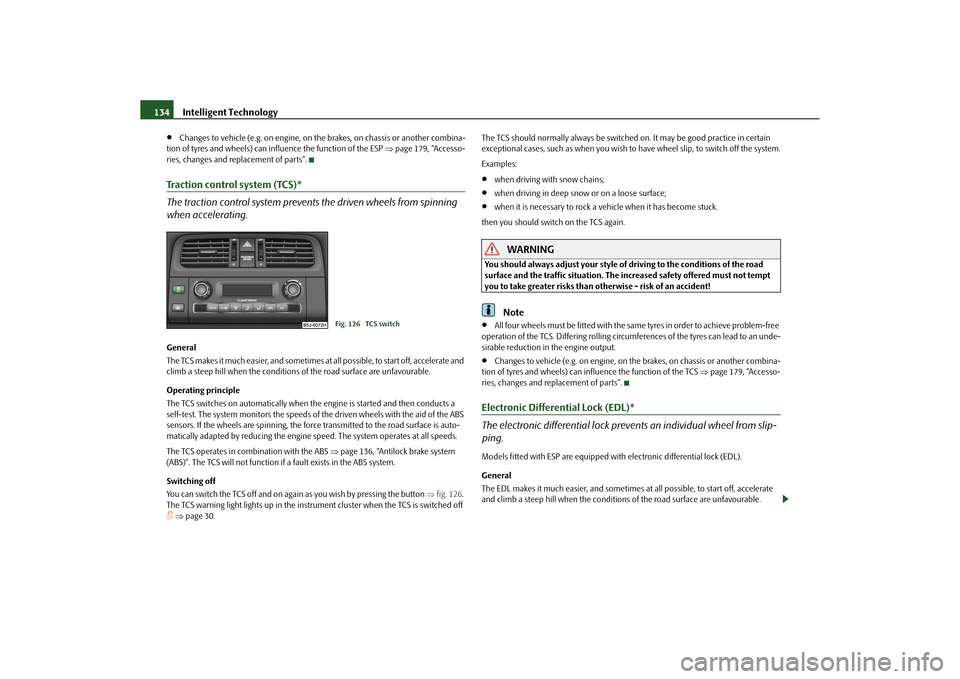
You can switch the TCS off and on again as you wish by pressing the button fig. 126 .
The TCS warning light lights up in the instru ment cluster when the TCS is switched off page 30. The TCS should normally always
be switched on. It may be good practice in certain
exceptional cases, such as when you wish to have wheel slip, to switch off the system.
Examples:
when driving with snow chains;
when driving in deep snow or on a loose surface;
when it is necessary to rock a vehicle when it has become stuck.
then you should switch on the TCS again.
WARNING
You should always adjust your style of driving to the conditions of the road
surface and the traffic situation. The increased safety offered must not tempt
you to take greater risks than otherwise - risk of an accident!
Note
All four wheels must be fitted with the same tyres in order to achieve problem-free
operation of the TCS. Differing rolling circum ferences of the tyres can lead to an unde-
sirable reduction in the engine output.
Changes to vehicle (e.g. on engine, on the brakes, on chassis or another combina-
tion of tyres and wheels) can influence the function of the TCS page 179, “Accesso-
ries, changes and replacement of parts”.
Electronic Differential Lock (EDL)*
The electronic differential lock prev ents an individual wheel from slip-
ping.Models fitted with ESP are equipped with electronic differential lock (EDL).
General
The EDL makes it much easier, and sometimes at all possible, to st art off, accelerate
and climb a steep hill when the conditions of the road surface are unfavourable.
Fig. 126 TCS switch
s16g.4.book Page 134 Wednesda y, February 10, 2010 3:53 PM
Page 136 of 231
Intelligent Technology135
Using the system
Safety
Driving Tips
General Maintenance
Breakdown assistance
Praktik
Technical Data
Operating principle
The EDL is activated automaticall
y, that is without any action on the part of the driver.
It monitors the speeds of the driven wheels with the aid of the ABS sensors. Should
only one drive wheel begin spinning on a slippery surface there will be an appreciable
difference in the speed of the driven wheels. The EDL function brakes the slipping
wheel and the differential transmits a greater driving force to the other driven wheel.
This control process is also accompanied by noises.
Overheating of the brakes
The EDL switches off automatically if unusually severe stresses exist in order to avoid
excessive heat generation in the disc brake on the wheel which is being braked. The
vehicle can continue to be driven and has the same characteristics as a vehicle not
fitted with EDL.
The EDL switches on again automatically as soon as the brake has cooled down.
WARNING
Carefully depress the accelerator when accelerating on uniformly slippery
road surfaces, such as ice and snow. The driven wheels might still spin despite
the EDL and affect the stability of the vehicle - risk of an accident!
You should always adapt your style of driving to the condition of road
surface and to the traffic situation even when your vehicle is fitted with EDL.
The increased safety offered must not tempt you to take greater risks than
otherwise - risk of an accident!Note
If the ABS or TCS or ESP warning light comes on, this may also indicate a fault in the
EDL. Please have the vehicle inspected as soon as possible by a specialist garage.
Changes to vehicle (e.g. on engine, on th e brakes, on chassis or another combina-
tion of tyres and wheels) can in fluence the function of the EDL page 179, “Accesso-
ries, changes and replacement of parts”.
BrakesWhat has a negative effect on braking efficiency?Wear-and-tear
Wear-and-tear to the brake pa ds is greatly dependent on the operating conditions of
the vehicle and your style of driving. Particularly if you drive a great deal in towns and
over short distances or if you adopt a sporty style of driving, it may be necessary to
have the thickness of the brake pads insp ected at a specialist garage between the
service inspections.
Wet roads or road salt
There may be a certain delay before the brakes take full effect un der certain conditions
such as when driving through water, during heavy rain showers or after the vehicle has
been washed in an automatic vehicle wash , since the brake discs and brake pads may
be moist or even have a coating of ice on them in winter. You should dry the brakes as
soon as possible by applying and releasing the brakes several times.
There also may be a certain delay before the full braking efficiency is available when
driving on roads which have been treated with road salt if you have not used the brakes
for some considerable time beforehand. The layer of salt on the brake discs and brake
pads must first be rubbed off when you apply the brakes.
Corrosion
Corrosion on the brake discs and dirt on th e bake pads occur if the vehicle has been
parked for a long period and if you do not make much use of the braking system.
We recommend cleaning the brake discs by firm ly applying the brakes at a fairly high
speed if you do not make much use of the braking system or if surface corrosion is
present .
Faults in the brake surface
If you notice that the braking distance has suddenly become longer and that the brake
pedal can be depressed further, it is possib le that a brake circuit of the dual-circuit
brake system has failed. Drive, in such cases, to the nearest specialist garage without
delay in order to have the problem rectified. Drive at a reduced speed while on your
way to the dealer and adapt your style of driving to the higher brake pedal pressure
required.
s16g.4.book Page 135 Wednesda y, February 10, 2010 3:53 PM
Page 137 of 231

Intelligent Technology
136
Low brake fluid level
An insufficient level of brake fluid may result in problems in the brake system. The level
of the brake fluid is monitored electronically page 31, “Brake system ”.
WARNING
Only apply the brakes for the purpose of drying and cleaning the brake discs
if the traffic conditions permit this. Do not place any other road users in jeop-
ardy.
When retrospectively mounting a front spoiler, solid wheel hubs etc. one
must ensure that the air supply to the front wheel brakes is not reduced other-
wise the braking system could run too hot.
Allow for the fact that new brake pads do not achieve their full braking effi-
ciency until approximately 200 kilometres. New brake pads must be first “run
in” before they develop their optimal friction force. You can, however, compen-
sate for this slightly reduced braking force by increasing the pressure on the
brake pedal. This guideline also applie s to any new brake pads installed at a
future date.Caution
Never allow the brakes to rub by applying sl ight pressure if you do not wish to brake
the vehicle. This causes the br akes to overheat and can also result in a longer braking
distance and excessive wear.
Before negotiating a steep downhill sectio n, please reduce your speed and shift
down into the next lower gear (manual gear box) or select a lower driving stage (auto-
matic gearbox). This enables you to make full use of the braking power of the vehicle
and reduces the strain on the brakes. Any ad ditional braking should be done intermit-
tently, not continuously.Note
The brake light flashes automatically in case of an emergency braking at speeds greater
than 60 km/h or with the intervention of th e ABS, which lasts longer than 1.5 seconds.
After the speed was reduced below 10 km/h or the vehicle was stopped, the brake light
stops flashing and the hazard warning light system switches on. The hazard warning
light system is switched off automatically after accelerating or driving off again.
Brake boosterThe brake booster boosts the pressure whic h you generate with the brake pedal. The
necessary pressure is only genera ted when the engine is running.
WARNING
Never switch off the engine befo re the vehicle is stationary.
The brake booster only operates when the engine is running. Greater phys-
ical effort for braking is required when en gine is switched off. Because if you do
not stop as normal, this can cause an accident and severe injuries.
Antilock brake system (ABS)ABS prevents the wheels locking when braking.General
The ABS contributes significan tly to enhancing the active safety of your vehicle.
Compared to a vehicle not fitted with the ABS brake system, you are able to retain
optimal steering ability even during a full br ake application on a slippery road surface
because the wheels do not lock up.
You must not expect, however, that the braking distance will be shorter under all
circumstances as a result of the ABS. The braking distance for example on gravel and
fresh snow, when you should anyway be driv ing slowly and cautiously, will be longer.
Operating principle
As soon as the vehicle speed has increased to about 20 km/hour an automatic test
procedure is conducted during which you will be able to hear a pumping noise for
about 1 second.
The brake pressure will be reduced on a wheel which is rotating at a speed which is too
low for the speed of the vehicle and tending to lock. This control cycle is noticeable
from a pulsating movement of the brake pedal which is accompanied by noises.
This is consciously intended to provide the driver with the information that the wheels
are tending to lock (ABS control range). You must always keep the brake pedal
depressed to enable the ABS to optimally control the brake application in this braking
range. Never interrupt the application of the brakes!
s16g.4.book Page 136 Wednesda y, February 10, 2010 3:53 PM
Page 138 of 231
Intelligent Technology137
Using the system
Safety
Driving Tips
General Maintenance
Breakdown assistance
Praktik
Technical Data
WARNING
The ABS can also not overcome the physical limits of your vehicle. Please do
not forget this, particularly when driving on icy or wet road surfaces. If the ABS
is operating within the control range, adapt your speed immediately to the
conditions of the road surface and the traffic situation. The increased safety
offered by the ABS must not tempt you to take greater risks than otherwise -
risk of an accident!
The normal braking system is still fully functional if there is an ABS fault.
Visit a specialist garage as quickly as poss ible and adjust your style of driving to
take account of the ABS fault in the meantime since you will not know the extent
of the fault and in how far the braking efficiency is affected.Note
A warning light comes on if a fault occurs in the ABS system
page 31.
Changes to vehicle (e.g. on engine, on th e brakes, on chassis or another combina-
tion of tyres and wheels) can in fluence the function of the ABS page 179, “Accesso-
ries, changes and replacement of parts”.
Brake Assist*During a severe brake application (e.g. if a hazard exists), the Brake Assist increases the
braking force and thus makes it possible to rapidly produce the pressure required in
the brake system.
The majority of drivers do apply the brakes in good time in dangerous situations, but
do not depress the brake pedal with sufficient pressure. Consequently, it is not possible
for the vehicle to achieve its maximum deceleration and the vehicle covers a greater
distance than necessary.
The Brake Assist is activated by the very quick operation of the brake pedal. In such
cases, a much greater braking pressure exists than during a normal brake application.
This makes it possible, even with a relative ly low resistance of the brake pedal, to
produce an adequate pressure in the brake system in the shortest possible time, which
is required for maximum deceleration of th e vehicle. You must apply the brake pedal
firmly and hold it in this position in order to achieve the shortest possible braking
distance. The Brake Assist is able to help you achi
eve a shorter braking distance in emergency
situations by rapidly producing the pressure required in the brake system. It fully
exploits the attributes of the ABS. After you release the brake pedal, the function of the
Brake Assist is automatically switched off and the brakes operate in the normal way.
The Brake Assist is part of the ESP system. If a fault occurs in the ESP, the Brake Assist
function is also not available. Further information on the ESP page 133.
WARNING
The Brake Assist is also not able to overcome the physical limits of your
vehicle in terms of the braking distance required.
Adapt your speed to the conditions of the road surface and to the traffic situ-
ation.
The increased safety offered by the Brake Assist must not tempt you to take
a greater safety risk than otherwise.
Uphill Start Assist*The uphill start assist makes it easier to start off on steep hills. The system assists a start
off by holding the brake pressure produced by the brake pedal actuation for approx. 2
seconds after releasing the brake pedal. The driver can therefore move his foot from
the brake pedal to the accelerator pedal and start off on the slope, without having to
actuate the handbrake. The brake pressure drops gradually the more you operate the
accelerator pedal. If the vehicle does not start off within 2 seconds, it starts to roll back.
The uphill start assist is active as of a 3% slope, if the driver door is closed. It is always
active on slopes when in forward or reverse start off. When driving downhill, it is
inactive.Electrohydraulic power steeringThe power steering enables you to steer the vehicle with less physical force.
The steering characteristics can be changed by a specialist garage.
s16g.4.book Page 137 Wednesda y, February 10, 2010 3:53 PM