child restraint SMART FORTWO 2016 User Guide
[x] Cancel search | Manufacturer: SMART, Model Year: 2016, Model line: FORTWO, Model: SMART FORTWO 2016Pages: 214, PDF Size: 4.93 MB
Page 39 of 214
facing child restraint system must lie as flat
as possible against the backrest of the front-
passenger seat.
The child restraint system must not touch the
roof. Adjust the backrest angle accordingly.
Only then can OCS be guaranteed to function
correctly. Always observe the child restraint
system manufacturer's installation instruc-
tions.
How the occupant classification system
(OCS) operates
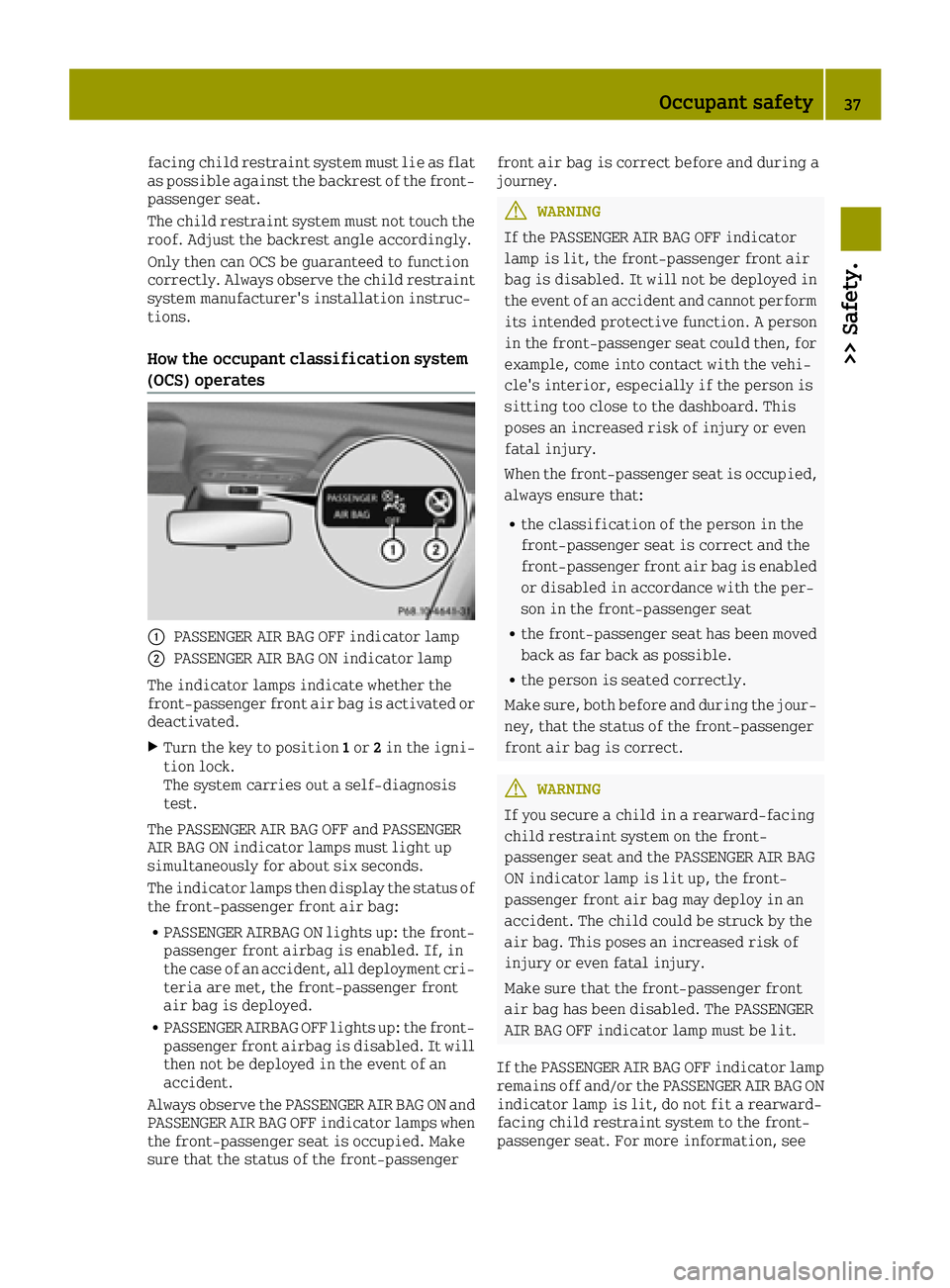
0043PASSENGER AIR BAG OFF indicator lamp
0044PASSENGER AIR BAG ON indicator lamp
The indicator lamps indicate whether the
front-passenger front air bag is activated or
deactivated.
XTurn the key to position 1or 2in the igni-
tion lock.
The system carries out a self-diagnosis
test.
The PASSENGER AIR BAG OFF and PASSENGER
AIR BAG ON indicator lamps must light up
simultaneously for about six seconds.
The indicator lamps then display the status of
the front-passenger front air bag:
RPASSENGER AIRBAG ON lights up: the front-
passenger front airbag is enabled. If, in
the case of an accident, all deployment cri-
teria are met, the front-passenger front
air bag is deployed.
RPASSENGER AIRBAG OFF lights up: the front-
passenger front airbag is disabled. It will then not be deployed in the event of an
accident.
Always observe the PASSENGER AIR BAG ON and
PASSENGER AIR BAG OFF indicator lamps when
the front-passenger seat is occupied. Make
sure that the status of the front-passenger front air bag is correct before and during a
journey.
GWARNING
If the PASSENGER AIR BAG OFF indicator
lamp is lit, the front-passenger front air
bag is disabled. It will not be deployed in
the event of an accident and cannot perform
its intended protective function. A person
in the front-passenger seat could then, for
example, come into contact with the vehi-
cle's interior, especially if the person is
sitting too close to the dashboard. This
poses an increased risk of injury or even
fatal injury.
When the front-passenger seat is occupied, always ensure that:
Rthe classification of the person in the
front-passenger seat is correct and the
front-passenger front air bag is enabledor disabled in accordance with the per-
son in the front-passenger seat
Rthe front-passenger seat has been movedback as far back as possible.
Rthe person is seated correctly.
Make sure, both before and during the jour-
ney, that the status of the front-passenger
front air bag is correct.
GWARNING
If you secure a child in a rearward-facing
child restraint system on the front-
passenger seat and the PASSENGER AIR BAG
ON indicator lamp is lit up, the front-
passenger front air bag may deploy in an
accident. The child could be struck by the
air bag. This poses an increased risk of
injury or even fatal injury.
Make sure that the front-passenger front
air bag has been disabled. The PASSENGER
AIR BAG OFF indicator lamp must be lit.
If the PASSENGER AIR BAG OFF indicator lamp
remains off and/or the PASSENGER AIR BAG ON
indicator lamp is lit, do not fit a rearward-
facing child restraint system to the front-
passenger seat. For more information, see
Occupant safety37
>> Safety.
Z
Page 40 of 214
"Problems with the Occupant Classification
System (OCS)" (Ypage 40).
GWARNING
If you secure a child in a forward-facing
child restraint system on the front-
passenger seat and you position the front-
passenger seat too close to the dashboard,
in the event of an accident, the child could:
Rcome into contact with the vehicle's
interior if the PASSENGER AIR BAG OFF
indicator lamp is lit, for example
Rbe struck by the air bag if the PASSENGER
AIR BAG ON is lit up
This poses an increased risk of injury or
even fatal injury.
Move the front-passenger seat as far back
as possible. Always make sure that the
shoulder belt strap is correctly routed
from the vehicle belt guide to the shoulder
belt guide on the child restraint system.
The shoulder belt strap must be routed for-
wards and downwards from the belt guide.
Always observe the child restraint system
manufacturer's installation instructions.
If OCS detects that:
Rthe front-passenger seat is not occupied,
the PASSENGER AIR BAG OFF indicator lamp
lights up continuously after the system's
self-diagnosis test. This indicates that
the front-passenger front air bag is deac-
tivated.
Rthe front-passenger seat is occupied by a
child aged up to twelve months in a stand-
ard child restraint system, the PASSENGER
AIR BAG OFF indicator lamp lights up con-
tinuously after the system's self-diagnosis
test. This indicates that the front-
passenger front air bag is deactivated.
In the case of a twelve-month-old child in a
standard child restraint system, the
PASSENGER AIR BAG ON indicator lamp may
light up continuously after the system's
self-diagnosis test. This indicates that
the front-passenger front air bag is acti-
vated. Categorization is dependent on the
type of child restraint system and the stat-
ure of the child, for example. Make sure
that the prerequisites for correct catego- rizat
ion have been met. If the PASSENGER
AIR BAG ON indicator lamp remains lit, do
not install a child restraint system on the
front-passenger seat.
Rthe front-passenger seat is occupied by a
person of smaller stature (e.g. a teenager
or a small adult), either the PASSENGER AIR
BAG ON or PASSENGER AIR BAG OFF indicator
lamp lights up continuously after the sys-
tem's self-diagnosis test depending on the categorization.
-If the PASSENGER AIR BAG ON indicator
lamp is lit, position the front-
passenger seat as far back as possible.
-If the PASSENGER AIR BAG OFF indicator
lamp lights up, a person of smaller stat-
ure should not sit on the front-passenger
seat.
Rthe front-passenger seat is occupied by an
adult or a person of an appropriate size,
the PASSENGER AIR BAG ON indicator lamp
lights up continuously after the system's
self-diagnosis test. This indicates that
the front-passenger front air bag is acti-
vated.
If children are traveling in the vehicle, be
sure to observe the notes on "Children in the
vehicle" (
Ypage 42).
If the OCS is malfunctioning, both the red
0075 restraint system warning lamp in the
instrument cluster and the PASSENGER AIR
BAG OFF indicator lamp light up simultane-
ously. In this case, the front-passenger air
bag is deactivated and does not deploy during
an accident. Have the system checked by
qualified technicians as soon as possible.
Consult a smart center. Only have the front-
passenger seat repaired at a smart center.
If the front-passenger seat, the seat cover or
the seat cushion are damaged, have the nec-
essary repair work carried out at a smart cen-
ter.
For safety reasons, smart recommends that you only use seat accessories which have been
approved by smart.
If the driver's air bag deploys , this does not
mean that the front-passenger front air bag
will also deploy. The Occupant Classifica-
tion System (OCS) categorizes the occupant on
the front-passenger seat. Depending on the
result, the front-passenger air bag is acti-
vated or deactivated.
38Occupant safety
>> Safety.
Page 41 of 214
System self-test
GDANGER
If both the PASSENGER AIR BAG OFF and
PASSENGER AIR BAG ON indicator lamps do
not light up during the system self-test, the
system is malfunctioning. The front-
passenger front air bag might be triggered
unintentionally or might not be triggered
at all in the event of an accident with high
deceleration. This poses an increased risk
of injury or even fatal injury.
In this case the front-passenger seat may
not be used. Do not install a child restraint
system on the front-passenger seat. Have
the Occupant Classification System (OCS)
checked and repaired immediately at a
qualified specialist workshop.
GDANGER
If the PASSENGER AIR BAG OFF indicator
lamp remains lit after the system self-test, the front-passenger front air bag is disa-
bled. It will not be deployed in the event of
an accident. In this case, the front-
passenger front air bag cannot perform its
intended protective function, e.g. when a
person is seated in the front-passenger
seat.
That person could, for example, come into
contact with the vehicle's interior, espe-
cially if the person is sitting too close to
the dashboard. This poses an increased
risk of injury or even fatal injury.
When the front-passenger seat is occupied,
always ensure that:
Rthe classification of the person in the
front-passenger seat is correct and the
front-passenger front air bag is enabledor disabled in accordance with the per-
son in the front-passenger seat
Rthe person is seated properly with a cor-
rectly fastened seatbelt
Rthe front-passenger seat has been movedback as far back as possible
If the PASSENGER AIR BAG OFF indicator
lamp remains lit when it should not, the
front-passenger seat may not be used. Do
not install a child restraint system on the
front-passenger seat. Have the Occupant
Classification System (OCS) checked and
repaired immediately at a qualified spe-
cialist workshop.
GWARNING
Objects between the seat surface and the
child restraint system could affect OCS
operation. This could result in the front-
passenger air bag not functioning as
intended during an accident. This poses an increased risk of injury or even fatal
injury.
Do not place any objects between the seat
surface and the child restraint system. The
entire base of the child restraint system
must always rest on the seat cushion of the
front-passenger seat. The backrest of the
forward-facing child restraint system
must, as far as possible, be resting on the
backrest of the front-passenger seat.
Always comply with the child restraint sys-
tem manufacturer's installation instruc-
tions.
After the system self-test, the PASSENGER AIR
BAG OFF or PASSENGER AIR BAG ON indicator
lamp displays the status of the front-
passenger front air bag (
Ypage 37).
For more information about the OCS, see
"Problems with the Occupant Classification
System" (
Ypage 40).
Occupant safety39
>> Safety.
Z
Page 42 of 214
Problems with the occupant classification system (OCS)
Be sure to observe the notes on "System self-test" (Ypage 39).
ProblemPossible causes/consequences and0050Solutions
The PASSENGER AIR BAG
OFF indicator lamp
lights up and remains
lit, even though the
front-passenger seat is
occupied by an adult or
a person of a stature
corresponding to that
of an adult.The classification of the person on the front-passenger seat is
incorrect.
XMake sure the conditions for a correct classification of the
person on the front-passenger seat are met (Ypage 36).
XIf the PASSENGER AIR BAG OFF indicator lamp remains lit, the
front-passenger seat may not be used.
XHave the OCS checked at a smart center as soon as possible.
The PASSENGER AIR BAG
OFF indicator lamp
does not light up and/or
does not stay on.
The front-passenger
seat is:
Runoccupied
Roccupied with the
weight of a child up
to twelve months old
in a child restraint
system
OCS is malfunctioning.
XMake sure there is nothing between the seat cushion and the
child seat.
XMake sure that the entire base of the child restraint system rests
on the seat cushion of the front-passenger seat. The backrest of
the forward-facing child restraint system must lie as flat as
possible against the backrest of the front-passenger seat. If
necessary, adjust the position of the front-passenger seat.
XWhen installing the child restraint system, make sure that the
seat belt is tight. Do not pull the seat belt tight using the front-
passenger seat adjustment. This could result in the seat belt and
the child restraint system being pulled too tightly.
XCheck for correct installation of the child restraint system.
XMake sure that no objects are applying additional weight onto
the seat.
XIf the PASSENGER AIR BAG OFF indicator lamp remains off and/or
the PASSENGER AIR BAG ON indicator lamp lights up, do not
install a child restraint system on the front-passenger seat.
XHave the OCS checked at a smart center as soon as possible.
Deployment of belt tensioners and air
bags
Important safety notes
GWARNING
The air bag parts are hot after an air bag
has been deployed. There is a risk of
injury.
Do not touch the air bag parts. Have a
deployed air bag replaced at a qualified
specialist workshop as soon as possible.
GWARNING
A deployed air bag no longer offers any
protection and cannot provide the intended
protection in an accident. There is an
increased risk of injury.
Have the vehicle towed to a qualified spe-
cialist workshop in order to have a
deployed air bag replaced.
For your own safety and that of your front
passenger, it is important that you have
deployed air bags replaced and faulty air
bags repaired. This will help to make sure the
air bags continue to perform their protective
function for the vehicle occupants in the
event of a crash.
40Occupant safety
>> Safety.
Page 44 of 214
Rthe deformation characteristics of the
vehicle
Rthe characteristics of the object with
which the vehicle has collided
Factors which can only be seen and measured
after a collision has occurred do not play a
decisive role in the deployment of an air bag.
Nor do they provide an indication of air bag
deployment.
The vehicle can be deformed considerably,
without an air bag being deployed. This is the
case if only parts which are relatively easily deformed are affected and the rate of decel-
eration is not high. Conversely, air bags may
be deployed even though the vehicle suffers
only minor deformation. This is the case if,
for example, very rigid vehicle parts such as longitudinal body members are hit, and suf-
ficient deceleration occurs as a result.
If the control unit of the restraint system
detects a side impact or a vehicle rollover,
the relevant components of the restraint sys-
tem are activated separately depending on
the anticipated type of accident.
RThorax/pelvis air bag on the side of
impact, independently of the Emergency
Tensioning Device and the use of the seat
belt
The thorax/pelvis air bag on the front-
passenger side deploys under the following
conditions:
-the OCS system detects that the front-
passenger seat is occupied or
-the belt tongue is engaged in the belt
buckle of the front-passenger seat
RWindow curtain air bag on the side of
impact, independently of the use of the seat
belt and independently of whether the
front-passenger seat is occupied
RWindow curtain air bags on the driver's andfront-passenger side in certain situations
when the vehicle rolls over, if the system
determines that deployment can offer
additional protection to that provided by
the seat belt
REmergency Tensioning Devices, if the sys-
tem determines that deployment can offer
additional protection in this situation
iNot all air bags are deployed in an acci-
dent. The differ ent air bag systems work
independently of each other. How the air bag system works is determined
by the severity of the accident detected,
especially the vehicle deceleration or
acceleration and the apparent type of acci-
dent:
RFrontal collision
RSide impact
RRollover
Children in the vehicle
Important safety notes
If a child younger than 12 years and under 5 ft
(1.50 m) in height is traveling in the vehicle:
Ralways secure the child in a child restraint
system suitable for Mercedes-Benz vehi-
cles. The child restraint system must be
appropriate to the age, weight and size of
the child
Rbe sure to observe the instructions and
safety notes in this section in addition to
the child restraint system manufacturer's
installation instructions
Rbe sure to observe the instructions and
safety notes in "Occupant classification
system (OCS)" (
Ypage 36)
GWARNING
If you leave children unsupervised in the
vehicle, they could set it in motion by, for example:
Rrelease the parking brake.
Rshift the automatic transmission out of
park position Por shift manual trans-
mission into neutral.
Rstart the engine.
In addition, they may operate vehicle
equipment and become trapped. There is a
risk of an accident and injury.
When leaving the vehicle, always take the
SmartKey with you and lock the vehicle.
Never leave children unsupervised in the
vehicle.
GWARNING
If persons, particularly children are sub-
jected to prolonged exposure to extreme
42Children in the vehicle
>> Safety.
Page 45 of 214
heat or cold, there is a risk of injury, pos-
sibly even fatal. Never leave children
unattended in the vehicle.
GWARNING
If the child restraint system is subjected to
direct sunlight, parts may get very hot.
Children may burn themselves on these
parts, particularly on the metal parts of the
child restraint system. There is a risk of
injury.
If you leave the vehicle, taking the child
with you, always ensure that the child
restraint system is not exposed to direct
sunlight. Protect it with a blanket, for
example. If the child restraint system has
been exposed to direct sunlight, let it cool
down before securing the child in it. Never
leave children unattended in the vehicle.
Always ensure that all vehicle occupants have
their seat belts fastened correctly and are
sitting properly. Particular attention must
be paid to children.
Read and follow the safety notes on the seat
belt (
Ypage 31) and the notes on correct use of
the seat belts (Ypage 32).
A booster seat may be necessary to achieve
proper seat belt positioning for children
over 41 lbs (18 kg) until they reach a height
where a lap/shoulder belt fits properly with-
out a booster seat.
Special seat belt retractor
GWARNING
If the seat belt is released while driving,
the child restraint system will no longer be
secured properly. The special seat belt
retractor is disabled and the inertia real
draws in a portion of the seat belt. The seat belt cannot be immediately refastened.
There is an increased risk of injury, pos-
sibly even fatal.
Stop the vehicle immediately, paying
attention to road and traffic conditions.
Reactivate the special seat belt retractor
and secure the child restraint system prop-erly.
The seat belt on the front-passenger side is
equipped with a special seat belt retractor.
When activated, the special seat belt retrac-
tor ensures that the seat belt will not slacken once the child restraint system has been
secured.
Installing a child restraint system:
XAlways comply with the child restraint sys-
tem manufacturer's installation instruc-
tions.
XPull the seat belt smoothly from the belt
loop.
XEngage the seat belt tongue in the belt
buckle.
Activating the special seat belt retractor:
XPull the seat belt out fully and let the seat
belt retractor retract it again.
While the seat belt is retracting, you
should hear a ratcheting sound. The special seat belt retractor is activated.
XPress the child restraint system down so
that the seat belt fits tightly and does not
slacken.
Removing a child restraint system and deac-
tivating the special seat belt retractor:
XAlways comply with the child restraint sys-
tem manufacturer's installation instruc-
tions.
XPress the seat belt buckle release button,
hold the belt tongue firmly and guide it
back towards the belt outlet.
The special seat belt retractor is deacti-
vated.
Child restraint system
The use of seat belts and child restraint sys- tems is required by law in:
Rall 50 states
Rthe U.S. territories
Rthe District of Columbia
Rall Canadian provinces
You can obtain further information about the correct child restraint system from any
authorized Mercedes-Benz Center.
Children in the vehicle43
>> Safety.
Z
Page 46 of 214
GWARNING
If the child restraint system is installed
incorrectly on a suitable seat, it cannot
protect as intended. The child cannot then
be restrained in the event of an accident,
heavy braking or sudden changes of direc-
tion. There is an increased risk of injury,
possibly even fatal.
Make sure that you observe the child
restraint system manufacturer's installa-
tion instructions and the notes on use.
Please ensure, that the base of the child
restraint system is always resting com-
pletely on the seat cushion. Never place
objects, e.g. cushions, under or behind the
child restraint system. Only use child
restraint systems with the original cover
designed for them. Only replace damaged
covers with genuine covers.
GWARNING
If the child restraint system is installed
incorrectly or is not secured, it can come
loose in the event of an accident, heavy
braking or a sudden change in direction.
The child restraint system could be thrown
about, striking vehicle occupants. There is an increased risk of injury, possibly even
fatal.
Always install child restraint systems
properly, even if they are not being used.
Make sure that you observe the child
restraint system manufacturer's installa-
tion instructions.
You will find further information on stowing
objects, luggage or loads under "Loading
guidelines" (
Ypage 142).
GWARNING
Child restraint systems or their securing
systems which have been damaged or sub-
jected to a load in an accident can no longer protect as intended. The child cannot then
be restrained in the event of an accident,
heavy braking or sudden changes of direc-
tion. There is an increased risk of injury,
possibly even fatal.
Replace child restraint systems which have
been damaged or subjected to a load in an
accident as soon as possible. Have the
securing systems on the child restraint
system checked at a qualified specialist
workshop, before you install a child
restraint system again.
Securing systems for child restraint systems
include:
Rthe seat belt system
Rthe Top Tether anchorages
iIf you install a child restraint system on
the front-passenger seat, make sure that
the backrest is securely engaged
(
Ypage 63).
iIf a child is carried on the front-
passenger seat, be sure to observe the
information on "Child restraint systems on
the front-passenger seat" (
Ypage 45).
There you will also find information on
disabling the front-passenger front air-
bag.
All child restraint systems must meet the fol-
lowing standards:
RU.S. Federal Motor Vehicle Safety Stand-
ards 213 and 225
RCanadian Motor Vehicle Safety Standards
213 and 210.2
Confirmation that the child restraint system
corresponds to the standards can be found on
an instruction label on the child restraint
system. This confirmation can also be found
in the installation instructions that are
included with the child restraint system.
Observe the warning labels in the vehicle
interior and on the child restraint system.
Top Tether
Introduction
Top Tether provides an additional connec-
tion between the child restraint system and
the vehicle. This helps reduce the risk of
injury even further. If the child restraint
44Children in the vehicle
>> Safety.
Page 47 of 214
system is fitted with a Top Tether belt, this
should always be used.
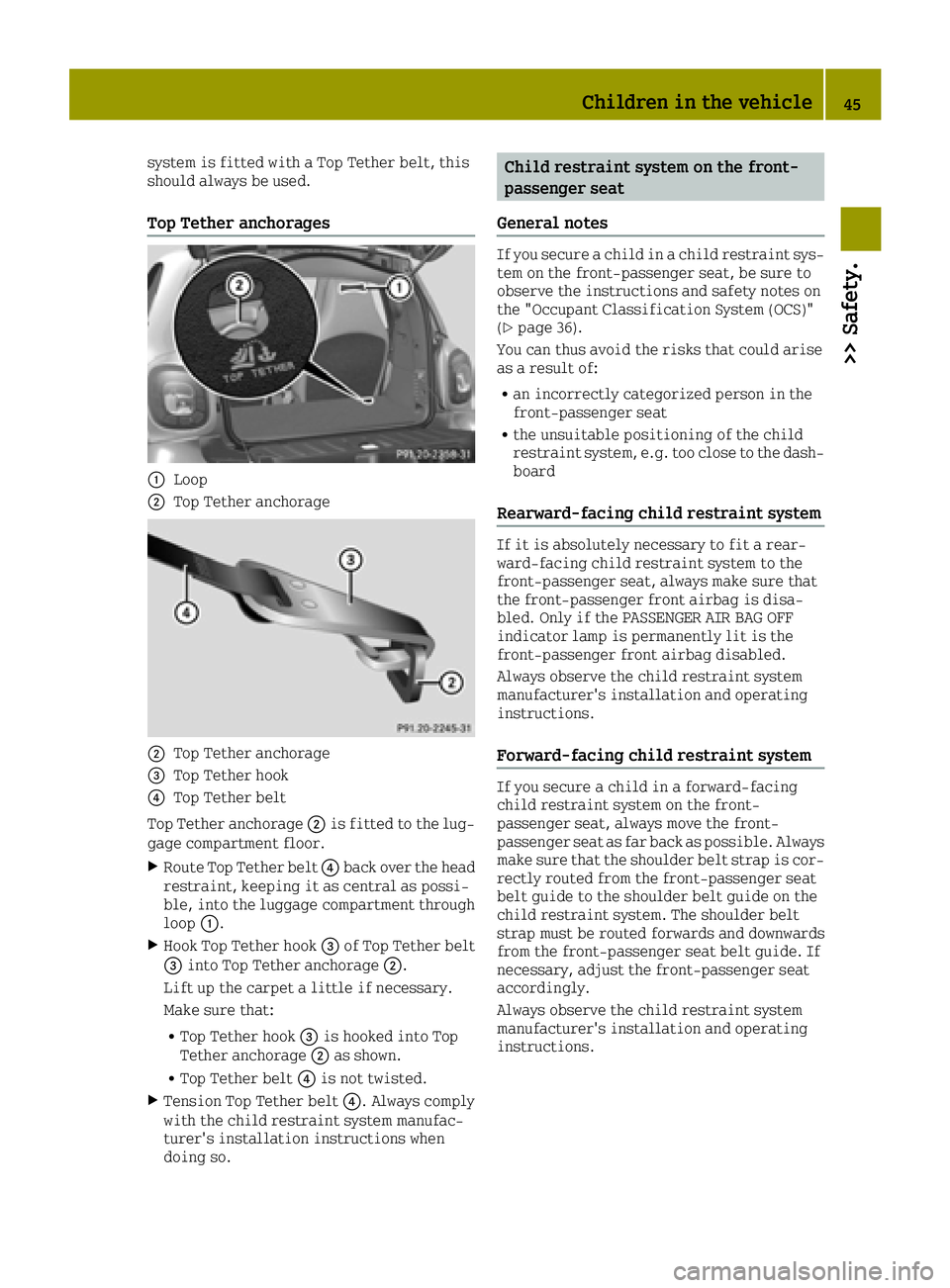
Top Tether anchorages
0043Loop
0044Top Tether anchorage
0044Top Tether anchorage
0087Top Tether hook
0085Top Tether belt
Top Tether anchorage 0044is fitted to the lug-
gage compartment floor.
XRoute Top Tether belt 0085back over the head
restraint, keeping it as central as possi-
ble, into the luggage compartment through
loop 0043.
XHook Top Tether hook 0087of Top Tether belt
0087 into Top Tether anchorage 0044.
Lift up the carpet a little if necessary.
Make sure that:
RTop Tether hook 0087is hooked into Top
Tether anchorage 0044as shown.
RTop Tether belt 0085is not twisted.
XTension Top Tether belt 0085. Always comply
with the child restraint system manufac-
turer's installation instructions when
doing so.
Child restraint system on the front-
passenger seat
General notes
If you secure a child in a child restraint sys-
tem on the front-passenger seat, be sure to
observe the instructions and safety notes on
the "Occupant Classification System (OCS)"
(
Ypage 36).
You can thus avoid the risks that could arise
as a result of:
Ran incorrectly categorized person in the
front-passenger seat
Rthe unsuitable positioning of the child
restraint system, e.g. too close to the dash-
board
Rearward-facing child restraint system
If it is absolutely necessary to fit a rear-
ward-facing child restraint system to the
front-passenger seat, always make sure that
the front-passenger front airbag is disa-
bled. Only if the PASSENGER AIR BAG OFF
indicator lamp is permanently lit is the
front-passenger front airbag disabled.
Always observe the child restraint system
manufacturer's installation and operating
instructions.
Forward-facing child restraint system
If you secure a child in a forward-facing
child restraint system on the front-
passenger seat, always move the front-
passenger seat as far back as possible. Always
make sure that the shoulder belt strap is cor-
rectly routed from the front-passenger seat
belt guide to the shoulder belt guide on the
child restraint system. The shoulder belt
strap must be routed forwards and downwards
from the front-passenger seat belt guide. If
necessary, adjust the front-passenger seat
accordingly.
Always observe the child restraint system
manufacturer's installation and operating
instructions.
Children in the vehicle45
>> Safety.
Z
Page 65 of 214
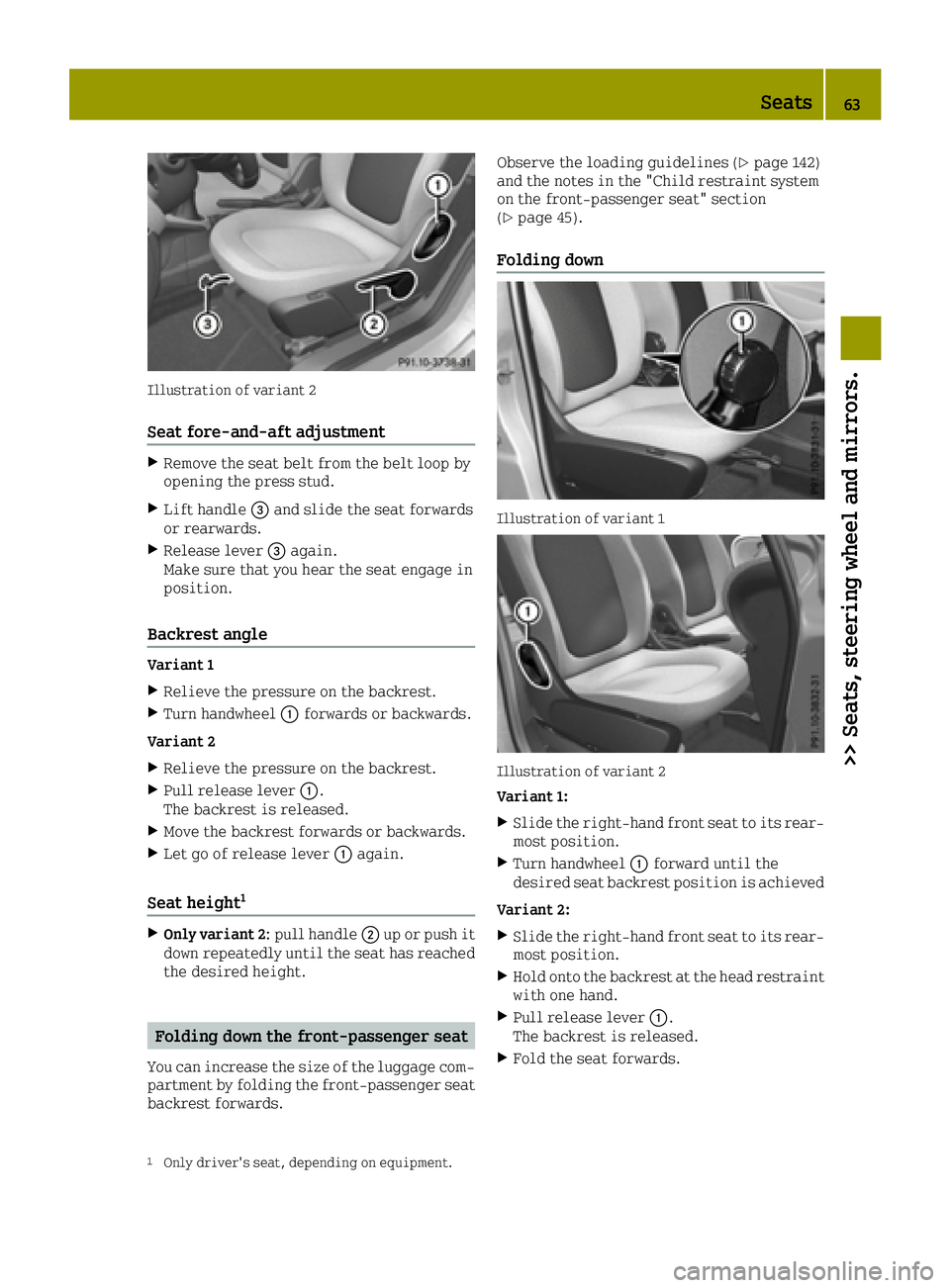
Illustration of variant 2
Seat fore-and-aft adjustment
XRemove the seat belt from the belt loop by
opening the press stud.
XLift handle0087and slide the seat forwards
or rearwards.
XRelease lever 0087again.
Make sure that you hear the seat engage in
position.
Backrest angle
Variant 1
XRelieve the pressure on the backrest.
XTurn handwheel 0043forwards or backwards.
Variant 2
XRelieve the pressure on the backrest.
XPull release lever 0043.
The backrest is released.
XMove the backrest forwards or backwards.
XLet go of release lever 0043again.
Seat height1
XOnly variant 2: pull handle 0044up or push it
down repeatedly until the seat has reached the desired height.
Folding down the front-passenger seat
You can increase the size of the luggage com-
partment by folding the front-passenger seat
backrest forwards. Observe the loading guidelines (
Ypage 142)
and the notes in the "Child restraint system
on the front-passenger seat" section
(
Ypage 45).
Folding down
Illustration of variant 1
Illustration of variant 2
Variant 1:
XSlide the right-hand front seat to its rear-
most position.
XTurn handwheel 0043forward until the
desired seat backrest position is achieved
Variant 2:
XSlide the right-hand front seat to its rear-
most position.
XHold onto the backrest at the head restraint
with one hand.
XPull release lever 0043.
The backrest is released.
XFold the seat forwards.
1Only driver's seat, depending on equipment.
Seats63
>> Seats, steering wheel and mirrors.
Z