fuel SMART FORTWO 2016 Owner's Guide
[x] Cancel search | Manufacturer: SMART, Model Year: 2016, Model line: FORTWO, Model: SMART FORTWO 2016Pages: 214, PDF Size: 4.93 MB
Page 185 of 214
iThe actual values for tires are vehicle-
specific and may deviate from the values in
the illustration.
Checking the tire pressures
Important safety notes
Observe the notes on tire pressure
(Ypage 180).
Information on air pressure for the tires on
your vehicle can be found:
Ron the vehicle's Tire and Loading Informa- tion placard on the B-pillar
Rin the tire pressure table in the fuel filler
flap (Ypage 98)
Rin the "Tire pressure" section
Checking tire pressures manually
To determine and set the correct tire pres-
sure, proceed as follows:
XRemove the valve cap of the tire that is to bechecked.
XPress the tire pressure gauge securely onto
the valve.
XRead the tire pressure and compare it with
the recommended value on the Tire and
Loading Information placard (
Ypage 180).
XIf the tire pressure is too low increase the
tire pressure to the recommended value.
XIf the tire pressure is too high, release
air. To do this, press down the metal pin in
the valve using the tip of a pen, for exam-
ple. Then check the tire pressure again
using the tire pressure checker.
XScrew the valve cap onto the valve.
XRepeat these steps for the other tires.
Tire pressure monitor
General notes
iThis function is only available in the
USA.
If a tire pressure monitor is installed, the
vehicle's wheels have sensors that monitor
the tire pressures in all four tires. The tire
pressure monitor warns you if the pressure
drops in one or more of the tires. The tire pressure monitor only functions if the cor-
responding sensors are fitted to all wheels.
Important safety notes
GWARNING
Each tire, including the spare (if provi-
ded), should be checked at least once every
two weeks when cold and inflated to the
pressure recommended by the vehicle man- ufacturer on the Tire and Loading Informa-
tion placard on the driver's door B-pillar
or the tire pressure label on the inside of
the fuel filler flap. If your vehicle has
tires of a different size than the size indi-
cated on the Tire and Loading Information
placard or, if available, the tire pressure
label, you should determine the proper tire
pressure for those tires.
As an added safety feature, your vehicle has been equipped with a tire pressure moni-
toring system (TPMS) that illuminates a low
tire pressure telltale when one or more of
your tires are significantly underinflated.
Accordingly, when the low tire pressure
telltale lights up, you should stop and
check your tires as soon as possible, and
inflate them to the proper pressure. Driv-
ing on a significantly underinflated tire
causes the tire to overheat and can lead to
tire failure.
Underinflation also reduces fuel effi-
ciency and tire tread life, and may affect
the vehicle's handling and stopping abil-
ity. Please note that the TPMS is not a sub-
stitute for proper tire maintenance, and it
is the driver's responsibility to maintain
correct tire pressure, even if underinfla-
tion has not reached the level to trigger
illumination of the TPMS low tire pressure
telltale.
Your vehicle has also been equipped with a
TPMS malfunction indicator to indicate
when the system is not operating properly.
The TPMS malfunction indicator is com-
bined with the low tire pressure telltale.
When the system detects a malfunction, the
Tire pressure183
>> Wheels and tires.
Z
Page 187 of 214
(Ypage 126) and the indicator and warning
lamps in the instrument cluster in the "Tires" section (
Ypage 139).
Restarting the tire pressure monitor
When you restart the tire pressure monitor,
all existing warning messages are deleted
and the warning lamps go out. The monitor
uses the currently set tire pressures as the
reference values for monitoring. In most
cases, the tire pressure monitor will auto-
matically detect the new reference values
after you have changed the tire pressure.
However, you can also define reference values
manually as described here. The tire pres-
sure monitor then monitors the new tire pres-
sure values.
XSet the tire pressure to the value recom-
mended for the corresponding driving sit-
uation on the Tire and Loading Information
placard on the B-pillar on the driver's side
(
Ypage 180).
Additional tire pressure values for dif-
ferent loads can also be found on the tire
pressure table on the inside of the fuel
filler flap (
Ypage 180).
XMake sure that the tire pressure is correct on all four wheels.
On-board computer with a color display
XTo restart the tire pressure monitor: press
the 0063 or0064 button on the steering
wheel to select the Settings
menu and
press 0076on the steering wheel to con-
firm.
XPress the 0063or0064 button to select the
TirePressureMonitorsubmenu and con-
firm with 0076.
The Tire Pressure Monitor Use Cur‐
rentPressuresAsNewReferenceVal‐ues?message appears in the display.
If you wish to confirm the restart:
XPress the 0063or0064 button to select yesand press the0076button to confirm.
The Tire Pressure Monitor Restarted
message appears in the display.
XPress 0076to confirm.
After a short while, the message is also
hidden without pressing the 0076button.
After driving for a few minutes, the system
checks whether the current tire pressures are within the specified range. The new
tire pressures are then accepted as refer-
ence values and monitored.
iIf the
Tire Pressure Monitor Restar‐tedmessage does not appear after approx-
imately 5 seconds, the restart was not suc-
cessful. If this occurs, repeat the restart.
If you wish to cancel the restart:
XPress the 0063or0064 button to select noand press the0076button to confirm.
The tire pressure values stored at the last
restart will continue to be monitored.
Radio type approval for the tire pressure
monitor
CountryRadio type approval number
USAFCC ID: MRXMW2433A
FCC ID: MRXGG4
FCC ID: MRXMC34MA4
CanadaIC: 2546A-MW2433A
IC: 2546A-GG4
IC: 2546A-MC34MA4
Loading the vehicle
Instruction labels for tires and loads
GWARNING
Overloaded tires can overheat, causing a
blowout. Overloaded tires can also impair
the steering and driving characteristics
and lead to brake failure. There is a risk of
accident.
Observe the load rating of the tires. The
load rating must be at least half of the GAWR
of your vehicle. Never overload the tires by exceeding the maximum load.
Two instruction labels on your vehicle show
the maximum possible load.
(1) The Tire and Loading Information plac- ard is on the B-pillar on the driver's
side. The Tire and Loading Information
placard shows the maximum permissible
number of occupants and the maximum
permissible vehicle load. It also con-
Loading the vehicle185
>> Wheels and tires.
Z
Page 188 of 214
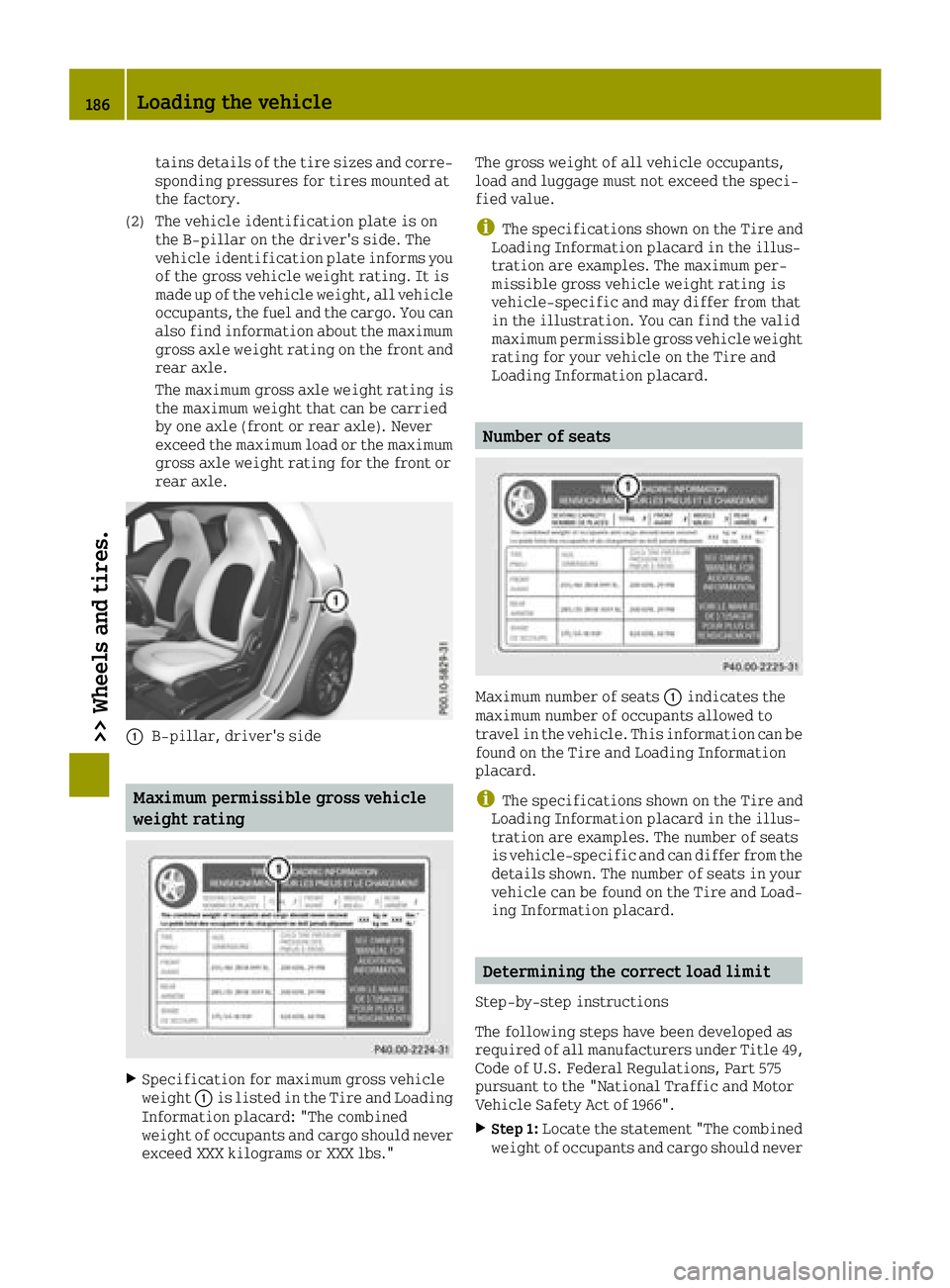
tains details of the tire sizes and corre-
sponding pressures for tires mounted at
the factory.
(2) The vehicle identification plate is on the B-pillar on the driver's side. The
vehicle identification plate informs you
of the gross vehicle weight rating. It is
made up of the vehicle weight, all vehicle
occupants, the fuel and the cargo. You can
also find information about the maximum
gross axle weight rating on the front and
rear axle.
The maximum gross axle weight rating is
the maximum weight that can be carried
by one axle (front or rear axle). Never
exceed the maximum load or the maximum gross axle weight rating for the front or
rear axle.
0043B-pillar, driver's side
Maximum permissible gross vehicle
weight rating
XSpecification for maximum gross vehicle
weight 0043is listed in the Tire and Loading
Information placard: "The combined
weight of occupants and cargo should never
exceed XXX kilograms or XXX lbs." The gross weight of all vehicle occupants,
load and luggage must not exceed the speci-
fied value.
iThe specifications shown on the Tire and
Loading Information placard in the illus-
tration are examples. The maximum per-
missible gross vehicle weight rating is
vehicle-specific and may differ from that
in the illustration. You can find the valid
maximum permissible gross vehicle weight
rating for your vehicle on the Tire and
Loading Information placard.
Number of seats
Maximum number of seats 0043indicates the
maximum number of occupants allowed to
travel in the vehicle. This information can be
found on the Tire and Loading Information
placard.
iThe specifications shown on the Tire and
Loading Information placard in the illus-
tration are examples. The number of seats
is vehicle-specific and can differ from the
details shown. The number of seats in your
vehicle can be found on the Tire and Load-
ing Information placard.
Determining the correct load limit
Step-by-step instructions
The following steps have been developed as
required of all manufacturers under Title 49,
Code of U.S. Federal Regulations, Part 575
pursuant to the "National Traffic and Motor
Vehicle Safety Act of 1966".
XStep 1: Locate the statement "The combined
weight of occupants and cargo should never
186Loading the vehicle
>> Wheels and tires.
Page 197 of 214
Rim
This is the part of the wheel on which the tire
is mounted.
GAWR (Gross Axle Weight Rating)
The GAWR is the maximum gross axle weight
rating. The actual load on an axle must never
exceed the gross axle weight rating. The
gross axle weight rating can be found on the
vehicle identification plate on the B-pillar
on the driver's side.
Speed rating
The speed rating is part of the tire identi-
fication. It specifies the speed range for
which the tire is approved.
GVW (Gross Vehicle Weight)
The gross vehicle weight includes the weight
of the vehicle including fuel, tools, the spare
wheel, accessories installed, occupants, lug-
gage and the drawbar noseweight, if appli-
cable. The gross vehicle weight must not
exceed the gross vehicle weight rating GVWR
as specified on the vehicle identification
plate on the B-pillar on the driver's side.
GVWR (Gross Vehicle Weight Rating)
The GVWR is the maximum permissible gross
weight of a fully loaded vehicle (the weight of
the vehicle including all accessories, occu-
pants, fuel, luggage and the drawbar nose-
weight, if applicable). The gross vehicle
weight rating is specified on the vehicle
identification plate on the B-pillar on the
driver's side.
Maximum loaded vehicle weight
The maximum weight is the sum of:
Rthe curb weight of the vehicle
Rthe weight of the accessories
Rthe load limit
Rthe weight of the factory installed optional
equipment
Kilopascal (kPa)
Metric unit for tire pressure. 6.9 kPa corre-
sponds to 1 psi. Another unit for tire pressure
is bar. 100 kilopascals (kPa) are the equiva-
lent of 1 bar.
Load index
In addition to the load-bearing index, the
load index may also be imprinted on the side-
wall of the tire. This specifies the load-
bearing capacity more precisely.
Curb weight
The weight of a vehicle with standard equip-
ment including the maximum capacity of fuel,
oil and coolant. It also includes the air-con-
ditioning system and optional equipment if
these are installed in the vehicle, but does
not include passengers or luggage.
Maximum load rating
The maximum load rating is the maximum per-
missible weight in kilograms or pounds for
which a tire is approved.
Maximum permissible tire pressure
Maximum permissible tire pressure for one
tire.
Maximum load on one tire
Maximum load on one tire. This is calculated by dividing the maximum axle load of one axle
by two.
PSI (pounds per square inch)
A standard unit of measure for tire pressure.
Aspect ratio
Relationship between tire height and tire
width in percent.
Tire pressure
This is pressure inside the tire applying an
outward force to each square inch of the tire'ssurface. The tire pressure is specified in
pounds per square inch (psi), in kilopascal
(kPa) or in bar. The tire pressure should only
be corrected when the tires are cold.
Cold tire pressure
The tires are cold:
Rif the vehicle has been parked with the
tires out of direct sunlight for at least
three hours and
Rif the vehicle has not been driven further
than 1 mile (1.6 km)
All about wheels and tires195
>> Wheels and tires.
Z
Page 202 of 214
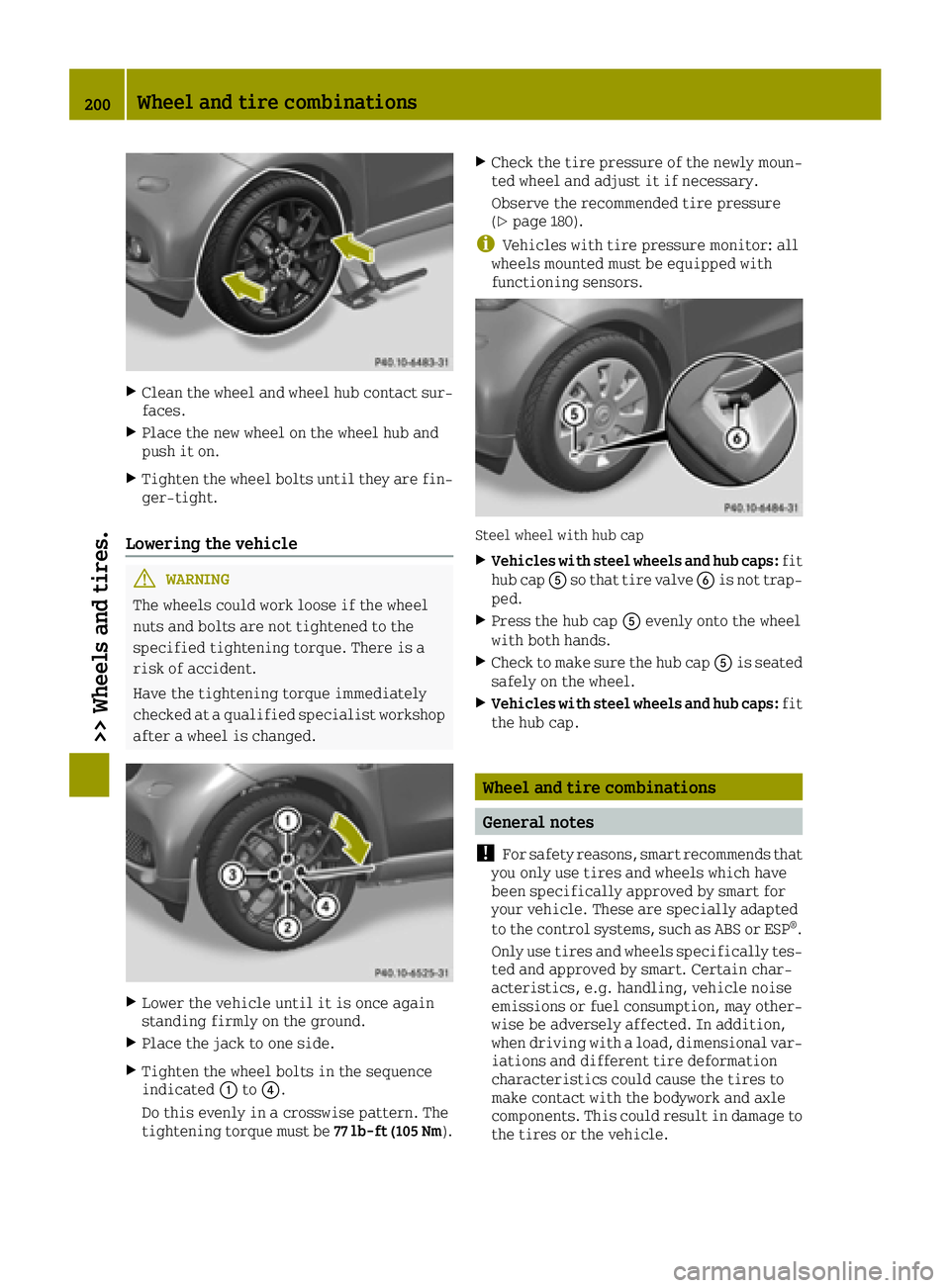
XClean the wheel and wheel hub contact sur-faces.
XPlace the new wheel on the wheel hub and
push it on.
XTighten the wheel bolts until they are fin-
ger-tight.
Lowering the vehicle
GWARNING
The wheels could work loose if the wheel
nuts and bolts are not tightened to the
specified tightening torque. There is a
risk of accident.
Have the tightening torque immediately
checked at a qualified specialist workshop
after a wheel is changed.
XLower the vehicle until it is once again
standing firmly on the ground.
XPlace the jack to one side.
XTighten the wheel bolts in the sequence
indicated 0043to0085.
Do this evenly in a crosswise pattern. The
tightening torque must be 77 lb-ft (105 Nm).
XCheck the tire pressure of the newly moun-
ted wheel and adjust it if necessary.
Observe the recommended tire pressure
(
Ypage 180).
iVehicles with tire pressure monitor: all
wheels mounted must be equipped with
functioning sensors.
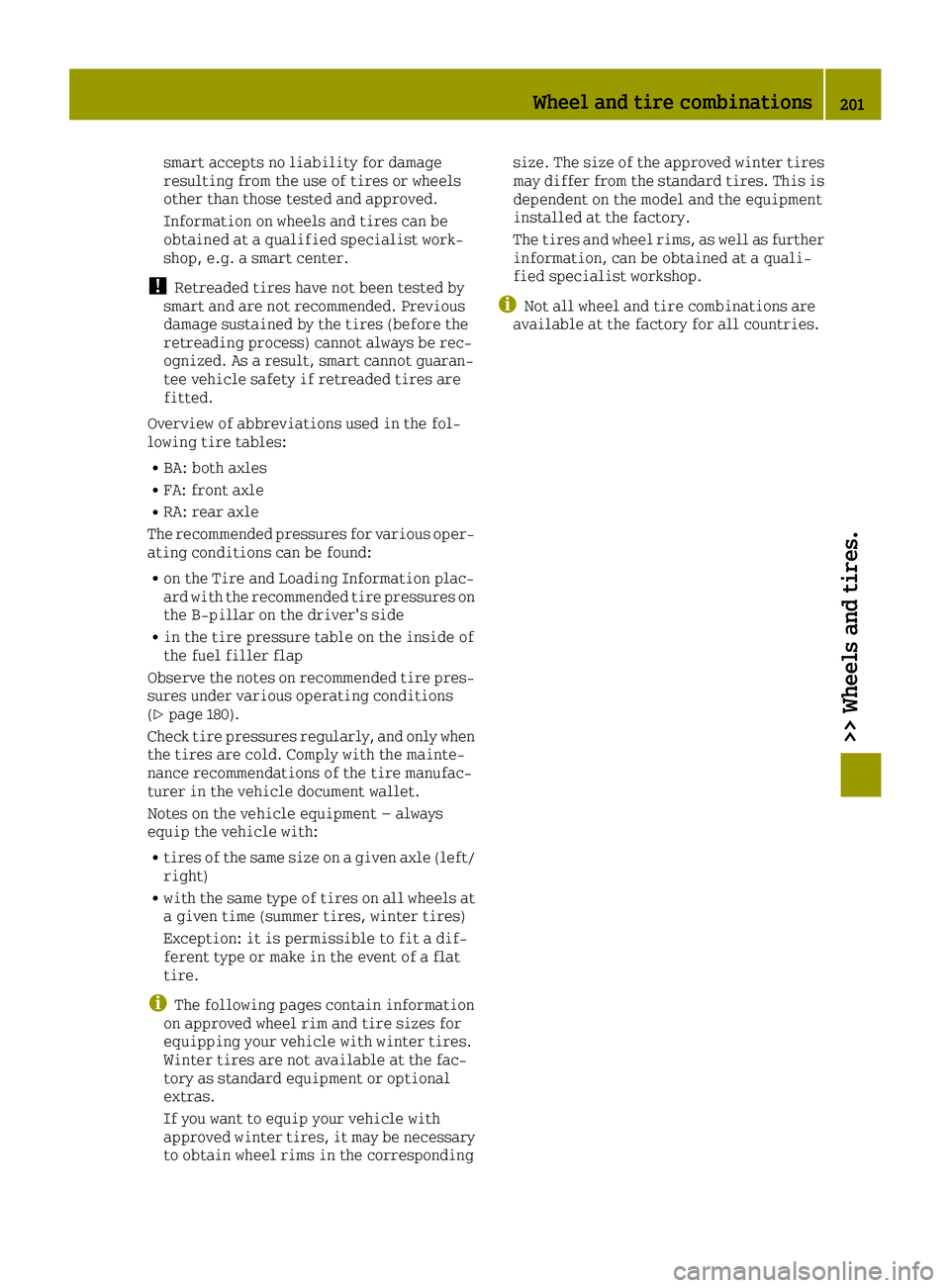
Steel wheel with hub cap
XVehicles with steel wheels and hub caps: fit
hub cap 0083so that tire valve 0084is not trap-
ped.
XPress the hub cap 0083evenly onto the wheel
with both hands.
XCheck to make sure the hub cap 0083is seated
safely on the wheel.
XVehicles with steel wheels and hub caps: fit
the hub cap.
Wheel and tire combinations
General notes
!
For safety reasons, smart recommends that
you only use tires and wheels which have
been specifically approved by smart for
your vehicle. These are specially adapted
to the control systems, such as ABS or ESP
®.
Only use tires and wheels specifically tes-
ted and approved by smart. Certain char-
acteristics, e.g. handling, vehicle noise
emissions or fuel consumption, may other-
wise be adversely affected. In addition,
when driving with a load, dimensional var-
iations and different tire deformation
characteristics could cause the tires to
make contact with the bodywork and axle
components. This could result in damage to
the tires or the vehicle.
200Wheel and tire combinations
>> Wheels and tires.
Page 203 of 214
smart accepts no liability for damage
resulting from the use of tires or wheels
other than those tested and approved.
Information on wheels and tires can be
obtained at a qualified specialist work-
shop, e.g. a smart center.
!Retreaded tires have not been tested by
smart and are not recommended. Previous
damage sustained by the tires (before the
retreading process) cannot always be rec-
ognized. As a result, smart cannot guaran-
tee vehicle safety if retreaded tires are
fitted.
Overview of abbreviations used in the fol-
lowing tire tables:
RBA: both axles
RFA: front axle
RRA: rear axle
The recommended pressures for various oper- ating conditions can be found:
Ron the Tire and Loading Information plac-
ard with the recommended tire pressures on
the B-pillar on the driver's side
Rin the tire pressure table on the inside of
the fuel filler flap
Observe the notes on recommended tire pres-
sures under various operating conditions
(
Ypage 180).
Check tire pressures regularly, and only when
the tires are cold. Comply with the mainte-
nance recommendations of the tire manufac-
turer in the vehicle document wallet.
Notes on the vehicle equipment – always
equip the vehicle with:
Rtires of the same size on a given axle (left/
right)
Rwith the same type of tires on all wheels at a given time (summer tires, winter tires)
Exception: it is permissible to fit a dif-
ferent type or make in the event of a flat
tire.
iThe following pages contain information
on approved wheel rim and tire sizes for
equipping your vehicle with winter tires.
Winter tires are not available at the fac-
tory as standard equipment or optional
extras.
If you want to equip your vehicle with
approved winter tires, it may be necessary
to obtain wheel rims in the corresponding size. The size of the approved winter tires
may differ from the standard tires. This is
dependent on the model and the equipment
installed at the factory.
The tires and wheel rims, as well as further
information, can be obtained at a quali-
fied specialist workshop.
iNot all wheel and tire combinations are
available at the factory for all countries.
Wheel and tire combinations201
>> Wheels and tires.
Z
Page 209 of 214
Service products and filling capaci-
ties
Important safety notes
GWARNING
Service products may be poisonous and haz-
ardous to health. There is a risk of injury.
Comply with instructions on the use, stor-
age and disposal of service products on the
labels of the respective original contain-
ers. Always store service products sealed
in their original containers. Always keep
service products out of the reach of chil-
dren.
HEnvironmental note
Dispose of service products in an environ-
mentally responsible manner.
Service products include the following:
RFuels
RLubricants (e.g. engine oil, transmission
oil)
RCoolant
RBrake fluid
RWindshield washer fluid
RClimate control system refrigerant
Components and service products must be
matched. You should therefore only use prod-
ucts that have been tested and approved by
Mercedes-Benz.
Information on tested and approved products
can be obtained at a smart center.
You can recognize service products approved by Mercedes-Benz by the following inscrip-
tion on the containers:
RMB-Freigabe (e.g. MB-Freigabe 229.51)
RMB Approval (e.g. MB Approval 229.51)
Other designations or recommendations
indicate a level of quality or a specification in accordance with an MB Sheet Number (e.g.
MB 229.5). They have not necessarily been
approved by Mercedes-Benz.
iFor further information inquire at any
smart center.
Fuel
Important safety notes
GWARNING
Fuel is highly flammable. If you handle fuel
incorrectly, there is a risk of fire and
explosion.
You must avoid fire, open flames, creating
sparks and smoking. Switch off the engine
and, if applicable, the auxiliary heating
before refueling.
GWARNING
Fuel is poisonous and hazardous to health.
There is a risk of injury.
You must make sure that fuel does not come
into contact with your skin, eyes or cloth-
ing and that it is not swallowed. Do not
inhale fuel vapors. Keep fuel away from
children.
If you or others come into contact with fuel,
observe the following:
RWash away fuel from skin immediately
using soap and water.
RIf fuel comes into contact with your eyes,
immediately rinse them thoroughly with
clean water. Seek medical assistance
without delay.
RIf fuel is swallowed, seek medical assis-
tance without delay. Do not induce vom-
iting.
RImmediately change out of clothing
which has come into contact with fuel.
Tank capacity
ModelTotal capa- city
All models8.7 US gal(33.0 l)
Service products and filling capacities207
>> Technical data.
Z
Page 210 of 214
ModelOf whichreserve
All modelsApprox.
1.3 US gal (5.0 l)
Gasoline
Fuel grade
!Do not use diesel to refuel vehicles with a
gasoline engine. Do not switch on the igni-
tion if you accidentally refuel with the
wrong fuel. Otherwise, the fuel will enter
the fuel system. Even small amounts of the
wrong fuel could result in damage to the
fuel system and the engine. Notify a quali-
fied specialist workshop and have the fuel
tank and fuel lines drained completely.
!Only refuel using premium-grade unlea-
ded gasoline with at least 91 AKI/95 RON
(91 octane).
!Only use the fuel recommended. Operating
the vehicle with other fuels can lead to
engine failure.
!Do not use the following:
RE85 (gasoline with 85% ethanol)
RE100 (100% ethanol)
RM15 (gasoline with 15% methanol)
RM30 (gasoline with 30% methanol)
RM85 (gasoline with 85% methanol)
RM100 (100% methanol)
RGasoline with metalliferous additives
RDiesel
Do not mix such fuels with the fuel recom-
mended for your vehicle. Do not use addi-
tives. Engine failure may otherwise occur.
This does not include cleaning additives
for the removal and prevention of residue
build-up. Gasoline must only be mixed with
cleaning additives recommended by smart
(see "Additives"). For further information
inquire at any smart center.
!To ensure the longevity and full perform-
ance of the engine, only premium-grade
unleaded gasoline must be used. If standard unleaded gasoline is unavail-
able and you have to refuel with unleaded
gasoline of a lower grade, observe the fol-
lowing precautions:
ROnly fill the fuel tank to half full with
regular unleaded gasoline and fill the
rest with premium-grade unleaded gas-
oline as soon as possible.
RDo not drive at the maximum speed.
RAvoid sudden acceleration and engine
speeds over 3,000 rpm.
You will usually find information about the
fuel grade on the pump. If you cannot find the
label on the pump, ask the staff for assis-
tance.
iFor further information, consult a quali-
fied specialist workshop or on the Internet
at http://www.smartusa.com (USA only).
iE10 fuel contains up to 10% bioethanol.
Your vehicle is E10-compatible. You can
refuel your vehicle using E10 fuel.
As a temporary measure, if the recommended
fuel is not available, you may also use regular unleaded gasoline with an octane rating of
87 AKI/91 RON. This may reduce engine per-
formance and increase fuel consumption.
Avoid driving at full throttle and sudden
acceleration. Never refuel using fuel with a
lower octane rating.
Information on refueling (
Ypage 97).
Additives
!Operating the engine with subsequently
added fuel additives can lead to engine
damage. Do not mix any fuel additives with the fuel. This does not include additives
for the removal and prevention of residue
buildup. Gasoline must only be mixed with
additives recommended by smart. Comply
with the instructions for use on the product
label. For further information on recom-
mended additives, inquire at any smart
center.
smart recommends that you use fuel brands
that have additives.
The quality of the fuel available in some
countries may not be sufficient. Residue
could build up in the injection system as a
result. In this case, in consultation with a
smart center, the gasoline may be mixed with
the cleaning additive recommended by smart.
208Service products and filling capacities
>> Technical data.
Page 211 of 214
You must observe the notes and mixing ratios
specified on the container.
Fuel consumption information
HEnvironmental note
CO
2(carbon dioxide) is the gas which sci-
entists believe to be principally respon-
sible for global warming (the greenhouse
effect). Your vehicle's CO
2emissions are
directly related to fuel consumption and
therefore depend on:
Refficient use of the fuel by the engine
Rdriving style
Rother non-technical factors, such as
environmental influences, road condi-
tions or traffic flow
You can minimize your vehicle's CO
2emis-
sions by driving carefully and having it
serviced regularly.
The vehicle will use more fuel than usual in
the following situations:
Rat very low outside temperatures
Rin city traffic
Ron short journeys
Rin mountainous terrain
Engine oil
General notes
!Never use engine oil or an oil filter of a
specification other than is necessary to
fulfill the prescribed service intervals.
Do not change the engine oil or oil filter in order to achieve longer replacement inter-
vals than those prescribed. You could oth-
erwise cause engine damage or damage to
the exhaust gas aftertreatment.
Follow the instructions in the service
interval display regarding the oil change.
Otherwise, you may damage the engine and
the exhaust gas aftertreatment.
When handling engine oil, observe the impor-
tant safety notes on service products
(
Ypage 207).
The engine oils are matched to the perform-
ance of smart engines and service intervals.
You should therefore only use engine oils and
oil filters that are approved for vehicles
with maintenance systems.
Consult a smart center to view a list of
approved engine oils and filters. Or visit the
website http://bevo.mercedes-benz.com.
The table shows which engine oils have been
approved for your vehicle.
ModelMB-Freigabe or MB-Approval
All models229.51, 229.53
iMB approval is indicated on the oil con-
tainers.
Filling capacities
The following values refer to an oil change
including the oil filter.
ModelCapacity
All models3.8 US qt (3.4 l)
Additives
!Do not use any additives in the engine oil.
This could damage the engine.
Service products and filling capacities209
>> Technical data.
Z
Page 212 of 214
Engine oil viscosity
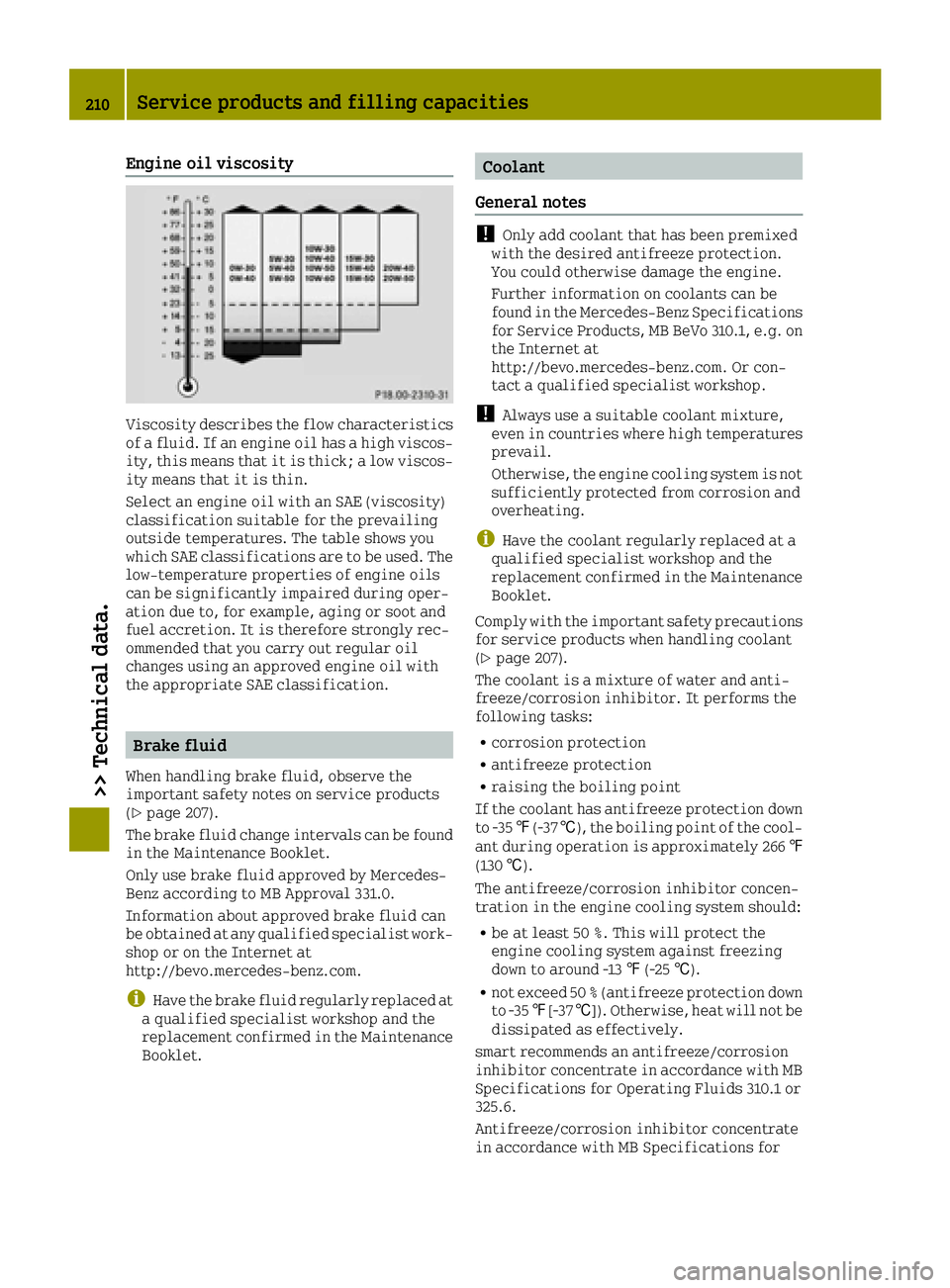
Viscosity describes the flow characteristics
of a fluid. If an engine oil has a high viscos-
ity, this means that it is thick; a low viscos-
ity means that it is thin.
Select an engine oil with an SAE (viscosity)
classification suitable for the prevailing
outside temperatures. The table shows you
which SAE classifications are to be used. The
low-temperature properties of engine oils
can be significantly impaired during oper-
ation due to, for example, aging or soot and
fuel accretion. It is therefore strongly rec-
ommended that you carry out regular oil
changes using an approved engine oil with
the appropriate SAE classification.
Brake fluid
When handling brake fluid, observe the
important safety notes on service products
(
Ypage 207).
The brake fluid change intervals can be found
in the Maintenance Booklet.
Only use brake fluid approved by Mercedes-
Benz according to MB Approval 331.0.
Information about approved brake fluid can
be obtained at any qualified specialist work-
shop or on the Internet at
http://bevo.mercedes-benz.com.
iHave the brake fluid regularly replaced at
a qualified specialist workshop and the
replacement confirmed in the Maintenance
Booklet.
Coolant
General notes
!Only add coolant that has been premixed
with the desired antifreeze protection.
You could otherwise damage the engine.
Further information on coolants can be
found in the Mercedes-Benz Specifications
for Service Products, MB BeVo 310.1, e.g. on
the Internet at
http://bevo.mercedes-benz.com. Or con-
tact a qualified specialist workshop.
!Always use a suitable coolant mixture,
even in countries where high temperatures
prevail.
Otherwise, the engine cooling system is not sufficiently protected from corrosion and
overheating.
iHave the coolant regularly replaced at a
qualified specialist workshop and the
replacement confirmed in the Maintenance
Booklet.
Comply with the important safety precautions
for service products when handling coolant
(
Ypage 207).
The coolant is a mixture of water and anti-
freeze/corrosion inhibitor. It performs the
following tasks:
Rcorrosion protection
Rantifreeze protection
Rraising the boiling point
If the coolant has antifreeze protection down
to -35 ‡(-37 †), the boiling point of the cool-
ant during operation is approximately 266 ‡
(130 †).
The antifreeze/corrosion inhibitor concen-
tration in the engine cooling system should:
Rbe at least 50 %. This will protect the
engine cooling system against freezing
down to around -13‡(-25 †).
Rnot exceed 50 % (antifreeze protection down
to-35 ‡[-37 †]). Otherwise, heat will not be
dissipated as effectively.
smart recommends an antifreeze/corrosion
inhibitor concentrate in accordance with MB
Specifications for Operating Fluids 310.1 or
325.6.
Antifreeze/corrosion inhibitor concentrate
in accordance with MB Specifications for
210Service products and filling capacities
>> Technical data.