service SMART FORTWO COUPE 2010 Owner's Manual
[x] Cancel search | Manufacturer: SMART, Model Year: 2010, Model line: FORTWO COUPE, Model: SMART FORTWO COUPE 2010Pages: 216, PDF Size: 9.7 MB
Page 115 of 216
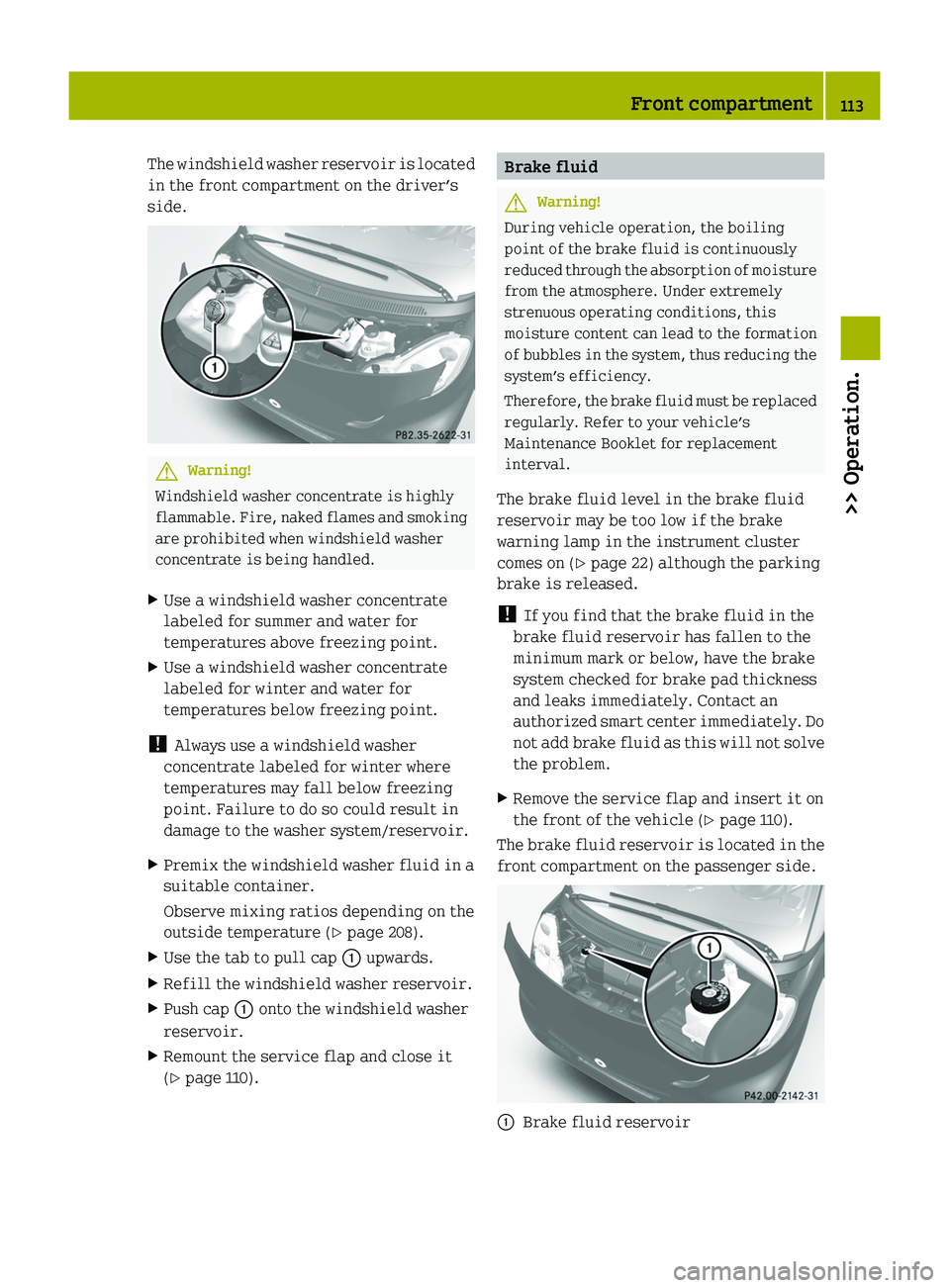
The windshield washer reservoir is located
in the front compartment on the driver’s
side.GWarning!
Windshield washer concentrate is highly
flammable. Fire, naked flames and smoking
are prohibited when windshield washer
concentrate is being handled.
XUse a windshield washer concentrate
labeled for summer and water for
temperatures above freezing point.XUse a windshield washer concentrate
labeled for winter and water for
temperatures below freezing point.
! Always use a windshield washer
concentrate labeled for winter where
temperatures may fall below freezing
point. Failure to do so could result in
damage to the washer system/reservoir.
XPremix the windshield washer fluid in a
suitable container.
Observe mixing ratios depending on the
outside temperature ( Y page 208).XUse the tab to pull cap 0046 upwards.XRefill the windshield washer reservoir.XPush cap 0046 onto the windshield washer
reservoir.XRemount the service flap and close it
( Y page 110).Brake fluidGWarning!
During vehicle operation, the boiling
point of the brake fluid is continuously
reduced through the absorption of moisture
from the atmosphere. Under extremely
strenuous operating conditions, this
moisture content can lead to the formation
of bubbles in the system, thus reducing the
system’s efficiency.
Therefore, the brake fluid must be replaced
regularly. Refer to your vehicle’s
Maintenance Booklet for replacement
interval.
The brake fluid level in the brake fluid
reservoir may be too low if the brake
warning lamp in the instrument cluster
comes on ( Y page 22) although the parking
brake is released.
! If you find that the brake fluid in the
brake fluid reservoir has fallen to the
minimum mark or below, have the brake
system checked for brake pad thickness
and leaks immediately. Contact an
authorized smart center immediately. Do
not add brake fluid as this will not solve
the problem.
XRemove the service flap and insert it on
the front of the vehicle ( Y page 110).
The brake fluid reservoir is located in the
front compartment on the passenger side.
0046Brake fluid reservoirFront compartment113>> Operation.451_AKB; 3; 22, en-USd2ureepe,Version: 2.11.8.12009-07-27T09:36:34+02:00 - Seite 113Z
Page 116 of 216
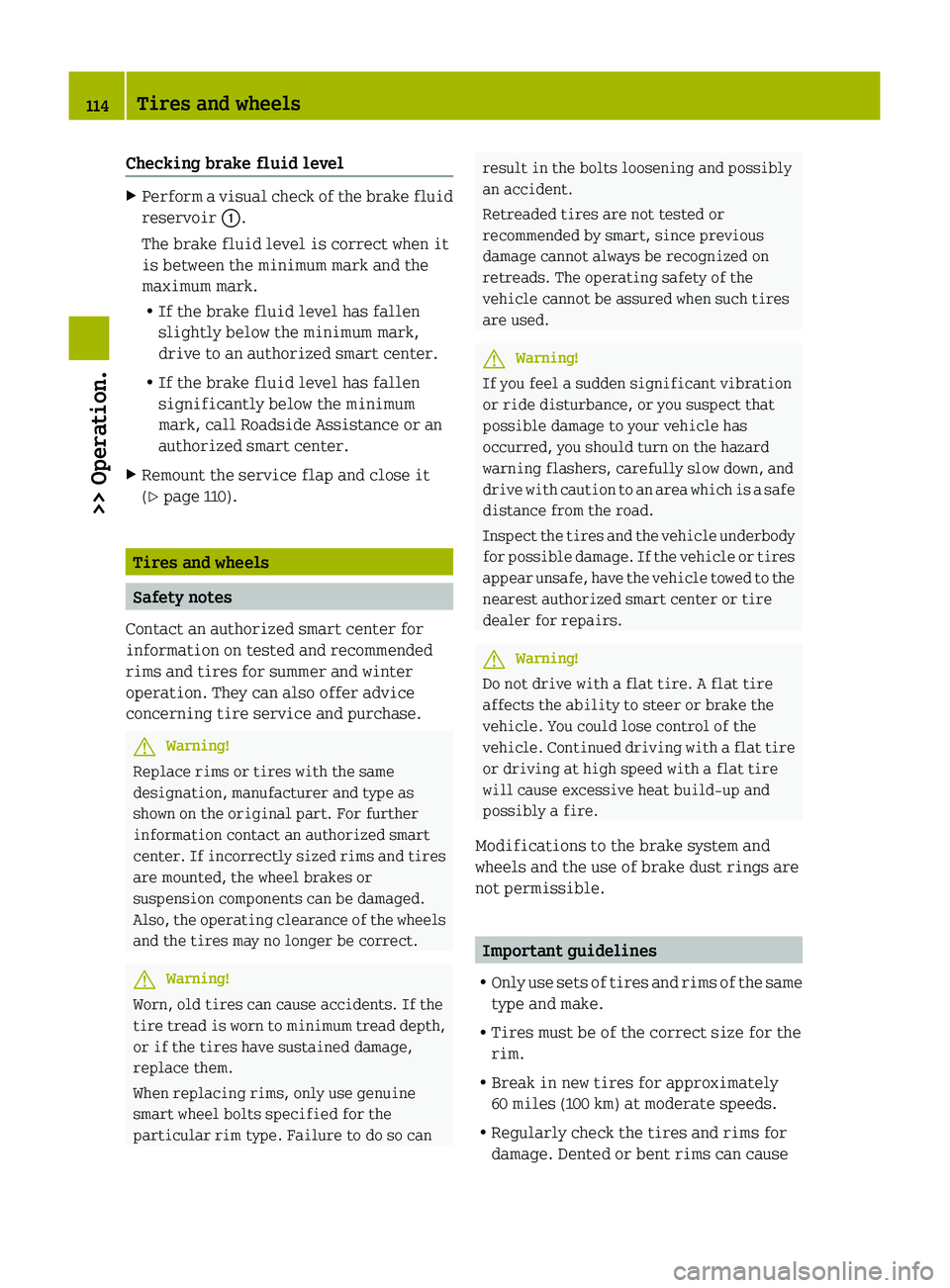
Checking brake fluid levelXPerform a visual check of the brake fluid
reservoir 0046.
The brake fluid level is correct when it
is between the minimum mark and the
maximum mark.
R If the brake fluid level has fallen
slightly below the minimum mark,
drive to an authorized smart center.
R If the brake fluid level has fallen
significantly below the minimum
mark, call Roadside Assistance or an
authorized smart center.XRemount the service flap and close it
( Y page 110).
Tires and wheels
Safety notes
Contact an authorized smart center for
information on tested and recommended
rims and tires for summer and winter
operation. They can also offer advice
concerning tire service and purchase.
GWarning!
Replace rims or tires with the same
designation, manufacturer and type as
shown on the original part. For further
information contact an authorized smart
center. If incorrectly sized rims and tires
are mounted, the wheel brakes or
suspension components can be damaged.
Also, the operating clearance of the wheels
and the tires may no longer be correct.
GWarning!
Worn, old tires can cause accidents. If the
tire tread is worn to minimum tread depth,
or if the tires have sustained damage,
replace them.
When replacing rims, only use genuine
smart wheel bolts specified for the
particular rim type. Failure to do so can
result in the bolts loosening and possibly
an accident.
Retreaded tires are not tested or
recommended by smart, since previous
damage cannot always be recognized on
retreads. The operating safety of the
vehicle cannot be assured when such tires
are used.GWarning!
If you feel a sudden significant vibration
or ride disturbance, or you suspect that
possible damage to your vehicle has
occurred, you should turn on the hazard
warning flashers, carefully slow down, and
drive with caution to an area which is a safe
distance from the road.
Inspect the tires and the vehicle underbody
for possible damage. If the vehicle or tires
appear unsafe, have the vehicle towed to the
nearest authorized smart center or tire
dealer for repairs.
GWarning!
Do not drive with a flat tire. A flat tire
affects the ability to steer or brake the
vehicle. You could lose control of the
vehicle. Continued driving with a flat tire
or driving at high speed with a flat tire
will cause excessive heat build-up and
possibly a fire.
Modifications to the brake system and
wheels and the use of brake dust rings are
not permissible.
Important guidelines
R Only use sets of tires and rims of the same
type and make.
R Tires must be of the correct size for the
rim.
R Break in new tires for approximately
60 miles (100 km) at moderate speeds.
R Regularly check the tires and rims for
damage. Dented or bent rims can cause
114Tires and wheels>> Operation.
451_AKB; 3; 22, en-USd2ureepe,Version: 2.11.8.12009-07-27T09:36:34+02:00 - Seite 114
Page 125 of 216
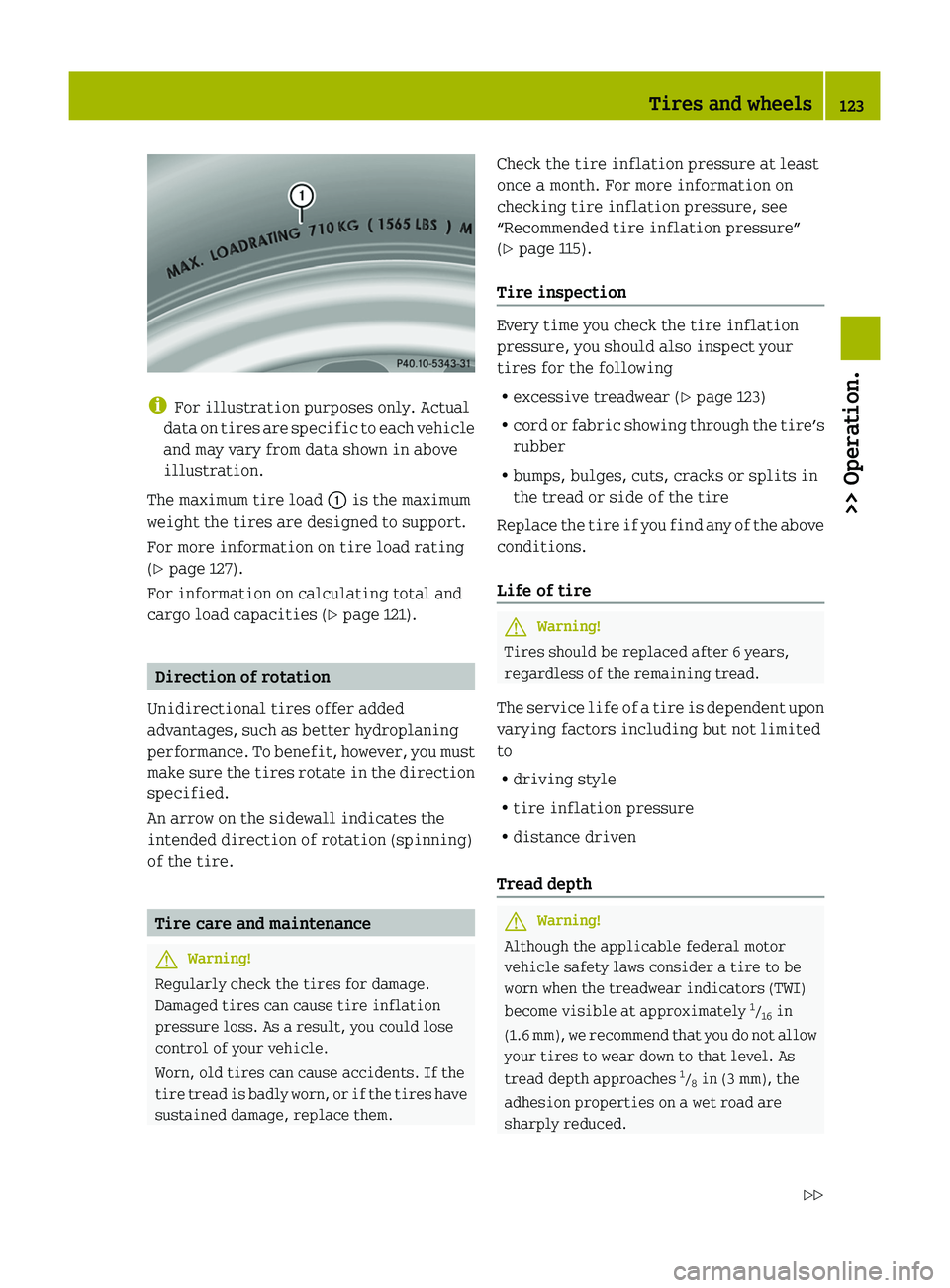
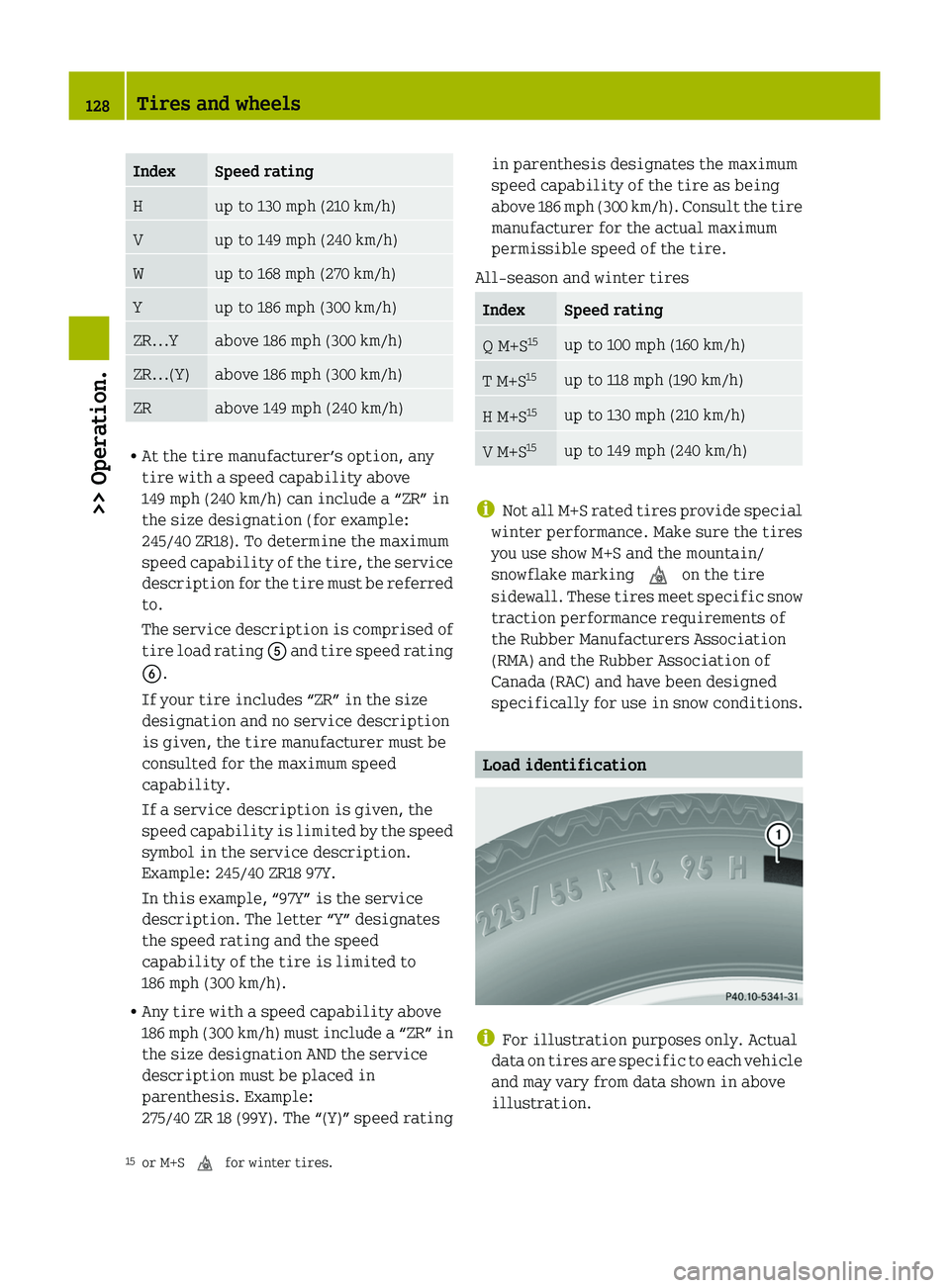
iFor illustration purposes only. Actual
data on tires are specific to each vehicle
and may vary from data shown in above
illustration.
The maximum tire load 0046 is the maximum
weight the tires are designed to support.
For more information on tire load rating
( Y page 127).
For information on calculating total and
cargo load capacities ( Y page 121).
Direction of rotation
Unidirectional tires offer added
advantages, such as better hydroplaning
performance. To benefit, however, you must
make sure the tires rotate in the direction
specified.
An arrow on the sidewall indicates the
intended direction of rotation (spinning)
of the tire.
Tire care and maintenance
GWarning!
Regularly check the tires for damage.
Damaged tires can cause tire inflation
pressure loss. As a result, you could lose
control of your vehicle.
Worn, old tires can cause accidents. If the
tire tread is badly worn, or if the tires have
sustained damage, replace them.
Check the tire inflation pressure at least
once a month. For more information on
checking tire inflation pressure, see
“Recommended tire inflation pressure”
( Y page 115).
Tire inspection
Every time you check the tire inflation
pressure, you should also inspect your
tires for the following
R excessive treadwear ( Y page 123)
R cord or fabric showing through the tire’s
rubber
R bumps, bulges, cuts, cracks or splits in
the tread or side of the tire
Replace the tire if you find any of the above
conditions.
Life of tire
GWarning!
Tires should be replaced after 6 years,
regardless of the remaining tread.
The service life of a tire is dependent upon
varying factors including but not limited
to
R driving style
R tire inflation pressure
R distance driven
Tread depth
GWarning!
Although the applicable federal motor
vehicle safety laws consider a tire to be
worn when the treadwear indicators (TWI)
become visible at approximately 1
/ 16 in
(1.6 mm), we recommend that you do not allow
your tires to wear down to that level. As
tread depth approaches 1
/ 8 in (3 mm), the
adhesion properties on a wet road are
sharply reduced.
Tires and wheels123>> Operation.451_AKB; 3; 22, en-USd2ureepe,Version: 2.11.8.12009-07-27T09:36:34+02:00 - Seite 123Z
Page 127 of 216
For example, a tire graded 150 would wear
one and one-half (1 1
/ 2) times as well on the
government course as a tire graded 100.
The relative performance of tires depends
upon the actual conditions of their use,
however, and may depart significantly from
the norm due to variations in driving
habits, service practices and differences
in road characteristics and climate.
Traction GWarning!
The traction grade assigned to this tire is
based on straight-ahead braking traction
tests, and does not include acceleration,
cornering, hydroplaning, or peak traction
characteristics.
The traction grades, from highest to
lowest, are AA, A, B, and C. Those grades
represent the tire’s ability to stop on wet
pavement as measured under controlled
conditions on specified government test
surfaces of asphalt and concrete. A tire
marked C may have poor traction
performance.
Temperature
GWarning!
The temperature grade for this tire is
established for a tire that is properly
inflated and not overloaded. Excessive
speed, underinflation, or excessive
loading, either separately or in
combination, can cause excessive heat
build-up and possible tire failure.
The temperature grades are A (the highest),
B, and C, representing the tire’s resistance
to the generation of heat and its ability to
dissipate heat when tested under
controlled conditions on a specified
indoor laboratory test wheel. Sustained
high temperature can cause the material of
the tire to degenerate and reduce tire life,
and excessive temperature can lead to
sudden tire failure. The grade C
corresponds to a level of performance
which all passenger car tires must meet
under the Federal Motor Vehicle Safety
Standard No. 109. Grades B and A represent
higher levels of performance on the
laboratory test wheel than the minimum
required by law.
Rotating tires
GWarning!
Do not rotate front and rear wheels as they
have different dimensions, e.g. rim size,
wheel offset etc. Otherwise, the handling
can be affected and you could endanger
yourself and others.
Thoroughly clean the mounting face of the
wheels and brake discs, i.e. the inner side
of the wheels/tires each time the wheels/
tires are changed. Check for and ensure
proper tire inflation pressure.
GWarning!
Have the tightening torque checked after
changing a wheel. Wheels could become
loose if not tightened with a torque of
81 lb‑ft (110 Nm).
Only use genuine smart wheel bolts
specified for your vehicle’s rims.
For information on wheel change, see “Flat
tire” ( Y page 172).
Tire labeling
Besides tire name (sales designation) and
manufacturer name, a number of markings
can be found on a tire.
Following are some explanations for the
markings on your vehicle’s tires:
Tires and wheels125>> Operation.451_AKB; 3; 22, en-USd2ureepe,Version: 2.11.8.12009-07-27T09:36:34+02:00 - Seite 125Z
Page 130 of 216
IndexSpeed ratingHup to 130 mph (210 km/h)Vup to 149 mph (240 km/h)Wup to 168 mph (270 km/h)Yup to 186 mph (300 km/h)ZR...Yabove 186 mph (300 km/h)ZR...(Y)above 186 mph (300 km/h)ZRabove 149 mph (240 km/h)
RAt the tire manufacturer’s option, any
tire with a speed capability above
149 mph (240 km/h) can include a “ZR” in
the size designation (for example:
245/40 ZR18). To determine the maximum
speed capability of the tire, the service
description for the tire must be referred
to.
The service description is comprised of
tire load rating 0086 and tire speed rating
0087 .
If your tire includes “ZR” in the size
designation and no service description
is given, the tire manufacturer must be
consulted for the maximum speed
capability.
If a service description is given, the
speed capability is limited by the speed
symbol in the service description.
Example: 245/40 ZR18 97Y.
In this example, “97Y” is the service
description. The letter “Y” designates
the speed rating and the speed
capability of the tire is limited to
186 mph (300 km/h).
R Any tire with a speed capability above
186 mph (300 km/h) must include a “ZR” in
the size designation AND the service
description must be placed in
parenthesis. Example:
275/40 ZR 18 (99Y). The “(Y)” speed rating
in parenthesis designates the maximum
speed capability of the tire as being
above 186 mph (300 km/h). Consult the tire
manufacturer for the actual maximum
permissible speed of the tire.
All-season and winter tiresIndexSpeed ratingQ M+S 15up to 100 mph (160 km/h)T M+S15up to 118 mph (190 km/h)H M+S 15up to 130 mph (210 km/h)V M+S15up to 149 mph (240 km/h)
i
Not all M+S rated tires provide special
winter performance. Make sure the tires
you use show M+S and the mountain/
snowflake marking 004D on the tire
sidewall. These tires meet specific snow
traction performance requirements of
the Rubber Manufacturers Association
(RMA) and the Rubber Association of
Canada (RAC) and have been designed
specifically for use in snow conditions.
Load identification
i For illustration purposes only. Actual
data on tires are specific to each vehicle
and may vary from data shown in above
illustration.
15 or M+S 004D for winter tires.128Tires and wheels>> Operation.
451_AKB; 3; 22, en-USd2ureepe,Version: 2.11.8.12009-07-27T09:36:34+02:00 - Seite 128
Page 134 of 216
Tire ply composition and material used
This indicates the number of plies or the
number of layers of rubber-coated fabric
in the tire tread and sidewall. Tire
manufacturers also must indicate the ply
materials in the tire and sidewall, which
include steel, nylon, polyester, and others.
Tire speed rating
Part of tire designation; indicates the
speed range for which a tire is approved.
Total load limit
Rated cargo and luggage load plus
68 kilograms (150 lbs) times the vehicle’s
designated seating capacity.
Traction
Force exerted by the vehicle on the road via
the tires. The amount of grip provided.
Tread
The portion of a tire that comes into
contact with the road.
Treadwear indicators
Narrow bands, sometimes called “wear
bars” that show across the tread of a tire
when only 1
/ 16 in (1.6 mm) of tread remains.
Uniform Tire Quality Grading Standards
A tire information system that provides
consumers with ratings for a tire’s
traction, temperature and treadwear.
Ratings are determined by tire
manufacturers using U.S. government
testing procedures. The ratings are molded
into the sidewall of the tire.
Vehicle maximum load on the tire
Load on an individual tire that is
determined by distributing to each axle
its share of the maximum loaded vehicle
weight and dividing it by two.
Winter driving
Before the onset of winter, have your
vehicle winterized at an authorized smart
center. This service includes:
R Check of anticorrosion and antifreeze
concentration.
R Addition of washer concentrate to the
water of the windshield/rear window.
Use a windshield washer concentrate
labeled for winter which is formulated
for temperatures below freezing point
( Y page 208).
R Battery test. Battery capacity drops with
decreasing ambient temperature. A well
charged battery helps to make sure the
engine can be started, even at low
ambient temperatures.
R Tire change.
Winter tires
GWarning!
Winter tires with a tread depth of less than
1 / 6 in (4 mm) must be replaced. They are no
longer suitable for winter operation.
Always use winter tires at temperatures
below 45 ¦ (7¥ ) and whenever wintry road
conditions prevail. Not all M+S rated tires
provide special winter performance. Make
sure the tires you use show the mountain/
snowflake marking 004D on the tire
sidewall. These tires meet specific snow
traction performance requirements of the
Rubber Manufacturers Association (RMA)
and the Rubber Association of Canada (RAC)
and have been designed specifically for
use in snow conditions. Use of winter tires
is the only way to achieve the maximum
132Winter driving>> Operation.
451_AKB; 3; 22, en-USd2ureepe,Version: 2.11.8.12009-07-27T09:36:34+02:00 - Seite 132
Page 136 of 216
Driving instructions
Drinking and driving
GWarning!
Do not drink alcohol or take drugs and drive
or allow anyone to drive who has been
drinking alcohol or taking drugs. Even a
small amount of alcohol or drugs can affect
your reflexes, perceptions and judgment.
The possibility of a serious or even fatal
accident are greatly increased when you
drink or take drugs and drive.
Pedals
GWarning!
Make sure absolutely no objects are
obstructing the pedals’ range of motion.
Keep the driver’s footwell clear of all
obstacles. If there are any floormats* or
carpets in the footwell, make sure the
pedals still have sufficient clearance.
During sudden acceleration or braking
maneuvers, the objects could get caught
between or beneath the pedals and restrict
your ability to brake or accelerate. This
could lead to accidents and/or injury.
Power assistance
GWarning!
With the engine not running, there is no
power assistance for the brake and
steering* systems. In this case, it is
important to keep in mind that a
considerably higher degree of effort is
necessary to brake and steer the vehicle.
Adapt your driving accordingly.
BrakesGWarning!
Make sure not to endanger any other road
users when carrying out braking
maneuvers.
Refer to the description of the hydraulic
brake assistant ( Y page 46).
! Because the ESP ®
operates
automatically, the engine must be turned
off (ignition switched off) when the
parking brake is being tested on a brake
test dynamometer. Active braking action
through the ESP ®
may otherwise seriously
damage the brake system which is not
covered by the smart Limited Warranty.
Brake pad wear or a leak in the brake system
may be the reason for low brake fluid level
in the brake fluid reservoir.
The brake fluid level in the brake fluid
reservoir may be too low if the brake
warning lamp in the instrument cluster
comes on ( Y page 22) although the parking
brake is released.
Have the brake system inspected
immediately. Contact an authorized smart
center.
All checks and service work on the brake
system should be carried out by qualified
technicians only. Contact an authorized
smart center.
Only install brake pads and use brake fluid
recommended by smart.
Inclines
! When driving down long and steep
grades, relieve the load on the brakes by
shifting into a lower gear to use the
engine’s braking power. This helps
prevent overheating of the brakes and
reduces brake pad wear.
When using the engine’s braking power, a
drive wheel may not spin for an extended
period of time, e.g. on slippery road
134Driving instructions>> Operation.* optional451_AKB; 3; 22, en-USd2ureepe,Version: 2.11.8.12009-07-27T09:36:34+02:00 - Seite 134
Page 138 of 216
GWarning!
If other than recommended brake pads are
installed, or other than recommended brake
fluid is used, the braking properties of the
vehicle can be degraded to an extent that
safe braking is substantially impaired.
This could result in an accident.
GWarning!
New brake pads will not achieve their
optimal braking effect until after several
hundred miles (kilometers). This means
that you must compensate for the reduced
braking effect by pressing harder on the
brake pedal and adapt your driving style
accordingly. The same applies after brake
pads or brake discs have been changed.
Drive sensibly - save fuel
Fuel consumption, to a great extent,
depends on driving habits and operating
conditions.
To save fuel you should:
R Shift gears in a timely manner.
R Avoid frequent acceleration and
deceleration.
R Keep tires at the recommended inflation
pressures.
R Remove carriers* when not in use.
R Remove unnecessary loads.
R Allow engine to warm up under low load
use.
R Have all maintenance work performed at
the intervals specified in the
Maintenance Booklet and as required by
the Maintenance System. Contact an
authorized smart center.
Fuel consumption is also increased by
driving in cold weather, in stop-and-go
traffic, on short trips, and in hilly areas.
Catalytic converter
Your smart is equipped with monolithic-
type catalytic converter, an important
element in conjunction with the oxygen
sensors to achieve substantial control of
the pollutants in the exhaust emissions.
Keep your vehicle in proper operating
condition by following our recommended
maintenance instructions as outlined in
your Maintenance Booklet.GWarning!
The catalytic converter can become very
hot. Coming into contact with the catalytic
converter could result in burns.
Note the following:
R Do not remove the protective heat guards.
R Do not apply any underseal.
R As with any vehicle, do not idle, park, or
operate this vehicle in areas where
combustible materials such as grass,
hay, or leaves can come into contact with
the hot exhaust system, as these
materials could be ignited and cause a
vehicle fire.
! To prevent damage to the catalytic
converter, only use premium unleaded
gasoline in this vehicle.
Any noticeable irregularities in engine
operation should be repaired promptly.
Otherwise, excessive unburned fuel may
reach the catalytic converter, causing it
to overheat and potentially start a fire.
It is essential to observe the following
points, as there is otherwise a danger of
overheating and the catalytic converter
may be damaged.
R Fill up only with premium unleaded
gasoline. Even small quantities of
leaded gasoline can damage the catalytic
converter.
R Make sure you adhere to the prescribed
service intervals.
136Driving instructions>> Operation.* optional451_AKB; 3; 22, en-USd2ureepe,Version: 2.11.8.12009-07-27T09:36:34+02:00 - Seite 136
Page 142 of 216
malfunction of the vehicle’s electronic
system, possibly resulting in an accident
and/or serious personal injury.
Radio transmitters, such as a mobile phone
or a citizens band unit should only be used
inside the vehicle if they are connected to
an antenna that is installed on the outside
of the vehicle.
Refer to the radio transmitter operation
instructions regarding use of an external
antenna.
Emission control
Certain engine systems serve to keep the
toxic components of the exhaust gases
within permissible legal limits.
These systems, of course, will function
properly only when maintained strictly
according to factory specifications.
Any adjustments to the engine should
therefore be carried out only by qualified
smart center authorized technicians.
Engine adjustments should not be altered
in any way. Moreover, the specified service
jobs must be carried out regularly
according to smart servicing
requirements. For details refer to the
Maintenance Booklet.
GWarning!
Inhalation of exhaust gas is hazardous to
your health. All exhaust gas contains
carbon monoxide (CO), and inhaling it can
cause unconsciousness and lead to death.
Do not run the engine in confined areas
(such as a garage) which are not properly
ventilated. If you think that exhaust gas
fumes are entering the vehicle while
driving, have the cause determined and
corrected immediately. If you must drive
under these conditions, drive only with at
least one window fully open at all times.
Coolant temperature
During severe operating conditions and
stop-and-go city traffic, the coolant
temperature may rise.
! Excessive coolant temperature causes
the red coolant temperature warning
lamp 00AE in the instrument cluster
comes on.
The engine should not be operated with
the red coolant temperature warning
lamp illuminated. Doing so may cause
serious engine damage which is not
covered by the smart Limited Warranty.
For more information on coolant
temperature warning lamp ( Y page 156).GWarning!
Driving when your engine is overheated can
cause some fluids which may have leaked
into the engine compartment to catch fire.
You could be seriously burned.
Steam from an overheated engine can cause
serious burns which can occur just by
opening the engine hood. Stay away from the
engine if you see or hear steam coming from
it.
Stop the vehicle in a safe location away
from other traffic. Turn off the engine, get
out of the vehicle and do not stand near the
vehicle until the engine has cooled down.
Driving abroad
Abroad, there is an extensive smart service
network at your disposal. If you plan to
drive into areas which are not listed in the
index of your smart center directory, you
should request pertinent information from
an authorized smart center.
Symmetrical low beams
i If you drive in countries where
vehicles drive on the other side of the
140Driving abroad>> Operation.
451_AKB; 3; 22, en-USd2ureepe,Version: 2.11.8.12009-07-27T09:36:34+02:00 - Seite 140
Page 169 of 216
Replacing bulbs for front lamps
Before you start to replace a bulb for a
front lamp, do the following first:XTurn the exterior lamp switch to position
0027 (Y page 62).XSwitch off the ignition.XOpen the service flap ( Y page 110).
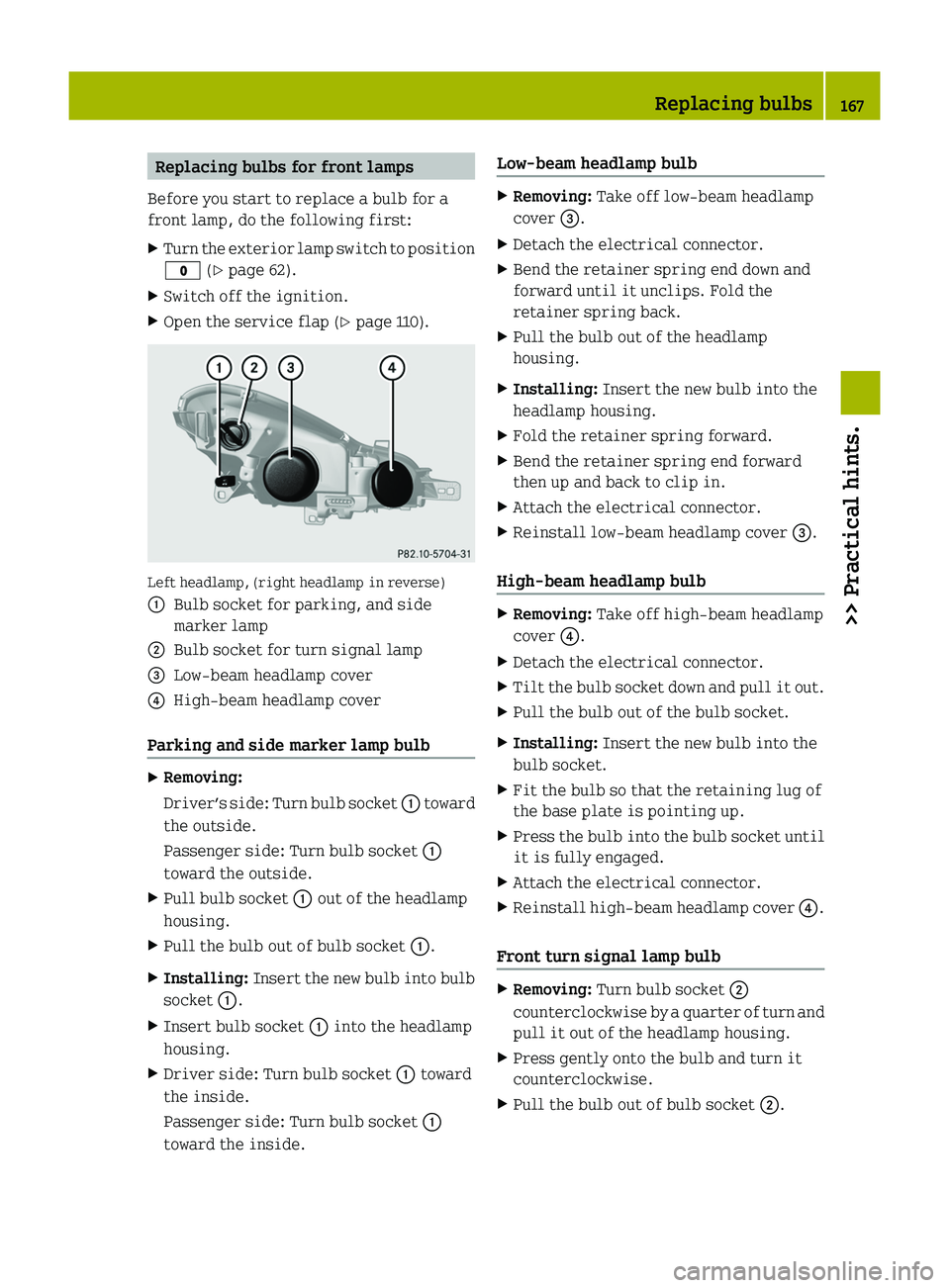
Left headlamp, (right headlamp in reverse)
0046Bulb socket for parking, and side
marker lamp0047Bulb socket for turn signal lamp008ALow‑beam headlamp cover0088High‑beam headlamp cover
Parking and side marker lamp bulb
XRemoving:
Driver’s side: Turn bulb socket 0046 toward
the outside.
Passenger side: Turn bulb socket 0046
toward the outside.XPull bulb socket 0046 out of the headlamp
housing.XPull the bulb out of bulb socket 0046.XInstalling: Insert the new bulb into bulb
socket 0046.XInsert bulb socket 0046 into the headlamp
housing.XDriver side: Turn bulb socket 0046 toward
the inside.
Passenger side: Turn bulb socket 0046
toward the inside.Low‑beam headlamp bulbXRemoving: Take off low‑beam headlamp
cover 008A.XDetach the electrical connector.XBend the retainer spring end down and
forward until it unclips. Fold the
retainer spring back.XPull the bulb out of the headlamp
housing.XInstalling: Insert the new bulb into the
headlamp housing.XFold the retainer spring forward.XBend the retainer spring end forward
then up and back to clip in.XAttach the electrical connector.XReinstall low‑beam headlamp cover 008A.
High‑beam headlamp bulb
XRemoving: Take off high‑beam headlamp
cover 0088.XDetach the electrical connector.XTilt the bulb socket down and pull it out.XPull the bulb out of the bulb socket.XInstalling: Insert the new bulb into the
bulb socket.XFit the bulb so that the retaining lug of
the base plate is pointing up.XPress the bulb into the bulb socket until
it is fully engaged.XAttach the electrical connector.XReinstall high‑beam headlamp cover 0088.
Front turn signal lamp bulb
XRemoving: Turn bulb socket 0047
counterclockwise by a quarter of turn and
pull it out of the headlamp housing.XPress gently onto the bulb and turn it
counterclockwise.XPull the bulb out of bulb socket 0047.Replacing bulbs167>> Practical hints.451_AKB; 3; 22, en-USd2ureepe,Version: 2.11.8.12009-07-27T09:36:34+02:00 - Seite 167Z