front side SMART FORTWO COUPE ELECTRIC DRIVE 2014 Owners Manual
[x] Cancel search | Manufacturer: SMART, Model Year: 2014, Model line: FORTWO COUPE ELECTRIC DRIVE, Model: SMART FORTWO COUPE ELECTRIC DRIVE 2014Pages: 222, PDF Size: 16.17 MB
Page 7 of 222
C
CAC (Customer Assistance Center) ......18
California retail buyers and les-
sees, important notice for ...............14
Cargo compartment cover blind ........104
CD player ..................................... 95
Center console ............................... 27
Central locking Automatic ................................ 53
Locking/unlocking from inside ....53
Certification label .......................214
Charge level gauge ......................... 81
Charging High-voltage battery ................. 112
Charging cable
Connecting .............................. 117
Control element ....................... 116
Storing .................................. 115
Warming up ............................. 114
Children in the vehicle ...................42
Air bags .................................. 33
Indicator lamp, passenger front
air bag off .......................... 41, 175
Infant and child restraint sys-
tems ....................................... 43
OCS (Occupant Classification
System) ................................... 39
Safety notes ............................. 42
Tether anchorage points .............44
Child safety
see Children in the vehicle
Cockpit ........................................ 22
Coin holder ................................. 106
Cold tire inflation pressure ...........144
Combination switch ........................66
Control system Charge and depart menu ..............90
Charging mode display ...............87
Control lever ............................ 83
Introduction ............................ 83
Menus and submenus ...................89
Messages menu .......................... 93
Multifunction display ................83
Odometer menu .......................... 89
Recuperation display .................84
Reset menu ............................... 90Settings menu
........................... 93
Start menu ............................... 90
Time menu ............................... 94
Coolant
Anticorrosion/antifreeze ....219, 220
Battery .................................. 125
Capacities ........................ 218, 219
Drive system ........................... 125
Temperature warning lamp .........172
Coolant temperature ......................152
Copyright ..................................... 19
Cruise control ............................... 97
Curb weight ................................. 144
Customer Assistance Center (CAC) ......18 D
Dashboard see Instrument cluster
Data recording .............................. 19
Daytime running lamp mode ..............65
Deep water see Standing water
Defroster
Rear window ............................ 103
Windshield ............................. 103
Department of Transportation
see DOT
Direction of rotation (tires) ...........137
Door control panel ......................... 28
Door handles ................................. 28
Doors Locking/unlocking from outside ...53
Opening from inside ..................54
DOT (Department of Transporta-
tion) .................................... 142, 144
Drinking and driving .....................147
Drive diagnostics Indicator lamp ........................ .173
Warning lamp ........................... 173
Driving
Abroad ................................... 153
Coolant temperature .................152
Hydroplaning .......................... 150
Instructions ....................... 76, 147
In winter ................................ 151
Safety systems .......................... 46 Index
5
Page 8 of 222
Through standing water
.............152
Tips, recuperation .....................81
Tips, transmission ..................... 81
Driving and parking
Safety notes ............................. 76
Driving safety systems ....................46
ABS ........................................ 46
ESP ®
....................................... 47
Hydraulic brake assistant ...........48 E
ECO indicator ............................... 86
Electrical system Improper work on or modifica-
tions ....................................... 16
Power outlet ............................ 110
Electronic immobilizer ..................49
Electronic Power Steering see EPS
Electronic Stability Program
see ESP ®
Emergency, in case of Hazard warning flasher ..........48, 68
Roadside Assistance ................... 15
Emergency Tensioning Device
see ETD
Emission control
Information label .....................214
System warranties ......................13
Engine
Electronics ............................. 212
Starting .................................. 76
Turning off .............................. 79
EPS (Electronic Power Steering)
Warning lamp .......................... 170
ESP ®
(Electronic Stability Program) ...47
Warning lamp .......................... 170
ETD (Emergency Tensioning Device) ...33
Safety guidelines ......................35
Exterior lamp switch ......................64
Exterior lighting Overview ................................ 180
Exterior rear view mirrors ..............61 F
Flat tire ..................................... 187
Fluids Capacities .............................. 218
Fog lamps ................................ 67, 180
Front air bags see Air bags
Front compartment ........................ 123
Front lamps Overview ................................ 180
Fuse chart ................................... 208
Fuses ......................................... 205 G
GAWR (Gross Axle Weight Rating) ......144
Global locking/unlocking ................53
Glove box .................................... 106
Gross Axle Weight Rating see GAWR
Gross Vehicle Weight
see GVW
Gross Vehicle Weight Rating
see GVWR
GVW (Gross Vehicle Weight) .............144
GVWR (Gross Vehicle Weight Rating) ..144 H
Halogen headlamps see Headlamps
Hazard warning flasher .................... 68
Headlamps Automatic headlamp mode ............ 64
Daytime running lamp mode .........65
High-beam flasher .....................66
High-beam headlamps ................. 66
Low-beam headlamps ..................64
Switch ..................................... 64
Head-thorax air bags ......................37
Heated exterior rear view mirrors .....61
Height adjustment Seats ...................................... 59
High-beam flasher ......................... 66
High-beam headlamps ................66, 180
Indicator lamp ......................... 171
High-mounted brake lamp ...............1816
Index
Page 10 of 222
Overview (kilometers)
................26
Overview (miles) ....................... 24
Passenger front air bag off ....36, 175
Seat belt telltale .....................168
SRS ........................................ 169
Turn signals ............................ 172
License plate lamps .......................181
Lighting ...................................... 64
Ambient lighting* .....................67
Coming home function ................66
Daytime running lamp mode .........65
Exterior .................................. 64
Interior .................................. 68
Loading
see Vehicle loading
Locking the vehicle ........................52
Manually ................................. 177
Loss of
Key ........................................ 176
Service and Warranty Informa-
tion booklet ............................ 212
Low-beam headlamps .................64, 180
Exterior lamp switch ..................64
Indicator lamp .........................1 71
Switching on ............................ 64M
Maintenance .................................. 14
Manual headlamp mode (Low-beam
headlamps) ................................... 64
Maximum loaded vehicle weight .......144
Maximum load rating (tires) ............144
Maximum permissible tire infla-
tion pressure ............................... 144
Mirrors Exterior rear view mirrors ..........61
Interior rear view mirror ............61 N
Normal occupant weight .................145
Number, vehicle identification
(VIN) .......................................... 215 O
Occupant Classification System see OCS (Occupant Classifica-
tion System)
Occupant distribution ...................145
Occupant safety Air bags .................................. 33
Children and air bags ................33
Children in the vehicle ..............42
Infant and child restraint sys-
tems ....................................... 43
Introduction ............................ 30
OCS (Occupant Classification
System) ................................... 39
Passenger front air bag off
indicator lamp ......................... 39
Seat belts ............................ 31, 35
SRS indicator lamp, malfunction .169
OCS (Occupant Classification Sys-
tem) ............................................ 39
Self-test ................................. 42
On-board Diagnostics Socket (OBD) ...213
Online access .............................. 120
Operating range ............................. 14
Operating safety ............................ 16
Outside temperature display ............87
Overhead control panel ...................28 P
Paintwork care ............................. 157
Panic alarm .................................. 45
Parcel nets ............................ 104, 107
Parking ........................................ 77
Parking brake ................................ 77
Parking lamps .............................. 180
Parts service ............................... 212
PASS AIR BAG OFF indicator lamp see Passenger front air bag off
indicator lamp
Passenger front air bag ...................36
Passenger front air bag off indica-
tor lamp ............................. 28, 36, 175
Passenger safety see Occupant safety
Passenger seat .............................. .59
Pedals ........................................ 1478
Index
Page 30 of 222
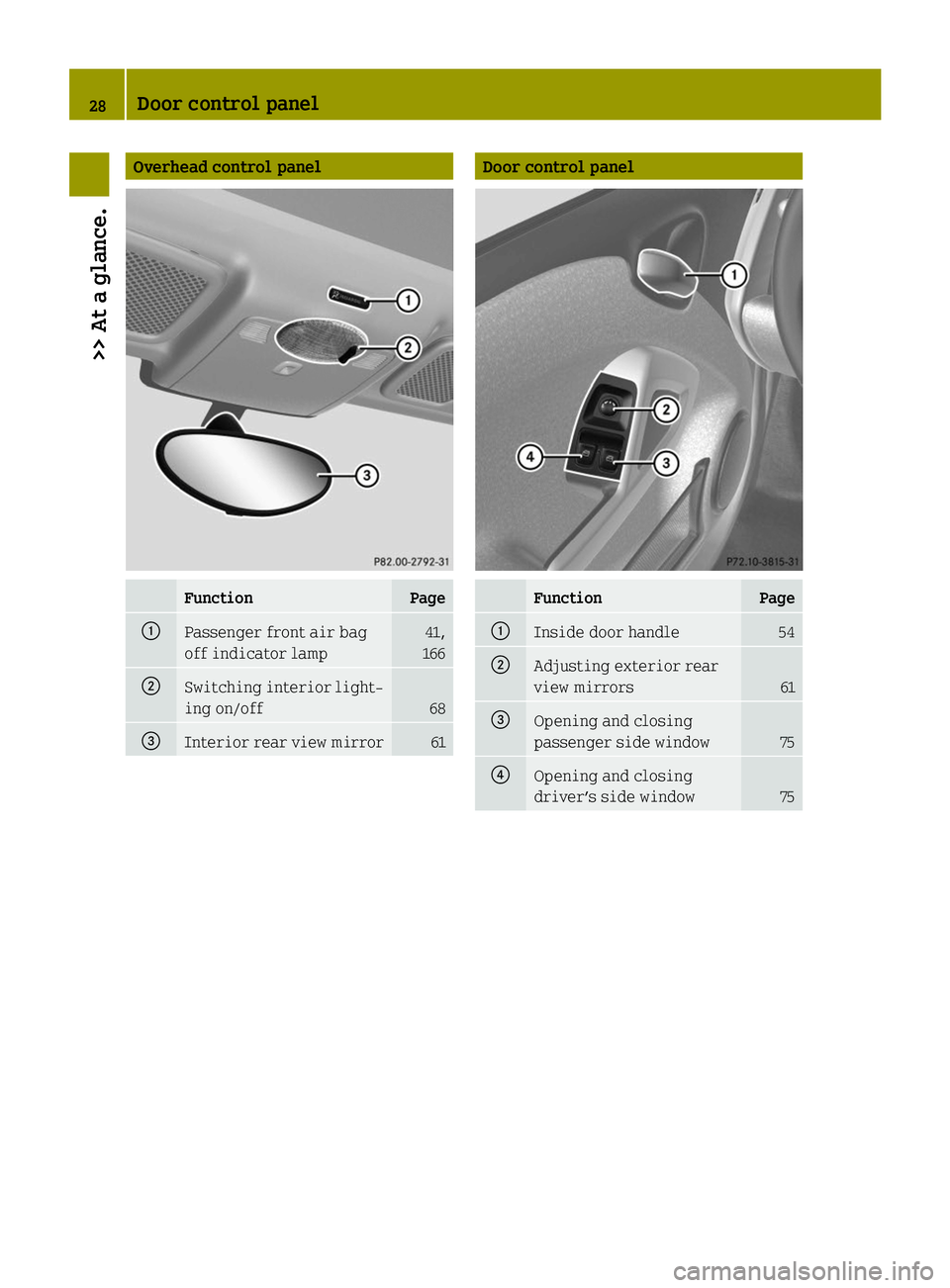
Overhead control panel
Function Page
0043
Passenger front air bag
off indicator lamp 41,
166 0044
Switching interior light-
ing on/off
68
0087
Interior rear view mirror 61 Door control panel
Function Page
0043
Inside door handle 54
0044
Adjusting exterior rear
view mirrors
61
0087
Opening and closing
passenger side window
75
0085
Opening and closing
driver’s side window
7528
Door control panel>> At a glance.
Page 34 of 222
that is as upright as possible and the belt
is properly positioned on the body. G
WARNING
Never let more people ride in the vehicle
than there are seat belts available. Make
sure everyone riding in the vehicle is cor-
rectly restrained with a separate seat belt.
Never use a seat belt for more than one per-
son at a time. G
WARNING
Seat belts of a vehicle involved in an acci-
dent must be inspected by smart. Only then
is it possible to determine whether the seat
belts were damaged or stressed in the acci-
dent. Damaged or stressed seat belts may
not properly protect you in a subsequent
accident.
Only use seat belts which have been
approved by smart.
Do not make any modifications to the seat
belts. This can lead to unintended activa-
tion of the Emergency Tensioning Devices
(ETDs) or to their failure to activate when
necessary.
Do not bleach or dye seat belts as this may
severely weaken them. In a crash, they may
not be able to provide adequate protection.
Have all work carried out only by qualified
technicians. Contact an authorized elec-
tric drive smart center. G
WARNING
USE SEAT BELTS PROPERLY
R Seat belts can only work when used prop-
erly. Never wear seat belts in any other
way than as described in this section, as
that could result in serious injuries in
case of an accident.
R Each occupant should wear their seat belt
at all times, because seat belts help
reduce the likelihood of and potential
severity of injuries in accidents,
including rollovers. The integrated
restraint system includes SRS (driver front air bag, passenger front air bag,
head-thorax air bags) and Emergency
Tensioning Devices (ETDs) with seat belt
force limiters.
The system is designed to enhance the
protection provided by secured seat
belts in certain frontal and side
impacts.
R Never wear the shoulder belt under your
arm, against your neck or off your
shoulder. Doing so may cause your body to
move too far forward in a frontal crash,
which would increase the chance of head
and neck injuries. The seat belt would
also apply too much force to the ribs or
abdomen, which could severely injure
internal organs such as your liver or
spleen.
R Never wear seat belts over rigid or
breakable objects in or on your clothing,
such as eyeglasses, pens, keys, etc., as
these might cause injuries.
R Position the lap belt as low as possible
on your hips and not across the abdomen.
If the lap seat belt is positioned across
your abdomen, it could cause serious
injuries in a crash.
R Never use a seat belt for more than one
person at a time. Do not fasten a seat belt
around a person and another person or
other objects at the same time.
R Seat belts should not be worn twisted. In
a crash, you would not have the full width
of the seat belt to manage impact forces.
The twisted seat belt against your body
could cause injuries.
R Pregnant women should also always use a
lap-shoulder belt. The lap belt portion
should be positioned as low as possible
on the hips to avoid any possible pres-
sure on the abdomen.
R Never place your feet on the instrument
panel, dashboard or on the seat. Always 32
Occupant safety>> Safety.
Page 35 of 222
keep both feet on the floor in front of the
seat.
R When using a seat belt to secure infant or
toddler restraints or children in booster
seats, always follow the child seat man-
ufacturer’s instructions. Emergency Tensioning Devices (ETDs)
and seat belt force limiters
The seat belts are equipped with Emer-
gency Tensioning Devices and seat belt
force limiters.
Emergency Tensioning Devices are
designed to activate in the following
cases:
R in frontal or rear-end impacts exceed-
ing the system deployment threshold
R if the restraint systems are operational
and functioning correctly
R in collisions with high vehicle decel-
eration/acceleration in the longitudi-
nal direction, e.g. a head-on collision
R on passenger side when the seat is occu-
pied and the seat belt is fastened
R independently of the front air bags
When activated, Emergency Tensioning
Devices remove slack from the seat belts in
such a way that the seat belts fit more
snugly against the body. Seat belt force
limiters, when activated, reduce the force
exerted by the seat belts on occupants dur-
ing a crash.
When the emergency tensioning device is
triggered, the SRS indicator lamp 0075in
the instrument cluster illuminates, see
“SRS indicator lamp” (Y page 169).G
WARNING
Once they have been triggered, Emergency
Tensioning Devices will no longer function
properly and must be replaced. smart rec-
ommends that you visit a qualified work-
shop to have this done. In particular, work
relevant to safety or on safety-related sys- tems must be carried out at a qualified
specialist workshop.
Comply with safety regulations when dis-
posing of Emergency Tensioning Devices.
These regulations are available at any
smart center.
The belt force limiter is designed to oper-
ate in unison with the front air bag, which
absorbs a portion of the seat belt’s decel-
erating forces, distributing the load over
a larger area.
In the event of a head-on or rear-end col-
lision, the emergency tensioning device is
activated if the vehicle is decelerated or
accelerated sufficiently in the longitudi-
nal direction at the start of impact with the
ignition switched on. Air bags
Air bags can reduce the severity of inju-
ries in serious collisions, e.g. in a head-
on collision or a side impact. G
WARNING
Air bags are designed to reduce the poten-
tial of injury in certain frontal impacts
(front air bags and knee bags), or side
impacts (head-thorax air bags, window
curtain air bags and thorax-pelvis air
bags) which may cause significant inju-
ries. However, no system available today
can completely eliminate injuries and
fatalities.
The deployment of the air bags temporarily
releases a small amount of dust from the air
bags. This dust is neither injurious to your
health, nor does it indicate a fire in the
vehicle. The dust might cause some tempo-
rary breathing difficulty for people with
asthma or other breathing trouble. To avoid
this, you may wish to get out of the vehicle
as soon as it is safe to do so. If you have any
breathing difficulty but cannot get out of
the vehicle after the air bag inflates, then
get fresh air by opening a window or door. Occupant safety
33>> Safety. Z
Page 36 of 222
G
WARNING
To reduce the risk of injury when the front
air bags inflate, it is very important for
the driver and passenger to always be in a
properly seated position and to wear their
respective seat belt.
For maximum protection in the event of a
collision always be in normal seated posi-
tion with your back against the backrest.
Fasten your seat belt and ensure it is prop-
erly positioned on your body.
Since the air bag inflates with considera-
ble speed and force, a proper seating and
hands on steering wheel position will help
to keep you at a safe distance from the air
bag.
Occupants who are unbelted, out of position
or too close to the air bag can be seriously
injured or killed by an air bag as it
inflates extremely quickly and with great
force:
R Sit properly belted in a position that is
as upright as possible with your back
against the seat backrest.
R Adjust the driver’s seat as far as possible
rearward, still permitting proper oper-
ation of vehicle controls. The distance
from the center of the driver’s breast-
bone to the center of the air bag cover on
the steering wheel must be at least
10 inches (25 cm) or more. You should be
able to accomplish this by adjustments to
the seat. If you have any problems, please
contact an authorized electric drive
smart center.
R Do not lean your head or chest close to the
steering wheel or dashboard.
R Keep hands on the outside of the steering
wheel rim. Placing hands and arms inside
the rim can increase the risk and poten-
tial severity of hand/arm injury when the
driver’s front air bag inflates. R
Adjust the passenger seat as far as pos-
sible rearward from the dashboard when
the seat is occupied.
R Occupants, especially children, should
never place their bodies or lean their
heads in the area of the door where the
head-thorax air bag (cabriolet) or
thorax-pelvis side air bag (coupé)
inflates. This could result in serious
injuries or death should the head-thorax
air bag (cabriolet) or thorax-pelvis side
air bag (coupé) be deployed. Always sit
as upright as possible, wear the seat belt
properly and use an appropriately sized
infant restraint, toddler restraint, or
booster seat recommended for the size
and weight of the child.
Failure to follow these instructions can
result in severe injuries to you or other
occupants.
If you sell your vehicle, it is important that
you make the buyer aware of this safety
information. Be sure to give the buyer this
Operator’s Manual.
i Air bags are designed to deploy only in
certain frontal impacts (front air bags
and knee bags), or side impacts (head-
thorax air bags, window curtain air bags
and thorax-pelvis air bags) which
exceed preset thresholds. Only during
these events will they provide their sup-
plemental protection.
The driver and passenger should always
wear their seat belts. Otherwise it is not
possible for air bags to provide their
supplemental protection.
In case of other types of impacts and
impacts below air bag deployment
thresholds, air bags will not deploy. The
driver and passenger will then be pro-
tected to the extent possible by a prop-
erly fastened seat belt. A properly fas-
tened seat belt is also needed to provide
the best possible protection in a roll-
over. 34
Occupant safety>> Safety.
Page 37 of 222
We caution you not to rely on the presence
of the air bags in order to avoid wearing
your seat belt.
It is important to your safety and that of
your passenger that you replace deployed
air bags and repair any malfunctioning
air bags to make sure the vehicle will
continue to provide supplemental crash
protection for occupants.
Safety guidelines for the seat belt,
Emergency Tensioning Devices (ETDs)
and air bag G
WARNING
R Damaged seat belts or seat belts that have
been highly stressed in an accident must
be replaced and their anchoring points
must also be checked. Only use seat belts
installed or supplied by an authorized
electric drive smart center.
R Air bags and Emergency Tensioning
Devices (ETDs) contain Perchlorate
material, which may require special
handling and regard for the environment.
Check with your local government’s dis-
posal guidelines. California residents,
see http://www.dtsc.ca.gov/
HazardousWaste/Perchlorate/index.cfm .
R Given the considerable deployment
speed, required inflation volume, and
the textile structure of the air bags,
there is the possibility of abrasions or
other, potentially more serious injuries
resulting from air bag deployment.
R Air bags and Emergency Tensioning
Devices (ETDs) are designed to function
on a one-time-only basis. An air bag or
ETD that has deployed must be replaced.
R Do not pass seat belts over sharp edges.
They could tear.
R Do not make any modification that could
change the effectiveness of the seat
belts.
R No modifications of any kind may be made
to any components or wiring of the SRS. This includes changing or removing any
component or part of the SRS, the instal-
lation of additional trim material,
badges, etc. over the steering wheel hub,
passenger front air bag cover, outboard
sides of the seat backrests, and instal-
lation of additional electrical/elec-
tronic equipment on or near SRS compo-
nents and wiring. Keep area between air
bags and occupants free from objects
(e.g. packages, purses, umbrellas, etc.).
R Do not bleach or dye seat belts as this may
severely weaken them. In a crash they may
not be able to provide adequate protec-
tion.
R Do not hang hangers on the coat hooks or
handles over the door. These items may
turn into projectiles and cause head and
other injuries when the head-thorax air
bag is deployed.
R Air bag system components will be hot
after an air bag has inflated. Do not touch
them.
R Never place your feet on the instrument
panel, dashboard, or on the seat. Always
keep both feet on the floor in front of the
seat.
R In addition, improper repair work on the
SRS creates a risk of rendering the SRS
inoperative or causing unintended air
bag deployment. Work on the SRS must
therefore only be performed by qualified
technicians. Contact an authorized elec-
tric drive smart center.
R For your protection and the protection of
others, when scrapping the air bag unit
or Emergency Tensioning Devices (ETDs),
our safety instructions must be followed.
These instructions are available from
any authorized electric drive smart
center.
How an air bag operates An air bag is inflated in a matter of mil-
liseconds. If an air bag is triggered, the Occupant safety
35>> Safety. Z
Page 38 of 222
SRS indicator lamp
0075in the instrument
cluster illuminates.
! If the air bags are activated, you will
hear a loud noise and some dust may be
generated. The explosion fundamentally
represents no risk to your hearing.
An inflated air bag slows down and reduces
the movement of the occupant. When the
occupant makes contact with a front air bag
or head-thorax air bag (cabriolet only),
hot gas flows out of the inflated front air
bags and head-thorax air bags (cabriolet
only). This reduces the load on the occu-
pant’s head and upper body. These air bags
are consequently deflated after the acci-
dent.
Driver front air bag/passenger front air
bag The front air bags are designed to reduce
the potential of injury in certain frontal
impacts.
Driver front air bag and passenger front
air bag are deployed
R at the start of an accident with high
vehicle deceleration in the longitudinal
direction
R independently of other air bags in the
vehicle being deployed
R never in the event of a rollover, unless
high vehicle deceleration in the longi-
tudinal direction is detected
i The front air bags in this vehicle have
been designed to inflate in two stages.
This allows the air bag to have different
rates of inflation that are based on the
rate of relevant vehicle deceleration
and a fastened or unfastened seat belt as
assessed by the air bag control unit.
On the passenger side, the front air bag
deployment is additionally influenced
by the passenger’s weight category as
identified by the Occupant Classifica-
tion System (OCS) (Y page 39). The lighter the passenger side occupant,
the higher the vehicle deceleration rate
required for the second stage inflation
of the air bag.
The air bags will not deploy in impacts
which do not exceed the system’s deploy-
ment thresholds. In such instances, the seat
belts are designed to protect you.
The passenger air bag will only be
deployed if
R the system, based on OCS weight sensor
readings, senses that the passenger seat
is occupied and the 0073006F
indicator lamp is not lit (Y page 41)
R the impact exceeds a preset deployment
threshold
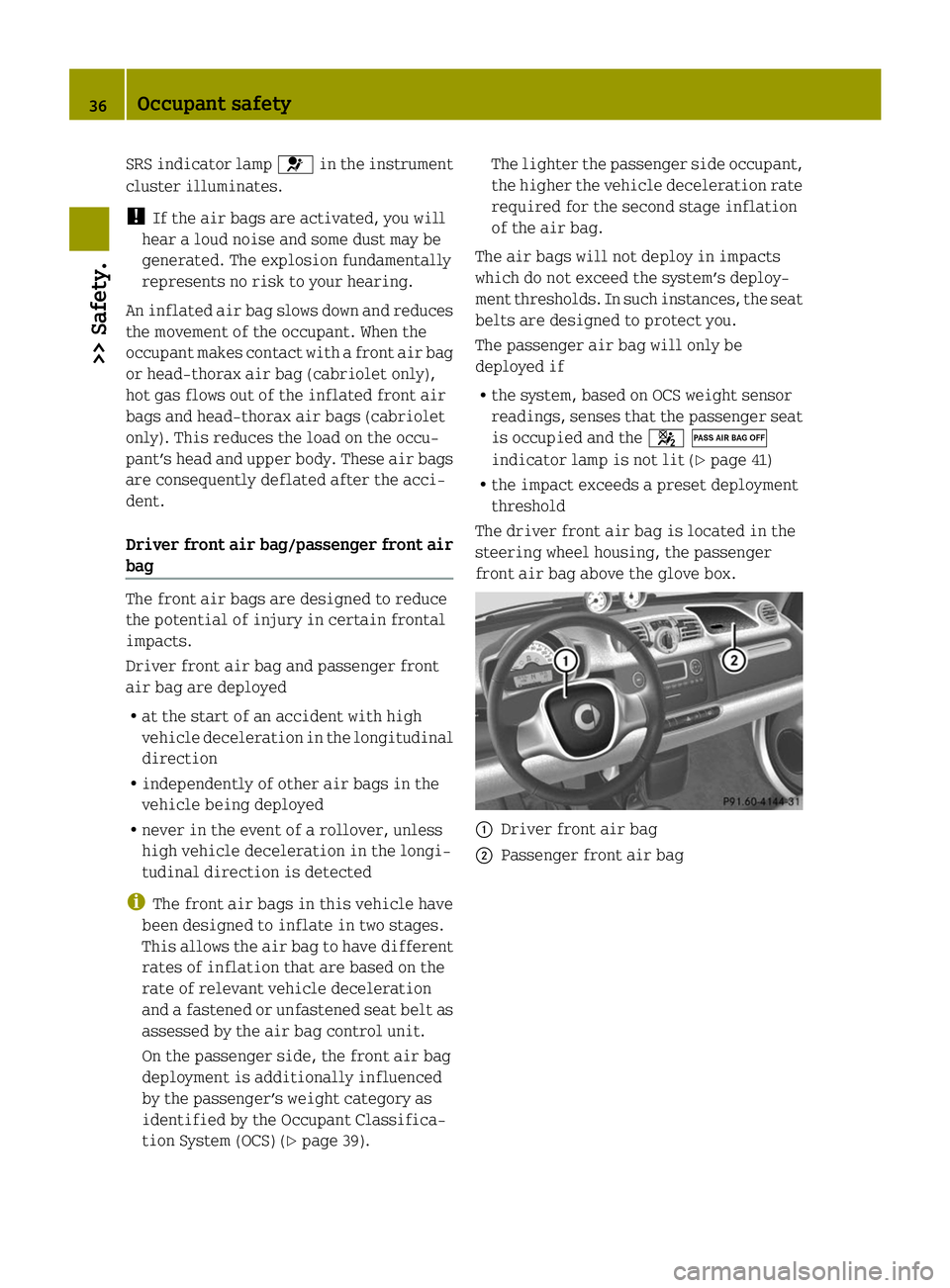
The driver front air bag is located in the
steering wheel housing, the passenger
front air bag above the glove box. 0043
Driver front air bag
0044 Passenger front air bag 36
Occupant safety>> Safety.
Page 39 of 222
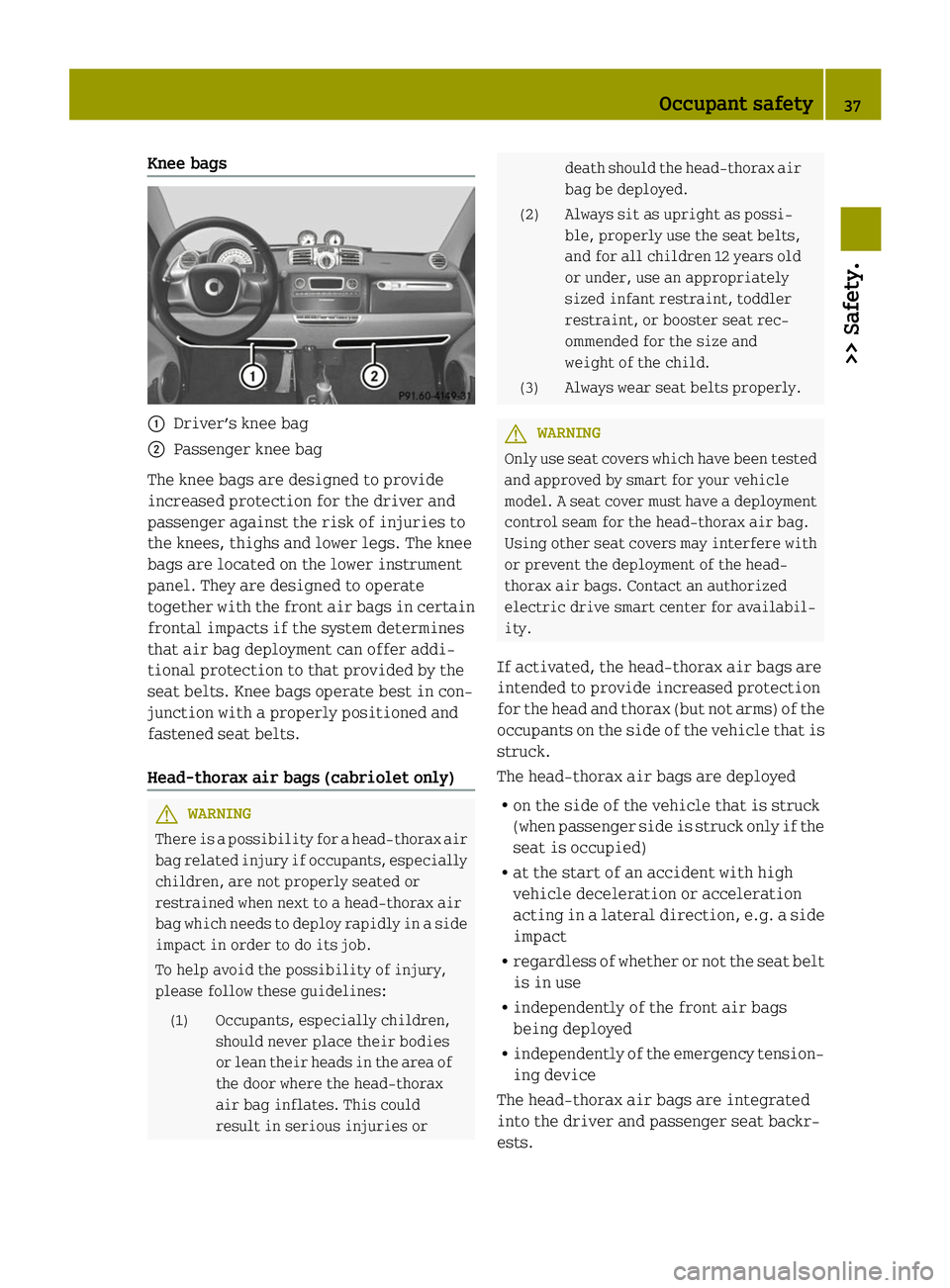
Knee bags
0043
Driver’s knee bag
0044 Passenger knee bag
The knee bags are designed to provide
increased protection for the driver and
passenger against the risk of injuries to
the knees, thighs and lower legs. The knee
bags are located on the lower instrument
panel. They are designed to operate
together with the front air bags in certain
frontal impacts if the system determines
that air bag deployment can offer addi-
tional protection to that provided by the
seat belts. Knee bags operate best in con-
junction with a properly positioned and
fastened seat belts.
Head-thorax air bags (cabriolet only) G
WARNING
There is a possibility for a head-thorax air
bag related injury if occupants, especially
children, are not properly seated or
restrained when next to a head-thorax air
bag which needs to deploy rapidly in a side
impact in order to do its job.
To help avoid the possibility of injury,
please follow these guidelines:
(1) Occupants, especially children, should never place their bodies
or lean their heads in the area of
the door where the head-thorax
air bag inflates. This could
result in serious injuries or death should the head-thorax air
bag be deployed.
(2) Always sit as upright as possi- ble, properly use the seat belts,
and for all children 12 years old
or under, use an appropriately
sized infant restraint, toddler
restraint, or booster seat rec-
ommended for the size and
weight of the child.
(3) Always wear seat belts properly. G
WARNING
Only use seat covers which have been tested
and approved by smart for your vehicle
model. A seat cover must have a deployment
control seam for the head-thorax air bag.
Using other seat covers may interfere with
or prevent the deployment of the head-
thorax air bags. Contact an authorized
electric drive smart center for availabil-
ity.
If activated, the head-thorax air bags are
intended to provide increased protection
for the head and thorax (but not arms) of the
occupants on the side of the vehicle that is
struck.
The head-thorax air bags are deployed
R on the side of the vehicle that is struck
(when passenger side is struck only if the
seat is occupied)
R at the start of an accident with high
vehicle deceleration or acceleration
acting in a lateral direction, e.g. a side
impact
R regardless of whether or not the seat belt
is in use
R independently of the front air bags
being deployed
R independently of the emergency tension-
ing device
The head-thorax air bags are integrated
into the driver and passenger seat backr-
ests. Occupant safety
37>> Safety. Z