maintenance SSANGYONG KORANDO 1997 Service User Guide
[x] Cancel search | Manufacturer: SSANGYONG, Model Year: 1997, Model line: KORANDO, Model: SSANGYONG KORANDO 1997Pages: 2053, PDF Size: 88.33 MB
Page 153 of 2053

D AEW OO M Y_2000
SECTION 1E1
M162 ENGINE ELECTRICAL
CAUTION: Disconnect the negative battery cable before removing or installing any electrical unit or when a
tool or equipment could easily come in contact with exposed electrical terminals. Disconnecting this cable
will help prevent personal injury and damage to the vehicle. The ignition must also be in LOCK unless other -
wise noted.
TABLE OF CONTENTS
Specifications 1E1 -- 2............................
Generator Specifications 1E1-- 2..................
Starting Motor Specifications 1E1-- 2...............
Battery Specifications 1E1-- 2.....................
Fastener Tightening Specifications 1E1 -- 2..........
Maintenance and Repair 1E1 -- 3...................
On-- Vehicle Service 1E1-- 3.........................Generator 1E1-- 3...............................
Starting Motor 1E1--4...........................
Battery 1E1--5.................................
Spark Plug 1E1 -- 6..............................
Ignition Cable 1E1-- 8............................
Unit Repair 1E1 -- 11..............................
Battery 1E1--11.................................
Page 155 of 2053

M162 ENGINE ELECTRICAL 1E 1 -- 3
D AEW OO M Y_2000
MAINTENANCE AND REPAIR
ON-VEHICLE SERVICE
GENERATOR
Preceding Work : Removal of the drivebelt
Removal & Installation Procedure
1. Disconnect the negative battery terminal.
2. Unscrew the nut and disconnect the terminal (1).
Installation Notice
Tightening Torque
14 -- 18 NSm (10 -- 13 lb-ft)
3. Unscrew the nut and disconnect the terminal (2).
Installation Notice
Tightening Torque
4--5NSm (35 -- 44 lb-in)
1 Terminal (B+)
2 Terminal (D+)
4. Unscrew the generator mounting bolt (3).
Installation Notice
Tightening Torque
25 NSm (18 lb-ft)
5. Remove the generator.
6. Installation should follow the removal procedure in
the reverse order.
3 Generator Mounting Bolt
4 Generator
Page 162 of 2053

1E 1 -- 10 M162 ENGINE ELECTRICAL
D AEW OO M Y_2000
Circuit Diagram
Inspection & Maintenance Procedure (for
MSE)
1. While the ignition switch is in ’OFF’ position, remove
the wiring connectors (1 and 15) from ignition coil and
measure the primary resistance between terminal
No.1 and No.15.
Specified Value
0.9 -- 1.6Ω(20°C)
Notice:If out of specified value, replace the ignition coil.
2. During engine cranking, measure primary voltage
(T1/1) between ECU terminal No. 71 and No. 69.
Specified Value
200 -- 350 V
Notice
DMeasure remaining cables.
-- T1/2 : No. 72 and 69.
-- T1/3 : No. 70 and 69.
DIf out of specified value, check ignition cable and
ECU.
3. Using a multi-- tester, measure the secondary coil re-
sistance between 5a and 5b.
Specified Value
6--8.5kΩ
Page 164 of 2053

D AEW OO M Y_2000
SECTION 1F1
ENGINE CONTROLS
CAUTION: Disconnect the negative battery cable before removing or installing any electrical unit or when a
tool or equipment could easily come in contact with exposed electrical terminals. Disconnecting this cable
will help prevent personal injury and damage to the vehicle. The ignition must also be in LOCK unless other -
wise noted.
TABLE OF CONTENTS
Engine and ECM Problem Check Report 1F1 -- 2....
Specifications 1F1 -- 3............................
Engine Data Display Table 1F1 -- 3.................
Fastener Tightening Specifications 1F1 -- 4..........
Fuel System Specification 1F1 -- 5.................
Temperature vs Resistance 1F1 -- 5................
Special Tools and Equipment 1F1 -- 6..............
Special Tools Table 1F1 -- 6.......................
Schematic and Routing Diagrams 1F1 -- 7..........
ECM Wiring Diagram
(3.2L DOHC -- MSE 3.62S) 1F1 -- 7..............
Diagnosis 1F1 -- 14................................
Failure Code Diagnosis 1F1 -- 14.....................
Clearing Failure Codes 1F1 -- 14...................
Failure Codes Table 1F1 -- 14.....................
Ignition System 1F1 -- 18...........................
Ignition Coil 1F1 -- 20.............................
Crankshaft Position (CKP) Sensor 1F1 -- 22.........
Camshaft Position (CMP) Sensor 1F1 -- 26..........
Camshaft Actuator 1F1 -- 30......................
Knock Sensor (KS) 1F1 -- 32......................
Spark Plug 1F1 -- 34.............................
System Voltage 1F1 -- 38.........................
Ignition Switch 1F1 -- 39..........................
Fuel System 1F1 -- 40..............................
Fuel Pump 1F1 -- 42.............................
Fuel Injector 1F1 -- 46............................
Purge Control Valve 1F1 -- 50.....................
Fuel Rail 1F1 -- 52...............................
Fuel Pressure Regulator 1F1 -- 54.................
Induction System 1F1 -- 56..........................
Throttle Valve Actuator 1F1 -- 56...................
Hot Film Air Mass (HFM) Sensor 1F1 -- 60..........
Engine Coolant Temperature (ECT) Sensor 1F1 -- 64.
Accelerator Pedal Module 1F1 -- 68................
Clutch Switch 1F1 -- 71...........................Cooling Fan 1F1 -- 72............................
A/C Compressor Relay 1F1 -- 73...................
Cruise Control Switch 1F1 -- 74....................
Traction Control System (TCS) 1F1 -- 75............
Resonance Flap 1F1 -- 76.........................
Stop Lamp Switch 1F1 -- 77.......................
Engine RPM 1F1 -- 78............................
Exhaust System 1F1 -- 79...........................
Catalytic Converter 1F1 -- 79......................
Oxygen Sensor 1F1 -- 80.........................
Engine Control Module 1F1 -- 86.....................
Serial Data Communication 1F1--88...............
Internal Failure 1F1 -- 90..........................
Electronic Throttle Controller Safety
Malfunction 1F1 -- 92...........................
Immobilizer 1F1 -- 94.............................
Maintenance and Repair 1F1 -- 95..................
On -- Vehicle Service 1F1 -- 95........................
Discharging the Pressure in Fuel System 1F1 -- 95...
Fuel Pump 1F1 -- 95.............................
Fuel Filter 1F1 -- 96..............................
Fuel Tank 1F1 -- 97..............................
Fuel Pressure Regulator 1F1 -- 98.................
Fuel Rail and Injector 1F1 -- 99....................
Engine Coolant Temperature Sensor 1F1 -- 100......
Throttle Body (Integrated with the
Actuator) 1F1 -- 101............................
Hot Film Air Mass (HFM) Sensor 1F1 -- 102.........
Knock Sensor 1F1 -- 102..........................
Pedal Position Sensor 1F1 -- 103...................
Oxygen Sensor 1F1 -- 103........................
Purge Control Valve 1F1 -- 104....................
Canister 1F1 -- 104...............................
Camshaft Position Sensor 1F1 -- 104...............
Crankshaft Position Sensor 1F1 -- 105..............
Engine Control Module 1F1 -- 105..................
Page 184 of 2053
M162 ENGINE CONTROLS 1F1 -- 21
D AEW OO M Y_2000
KAB1F140
Failure
CodeDescriptionTrouble AreaMaintenance Hint
64
No ignition voltage
output (No. 1 ignition
coil)DInspectiontheECMpin70(71and72)
about short circuit or open with bad
contact
DInspectionthepowersourcetoignition
65
No ignition voltage
output (No. 2 ignition
coil)Malfunction of ignition circuit
Primary current values or
secondary short circuit
DInspectionthepowersourcetoignition
coil
DInspection the ignition coil, high
tension cords etc.
DInspectionthesparkplug(wetcracks
66
No ignition voltage
output (No. 3 ignition
coil)DInspection the spark plug (wet, cracks,
wear, improper gap, burned
electrodes, heavy deposit)
DInspection the ECM
Circuit Description
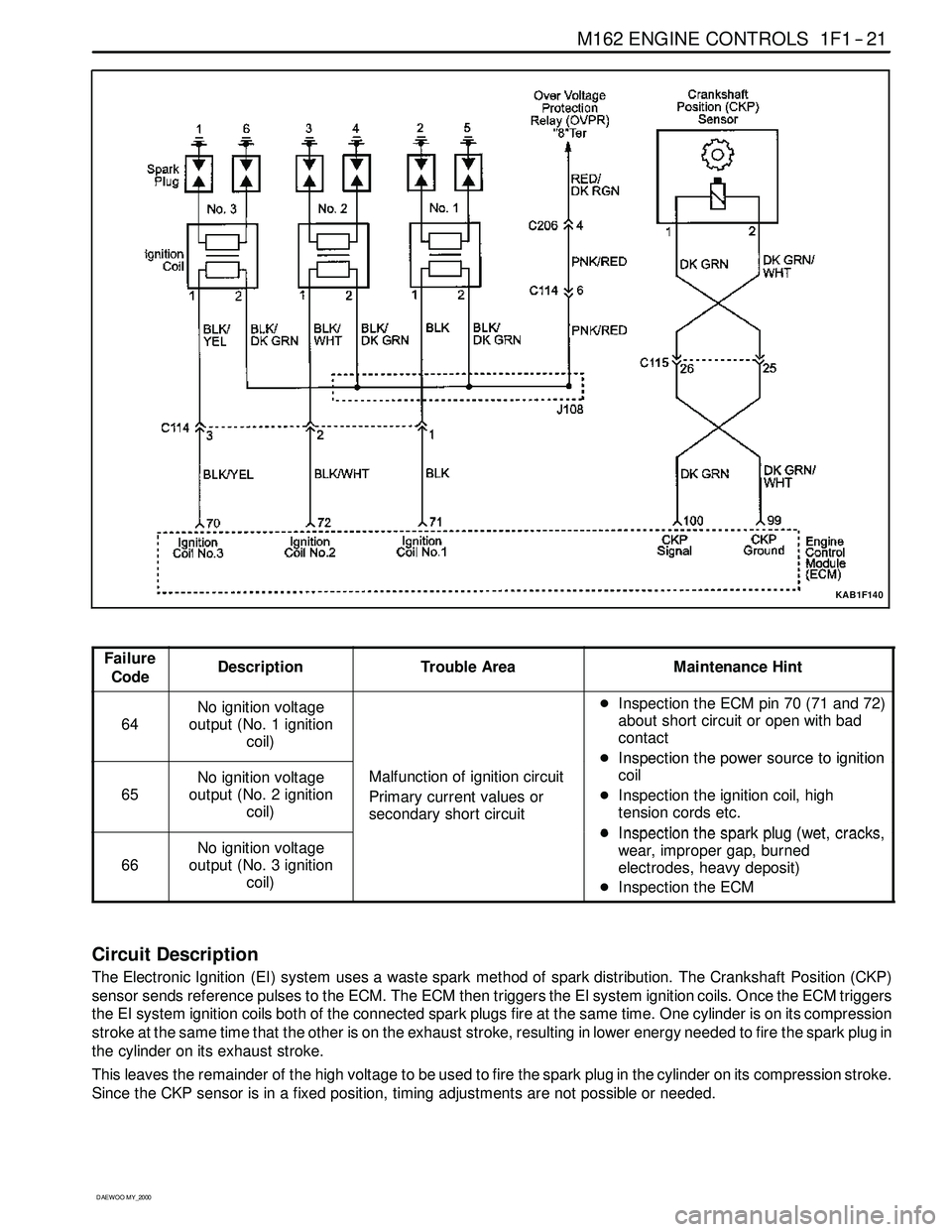
The Electronic Ignition (EI) system uses a waste spark method of spark distribution. The Crankshaft Position (CKP)
sensor sends reference pulses to the ECM. The ECM then triggers the EI system ignition coils. Once the ECM triggers
the EI system ignition coils both of the connected spark plugs fire at the same time. One cylinder is on its compression
stroke at the same time that the other is on the exhaust stroke, resulting in lower energy needed to fire the spark plug in
the cylinder on its exhaust stroke.
This leaves the remainder of the high voltage to be used to fire the spark plug in the cylinder on its compression stroke.
Since the CKP sensor is in a fixed position, timing adjustments are not possible or needed.
Page 186 of 2053
M162 ENGINE CONTROLS 1F1 -- 23
D AEW OO M Y_2000
KAB1F150
Failure
CodeDescriptionTrouble AreaMaintenance Hint
17
Crankshaft position
sensor signal failure (no
engine revolution signal)Even through cam position
recognition is normal, no
crankshaft position signal
recognition
DMonitoring the actual rpm through or
scan tool
18
Crankshaft position
sensor signal failure
(rpm > max. value)When more than applicable
revolution values or
implausibleto60–2teeth
scantool
DInspection the ECM pin 100, 99 about
short circuit with bad contact
DInspection the CKP sensor
20
Crankshaft position
sensor signal failure
(gap recognition failure)
When implausible recognition
of cam and crank angle signal
or intermittent sensing the
signal or error count of
undetected gap.
p
DInspection the air gap between sensor
and drive plate
DInspection the drive plate (teeth
condition)
DInspection the ECM
67Crankshaft position
sensor adaptation failureWhen faulty crank angle
sensor adaption
p
Circuit Description
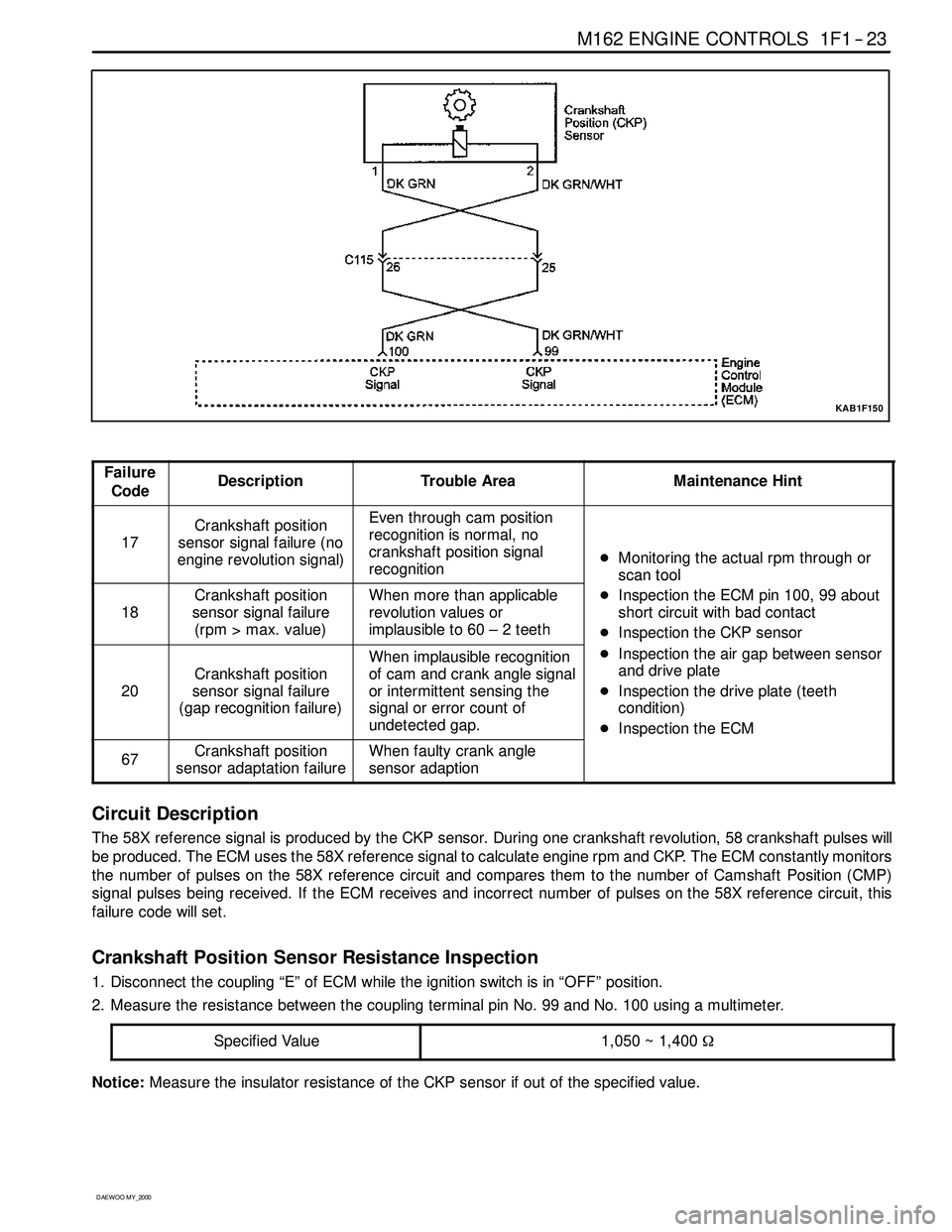
The 58X reference signal is produced by the CKP sensor. During one crankshaft revolution, 58 crankshaft pulseswill
be produced. The ECM uses the 58X reference signal to calculate engine rpm and CKP. The ECM constantly monitors
the number of pulses on the 58X reference circuit and compares them to the number of Camshaft Position (CMP)
signal pulses being received. If the ECM receives and incorrect number of pulses on the 58X reference circuit, this
failure code will set.
Crankshaft Position Sensor Resistance Inspection
1. Disconnect the coupling “E” of ECM while the ignition switch is in “OFF” position.
2. Measure the resistance between the coupling terminal pin No. 99 and No. 100 using a multimeter.
Specified Value
1,050 ~ 1,400Ω
Notice:Measure the insulator resistance of the CKP sensor if out of the specified value.
Page 190 of 2053

M162 ENGINE CONTROLS 1F1 -- 27
D AEW OO M Y_2000
KAB1F160
Failure
CodeDescriptionTrouble AreaMaintenance Hint
19
Camshaft position
sensor signal :
No. 1 cylinder
recognition failureWhen no cam recognition
signal during TN 24 counts
more. (maintain the constant
low or high level)DInspection the source voltage of CMP
sensor
DInspection the ECM pin 106, 104
about short circuit or open with bad
contact
58
Camshaft position
sensor signal : No. 1
cylinder synchronization
failure
When synchronization fault of
cylinder 1 (TDC recognition)
contact
DInspection the CMP sensor
DInspection the damage of sensor or
sprocket
DInspection the ECM
Circuit Description
The CMP sensor sends a cam position signal to the ECM. If the cam position signal is lost while the engine is running,
the fuel injection system shifts to a calculated sequential fuel injection mode based on the last fuel injection pulse, and
the engine continuous to run.
Camshaft Position Sensor Signal Voltage Inspection
1. Measure the voltage between the ECM terminal No. 11 and No. 106 while the engine speed is at idle.
Specified Value
1.2~1.7v
Notice:The signal voltagewill be changed in the range of 1.2 ~ 1.7 v.
Page 194 of 2053

M162 ENGINE CONTROLS 1F1 -- 31
D AEW OO M Y_2000
KAB1F160
Failure
CodeDescriptionTrouble AreaMaintenance Hint
226Camshaft actuator short
circuit to battery
When malfunction of cam
DMonitoring the actual operational
status through scan tool
DInspection the ECM pin 73 about short
circuit or open
227Camshaft actuator short
circuit to ground or open
Whenmalfunctionofcam
phasing control
p
DInspection the power source short
circuit or open to cam actuator
DInspection the magnet and hardware
DInspection the ECM
Camshaft Actuator Current Consumption Inspection
1. Run the engine to reach the coolant temperature above 70°C.
2. Increase the engine rpm up to 2000 rpm
3. Measure the current between the No. 1 and No. 2 pin of the camshaft actuator connector.
Specified Value
1~1.5A
Notice:If the measured value is not within the specified value, check the cable.
Page 196 of 2053

M162 ENGINE CONTROLS 1F1 -- 33
D AEW OO M Y_2000
KAB1F170
Failure
CodeDescriptionTrouble AreaMaintenance Hint
56No. 1 knock sensor
signal failure
When recognition in more
than control gain threshold at
normal operational condition
of other system during over
75 and 3,000 rpm running
area (cylinder 1, 2, 3)DInspection the ECM pin 118, 117 about
short circuit or open with bad contact
DInspection the KS 1 malfunction
DInspection the ECM
57No. 2 knock sensor
signal failure
When recognition in more
than control gain threshold at
normal operational condition
of other system during over
75 and 3,000 rpm running
area (cylinder 4, 5, 6)DInspection the ECM pin 115, 114 about
short circuit or open with bad contact
DInspection the KS 2 malfunction
DInspection the ECM
Circuit Description
The KS system is used to detect engine detonation, allowing the ECM to retard the ignition control spark timing based
on the KS signal being received. The KS signal’s amplitude and frequency depend upon the amount of knock being
experienced. The ECM monitors the KS signal and can diagnose the KS sensor and circuitry.
Knock Sensor Resistance Inspection
1. Disconnect the coupling from ECM while the ignition switch is in “OFF” position.
2. Measure the resistance between the coupling terminal pin No. 118 and No. 117 and terminal pin No. 115 and No.
114usingamultimeter.
Specified Value
>10 MΩ
Notice:Replace the KS if the measured values is out of the specified values. Check the connector and wire connec-
tion between ECM and the KS if the measured values are normal.
Page 198 of 2053

M162 ENGINE CONTROLS 1F1 -- 35
D AEW OO M Y_2000
KAB1F180
Failure
CodeDescriptionTrouble AreaMaintenance Hint
68Random / Multiple
Misfire
When detection misfire of
multiple cylinder for source of
over the emission threshold or
catalyst damage
DInspection the ignition system
DInspection the injection system
DInspection the fuel pressure
DInspection the compression pressure
DInspection the valve timing or
clearance
DInspection the air flow sensor
DInspection the crankshaft position
sensor and air gap
DInspection the engine wiring system
DInspection the Engine Control Module
(ECM)
Circuit Description
The ECM monitors the crankshaft and camshaft positions to detect if the engine is misfiring. The ECM looks for a quick
drop in crankshaft speed. Misfire multiple cylinder is monitored by engine roughness measuring. The actual roughness
value is compared with the actual (emission and catalyst damage) threshold.