fuel pressure SSANGYONG KORANDO 1997 Service Owner's Manual
[x] Cancel search | Manufacturer: SSANGYONG, Model Year: 1997, Model line: KORANDO, Model: SSANGYONG KORANDO 1997Pages: 2053, PDF Size: 88.33 MB
Page 262 of 2053
M162 ENGINE CONTROLS 1F1 -- 99
D AEW OO M Y_2000
KAA1F440
FUEL RAIL AND INJECTORS
Removal and Installation Procedure
Caution: The fuel system is under pressure. To
avoid fuel spillage and the risk of personal injury or
fire, it is necessary to relieve the fuel system pres -
sure before disconnecting the fuel lines.
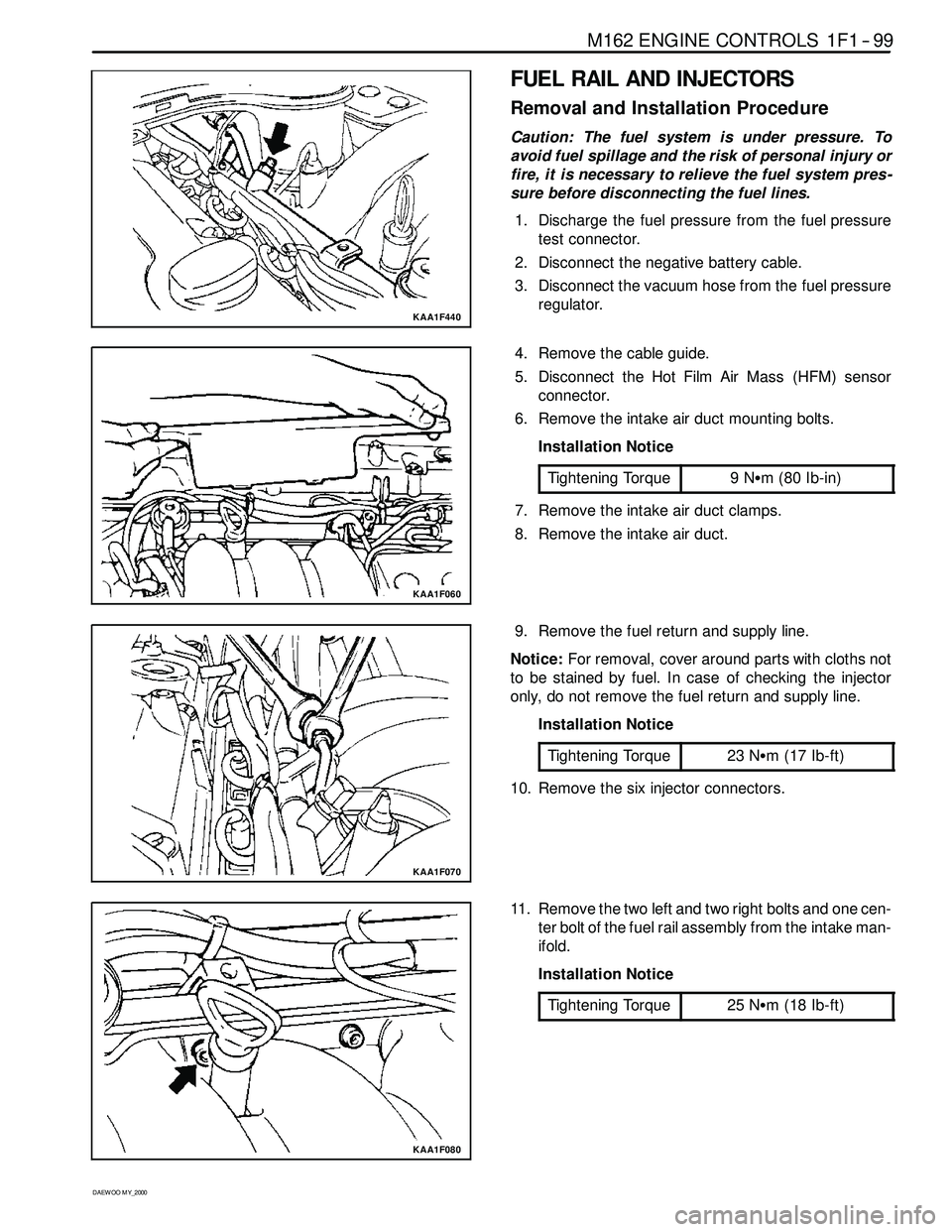
1. Discharge the fuel pressure from the fuel pressure
test connector.
2. Disconnect the negative battery cable.
3. Disconnect the vacuum hose from the fuel pressure
regulator.
KAA1F060
4. Remove the cable guide.
5. Disconnect the Hot Film Air Mass (HFM) sensor
connector.
6. Remove the intake air duct mounting bolts.
Installation Notice
Tightening Torque
9NSm (80 Ib-in)
7. Remove the intake air duct clamps.
8. Remove the intake air duct.
KAA1F070
9. Remove the fuel return and supply line.
Notice:For removal, cover around parts with cloths not
to be stained by fuel. In case of checking the injector
only, do not remove the fuel return and supply line.
Installation Notice
Tightening Torque
23 NSm (17 Ib-ft)
10. Remove the six injector connectors.
KAA1F080
11. Remove the two left and two right bolts and one cen-
ter bolt of the fuel rail assembly from the intake man-
ifold.
Installation Notice
Tightening Torque
25 NSm (18 Ib-ft)
Page 263 of 2053
1F1 -- 100 M162 ENGINE CONTROLS
D AEW OO M Y_2000
KAA1F090
Notice:Before removal, the fuel rail assembly may be
cleaned with a spray-type cleaner, following package in-
structions. Do not immerse the fuel rails in liquid clean-
ing solvent. Use care in removing the fuel rail assembly
to prevent damage to the electrical connectors and in-
jector spray tips. Prevent dirt and other contaminants
from entering open lines and passages. Fittings should
be capped and holes plugged during service.
Important:If an injector becomes separated from the
rail and remains in the cylinder head, replace the injector
O-ring seals and the retaining clip.
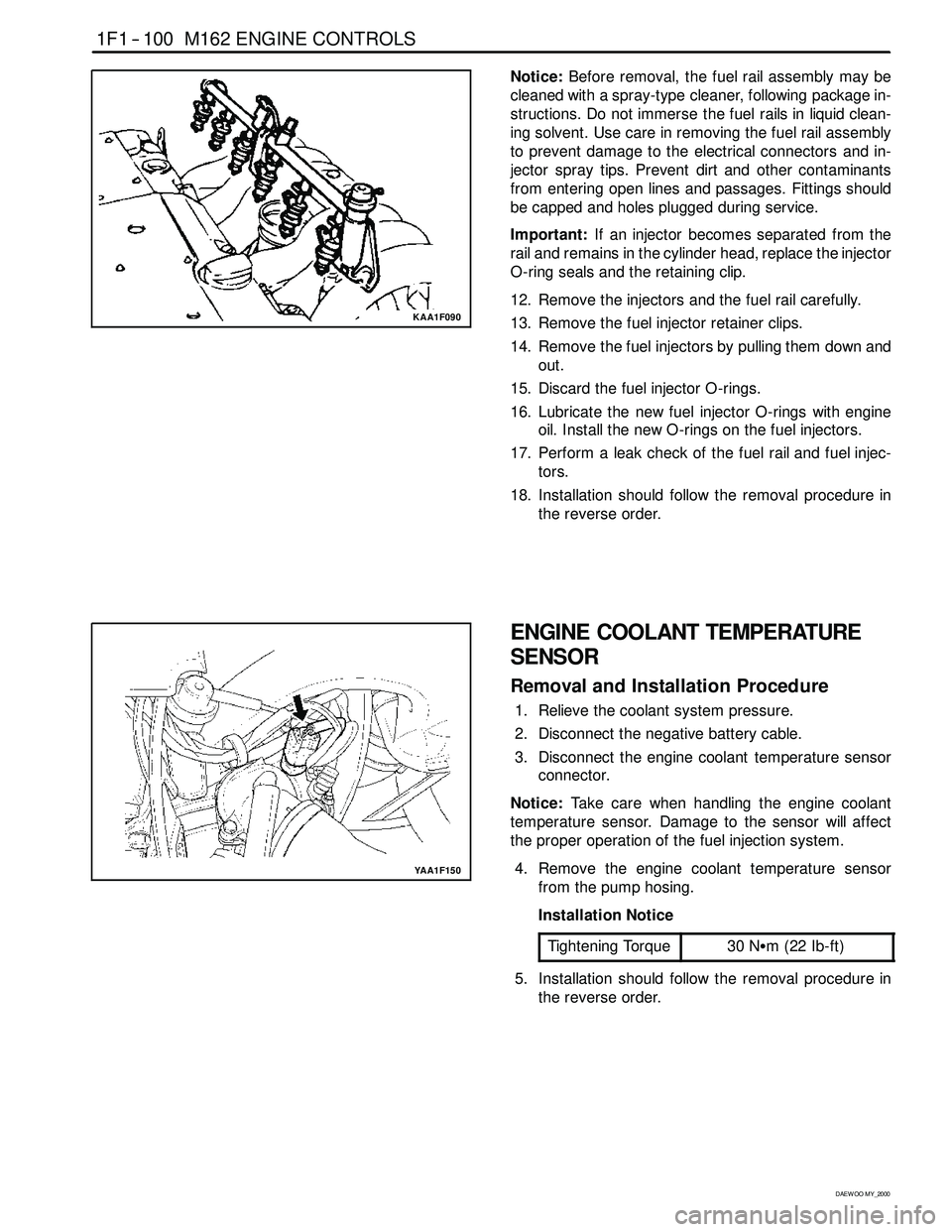
12. Remove the injectors and the fuel rail carefully.
13. Remove the fuel injector retainer clips.
14. Remove the fuel injectors by pulling them down and
out.
15. Discard the fuel injector O-rings.
16. Lubricate the new fuel injector O-rings with engine
oil. Install the new O-rings on the fuel injectors.
17. Perform a leak check of the fuel rail and fuel injec-
tors.
18. Installation should follow the removal procedure in
the reverse order.
YAA1F150
ENGINE COOLANT TEMPERATURE
SENSOR
Removal and Installation Procedure
1. Relieve the coolant system pressure.
2. Disconnect the negative battery cable.
3. Disconnect the engine coolant temperature sensor
connector.
Notice:Take care when handling the engine coolant
temperature sensor. Damage to the sensor will affect
the proper operation of the fuel injection system.
4. Remove the engine coolant temperature sensor
from the pump hosing.
Installation Notice
Tightening Torque
30 NSm (22 Ib-ft)
5. Installation should follow the removal procedure in
the reverse order.
Page 286 of 2053
1A2 -- 2 GENERAL ENGINE INFORMATION
D AEW OO M Y_2000
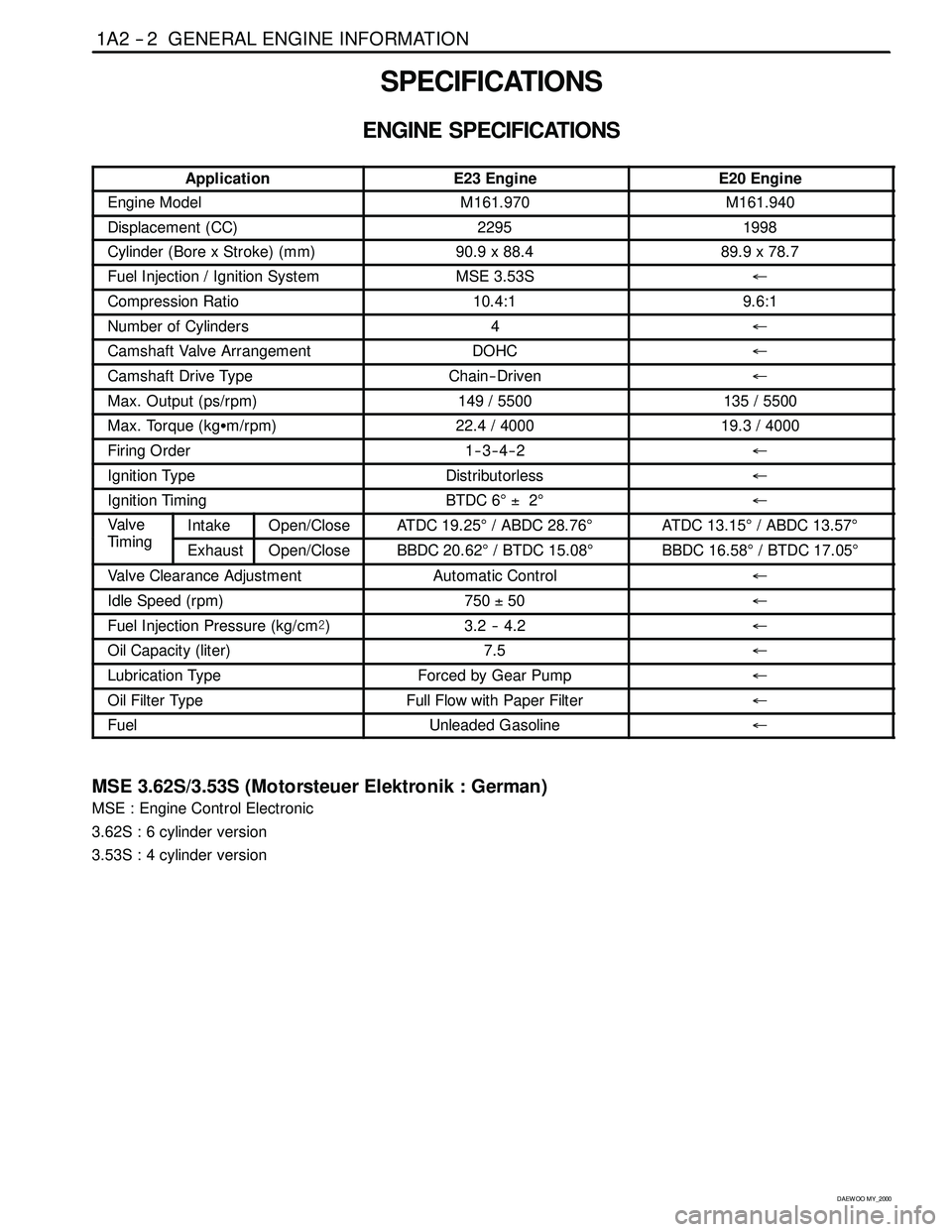
SPECIFICATIONS
ENGINE SPECIFICATIONS
ApplicationE23 EngineE20 Engine
Engine ModelM161.970M161.940
Displacement (CC)22951998
Cylinder (Bore x Stroke)(mm)90.9 x 88.489.9 x 78.7
Fuel Injection / Ignition SystemMSE 3.53S←
Compression Ratio10.4:19.6:1
Number of Cylinders4←
Camshaft Valve ArrangementDOHC←
Camshaft Drive TypeChain-- Driven←
Max. Output (ps/rpm)149 / 5500135 / 5500
Max. Torque (kgSm/rpm)22.4 / 400019.3 / 4000
Firing Order1--3--4--2←
Ignition TypeDistributorless←
Ignition TimingBTDC 6°±2°←
Va lv e
Tii
IntakeOpen/CloseATDC 19.25°/ ABDC 28.76°ATDC 13.15°/ ABDC 13.57°
Tim in gExhaustOpen/CloseBBDC 20.62°/ BTDC 15.08°BBDC 16.58°/ BTDC 17.05°
Valve Clearance AdjustmentAutomatic Control←
Idle Speed (rpm)750±50←
Fuel Injection Pressure (kg/cm@)3.2 -- 4.2←
Oil Capacity (liter)7.5←
Lubrication TypeForced by Gear Pump←
Oil Filter TypeFull Flow with Paper Filter←
FuelUnleaded Gasoline←
MSE 3.62S/3.53S (Motorsteuer Elektronik : German)
MSE : Engine Control Electronic
3.62S : 6 cylinder version
3.53S : 4 cylinder version
Page 423 of 2053

D AEW OO M Y_2000
SECTION 1F2
ENGINE CONTROLS
CAUTION: Disconnect the negative battery cable before removing or installing any electrical unit or when a
tool or equipment could easily come in contact with exposed electrical terminals. Disconnecting this cable
will help prevent personal injury and damage to the vehicle. The ignition must also be in LOCK unless other -
wise noted.
TABLE OF CONTENTS
Engine and ECM Problem Check Report 1F2 -- 2....
Specifications 1F2 -- 3............................
Engine Data Display Table 1F2 -- 3.................
Fastener Tightening Specifications 1F2 -- 4..........
Fuel System Specification 1F2 -- 5.................
Temperature vs Resistance 1F2 -- 5................
Special Tools and Equipment 1F2 -- 6..............
Special Tools Table 1F2 -- 6.......................
Schematic and Routing Diagrams 1F2 -- 7..........
ECM Wiring Diagram
(2.3L DOHC -- MSE 3.53S) 1F2 -- 7..............
Diagnosis 1F2 -- 14................................
Failure Code Diagnosis 1F2 -- 14.....................
Clearing Failure Codes 1F2 -- 14...................
Failure Codes Table 1F2 -- 14.....................
Ignition System 1F2 -- 18...........................
Ignition Coil 1F2 -- 20.............................
Crankshaft Position (CKP) Sensor 1F2 -- 22.........
Camshaft Position (CMP) Sensor 1F2 -- 26..........
Camshaft Actuator 1F2 -- 30......................
Knock Sensor (KS) 1F2 -- 32......................
Spark Plug 1F2 -- 34.............................
System Voltage 1F2 -- 38.........................
Ignition Switch 1F2 -- 39..........................
Fuel System 1F2 -- 40..............................
Fuel Pump 1F2 -- 42.............................
Fuel Injector 1F2 -- 46............................
Purge Control Valve 1F2 -- 50.....................
Fuel Rail 1F2 -- 52...............................
Fuel Pressure Regulator 1F2 -- 54.................
Induction System 1F2 -- 56..........................
Throttle Valve Actuator 1F2 -- 56...................
Hot Film Air Mass (HFM) Sensor 1F2 -- 60..........
Engine Coolant Temperature (ECT) Sensor 1F2 -- 64.
Accelerator Pedal Module 1F2 -- 68................Cooling Fan 1F2 -- 72............................
A/C Compressor Relay 1F2 -- 73...................
Cruise Control Switch 1F2 -- 74....................
Traction Control System (TCS) 1F2 -- 75............
Stop Lamp Switch 1F2 -- 76.......................
Engine RPM 1F2 -- 77............................
Exhaust System 1F2 -- 78...........................
Catalytic Converter 1F2 -- 78......................
Oxygen Sensor 1F2 -- 80.........................
Engine Control Module 1F2 -- 86.....................
Serial Data Communication 1F2--88...............
Internal Failure 1F2 -- 90..........................
Electronic Throttle Controller Safety
Malfunction 1F2 -- 92...........................
Immobilizer 1F2 -- 94.............................
Maintenance and Repair 1F2 -- 95..................
On -- Vehicle Service 1F2 -- 95........................
Discharging the Pressure in Fuel System 1F2 -- 95...
Fuel Pump 1F2 -- 95.............................
Fuel Filter 1F2 -- 96..............................
Fuel Tank 1F2 -- 97..............................
Fuel Pressure Regulator 1F2 -- 98.................
Fuel Rail and Injector 1F2 -- 99....................
Engine Coolant Temperature Sensor 1F2 -- 100......
Throttle Body (Integrated with the
Actuator) 1F2 -- 101............................
Hot Film Air Mass (HFM) Sensor 1F2 -- 102.........
Knock Sensor 1F2 -- 102..........................
Pedal Position Sensor 1F2 -- 103...................
Oxygen Sensor 1F2 -- 103........................
Purge Control Valve 1F2 -- 104....................
Canister 1F2 -- 104...............................
Camshaft Position Sensor 1F2 -- 104...............
Crankshaft Position Sensor 1F2 -- 105..............
Engine Control Module 1F2 -- 105..................
Page 426 of 2053

1F2 -- 4 M161 ENGINE CONTROLS
D AEW OO M Y_2000
FASTENER TIGHTENING SPECIFICATIONS
ApplicationNSmLb-FtLb-In
Camshaft Position Sensor Retaining Bolts10--89
Canister Mounting Bolts6--53
Coolant Temperature Sensor3022--
Crankshaft Position Sensor Retaining Bolt10--89
Engine Control Module (ECM) Mounting Bracket Nuts10--89
Fuel Filter Mounting Bracket Bolt6--53
Fuel Filter Lines2821--
Fuel Pressure Test Connector2518--
Fuel Rail Assembly Bolts2518--
Fuel Return And Supply Lines2317--
Fuel Tank Retaining Nuts3828--
Knock Sensor Mounting Bolt2518--
Oxygen Sensor5541--
Pedal Position Censor Mounting Bolts And Nut6--53
Throttle Body Bolts12--106
Page 428 of 2053

1F2 -- 6 M161 ENGINE CONTROLS
D AEW OO M Y_2000
SPECIAL TOOLS AND EQUIPMENT
SPECIAL TOOLS TABLE
YAA1F890
661 589 00 46 00
Fuel Tank Cap Wrench
KAA1F490
103 589 00 21 00
Fuel Pressure Gauge
Page 453 of 2053
M161 ENGINE CONTROLS 1F2 -- 35
D AEW OO M Y_2000
KAB1F450
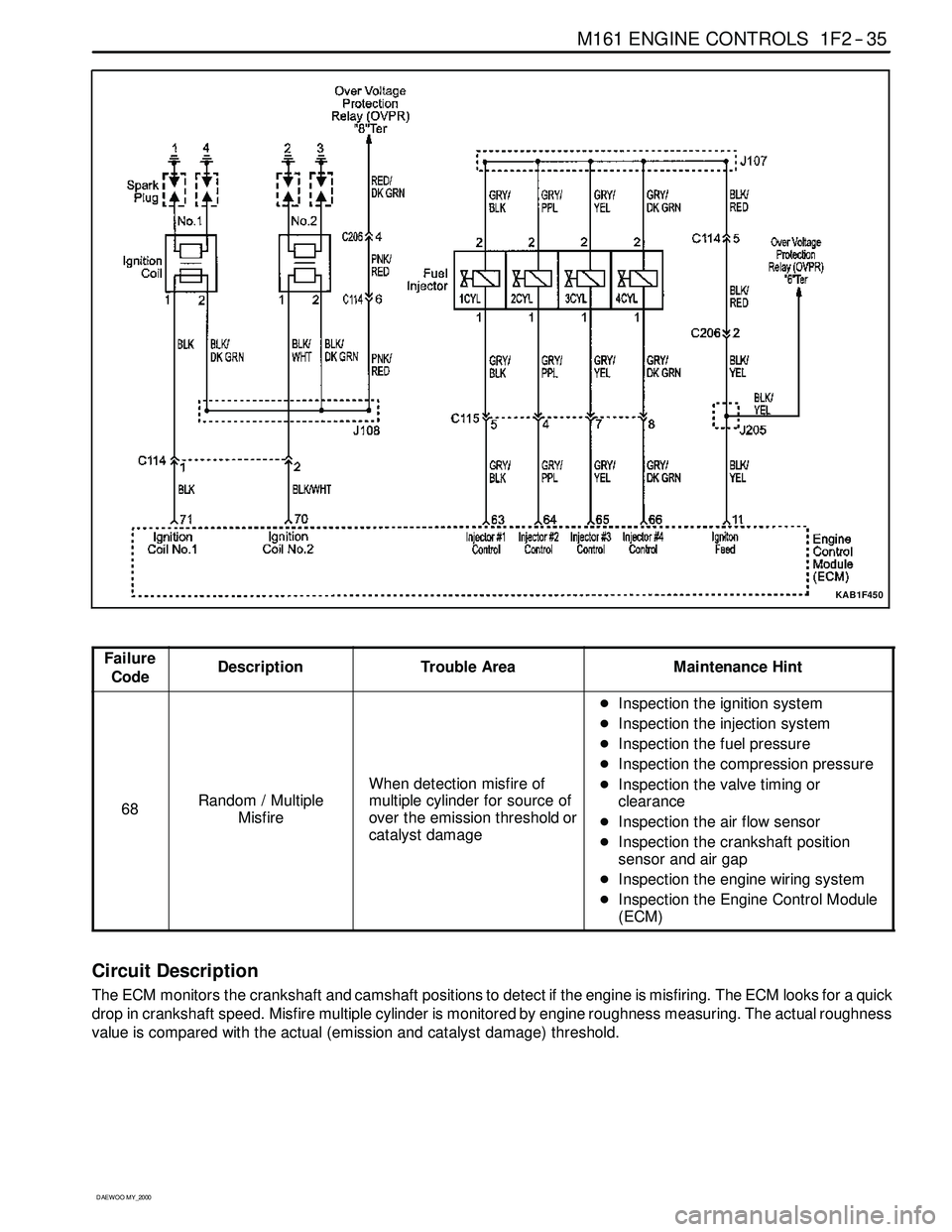
Failure
CodeDescriptionTrouble AreaMaintenance Hint
68Random / Multiple
Misfire
When detection misfire of
multiple cylinder for source of
over the emission threshold or
catalyst damage
DInspection the ignition system
DInspection the injection system
DInspection the fuel pressure
DInspection the compression pressure
DInspection the valve timing or
clearance
DInspection the air flow sensor
DInspection the crankshaft position
sensor and air gap
DInspection the engine wiring system
DInspection the Engine Control Module
(ECM)
Circuit Description
The ECM monitors the crankshaft and camshaft positions to detect if the engine is misfiring. The ECM looks for a quick
drop in crankshaft speed. Misfire multiple cylinder is monitored by engine roughness measuring. The actual roughness
value is compared with the actual (emission and catalyst damage) threshold.
Page 458 of 2053
1F2 -- 40 M161 ENGINE CONTROLS
D AEW OO M Y_2000
FUEL SYSTEM
The function of the fuel metering system is to deliver the correct amount of fuel to the engine under all operating condi-
tions. The fuel is delivered to the engine by the individual fuel injectors mounted into the intake manifold near each
cylinder.
The main fuel control sensors are the Mass Air Flow (MAF) sensor and the oxygen (O2) sensors.
The MAF sensor monitors the mass flow of the air being drawn into the engine. An electrically heated element is
mounted in the intake air stream, where it is cooled by the flow of incoming air. Engine Control Module (ECM) modu-
lates the flow of heating current to maintain the temperature differential between the heated film and the intake air at a
constant level. The amount of heating current required to maintain the temperature thus provides an index for the
mass air flow. This concept automatically compensates for variations in air density, as this is one of the factors that
determines the amount of warmth that the surrounding air absorbs from the heated element. MAF sensor is located
between the air filter and the throttle valve.
Under high fuel demands, the MAF sensor reads a high mass flow condition, such as wide open throttle. The ECM
uses this information to enrich the mixture, thus increasing the fuel injector on-- time, to provide the correct amount of
fuel. When decelerating, the mass flow decreases. This mass flow change is sensed by the MAF sensor and read by
the ECM, which then decreases the fuel injector on-- time due to the low fuel demand conditions.
The O2 sensors are located in the exhaust pipe before catalytic converter. The O2 sensors indicate to the ECM the
amount of oxygen in the exhaust gas, and the ECM changes the air/fuel ratio to the engine by controlling the fuel
injectors. The best air/fuel ratio to minimize exhaust emissions is 14.7 to 1, which allows the catalytic converter to
operate most efficiently. Because of the constant measuring and adjusting of the air/fuel ratio, the fuel injection system
is called a “closed loop” system.
The ECM uses voltage inputs from several sensors to determine how much fuel to provide to the engine. The fuel is
delivered under one of several conditions, called ‘‘modes”.
Starting Mode
When the ignition is turned ON, the ECM turns the fuel pump relay on for 1 second. The fuel pump then builds fuel
pressure. The ECM also checks the Engine Coolant Temperature (ECT) sensor and the Throttle Position (TP) sensor
and determines the proper air/fuel ratio for starting the engine. This ranges from 1.5 to 1 at -- 36°C(--33°F) coolant
temperature to 14.7 to 1 at 94°C (201°F) coolant temperature. The ECM controls the amount of fuel delivered in the
starting mode by changing how long the fuel injector is turned on and off. This is done by ‘‘pulsing” the fuel injectors for
very short times.
Run Mode
The run mode has two conditions called ‘‘open loop” and ‘‘closed loop”.
Open Loop
When the engine is first started and it is above 690 rpm, thesystem goes into “open loop” operation. In “open loop”, the
ECM ignores the signal from the HO2S and calculates the air/fuel ratio based on inputs from the ECT sensor and the
MAF sensor. The ECM stays in “open loop” until the following conditions are met:
DThe O2 has a varying voltage output, showing that it is hot enough to operate properly.
DThe ECT sensor is above a specified temperature (22.5°C).
DA specific amount of time has elapsed after starting the engine.
Closed Loop
The specific values for the above conditions vary with different engines and are stored in the Electronically Erasable
Programmable Read -- Only Memory (EEPROM). When these conditions are met, thesystem goes into “closed loop”
operation. In “closed loop”, the ECM calculates the air/fuel ratio (fuel injector on-- time) based on the signals from the
O2 sensors. This allows the air/fuel ratio to stay very close to 14.7 to 1.
Acceleration Mode
The ECM responds to rapid changes in throttle position and airflow and provides extra fuel.
Deceleration Mode
The ECM responds to changes in throttle position and airflow and reduces the amount of fuel. When deceleration is
very fast, the ECM can cut off fuel completely for short periods of time.
Page 460 of 2053

1F2 -- 42 M161 ENGINE CONTROLS
D AEW OO M Y_2000
FUEL PUMP
YAA1F380
Requirements for Fuel Pump
ItemSpecified ValueItemSpecified Value
System Pressure3.8 barMinimum Delivery at 8V30 Litre/Hr
Maximum Pressure8.5 bar (12 V)Operating Voltage8V
Minimum Pressure5.0 bar (12 V)Maximum Allowable
Current7.5 A
Nominal Voltage12 VAmbient Temperature-- 30 ~ +70°C
Minimum Amount
of Fuel Supply114 Liter/Hr (12 V, 3.8 bar,
-- 30 ~ +70°C)Maximum Amount
of Fuel Supply165 Liter/Hr (12V, 3.8 bar,
-- 3 0 ~ + 7 0°C)
Page 464 of 2053

1F2 -- 46 M161 ENGINE CONTROLS
D AEW OO M Y_2000
FUEL INJECTOR
YAA1F0C0
The Multipoint Fuel Injection (MFI) assembly is a solenoid -- operated device controlled by the Engine Control Module
(ECM) that meters pressurized fuel to an each individual cylinder. The injector sprays the fuel, in precise quantities at a
point in time determined by the ECM, directly toward the cylinder intake valve. ECM energizes the fuel injector solenoid
to lift the needle valve and to flow the fuel through the orifice. This injector ’s discharge orifice is calibrated to meet the
effective fuel atomization necessary for both ensuring the maximum homogeneity in the air -- fuel mixture and holding
the condensation along the walls of the intake tract to a minimum.
Fuel enters the top feed injector from above and flows through its vertical axis. The lower end extends into the intake
valve. Fuel from the tip is directed at the intake valve, causing it to become further atomized and vaporized before
entering the combustion chamber.
A fuel injector which is stuck partially open would cause a loss of fuel pressure after the engine is shut down. Also, an
extended crank time would be noticed on some engines. Dieseling could also occur because some fuel could be deliv-
ered to the engine after the ignition is turned off.