hood open SSANGYONG KORANDO 1997 Service Repair Manual
[x] Cancel search | Manufacturer: SSANGYONG, Model Year: 1997, Model line: KORANDO, Model: SSANGYONG KORANDO 1997Pages: 2053, PDF Size: 88.33 MB
Page 14 of 2053
0B -- 14 GENERAL INFORMATION
D AEW OO M Y_2000
EACH TIME THE OIL IS CHANGED
Brake System Inspection
This inspection should be done when the wheels are re-
moved for rotation. Inspect the lines and the hoses for
proper hookup, binding, leaks, cracks, chafing, etc. In-
spect the disc brake pads for wear. Inspect the rotors for
surface condition. Inspect other brake parts, the parking
brake, etc., at the same time. Inspect the brakes more
often if habit or conditions result in frequent braking.
Steering, Suspension and Front Drive Axle
Boot And Seal Inspection
Inspect the front and rear suspension and the steering
system for damaged, loose or missing parts, signs of
wear or lack of lubrication. Inspect the power steering
line and the hoses for proper hookup, binding, leaks,
cracks, chafing, etc. Clean and inspect the drive axle
boot and seals for damage, tears or leakage. Replace
the seals if necessary.
Exhaust System Inspection
Inspect the complete system (including the catalytic
converter if equipped). Inspect the body near the ex-
haust system. Look for broken, damaged, missing, or
out -- of -- position parts as well as open seams, holes,
loose connections, or other conditions which could
cause heat buildup in the floor pan or could let exhaust
fumes seep into the trunk or passenger compartment.
Throttle Linkage Inspection
Inspect the throttle linkage for interference or binding,
damaged, or missing parts. Lubricate all linkage joints
and throttle cable joints, the intermediate throttle shaft
bearing, the return spring at throttle valve assembly, and
the accelerator pedal sliding face with suitable grease.
Check the throttle cable for free movements.
Engine Drive Belts
Inspect all belts for cracks, fraying, wear and proper ten-
sion. Adjust or replace the belts as needed.
Hood Latch Operation
When opening the hood, note the operation of the sec-
ondary latch. It should keep the hood from opening all
the way when the primary latch is released. The hood
must close firmly.
AT LEAST ANNUALLY
Lap and Shoulder Belts Condition and Operation
Inspect the belt system including: the webbing, the
buckles, the latch plates, the retractor, the guide loops
and the anchors.
Movable Head Restraint Operation
On vehicles with movable head restraints, the restraints
must stay in the desired position.
Spare Tire and Jack Storage
Be alert to rattles in the rear of the vehicle. The spare
tire, all the jacking equipment, and the tools must be se-
curely stowed at all times. Oil the jack ratchet or the
screw mechanism after each use.
Key Lock Service
Lubricate the key lock cylinder.
Body Lubrication Service
Lubricate all the body door hinges including the hood,
the fuel door, the rear compartment hinges and the
latches, the glove box and the console doors, and any
folding seat hardware.
Underbody Flushing
Flushing the underbody will remove any corrosive mate-
rials used for ice and snow removal and dust control. At
least every spring clean the underbody. First, loosen the
sediment packed in closed areas of the vehicle. Then
flush the underbody with plain water.
Engine Cooling System
Inspect the coolant and freeze protection fluid. If the
fluid is dirty or rusty, drain, flush and refill the engine
cooling system with new coolant. Keep the coolant at
the proper mixture in order to ensure proper freeze
protection, corrosion protection and engine operating
temperature. Inspect the hoses. Replace the cracked,
swollen, or deteriorated hoses. Tighten the clamps.
Clean the outside of the radiator and the air conditioning
condenser. Wash the filler cap and the neck. Pressure
test the cooling system and the cap in order to help en-
sure proper operation.
Page 40 of 2053
1B1 -- 8 M162 ENGINE MECHANICAL
D AEW OO M Y_2000
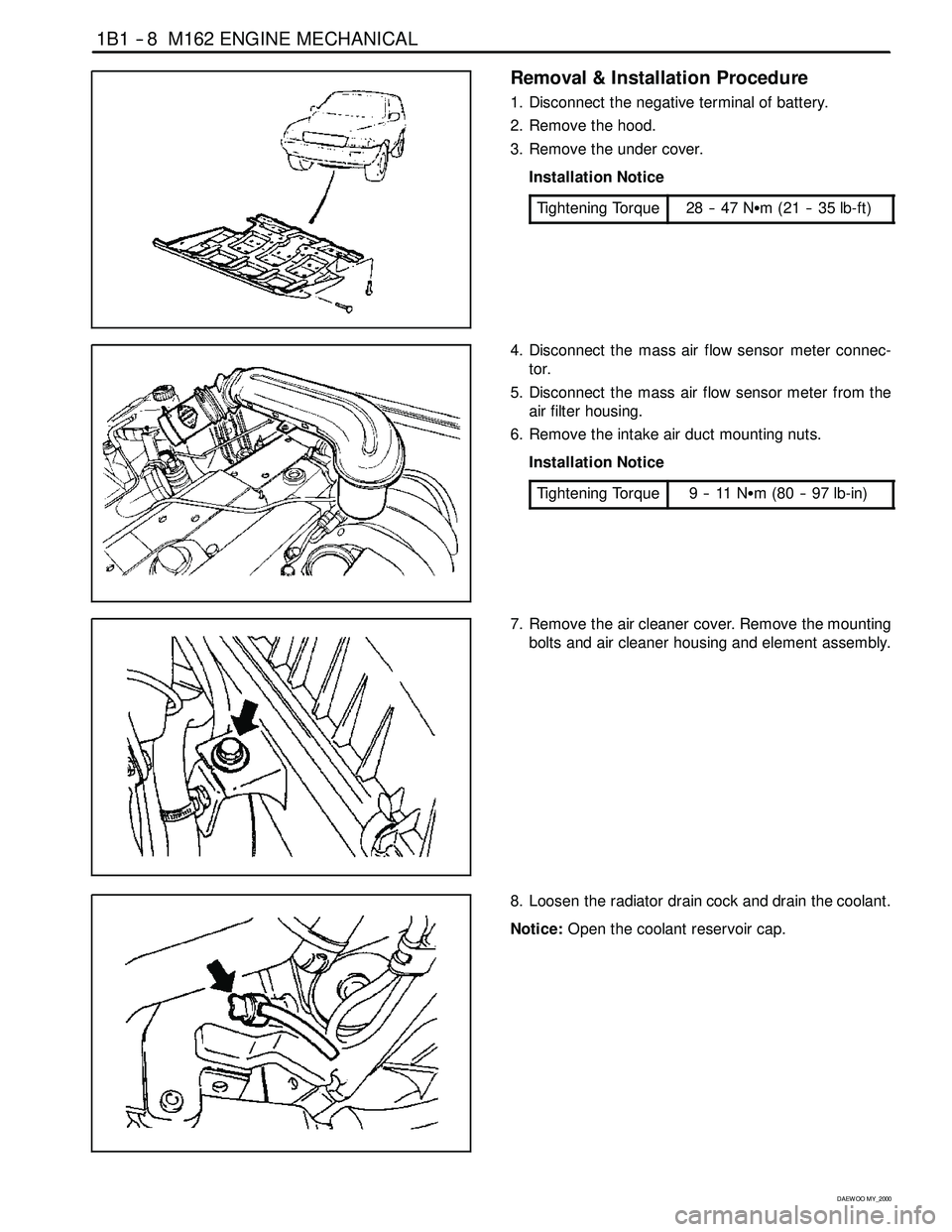
Removal & Installation Procedure
1. Disconnect the negative terminal of battery.
2. Remove the hood.
3. Remove the under cover.
Installation Notice
Tightening Torque
28 -- 47 NSm (21 -- 35 lb-ft)
4. Disconnect the mass air flow sensor meter connec-
tor.
5. Disconnect the mass air flow sensor meter from the
air filter housing.
6. Remove the intake air duct mounting nuts.
Installation Notice
Tightening Torque
9--11NSm (80 -- 97 lb-in)
7. Remove the air cleaner cover. Remove the mounting
bolts and air cleaner housing and element assembly.
8. Loosen the radiator drain cock and drain the coolant.
Notice:Open the coolant reservoir cap.
Page 301 of 2053

1B2 -- 8 M161 ENGINE MECHANICAL
D AEW OO M Y_2000
Removal & Installation Procedure
1. Disconnect the negative terminal of battery.
2. Remove the hood.
3. Remove the under cover.
Installation Notice
Tightening Torque
28 -- 47 NSm (21 -- 35 lb-ft)
4. Disconnect the coupling of HFM sensor and remove
the air cleaner cross pipe.
5. Remove the air cleaner cover. Remove the mounting
bolts and air cleaner housing and element assembly.
6. Loosen the radiator drain cock and drain the coolant.
Notice:Open the coolant reservoir cap.
Page 562 of 2053
OM600 ENGINE MECHANICAL 1B3 -- 13
D AEW OO M Y_2000
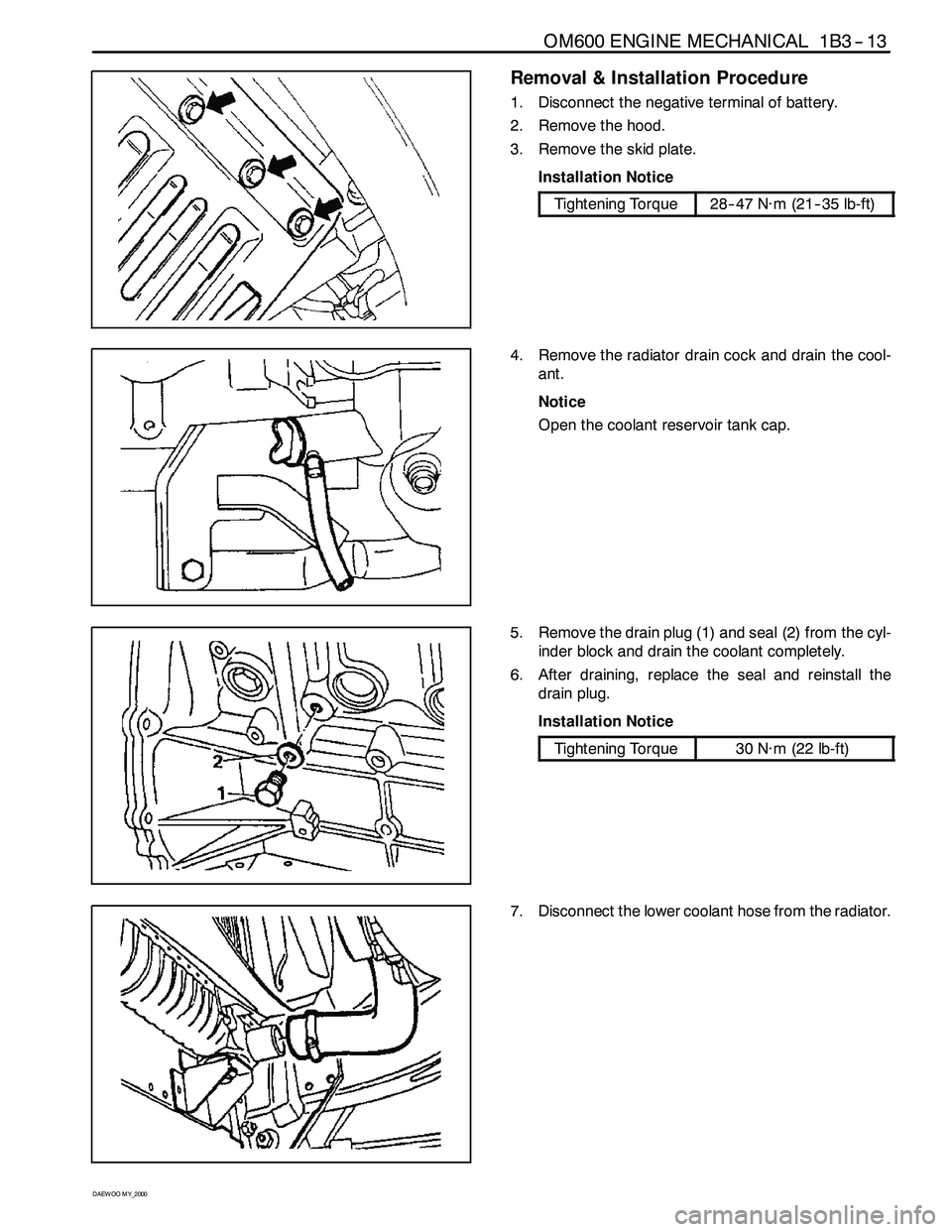
Removal & Installation Procedure
1. Disconnect the negative terminal of battery.
2. Remove the hood.
3. Remove the skid plate.
Installation Notice
Tightening Torque28-- 47 N∙m (21-- 35 lb-ft)
4. Remove the radiator drain cock and drain the cool-
ant.
Notice
Open the coolant reservoir tank cap.
5. Remove the drain plug (1) and seal (2) from the cyl-
inder block and drain the coolant completely.
6. After draining, replace the seal and reinstall the
drain plug.
Installation Notice
Tightening Torque30 N∙m (22 lb-ft)
7. Disconnect the lower coolant hose from the radiator.
Page 1689 of 2053
LIGHTING SYSTEM 9B-15
SSANGYONG MY2002
REPAIR INSTRUCTIONS
KAA9B020
KAA9B030
ON-VEHICLE SERVICE
UNIT REPAIR
HEAD LAMPS
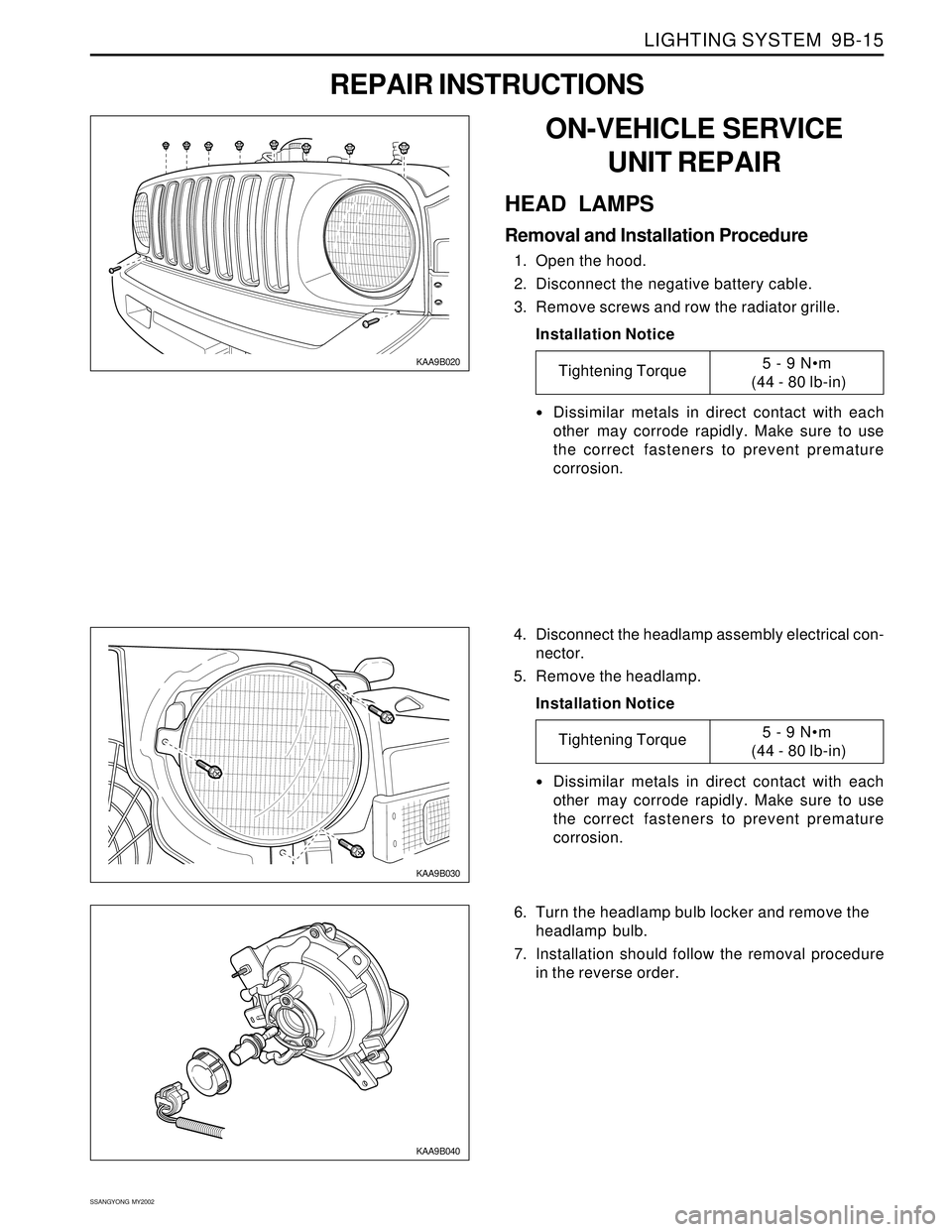
Removal and Installation Procedure
1. Open the hood.
2. Disconnect the negative battery cable.
3. Remove screws and row the radiator grille.
Installation Notice
Dissimilar metals in direct contact with each
other may corrode rapidly. Make sure to use
the correct fasteners to prevent premature
corrosion.
4. Disconnect the headlamp assembly electrical con-
nector.
5. Remove the headlamp.
Installation Notice
Dissimilar metals in direct contact with each
other may corrode rapidly. Make sure to use
the correct fasteners to prevent premature
corrosion.
Tightening Torque5 - 9 Nm
(44 - 80 lb-in)
Tightening Torque5 - 9 Nm
(44 - 80 lb-in)
KAA9B040
6. Turn the headlamp bulb locker and remove the
headlamp bulb.
7. Installation should follow the removal procedure
in the reverse order.
Page 1713 of 2053

WIPER, WASHER SYSTEMS 9D-5
SSANGYONG MY2002
KAA9D050
KAA9D060
5. Remove nuts and the wiper motor.
Installation Notice
Dissimilar metals in direct contact with each
other may corrode rapidly. Make sure to use
the correct fasteners to prevent premature
corrosion.
6. Installation should follow the removal procedure
in the reverse order.
WINDSHIELD WASHER
RESERVOIR
Removal and Installation Procedure
1. Open the hood.
2. Disconnect the negative battery cable.
3. Remove the coolant reservoir. Refer to Section 1D,
ENGING COOLING.
4. Disconnect the washer hose from the washer
pump.
WINDSHIELD WIPER BLADE
Removal and Installation Procedure
1. Rotate the wiper blade on the arm.
2. While pressing the retainer clip, slide the wiper
blade down the wiper arm and remove the blade.
3. Installation should follow the removal procedure
in the reverse order.
Tightening Torque8 - 12 Nm
(71 - 106 lb-ft)
KAA9D070
5. Disconnect the reservoir pump electrical
connector.
6. Remove the bolt and the reservoir
Installation Notice
Dissimilar metals in direct contact with each
other may corrode rapidly. Make sure to use
the correct fasteners to prevent premature
corrosion.
7. Installation should follow the removal procedure
in the reverse order.
Tightening Torque5 - 9 Nm
(44 - 80 lb-in)
Page 1714 of 2053

SSANGYONG MY2002
9D-6 WIPER, WASHER SYSTEMS
KAA9D080
KAA9D090
KAA9D100
WINDSHIELD WASHER PUMP
Removal and Installation Procedure
1. Remove the windshield washer reservoir. Refer to
in this section “windshield washer reservoir”.
2. Remove the windshield washer pump.
3. Installation should follow the removal procedure
in the reverse order.
WINDSHIELD WASHER HOSES
Removal and Installation Procedure
1. Open the hood.
2. Disconnect the windshield washer hose from the
washer nozzles on the hood.
3. Disconnect the washer hose from the washer
reservoir.
4. Remove the washer hose.
5. Installation should follow the removal procedure
in the reverse order.
KAA9D110
REAR WIPER ARM
Removal and Installation Procedure
1. Remove the spare tire with wheel nuts.
2. Pry off the rear wiper arm cap.
3. Remove the rear wiper arm with the nut.
Installation Notice
Dissimilar metals in direct contact with each other
may corrode rapidly. Make sure to use the correct
fasteners to prevent premature corrosion.
4. Installation should follow the removal procedure
in the reverse order.
WINDSHIELD WASHER NOZZLES
Removal and Installation Procedure
1. Open the hood.
2. Disconnect the washer hose from the nozzle.
3. Remove the nozzle from the hood.
4. Installation should follow the removal procedure
in the reverse order.
Tightening Torque8 - 12 Nm
(71 - 106 lb-in)
Page 1840 of 2053

BODY FRONT END 9R-5
SSANGYONG MY2002
COWL VENT GRILLE
Removal and Installation Procedure
1. Open the hood.
2. Remove the wiper arms. Refer to Section 9D,
Wipers/Washer System.
3. Remove the cowl vent grille with the screws.
4. Installation should follow the removal procedure
in the reverse order.
KAA9R020
KAA9R030
HOOD
Removal and Installation Procedure
Important: Install protective coverings over the fenders
and the windshield to prevent damage to the paint,
the glass, and the moldings when removing and
installing the hood.
1. Open the hood.
2. Mark the position of the hinge to the hood to aid
in alignment during installation.
3. Remove the washer hoses from the hood.
4. Remove the hood gas spring. Refer to “Hood Gas
Spring” in this section.
5. Remove the bolts retaining the hood to both of
the hinges.
Installation Notice
Dissimilar metals in direct contact with each
other may corrode rapidly. Make sure to use
the correct fasteners to prevent premature
corrosion.
6. With the aid of another technician, remove the hood
from the hinges.
7. Installation should follow the removal procedure
in the reverse order.
Tightening Torque7.84 - 11.76 Nm
(5.78 - 8.68 lb-ft)
Page 1841 of 2053

SSANGYONG MY2002
9R-6 BODY FRONT END
HOOD HINGES
Removal and Installation Procedure
1. Remove the hood. Refer to “Hood” in this section.
2. Remove the cowl vent grille. Refer to “Cowl Vent
Grille” in this section.
3. Remove the side cowl vent panel Refer to “Side
Cowl Vent Panel” in this section.
4. Remove the bolts and the hood hinges
Installation Notice
Dissimilar metals in direct contact with each
other may corrode rapidly. Make sure to use
the correct fasteners to prevent premature
corrosion.
5. Installation should follow the removal procedure
in the reverse order.
KAA9R040
HOOD GAS SPRING
Removal and Installation Procedure
1. Open the hood.
2. Remove the wiper arms. Refer to Section 9D,
Wipers/Washer System.
3. Remove the cowl vent grille with the screws.
4. Remove gas spring fix bolt and pull up the gas
spring from the ball stud by spreding the retainer
with screw driver.
5. Remove ball stud from hood. (or not)
Installation Notice
6. Installation should follow the removal procedure
in the reverse order.
KAA9R050
Tightening Torque12.74 - 25.48 Nm
(9.4 - 18.8 lb-ft)
Tightening
Torque9 - 11 Nm
(6.63 - 8.11 lb-ft)
16 - 23 Nm
(11.8 - 16.96 lb-ft)
Spring fix
bolt
Ball stud
bolt
Page 1849 of 2053
SSANGYONG MY2002
9T1-2 REMOTE KEYLESS ENTRY AND ANTI-THEFT SYSTEM
DESCRIPTION AND OPERATION
REMOTE KEYLESS ENTRY AND
ANTI-THEFT SYSTEM
The remote keyless entry and anti-theft system can
perform the following functions:
•Remotely lock and unlock the vehicle doors by
means of a hand-held, high-frequency transmitter.
Sense intrusion into the vehicle through the doors
or the hood.
Activate a warning if an intrusion is detected.
Automatically relock the doors if thedoor or the
tail gate is not opened within 30 seconds after the
vehicle has been unlocked by remote keyless
entry.
Help the driver find the vehicle in a parking area.
The remote keyless entry system consist of the
following components:
STICS.
Remote keyless entry system receiver.
Hand-held transmitter.
Tailgate open switch.
Door contact switch.
Siren.
Hood open switch
Key reminder switch.
Antenna.
STICS can perform the following functions:
1. Wiper INT sening vehicle speed.
By operating INT tiem control volume, variable
time will be changed within 1.5-20 seconds
2. Washer relating wiper.
3. Dimming room lamp.
When room lamp is coupled with door, it truns on
if door is opened. After closing the door it
maintains 2 seconds of lighting and dims off
whithin 3 seconds.
4. Time delayed power window control.
Power window can be operated within 30 seconds
after truning the IGN 1 switch from ON to OFF. If
driver/passenger’s door is opened within the 30
seconds from that moment.
5. Rear defogger timer.
The rear defogger will be operated for 12 min. by
turning ON the defogger switch while engine is
running.
Defogger will be stopped by pushing the switch
again.
The defogger will be operated 6 mim, if push ON
the switch within 10 min. after 12 min. of operation.6. Seat belt waring.
The warning lamp will be turned on for about 6
sec. With an intermittent chime bell when the IGN.
Switch is ON unless fastening the seat belt.
7. parking brake warning.
The indicator lamp will flash if drive while the
parking brake is applied.
8. Tail lamp lighting warning.
When the driver’s door is opened while the tail
lamp is still ON, the buzzer operates intermittently.
In this condition, the door will be automatically
unlock when it locked.
9. Door ajar warning.
The indicator lamp will be blinking when the door
is not closed completely and driving.
10. IGN key reminder.
The chime will be operated intermittently if the
driver’s door is opened while the IGN key is still
remain-ing in the ignition switch. In this condition,
the door will be automatically unlocked when it
locked.
11. Central door lock.
All doors will be locked/unlocked by locking/
unlocking the driver’s or passenger’s door.
12. coupled with REKES.
Being coupled with REKES (remote keyless entry
system), all doors will be locked/unlocked
according to signals of transmitter when the
ignition key is not inserted.
13. iginition key hole illumination.
coupled with door switch, ignition key hole
illumination lamp will trun on when the driver ’s
door is opened and will dim off after 10 sec. After
closing the door.
14. Auto door lock.
All doors will be locked automatically if the vehicle
speed reaches 50 km/h though the doors are in
unlock.
15. Auto door unlock.
All doors will be automatically unlock if the vehicle
crashes while driving (over 15km/h).
Operate the burglar alarm.
1. Burglar alarm must operate immediately when the
door, tailgate or hood is opened with improper
ways after all doors and hood were closed and
continued this status for 1 seconds.
2. If the tailgate is opened by key when the system
is on the burglar alarm cindition, the sysem must
be changed to the second burglar alarm condition
frim normal condition.