instrument cluster SSANGYONG KORANDO 1997 Service Repair Manual
[x] Cancel search | Manufacturer: SSANGYONG, Model Year: 1997, Model line: KORANDO, Model: SSANGYONG KORANDO 1997Pages: 2053, PDF Size: 88.33 MB
Page 922 of 2053

SSAMGYONG MY2002
4A-2 HYDRAULIC BRAKES
DESCRIPTION AND OPERATION
GENERAL DESCRIPTION
Brake fluid should meet the DOT 4 specification. Use
only clear fluid from a sealed container.
Fluid that is exposed to the air will absorb moisture.
Water in the brake fluid will cause the fluid to boil and
the rubber components to deteriorate.
Thoroughly clean the master cylinder reservoir cap be-
fore removing it. Do not let any dirt or foreign material
fall into the fluid reservoir.
There is a brake fluid level switch under the master
cylinder reservoir.When the fluid level is low, the BRAKE lamp in the
instrument cluster will turn on.
The correct brake fluid level is marked on the both
side of the brake fluid reservoir. If the fluid level is
below the MIN indicator mark, check the hydraulic brake
system for leaks. Fix any leaks. Then refill the reservoir
to the MAX indicator mark.
The hydraulic brake system is parallel split on Antilock
Brake Systems. This means the left front and left rear
brakes are on one hydraulic circuit and the right front
and right rear are on the other.
Page 925 of 2053
HYDRAULIC BRAKES 4A-5
SSANGYONG MY2002
Value(s)
-
-
-
-
-
-
-
-
-
-
-
-
-
-
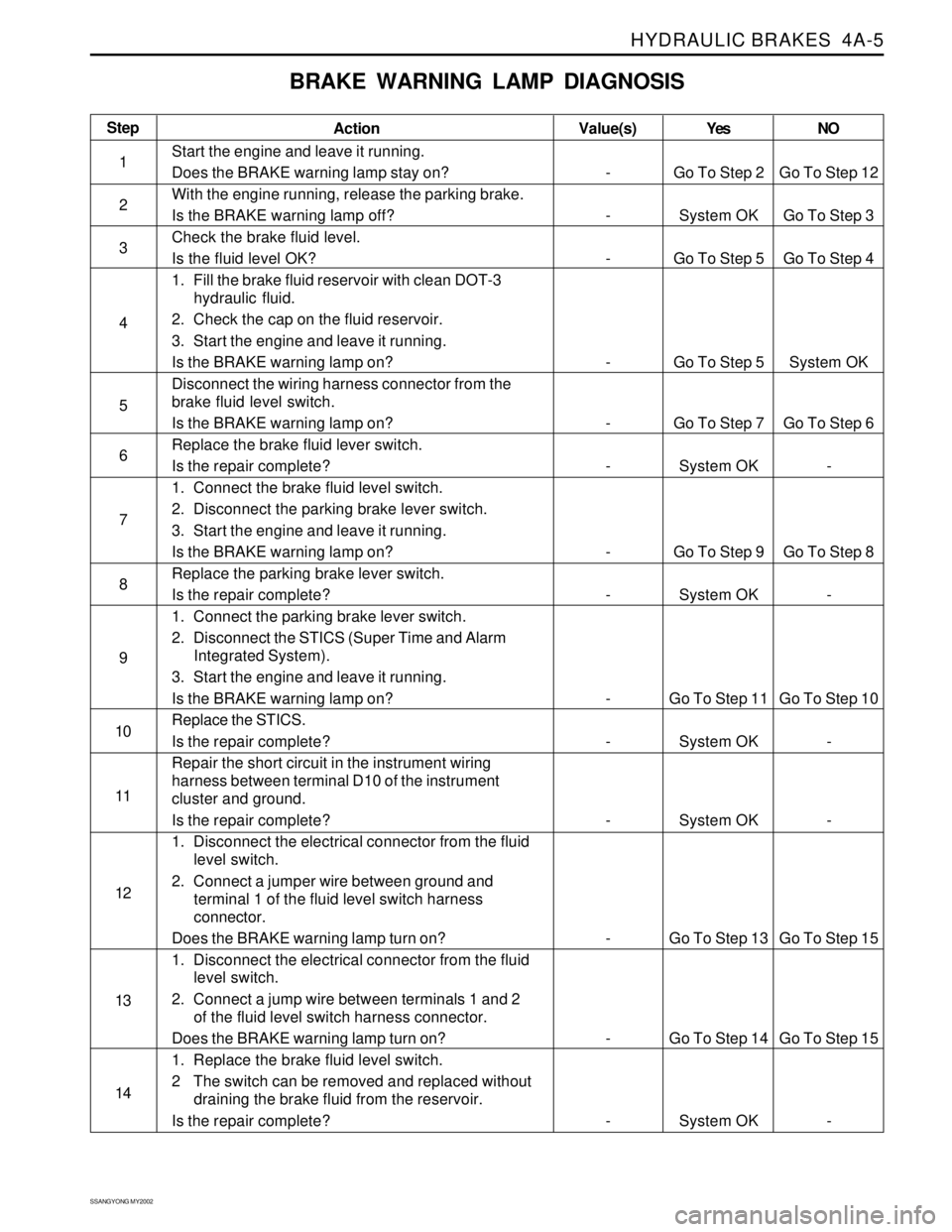
BRAKE WARNING LAMP DIAGNOSIS
Step
1
2
3
4
5
6
7
8
9
10
11
12
13
14Action
Start the engine and leave it running.
Does the BRAKE warning lamp stay on?
With the engine running, release the parking brake.
Is the BRAKE warning lamp off?
Check the brake fluid level.
Is the fluid level OK?
1. Fill the brake fluid reservoir with clean DOT-3
hydraulic fluid.
2. Check the cap on the fluid reservoir.
3. Start the engine and leave it running.
Is the BRAKE warning lamp on?
Disconnect the wiring harness connector from the
brake fluid level switch.
Is the BRAKE warning lamp on?
Replace the brake fluid lever switch.
Is the repair complete?
1. Connect the brake fluid level switch.
2. Disconnect the parking brake lever switch.
3. Start the engine and leave it running.
Is the BRAKE warning lamp on?
Replace the parking brake lever switch.
Is the repair complete?
1. Connect the parking brake lever switch.
2. Disconnect the STICS (Super Time and Alarm
Integrated System).
3. Start the engine and leave it running.
Is the BRAKE warning lamp on?
Replace the STICS.
Is the repair complete?
Repair the short circuit in the instrument wiring
harness between terminal D10 of the instrument
cluster and ground.
Is the repair complete?
1. Disconnect the electrical connector from the fluid
level switch.
2. Connect a jumper wire between ground and
terminal 1 of the fluid level switch harness
connector.
Does the BRAKE warning lamp turn on?
1. Disconnect the electrical connector from the fluid
level switch.
2. Connect a jump wire between terminals 1 and 2
of the fluid level switch harness connector.
Does the BRAKE warning lamp turn on?
1. Replace the brake fluid level switch.
2 The switch can be removed and replaced without
draining the brake fluid from the reservoir.
Is the repair complete?Yes
Go To Step 2
System OK
Go To Step 5
Go To Step 5
Go To Step 7
System OK
Go To Step 9
System OK
Go To Step 11
System OK
System OK
Go To Step 13
Go To Step 14
System OKNO
Go To Step 12
Go To Step 3
Go To Step 4
System OK
Go To Step 6
-
Go To Step 8
-
Go To Step 10
-
-
Go To Step 15
Go To Step 15
-
Page 926 of 2053
SSAMGYONG MY2002
4A-6 HYDRAULIC BRAKES
Action
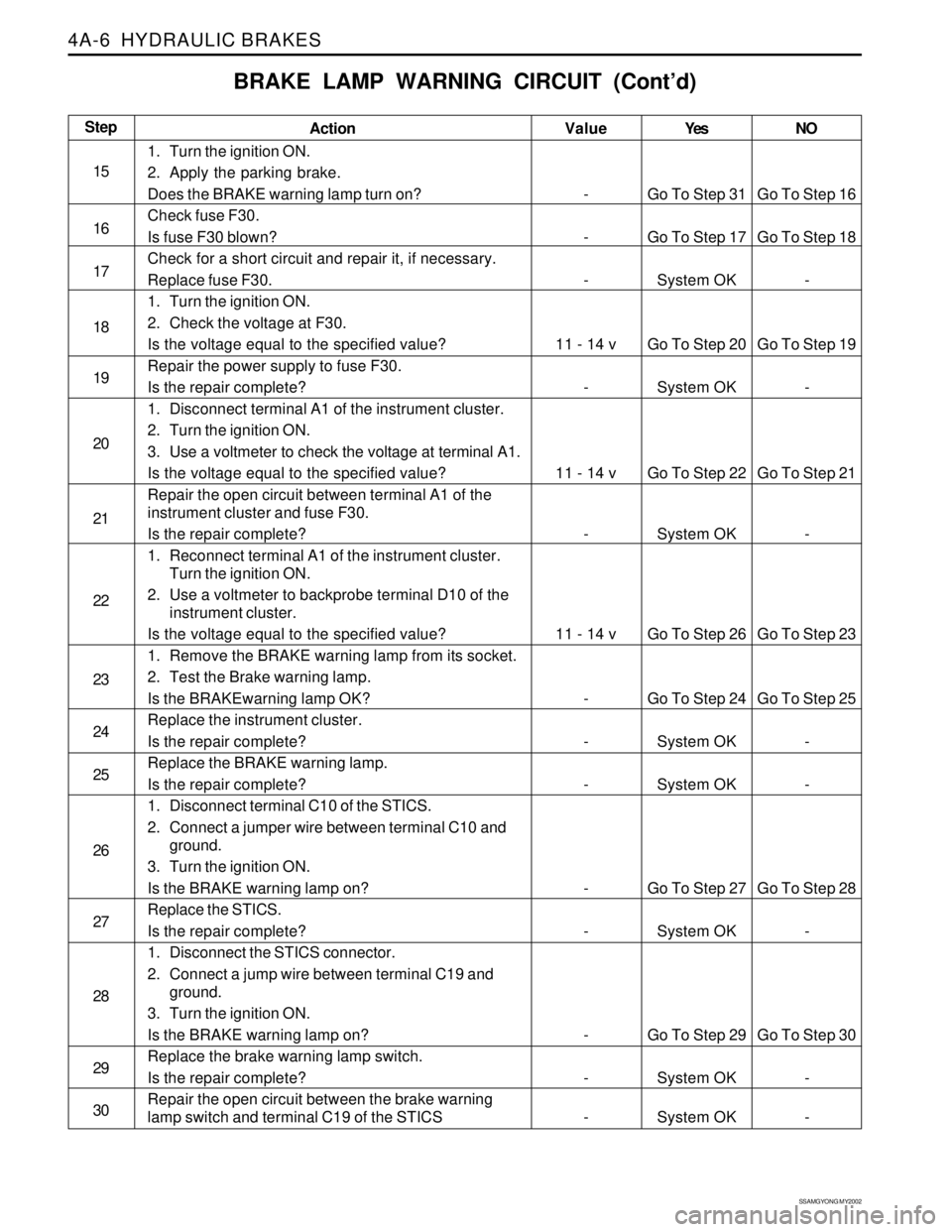
1. Turn the ignition ON.
2. Apply the parking brake.
Does the BRAKE warning lamp turn on?
Check fuse F30.
Is fuse F30 blown?
Check for a short circuit and repair it, if necessary.
Replace fuse F30.
1. Turn the ignition ON.
2. Check the voltage at F30.
Is the voltage equal to the specified value?
Repair the power supply to fuse F30.
Is the repair complete?
1. Disconnect terminal A1 of the instrument cluster.
2. Turn the ignition ON.
3. Use a voltmeter to check the voltage at terminal A1.
Is the voltage equal to the specified value?
Repair the open circuit between terminal A1 of the
instrument cluster and fuse F30.
Is the repair complete?
1. Reconnect terminal A1 of the instrument cluster.
Turn the ignition ON.
2. Use a voltmeter to backprobe terminal D10 of the
instrument cluster.
Is the voltage equal to the specified value?
1. Remove the BRAKE warning lamp from its socket.
2. Test the Brake warning lamp.
Is the BRAKEwarning lamp OK?
Replace the instrument cluster.
Is the repair complete?
Replace the BRAKE warning lamp.
Is the repair complete?
1. Disconnect terminal C10 of the STICS.
2. Connect a jumper wire between terminal C10 and
ground.
3. Turn the ignition ON.
Is the BRAKE warning lamp on?
Replace the STICS.
Is the repair complete?
1. Disconnect the STICS connector.
2. Connect a jump wire between terminal C19 and
ground.
3. Turn the ignition ON.
Is the BRAKE warning lamp on?
Replace the brake warning lamp switch.
Is the repair complete?
Repair the open circuit between the brake warning
lamp switch and terminal C19 of the STICS
BRAKE LAMP WARNING CIRCUIT (Cont’d)
Yes
Go To Step 31
Go To Step 17
System OK
Go To Step 20
System OK
Go To Step 22
System OK
Go To Step 26
Go To Step 24
System OK
System OK
Go To Step 27
System OK
Go To Step 29
System OK
System OKNO
Go To Step 16
Go To Step 18
-
Go To Step 19
-
Go To Step 21
-
Go To Step 23
Go To Step 25
-
-
Go To Step 28
-
Go To Step 30
-
-Step
15
16
17
18
19
20
21
22
23
24
25
26
27
28
29
30Value
-
-
-
11 - 14 v
-
11 - 14 v
-
11 - 14 v
-
-
-
-
-
-
-
-
Page 927 of 2053

HYDRAULIC BRAKES 4A-7
SSANGYONG MY2002
BRAKE LAMP WARNING CIRCUIT (Cont’d)
Action
1. Disconnect the brake fluid level switch.
2. Use an ohmmeter to check the resistance between
terminal 2 of the switch connector and ground.
Is the resistance equal to the specified value?
Repair the open circuit between ground and the brake
fluid level switch.
Is the repair complete?
Repair the open circuit between terminal 1 of the brake
fluid level switch and terminal D10 of the instrument
cluster.
Is the repair complete?Yes
Go To Step 32
System OK
System OKNO
Go To Step 33
-
-Step
31
32
33Value(s)
≈ 0 Ω
-
-
Page 1003 of 2053

SSANGYONG MY2002
4F-20 ABS AND TCS
Go to Step 15
System OK
Go to Step 17
System OK
System OK
Go to Step 20
System OK
Go to Step 22
System OK
System OK Value(s) Step
14
15
16
17
18
19
20
21
22
23
ABS Indicator Lamp Inoperative (Cont’d)
Action Yes No
Check the wiring harnesses and the connectors in
circuit Lg from the I/P cluster terminal D7 to terminal
31 of the EBCM connector.
Is the voltage equal to the specified value?
Repair the open or high resistance found.
Is the repair complete?
Check for continuity between terminal 19 of the EBCM
connector and ground G205.
Is the the continuity equal to the specified value?
Replace the ABS unit.
Is the repair complete?
Repair the continuity problem between terminal 19 of
the EBCM connector and ground G205.
Is the repair complete?
1. Turn the ignition to LOCK.
2. Check fuse F30 in the I/P fuse block.
Is fuse F30 blown?
Replace fuse F30.
Is the repair complete?
1. Turn the ignition on.
2. Check the voltage at fuse F30.
Is the voltage equal to the specified value?
Repair the power supply to fuse F30.
Is the repair complete?
1. Remove the instrument cluster.
2. Check the circuit PNK from fuse F30 to terminal A1
of the I/P cluster connector.
3. Repair any open or high resistance found in a wiring
harness, splice pack, or connector.
Is the repair complete?
∞
-
≈ 0 Ω
-
-
-
-
11 - 14 v
-
-Go to Step 16
-
Go to Step 18
-
-
Go to Step 21
-
Go to Step 23
-
-
Page 1085 of 2053
SSANGYONG MY2002
4F-102 ABS AND TCS
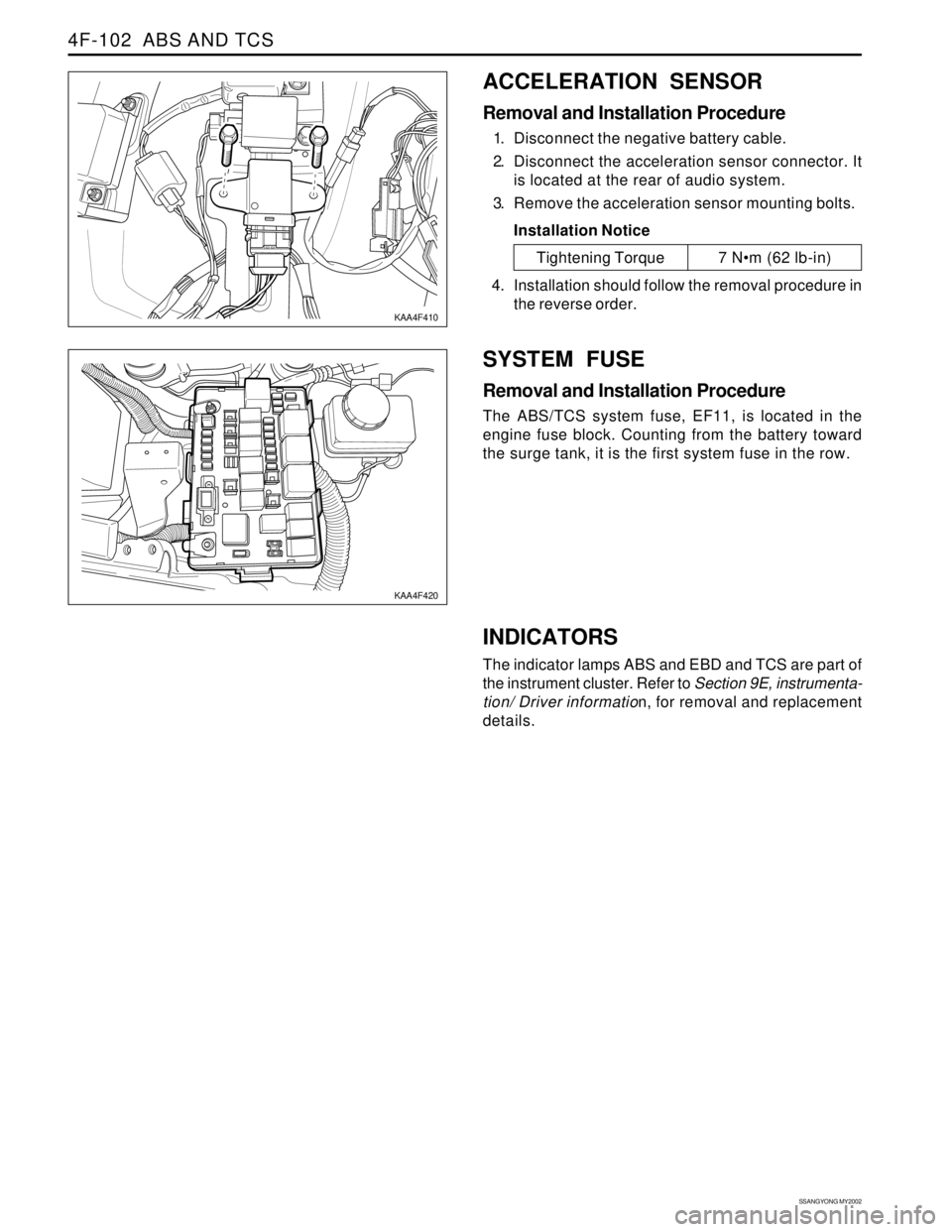
ACCELERATION SENSOR
Removal and Installation Procedure
1. Disconnect the negative battery cable.
2. Disconnect the acceleration sensor connector. It
is located at the rear of audio system.
3. Remove the acceleration sensor mounting bolts.
Installation Notice
SYSTEM FUSE
Removal and Installation Procedure
The ABS/TCS system fuse, EF11, is located in the
engine fuse block. Counting from the battery toward
the surge tank, it is the first system fuse in the row.
KAA4F410
KAA4F420
Tightening Torque 7 Nm (62 lb-in)
4. Installation should follow the removal procedure in
the reverse order.
INDICATORS
The indicator lamps ABS and EBD and TCS are part of
the instrument cluster. Refer to Section 9E, instrumenta-
tion/ Driver information, for removal and replacement
details.
Page 1089 of 2053
SSANGYONG MY2002
4G-2 PARKING BRAKE
DESCRIPTION AND OPERATION
BRAKE CALIPER
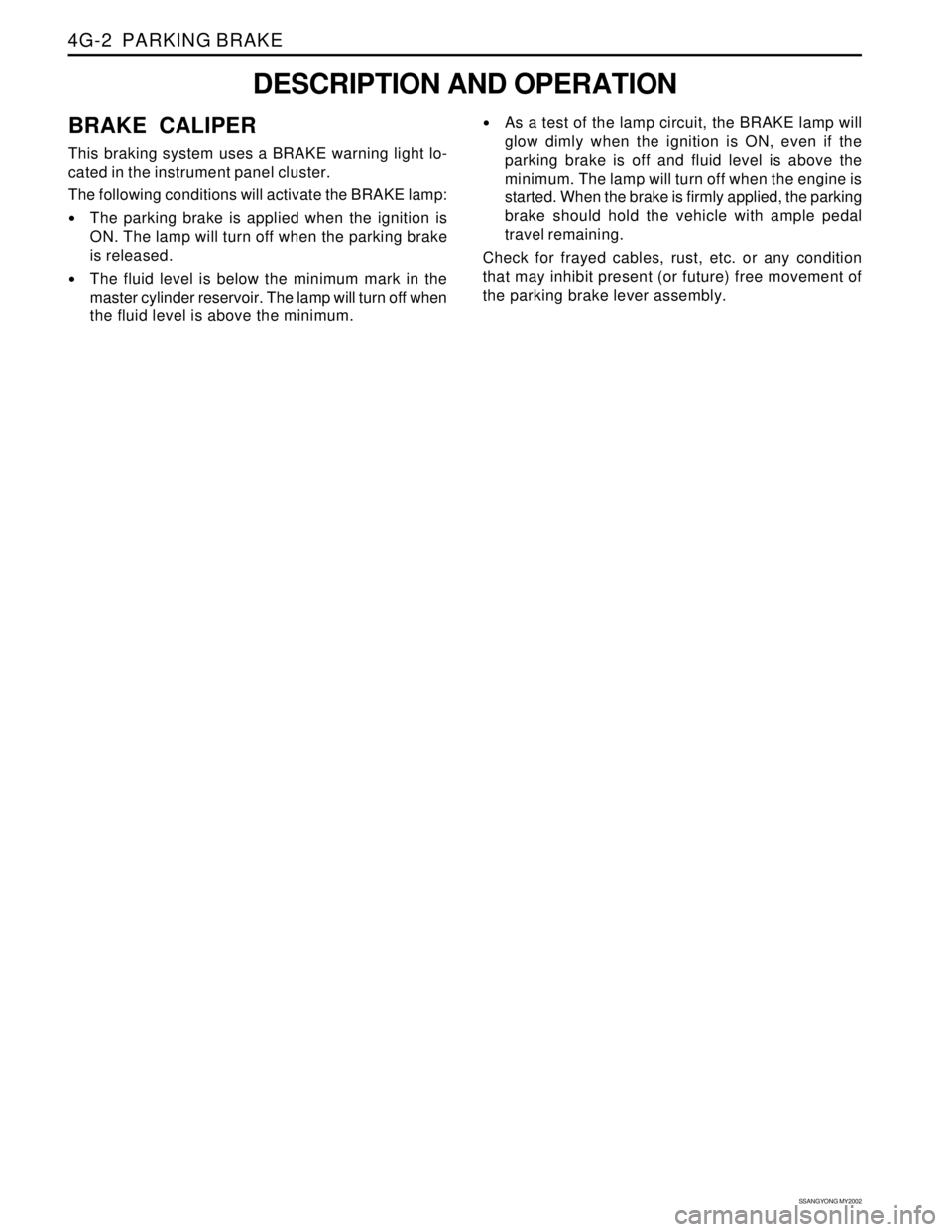
This braking system uses a BRAKE warning light lo-
cated in the instrument panel cluster.
The following conditions will activate the BRAKE lamp:
•The parking brake is applied when the ignition is
ON. The lamp will turn off when the parking brake
is released.
The fluid level is below the minimum mark in the
master cylinder reservoir. The lamp will turn off when
the fluid level is above the minimum.
As a test of the lamp circuit, the BRAKE lamp will
glow dimly when the ignition is ON, even if the
parking brake is off and fluid level is above the
minimum. The lamp will turn off when the engine is
started. When the brake is firmly applied, the parking
brake should hold the vehicle with ample pedal
travel remaining.
Check for frayed cables, rust, etc. or any condition
that may inhibit present (or future) free movement of
the parking brake lever assembly.
Page 1092 of 2053
PARKING BRAKE 4G-5
SSANGYONG MY2002
KAA4G040
KAA4G050
KAA4G060
KAA4G070
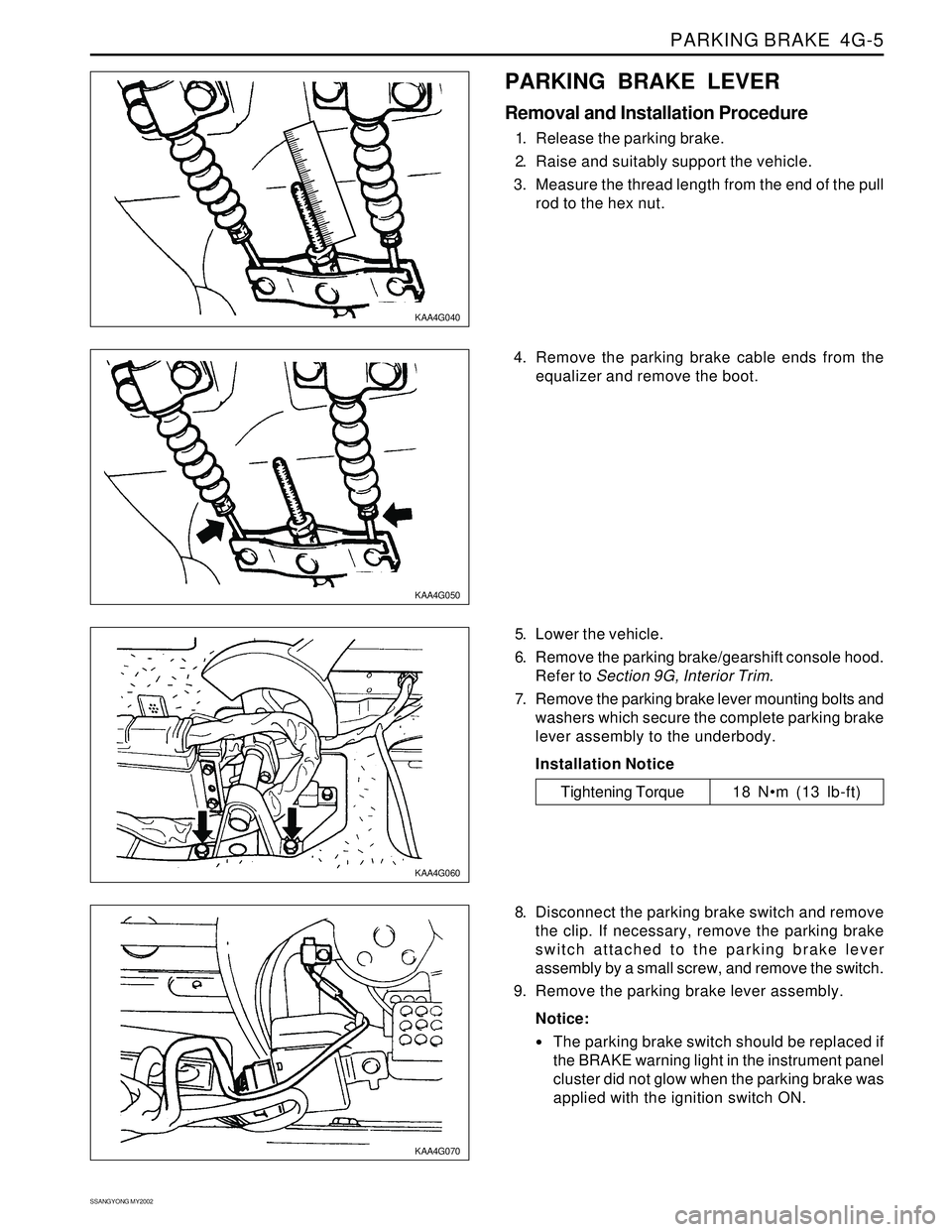
PARKING BRAKE LEVER
Removal and Installation Procedure
1. Release the parking brake.
2. Raise and suitably support the vehicle.
3. Measure the thread length from the end of the pull
rod to the hex nut.
5. Lower the vehicle.
6. Remove the parking brake/gearshift console hood.
Refer to Section 9G, Interior Trim.
7. Remove the parking brake lever mounting bolts and
washers which secure the complete parking brake
lever assembly to the underbody.
Installation Notice
8. Disconnect the parking brake switch and remove
the clip. If necessary, remove the parking brake
switch attached to the parking brake lever
assembly by a small screw, and remove the switch.
9. Remove the parking brake lever assembly.
Notice:
The parking brake switch should be replaced if
the BRAKE warning light in the instrument panel
cluster did not glow when the parking brake was
applied with the ignition switch ON.
Tightening Torque 18 Nm (13 lb-ft) 4. Remove the parking brake cable ends from the
equalizer and remove the boot.
Page 1102 of 2053

5A-8 AUTOMATIC TRANSMISSION
SSANGYONG MY2002
Solenoid Valve Symbols
(ON/OFF Solenoids)
The solenoid symbol shown adjacent to each solenoid
on the hydraulic system schematics indicates the state
of the oil flow through the solenoid valve with the power
ON or OFF.
Normally Open (NO) Solenoid
POWER ON: Line 500 port is closed. The output port
is open to exhaust at the solenoid valve.
POWER OFF: The exhaust port is closed. The output
port is open to line 500.
Variable Pressure Solenoid Multiplexing System
Friction element shifting pressures are controlled by
the Variable Pressure Solenoid (VPS).
Line pressure is completely independent of shift pres-
sure and is a function of throttle position, gear state
and engine speed.
S5 is a proportional or variable pressure solenoid that
provides the signal pressure to the clutch and band
regulator valves thereby controlling shift pressures.
VPS pressure is multiplexed to the clutch regulator
valve, the band regulator valve and the converter clutch
regulator valve during automatic gearshifts.
A variable pressure solenoid produces a hydraulic
pressure inversely proportional to the current applied.
During a gearshift the TCM applies a progressively
increasing or decreasing (ramped) current to the
solenoid. Current applied will vary between a minimum
oaf 200 mA and a maximum of 1000 mA. Increasing
current decreases output (S5) pressure. Decreasing
current increases output (S5) pressure.
Line 500 pressure, (approximately 440 to 560 kPa), is
the reference pressure for the VPS, and the VPS output
pressure is always below line 500 pressure.
When the VPS is at standby, that is no gearshift is
taking place, the VPS current is set to 200 mA giving
maximum output pressure.
Under steady state conditions the band and clutch
regulator valve solenoids are switched OFF.This applies full Line 500 pressure to the plunger and
because Line 500 pressure is always greater than S5
pressure it squeezes the S5 oil out between the
regulator valve and the plunger. The friction elements
are then fed oil pressure equal to Line 500 multiplied
by the amplification ratio.
When a shift is initiated the required ON/OFF solenoid
is switched ON cutting the supply of Line 500 to the
plunger.
At the same time the VPS pressure is reduced to the
ramp start value and assumes control of the regulator
valve by pushing the plunger away from the valve.
The VPS then carries out the required pressure ramp
and the timed shift is completed by switching OFF the
ON/ OFF solenoid and returning the VPS to the standby
pressure.
This system enables either the band or clutch or both
to be electrically controlled for each gearshift.
Mode Indicator Light
Depending on the application, the mode indicator light
may be used to indicate the mode that has been se-
lected or if an overheat condition exists. The mode
indicator light is usually located on the instrument
cluster.
Communication Systems
CAN
The Controller Area Network (CAN) connects various
control modules by using a twisted pair of wires, to
share common information. This results in a reduction
of sensors and wiring. TCM obtains the actual engine
speed and throttle position, vehicle speed and
accelerator position etc. from ECM via CAN without
any additional sensors.
K-Line
The K-line is typically used for obtaining diagnostic
information from the TCM. A scan tool with a special
interface is connected to the TCM via Data Link
Connector (DLC) and all current faults, stored faults,
runtime parameters are then available. The stored
trouble codes can also be cleared by scan tool.
The K-line can be used for vehicle coding at the
manufacturer’s plant or in the workshop. This allows
for one TCM design to be used over different vehicle
mod-els.
The particular code is sent to the microprocessor via
the K-line and this results in the software selecting the
correct shift and VPS ramp parameters.
Data Link Connector (DLC)
The Data Link Connector (DLC) is a multiple cavity
connector. The DLC provides the means to access the
serial data from the TCM.
The DLC allows the technician to use a scan tool to
monitor the various systems and display the Diagnostic
Trouble Codes (DTCs).
KAA5A070
Page 1578 of 2053

SSANGYONG MY2002
8A-2 SEAT BELTS
DESCRIPTION AND OPERATION
DRIVER SEAT BELT WARNING
The driver’s seat belt incorporates a seat belt warning
lamp in the instrument cluster to remind the driver if
the seat belt is not fastened when the ignition is turned
ON. The warning lamp blinks for eight seconds with
chime and goes out.
THREE-POINT FRONT SEAT BELT
WITH PRETENSIONER
The front seat belt contains an electronically controlled
pyrotechnic retractor, pretensioner, which reduces seat
belt slack when it activated in a head-on or angled
front collision. The front seat belt must be replaced
after an accident that causes its activation. At normal
condition the driver’s seat belt operates as emergency
locking retractor (ELR).
Emergency Locking Retractor (ELR)
The ELR seat belt is always unlocked, allowing the
passenger freedom of movement, except in
emergencies such as rapid deceleration, rapid
acceleration, or hard cornering maneuvers.
THREE-POINT REAR OUTBOARD
SEAT BELT
The rear outboard seating position uses the emergency
locking retractor (ELR). Refer to Three-point front seat
belt with pretensioner in this section for details.
TWO-POINT LAP REAR CENTER
SEAT BELT
The two-point lap rear center seat belt is a single contin-
uous length of webbing. The webbing is routed from
the anchor through plate and into a single retractor.
OPERATIONAL AND FUNCTIONAL
CHECKS
Caution:
Keep sharp objects and potentially damaged ob
jects away from seat belts.
Avoid bending or damaging any portion of
buckle or the latch plate
Do not breach or dye the belt webbing. Use only
mild soap and water in order to clean the belts.
When installing the seat belt anchor bolts and
screws, start the bolts and screws by hand in or-
der to prevent cross-threading.
Do not attempt any repairs on the retractor mech-
anisms or covers. Replace any defective assem-
blies with new assemblies.
Replace any belts that are cut or damaged in any
way.
1. Inspect all seat anchor bolts and screws in order to
verify that they are secure.
2. Inspect the seat belt buckle. The buckle must lock
and unlock easily.
3. After inserting the latch into the buckle, tug sharply
on the belt. The buckle must remain locked.
4. Fully extend the shoulder belt portion to make sure
that there is no twisting or tears in the belt.
5. Let the shoulder belt retract fully. The belt should
retract easily.
CHILD SEAT TETHER ANCHOR
There are three child seat tether anchors to hold the
child seat firmly. One is located rear center of ceiling
and two are located on the rear corner of floor.