lamp SSANGYONG KORANDO 2013 User Guide
[x] Cancel search | Manufacturer: SSANGYONG, Model Year: 2013, Model line: KORANDO, Model: SSANGYONG KORANDO 2013Pages: 1336, PDF Size: 92.18 MB
Page 313 of 1336
0000-00
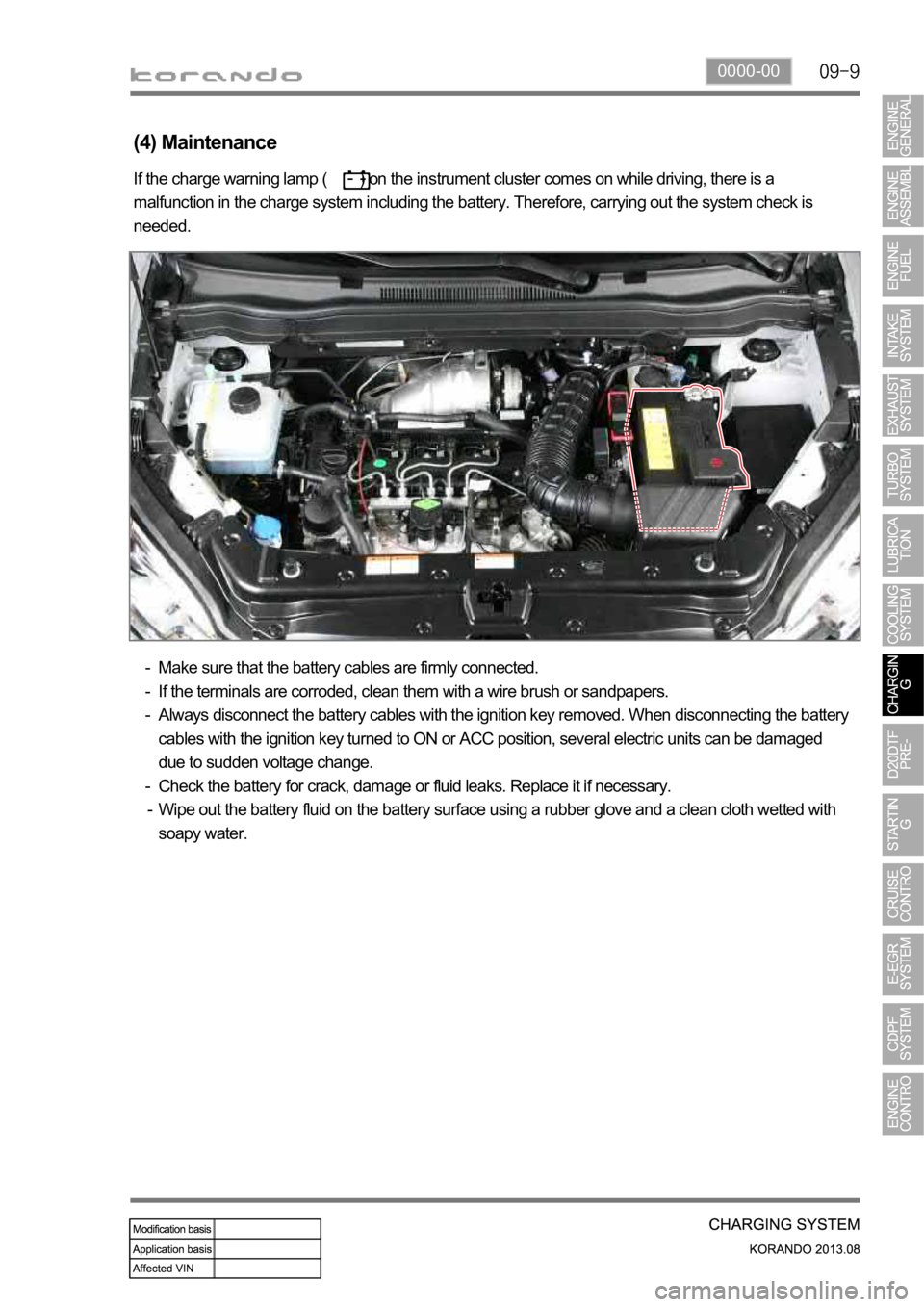
(4) Maintenance
Make sure that the battery cables are firmly connected.
If the terminals are corroded, clean them with a wire brush or sandpapers.
Always disconnect the battery cables with the ignition key removed. When disconnecting the battery
cables with the ignition key turned to ON or ACC position, several electric units can be damaged
due to sudden voltage change.
Check the battery for crack, damage or fluid leaks. Replace it if necessary.
Wipe out the battery fluid on the battery surface using a rubber glove and a clean cloth wetted with
soapy water. -
-
-
-
-
If the charge warning lamp ( ) on the instrument cluster comes on while driving, there is a
malfunction in the charge system including the battery. Therefore, carrying out the system check is
needed.
Page 360 of 1336
2. CAUTIONS
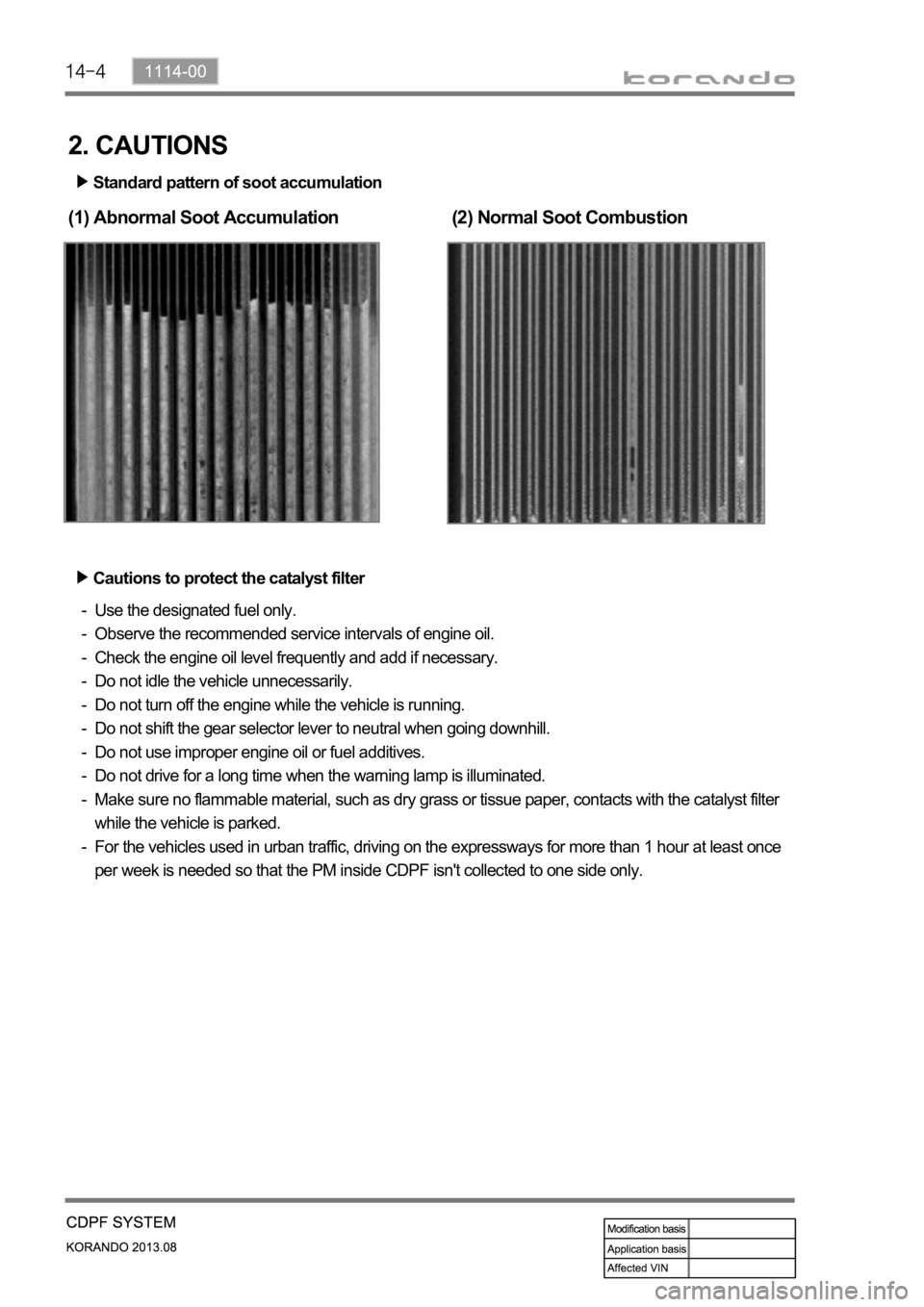
Standard pattern of soot accumulation
(1) Abnormal Soot Accumulation(2) Normal Soot Combustion
Cautions to protect the catalyst filter
Use the designated fuel only.
Observe the recommended service intervals of engine oil.
Check the engine oil level frequently and add if necessary.
Do not idle the vehicle unnecessarily.
Do not turn off the engine while the vehicle is running.
Do not shift the gear selector lever to neutral when going downhill.
Do not use improper engine oil or fuel additives.
Do not drive for a long time when the warning lamp is illuminated.
Make sure no flammable material, such as dry grass or tissue paper, contacts with the catalyst filter
while the vehicle is parked.
For the vehicles used in urban traffic, driving on the expressways for more than 1 hour at least once
per week is needed so that the PM inside CDPF isn't collected to one side only. -
-
-
-
-
-
-
-
-
-
Page 361 of 1336
1114-00
(3) Warning Lamp Related to CDPF
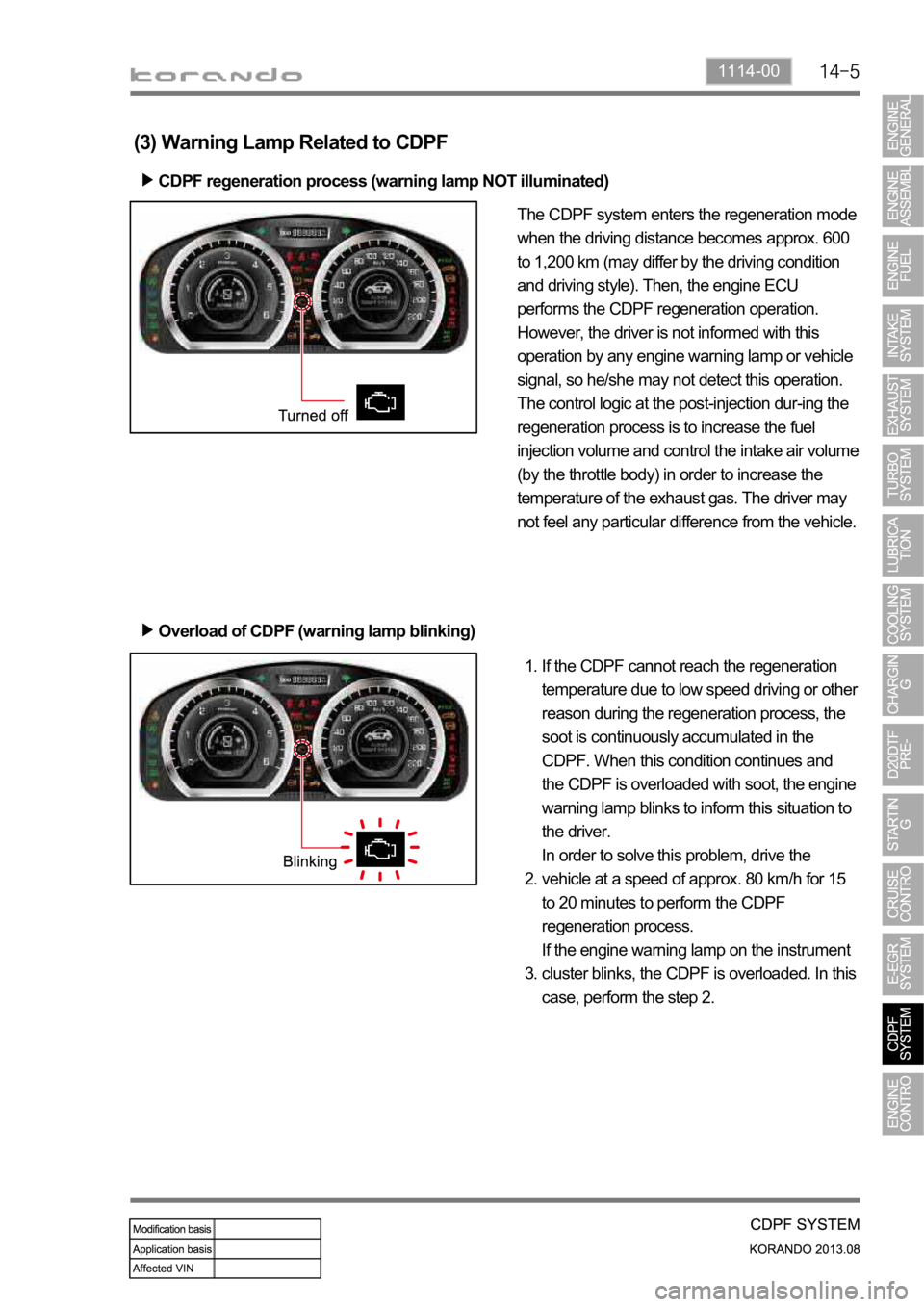
CDPF regeneration process (warning lamp NOT illuminated)
Overload of CDPF (warning lamp blinking)
The CDPF system enters the regeneration mode
when the driving distance becomes approx. 600
to 1,200 km (may differ by the driving condition
and driving style). Then, the engine ECU
performs the CDPF regeneration operation.
However, the driver is not informed with this
operation by any engine warning lamp or vehicle
signal, so he/she may not detect this operation.
The control logic at the post-injection dur-ing the
regeneration process is to increase the fuel
injection volume and control the intake air volume
(by the throttle body) in order to increase the
temperature of the exhaust gas. The driver may
not feel any particular difference from the vehicle.
If the CDPF cannot reach the regeneration
temperature due to low speed driving or other
reason during the regeneration process, the
soot is continuously accumulated in the
CDPF. When this condition continues and
the CDPF is overloaded with soot, the engine
warning lamp blinks to inform this situation to
the driver.
In order to solve this problem, drive the
vehicle at a speed of approx. 80 km/h for 15
to 20 minutes to perform the CDPF
regeneration process.
If the engine warning lamp on the instrument
cluster blinks, the CDPF is overloaded. In this
case, perform the step 2. 1.
2.
3.
Page 362 of 1336

Excessive overload of CDPF (warning lamp illuminated)
If the vehicle is driven at a speed of 5 to 10
km/h for an extended period of time, the soot
accumulated in the CDPF cannot be burned
as the CDPF cannot reach the regeneration
temperature. Then, an excessive amount of
soot can be accumulated in the CDPF.
This case is much worse than the simple over-
load of the CDPF. To inform this to the driver,
the engine warning lamp comes on and the
engine power is decreased to protect the
system.
To solve this problem, blow soot between the
engine and exhaust system several times and
erase the related DTC. Then, check if the
same DTC is regenerated again. If so, check
the DTC related to the differential pressure
sensor. 1.
2.
3.
Page 427 of 1336
4) Basic Inspection
(1) Horn operation
Listen for the horn sound when pressing the horn pad on the steering wheel. -
(2) Brake operation
Check if there is any abnormal noise, unusually long braking distance, or uneven braking force. If the
brake warning lamp does not go out even after starting the engien or are flashing during driving,
have the brake system checked immediately.
Check the brake pipes and hoses for connection, oil leak, crack or interference after changing the
position of tires. When replacing the tires, check the brake disc for surface condition and wear.
Check the parking brake cable and brake operation. Shorten the checking interval if the parking
brake is used frequently. -
-
-
(3) Exhaust system
Be aware to any changes in sound or smell from the exhaust system. These may be caused by leak or
overheat. Have the exhaust system checked and repaired immediately.
Inspect the exhaust system including catalytic converter. Inspect all the components and body frame
near the exhaust system. -
-
(4) Tires
Unusual vibration of the steering wheel and seats or pulling to one side on the straight and level roads
may indicates the uneven tire inflation pressure or poor wheel balance. -
(5) Steering and suspension system
Inspect the front and rear suspension and the steering system for damage, looseness or missing
parts, signs of wear or lack of lubrication. Inspect the power steering line and the hoses for
connection, leak, crack and chafing. Inspect the drive axle boot and seals for damage, tear or leak.
Replace or repair the system if necessary. -
(6) Engine oil
Check the oil level when the engine is still warm and add the specified engine oil if necessary. -
(7) Coolant
Check the coolant level in the coolant reservoir, coolant conditions (contamination, foreign material),
and hoses for damage and leak. Replace or add the Ssangyong genuine coolant, if needed. -
(8) Engine drive belt
Check all drive belts on the engine for wear, crack and looseness. Retighten or replace the belt, if
needed. -
Page 438 of 1336
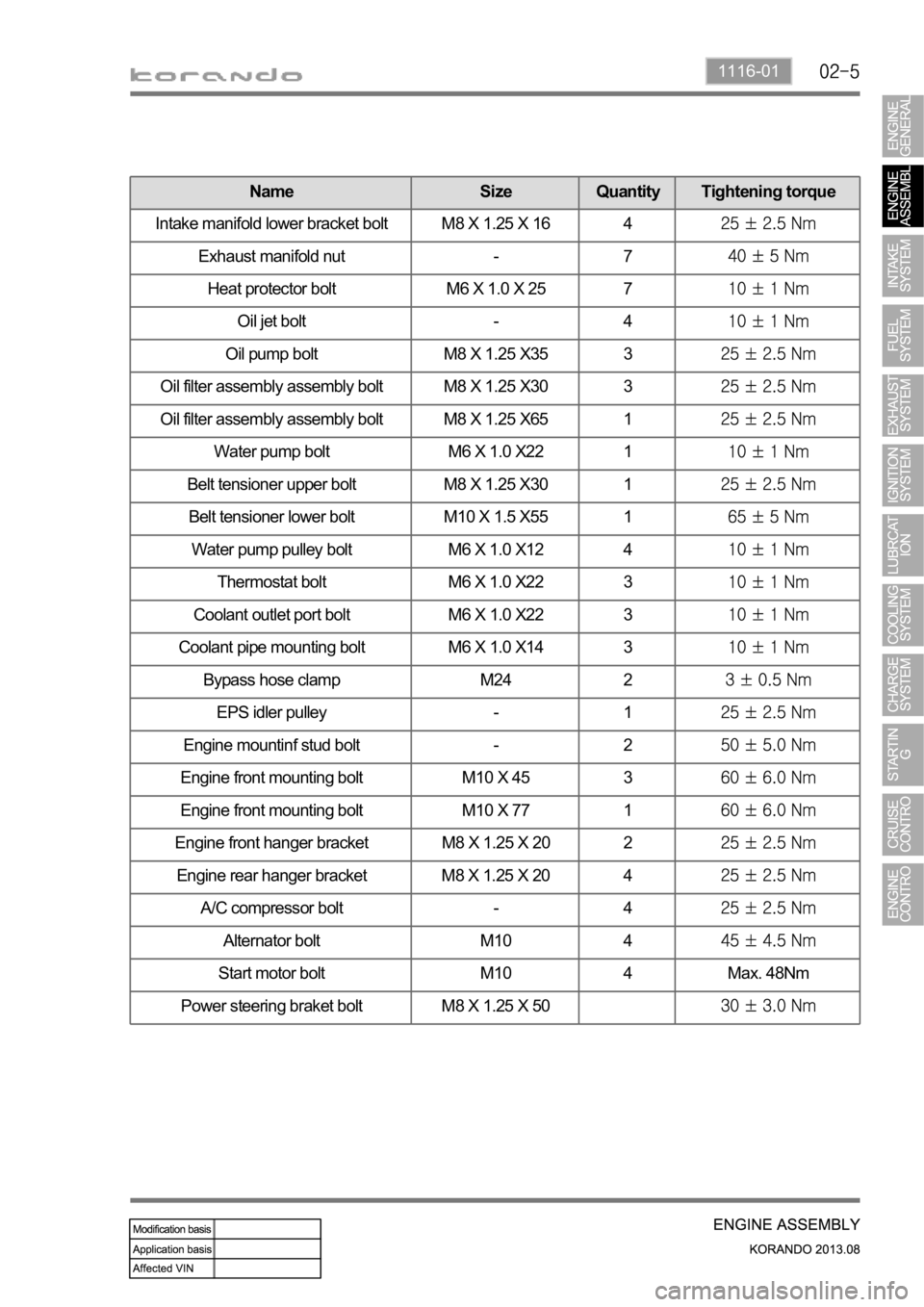
1116-01
Name Size Quantity Tightening torque
Intake manifold lower bracket bolt M8 X 1.25 X 16 4
Exhaust manifold nut - 7
Heat protector bolt M6 X 1.0 X 25 7
Oil jet bolt - 4
Oil pump bolt M8 X 1.25 X35 3
Oil filter assembly assembly bolt M8 X 1.25 X30 3
Oil filter assembly assembly bolt M8 X 1.25 X65 1
Water pump bolt M6 X 1.0 X22 1
Belt tensioner upper bolt M8 X 1.25 X30 1
Belt tensioner lower bolt M10 X 1.5 X55 1
Water pump pulley bolt M6 X 1.0 X12 4
Thermostat bolt M6 X 1.0 X22 3
Coolant outlet port bolt M6 X 1.0 X22 3
Coolant pipe mounting bolt M6 X 1.0 X14 3
Bypass hose clamp M24 2
EPS idler pulley - 1
Engine mountinf stud bolt - 2
Engine front mounting bolt M10 X 45 3
Engine front mounting bolt M10 X 77 1
Engine front hanger bracket M8 X 1.25 X 20 2
Engine rear hanger bracket M8 X 1.25 X 20 4
A/C compressor bolt - 4
Alternator bolt M10 4
Start motor bolt M10 4 Max. 48Nm
Power steering braket bolt M8 X 1.25 X 50
Page 454 of 1336

1311-01
The drive chain is single chain drive system with simple design and variable performance, and it utilizes
the hydraulic tensioner to reduce the wave impact generated by the chain. The silent chain provides the
silence during the operation. To improve NVH, the shoulder bolt has been introduced. Overview
Layout and Components
Hydraulic tensioner
Consists of tensioner housing
plug, spring, check valve, and
operated by hydraulic
pressure and spring in
tensioner
Timing chain
Chain type: Silent chain type
Links: 146 ea
Tensioner rail
Installed between exjaust
camshaft sprocket and
crankshaft sprocket
Crankshaft sprocket
Teeth: 21 ea
Oil pump sprocket
Teeth: 28 ea
Exhaust camshaft
sprocket
Teeth:42 eaIntake camshaft
sprocket
CVVT
Teeth: 42 ea
OCV
Controls the hydraulic circuit
to control the intake cam
sprocket variably
Clamping rail
Installed between intake
camshaft sprocket and
crankshaft sprocket
Mechanical tensioner
Operated by spring in
tensioner
Oil pump chain
Chain type: Silent chain type
Links: 58 ea
Page 459 of 1336
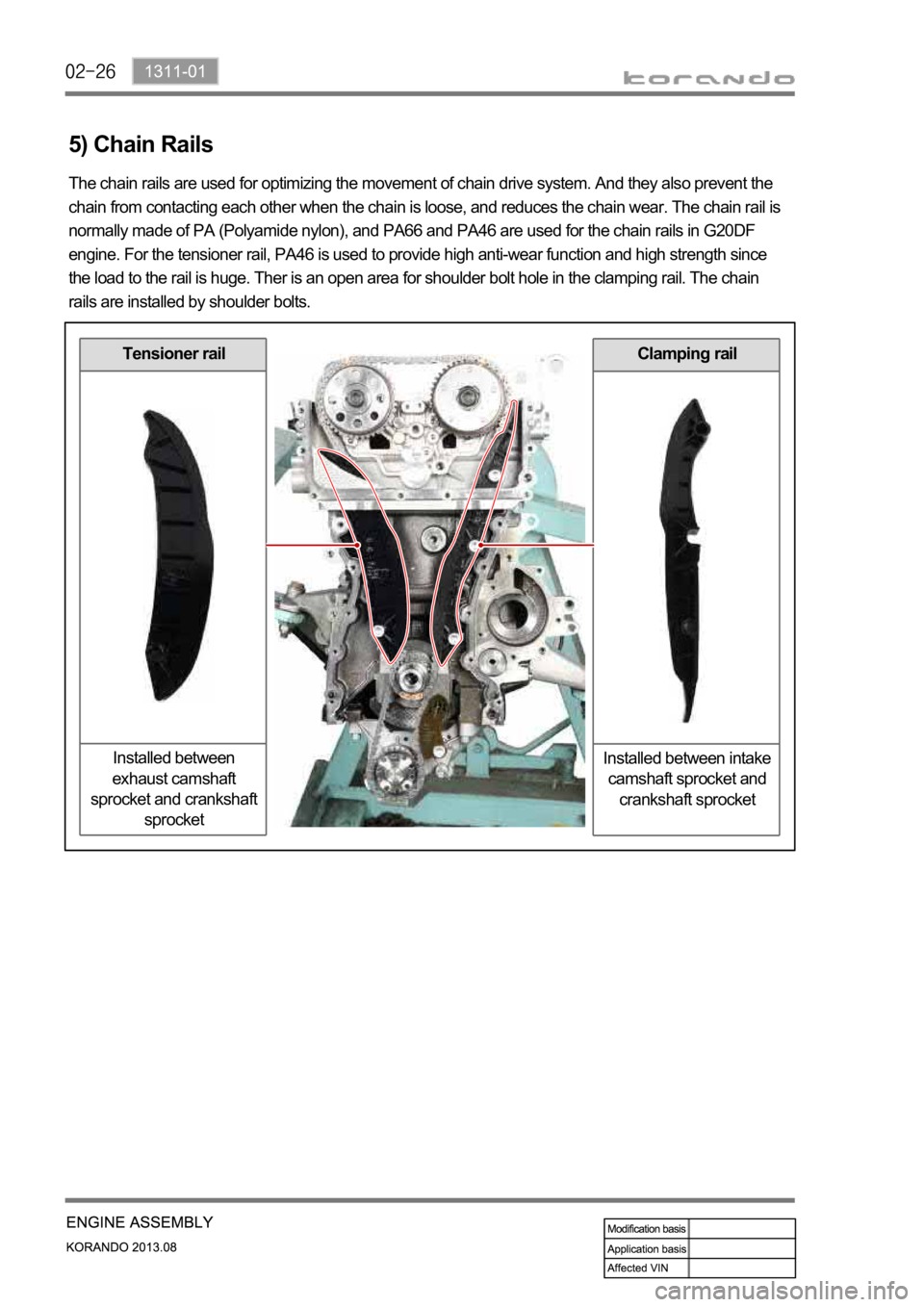
Clamping rail
Installed between intake
camshaft sprocket and
crankshaft sprocket
5) Chain Rails
The chain rails are used for optimizing the movement of chain drive system. And they also prevent the
chain from contacting each other when the chain is loose, and reduces the chain wear. The chain rail is
normally made of PA (Polyamide nylon), and PA66 and PA46 are used for the chain rails in G20DF
engine. For the tensioner rail, PA46 is used to provide high anti-wear function and high strength since
the load to the rail is huge. Ther is an open area for shoulder bolt hole in the clamping rail. The chain
rails are installed by shoulder bolts.
Tensioner rail
Installed between
exhaust camshaft
sprocket and crankshaft
sprocket
Page 474 of 1336

0000-00
Air Cleaner Assy
Element Assy
Air Cleaner MTG NO.2
Insulator Collar
Spring Clamp
Resonance Duct
Resonance O-Ring
Air Cleaner MTG NO.1
Air Cleaner MTG Bolt 1.
3.
5.
6.
7.
8.
9.
10.
11.Snorkel Assy
Water Portector
Resonator Assy
RR Fascia MTG Screw Rivet
Bolt
Nut
Screw
Air Cleaner to Engine Hose Assy 12.
13.
14.
17.
18.
19.
20.
21.
Page 481 of 1336
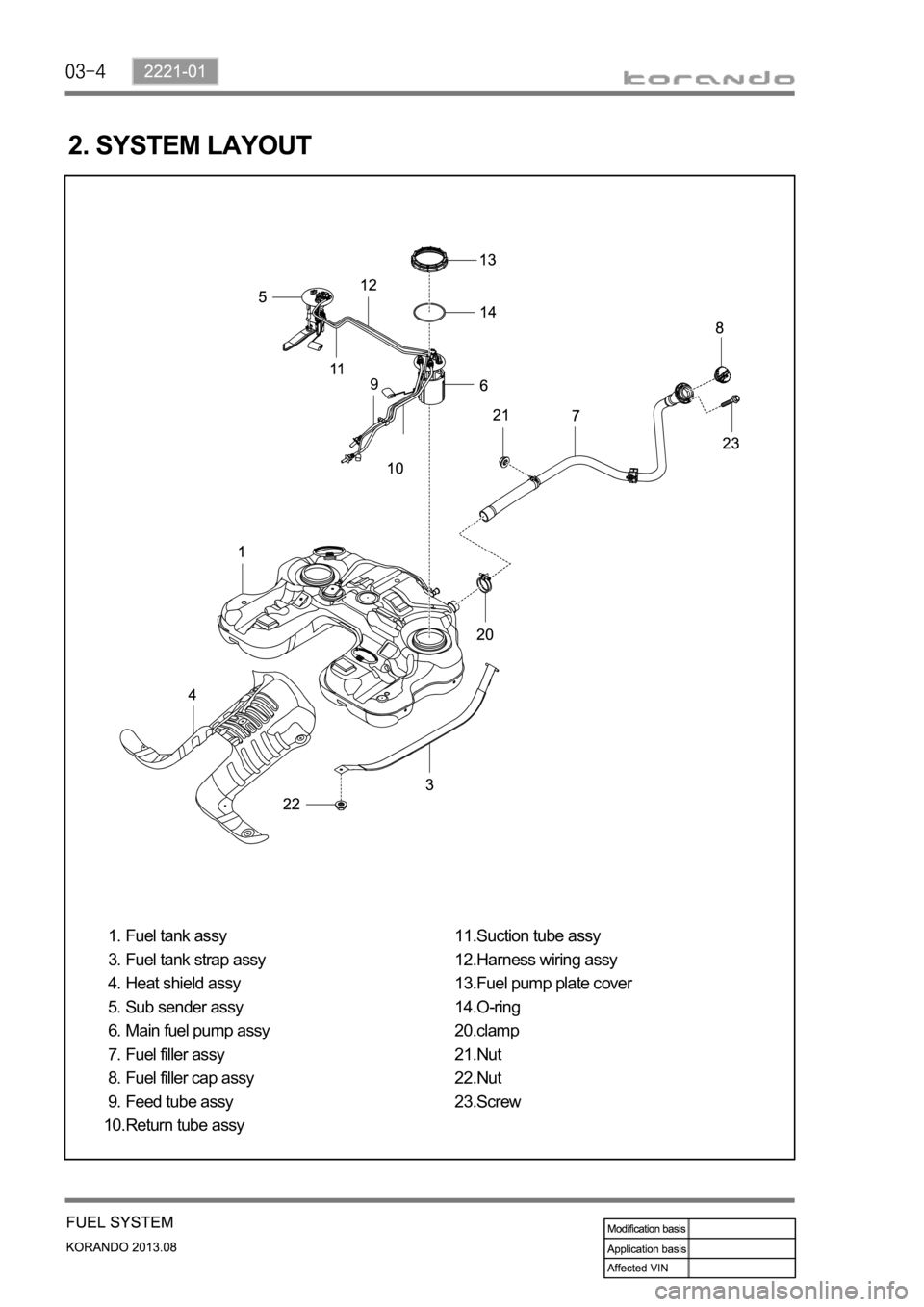
2. SYSTEM LAYOUT
Fuel tank assy
Fuel tank strap assy
Heat shield assy
Sub sender assy
Main fuel pump assy
Fuel filler assy
Fuel filler cap assy
Feed tube assy
Return tube assy 1.
3.
4.
5.
6.
7.
8.
9.
10.Suction tube assy
Harness wiring assy
Fuel pump plate cover
O-ring
clamp
Nut
Nut
Screw 11.
12.
13.
14.
20.
21.
22.
23.