automatic SSANGYONG NEW ACTYON SPORTS 2012 User Guide
[x] Cancel search | Manufacturer: SSANGYONG, Model Year: 2012, Model line: NEW ACTYON SPORTS, Model: SSANGYONG NEW ACTYON SPORTS 2012Pages: 828, PDF Size: 91.28 MB
Page 382 of 828
04-6
2. DESCRIPTION AND OPERATION
1) General Description
The cooling system maintains the engine temperature at an efficient level during all engine
operating conditions.
When the engine is cold, the cooling system cools the engine slowly or not at all. This slow
cooling of the engine allows the engine to warm up quickly.
The cooling system includes a radiator and recovery subsystem, cooling fans, a thermostat and
housing, a water pump, and a water pump drive belt. The timing belt drives the water pump.
All components must function properly for the cooling system to operation. The water pump
draws the coolant from the radiator. The coolant then circulates through water jackets in the
engine block, the intake manifold, and the cylinder head. When the coolant reaches the operating
temperature of the thermostat, the thermostat opens. The coolant then goes back to the radiator
where it cools.
This system directs some coolant through the hoses to the heat core. This provides for heating
and defrosting.
The coolant reservoir is connected to the radiator to recover the coolant displaced by expansion
from the high temperatures. The coolant reservoir maintains the correct coolant level.
The cooling system for this vehicle has no radiator cap or filler neck. The coolant is added to the
cooling system through the coolant reservoir.
2) Radiator
This vehicle has a lightweight tube-and-fin aluminum radiator. Plastic tanks are mounted on the
upper and the lower sides of the radiator core.
On vehicles equipped with automatic transaxles, the transaxle fluid cooler lines run through the
radiator tank.
A radiator drain plug is on this radiator.
To drain the cooling system, open the drain plug.
3) Coolant Reservoir
The coolant reservoir is a transparent plastic reservoir, similar to the windshield washer reservoir.
The coolant reservoir is connected to the radiator by a hose and to the engine cooling system by
another hose.
As the vehicle is driven, the engine coolant heats and expands. The portion of the engine coolant
displaced by this expansion flows from the radiator and the engine into the coolant reservoir. The
air trapped in the radiator and the engine is degassed into the coolant reservoir.
When the engine stops, the engine coolant cools and contracts. The displaced engine coolant is
then drawn back into the radiator and the engine. This keeps the radiator filled with the coolant to
the desired level at all times and increases the cooling efficiency.
Maintain the coolant level between the MIN and MAX marks on the coolant reservoir when the
system is cold.
Page 395 of 828

05-8
5) Jump Starting Procedure
Position the vehicle with the charged battery so that the jumper cables will reach from the
charged battery to the battery that requires charging.
Turn off the ignition, all the lights, and all the electrical loads in both vehicles.
Leave the hazard flasher on if jump starting where there may be other traffic and any other
lights needed for the work area.
Apply the parking brake firmly in both vehicles. 1.
2.
3.
4.
Shift an automatic transmission to PARK. 5.
Clamp one end of the first jumper cable to the positive terminal on the booster battery. Make
sure it does not touch any other metal parts.
Clamp the other end of the same cable to the positive terminal on the discharged battery.
Never connect the other end to the negative terminal of the discharged battery. 6.
7.
Clamp one end of the second cable to the negative terminal of the booster battery.
Make the final connection to a solid engine ground, such as the engine lift bracket at least 450
millimeters (18 inches) from the discharged battery.
Start the engine of the vehicle with the good battery.
Run the engine at a moderate speed for several minutes.
Then start the engine of the vehicle with the discharged battery.
Remove the jumper cables by reversing the above sequence exactly, removing the negative
cable from the vehicle with the discharged battery first.
While removing each clamp, take care that it does not touch any other metal while the other
end remains attached. 8.
9.
10.
11.
12.In order to avoid damaging the vehicle make sure the cables are not on or near pulleys, fans,
or other parts that will move when the engine starts.
In order to avoid injury, do not use cables that have loose or missing insulation.
Page 398 of 828
12-38510-23
1. SYSTEM DESCRIPTION
1) System Description
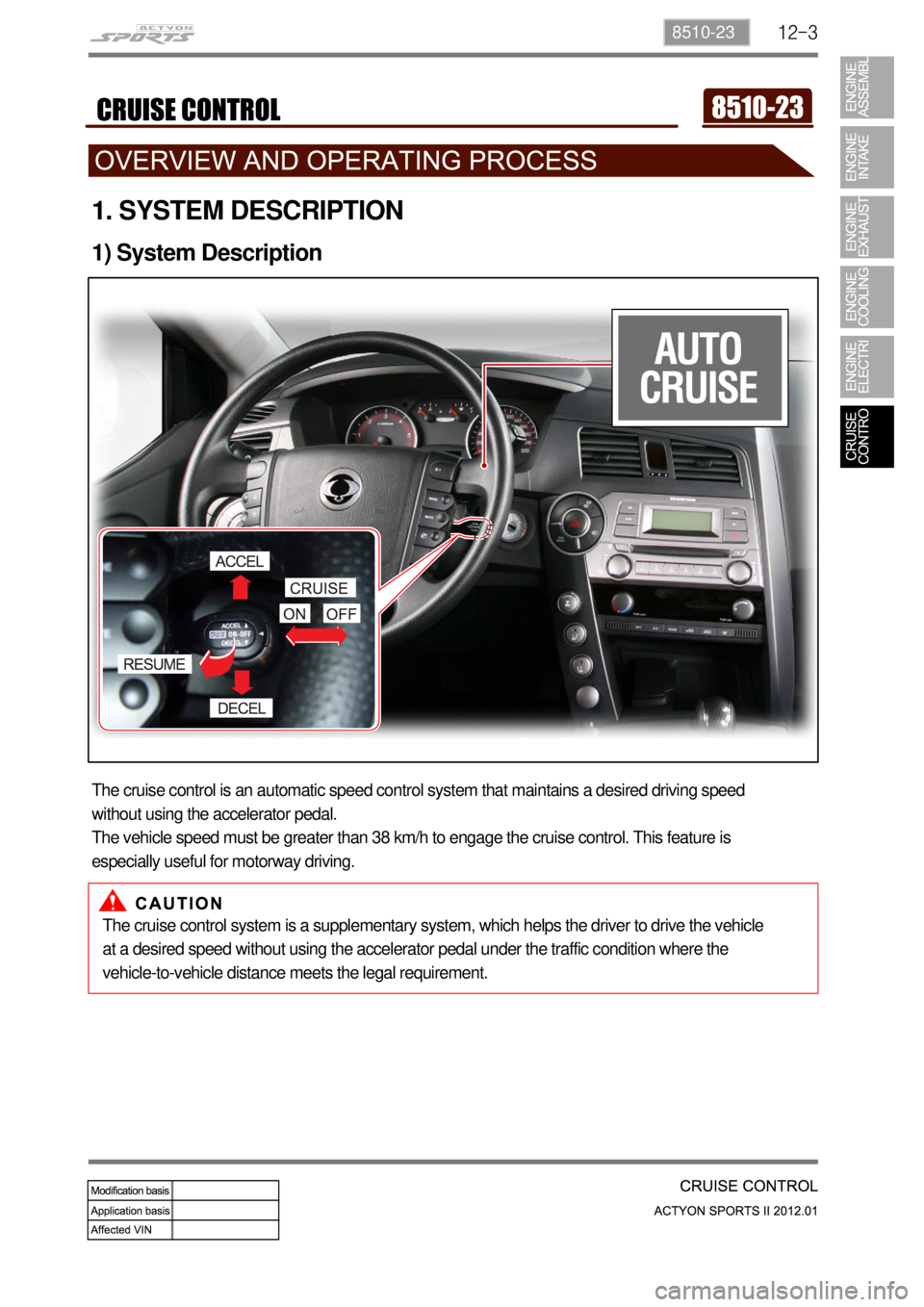
The cruise control is an automatic speed control system that maintains a desired driving speed
without using the accelerator pedal.
The vehicle speed must be greater than 38 km/h to engage the cruise control. This feature is
especially useful for motorway driving.
The cruise control system is a supplementary system, which helps the driver to drive the vehicle
at a desired speed without using the accelerator pedal under the traffic condition where the
vehicle-to-vehicle distance meets the legal requirement.
Page 421 of 828

02-78710-01
1) Wiper and Washer Operations
When pulling up the lever, the wiper
operates once and the wiper lever
returns to the "OFF" position.
Stop the operation.
Operates automatically
according to the vehicle
speed or the amount of rain.
Continuous wipe, slow
operation.Front Wiping Speed Control Switch
FAST: Fast interval
SLOW: Slow interval
Continuous wipe, fast operation
Front Wiper and Washer Coupled Operation
Pull the lever briefly (below 0.6 seconds):
One wiping cycle without washer spray
Pull and hold the lever for more than 0.6 seconds:
Three wiping cycles with washer spray
Front Auto Washer Switch (AFW)
When the front wiper switch is off and this switch is pressed,
washer fluid will be sprayed and the wiper will automatically
operate 4 times. Then, the fluid will be sprayed again and the
wiper will automatically operate 3 times.
MIST
OFF
AUTO
LO
HI
Previous model
Pressing the switch makes washer
fluid to be sprayed for 2 sec. with
four wiping, after having delay of 0.6
sec., washer fluid to be sprayed for
1.5 sec. with three wiping
Pressing the switch makes washer
fluid to be sprayed for 2 sec. with
four wiping, and washer fluid to be
sprayed for 1.5 sec. with three
wiping, with no delay of time New model
Page 427 of 828

02-138710-01
Rain sensing unit
(AUTO light integrated type)
▶INT Switch Auto Position Reminder (Power-Up Reminder Wiper)
When turning off and on the auto INT switch, the system drives the wiper motor through
LOW relay regardless of communication with rain sensor.
When turning the INT-AUTO switch from the "OFF" to "ON" position with the ignition switch
in the "ON" mode, the LOW relay operates to drive the wiper motor for 1 cycle, regardless
of the rain sensor communication.
After that, when turning the INT-AUTO switch from the "OFF" to "ON" position, the LO
W
relay operates to drive the wiper motor for 1 cycle only if data from the rain sensor
indicates rain drops. -
-
Multifunction wiper switch:
AUTO and sensitivity control
A sensor that emits infrared rays through LED
and then detects the amount of rain drops by
receiving reflected rays against sensing section
(rain sensor mounting section on the
windshield) with photodiode (auto light sensor
integrated type)AUTO: Wiper operates automatically by rain
sensor
FAST↔SLOW: Auto delay/Auto speed control. A
position that can control sensitivity against rains
on the windshield and transmits wiping demand
signal accordingly
Page 434 of 828

02-20
▶Auto Light Control
The tail lamps and headlamps can be controlled by the communication with the rain
sensor only when the auto light switch is in "AUTO" position with the ignition switch "ON". -
Rain detected headlamp: If it rains heavy which requires the highest INT speed (almost
LOW), the headlamps are turned on automatically. -
Night detected wiping: When the auto light control turns on the headlamps and the rain
sensor detects the rain, the wiper sensitivity is automatically increased by one level in
comparison with daytime.
(i.e. the AUTO wiper switch is at the 3rd level, but the wiper operates at the 4th level.) -
Enlarged auto light sensor Emitter lens
The LED emitting the infrared
rays is installed on the bottom
and the lens guides the
infrared rays to target point.
Auto light sensor (Vertical)
Auto light sensor (Horizon)
Page 435 of 828

02-218710-01
▶Volume Sensitive INT (Intermittent) Wiper
For RKSTICS without the rain sensor, perform the following operation:
Controls the wiper intermittent operation by the values from the vehicle speed and the
volume (resistance). -
Calculates and converts the Intermittent interval automatically by obtaining the IN
T
VOLUME when the ignition switch and the INT switch is in the "ON" position.
The wipers are operated in vehicle speed sensitive mode when turning the INT switch to
the "ON" position with the engine running or starting the engine with the INT switch
positioned to "ON".
Intermittent interval (at 0 km/h): 3 ± 0.5 ~ 19 ± 2 seconds ˙
˙
˙
Vehicle speed calculation -
[Input the vehicle speed]
It is calculated by the numbers of input pulses for one second.
VOLUME calculation -
The pause time of the vehicle speed sensitive INT wiper is calculated by the INT volume
(input voltage). Each level has the hysteresis. ˙
Pause time calculation -
Pause time means the duration that wipers are stopped at parking position.
Elapsed time means the duration after the wiper motor started to operate from parking
position.
The pause time is calculated by the vehicle speed and the VOLUME.
※If the pause time is below 1.0 second, the wipers operate without pause.
※If the pause time is over 1.5 seconds, the wipers operate intermittently. ˙
˙
˙60 [km/h] × 60 [sec]
1 [PULSE/SEC] =
637 × 4 PULSE≒ 1.41 [km/h]
Page 444 of 828

02-30
▶Center Room Lamp Control
The overhead console lamp (front room lamp) and the center room lamp come on at 100%
when opening the door (driver's/passenger's/rear) while the center room lamp switch is at the
door coupled/tailgate coupled operating position and the key reminder switch is "OFF".
When the door (driver's/passenger's/rear) is opened, the front and center room lamps
come on at 100% and automatically go off after 30 seconds.
The room lamp stays on for 2 seconds and then dims through 3 seconds when closing the
doors within 30 seconds.
The dimming operation must have greater than 32 steps per one second.
The room lamp output should stop immediately after turning on the ignition key during the
dimming operation.
The front room lamp and the center room lamp come on for 30 seconds when receiving
the unlock signal from the remote control key while the doors are closed.
The front room lamp and the center room lamp output period is extended by 30 seconds
when receiving the unlock signal from the remote control key again during output under
step (5). (The lamp stays on when unlocked by the remote control key.)
When a door is opened during its extended period, the lamp stays on. If closed, operates
as in step (2).
The room lamp output stops immediately after receiving the lock signal from door lock
switches while all doors are closed or entering into the anti-theft mode by pushing LOC
K
button on the remote control key. 1.
2.
3.
4.
5.
6.
7.
8.
Page 456 of 828

02-42
The door lock system outputs "LOCK" when the vehicle speed maintains over 30 km/h.
However, it doesn't output "LOCK" when all doors are locked or failed.
If any of doors is unlocked after outputting "LOCK" in step 1, outputs "LOCK" up to 5 times
(except step (1)) at the interval of one second.
If any of doors is unlocked after 5 times of "LOCK" outputs, the door
(driver's/passenger's/rear) is regarded as "FAIL".
If the door that was regarded as fail is changed (UNLOCK to LOCK), it will be recognized
as a normal one.
If any door is regarded as FAIL, the auto door lock function does not work. (if it is
occurred when the vehicle speed is over 30 km/h, the auto door lock output does not
occur even if the vehicle speed falls below 30 km/h and accelerates again to over 30
km/h.) Nonetheless, the central door lock function works properly.
When the system receives "UNLOCK" signal from a door switch, it outputs "LOCK" signals
5 times. If additional "LOCK" signal from another door switch is detected during the
period, the system outputs five "LOCK" signals 5 times for the switch.
The door lock system outputs "UNLOCK" automatically if the "LOCK" output conditions are
established by this function or the key is cycled (IGN=OFF) (even when there is no "LOCK"
output while the vehicle speed maintains over 30 km/h under lock condition).
(If the LOCK condition is established with the ignition switch ON, the system outputs
UNLOCK signal unconditionally when turning the ignition switch to OFF position.)
However, when the ignition key is turned to "OFF" position, the lock output conditions will
be cancelled.
The "FAIL" condition of the door will be erased when the ignition key is turned to "OFF"
position. 1.
2.
3.
4.
5.
6.
7.
8. ▶Auto Door Lock
T2: 0.5 s
(*1) LOCK: Driver's & Passenger's & Rear door & = Lock
Page 457 of 828

02-438710-01
▶Auto Door Unlock (Crash Unlock: Automatic Door Unlock in Collision)
The air bag collision signal input cannot be accepted within 7 seconds after turning the
ignition key to "ON" position.
After this period, the door lock system outputs "UNLOCK" for all doors for 5 seconds from
40 ms after receiving the air bag collision signal.
Even though the key is turned to "OFF" position during the output of "UNLOCK", the output
continues on for remaining period.
The function is erased when turning "OFF" the ignition switch. 1.
2.
3.
4.
Cautions for door lock/unlock control
The "Unlock" control by air bag signal prevails over any "LOCK" or "UNLOCK" control by
other functions.
The "LOCK/UNLOCK" request by other functions will be ignored after/during the output of
"UNLOCK" by the air bag.
However, the door lock is controlled by other functions when the ignition switch is "OFF".
"LOCK" (or "UNLOCK") output is ignored if "LOCK" (or "UNLOCK") output is required while
performing the output of "LOCK" (or "UNLOCK").
(However, UNLOCK by air bag signal and operation by the remote control key are valid.)
If the door lock system outputs "LOCK" and "UNLOCK" simultaneously, only the "LOCK"
output can be activated. 1.
2.
3.
4.