automatic SSANGYONG NEW ACTYON SPORTS 2012 Workshop Manual
[x] Cancel search | Manufacturer: SSANGYONG, Model Year: 2012, Model line: NEW ACTYON SPORTS, Model: SSANGYONG NEW ACTYON SPORTS 2012Pages: 828, PDF Size: 91.28 MB
Page 559 of 828
01-153680-01
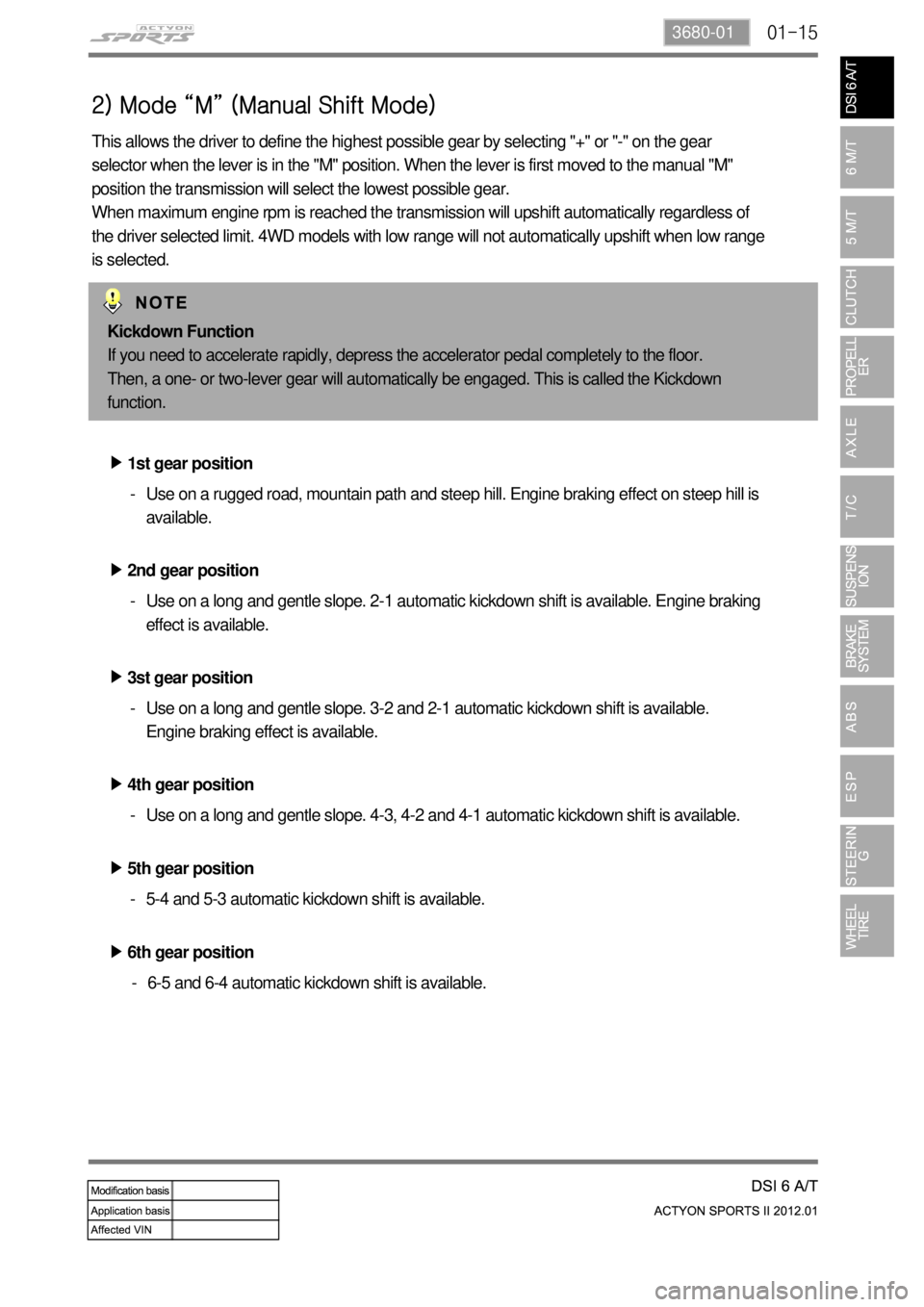
2) Mode “M” (Manual Shift Mode)
This allows the driver to define the highest possible gear by selecting "+" or "-" on the gear
selector when the lever is in the "M" position. When the lever is first moved to the manual "M"
position the transmission will select the lowest possible gear.
When maximum engine rpm is reached the transmission will upshift automatically regardless of
the driver selected limit. 4WD models with low range will not automatically upshift when low range
is selected.
1st gear position ▶
2nd gear position ▶
3st gear position ▶
4th gear position ▶
5th gear position ▶
6th gear position ▶Use on a rugged road, mountain path and steep hill. Engine braking effect on steep hill is
available. -
Use on a long and gentle slope. 2-1 automatic kickdown shift is available. Engine braking
effect is available. -
Use on a long and gentle slope. 3-2 and 2-1 automatic kickdown shift is available.
Engine braking effect is available. -
Use on a long and gentle slope. 4-3, 4-2 and 4-1 automatic kickdown shift is available. -
5-4 and 5-3 automatic kickdown shift is available. -
6-5 and 6-4 automatic kickdown shift is available. -
Kickdown Function
If you need to accelerate rapidly, depress the accelerator pedal completely to the floor.
Then, a one- or two-lever gear will automatically be engaged. This is called the Kickdown
function.
Page 560 of 828

01-16
4. LIMP HOME MODE
In case of transmission malfunction ▶
If a serious fault occurs in the automatic transmission, the TCU enters the limp home
mode to secure safe driving and protect the automatic transmission.
As power is no longer supplied to the solenoid, the current basic function (P, R, N, D) is
maintained and the 4th gear can be maintained only by the operation of the hydraulic
system without electrical operation.
The ECU communicates with other electric modules with CAN. If a serious fault occurs, the
transmission automatically enters the limp home mode for service.
The TCU monitors all factors which can affect to the performance of the transmission and
diagnose the system according to OBD II regulation. 1.
2.
3.
4.
In case of overheated transmission ▶
The TCU enters the limp home mode when the batter voltage drops below 8 V.
If the transmission is overheated, the shift pattern is changed to the hot mode to cool the
transmission more efficiently.
While the transmission is overheated, the selector lever symbol and engine temperature
warning lamp on the instrument cluster blink until the transmission is cooled down to the
normal operation temperature. If the transmission is excessively overheated, the gear
cannot be shifted but remains in the neutral position. 1.
2.
3.
Towing the vehicle with A/T ▶
The best way to transport the vehicle is to load it to a truck and transport it, especially if the
vehicle is 4WD.
If towing the vehicle with the propeller shaft connected, the transmission or oil pump of
transfer case may malfunction, resulting in internal damage due to poor lubrication. -
Page 561 of 828

01-173680-01
5. ELECTRONIC CONTROL SYSTEM
1) Overview
The transmission control unit (TCU) and its input/output networks control the operations of
transmission:
Shift timing
Line pressure
Clutch pressure (shift feel)
Torque converter clutch -
-
-
-
In addition, the TCU receives input signals from certain transmission-related sensors and
switches. The TCU also uses these signals when determining transmission operating strategy.
Using all of these input signals, the TCU can determine when the time and conditions are right for
a shift, or when to apply or release the torque converter clutch. It will also determine the pressure
needed to optimise shift feel. To accomplish this, the TCU operates six variable bleed control
solenoids and four ON/OFF solenoids to control the operations of transmission.
2) Transmission Control Unit (TCU)
The transmission control unit (TCU) is mounted under the driver's seat and controls the operation
of the transmission.
TCU processes the analog information from the internal sensors and the digital information
through CAN communication lines. TCU monitors all the input and output signals. If there is any
<008d008800900093009c0099008c00530047007b006a007c0047008a008f00880095008e008c009a0047009b008f008c0047009a00a0009a009b008c00940047009b0096004702c800730090009400970047006f00960094008c004700740096008b008c02
c9004700880095008b004700880093008c0099009b009a0047>to the driver through the
warning lamp on the instrument cluster.
(1) Hard-wired (Analog) Input/Output
Input/Output Data between TGS Lever and TCU ▶
Position and conditions of gear select lever
Driving moded (Winter or Standard) -
-
Position of inhibitor switch - Input/Output Data between Inhibitor and TCU ▶
6 control signals for variable bleed solenoid
4 control signals for ON/OFF solenoid
Transmission input speed
Transmission output speed
Transmission oil temperature
EMM (Embeded Memory Module) -
-
-
-
-
- Input/Output Data between Automatic Transmission and TCU ▶
Input/Output Data between Self Diagnostic Connector and TCU ▶
Various DTC codes and TCU information -
Page 565 of 828

01-213680-01
Pressure Modulation ▶
To provide a higher level of shift comfort and durability, the hydraulic pressure in the shift related
friction elements of the transmission must be matched accurately to the input torque to
transmission. This hydraulic pressure is composed of a hydraulically pre-set basic pressure and a
control pressure which is set by one of the variable bleed solenoids.
The transmission input torque can be directly calculated from the following operating parameters:
engine torque signals
engine speed or any signal transmitted from ECU through CAN lines
converter slip -
-
-
Separate pressure characteristics for each gear change make it possible to adapt precisely to the
particular shift operation.
5) Shift Mode Selection by TCU
The driver can select Standard (S) or Winter mode (W) with the mode switch. TCU automatically
changes the shift mode according to the transmission oil temperature, uphill or downhill gradient,
and altitude to keep the good driving conditions.
Standard Mode (S) ▶
Uphii and Downhill Mode ▶
Altitude Mode ▶ Standard Mode is selected when setting the mode switch in Standard (S) position with the gear
<009a008c0093008c008a009b00470093008c009d008c0099004700900095004702c8006b02c9004700880095008b0047009b008f008c0047009b009900880095009a00940090009a009a00900096009500470096009000930047009b008c00940097008c00
990088009b009c0099008c0047009000950047009500960099>mal operating range. Proper shift
timing provides the optimized fuel economy and good driving conditions.
In this mode, the operating points of torque converter lock-up clutch and the shifting points are
adjusted according to the vehicle weight.
In this mode, the shifting points are automatically adjusted according to the altitude to compensate
the engine torque changes due to barometric pressure and temperature.
Page 616 of 828

03-8
Variant Coding Options
(2) Detects the position of the shifting lever for the HDC operation
among ABS functions.
The HDC function operates only if the M/T shift lever is in forward or reverse position. Please refer
to the ABS section for the specific information related to the HDC.
Variant Coding Related to N Switch ▶
The N switch transmits information to the ECU through the CAN communication while New Rexton
is connected to the ECU through wires. Thus, if you set the variant coding in the engine ECU, you
must do it differently, and you must set the variant coding differently according to the vehicle
category and specification as below.
Neutral Signal Input None / Wire / CANWire /
Actyon & Kyron models with
manual transmission
New Rexton model with manual
transmission Manufactured
after 04.09.15
BODY IN: after 154600
Automatic transmission & Rodius
model with automatic
transmission before 2006
Page 629 of 828

07-53240-01
Operation ▶
Description Mode Conditions
Driving
mode2H 2 Wheel drive
(rear wheel)Rear-wheel drive mode. This is used under
normal or high-speed driving conditions on
public roads or highways.
4H 4 Wheel drive
(high speed)This is used under sandy, muddy or snow-
covered road conditions
4L 4 Wheel drive
(low speed)This is used for maximum traction.
When cornering with low speed in 4WD
condition, there could be tire dragging, some
mechanical shocks and resistances in
vehicle’s drive train. These are normal
conditions due to internal resistance in the
drive train when the 4WD system is properly
working
Mode change2H←4H2 Wheel drive
↔4 Wheel driveShifting is possible while driving at the speed
of 70 km/h or less
2H,
4H↔4L2 Wheel drive,
4 Wheel drive (high
speed)
↔4 Wheel drive
(low speed)For Automatic Transmission:
For Manual Transmission:
Stop the vehicle on level ground and
move the gear selector lever into the
“N” position. Turn the switch to the
desired position. ·
Stop the vehicle on level ground and
move the gear selector lever into the
“N” position. Then turn the switch to
the desired position while depressing
the clutch pedal. ·
To make the mode change easily, stop
the vehicle on level ground and turn the
mode switch to the desired position and
move the shift lever to "N"-"R"-"N" while
depressing the brake pedal.
Page 630 of 828

07-6
2. LAYOUT
Front axle
Front locking hub system (IWE)
Front propeller shaft
DSI 6-speed automatic
transmission
Part-time transfer case
Rear propeller shaft
Rear axle
Page 645 of 828

08-94411-01
Under View (4WD, Automatic Transmission)
Rear suspension
1. SUSPENSION
The suspension is the device to connect the axle and vehicle. It absorbs the vibrations and
impacts from road surface, which enhances the comforts, driving force, braking force and
drivability.
Front suspension
Page 652 of 828
09-4
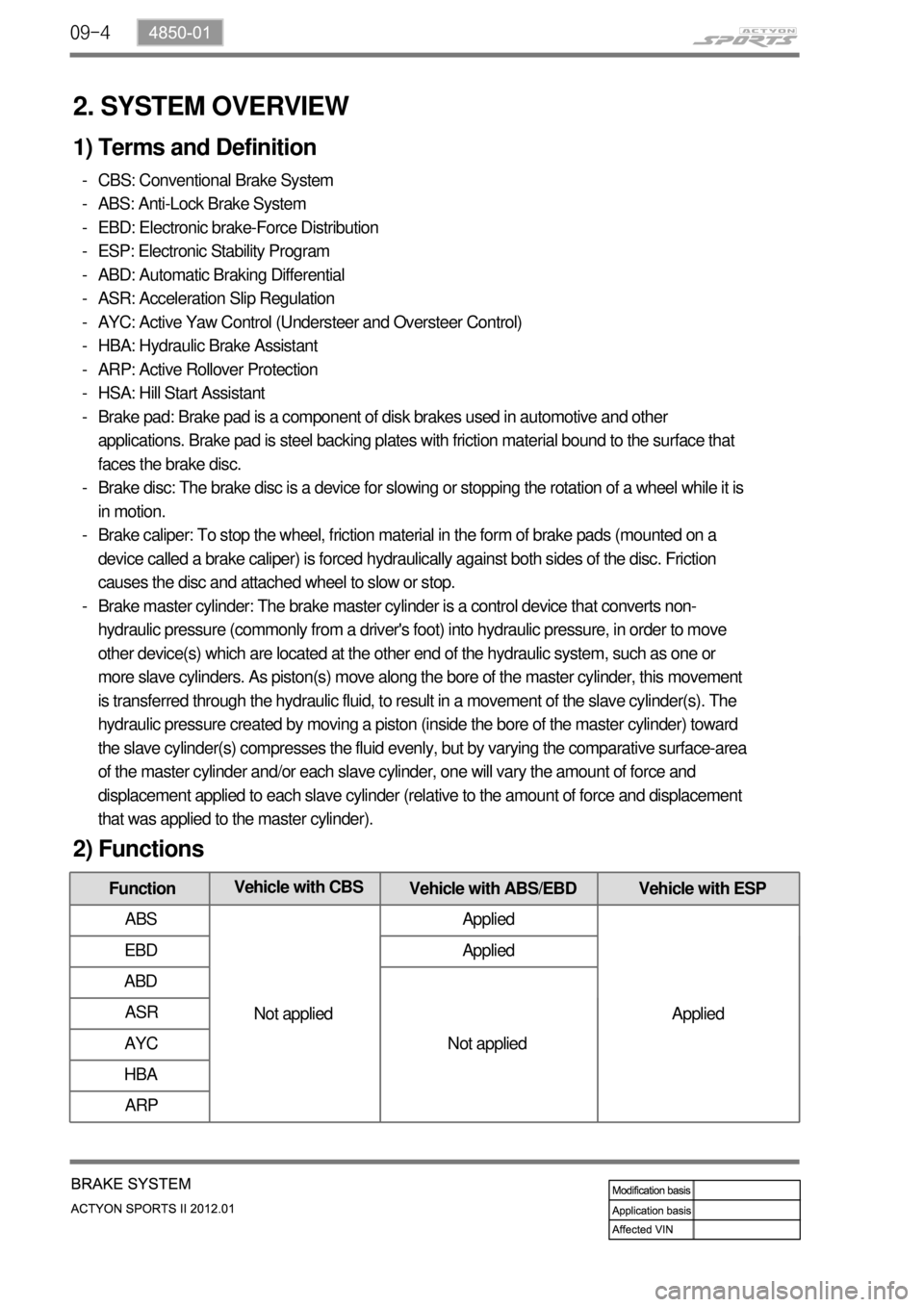
2. SYSTEM OVERVIEW
1) Terms and Definition
CBS: Conventional Brake System
ABS: Anti-Lock Brake System
EBD: Electronic brake-Force Distribution
ESP: Electronic Stability Program
ABD: Automatic Braking Differential
ASR: Acceleration Slip Regulation
AYC: Active Yaw Control (Understeer and Oversteer Control)
HBA: Hydraulic Brake Assistant
ARP: Active Rollover Protection
HSA: Hill Start Assistant
Brake pad: Brake pad is a component of disk brakes used in automotive and other
applications. Brake pad is steel backing plates with friction material bound to the surface that
faces the brake disc.
Brake disc: The brake disc is a device for slowing or stopping the rotation of a wheel while it is
in motion.
Brake caliper: To stop the wheel, friction material in the form of brake pads (mounted on a
device called a brake caliper) is forced hydraulically against both sides of the disc. Friction
causes the disc and attached wheel to slow or stop.
Brake master cylinder: The brake master cylinder is a control device that converts non-
hydraulic pressure (commonly from a driver's foot) into hydraulic pressure, in order to move
other device(s) which are located at the other end of the hydraulic system, such as one or
more slave cylinders. As piston(s) move along the bore of the master cylinder, this movement
is transferred through the hydraulic fluid, to result in a movement of the slave cylinder(s). The
hydraulic pressure created by moving a piston (inside the bore of the master cylinder) toward
the slave cylinder(s) compresses the fluid evenly, but by varying the comparative surface-area
of the master cylinder and/or each slave cylinder, one will vary the amount of force and
displacement applied to each slave cylinder (relative to the amount of force and displacement
that was applied to the master cylinder). -
-
-
-
-
-
-
-
-
-
-
-
-
-
FunctionVehicle with CBS
Vehicle with ABS/EBD Vehicle with ESP
ABS
Not appliedApplied
Applied EBD Applied
ABD
Not applied ASR
AYC
HBA
ARP
2) Functions
Page 656 of 828

09-8
Problem Possible Cause Action
Increased pedal stroke Air in brake line Bleed air
Oil leak Repair
Worn brake pad Replace
Excessive clearance between push rod and master
cylinderAdjust
Worn or damaged piston seal Replace
Brake dragging Parking brake is not fully released Release
Incorrect adjustment of parking brake Adjust
Incorrectly adjusted clearance of parking brake
shoeAdjust
Faulty brake pedal return spring Replace
Incorrectly adjusted free play of brake pedal Adjust
Faulty master cylinder Replace
Lack of lubrication in sliding parts Lubricate
Faulty brake booster (vacuum leak) Repair
Wear, hardening or poor contact of brake pad Replace
Oil or water on lining Repair or replace
Fixed or broken parking brake cable Replace
Excessive stroke of brake lever Adjust notch
Faulty auto clearance adjuster Repair
Poor parking
brake
Increased stroke of
parking brake leverLoosened parking brake cable Adjust or replace
Incorrectly adjusted parking brake cable Adjus
Defective automatic lining clearance adjuster Repair or replace
Worn brake lining Replace