cooling SSANGYONG NEW ACTYON SPORTS 2013 Owner's Manual
[x] Cancel search | Manufacturer: SSANGYONG, Model Year: 2013, Model line: NEW ACTYON SPORTS, Model: SSANGYONG NEW ACTYON SPORTS 2013Pages: 751, PDF Size: 72.63 MB
Page 458 of 751
01-12
2. FEATURES
Early Downshifts with Hard Braking and Skip Shifts ▶
When heavy braking is detected, the transmission downshifts early and skips gears to provide increased
engine braking to provide gear selection for tip-in.
Gear Hold on Uphill/Downhill ▶
If the accelerator pedal is released when travelling uphill, upshifts are prevented to reduce busyness on
grades. If the accelerator pedal is released when travelling downhill, upshifts are prevented to enhance
engine braking.
Soft Engagement when Shifting to “D” and “R” Position ▶
A soft engagement feature avoids harsh take up of drive when selecting Drive or Reverse. This is
achieved by limiting engine speed and engine torque which results in a rapid, but progressive
engagement of either Drive or Reverse when moving from the Park or Neutral positions. There is no
drive engagement prevention strategy implemented on the transmission system as there is sufficient
engine strategy to protect the system. However, reverse gear engagement is prevented until engine
speed is less than 1400 rpm and the accelerator pedal position is less than 12% and vehicle speed is
less than 10 km/h.
Converter Clutch Lock-Up In All Gears ▶
The transmission features converter clutch lock-up in all gears. This feature provides improved fuel
economy and vehicle performance. It also improves transmission cooling efficiency when towing heavy
loads at low speeds, e.g. in city driving or hill terrain.
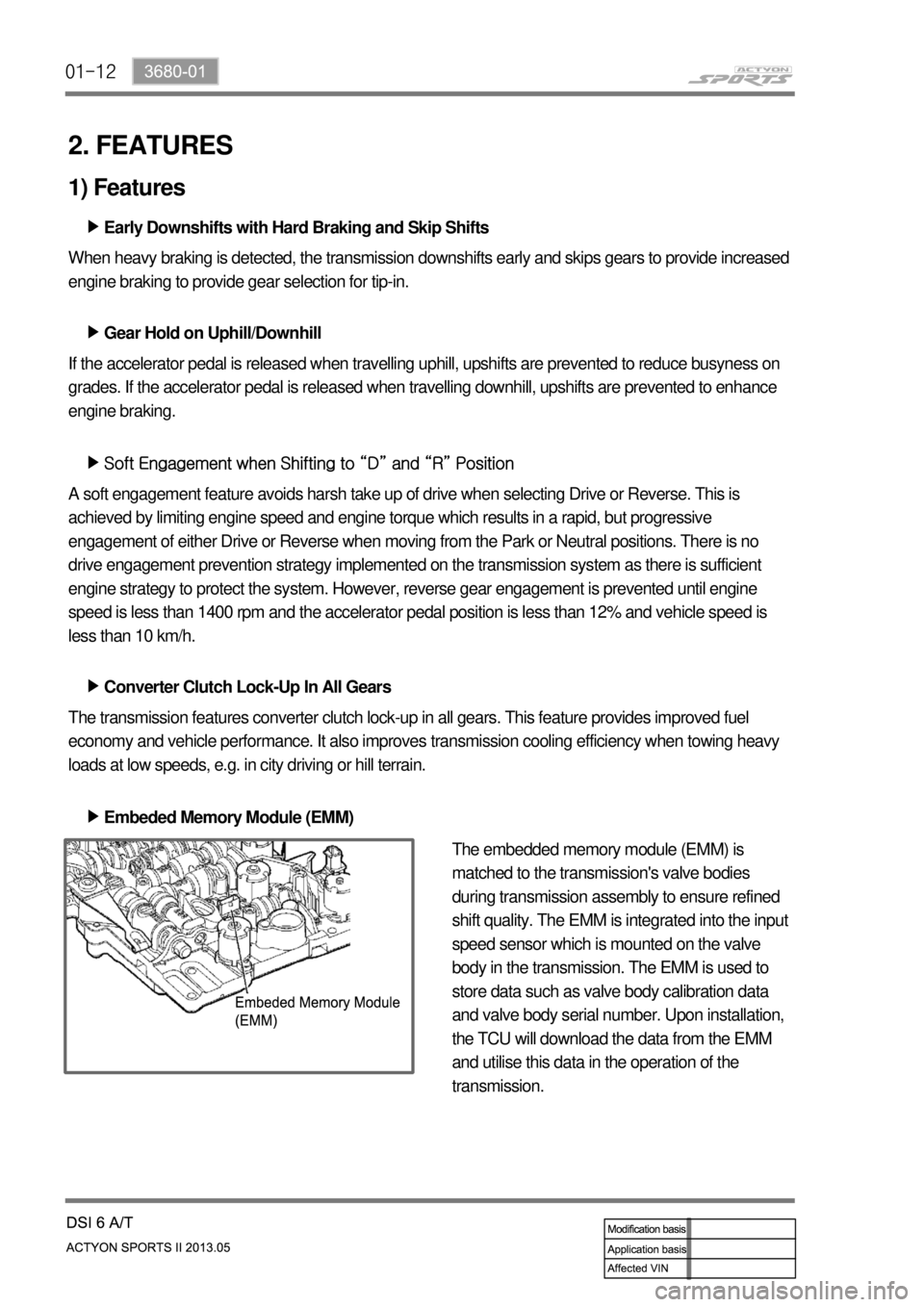
Embeded Memory Module (EMM) ▶
The embedded memory module (EMM) is
matched to the transmission's valve bodies
during transmission assembly to ensure refined
shift quality. The EMM is integrated into the input
speed sensor which is mounted on the valve
body in the transmission. The EMM is used to
store data such as valve body calibration data
and valve body serial number. Upon installation,
the TCU will download the data from the EMM
and utilise this data in the operation of the
transmission.
1) Features
Page 459 of 751

01-133680-01
2) Cooling System
The transmission cooling system ensures rapid warm-up and constant operating temperature resulting
in reduced fuel consumption and refined shift quality.
It also includes a cooler by-pass within the hydraulic system to allow sufficient cooling and lubrication to
the transmission drivetrain in the event of a blockage in the transmission cooler.
Gear Shift ▶
Coastdown ▶
Torque Demand ▶ Transmission gear change is controlled by the TCU. The TCU receives inputs from various engine and
vehicle sensors to select shift schedules and to control the shift feel and torque converter clutch (TCC)
operation at each gear change
Coastdown downshifts occur at 0% accelerator pedal when the vehicle is coasting down to a stop. To
reduce the shift shock and to improve the shift feeling during downshift, TCU electronically controls the
transmission.
Torque demand downshifts occur (automatically) when the driver demand for torque is greater than the
engine can provide at that gear ratio. If applied, the transmission will disengage the TCC to provide
added acceleration.
3) Shift Strategy
Page 468 of 751
01-22
Winter Mode (W) ▶
Low Range Driving Mode ▶
Warm Up Mode ▶ When the Winter mode is selected, the second gear is engaged to start off the vehicle easily to prevent
wheel spin on slippery surfaces and WINTER mode indicator comes ON. The first gear is not available
in this mode.
When the vehicle is in 4L driving mode, the transmission uses a different shift mode to optimize the low
range driving. Similar to Winter mode, the first gear is not available.
This mode is normally used when the transmission oil temperature is below 20°C.
<007b008f008c0047009b009600990098009c008c0047008a00960095009d008c0099009b008c00990047008a0088009500950096009b00470089008c004700930096008a0092008c008b0054009c009700470089008c00930096009e00470059005700b600
6a0047009b00960047009700990096009d0090008b008c0047>the warming up process of
transmission.
Hot Mode ▶
<0070008d0047009b008f008c0047009b009900880095009a00940090009a009a00900096009500470096009000930047009b008c00940097008c00990088009b009c0099008c00470090009a00470089008c009b009e008c008c0095004700580058005700
b6006a004700880095008b00470058005b005c00b6006a0053> the system provides the cooling
and reduces the load to the transmission. This is called Hot Mode.
Above 110°C:
Above 130°C:
Above 145°C: -
-
-
In Hot Mode, any of shift mode is not available.
Cruise Control ▶
When the cruise control is activated, the engine ECU requests the downshift to increase the engine
brake effect.PWM fan ON
the engine torque is reduced and WINTER indicator is blinking
the transmission is held in Neutral (N) gear until the oil temperature falls below
120°C (Final protection)
Page 704 of 751

01-256810-01
6. A/C COOLING CYCLE
1) System Flow
"Compression -> Condensation -> Expansion -> Evaporation" -
2) Functions
(1) Compressor
Condition: Gas
Function: Circulates the refrigerant and increases the pressure and temperature for easier
evaporation. -
-
(2) Condenser
Condition: Gas/Liquid
Function: Cools and condenses the refrigerant by using ambient air to liquefy it under high pressure. -
-
(3) Receiver drier
Condition: Gas/Liquid
Function: Keeps the refrigerant free from moisture by separating/collecting the moisture from it. -
-
(4) Expansion valve
Condition: Liquid/Liquefied gas
Function: Performs adiabatic expansion and flow control for easier evaporation. -
-
(5) Evaporator
Condition: Liquefied gas/Gas
Function: Cools the air by absorbing the heat from the air around the evaporator. -
-
Page 705 of 751

01-26
3) Description for Each Cycle
(1) Compression
The evaporated refrigerant in the evaporator enters to the compressor. And the refrigerant gas is
compressed until it can be liquefied at ambient temperature.
Thus, the low refrigerant pressure is maintained so that the liquid refrigerant can be evaporated
actively at low temperature (around 0 ℃). -
-
(2) Condensation
The high pressure and high temperature gas (refrigerant) from the compressor is cooled down by the
fresh air entered into the condenser. Then, this gas is converted to liquid and collected in the receiver
drier.
The heat generated from the high pressure refrigerant is dissipated to the ambient air, and it is called
"heat of condensation".
The heat of condensation is the summation of the heat of vaporization (heat that the refrigerant
absorbs from the inside of the vehicle) and the calorific value converted from the amount of work
which is needed to compress. -
-
(3) Expansion
The liquid refrigerant lowers the pressure making its evaporation easily accomplished.
This process (lowering the pressure to the level at which evaporation easily takes place before the
liquid refrigerant is sent to the evaporator) is called
"Adiabatic Expansion".
During adiabatic expansion, the expansion valve lowers the pressure of the refrigerant and
determines the correct amount of refrigerant going into the air conditioning evaporator.
That is, the amount of heat, which is needed to stop the evaporation, is determined according to the
cooling load.
The expansion valve detects this and regulates the amount of the refrigerant exactly. -
-
(4) Evaporator
The refrigerant is converted from liquid to gas in the evaporator.
(The refrigerant in the form of fog in the evaporator is vaporized actively)
At this time the refrigerant, in the form of liquid, absorbs the heat in the air which is need for
evaporation (latent heat) and is cooled down. Then the blower blows the cooled air inside the vehicle
to lower the temperature.
There are liquid refrigerant from the expansion valve and evaporated refrigerant in the evaporator.
The evaporation temperature can be predicted from the evaporation pressure (i.e. relationship
between saturation pressure and saturation temperature).
It is important to keep the pressure inside the evaporator low, so that the refrigerant is evaporated at
low temperature to make sure the completely evaporated refrigerant is entered into the compressor. -
-
-
-
-