Exhaust system SUBARU CROSSTREK 2017 1.G User Guide
[x] Cancel search | Manufacturer: SUBARU, Model Year: 2017, Model line: CROSSTREK, Model: SUBARU CROSSTREK 2017 1.GPages: 572, PDF Size: 41.52 MB
Page 474 of 572

Appearance care/Exterior care
Exterior care
&Washing
CAUTION
.When washing the vehicle, the
brakes may get wet. As a result,
the brake stopping distance will
be longer. To dry the brakes,
drive the vehicle at a safe speed
while lightly depressing the
brake pedal to heat up the
brakes.
.Do not wash the engine compart-
ment and area adjacent to it. If
water enters the engine air intake
or electrical parts, it will cause
engine trouble or a malfunction
of electrical equipment.
.When washing inner fenders,
underbody, bumpers and pro-
truding objects such as exhaust
pipes, be careful to prevent in-
juries from contacting sharp
ends.
.Do not use any organic solvents
when washing the surface of the
bulb assembly cover. However, if
a detergent with organic solvents
is used to wash the cover sur-
face, completely rinse off thedetergent with water. Otherwise,
the cover surface may be da-
maged.
.Since your vehicle is equipped
with a rear wiper, automatic car-
wash brushes could become
tangled around it, damaging the
wiper arm and other compo-
nents. Ask the automatic car-
wash operator not to let the
brushes touch the wiper arm or
to fix the wiper arm on the rear
window glass with adhesive tape
before operating the machine.
NOTE
When having your vehicle washed in
an automatic car wash, make sure
beforehand that the car wash is of
suitable type.
The best way to preserve your vehicle’s
beauty is frequent washing. Wash the
vehicle at least once a month to avoid
contamination by road grime.
Wash dirt off with a wet sponge and plenty
of lukewarm or cold water. Do not wash
the vehicle with hot water and in direct
sunlight.
Salt, chemicals, insects, tar, soot, tree
sap, and bird droppings should be washedoff by using a light detergent, as required.
If you use a light detergent, make certain
that it is a neutral detergent. Do not use
strong soap or chemical detergents. All
cleaning agents should be promptly
flushed from the surface and not allowed
to dry there. Rinse the vehicle thoroughly
with plenty of lukewarm water. Wipe the
remaining water off with a chamois or soft
cloth. Wear rubber gloves and use a hand
brush when washing down underbody,
inner fenders and suspension to effec-
tively remove mud and dirt off.
!Washing the underbody
Chemicals, salts and gravel used for
deicing road surfaces are extremely cor-
rosive, accelerating the corrosion of un-
derbody components, such as the exhaust
system, fuel and brake lines, brake
cables, floor pan and fenders, and sus-
pension.
Thoroughly flush the underbody and in-
side of the fenders with lukewarm or cold
water at frequent intervals to reduce the
harmful effects of such agents.
Mud and sand adhering to the underbody
components may accelerate their corro-
sion.
After driving off-road or on muddy or
sandy roads, wash the mud and sand off
the underbody. Carefully flush the suspen-
10-2
Page 476 of 572
Appearance care/Corrosion protection
washing device.
.Clean the vehicle (including the alumi-
num wheels) with water as soon as
possible when it has been splashed with
sea water, exposed to sea breezes, or
driven on roads treated with salt or other
agents.Corrosion protection
Your SUBARU has been designed and
built to resist corrosion. Special materials
and protective finishes have been used on
most parts of the vehicle to help maintain
fine appearance, strength, and reliable
operation.
&Most common causes of
corrosion
The most common causes of corrosion
are:
.The accumulation of moisture retaining
dirt and debris in body panel sections,
cavities, and other areas.
.Damage to paint and other protective
coatings caused by gravel and stone
chips or minor accidents.
Corrosion is accelerated on the vehicle
when:
.It is exposed to road salt or dust control
chemicals, or used in coastal areas where
there is more salt in the air, or in areas
where there is considerable industrial
pollution.
.It is driven in areas of high humidity,
especially when temperatures range just
above freezing.
.Dampness in certain parts of thevehicle remains for a long time, even
though other parts of the vehicle may be
dry.
.High temperatures will cause corrosion
to parts of the vehicle which cannot dry
quickly due to lack of proper ventilation.
&To help prevent corrosion
Wash the vehicle regularly to prevent
corrosion of the body and suspension
components. Also, wash the vehicle
promptly after driving on any of the
following surfaces.
.roads that have been salted to prevent
them from freezing in winter
.mud, sand, or gravel
.coastal roads
After the winter has ended, it is recom-
mended that the underbody be given a
very thorough washing.
Before the beginning of winter, check the
condition of underbody components, such
as the exhaust system, fuel and brake
lines, brake cables, suspension, steering
system, floor pan, and fenders. If any of
them are found to be rusted, they should
be given an appropriate rust prevention
treatment or should be replaced. Contact
your SUBARU dealer to perform this kind
of maintenance and treatment if you need
10-4
Page 494 of 572
Maintenance and service/Clutch fluid (MT models)
Alcohol contained in the brake
fluid may damage them.
.Be careful not to spill brake fluid
when adding it. If brake fluid
touches the exhaust pipe, it may
cause a bad smell, smoke, and/or
a fire. If brake fluid gets on the
exhaust pipe, be sure to wipe it
off.
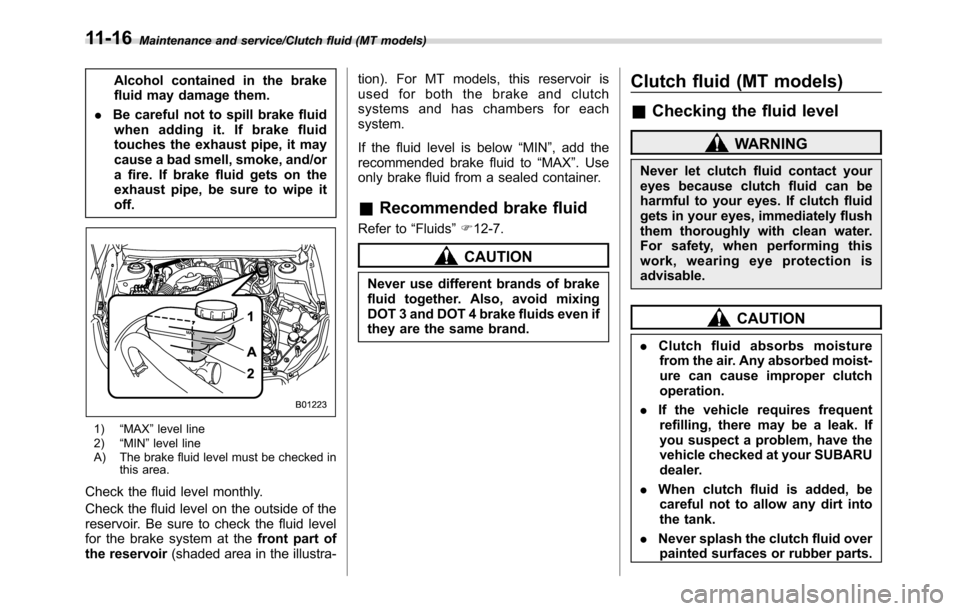
1)“MAX”level line
2)“MIN”level line
A) The brake fluid level must be checked in
this area.
Check the fluid level monthly.
Check the fluid level on the outside of the
reservoir. Be sure to check the fluid level
for the brake system at thefront part of
the reservoir(shaded area in the illustra-tion). For MT models, this reservoir is
used for both the brake and clutch
systems and has chambers for each
system.
If the fluid level is below“MIN”, add the
recommended brake fluid to“MAX”. Use
only brake fluid from a sealed container.
&Recommended brake fluid
Refer to“Fluids”F12-7.
CAUTION
Never use different brands of brake
fluid together. Also, avoid mixing
DOT 3 and DOT 4 brake fluids even if
they are the same brand.
Clutch fluid (MT models)
&Checking the fluid level
WARNING
Never let clutch fluid contact your
eyes because clutch fluid can be
harmful to your eyes. If clutch fluid
gets in your eyes, immediately flush
them thoroughly with clean water.
For safety, when performing this
work, wearing eye protection is
advisable.
CAUTION
.Clutch fluid absorbs moisture
from the air. Any absorbed moist-
ure can cause improper clutch
operation.
.If the vehicle requires frequent
refilling, there may be a leak. If
you suspect a problem, have the
vehicle checked at your SUBARU
dealer.
.When clutch fluid is added, be
careful not to allow any dirt into
the tank.
.Never splash the clutch fluid over
painted surfaces or rubber parts.
11-16
Page 495 of 572
Alcohol contained in the clutch
fluid may damage them.
.Be careful not to spill clutch fluid
when adding it. If clutch fluid
touches the exhaust pipe, it may
cause a bad smell, smoke, and/or
a fire. If clutch fluid gets on the
exhaust pipe, be sure to wipe it
off.
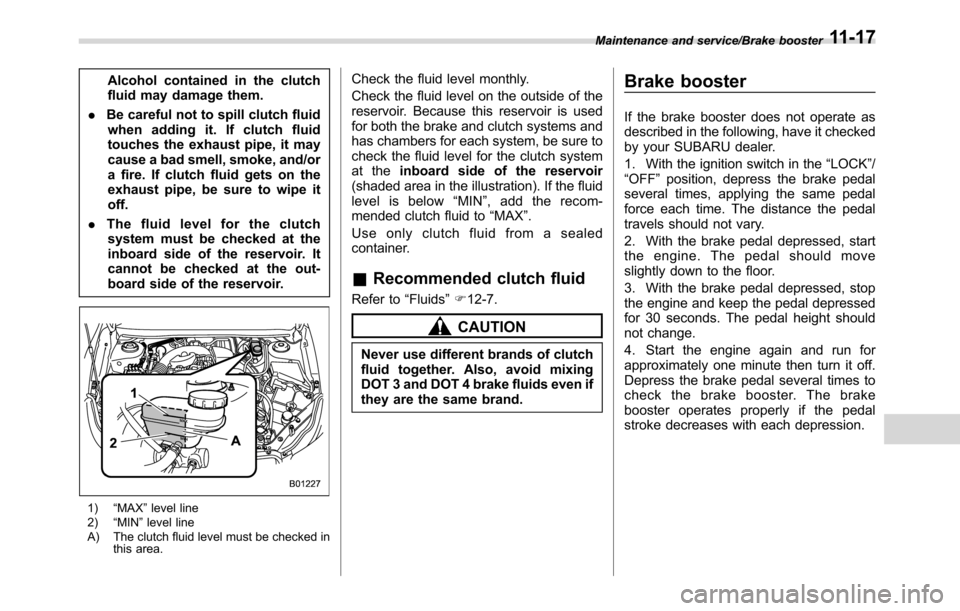
.The fluid level for the clutch
system must be checked at the
inboard side of the reservoir. It
cannot be checked at the out-
board side of the reservoir.
1)“MAX”level line
2)“MIN”level line
A) The clutch fluid level must be checked in
this area.
Check the fluid level monthly.
Check the fluid level on the outside of the
reservoir. Because this reservoir is used
for both the brake and clutch systems and
has chambers for each system, be sure to
check the fluid level for the clutch system
at theinboard side of the reservoir
(shaded area in the illustration). If the fluid
level is below“MIN”, add the recom-
mended clutch fluid to“MAX”.
Use only clutch fluid from a sealed
container.
&Recommended clutch fluid
Refer to“Fluids”F12-7.
CAUTION
Never use different brands of clutch
fluid together. Also, avoid mixing
DOT 3 and DOT 4 brake fluids even if
they are the same brand.
Brake booster
If the brake booster does not operate as
described in the following, have it checked
by your SUBARU dealer.
1. With the ignition switch in the“LOCK”/
“OFF”position, depress the brake pedal
several times, applying the same pedal
force each time. The distance the pedal
travels should not vary.
2. With the brake pedal depressed, start
the engine. The pedal should move
slightly down to the floor.
3. With the brake pedal depressed, stop
the engine and keep the pedal depressed
for 30 seconds. The pedal height should
not change.
4. Start the engine again and run for
approximately one minute then turn it off.
Depress the brake pedal several times to
check the brake booster. The brake
booster operates properly if the pedal
stroke decreases with each depression.
Maintenance and service/Brake booster11-17
Page 560 of 572

14-4Index
Interior.................................................................. 10-5
Ventilation grille..................................................... 4-11
Climate control system................................................. 4-3
Automatic................................................................ 4-7
Manual................................................................... 4-8
Clock................................................................ 3-37, 3-52
Clutch
Fluid.................................................................... 11-16
Pedal.................................................................. 11-18
Coat hook................................................................. 6-11
Continuously variable transmission (CVT)..................... 7-23
Fluid............................................................ 11-15, 12-7
Oil temperature warning light (AT OIL TEMP)............ 3-19
Coolant............................................................ 11-11, 12-7
Temperature high warning light................................ 3-17
Temperature low indicator light................................. 3-17
Cooling system......................................................... 11-10
Corrosion protection................................................... 10-4
Cruise control............................................................ 7-44
Indicator light......................................................... 3-31
Set indicator light................................................... 3-31
Cup holder.................................................................. 6-7
D
Daytime running light system....................................... 3-91
Defogger................................................................. 3-100
Defrosting................................................................. 4-11
Deicer.................................................................... 3-100
Differential gear oil
Front........................................................... 11-15, 12-6
Rear............................................................ 11-15, 12-6Dimensions................................................................ 12-2
Disarming the alarm system......................................... 2-30
Disc brake pad wear warning indicators........................ 7-31
Dome light......................................................... 6-2, 11-41
Door
Locks..................................................................... 2-5
Open warning light.................................................. 3-23
Drive belts............................................................... 11-14
Driving
AWD vehicles......................................................... 8-4
Car phone/cell phone.................................................. 7
Drinking..................................................................... 6
Drugs........................................................................ 7
Foreign countries..................................................... 8-4
Off road.................................................................. 8-6
Pets.......................................................................... 8
Snowy and icy roads............................................... 8-9
Tips ................................................. 7-23, 7-29, 8-2, 8-4
Tired or sleepy........................................................... 7
Winter.................................................................... 8-8
E
ECO gauge....................................................... 3-12, 3-48
Electrical system........................................................ 12-7
Electronic Brake Force Distribution (EBD) system........... 7-33
Warning................................................................ 3-22
Emergency Locking Retractor (ELR)............................. 1-12
Engine
Compartment overview............................................ 11-7
Coolant....................................................... 11-11, 12-7
Exhaust gas (carbon monoxide)............................. 6, 8-2