Window SUBARU CROSSTREK 2018 User Guide
[x] Cancel search | Manufacturer: SUBARU, Model Year: 2018, Model line: CROSSTREK, Model: SUBARU CROSSTREK 2018Pages: 474, PDF Size: 20.76 MB
Page 59 of 474
(60,1)
北米Model "A1320BE-C" EDITED: 2017/ 10/ 10
!Installing forward facing child re-
straint
WARNING
Before installing a child restraint
system, be sure to confirm that the
seatback is securely locked into
place. Otherwise, in an accident,
serious injury or death could result.
1. Shake the seatback slightly to confirm
that it is securely locked into place.
–Check the red colored unlocking
marker which is attached to the bottom
of the lock release knob is invisible. For
details, refer to“Folding down the rear
seatback”F1-6.
2. Prepare the rear seat head restraint
where a child restraint system is intended
to be installed in the following way.
–When a child restraint system is
installed on thewindow-side seating
position, remove the rear seat head
restraint. For details, refer to“Rear
seats”F1-9.
Store the head restraint in the cargo
area. Avoid placing the head restraint
in the passenger compartment to pre-
vent it from being thrown around in the
passenger compartment in a sudden
stop or a sharp turn.–When a child restraint system is
installed on therear center seating
position, raise the rear seat head
restraint to the extended position. Do
not remove the head restraint. For
details, refer to“Rear seats”F1-9.
3. Place the child restraint system in the
rear seating position.
WARNING
When you intend to install a child
restraint system on the rear center
seating position, if the child restraint
system does not fit snugly against
the contours of the rear center seat
cushion, install the child restraint
system on the window-side seating
position to be safe. For details, refer
to“Where to place a child restraint
system”F1-26.
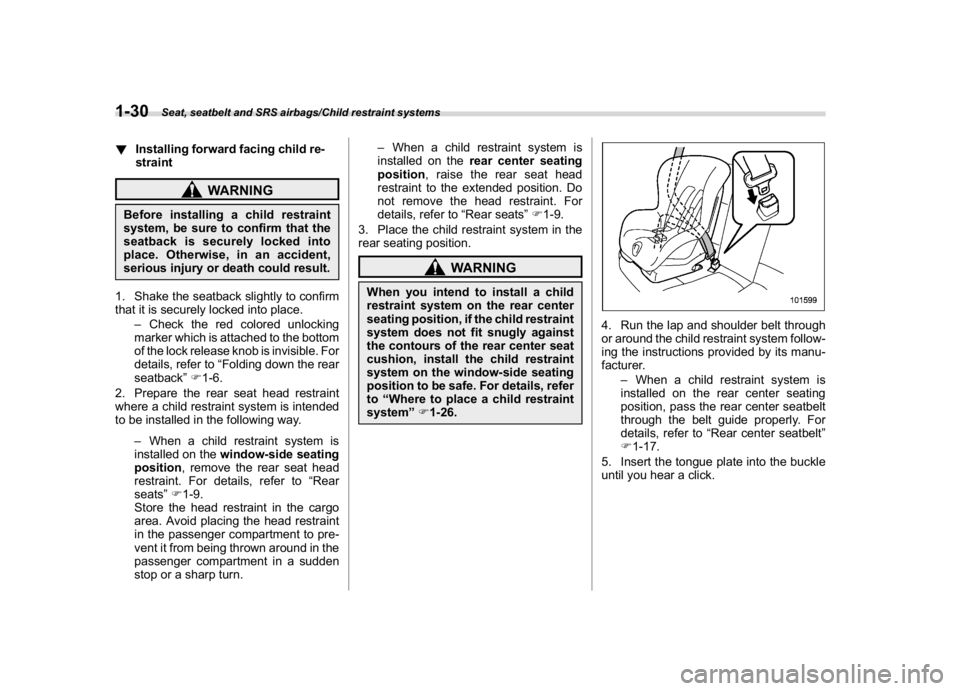
4. Run the lap and shoulder belt through
or around the child restraint system follow-
ing the instructions provided by its manu-
facturer.
–When a child restraint system is
installed on the rear center seating
position, pass the rear center seatbelt
through the belt guide properly. For
details, refer to“Rear center seatbelt”
F1-17.
5. Insert the tongue plate into the buckle
until you hear a click.
Seat, seatbelt and SRS airbags/Child restraint systems
1-30
Page 63 of 474
(64,1)
北米Model "A1320BE-C" EDITED: 2017/ 10/ 10
The lower anchorages (bars) are used for
installing a child restraint system only on
the rear seat window-side seating posi-
tions. For each window-side seating posi-
tion, two lower anchorages are provided.
Each lower anchorage is located where
the seat cushion meets the seatback.
!Tether anchoragesThe tether anchorages (upper an-
chorages) are provided at the locations
shown in the above illustration. For details,
refer to“Top tether anchorages”F1-36.!To install a child restraint system
using lower and tether an-
chorages
To install a child restraint system using
lower and tether anchorages, perform the
following procedure.
WARNING
Before installing a child restraint
system, be sure to confirm that the
seatback is securely locked into
place. Otherwise, in an accident,
serious injury or death could result.
1. Shake the seatback slightly to confirm
that it is securely locked into place.
–Check the red colored unlocking
marker which is attached to the bottom
of the lock release knob is invisible. For
details, refer to“Folding down the rear
seatback”F1-6.
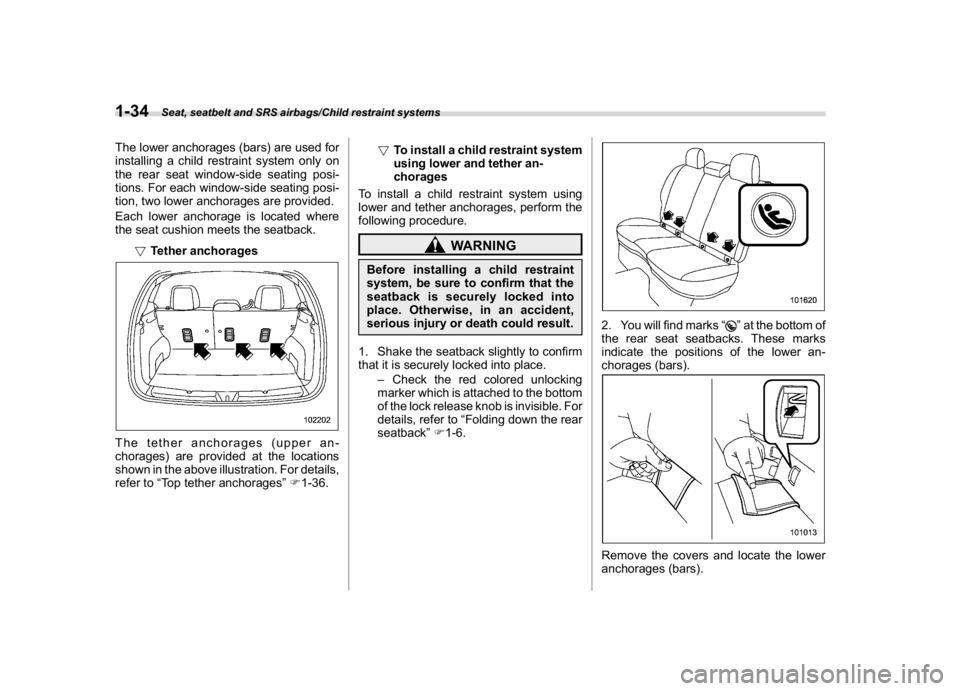
2. You will find marks“
”at the bottom of
the rear seat seatbacks. These marks
indicate the positions of the lower an-
chorages (bars).
Remove the covers and locate the lower
anchorages (bars).
Seat, seatbelt and SRS airbags/Child restraint systems
1-34
Page 66 of 474
(67,1)
北米Model "A1320BE-C" EDITED: 2017/ 10/ 10
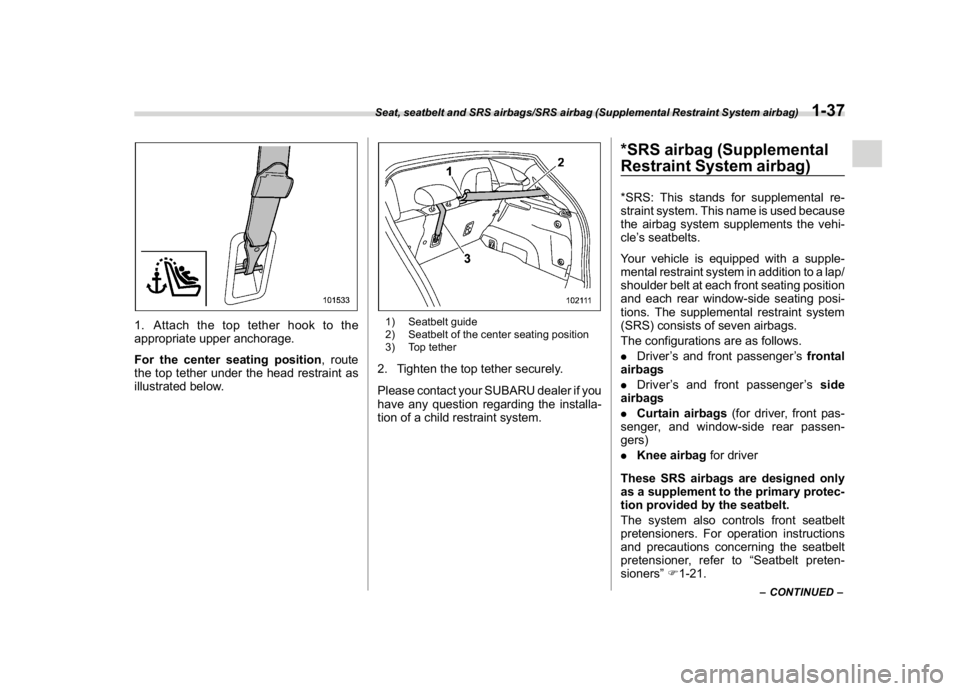
1. Attach the top tether hook to the
appropriate upper anchorage.
For the center seating position, route
the top tether under the head restraint as
illustrated below.
1) Seatbelt guide
2) Seatbelt of the center seating position
3) Top tether2. Tighten the top tether securely.
Please contact your SUBARU dealer if you
have any question regarding the installa-
tion of a child restraint system.
*SRS airbag (Supplemental
Restraint System airbag)*SRS: This stands for supplemental re-
straint system. This name is used because
the airbag system supplements the vehi-
cle’s seatbelts.
Your vehicle is equipped with a supple-
mental restraint system in addition to a lap/
shoulder belt at each front seating position
and each rear window-side seating posi-
tions. The supplemental restraint system
(SRS) consists of seven airbags.
The configurations are as follows.
.Driver’s and front passenger’sfrontal
airbags
.Driver’s and front passenger’sside
airbags
.Curtain airbags(for driver, front pas-
senger, and window-side rear passen-
gers)
.Knee airbagfor driver
These SRS airbags are designed only
as a supplement to the primary protec-
tion provided by the seatbelt.
The system also controls front seatbelt
pretensioners. For operation instructions
and precautions concerning the seatbelt
pretensioner, refer to“Seatbelt preten-
sioners”F1-21.
–CONTINUED–
Seat, seatbelt and SRS airbags/SRS airbag (Supplemental Restraint System airbag)
1-37
1
Page 68 of 474
(69,1)
北米Model "A1320BE-C" EDITED: 2017/ 10/ 10
.Since your vehicle is equipped
with SRS curtain airbags, do not
sit or lean unnecessarily close to
the front or rear door on either
side. Also, do not put your head,
arms or hands out of the window.
The SRS curtain airbags on both
sides of the cabin are stored in
the roof side (between the front
pillar and a point behind the rear
quarter glass), and they provide
protection by deploying rapidly
(faster than the blink of an eye) in
the event of a side impact, roll-
over or an offset frontal collision.
However, the force of its deploy-
ment may cause injuries if your
head is too close to it.
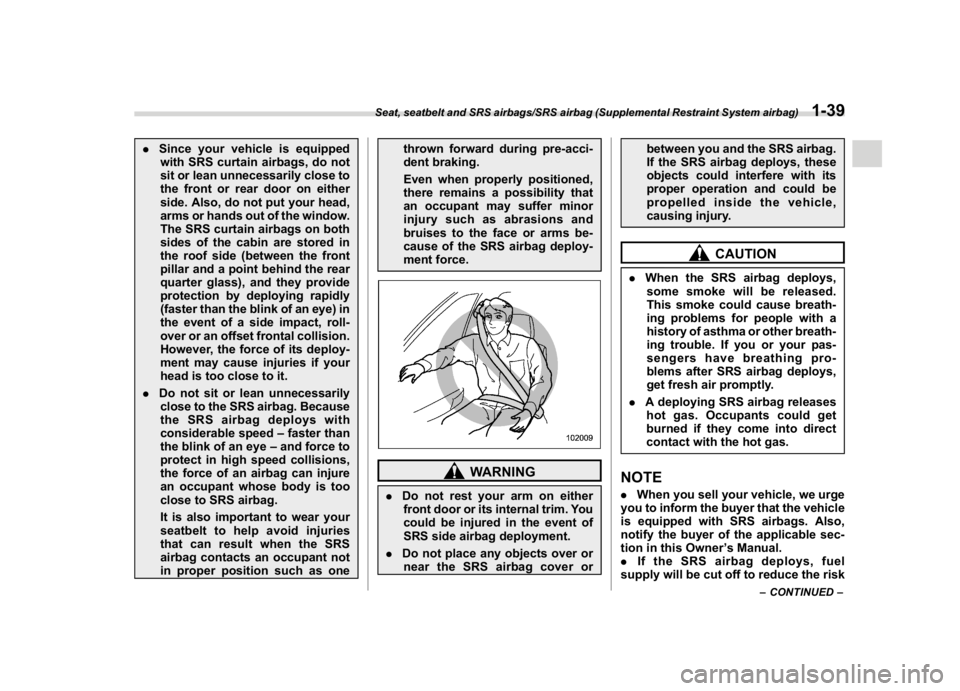
.Do not sit or lean unnecessarily
close to the SRS airbag. Because
the SRS airbag deploys with
considerable speed–faster than
the blink of an eye–and force to
protect in high speed collisions,
the force of an airbag can injure
an occupant whose body is too
close to SRS airbag.
It is also important to wear your
seatbelt to help avoid injuries
that can result when the SRS
airbag contacts an occupant not
in proper position such as onethrown forward during pre-acci-
dent braking.
Even when properly positioned,
there remains a possibility that
an occupant may suffer minor
injury such as abrasions and
bruises to the face or arms be-
cause of the SRS airbag deploy-
ment force.
WARNING
.Do not rest your arm on either
front door or its internal trim. You
could be injured in the event of
SRS side airbag deployment.
.Do not place any objects over or
near the SRS airbag cover orbetween you and the SRS airbag.
If the SRS airbag deploys, these
objects could interfere with its
proper operation and could be
propelled inside the vehicle,
causing injury.
CAUTION
.When the SRS airbag deploys,
some smoke will be released.
This smoke could cause breath-
ing problems for people with a
history of asthma or other breath-
ing trouble. If you or your pas-
sengers have breathing pro-
blems after SRS airbag deploys,
get fresh air promptly.
.A deploying SRS airbag releases
hot gas. Occupants could get
burned if they come into direct
contact with the hot gas.NOTE.When you sell your vehicle, we urge
you to inform the buyer that the vehicle
is equipped with SRS airbags. Also,
notify the buyer of the applicable sec-
tion in this Owner’s Manual.
.If the SRS airbag deploys, fuel
supply will be cut off to reduce the risk
–CONTINUED–
Seat, seatbelt and SRS airbags/SRS airbag (Supplemental Restraint System airbag)
1-39
1
Page 73 of 474
(74,1)
北米Model "A1320BE-C" EDITED: 2017/ 10/ 10
WARNING
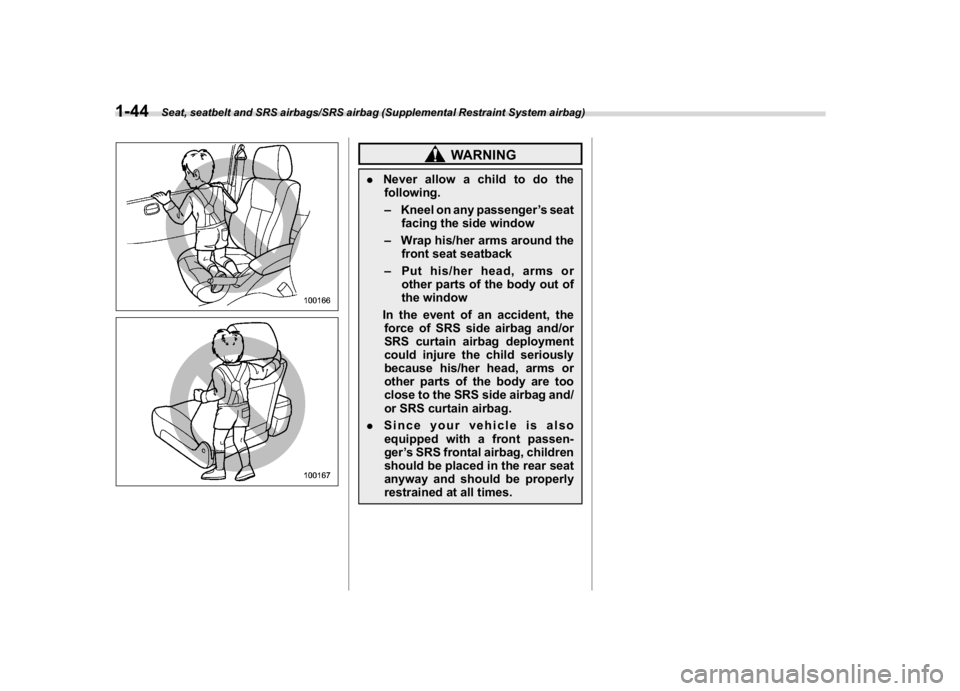
.Never allow a child to do the
following.
–Kneel on any passenger’s seat
facing the side window
–Wrap his/her arms around the
front seat seatback
–Put his/her head, arms or
other parts of the body out of
the window
In the event of an accident, the
force of SRS side airbag and/or
SRS curtain airbag deployment
could injure the child seriously
because his/her head, arms or
other parts of the body are too
close to the SRS side airbag and/
or SRS curtain airbag.
.Since your vehicle is also
equipped with a front passen-
ger’s SRS frontal airbag, children
should be placed in the rear seat
anyway and should be properly
restrained at all times.
Seat, seatbelt and SRS airbags/SRS airbag (Supplemental Restraint System airbag)
1-44
Page 88 of 474

(89,1)
北米Model "A1320BE-C" EDITED: 2017/ 10/ 10
for front seat occupants.
!SRS curtain airbag
Your vehicle is equipped with a SUBARU
SRS curtain airbag system that complies
with the Federal Motor Vehicle Safety
Standard (FMVSS) No. 226.
The SRS curtain airbag on each side of the
cabin is stored in the roof side (between
the front pillar and a point over the rear
seat). An“SRS AIRBAG”mark is located
at the top of each center pillar.
Inamoderatetoseveresideimpact
collision, the SRS curtain airbag on the
impacted side of the vehicle deploys
between the occupant and the side win-
dow and supplements the seatbelt by
reducing the impact on the occupant’s
head.
In a rollover, SRS curtain airbags on both
sides of the vehicle deploy between the
occupant and the side window and supple-
ment the seatbelt by reducing the impact to
the occupant’s head.
In an offset frontal collision, SRS curtain
airbags on both sides of the vehicle deploy
between the occupant and the side win-
dow and supplement the seatbelt by
reducing the impact to the occupant’s
head and chest.!Operation
The SRS side airbag and SRS curtain
airbag can function only when the ignition
switch is in the“ON”position.
The following airbags deploy indepen-
dently of each other since each has its
own impact sensor.
.Driver’s SRS side airbag
.Front passenger’s SRS side airbag
.SRS curtain airbag (right-hand side)
.SRS curtain airbag (left-hand side)
Therefore, they may not both deploy in the
same accident. Also, the SRS side airbag
and SRS curtain airbag deploys indepen-
dently of the driver’s and front passenger’s
SRS frontal airbags in the steering wheel
and instrument panel.
An impact sensor, which senses impact
force, is located in each of the following
locations.
.In the left and right front doors
.In the left and right center pillars
.In the left and right rear wheel houses
.Under the rear center seat
A rollover sensor is also located inside the
airbag control module.
–CONTINUED–
Seat, seatbelt and SRS airbags/SRS airbag (Supplemental Restraint System airbag)
1-59
1
Page 97 of 474
(98,1)
北米Model "A1320BE-C" EDITED: 2017/ 10/ 10
.Under the center of the instru-
ment panel
.On both the right and left sides at
the front of the vehicle
.Steering wheel and column and
nearby areas
.Bottom of the steering column
and nearby areas
.Top of the dashboard on front
passenger’s side and nearby
areas
.Each front seat and nearby area
.Inside each center pillar
.Inside each front door
.In each roof side (from the front
pillar to a point over the rear seat)
.Between the rear seat cushion
and rear wheel house on each
side
.Under the rear center seat
In the event that the SRS airbag is
deployed, replacement of the system
should be performed only by an author-
ized SUBARU dealer. When the compo-
nents of the SRS airbag system are
replaced, use only genuine SUBARU
parts.
NOTEIn the following cases, contact your
SUBARU dealer as soon as possible.
.The front part of the vehicle was
involved in an accident in which only
the driver’s SRS frontal airbag or both
driver’s and front passenger’sSRS
frontal airbags did not deploy.
.The pad of the steering wheel, the
cover over the front passenger’s SRS
frontal airbag, or either roof side (from
the front pillar to a point over the rear
seat) is scratched, cracked, or other-
wise damaged.
.The center pillar, front door, rear
wheel house or rear sub frame, or an
area near these parts, was involved in
an accident in which the SRS side
airbag and SRS curtain airbag did not
deploy.
.The fabric or leather of either front
seatback is cut, frayed, or otherwise
damaged.
.The rear part of the vehicle was
involved in an accident in which no
SRS airbag was deployed.
&Precautions against vehicle
modification
WARNING
To avoid accidental activation of the
system or rendering the system
inoperative, which may result in
serious injury, no modifications
should be made to any components
or wiring of the SRS airbag system.
This includes following modifica-
tions.
.Installation of custom steering
wheels
.Attachment of additional trim ma-
terials to the dashboard
.Installation of custom seats
.Replacement of seat fabric or
leather
.Installation of additional fabric or
leather on the front seat
.Attachment of a hands-free mi-
crophone or any other accessory
to a front pillar, a center pillar, a
rear pillar, the windshield, a side
window, an assist grip, or any
other cabin surface that would be
near a deploying SRS curtain
airbag.
Seat, seatbelt and SRS airbags/SRS airbag (Supplemental Restraint System airbag)
1-68
Page 100 of 474
(103,1)
北米Model "A1320BE-C" EDITED: 2017/ 10/ 10
Keys.........................................................................2-2
Key number plate................................................... 2-2
Keyless access with push-button start system
(if equipped).........................................................2-2
Safety precautions................................................. 2-3
Locking and unlocking by holding the access
key fob ................................................................ 2-6
Unlock using PIN Code Access.............................2-10
Power saving function.......................................... 2-11
Power saving function of access key fob..............2-12
Disabling keyless access function.........................2-12
Selecting audible signal operation.........................2-13
Warning chimes and warning indicator..................2-13
When access key fob does not operate properly ... 2-14
Replacing battery of access key fob......................2-14
Replacing access key fob.....................................2-14
Certification for keyless access with push-
button start system.............................................2-14
Immobilizer............................................................2-15
Security indicator light..........................................2-15
Key replacement...................................................2-15
Certification for immobilizer system......................2-16
Remote keyless entrysystem..............................2-17
Locking the doors.................................................2-18
Unlocking the doors..............................................2-18
Unlocking the rear gate.........................................2-19
Vehicle finder function..........................................2-19
Sounding a panic alarm........................................2-19
Setting audible signal operation
(models without“keyless access with push-
button start system”) ..........................................2-19Replacing the battery............................................2-20
Replacing lost transmitters...................................2-20
Certification for remote keyless entry system........2-20
Door locks.............................................................2-21
Locking and unlocking from the outside...............2-21
Locking and unlocking from the inside.................2-22
Key lock-in prevention function............................2-23
Battery drainage prevention function....................2-24
Alarm system........................................................2-24
Alarm system operation........................................2-25
Arming the system...............................................2-25
Disarming the system...........................................2-26
Alarm system setting............................................2-26
If you have accidentally triggered the alarm
system..............................................................2-27
Valet mode...........................................................2-27
Child safety locks.................................................2-28
Windows................................................................2-28
Power window operation.......................................2-28
Initialization of power window with one-touch
auto up/down function.......................................2-30
Rear gate...............................................................2-31
Lock/unlock..........................................................2-31
Open/close...........................................................2-31
Moonroof (if equipped).........................................2-32
Moonroof switches...............................................2-33
Sunshade.............................................................2-34
Keys and doors
2
Page 104 of 474

(107,1)
北米Model "A1320BE-C" EDITED: 2017/ 10/ 10
may damage the battery or
cause circuit malfunctions.
–Do not wash the access key
fob in an ultrasonic washer.
–Do not leave the access key
fob in humid or dusty loca-
tions. Doing so may cause
malfunctions.
–Keep the access key fob away
from magnetic sources.
–Do not leave the access key
fob near a personal computer
or home electrical appliance.
–Do not leave the access key
fob near a battery charger or
any electrical accessories.
–Do not apply metallic window
tint or attach metallic objects
to the windows.
–Do not fit non genuine acces-
sories or parts.
.If the access key fob is dropped,
the integrated emergency key in-
side may become loose. Be care-
ful not to lose the emergency key.
.When traveling in an airplane, do
not press the button of the ac-
cess key fob. If any button of the
access key fob is pressed, radio
waves are emitted and may affectthe operation of the airplane.
When carrying the access key
fob in a bag, take measures to
prevent the buttons from being
pressed accidentally.
NOTE.The operational/non-operational
setting for the keyless access function
can be changed. For the setting proce-
dure, refer to“Disabling keyless ac-
cess function”F2-12.
.For detailed information about the
operation method for the push-button
ignition switch while the keyless ac-
cess function is switched to the non-
operational mode, refer to“Access key
fob–if access key fob does not operate
properly”F9-17.
.The keyless access with push-but-
ton start system uses weak radio
waves. The status of the access key
fob and environmental conditions may
interfere with the communication be-
tween the access key fob and the
vehicle under the following conditions,
and it may not be possible to lock or
unlock the doors or start the engine.
–When operating near a facility
where strong radio waves are trans-
mitted, such as a broadcast stationand power transmission lines
–When products that transmit
radio waves are used, such as an
access key fob or a remote trans-
mitter key of another vehicle
–When carrying the access key fob
of your vehicle together with the
access key fob or the remote trans-
mitter of another vehicle
–When the access key fob is
placed near wireless communica-
tion equipment such as a cell phone
–When the access key fob is
placed near a metallic object
–When metallic accessories are
attached to the access key fob
–When carrying the access key fob
with electronic appliances such as a
laptop computer
–When the battery of the access
key fob is discharged
.The access key fob is always com-
municating with the vehicle and is
continuously using the battery.
Although the life of the battery varies
depending on the operating conditions,
it is approximately 1 to 2 years. If the
battery becomes fully discharged, re-
place it with a new one.
.If an access key fob is lost, it is
recommended that all of the remaining
access key fobs be reregistered. For
–CONTINUED–
Keys and doors/Keyless access with push-button start system
2-5
2
Page 114 of 474

(117,1)
北米Model "A1320BE-C" EDITED: 2017/ 10/ 10
.Mexico-spec. modelsIFT
RLVDE1415-1661
14AHK
DENSO
ImmobilizerThe immobilizer system is designed to
prevent an unauthorized person from
starting the engine. Only keys registered
with your vehicle’s immobilizer system can
be used to operate your vehicle. If engine
start is attempted with an unregistered
access key fob or key, the engine will not
start. Even if the engine does start, it will
stop after a few seconds. This system,
however, is not a 100% anti-theft guaran-
tee.
CAUTION
.Do not place the key under direct
sunlight or anywhere it may be-
come hot.
.Do not get the key wet. If the key
gets wet, wipe it dry with a cloth
immediately.
.Do not modify or remove the
system. If modified or removed,
the proper operation of the sys-
tem cannot be guaranteed.
NOTE.To protect your vehicle from theft,
please pay close attention to the follow-
ing security precautions:
–Never leave your vehicle unat-
tended with its keys inside.
–Before leaving your vehicle,
close all windows and the moon-
roof, and lock the doors and rear
gate.
–Do not leave spare keys or any
record of your key number in the
vehicle.
.The vehicle has a maintenance-free
type immobilizer system.&Security indicator lightRefer to“Security indicator light”F3-29.&Key replacementYour key number plate will be required if
you ever need a replacement key made.
Any new key must be registered for use
with your vehicle’s immobilizer system
before it can be used. The maximum
number of keys that can be registered for
use with one vehicle is as follows.
.Four (models without“keyless access
with push-button start system”)
.Seven (models with“keyless access
–CONTINUED–
Keys and doors/Immobilizer
2-15
2