Window SUBARU CROSSTREK 2018 Owners Manual
[x] Cancel search | Manufacturer: SUBARU, Model Year: 2018, Model line: CROSSTREK, Model: SUBARU CROSSTREK 2018Pages: 474, PDF Size: 20.76 MB
Page 4 of 474
(3,1)
北米Model "A1320BE-C" EDITED: 2017/ 10/ 10
Warranties&Warranties for U.S.A.SUBARU vehicles distributed by Subaru of
America, Inc. and sold at retail by an
authorized SUBARU dealer in the United
States come with the following warranties:
.SUBARU Limited Warranties
.Federal Emission Control Systems
Warranties
.California Emissions Control Sys-
tems Warranties
All warranty information, including applic-
ability, details of coverage and exclusions,
is in the“Warranty and Maintenance
Booklet”. Read these warranties carefully.&Warranties for CanadaSUBARU vehicles distributed by Subaru
Canada, Inc. and sold at retail by an
authorized SUBARU dealer in Canada
come with the following warranties:
.SUBARU Limited Warranty
.Emission Control System Warranty
All warranty information, including applic-
ability, details of coverage and exclusions,
is in the“Warranty and Service Booklet”.
Read these warranties carefully.
&Warranties except for U.S.A.
and CanadaAll warranty information, including details
of coverage and exclusions, is in the
“Warranty and Maintenance Booklet”.
Read these warranties carefully.
How to use this Owner’s
Manual&Using your Owner’s ManualBefore you operate your vehicle, carefully
read this manual. To protect yourself and
extend the service life of your vehicle,
follow the instructions in this manual.
Failure to observe these instructions may
result in serious injury and damage to your
vehicle.
This manual is composed of fourteen
chapters. Each chapter begins with a brief
table of contents, so you can usually tell at
a glance if that chapter contains the
information you want.
Chapter 1: Seat, seatbelt and SRS air-
bags
This chapter informs you how to use the
seat and seatbelt and contains precau-
tions for the SRS airbags.
Chapter 2: Keys and doors
This chapter informs you how to operate
the keys, locks and windows.
Chapter 3: Instruments and controls
This chapter informs you about the opera-
tion of instrument panel indicators and how
to use the instruments and other switches.
–CONTINUED–
1
0
Page 8 of 474
(7,1)
北米Model "A1320BE-C" EDITED: 2017/ 10/ 10
collision, because the child will
be caught between the passen-
ger and objects inside the vehi-
cle.
.While riding in the vehicle, infants
and small children should always
be seated in the REAR seat in an
infant or child restraint system
which is appropriate for the
child’s age, height and weight. If
a child is too big for a child
restraint system, the child should
sit in the REAR seat and be
restrained using the seatbelts.
According to accident statistics,
children are safer when properly
restrained in the rear seating
positions than in the front seating
positions. Never allow a child to
stand up or kneel on the seat.
.Place children in the REAR seat
properly restrained at all times in
a child restraint device or in a
seatbelt. The SRS airbag deploys
with considerable speed and
force and can injure or even kill
children, especially if they are not
restrained or improperly re-
strained. Because children are
lighter and weaker than adults,
their risk of being injured from
deployment is greater..NEVER INSTALL A FORWARD OR
REARWARD FACING CHILD
SEAT IN THE FRONT SEAT.
DOING SO RISKS SERIOUS IN-
JURY OR DEATH TO THE CHILD
BY PLACING THE CHILD’S HEAD
TOO CLOSE TO THE SRS AIR-
BAG.
.Always turn the child safety locks
to the“LOCK”position when
children sit in the rear seat.
Serious injury could result if a
child accidentally opens the door
and falls out. Refer to“Child
safety locks”F2-28.
.Always lock the passenger’s win-
dows using the lock switch when
children are riding in the vehicle.
Failure to follow this procedure
could result in injury to a child
operating the power window. Re-
fer to“Windows”F2-28.
.Never leave unattended children,
adults or animals in the vehicle.
They could accidentally injure
themselves or others through
inadvertent operation of the ve-
hicle. Also, on hot or sunny days,
temperature in a closed vehicle
could quickly become high en-
ough to cause severe or possibly
fatal injuries to them..When leaving the vehicle, close
all windows and lock all doors.
For instructions and precautions, carefully
read the following sections.
.For the seatbelt system, refer to“Seat-
belts”F1-12.
.For the child restraint system, refer to
“Child restraint systems”F1-25.
.For the SRS airbag system, refer to
“SRS airbag (Supplemental Restraint Sys-
tem airbag)”F1-37.
–CONTINUED–
5
0
Page 9 of 474
(8,1)
北米Model "A1320BE-C" EDITED: 2017/ 10/ 10
&Engine exhaust gas (carbon
monoxide)
WARNING
.Never inhale engine exhaust gas.
Engine exhaust gas contains
carbon monoxide, a colorless
and odorless gas which is dan-
gerous, or even lethal, if inhaled.
.Always properly maintain the en-
gine exhaust system to prevent
engine exhaust gas from entering
the vehicle.
.Never run the engine in a closed
space, such as a garage, except
for the brief time needed to drive
the vehicle in or out of it.
.Avoid remaining in a parked ve-
hicle for a lengthy time while the
engine is running. If that is un-
avoidable, then use the ventila-
tion fan to force fresh air into the
vehicle.
.Always keep the front ventilator
inlet grille free from snow, leaves
or other obstructions to ensure
that the ventilation system al-
ways works properly.
.If at any time you suspect that
exhaust fumes are entering thevehicle, have the problem
checked and corrected as soon
as possible. If you must drive
under these conditions, drive
only with all windows fully open.
.Keep the rear gate closed while
driving to prevent exhaust gas
from entering the vehicle.
&Drinking and driving
WARNING
Drinking and then driving is very
dangerous. Alcohol in the blood-
stream delays your reaction time
and impairs your perception, judg-
ment and attentiveness. If you drive
after drinking–even if you drink just
a little–it will increase the risk of
being involved in a serious or fatal
accident, injuring or killing yourself,
your passengers and others. In
addition, if you are injured in the
accident, alcohol may increase the
severity of that injury.
Please don’t drink and drive.
Drunken driving is one of the most frequent
causes of accidents. Since alcohol affects
all people differently, you may have con-sumed too much alcohol to drive safely
even if the level of alcohol in your blood is
below the legal limit. The safest thing you
can do is never drink and drive. However if
you have no choice but to drive, stop
drinking and sober up completely before
getting behind the wheel.
&Drugs and driving
WARNING
There are some drugs (over the
counter and prescription) that can
delay your reaction time and impair
your perception, judgment and at-
tentiveness. If you drive after taking
them, it may increase your, your
passengers’and other persons’risk
of being involved in a serious or fatal
accident.
If you are taking any drugs, check with
your doctor or pharmacist or read the
literature that accompanies the medication
to determine if the drug you are taking can
impair your driving ability. Do not drive
after taking any medications that can make
you drowsy or otherwise affect your ability
to safely operate a motor vehicle. If you
have a medical condition that requires you
to take drugs, please consult with your
doctor.
6
Page 16 of 474
(15,1)
北米Model "A1320BE-C" EDITED: 2017/ 10/ 10
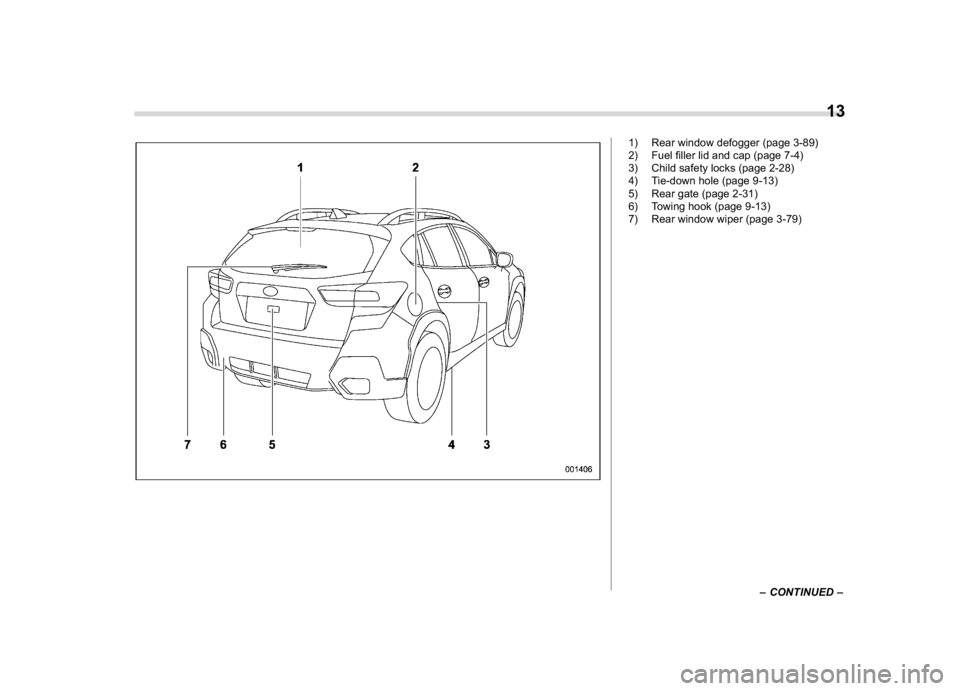
1) Rear window defogger (page 3-89)
2) Fuel filler lid and cap (page 7-4)
3) Child safety locks (page 2-28)
4) Tie-down hole (page 9-13)
5) Rear gate (page 2-31)
6) Towing hook (page 9-13)
7) Rear window wiper (page 3-79)
–CONTINUED–
13
0
Page 18 of 474
(17,1)
北米Model "A1320BE-C" EDITED: 2017/ 10/ 10
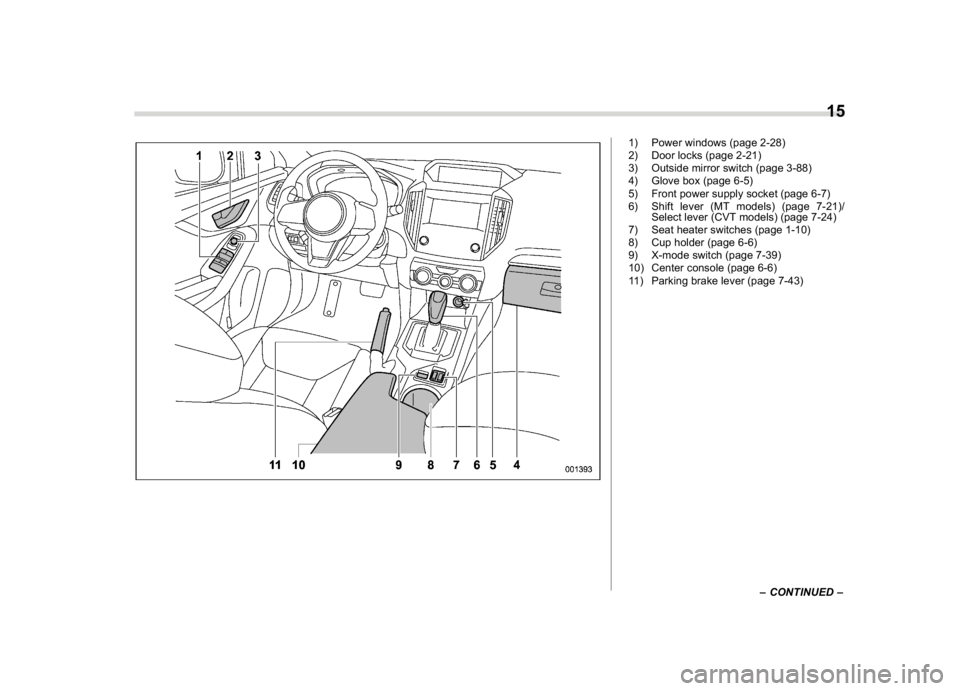
1) Power windows (page 2-28)
2) Door locks (page 2-21)
3) Outside mirror switch (page 3-88)
4) Glove box (page 6-5)
5) Front power supply socket (page 6-7)
6) Shift lever (MT models) (page 7-21)/
Select lever (CVT models) (page 7-24)
7) Seat heater switches (page 1-10)
8) Cup holder (page 6-6)
9) X-mode switch (page 7-39)
10) Center console (page 6-6)
11) Parking brake lever (page 7-43)
–CONTINUED–
15
0
Page 21 of 474
(20,1)
北米Model "A1320BE-C" EDITED: 2017/ 10/ 10
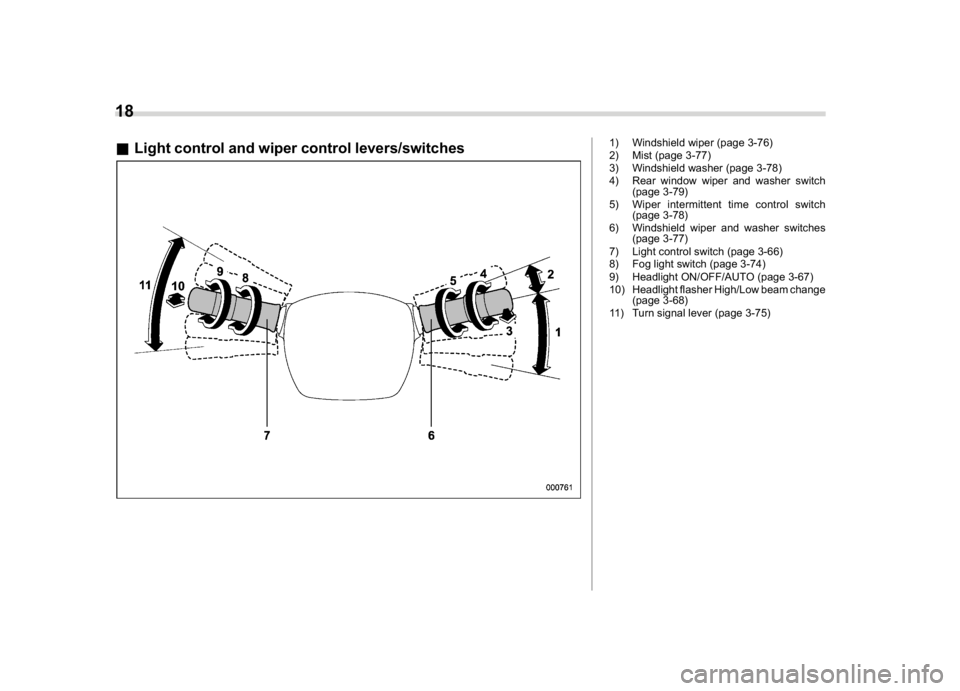
&Light control and wiper control levers/switches
1) Windshield wiper (page 3-76)
2) Mist (page 3-77)
3) Windshield washer (page 3-78)
4) Rear window wiper and washer switch
(page 3-79)
5) Wiper intermittent time control switch
(page 3-78)
6) Windshield wiper and washer switches
(page 3-77)
7) Light control switch (page 3-66)
8) Fog light switch (page 3-74)
9) Headlight ON/OFF/AUTO (page 3-67)
10) Headlight flasher High/Low beam change
(page 3-68)
11) Turn signal lever (page 3-75)
18
Page 28 of 474
(27,1)
北米Model "A1320BE-C" EDITED: 2017/ 10/ 10
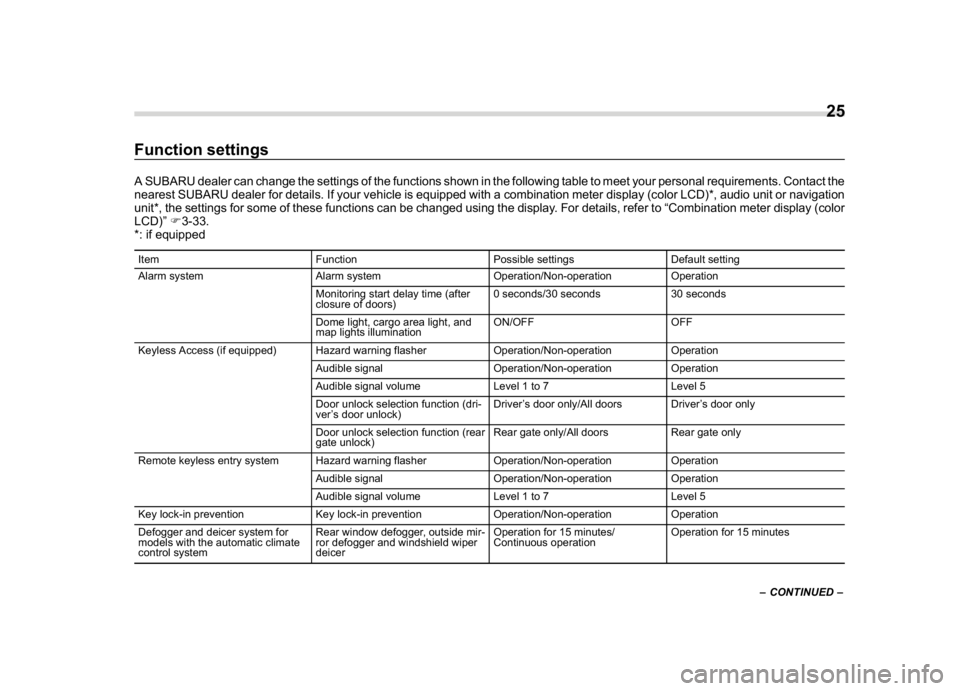
Function settingsA SUBARU dealer can change the settings of the functions shown in the following table to meet your personal requirements. Contact the
nearest SUBARU dealer for details. If your vehicle is equipped with a combination meter display (color LCD)*, audio unit or navigation
unit*, the settings for some of these functions can be changed using the display. For details, refer to“Combination meter display (color
LCD)”F3-33.
*: if equippedItem Function Possible settings Default setting
Alarm system Alarm system Operation/Non-operation Operation
Monitoring start delay time (after
closure of doors)0 seconds/30 seconds 30 seconds
Dome light, cargo area light, and
map lights illuminationON/OFF OFF
Keyless Access (if equipped) Hazard warning flasher Operation/Non-operation Operation
Audible signal Operation/Non-operation Operation
Audible signal volume Level 1 to 7 Level 5
Door unlock selection function (dri-
ver’s door unlock)Driver’s door only/All doors Driver’s door only
Door unlock selection function (rear
gate unlock)Rear gate only/All doors Rear gate only
Remote keyless entry system Hazard warning flasher Operation/Non-operation Operation
Audible signal Operation/Non-operation Operation
Audible signal volume Level 1 to 7 Level 5
Key lock-in prevention Key lock-in prevention Operation/Non-operation Operation
Defogger and deicer system for
models with the automatic climate
control systemRear window defogger, outside mir-
ror defogger and windshield wiper
deicerOperation for 15 minutes/
Continuous operationOperation for 15 minutes
–CONTINUED–
25
0
Page 38 of 474
(39,1)
北米Model "A1320BE-C" EDITED: 2017/ 10/ 10
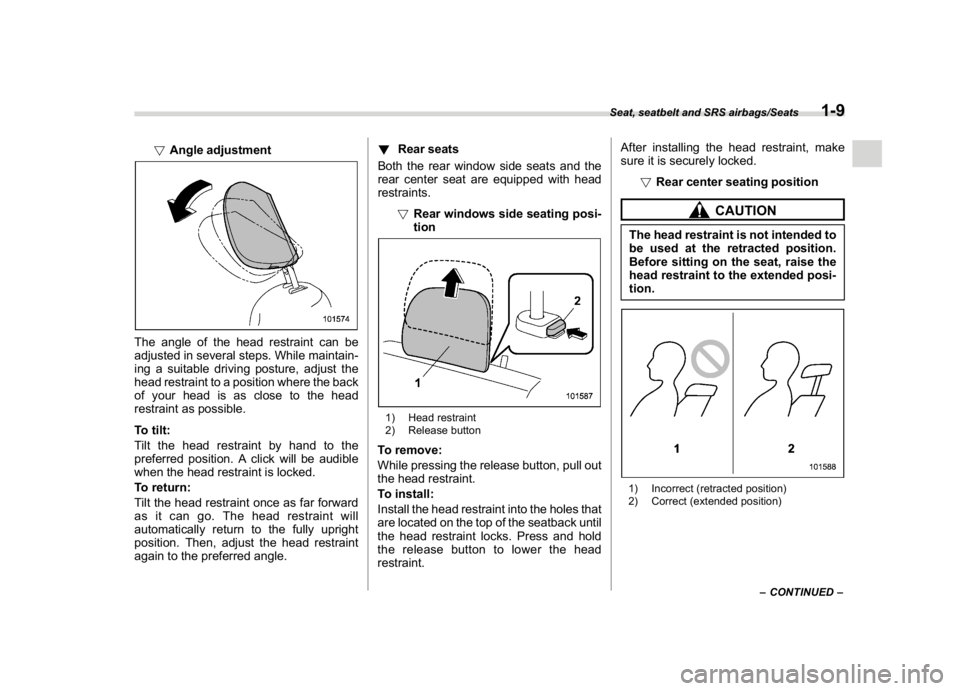
!Angle adjustment
The angle of the head restraint can be
adjusted in several steps. While maintain-
ing a suitable driving posture, adjust the
head restraint to a position where the back
of your head is as close to the head
restraint as possible.
To tilt:
Tilt the head restraint by hand to the
preferred position. A click will be audible
when the head restraint is locked.
To return:
Tilt the head restraint once as far forward
as it can go. The head restraint will
automatically return to the fully upright
position. Then, adjust the head restraint
again to the preferred angle.!Rear seats
Both the rear window side seats and the
rear center seat are equipped with head
restraints.
!Rear windows side seating posi-
tion
1) Head restraint
2) Release buttonTo remove:
While pressing the release button, pull out
the head restraint.
To install:
Install the head restraint into the holes that
are located on the top of the seatback until
the head restraint locks. Press and hold
the release button to lower the head
restraint.After installing the head restraint, make
sure it is securely locked.
!Rear center seating position
CAUTION
The head restraint is not intended to
be used at the retracted position.
Before sitting on the seat, raise the
head restraint to the extended posi-
tion.1) Incorrect (retracted position)
2) Correct (extended position)
–CONTINUED–
Seat, seatbelt and SRS airbags/Seats
1-9
1
Page 55 of 474
(56,1)
北米Model "A1320BE-C" EDITED: 2017/ 10/ 10
seat. Unrestrained children will be
thrown forward during sudden stop
or in an accident and can be injured
seriously.
Additionally, children standing up or
kneeling on or in front of the front
seat are exposed another serious
danger. Since the SRS airbag de-
ploys with considerable speed and
force, the child could be injured or
even killed.&Safety tips for installing child
restraint systems
WARNING
.Child restraint systems and seat-
belts can become hot in a vehicle
that has been closed up in sunny
weather; they could burn a small
child. Check the child restraint
system before you place a child
in it..Do not leave an unsecured child
restraint system in your vehicle.
Unsecured child restraint sys-
tems can be thrown around in-
side of the vehicle in a sudden
stop, turn or accident; they can
strike and injure vehicle occu-
pants as well as result in serious
injuries or death to the child.
CAUTION
When you install a child restraint
system, follow the manufacturer’s
instructions supplied with it. After
installing the child restraint system,
check to ensure that it is held
securely in position. If it is not held
tight and secure, the danger of your
child suffering personal injury in the
event of an accident may be in-
creased.
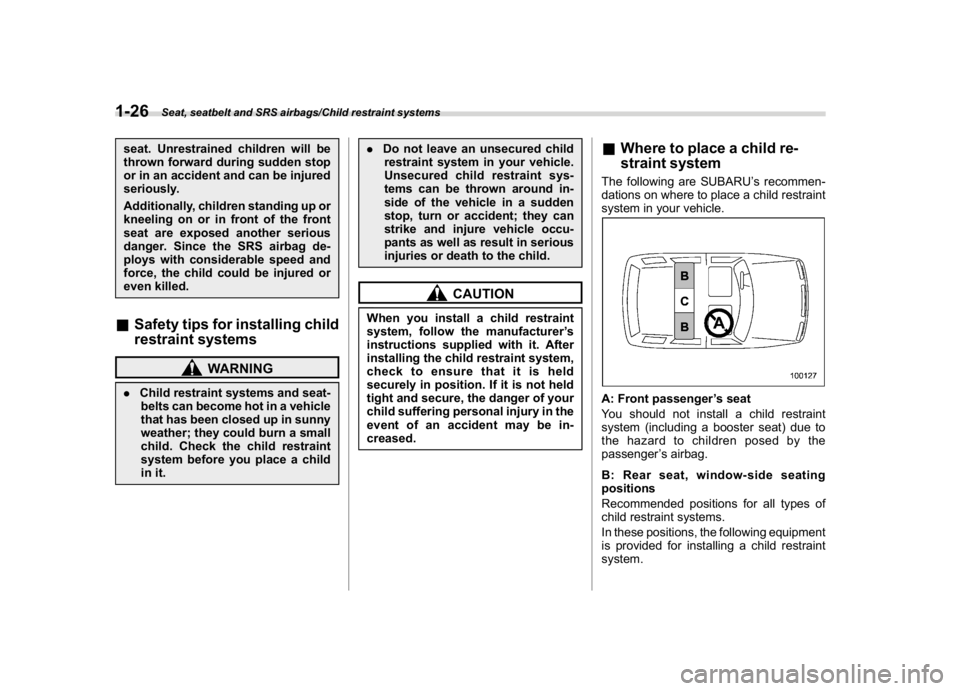
&Where to place a child re-
straint systemThe following are SUBARU’s recommen-
dations on where to place a child restraint
system in your vehicle.A: Front passenger’s seat
You should not install a child restraint
system (including a booster seat) due to
the hazard to children posed by the
passenger’s airbag.
B: Rear seat, window-side seating
positions
Recommended positions for all types of
child restraint systems.
In these positions, the following equipment
is provided for installing a child restraint
system.
Seat, seatbelt and SRS airbags/Child restraint systems
1-26
Page 56 of 474
(57,1)
北米Model "A1320BE-C" EDITED: 2017/ 10/ 10
.Automatic Locking Retractor/Emer-
gency Locking Retractor (ALR/ELR) seat-
belts
.Lower anchorages (bars)
.Upper anchorages (tether anchorages)
Some types of child restraints might not be
able to be secured firmly due to projection
of the seat cushion.
In this seating position, you should use
only a child restraint system that has a
bottom base that fits snugly against the
contours of the seat cushion and can be
securely retained using the seatbelt.
C: Rear seat, center seating position
The ALR/ELR seatbelt and an upper
anchorage (tether anchorage) are pro-
vided in this position.
Some types of child restraints might not be
able to be secured firmly due to projection
of the seat cushion.
In this seating position, you should use
only a child restraint system that has a
bottom base that fits snugly against the
contours of the seat cushion and can be
securely retained using the seatbelt.
When you install a child restraint system in
the rear seat’s center seating position,
raise the center head restraint.
Lower anchorages (bars) for window-side
seating positions may be used for a seat inthecenterseatingpositionifachild
restraint system manufacturer’s instruc-
tions permit and specify using anchors as
far apart as those in this vehicle.
If a child restraint system is not correctly
fixed in place (for example, if a child
restraint system can be moved more than
1 inch (2.5 cm) from side to side), you
should install the child restraint system in a
rear seat, window-side seating position.
WARNING
.Even with advanced airbags, chil-
dren can be seriously injured by
the airbag. Place children in the
rear seat properly restrained at
all times. The SRS airbag deploys
with considerable speed and
force and can injure or even kill
children, especially if they are not
restrained or improperly re-
strained. Because children are
lighter and weaker than adults,
their risk of being injured from
deployment is greater.
For that reason, be sure to secure
ALL types of child restraint de-
vices (including forward facing
child seats) in the REAR seats at
all times. You should choose a
restraint device which is appro-priate for the child’s age, height
and weight. According to acci-
dent statistics, children are safer
when properly restrained in the
rear seating positions than in the
front seating positions.
.Do not use lower anchorages
(bars) for a seat in the center
seating position unless a child
restraint system manufacturer’s
instructions permit and specify
using anchors spaced as far
apart as those in this vehicle.
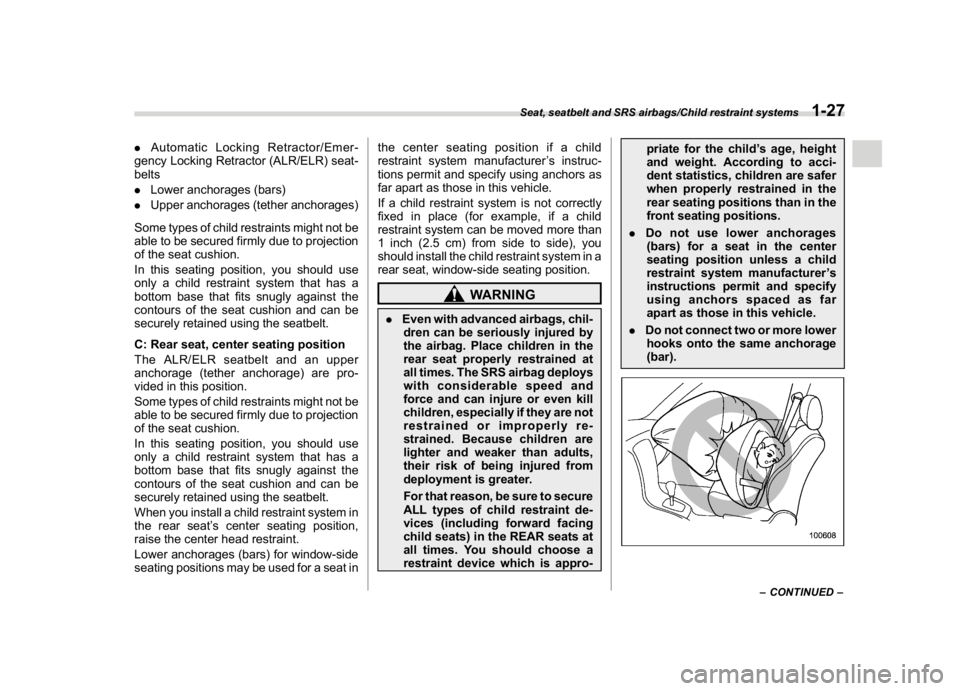
.Do not connect two or more lower
hooks onto the same anchorage
(bar).
–CONTINUED–
Seat, seatbelt and SRS airbags/Child restraint systems
1-27
1