display SUBARU FORESTER 2004 Service Repair Manual
[x] Cancel search | Manufacturer: SUBARU, Model Year: 2004, Model line: FORESTER, Model: SUBARU FORESTER 2004Pages: 2870, PDF Size: 38.67 MB
Page 2192 of 2870
EN(H4DOTC 2.5)-168
ENGINE (DIAGNOSTIC)
Diagnostic Procedure with Diagnostic Trouble Code (DTC)
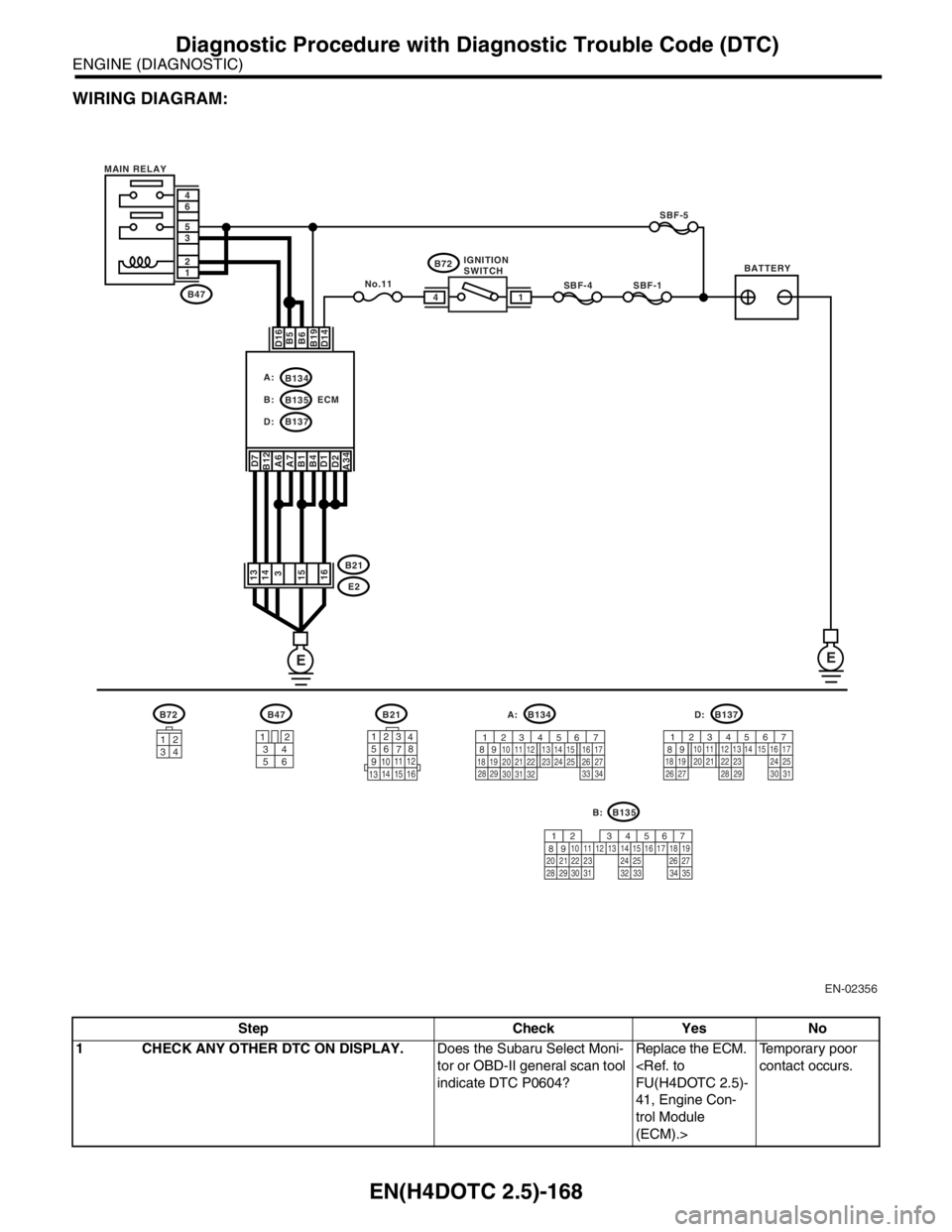
WIRING DIAGRAM:
Step Check Yes No
1 CHECK ANY OTHER DTC ON DISPLAY.Does the Subaru Select Moni-
tor or OBD-II general scan tool
indicate DTC P0604?Replace the ECM.
41, Engine Con-
trol Module
(ECM).>Temporary poor
contact occurs.
EN-02356
B72
B135
3412
BATTERY MAIN RELAY
SBF-4 SBF-1SBF-5
B72
D16 D7
B12
A6
A7
B1
B4
D1
D2
A34B5
B6
B19
D14
No.11
B47
E2 B21 1 2 3 5 6 4
ECM
E
E
1 4
B134
B135
B137 A:
B:
D:
14133
15
16
34 12
56123
4
56
78
91011 12
1314 15 16
B134 B21 B47B137 A: D:
B: IGNITION
SWITCH
56 7
82 1
94 310
24 22 23 25 11 12 13 14 15
26 27
2816 17
18 19 20 21
33 34 29
32 30 31
567
82 1
94 310
24 22 23 2511 12 13 14 15
26 27
2816 17 18 19
20 21
29 30 31 32 33 34 35
567
82 1
94 310
22 23 11 12 13 14 15
24 25
2616 17
18 19 20 21
27 28 29 30 31
Page 2221 of 2870

EN(H4DOTC 2.5)-197
ENGINE (DIAGNOSTIC)
Diagnostic Procedure with Diagnostic Trouble Code (DTC)
Step Check Yes No
1 CHECK CURRENT DATA.
1) Start the engine.
2) Read the data of tumble generator valve
position sensor signal using Subaru Select
Monitor or OBD-II general scan tool.
N
OTE:
Subaru Select Monitor
For detailed operation procedure, refer to “READ
CURRENT DATA SHOWN ON DISPLAY FOR
ENGINE”.
OBD-II general scan tool
For detailed operation procedures, refer to the
OBD-II General Scan Tool Operation Manual.Is the voltage more than 4.9 V? Go to step 2.Even if the mal-
function indicator
light illuminates,
the circuit has
returned to a nor-
mal condition at
this time. A tempo-
rary poor contact
of the connector
may be the cause.
N
OTE:
In this case repair
the following:
Poor contact in
tumble generator
valve position sen-
sor connector
Poor contact in
ECM connector.
Poor contact in
coupling connector
2 CHECK HARNESS BETWEEN TUMBLE
GENERATOR VALVE POSITION SENSOR
AND ECM CONNECTOR.
1) Turn the ignition switch to OFF.
2) Disconnect the connectors from throttle
position sensor.
3) Measure the resistance of harness
between tumble generator valve position sen-
sor connector and engine ground.
Connector & terminal
(E54) No. 2 — Engine ground:Is the resistance less than 5
Ω?Go to step 3.Repair the harness
and connector.
N
OTE:
In this case repair
the following:
Open circuit in
harness between
tumble generator
valve position sen-
sor and ECM con-
nector
Poor contact in
coupling connector
Poor contact in
joint connector
3 CHECK HARNESS BETWEEN TUMBLE
GENERATOR VALVE POSITION SENSOR
AND ECM CONNECTOR.
1) Turn the ignition switch to ON.
2) Measure the voltage between throttle posi-
tion sensor connector and engine ground.
Connector & terminal
(E54) No. 3 (+) — Engine ground (
−):Is the voltage more than 4.9 V? Repair battery
short circuit in har-
ness between tum-
ble generator valve
position sensor
and ECM connec-
tor. After repair,
replace the ECM.
41, Engine Con-
trol Module
(ECM).>Replace the tum-
ble generator valve
assembly.
33, Tumble Gener-
ator Valve Assem-
bly.>
Page 2222 of 2870

EN(H4DOTC 2.5)-198
ENGINE (DIAGNOSTIC)
Diagnostic Procedure with Diagnostic Trouble Code (DTC)
BF:DTC P1090 TUMBLE GENERATED VALVE SYSTEM 1 (VALVE OPEN)
DTC DETECTING CONDITION:
Immediately at fault recognition
CAUTION:
After repair or replacement of faulty parts, conduct Clear Memory Mode
BG:DTC P1091 TUMBLE GENERATED VALVE SYSTEM 1 (VALVE CLOSE)
DTC DETECTING CONDITION:
Immediately at fault recognition
CAUTION:
After repair or replacement of faulty parts, conduct Clear Memory Mode
Step Check Yes No
1 CHECK ANY OTHER DTC ON DISPLAY.Is any other DTC displayed? Inspect the rele-
vant DTC using
“List of Diagnostic
Trouble Code
(DTC)”.
65, List of Diag-
nostic Trouble
Code (DTC).>Go to step 2.
2 CHECK TUMBLE GENERATOR VALVE RH
1) Remove the tumble generator valve assembly.
2) Check tumble generator valve body.Does the tumble generator
valve move smoothly? (No dirt
or foreign materials clogged)Replace the tum-
ble generator valve
assembly.
33, Tumble Gener-
ator Valve Assem-
bly.>Clean tumble gen-
erator valve.
Step Check Yes No
1 CHECK ANY OTHER DTC ON DISPLAY.Is any other DTC displayed? Inspect the rele-
vant DTC using
“List of Diagnostic
Trouble Code
(DTC)”.
65, List of Diag-
nostic Trouble
Code (DTC).>Go to step 2.
2 CHECK TUMBLE GENERATOR VALVE RH
1) Remove the tumble generator valve assembly.
2) Check tumble generator valve body.Does the tumble generator
valve move smoothly? (No dirt
or foreign materials clogged)Replace the tum-
ble generator valve
assembly.
33, Tumble Gener-
ator Valve Assem-
bly.>Clean tumble gen-
erator valve.
Page 2223 of 2870

EN(H4DOTC 2.5)-199
ENGINE (DIAGNOSTIC)
Diagnostic Procedure with Diagnostic Trouble Code (DTC)
BH:DTC P1092 TUMBLE GENERATED VALVE SYSTEM 2 (VALVE OPEN)
DTC DETECTING CONDITION:
Immediately at fault recognition
CAUTION:
After repair or replacement of faulty parts, conduct Clear Memory Mode
Step Check Yes No
1 CHECK ANY OTHER DTC ON DISPLAY.Is any other DTC displayed? Inspect the rele-
vant DTC using
“List of Diagnostic
Trouble Code
(DTC)”.
65, List of Diag-
nostic Trouble
Code (DTC).>Go to step 2.
2 CHECK TUMBLE GENERATOR VALVE RH
1) Remove the tumble generator valve assembly.
2) Check tumble generator valve body.Does the tumble generator
valve move smoothly? (No dirt
or foreign materials clogged)Replace the tum-
ble generator valve
assembly.
33, Tumble Gener-
ator Valve Assem-
bly.>Clean tumble gen-
erator valve.
Page 2224 of 2870

EN(H4DOTC 2.5)-200
ENGINE (DIAGNOSTIC)
Diagnostic Procedure with Diagnostic Trouble Code (DTC)
BI: DTC P1093 TUMBLE GENERATED VALVE SYSTEM 2 (VALVE CLOSE)
DTC DETECTING CONDITION:
Immediately at fault recognition
CAUTION:
After repair or replacement of faulty parts, conduct Clear Memory Mode
Step Check Yes No
1 CHECK ANY OTHER DTC ON DISPLAY.Is any other DTC displayed? Inspect the rele-
vant DTC using
“List of Diagnostic
Trouble Code
(DTC)”.
65, List of Diag-
nostic Trouble
Code (DTC).>Go to step 2.
2 CHECK TUMBLE GENERATOR VALVE RH
1) Remove the tumble generator valve assembly.
2) Check tumble generator valve body.Does the tumble generator
valve move smoothly? (No dirt
or foreign materials clogged)Replace the tum-
ble generator valve
assembly.
33, Tumble Gener-
ator Valve Assem-
bly.>Clean tumble gen-
erator valve.
Page 2233 of 2870

EN(H4DOTC 2.5)-209
ENGINE (DIAGNOSTIC)
Diagnostic Procedure with Diagnostic Trouble Code (DTC)
BN:DTC P1110 ATMOSPHERIC PRESSURE SENSOR CIRCUIT MALFUNCTION
(LOW INPUT)
DTC DETECTING CONDITION:
Immediately at fault recognition
CAUTION:
After repair or replacement of faulty parts, conduct Clear Memory Mode
BO:DTC P1111 ATMOSPHERIC PRESSURE SENSOR CIRCUIT MALFUNCTION
(HIGH INPUT)
DTC DETECTING CONDITION:
Immediately at fault recognition
CAUTION:
After repair or replacement of faulty parts, conduct Clear Memory Mode
BP:DTC P1160 RETURN SPRING FAILURE
NOTE:
For diagnostic procedure, refer to DTC P2101.
Trouble Code (DTC).>
Step Check Yes No
1 CHECK ANY OTHER DTC ON DISPLAY.Does the Subaru Select Moni-
tor or OBD-II general scan tool
indicate DTC P1110?Replace the ECM.
41, Engine Con-
trol Module
(ECM).>
N
OTE:
Atmospheric pres-
sure sensor is built
in ECM.Temporary poor
contact occurs.
Step Check Yes No
1 CHECK ANY OTHER DTC ON DISPLAY.Does the Subaru Select Moni-
tor or OBD-II general scan tool
indicate DTC P1111?Replace the ECM.
41, Engine Con-
trol Module
(ECM).>
N
OTE:
Atmospheric pres-
sure sensor is built
in ECM.Temporary poor
contact occurs.
Page 2237 of 2870

EN(H4DOTC 2.5)-213
ENGINE (DIAGNOSTIC)
Diagnostic Procedure with Diagnostic Trouble Code (DTC)
Step Check Yes No
1 CHECK ANY OTHER DTC ON DISPLAY.Is any other DTC displayed? Inspect the rele-
vant DTC using
“List of Diagnostic
Trouble Code
(DTC)”.
65, List of Diag-
nostic Trouble
Code (DTC).>
N
OTE:
In this case, it is
not necessary to
inspect DTC
P1544.Go to step 2.
2 CHECK EXHAUST SYSTEM.
Check exhaust system parts.
NOTE:
Check the following items:
Loose installation of exhaust manifold
Cracks or hole of exhaust manifold
Loose installation of front oxygen (A/F) sen-
sorIs there a fault in exhaust sys-
tem?Repair or replace
failure, then
replace the precat-
alytic converter.Contact the SUB-
ARU dealer.
NOTE:
Inspection by DTM
is required, because
probable cause is
deterioration of mul-
tiple parts.
Page 2344 of 2870

4AT-32
AUTOMATIC TRANSMISSION
Road Test
4. Road Test
A: INSPECTION
1. GENERAL PRECAUTION
Road tests should be conducted to properly diag-
nose the condition of the automatic transmission.
NOTE:
When performing the test, do not exceed posted
speed limit.
2. D RANGE SHIFT FUNCTION
Check shifting between 1st ←→ 2nd ←→ 3rd ←→
4th while driving on normal city streets.
3. D RANGE SHIFT SHOCK
Check the shock level when shifting up during nor-
mal driving.
4. KICK-DOWN FUNCTION
Check kick-down for each gear. Also check the
kick-down shock level.
5. ENGINE BRAKE OPERATION
Check the 3rd gear engine brake when shifting
down from D ←→ 3rd range while driving in 4th
gear of D range [50 — 60 km/h (31 — 37 MPH)].
Check the 2nd gear engine brake when shifting
between 3rd ←→ 2nd range while driving in the 3rd
range of 3rd gear [40 — 50 km/h (25 — 31 MPH)].
Check the 1st gear engine brake when shifting
between 2nd ←→ 1st range while driving in the 2nd
range of 2nd gear [20 — 30 km/h (12 — 19 MPH)].
6. LOCK-UP FUNCTION
Check that rpm does not change sharply when
the axle pedal is lightly depressed when driving on
flat roads at 60 km/h (37 MPH).
Check slip lock-up with following procedure.
Subaru Select Monitor is needed for checking (EC,
EK model).
Before start checking, check that the DTC is not ex-
isted using Subaru Select Monitor. When the DTC
is existed, perform the collective action with DTC
and check that the DTC is not existed again, and
then start the checking.
1) The check performed on flat and straight road or
free roller.
NOTE:
Slip lock-up does not operate when the vehicle is
lifted up, because of not occurring surface resis-
tance.
Also checking on the free roller, check with de-
pressing foot brake lightly to make the checking
easier, because the surface resistance will be defi-
cient2) Connect the Subaru Select Monitor.
3) Check ATF temperature using Subaru Select
Monitor.
NOTE:
ATF temperature is between 50 — 100°C (122
— 212°F).
When the temperature is low, warm-up the ATF
by running the vehicle or etc.
4) Start the engine, and make the lock-up duty be
able to read on data display of Subaru Select Mon-
itor.
5) 35 — 40 Drive the vehicle at a constant speed of
35 — 40 km/h (22 — 25 MPH).
6) Read the lock-up duty while vehicle is running.
Standard value:
25 — 45%
NOTE:
On the free roller, the value sometimes lowers.
Slip lock-up control is not operating when the
lock-up duty is less than 5%, or when the lock-up
duty goes down immediately after starts rise. On
these cases, improper ATF or deterioration of ATF
may be the cause. Check the amount of ATF or re-
place them, and then recheck it.
7. P RANGE OPERATION
Stop the vehicle on an uphill grade of 5% or more
and shift to “P” range. Check that the vehicle does
not move when the parking brake is released.
8. NOISE AND VIBRATION
Check for unusual sounds and vibration while driv-
ing and during shifting.
9. CLIMBING CONTROL FUNCTION
Check that the gear remains in 3rd when going
up a grade.
Check that the gear remains in 3rd when apply-
ing the brakes while going down a grade.
10.TRANSFER CLUTCH
Check tight corner braking when the vehicle started
with steering fully turned.
11.OIL LEAKS
After the driving test, inspect for oil leaks.
Page 2383 of 2870

4AT-70
AUTOMATIC TRANSMISSION
Air Bleeding of Control Valve
18.Air Bleeding of Control Valve
A: PROCEDURE
1) Lift-up the vehicle with shifting the select lever to
“P” range and applying the parking brake.
2) Connect the Subaru Select Monitor to the vehi-
cle.
3) Make sure there is no trouble code using Subaru
Select Monitor.
4) Using Subaru Select Monitor, check that the
ATF temperature is in less than 60°C (140°F).
5) Power OFF the Subaru Select Monitor.
6) Turn the ignition switch to “OFF”.
7) Shift the select lever to “R” range.
8) Depress the brake pedal fully until the air bleed-
ing is completed.
9) Turn the ignition switch to ON.
10) Shift the select lever to “P” range, and then wait
for more than 3 seconds.
11) Shift the select lever to “R” range, and then wait
for more than 3 seconds.
12) Shift the select lever to “N” range, and then wait
for more than 3 seconds.
13) Shift the select lever to “D” range, and then wait
for more than 3 seconds.
14) Shift the select lever to “N” range, and then wait
for more than 3 seconds.
15) Slightly depress the accelerator pedal fully.
16) Slightly release the accelerator pedal fully.
17) Start the engine.
18) Shift the select lever to “D” range.
19) Turn the Subaru Select Monitor switch to ON.
20) Select {Each System Check} in «Main Menu»
of Subaru Select Monitor.
21) On the «System Selection Menu» display
screen, select the “Transmission”. Air bleeding of
control valve starts on transmission. At this time,
the POWER indicator light in combination meter
blinks at 2 Hz. When the POWER indicator light
does not blink, repeat the procedures from step 4).
22) Air bleeding of control valve is finished when
blinking of POWER indicator light in combination
meter changes from 2 Hz to 0.5 Hz.
NOTE:
When blinking of POWER indicator light changes
from 2 Hz to 4 Hz during air bleeding, repeat the
procedure from step 4).
23) Shift the select lever to “N” range, and then turn
the ignition switch to OFF.
24) Shift the select lever to the “P” range, and then
finish the air bleeding.
Page 2460 of 2870

AUTOMATIC TRANSMISSION
(DIAGNOSTIC)
4AT(H4SO)
Page
1. Basic Diagnostic Procedure ........................................................................2
2. Check List for Interview ...............................................................................4
3. General Description ....................................................................................5
4. Electrical Components Location..................................................................8
5. Transmission Control Module (TCM) I/O Signal .......................................12
6. Subaru Select Monitor...............................................................................17
7. Read Diagnostic Trouble Code (DTC) ......................................................20
8. Inspection Mode ........................................................................................22
9. Clear Memory Mode..................................................................................23
10. Power Indicator Light Display....................................................................24
11. Diagnostic Procedure for Subaru Select Monitor Communication ............32
12. List of Diagnostic Trouble Code (DTC) .....................................................35
13. Diagnostic Procedure with Diagnostic Trouble Code (DTC) .....................36
14. Diagnostic Procedure without Diagnostic Trouble Code (DTC) ................84
15. Symptom Related Diagnostic ..................................................................110