check engine SUBARU FORESTER 2004 Service Repair Manual
[x] Cancel search | Manufacturer: SUBARU, Model Year: 2004, Model line: FORESTER, Model: SUBARU FORESTER 2004Pages: 2870, PDF Size: 38.67 MB
Page 1342 of 2870

EN(H4SO)-244
ENGINE (DIAGNOSTIC)
Diagnostic Procedure with Diagnostic Trouble Code (DTC)
Step Check Yes No
1 CHECK OPERATION OF STARTER MOTOR.
Place the inhibitor switch in the “P” or “N”
range. (AT model)
Depress the clutch pedal. (MT model)Does the starter motor operate
when ignition switch to
START?Repair harness
and connector.
N
OTE:
In this case repair
the following:
Open or ground
short circuit in har-
ness between
ECM and starter
motor connector.
Poor contact in
ECM connector.Check starter
motor circuit.
STARTER
MOTOR CIR-
CUIT, Diagnostics
for Engine Start-
ing Failure.>
Page 1344 of 2870

EN(H4SO)-246
ENGINE (DIAGNOSTIC)
Diagnostic Procedure with Diagnostic Trouble Code (DTC)
Step Check Yes No
1 CHECK INPUT SIGNAL FROM ECM.
1) Turn the ignition switch to OFF.
2) Measure the voltage between ECM and
chassis ground.
Connector & terminal
(B134) No. 9 (+) — Chassis ground (
−):Is the voltage more than 10 V? Repair the poor
contact in ECM
connector.Go to step 2.
2 CHECK HARNESS BETWEEN ECM AND
MAIN FUSE BOX CONNECTOR.
1) Disconnect the connector from ECM.
2) Measure the resistance of harness
between ECM and chassis ground.
Connector & terminal
(B135) No. 9 — Chassis ground:Is the resistance less than 10
Ω?Repair ground
short circuit in har-
ness between
ECM connector
and battery termi-
nal.Go to step 3.
3 CHECK FUSE SBF-5.Is the fuse blown out? Replace the fuse. Repair harness
and connector.
N
OTE:
In this case repair
the following:
Open circuit in
harness between
ECM and battery
Poor contact in
ECM connector.
Poor contact in
battery terminal
Page 1346 of 2870

EN(H4SO)-248
ENGINE (DIAGNOSTIC)
Diagnostic Procedure with Diagnostic Trouble Code (DTC)
Step Check Yes No
1 CHECK OUTPUT SIGNAL FROM ECM.
1) Start the engine, and warm-up the engine.
2) Turn the ignition switch to OFF.
3) Turn the ignition switch to ON.
4) Measure the voltage between ECM and
chassis ground.
Connector & terminal
(B136) No. 15 (+) — Chassis ground (
−):Is the voltage more than 3 V? Repair the poor
contact in ECM
connector.Go to step 2.
2 CHECK HARNESS BETWEEN ECM AND
TCM CONNECTOR.
1) Turn the ignition switch to OFF.
2) Disconnect the connector from ECM and
TCM.
3) Measure the resistance of harness
between ECM and chassis ground.
Connector & terminal
(B136) No. 15 — Chassis ground:Is the resistance more than 1
MΩ?Go to step 3.Repair ground
short circuit in har-
ness between
ECM and TCM
connector.
3 CHECK HARNESS BETWEEN ECM AND
TCM CONNECTOR.
Measure the resistance of harness between
TCM and ECM connector.
Connector & terminal
(B136) No. 15 — (B55) No. 10:Is the resistance less than 1
Ω?Repair the poor
contact in ECM or
TCM connector.Repair the open
circuit in harness
between ECM and
TCM connector.
Page 1348 of 2870

EN(H4SO)-250
ENGINE (DIAGNOSTIC)
Diagnostic Procedure with Diagnostic Trouble Code (DTC)
Step Check Yes No
1 CHECK OUTPUT SIGNAL FROM ECM.
1) Start the engine, and warm-up the engine.
2) Turn the ignition switch to OFF.
3) Disconnect the connector from TCM.
4) Turn the ignition switch to ON.
5) Measure the voltage between ECM and
chassis ground.
Connector & terminal
(B136) No. 15 (+) — Chassis ground (
−):Is the voltage less than 3 V? Go to step 2.Repair battery
short circuit in har-
ness between
ECM and TCM
connector. After
repair, replace the
ECM.
Engine Control
Module (ECM).>
2 CHECK HARNESS BETWEEN ECM AND
TCM CONNECTOR.
1) Turn the ignition switch to OFF.
2) Measure the voltage between ECM and
chassis ground.
Connector & terminal
(B136) No. 15 (+) — Chassis ground (
−):Is the voltage more than 10 V
by shaking the ECM harness
and connector?Repair the battery
short circuit in har-
ness between
ECM and TCM
connector. After
repair, replace the
ECM.
Engine Control
Module (ECM).>Contact the SUB-
ARU dealer.
N
OTE:
Inspection by DTM
is required, because
probable cause is
deterioration of mul-
tiple parts.
Page 1350 of 2870

EN(H4SO)-252
ENGINE (DIAGNOSTIC)
Diagnostic Procedure with Diagnostic Trouble Code (DTC)
Step Check Yes No
1 CHECK INPUT SIGNAL FROM ECM.
1) Turn the ignition switch to ON.
2) Measure the voltage between ECM and
chassis ground.
Connector & terminal
(B136) No. 1 (+) — Chassis ground (
−):Is the voltage more than 4.5 V? Go to step 2.Go to step 4.
2 CHECK INPUT SIGNAL FROM ECM.
Measure the voltage between ECM and chas-
sis ground.
Connector & terminal
(B136) No. 1 (+) — Chassis ground (
−):Is the voltage more than 10 V? Repair battery
short circuit in har-
ness between
ECM and TCM
connector.Go to step 3.
3 CHECK POOR CONTACT.
Check poor contact in ECM connector.Is there poor contact in ECM
connector?Repair the poor
contact in ECM
connector.Replace the ECM.
Engine Control
Module (ECM).>
4 CHECK HARNESS BETWEEN ECM AND
TCM CONNECTOR.
1) Turn the ignition switch to OFF.
2) Disconnect the connector from ECM and
TCM.
3) Measure the resistance of harness
between TCM and ECM connector.
Connector & terminal
(B136) No. 1 — (B56) No. 5:Is the resistance less than 1
Ω?Go to step 5.Repair the open
circuit in harness
between ECM and
TCM connector.
5 CHECK HARNESS BETWEEN ECM AND
TCM CONNECTOR.
Measure the resistance of harness between
ECM and chassis ground.
Connector & terminal
(B136) No. 1 — Chassis ground:Is the resistance more than 1
MΩ?Go to step 6.Repair ground
short circuit in har-
ness between
ECM and TCM
connector.
6 CHECK POOR CONTACT.
Check poor contact in TCM connector.Is there poor contact in TCM
connector?Repair poor con-
tact in TCM con-
nector.Replace the TCM.
trol Module
(TCM).>
Page 1352 of 2870

EN(H4SO)-254
ENGINE (DIAGNOSTIC)
Diagnostic Procedure with Diagnostic Trouble Code (DTC)
Step Check Yes No
1 CHECK INPUT SIGNAL FROM ECM.
1) Turn the ignition switch to ON.
2) Measure the voltage between ECM and
chassis ground.
Connector & terminal
(B136) No. 18 (+) — Chassis ground (
−):Is the voltage more than 4.5 V? Go to step 2.Go to step 4.
2 CHECK INPUT SIGNAL FROM ECM.
Measure the voltage between ECM and chas-
sis ground.
Connector & terminal
(B136) No. 18 (+) — Chassis ground (
−):Is the voltage more than 10 V? Repair battery
short circuit in har-
ness between
ECM and TCM
connector.Go to step 3.
3 CHECK POOR CONTACT.
Check poor contact in ECM connector. Is there poor contact in ECM
connector?Repair the poor
contact in ECM
connector.Replace the ECM.
Engine Control
Module (ECM).>
4 CHECK HARNESS BETWEEN ECM AND
TCM CONNECTOR.
1) Turn the ignition switch to OFF.
2) Disconnect the connector from ECM and
TCM.
3) Measure the resistance of harness
between TCM and ECM connector.
Connector & terminal
(B136) No. 18 — (B56) No. 14:Is the resistance less than 1
Ω?Go to step 5.Repair the open
circuit in harness
between ECM and
TCM connector.
5 CHECK HARNESS BETWEEN ECM AND
TCM CONNECTOR.
Measure the resistance of harness between
ECM and chassis ground.
Connector & terminal
(B136) No. 18 — Chassis ground:Is the resistance more than 1
MΩ?Go to step 6.Repair ground
short circuit in har-
ness between
ECM and TCM
connector.
6 CHECK POOR CONTACT.
Check poor contact in TCM connector. Is there poor contact in TCM
connector?Repair poor con-
tact in TCM con-
nector.Replace the TCM.
trol Module
(TCM).>
Page 1354 of 2870

EN(H4SO)-256
ENGINE (DIAGNOSTIC)
General Diagnostic Table
*1: Check ignition coil & ignitor ASSY and spark plug.
*2: Indicate the symptom occurring only in cold temperatures.
*3: Ensure the secure installation.
*4: Check fuel injector, fuel pressure regulator and fuel filter.
*5: Inspect air leak in air intake system.
*6: Adjust the accelerator cable.
2. AUTOMATIC TRANSMISSION
NOTE:
Check general diagnostics table with non-conformity symptom for automatic transmission.
6. Surging1) Intake manifold pressure sensor
2) Intake air temperature sensor
3) Manifold absolute pressure sensor
4) Engine coolant temperature sensor (*2)
5) Crankshaft position sensor (*3)
6) Camshaft position sensor (*3)
7) Fuel injection parts (*4)
8) Throttle position sensor
9) Fuel pump and fuel pump relay
7. Spark knock1) Intake manifold pressure sensor
2) Intake air temperature sensor
3) Manifold absolute pressure sensor
4) Engine coolant temperature sensor
5) Knock sensor
6) Fuel injection parts (*4)
7) Fuel pump and fuel pump relay
8. After burning in exhaust system1) Intake manifold pressure sensor
2) Intake air temperature sensor
3) Manifold absolute pressure sensor
4) Engine coolant temperature sensor (*2)
5) Fuel injection parts (*4)
6) Fuel pump and fuel pump relay Symptom Problem parts
Page 1454 of 2870
IN(H4DOTC)-15
INTAKE (INDUCTION)
Resonator Chamber
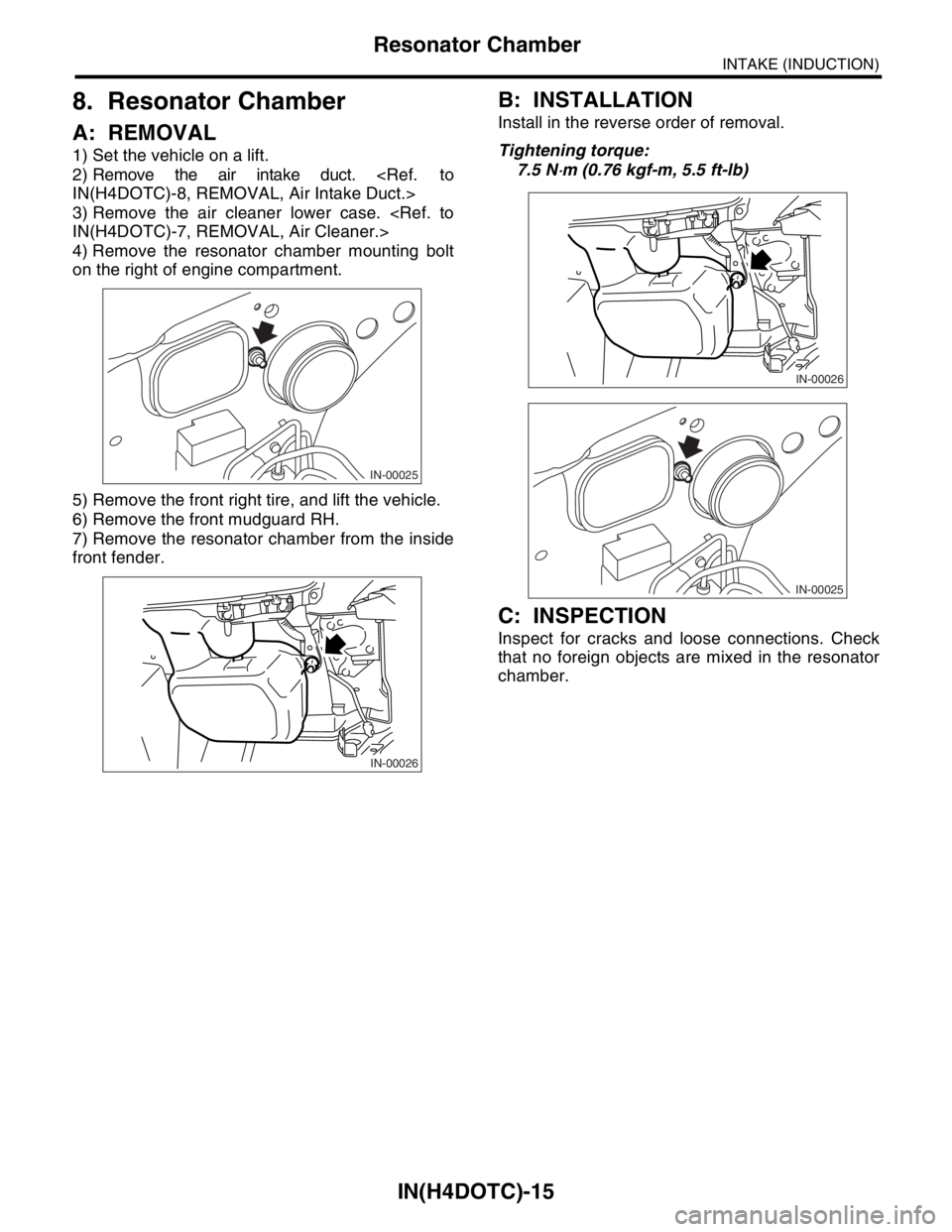
8. Resonator Chamber
A: REMOVAL
1) Set the vehicle on a lift.
2) Remove the air intake duct.
3) Remove the air cleaner lower case.
4) Remove the resonator chamber mounting bolt
on the right of engine compartment.
5) Remove the front right tire, and lift the vehicle.
6) Remove the front mudguard RH.
7) Remove the resonator chamber from the inside
front fender.
B: INSTALLATION
Install in the reverse order of removal.
Tightening torque:
7.5 N
⋅m (0.76 kgf-m, 5.5 ft-lb)
C: INSPECTION
Inspect for cracks and loose connections. Check
that no foreign objects are mixed in the resonator
chamber.
IN-00025
IN-00026
IN-00026
IN-00025
Page 1478 of 2870

ME(H4DOTC)-22
MECHANICAL
General Description
C: CAUTION
Wear working clothing, including a cap, protec-
tive goggles, and protective shoes during opera-
tion.
Remove contamination including dirt and corro-
sion before removal, installation or disassembly.
Keep the disassembled parts in order and pro-
tect them from dust or dirt.
Before removal, installation or disassembly, be
sure to clarify the failure. Avoid unnecessary re-
moval, installation, disassembly, and replacement.
Be careful not to burn yourself, because each
part in the vehicle is hot after running.
Be sure to tighten fasteners including bolts and
nuts to the specified torque.
Place shop jacks or rigid racks at the specified
points.
Before disconnecting electrical connectors of
sensors or units, be sure to disconnect the ground
cable from battery.
All parts should be thoroughly cleaned, paying
special attention to the engine oil passages, pis-
tons and bearings.
Rotating parts and sliding parts such as piston,
bearing and gear should be coated with oil prior to
assembly.
Be careful not to let oil, grease or coolant contact
the timing belt, clutch disc and flywheel.
All removed parts, if to be reused, should be re-
installed in the original positions and directions.
Bolts, nuts and washers should be replaced with
new ones as required.
Even if necessary inspections have been made
in advance, proceed with assembly work while
making rechecks.
Remove or install the engine in an area where
chain hoists, lifting devices, etc. are available for
ready use.
Be sure not to damage coated surfaces of body
panels with tools or stain seats and windows with
coolant or oil. Place a cover over fenders, as re-
quired, for protection.
Prior to starting work, prepare the following:
Service tools, clean cloth, containers to catch cool-
ant and oil, wire ropes, chain hoist, transmission
jacks, etc.
Lift-up or lower the vehicle when necessary.
Make sure to support the correct positions.
Page 1487 of 2870

ME(H4DOTC)-31
MECHANICAL
Compression
2. Compression
A: INSPECTION
CAUTION:
After warming-up, engine becomes very hot. Be
careful not to burn yourself during measure-
ment.
1) After warming-up the engine, turn the ignition
switch to OFF.
2) Make sure that the battery is fully charged.
3) Release the fuel pressure.
SURE, OPERATION, Fuel.>
4) Remove all the spark plugs.
5) Fully open the throttle valve.
6) Check the starter motor for satisfactory perfor-
mance and operation.
7) Hold the compression gauge tight against spark
plug hole.
NOTE:
When using a screw-in type compression gauge,
the screw (put into cylinder head spark plug hole)
should be less than 18 mm (0.71 in) long.
8) Crank the engine by means of starter motor, and
then read the maximum value on the gauge when
the pointer is steady.9) Perform at least two measurements per cylinder,
and make sure that the values are correct.
Compression (350 rpm and fully open throttle):
Standard
981 — 1,177 kPa (10 — 12 kgf/cm
2, 142 —
171 psi)
Limit
882 kPa (9.0 kgf/cm
2, 128 psi)
Difference between cylinders
Less than 49 kPa (0.5 kgf/cm
2, 7 psi)
ME-00007