torque SUBARU FORESTER 2004 Service Repair Manual
[x] Cancel search | Manufacturer: SUBARU, Model Year: 2004, Model line: FORESTER, Model: SUBARU FORESTER 2004Pages: 2870, PDF Size: 38.67 MB
Page 2864 of 2870
CL-38
CLUTCH SYSTEM
Clutch Pedal
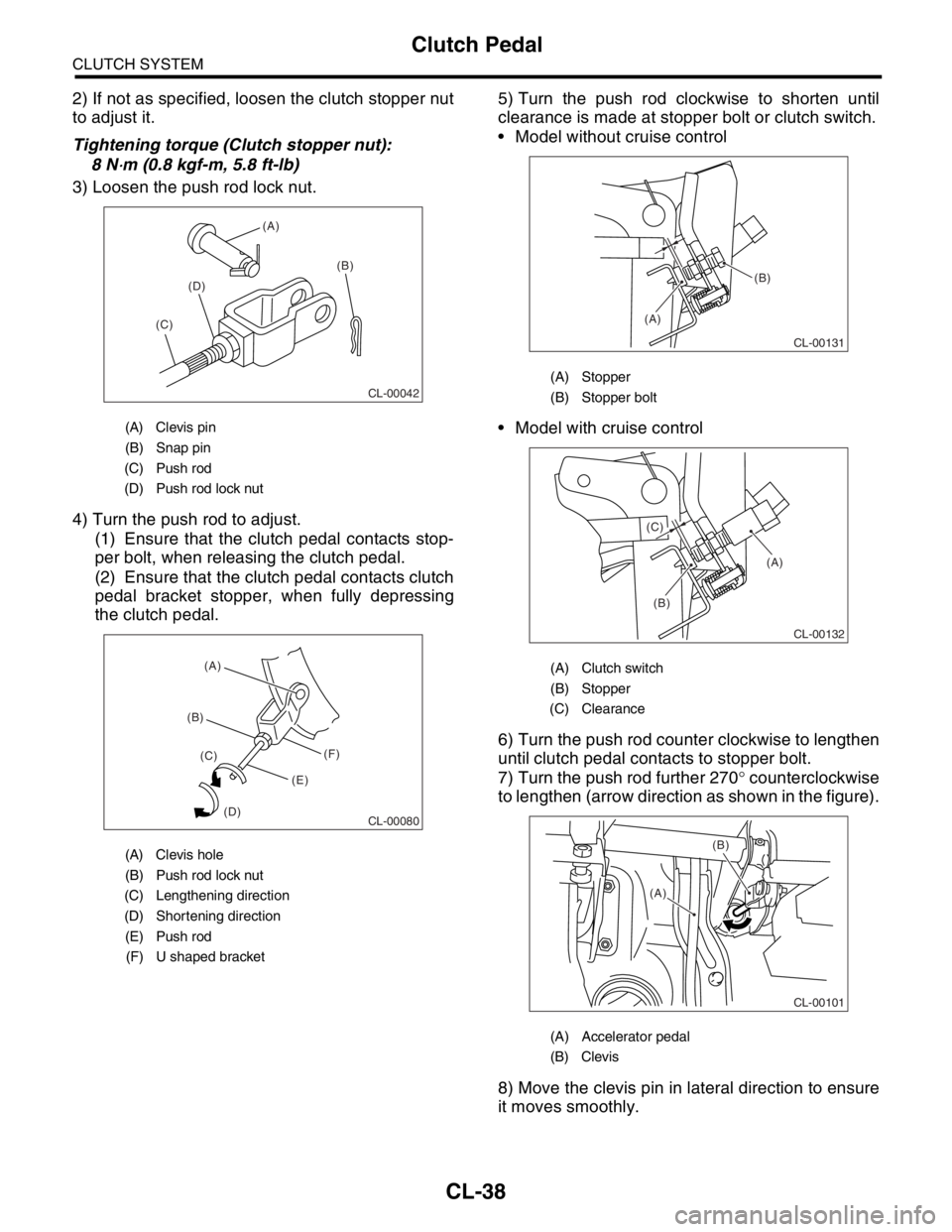
2) If not as specified, loosen the clutch stopper nut
to adjust it.
Tightening torque (Clutch stopper nut):
8 N
⋅m (0.8 kgf-m, 5.8 ft-lb)
3) Loosen the push rod lock nut.
4) Turn the push rod to adjust.
(1) Ensure that the clutch pedal contacts stop-
per bolt, when releasing the clutch pedal.
(2) Ensure that the clutch pedal contacts clutch
pedal bracket stopper, when fully depressing
the clutch pedal.5) Turn the push rod clockwise to shorten until
clearance is made at stopper bolt or clutch switch.
Model without cruise control
Model with cruise control
6) Turn the push rod counter clockwise to lengthen
until clutch pedal contacts to stopper bolt.
7) Turn the push rod further 270° counterclockwise
to lengthen (arrow direction as shown in the figure).
8) Move the clevis pin in lateral direction to ensure
it moves smoothly.
(A) Clevis pin
(B) Snap pin
(C) Push rod
(D) Push rod lock nut
(A) Clevis hole
(B) Push rod lock nut
(C) Lengthening direction
(D) Shortening direction
(E) Push rod
(F) U shaped bracket
CL-00042
(A)
(B)
(C)(D)
CL-00080
(B)(A)
(C)
(D)(E)(F)
(A) Stopper
(B) Stopper bolt
(A) Clutch switch
(B) Stopper
(C) Clearance
(A) Accelerator pedal
(B) Clevis
(A)
(B)
CL-00131
(A)
(B) (C)
CL-00132
CL-00101
(B)
(A)
Page 2865 of 2870
CL-39
CLUTCH SYSTEM
Clutch Pedal
9) Tighten the push rod lock nut.
Tightening torque :
10 N
⋅m (1.0 kgf-m, 7.2 ft-lb)
10) Measure the full stroke amount of clutch pedal
again.
Specified clutch pedal full stroke: A
130 — 135 mm (5.12 — 5.31 in)
11) Install the clutch switch.
2. RHD MODEL
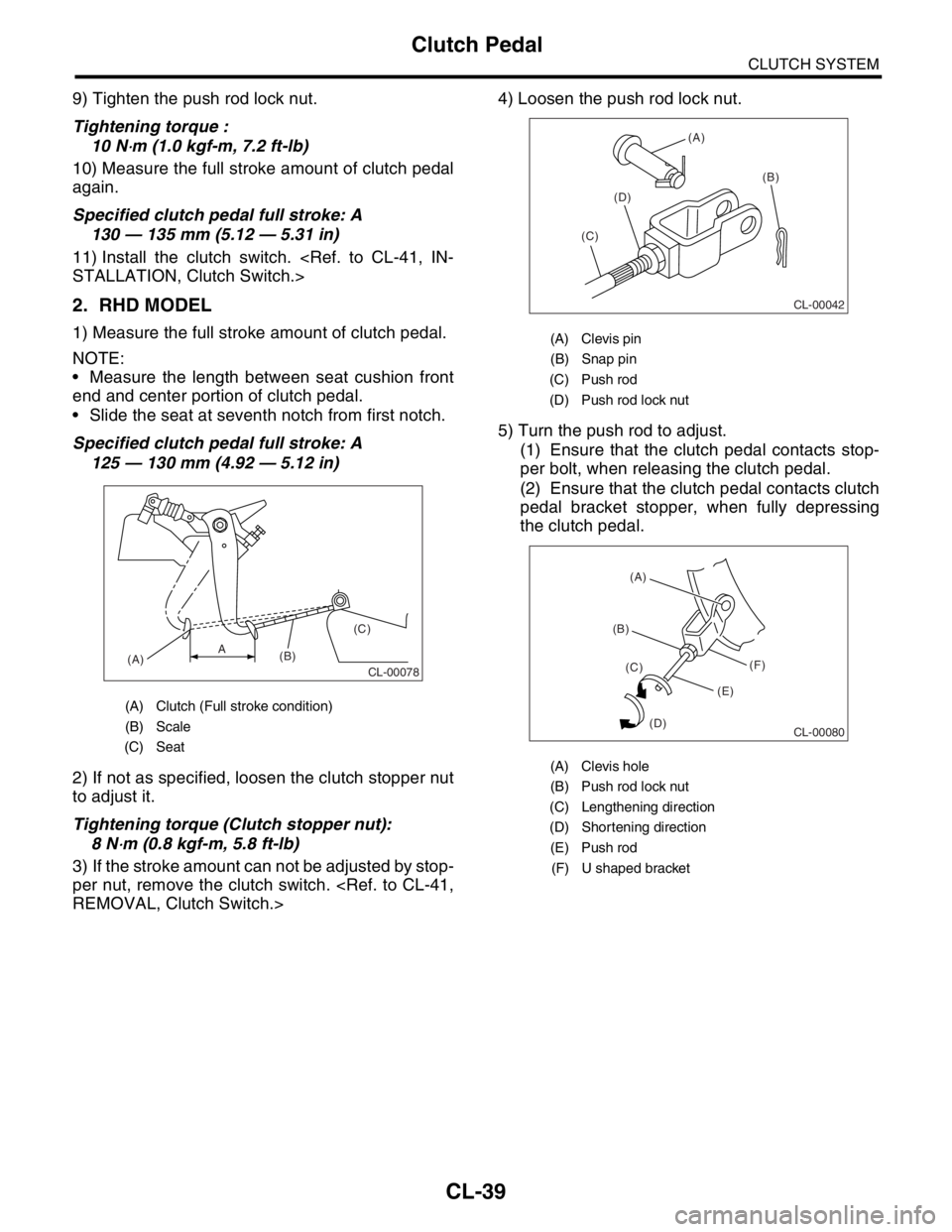
1) Measure the full stroke amount of clutch pedal.
NOTE:
Measure the length between seat cushion front
end and center portion of clutch pedal.
Slide the seat at seventh notch from first notch.
Specified clutch pedal full stroke: A
125 — 130 mm (4.92 — 5.12 in)
2) If not as specified, loosen the clutch stopper nut
to adjust it.
Tightening torque (Clutch stopper nut):
8 N
⋅m (0.8 kgf-m, 5.8 ft-lb)
3) If the stroke amount can not be adjusted by stop-
per nut, remove the clutch switch.
5) Turn the push rod to adjust.
(1) Ensure that the clutch pedal contacts stop-
per bolt, when releasing the clutch pedal.
(2) Ensure that the clutch pedal contacts clutch
pedal bracket stopper, when fully depressing
the clutch pedal.
(A) Clutch (Full stroke condition)
(B) Scale
(C) Seat
CL-00078(A)(B)(C)A
(A) Clevis pin
(B) Snap pin
(C) Push rod
(D) Push rod lock nut
(A) Clevis hole
(B) Push rod lock nut
(C) Lengthening direction
(D) Shortening direction
(E) Push rod
(F) U shaped bracket
CL-00042
(A)
(B)
(C)(D)
CL-00080
(B)(A)
(C)
(D)(E)(F)
Page 2866 of 2870
CL-40
CLUTCH SYSTEM
Clutch Pedal
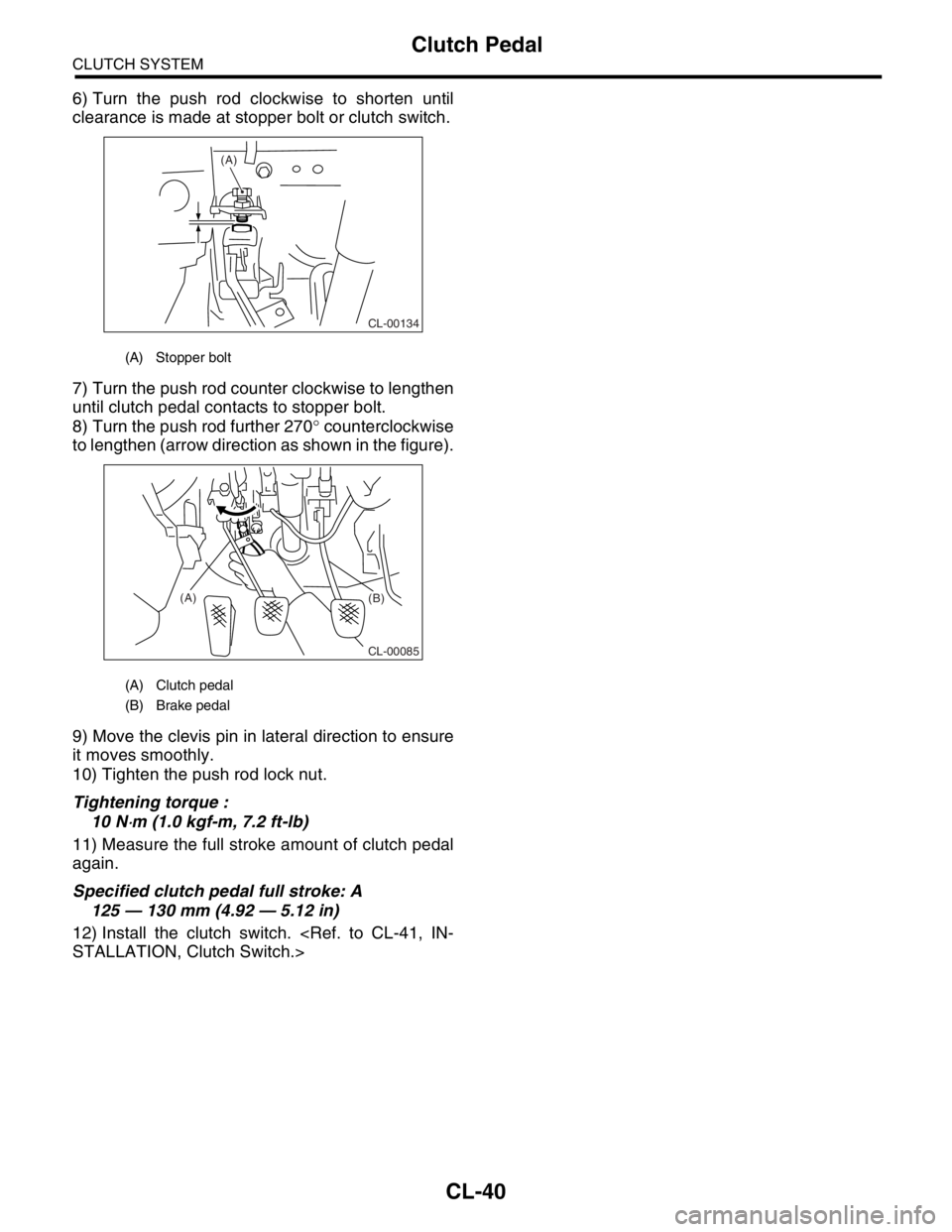
6) Turn the push rod clockwise to shorten until
clearance is made at stopper bolt or clutch switch.
7) Turn the push rod counter clockwise to lengthen
until clutch pedal contacts to stopper bolt.
8) Turn the push rod further 270° counterclockwise
to lengthen (arrow direction as shown in the figure).
9) Move the clevis pin in lateral direction to ensure
it moves smoothly.
10) Tighten the push rod lock nut.
Tightening torque :
10 N
⋅m (1.0 kgf-m, 7.2 ft-lb)
11) Measure the full stroke amount of clutch pedal
again.
Specified clutch pedal full stroke: A
125 — 130 mm (4.92 — 5.12 in)
12) Install the clutch switch.
(A) Stopper bolt
(A) Clutch pedal
(B) Brake pedal
CL-00134
(A)
CL-00085
(A)
(B)
Page 2867 of 2870
CL-41
CLUTCH SYSTEM
Clutch Switch
11.Clutch Switch
A: REMOVAL
1) Disconnect the ground cable from battery.
2) Remove the instrument panel lower cover.
3) Disconnect the connector from clutch switch.
4) Remove the clutch switch.
B: INSTALLATION
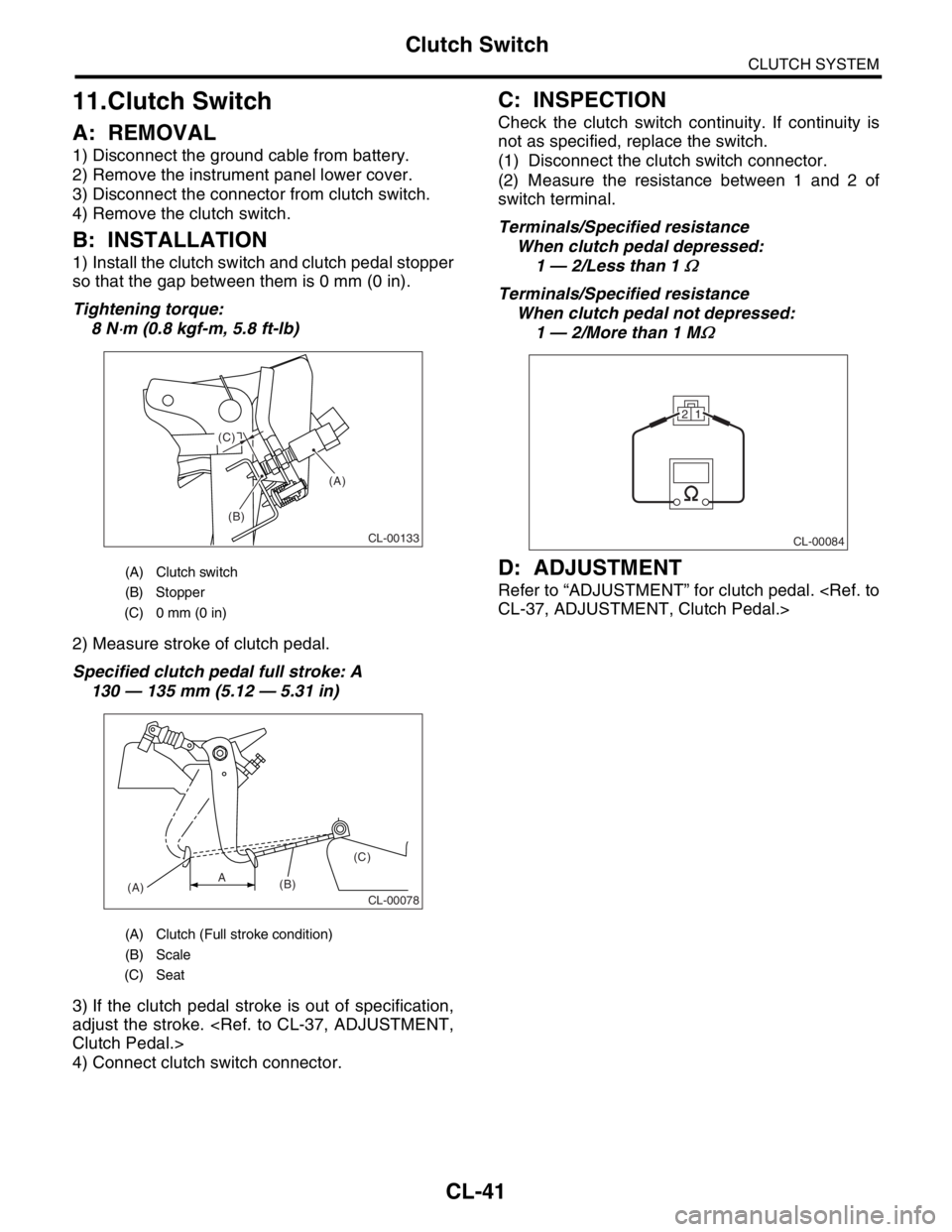
1) Install the clutch switch and clutch pedal stopper
so that the gap between them is 0 mm (0 in).
Tightening torque:
8 N
⋅m (0.8 kgf-m, 5.8 ft-lb)
2) Measure stroke of clutch pedal.
Specified clutch pedal full stroke: A
130 — 135 mm (5.12 — 5.31 in)
3) If the clutch pedal stroke is out of specification,
adjust the stroke.
4) Connect clutch switch connector.
C: INSPECTION
Check the clutch switch continuity. If continuity is
not as specified, replace the switch.
(1) Disconnect the clutch switch connector.
(2) Measure the resistance between 1 and 2 of
switch terminal.
Terminals/Specified resistance
When clutch pedal depressed:
1 — 2/Less than 1
Ω
Terminals/Specified resistance
When clutch pedal not depressed:
1 — 2/More than 1 M
Ω
D: ADJUSTMENT
Refer to “ADJUSTMENT” for clutch pedal.
(A) Clutch switch
(B) Stopper
(C) 0 mm (0 in)
(A) Clutch (Full stroke condition)
(B) Scale
(C) Seat
(A)
(B) (C)
CL-00133
CL-00078(A)(B)(C)A
CL-00084
21
Page 2869 of 2870

CL-43
CLUTCH SYSTEM
General Diagnostic Table
2. CLUTCH PEDAL
3. DIAGNOSTIC DIAGRAM OF CLUTCH DRAG
4. Noisy clutch
Examine whether the noise is generated
when the clutch is disengaged, engaged,
or partially engaged.(a) Broken, worn or unlubricated release
bearingReplace the release bearing.
(b) Insufficient lubrication of pilot bearing Replace.
(c) Loose clutch disc hub Replace the clutch disc.
(d) Loose torsion spring retainer Replace the clutch disc.
(e) Deteriorated or broken torsion spring Replace the clutch disc.
5. Clutch grabs.
When starting the vehicle with the clutch
partially engaged, the clutch engages
suddenly and the vehicle jumps instead
of making a smooth start.(a) Grease or oil on facing Replace the clutch disc.
(b) Deteriorated cushioning spring Replace the clutch disc.
(c) Worn or rusted spline of clutch disc or
main shaftTake off rust, apply grease or replace the
clutch disc or main shaft.
(d) Deteriorated or broken torsion spring Replace the clutch disc.
(e) Loose engine mounting Retighten or replace the mounting.
(f) Deteriorated diaphragm spring Replace.
Trouble Corrective action
Insufficient pedal play Adjust pedal play.
Clutch pedal free play insufficient Adjust pedal free play.
Excessively worn and damaged pedal shaft and/or bushing Replace the bushing and/or shaft with a new one.
Step Check Yes No
1 CHECK GEAR NOISE.
1) Start the engine.
2) Disengage the clutch and shift quickly from
neutral to reverse in idling condition.Is there any abnormal noise
from the transmission gear?Go to step 2.Clutch is normal.
2 CHECK GEAR NOISE.
Disengage the clutch at idle and shift from neu-
tral to reverse within 0.5 — 1.0 seconds.Is there any abnormal noise
from the transmission gear?Go to step 3.Defective trans-
mission or exces-
sive clutch drag
torque. Inspect the
pilot bearing,
clutch disc, trans-
mission and clutch
disc hub spline.
3 CHECK GEAR NOISE.
1) Disengage the clutch at idle and shift from
neutral to reverse within 0.5 — 1.0 seconds.
2) With the clutch disengaged, shift from N to
R, R to N several times.Is there any abnormal noise
from the transmission gear?Defect in clutch
disengaging.
Inspect the clutch
disc, clutch cover,
clutch release, and
clutch pedal free
play.Clutch and fly-
wheel seizure.
Inspect the clutch
disc, spline of
clutch disc hub. Symptom Possible cause Corrective