diff SUBARU LEGACY 1999 Service User Guide
[x] Cancel search | Manufacturer: SUBARU, Model Year: 1999, Model line: LEGACY, Model: SUBARU LEGACY 1999Pages: 1456, PDF Size: 59.93 MB
Page 188 of 1456
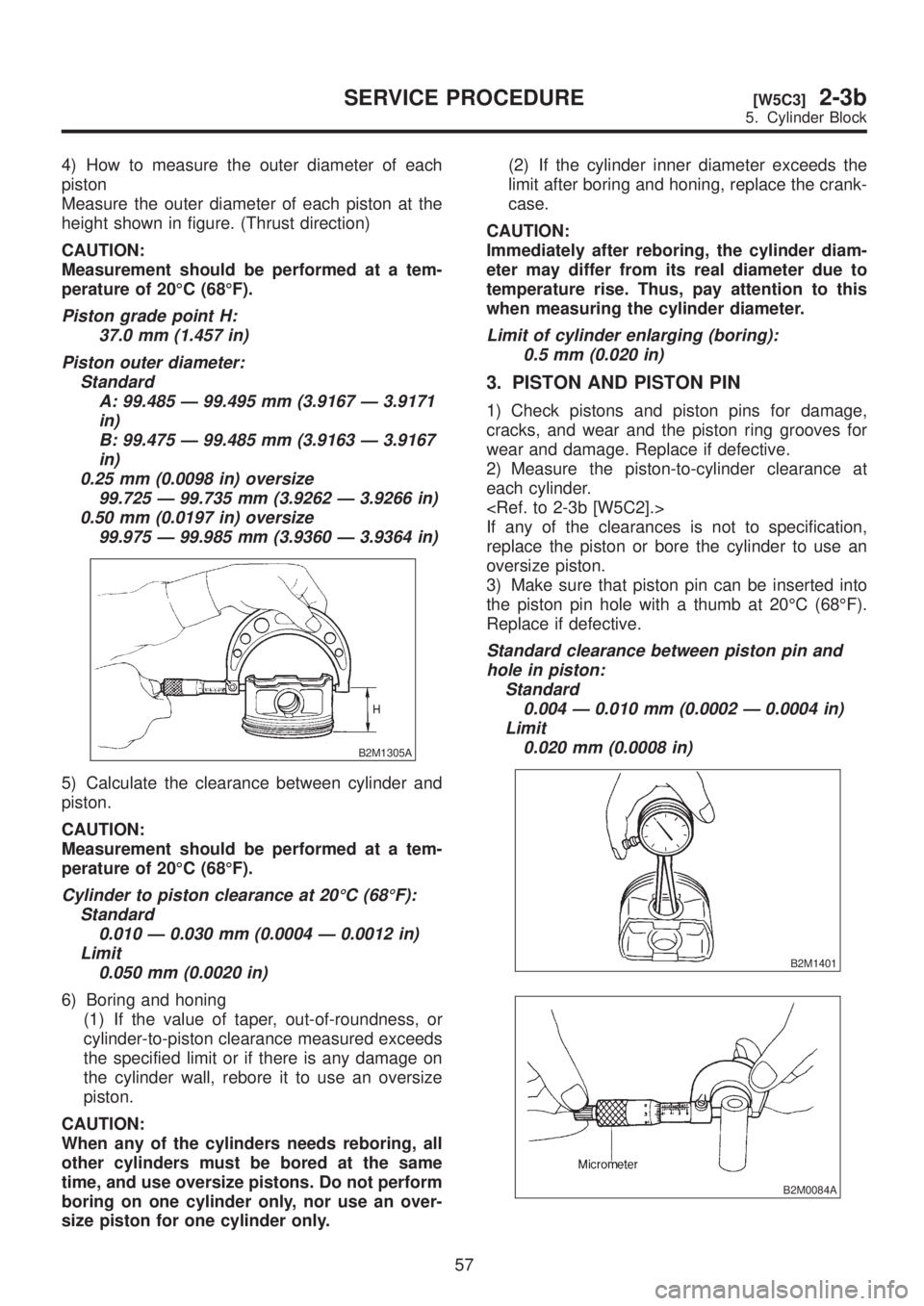
4) How to measure the outer diameter of each
piston
Measure the outer diameter of each piston at the
height shown in figure. (Thrust direction)
CAUTION:
Measurement should be performed at a tem-
perature of 20ÉC (68ÉF).
Piston grade point H:
37.0 mm (1.457 in)
Piston outer diameter:
Standard
A: 99.485 Ð 99.495 mm (3.9167 Ð 3.9171
in)
B: 99.475 Ð 99.485 mm (3.9163 Ð 3.9167
in)
0.25 mm (0.0098 in) oversize
99.725 Ð 99.735 mm (3.9262 Ð 3.9266 in)
0.50 mm (0.0197 in) oversize
99.975 Ð 99.985 mm (3.9360 Ð 3.9364 in)
B2M1305A
5) Calculate the clearance between cylinder and
piston.
CAUTION:
Measurement should be performed at a tem-
perature of 20ÉC (68ÉF).
Cylinder to piston clearance at 20ÉC (68ÉF):
Standard
0.010 Ð 0.030 mm (0.0004 Ð 0.0012 in)
Limit
0.050 mm (0.0020 in)
6) Boring and honing
(1) If the value of taper, out-of-roundness, or
cylinder-to-piston clearance measured exceeds
the specified limit or if there is any damage on
the cylinder wall, rebore it to use an oversize
piston.
CAUTION:
When any of the cylinders needs reboring, all
other cylinders must be bored at the same
time, and use oversize pistons. Do not perform
boring on one cylinder only, nor use an over-
size piston for one cylinder only.(2) If the cylinder inner diameter exceeds the
limit after boring and honing, replace the crank-
case.
CAUTION:
Immediately after reboring, the cylinder diam-
eter may differ from its real diameter due to
temperature rise. Thus, pay attention to this
when measuring the cylinder diameter.
Limit of cylinder enlarging (boring):
0.5 mm (0.020 in)
3. PISTON AND PISTON PIN
1) Check pistons and piston pins for damage,
cracks, and wear and the piston ring grooves for
wear and damage. Replace if defective.
2) Measure the piston-to-cylinder clearance at
each cylinder.
If any of the clearances is not to specification,
replace the piston or bore the cylinder to use an
oversize piston.
3) Make sure that piston pin can be inserted into
the piston pin hole with a thumb at 20ÉC (68ÉF).
Replace if defective.
Standard clearance between piston pin and
hole in piston:
Standard
0.004 Ð 0.010 mm (0.0002 Ð 0.0004 in)
Limit
0.020 mm (0.0008 in)
B2M1401
B2M0084A
57
[W5C3]2-3bSERVICE PROCEDURE
5. Cylinder Block
Page 373 of 1456
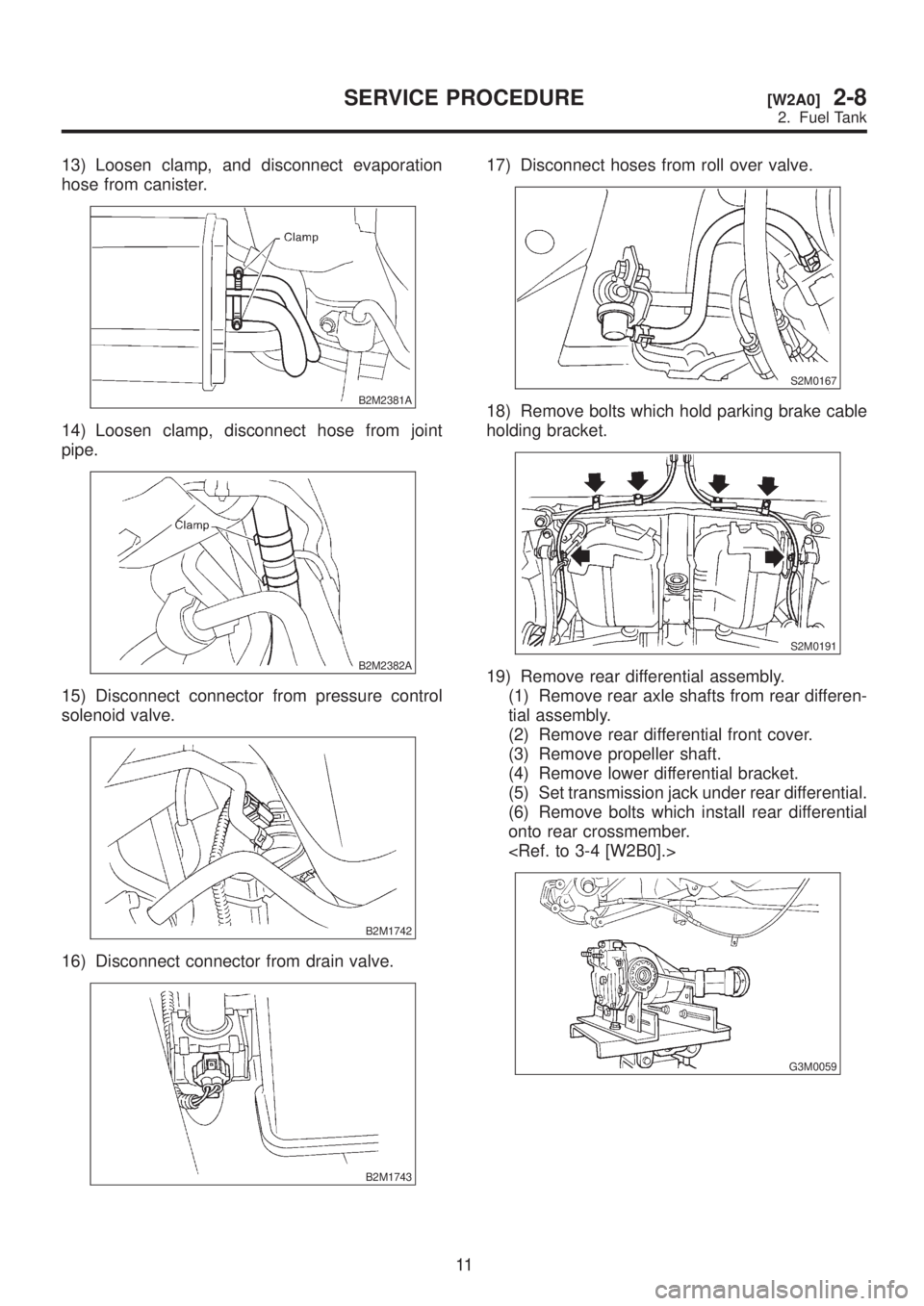
13) Loosen clamp, and disconnect evaporation
hose from canister.
B2M2381A
14) Loosen clamp, disconnect hose from joint
pipe.
B2M2382A
15) Disconnect connector from pressure control
solenoid valve.
B2M1742
16) Disconnect connector from drain valve.
B2M1743
17) Disconnect hoses from roll over valve.
S2M0167
18) Remove bolts which hold parking brake cable
holding bracket.
S2M0191
19) Remove rear differential assembly.
(1) Remove rear axle shafts from rear differen-
tial assembly.
(2) Remove rear differential front cover.
(3) Remove propeller shaft.
(4) Remove lower differential bracket.
(5) Set transmission jack under rear differential.
(6) Remove bolts which install rear differential
onto rear crossmember.
G3M0059
11
[W2A0]2-8SERVICE PROCEDURE
2. Fuel Tank
Page 375 of 1456
B2M1744B
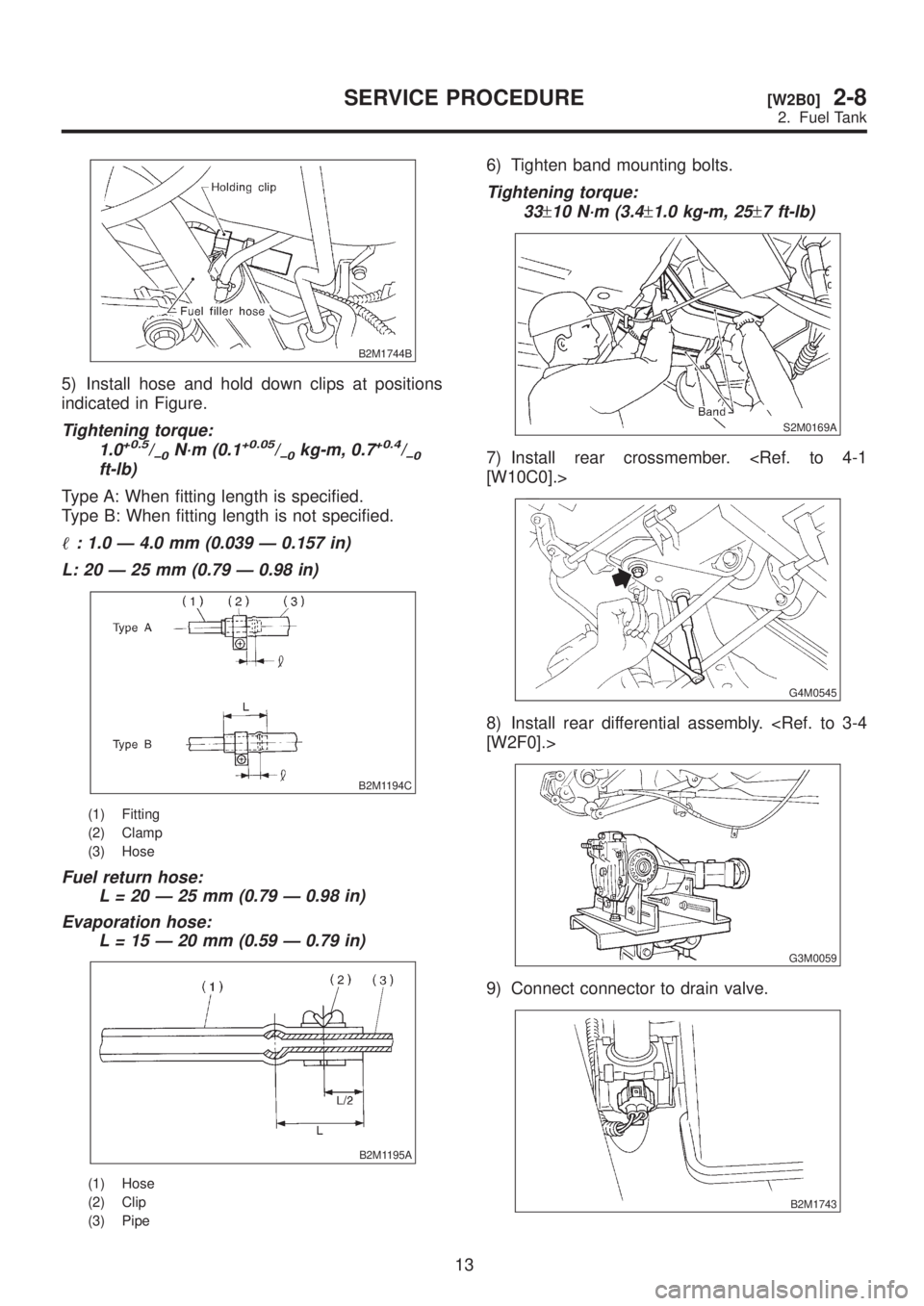
5) Install hose and hold down clips at positions
indicated in Figure.
Tightening torque:
1.0+0.5/þ0N´m (0.1+0.05/þ0kg-m, 0.7+0.4/þ0ft-lb)
Type A: When fitting length is specified.
Type B: When fitting length is not specified.
: 1.0 Ð 4.0 mm (0.039 Ð 0.157 in)
L: 20 Ð 25 mm (0.79 Ð 0.98 in)
B2M1194C
(1) Fitting
(2) Clamp
(3) Hose
Fuel return hose:
L = 20 Ð 25 mm (0.79 Ð 0.98 in)
Evaporation hose:
L = 15 Ð 20 mm (0.59 Ð 0.79 in)
B2M1195A
(1) Hose
(2) Clip
(3) Pipe
6) Tighten band mounting bolts.
Tightening torque:
33
±10 N´m (3.4±1.0 kg-m, 25±7 ft-lb)
S2M0169A
7) Install rear crossmember.
G4M0545
8) Install rear differential assembly.
G3M0059
9) Connect connector to drain valve.
B2M1743
13
[W2B0]2-8SERVICE PROCEDURE
2. Fuel Tank
Page 415 of 1456
1. General
A: PRECAUTION
When servicing clutch system, pay attention to the
following items.
1. MECHANICAL APPLICATION TYPE
1) Check the routing of clutch cable for smooth-
ness.
2) Excessive tightness or looseness of clutch
cable have a bad influence upon the cable durabil-
ity.
3) Apply grease sufficiently to the connecting por-
tion of clutch pedal.
4) Apply grease sufficiently to the release lever
portion.
5) Position clutch cable through the center of toe
board hole and route it smoothly. Adjustment is
done by moving the outer cable.
6) Make sure not to let the clutch chatter when
starting forward or rearward. If clutch chattering
occurs, readjust so that the bend of clutch outer
cable becomes flatter.
2. HYDRAULIC APPLICATION TYPE
1) Check fluid level using a scale on outside of
reservoir tank. If the level is below ªMINº, add
clutch fluid to bring it up to ªMAXº.
Recommended clutch fluid:
FMVSS No. 116, fresh DOT3 or DOT4
brake fluid
CAUTION:
IAvoid mixing different brakes of brake fluid
to prevent degradation of the fluid.
IBe careful not to allow dirt or dust to get into
the reservoir tank.
IUse fresh DOT3 or DOT4 brake fluid when
refilling fluid.
S2M0351A
2) Make sure that brake fluid does not leak from
master cylinder, operating cylinder and piping.
3) Apply grease sufficiently to the release lever
pinion.
4) Check for proper clutch disengagement and
clutch pedal return ability.
2. On-car Service
A: ADJUSTMENT
1. MECHANICAL APPLICATION TYPE
1) Remove release lever return spring from lever
(Models without hill holder only).
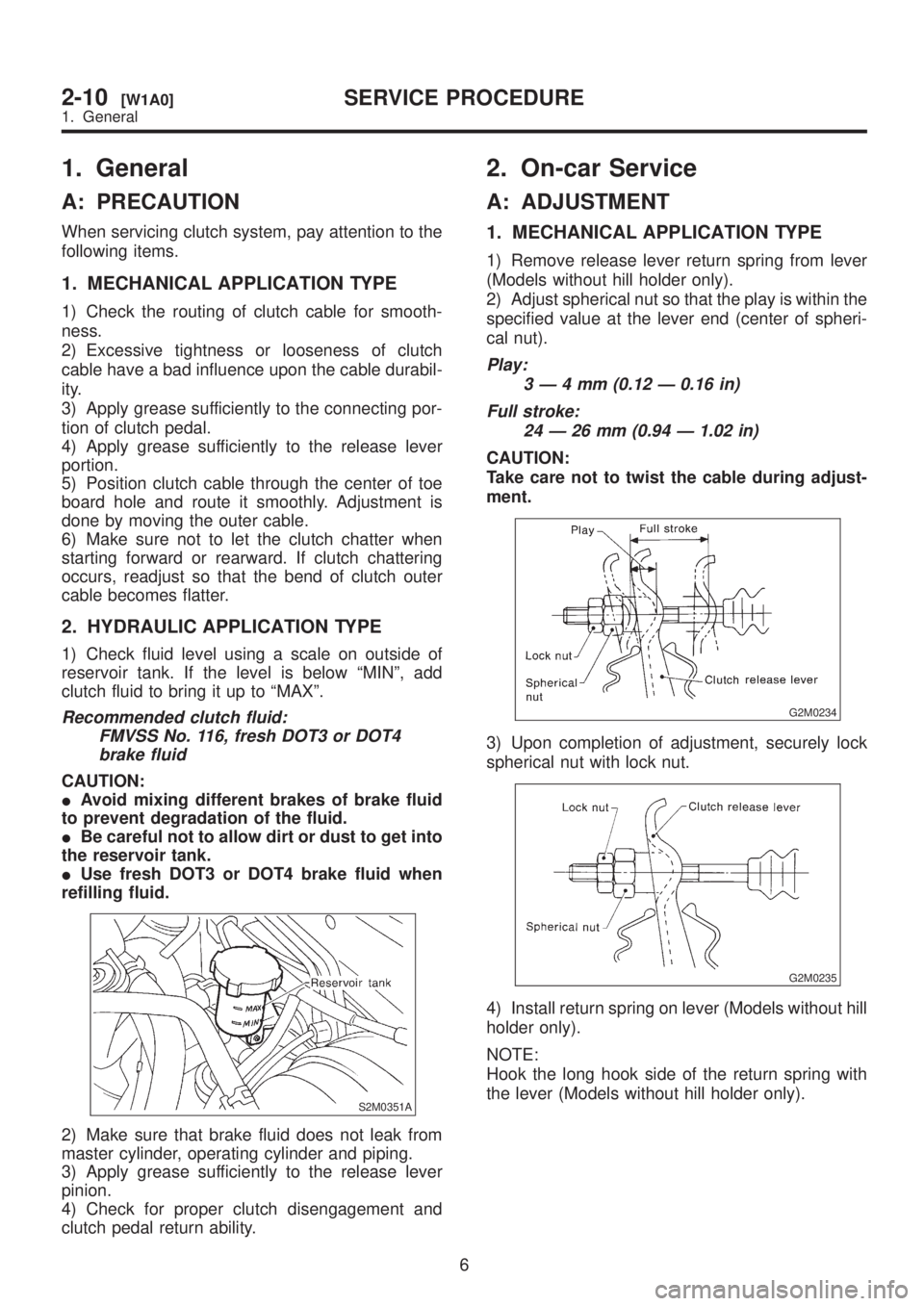
2) Adjust spherical nut so that the play is within the
specified value at the lever end (center of spheri-
cal nut).
Play:
3Ð4mm(0.12 Ð 0.16 in)
Full stroke:
24 Ð 26 mm (0.94 Ð 1.02 in)
CAUTION:
Take care not to twist the cable during adjust-
ment.
G2M0234
3) Upon completion of adjustment, securely lock
spherical nut with lock nut.
G2M0235
4) Install return spring on lever (Models without hill
holder only).
NOTE:
Hook the long hook side of the return spring with
the lever (Models without hill holder only).
6
2-10[W1A0]SERVICE PROCEDURE
1. General
Page 416 of 1456
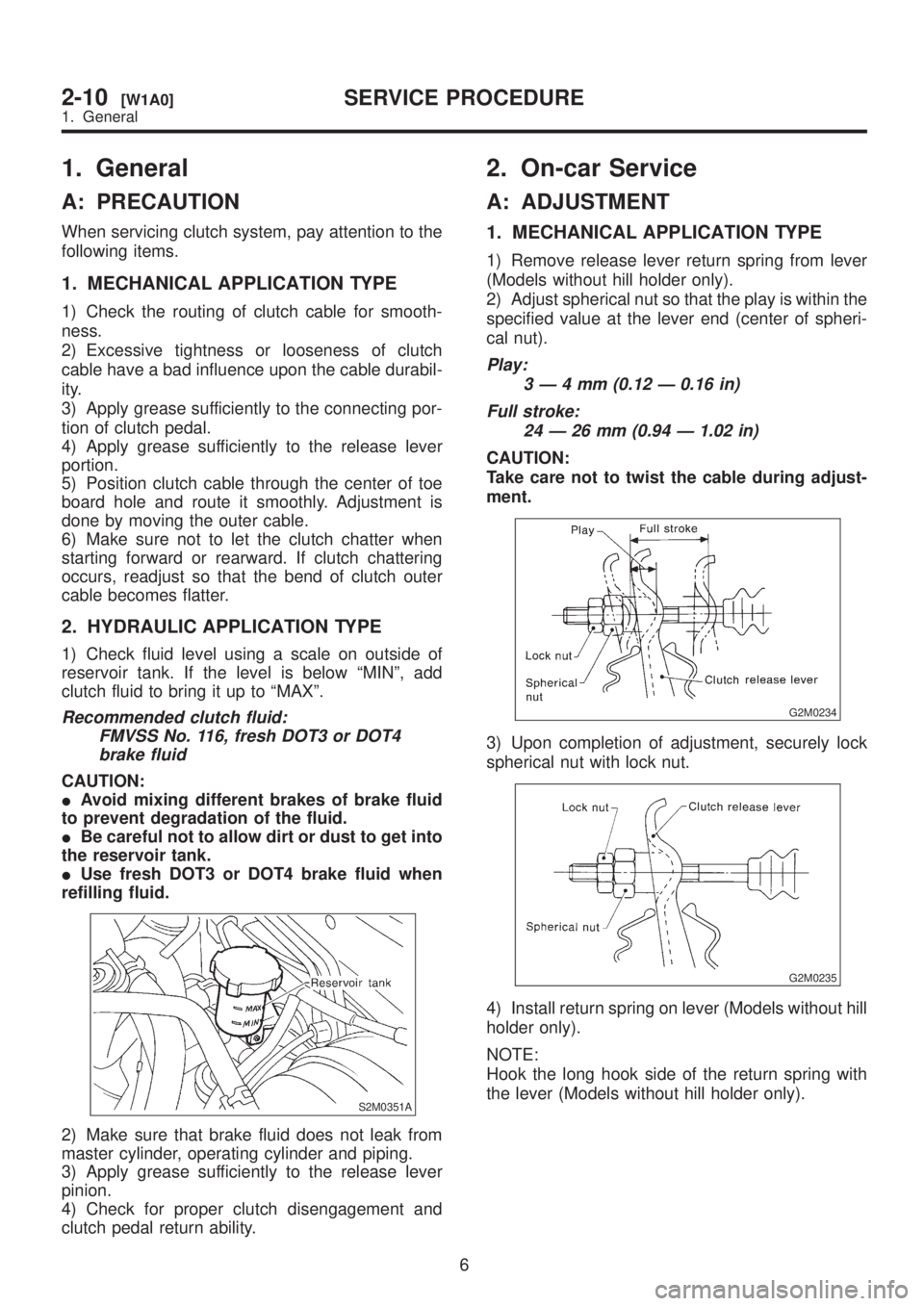
1. General
A: PRECAUTION
When servicing clutch system, pay attention to the
following items.
1. MECHANICAL APPLICATION TYPE
1) Check the routing of clutch cable for smooth-
ness.
2) Excessive tightness or looseness of clutch
cable have a bad influence upon the cable durabil-
ity.
3) Apply grease sufficiently to the connecting por-
tion of clutch pedal.
4) Apply grease sufficiently to the release lever
portion.
5) Position clutch cable through the center of toe
board hole and route it smoothly. Adjustment is
done by moving the outer cable.
6) Make sure not to let the clutch chatter when
starting forward or rearward. If clutch chattering
occurs, readjust so that the bend of clutch outer
cable becomes flatter.
2. HYDRAULIC APPLICATION TYPE
1) Check fluid level using a scale on outside of
reservoir tank. If the level is below ªMINº, add
clutch fluid to bring it up to ªMAXº.
Recommended clutch fluid:
FMVSS No. 116, fresh DOT3 or DOT4
brake fluid
CAUTION:
IAvoid mixing different brakes of brake fluid
to prevent degradation of the fluid.
IBe careful not to allow dirt or dust to get into
the reservoir tank.
IUse fresh DOT3 or DOT4 brake fluid when
refilling fluid.
S2M0351A
2) Make sure that brake fluid does not leak from
master cylinder, operating cylinder and piping.
3) Apply grease sufficiently to the release lever
pinion.
4) Check for proper clutch disengagement and
clutch pedal return ability.
2. On-car Service
A: ADJUSTMENT
1. MECHANICAL APPLICATION TYPE
1) Remove release lever return spring from lever
(Models without hill holder only).
2) Adjust spherical nut so that the play is within the
specified value at the lever end (center of spheri-
cal nut).
Play:
3Ð4mm(0.12 Ð 0.16 in)
Full stroke:
24 Ð 26 mm (0.94 Ð 1.02 in)
CAUTION:
Take care not to twist the cable during adjust-
ment.
G2M0234
3) Upon completion of adjustment, securely lock
spherical nut with lock nut.
G2M0235
4) Install return spring on lever (Models without hill
holder only).
NOTE:
Hook the long hook side of the return spring with
the lever (Models without hill holder only).
6
2-10[W1A0]SERVICE PROCEDURE
1. General
Page 429 of 1456
7. Brake Fluid
A: REPLACEMENT
CAUTION:
IThe FMVSS No. 116, fresh DOT3 or 4 brake
fluid must be used.
ICover bleeder with waste cloth, when loos-
ening it, to prevent brake fluid from being
splashed over surrounding parts.
IAvoid mixing different brands of brake fluid
to prevent degrading the quality of the fluid.
IBe careful not to allow dirt or dust to get into
the reservoir tank.
NOTE:
IDuring bleeding operation, keep the clutch
reserve tank filled with brake fluid to eliminate entry
of air.
IClutch pedal operating must be very slow.
IFor convenience and safety, it is advisable to
have two man working.IThe amount of brake fluid required is approxi-
mately 70 m(2.4 US fl oz, 2.5 Imp fl oz) for total
clutch system.
1) Either jack-up vehicle and place a safety stand
under it, or lift-up vehicle.
2) Remove both front and rear wheels.
3) Draw out the brake fluid from reserve tank with
syringe.
4) Refill reservoir tank with recommended brake
fluid.
Recommended brake fluid:
FMVSS No. 116, fresh DOT3 or 4 brake
fluid
5) Bleed air from oil line with the help of a co-
worker.
18
2-10[W7A0]SERVICE PROCEDURE
7. Brake Fluid
Page 430 of 1456
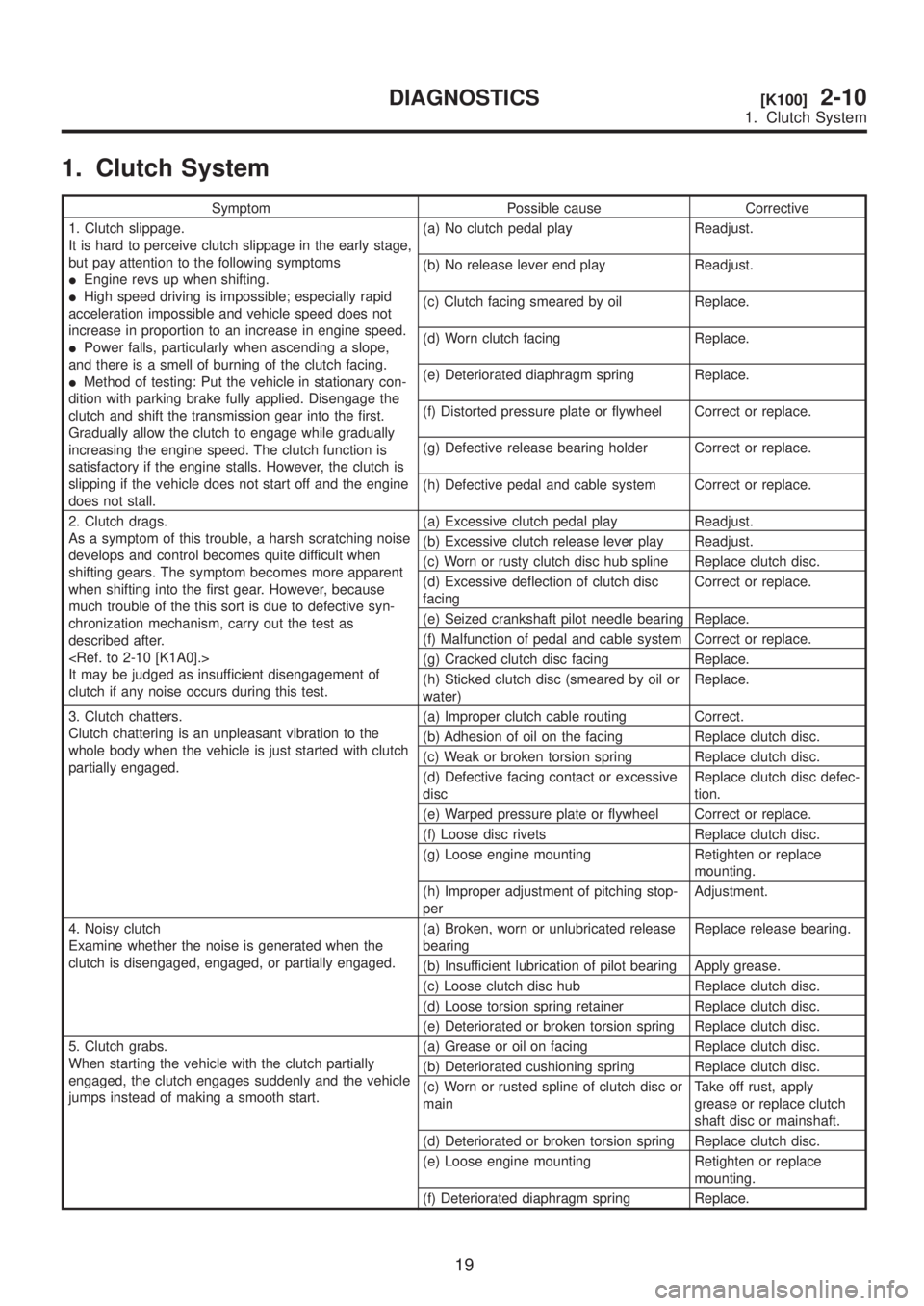
1. Clutch System
Symptom Possible cause Corrective
1. Clutch slippage.
It is hard to perceive clutch slippage in the early stage,
but pay attention to the following symptoms
IEngine revs up when shifting.
IHigh speed driving is impossible; especially rapid
acceleration impossible and vehicle speed does not
increase in proportion to an increase in engine speed.
IPower falls, particularly when ascending a slope,
and there is a smell of burning of the clutch facing.
IMethod of testing: Put the vehicle in stationary con-
dition with parking brake fully applied. Disengage the
clutch and shift the transmission gear into the first.
Gradually allow the clutch to engage while gradually
increasing the engine speed. The clutch function is
satisfactory if the engine stalls. However, the clutch is
slipping if the vehicle does not start off and the engine
does not stall.(a) No clutch pedal play Readjust.
(b) No release lever end play Readjust.
(c) Clutch facing smeared by oil Replace.
(d) Worn clutch facing Replace.
(e) Deteriorated diaphragm spring Replace.
(f) Distorted pressure plate or flywheel Correct or replace.
(g) Defective release bearing holder Correct or replace.
(h) Defective pedal and cable system Correct or replace.
2. Clutch drags.
As a symptom of this trouble, a harsh scratching noise
develops and control becomes quite difficult when
shifting gears. The symptom becomes more apparent
when shifting into the first gear. However, because
much trouble of the this sort is due to defective syn-
chronization mechanism, carry out the test as
described after.
It may be judged as insufficient disengagement of
clutch if any noise occurs during this test.(a) Excessive clutch pedal play Readjust.
(b) Excessive clutch release lever play Readjust.
(c) Worn or rusty clutch disc hub spline Replace clutch disc.
(d) Excessive deflection of clutch disc
facingCorrect or replace.
(e) Seized crankshaft pilot needle bearing Replace.
(f) Malfunction of pedal and cable system Correct or replace.
(g) Cracked clutch disc facing Replace.
(h) Sticked clutch disc (smeared by oil or
water)Replace.
3. Clutch chatters.
Clutch chattering is an unpleasant vibration to the
whole body when the vehicle is just started with clutch
partially engaged.(a) Improper clutch cable routing Correct.
(b) Adhesion of oil on the facing Replace clutch disc.
(c) Weak or broken torsion spring Replace clutch disc.
(d) Defective facing contact or excessive
discReplace clutch disc defec-
tion.
(e) Warped pressure plate or flywheel Correct or replace.
(f) Loose disc rivets Replace clutch disc.
(g) Loose engine mounting Retighten or replace
mounting.
(h) Improper adjustment of pitching stop-
perAdjustment.
4. Noisy clutch
Examine whether the noise is generated when the
clutch is disengaged, engaged, or partially engaged.(a) Broken, worn or unlubricated release
bearingReplace release bearing.
(b) Insufficient lubrication of pilot bearing Apply grease.
(c) Loose clutch disc hub Replace clutch disc.
(d) Loose torsion spring retainer Replace clutch disc.
(e) Deteriorated or broken torsion spring Replace clutch disc.
5. Clutch grabs.
When starting the vehicle with the clutch partially
engaged, the clutch engages suddenly and the vehicle
jumps instead of making a smooth start.(a) Grease or oil on facing Replace clutch disc.
(b) Deteriorated cushioning spring Replace clutch disc.
(c) Worn or rusted spline of clutch disc or
mainTake off rust, apply
grease or replace clutch
shaft disc or mainshaft.
(d) Deteriorated or broken torsion spring Replace clutch disc.
(e) Loose engine mounting Retighten or replace
mounting.
(f) Deteriorated diaphragm spring Replace.
19
[K100]2-10DIAGNOSTICS
1. Clutch System
Page 456 of 1456
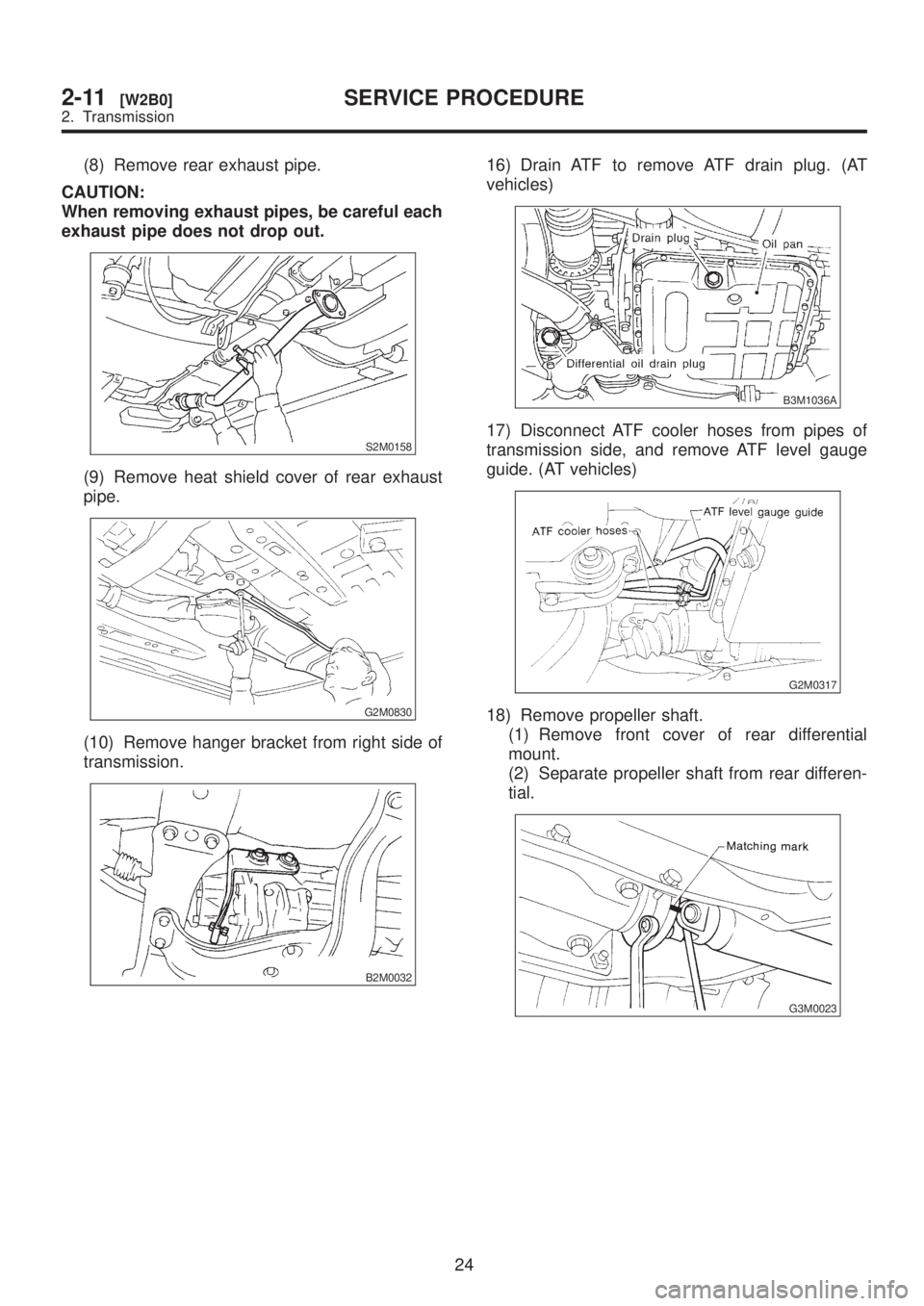
(8) Remove rear exhaust pipe.
CAUTION:
When removing exhaust pipes, be careful each
exhaust pipe does not drop out.
S2M0158
(9) Remove heat shield cover of rear exhaust
pipe.
G2M0830
(10) Remove hanger bracket from right side of
transmission.
B2M0032
16) Drain ATF to remove ATF drain plug. (AT
vehicles)
B3M1036A
17) Disconnect ATF cooler hoses from pipes of
transmission side, and remove ATF level gauge
guide. (AT vehicles)
G2M0317
18) Remove propeller shaft.
(1) Remove front cover of rear differential
mount.
(2) Separate propeller shaft from rear differen-
tial.
G3M0023
24
2-11[W2B0]SERVICE PROCEDURE
2. Transmission
Page 461 of 1456

12) Install stabilizer clamps onto front crossmem-
ber.
Tightening torque:
25
±4 N´m (2.5±0.4 kg-m, 18.1±2.9 ft-lb)
G2M0323
13) Install gear shift rod and stay. (MT vehicles)
(1) Install gear shift rod onto transmission.
G3M0697
(2) Install stay onto transmission.
(3) Install spring.
14) Install shift selector cable onto selector lever.
(AT vehicles)
(1) Install selector cable into selector lever.
(2) Install cable bracket onto body.
NOTE:
Tighten selector cable adjusting and lock nut after
checking selector lever operation.
S3M0013A
15) Install ATF level gauge guide, and ATF cooler
hoses onto pipe. (AT vehicles)
G2M0317
16) Install propeller shaft.
(1) Install propeller shaft into transmission.
(2) Tighten bolts which install propeller shaft
onto companion flange of rear differential.
Tightening torque:
31
±8 N´m (3.2±0.8 kg-m, 23.1±5.8 ft-lb)
G3M0023
(3) Install center bearing bracket on body.
Tightening torque:
52
±5 N´m (5.3±0.5 kg-m, 38.3±3.6 ft-lb)
S2M0219A
17) Install exhaust system.
29
[W2C0]2-11SERVICE PROCEDURE
2. Transmission
Page 463 of 1456
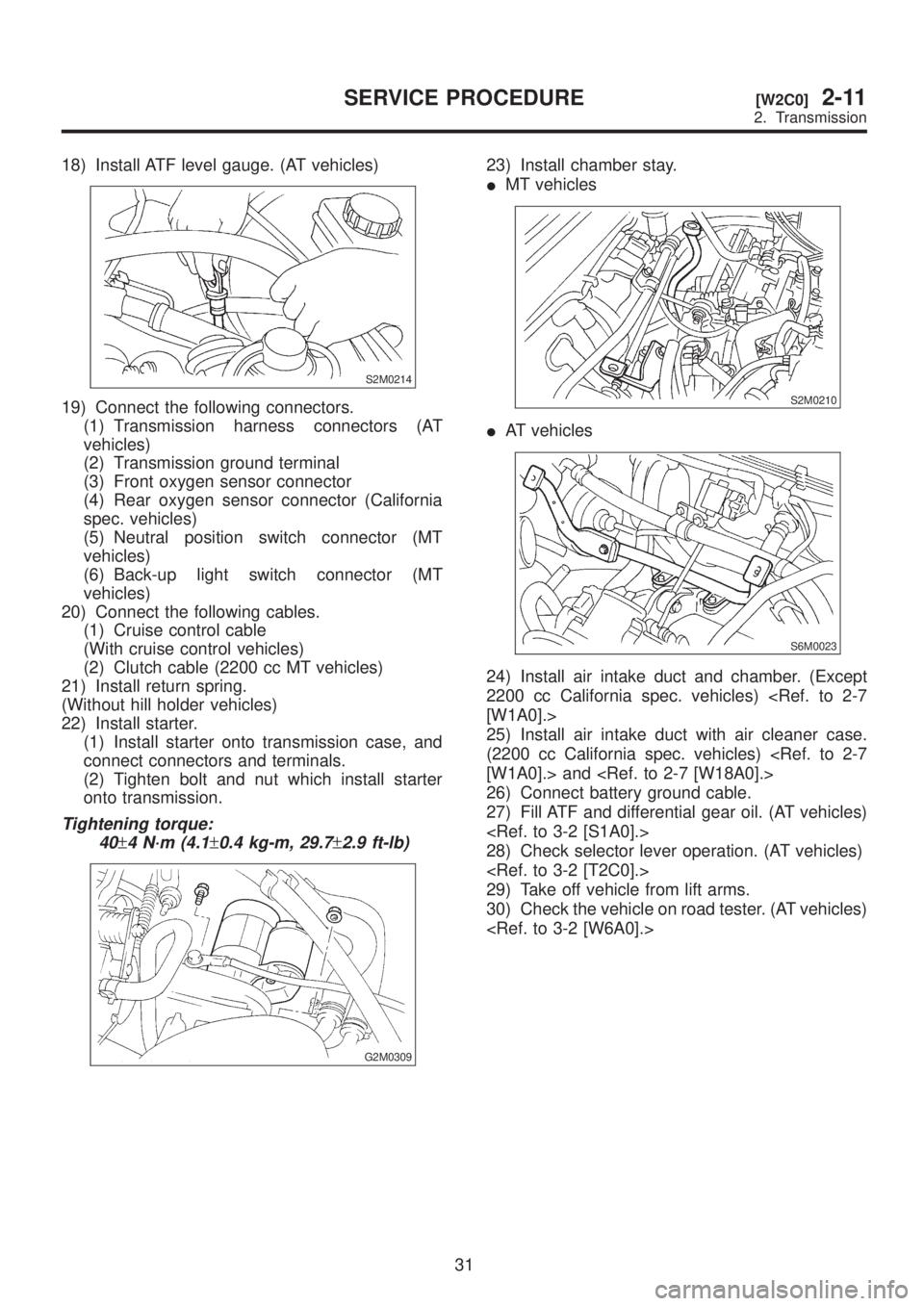
18) Install ATF level gauge. (AT vehicles)
S2M0214
19) Connect the following connectors.
(1) Transmission harness connectors (AT
vehicles)
(2) Transmission ground terminal
(3) Front oxygen sensor connector
(4) Rear oxygen sensor connector (California
spec. vehicles)
(5) Neutral position switch connector (MT
vehicles)
(6) Back-up light switch connector (MT
vehicles)
20) Connect the following cables.
(1) Cruise control cable
(With cruise control vehicles)
(2) Clutch cable (2200 cc MT vehicles)
21) Install return spring.
(Without hill holder vehicles)
22) Install starter.
(1) Install starter onto transmission case, and
connect connectors and terminals.
(2) Tighten bolt and nut which install starter
onto transmission.
Tightening torque:
40
±4 N´m (4.1±0.4 kg-m, 29.7±2.9 ft-lb)
G2M0309
23) Install chamber stay.
IMT vehicles
S2M0210
IAT vehicles
S6M0023
24) Install air intake duct and chamber. (Except
2200 cc California spec. vehicles)
25) Install air intake duct with air cleaner case.
(2200 cc California spec. vehicles)
26) Connect battery ground cable.
27) Fill ATF and differential gear oil. (AT vehicles)
28) Check selector lever operation. (AT vehicles)
29) Take off vehicle from lift arms.
30) Check the vehicle on road tester. (AT vehicles)
31
[W2C0]2-11SERVICE PROCEDURE
2. Transmission