fuse SUBARU LEGACY 1999 Service Owner's Manual
[x] Cancel search | Manufacturer: SUBARU, Model Year: 1999, Model line: LEGACY, Model: SUBARU LEGACY 1999Pages: 1456, PDF Size: 59.93 MB
Page 978 of 1456
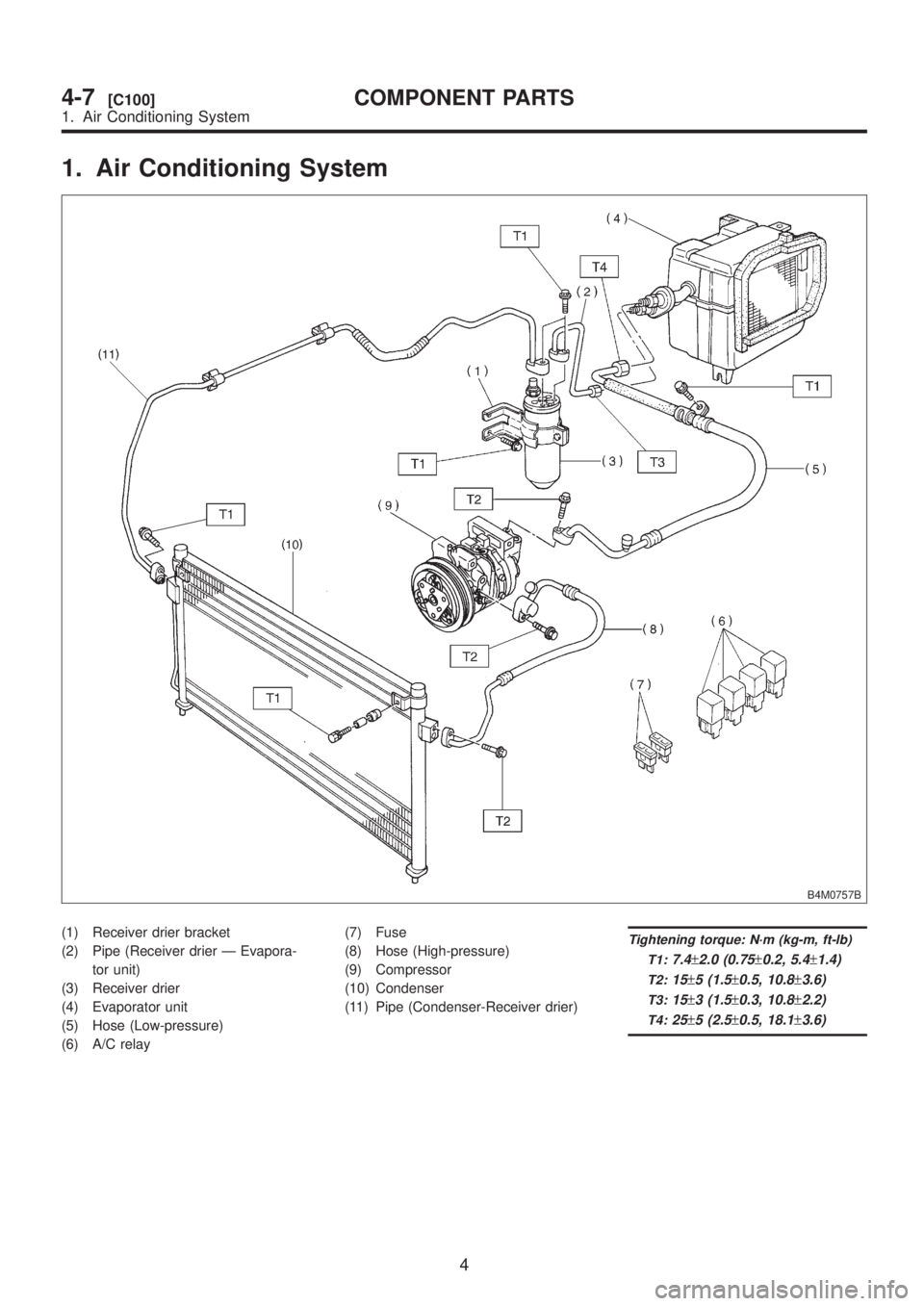
1. Air Conditioning System
B4M0757B
(1) Receiver drier bracket
(2) Pipe (Receiver drier Ð Evapora-
tor unit)
(3) Receiver drier
(4) Evaporator unit
(5) Hose (Low-pressure)
(6) A/C relay(7) Fuse
(8) Hose (High-pressure)
(9) Compressor
(10) Condenser
(11) Pipe (Condenser-Receiver drier)Tightening torque: N´m (kg-m, ft-lb)
T1:
7.4±2.0 (0.75±0.2, 5.4±1.4)
T2:15±5 (1.5±0.5, 10.8±3.6)
T3:15±3 (1.5±0.3, 10.8±2.2)
T4:25±5 (2.5±0.5, 18.1±3.6)
4
4-7[C100]COMPONENT PARTS
1. Air Conditioning System
Page 1012 of 1456
17. Relay and Fuse
A: LOCATION
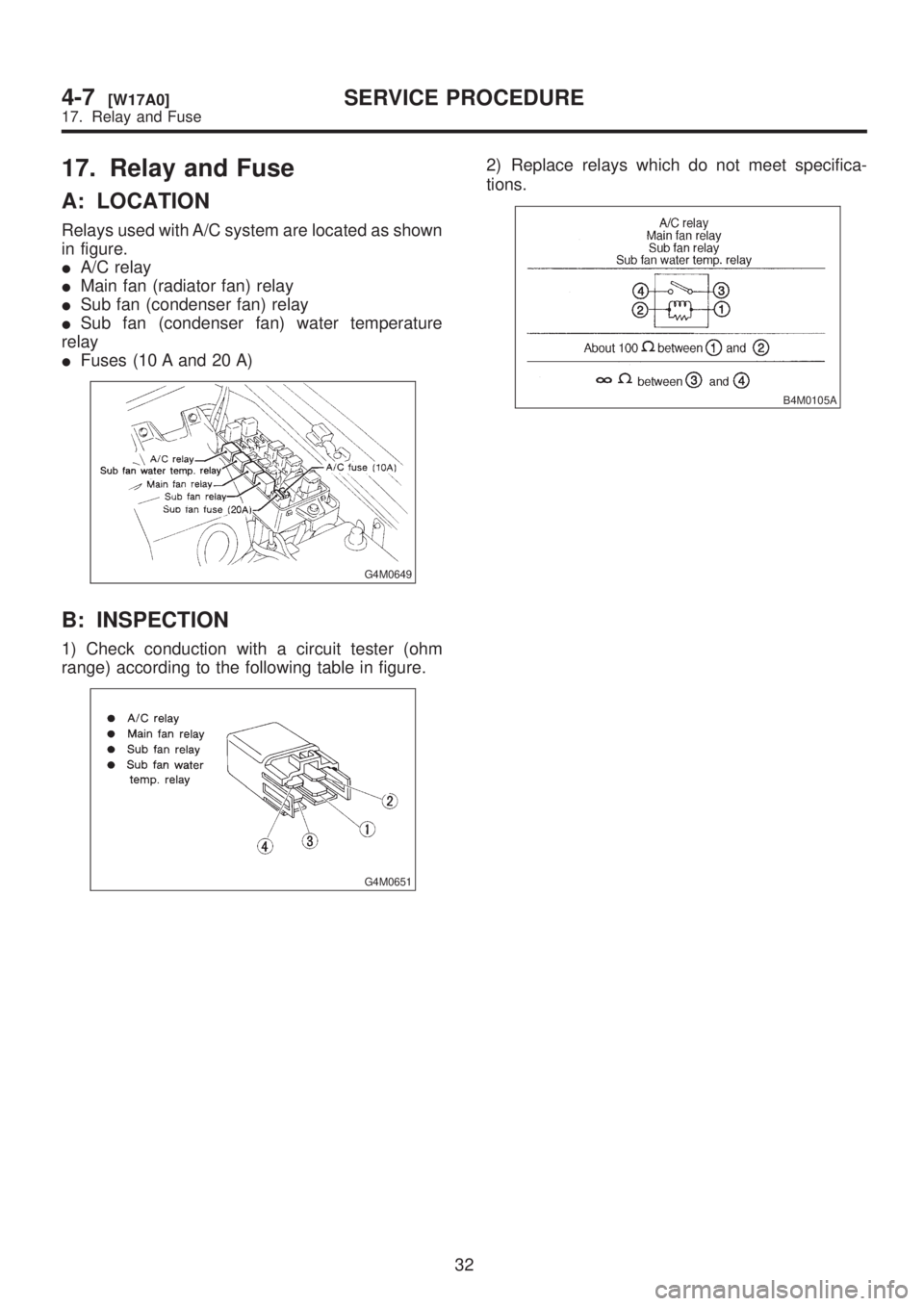
Relays used with A/C system are located as shown
in figure.
IA/C relay
IMain fan (radiator fan) relay
ISub fan (condenser fan) relay
ISub fan (condenser fan) water temperature
relay
IFuses (10 A and 20 A)
G4M0649
B: INSPECTION
1) Check conduction with a circuit tester (ohm
range) according to the following table in figure.
G4M0651
2) Replace relays which do not meet specifica-
tions.
B4M0105A
32
4-7[W17A0]SERVICE PROCEDURE
17. Relay and Fuse
Page 1099 of 1456
1. Sunroof
Entry of water into compartment(1) Check roof panel and glass lid assembly for improper or
poor sealing.
(2) Check drain tube for clogging.
(3) Check sunroof frame seal and body for improper fit.
Booming noise(1) Check glass lid assembly and roof panel for improper
clearance.
(2) Check sun shade and roof trim for improper clearance.
Abnormal motor noise(1) Check motor for looseness.
(2) Check gears and bearings for wear.
(3) Check cable for wear.
(4) Check cable pipe for deformities.
Failure of sunroof to operate
(Motor operates properly.)(1) Check guide rail for foreign particles.
(2) Check guide rail for improper installation.
(3) Check parts for mutual interference.
(4) Check cable slider for improper clinching.
(5) Check cable for improper installation.
(6) Check clutch adjustment nut for improper tightness.
Motor does not rotate or rotates improperly.
(Use sunroof wrench to check operation.)(1) Check fuse for blowout.
(2) Check switch for improper function.
(3) Check motor for incorrect terminal voltage.
(4) Check relay for improper operation.
(5) Check poor grounding system.
(6) Check cords for discontinuity and terminals for poor con-
nections.
(7) Check limit switch for improper operation.
67
[K100]5-1DIAGNOSTICS
1. Sunroof
Page 1153 of 1456
4. Rear Seat Belt
A: REMOVAL AND INSTALLATION
1. SEDAN
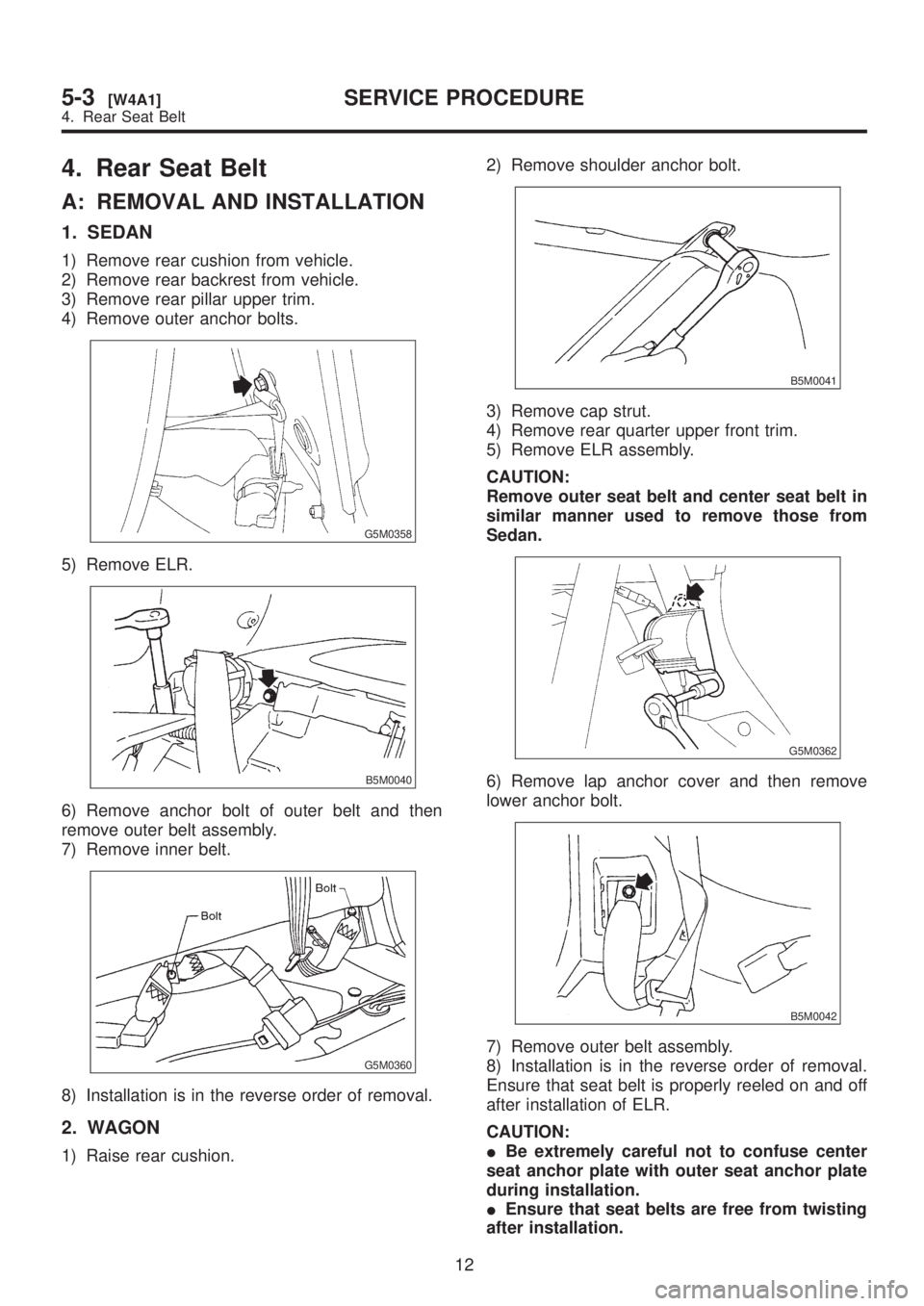
1) Remove rear cushion from vehicle.
2) Remove rear backrest from vehicle.
3) Remove rear pillar upper trim.
4) Remove outer anchor bolts.
G5M0358
5) Remove ELR.
B5M0040
6) Remove anchor bolt of outer belt and then
remove outer belt assembly.
7) Remove inner belt.
G5M0360
8) Installation is in the reverse order of removal.
2. WAGON
1) Raise rear cushion.2) Remove shoulder anchor bolt.
B5M0041
3) Remove cap strut.
4) Remove rear quarter upper front trim.
5) Remove ELR assembly.
CAUTION:
Remove outer seat belt and center seat belt in
similar manner used to remove those from
Sedan.
G5M0362
6) Remove lap anchor cover and then remove
lower anchor bolt.
B5M0042
7) Remove outer belt assembly.
8) Installation is in the reverse order of removal.
Ensure that seat belt is properly reeled on and off
after installation of ELR.
CAUTION:
IBe extremely careful not to confuse center
seat anchor plate with outer seat anchor plate
during installation.
IEnsure that seat belts are free from twisting
after installation.
12
5-3[W4A1]SERVICE PROCEDURE
4. Rear Seat Belt
Page 1226 of 1456
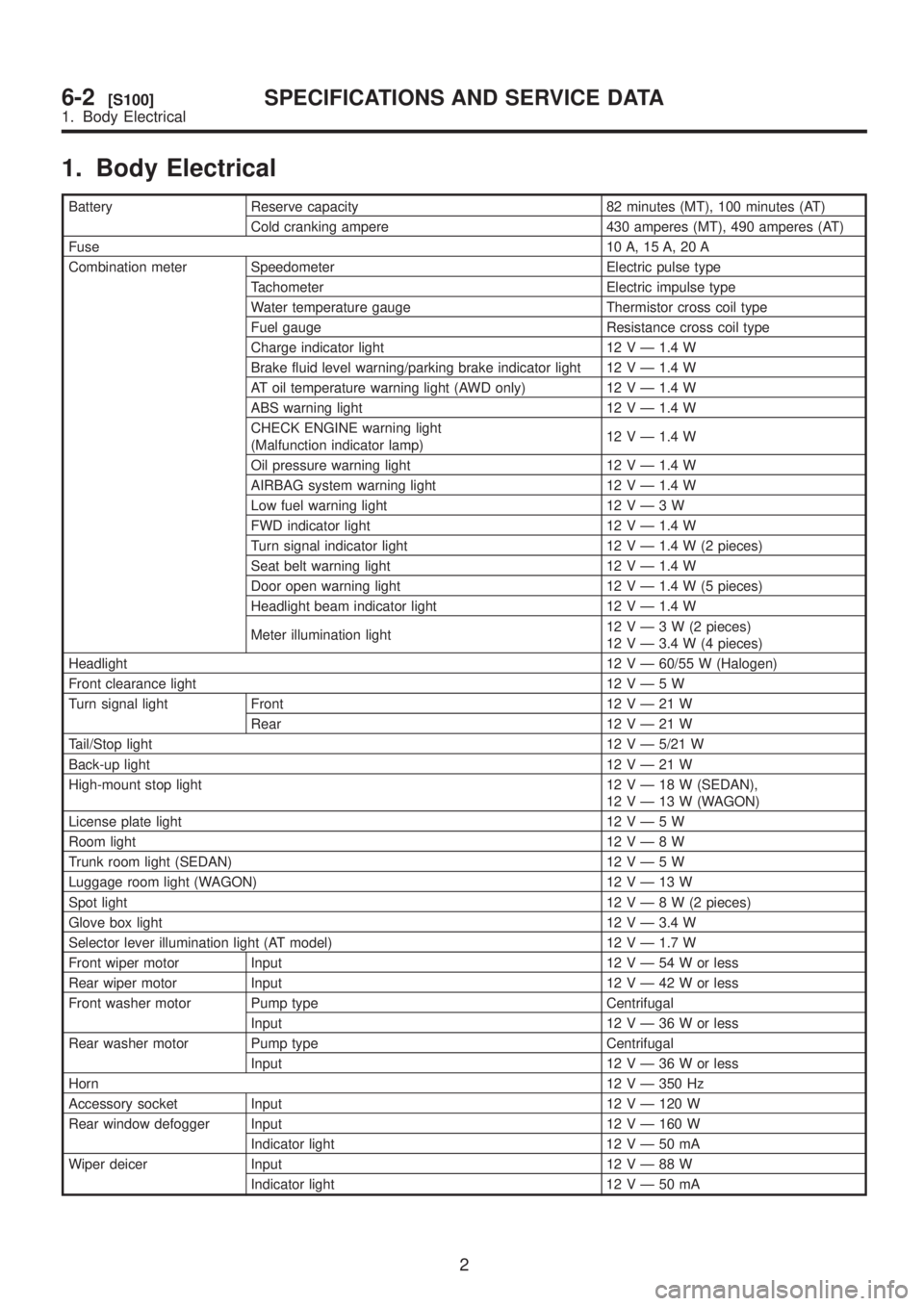
1. Body Electrical
Battery Reserve capacity 82 minutes (MT), 100 minutes (AT)
Cold cranking ampere 430 amperes (MT), 490 amperes (AT)
Fuse10 A, 15 A, 20 A
Combination meter Speedometer Electric pulse type
Tachometer Electric impulse type
Water temperature gauge Thermistor cross coil type
Fuel gauge Resistance cross coil type
Charge indicator light 12 V Ð 1.4 W
Brake fluid level warning/parking brake indicator light 12 V Ð 1.4 W
AT oil temperature warning light (AWD only) 12 V Ð 1.4 W
ABS warning light 12 V Ð 1.4 W
CHECK ENGINE warning light
(Malfunction indicator lamp)12 V Ð 1.4 W
Oil pressure warning light 12 V Ð 1.4 W
AIRBAG system warning light 12 V Ð 1.4 W
Low fuel warning light 12VÐ3W
FWD indicator light 12 V Ð 1.4 W
Turn signal indicator light 12 V Ð 1.4 W (2 pieces)
Seat belt warning light 12 V Ð 1.4 W
Door open warning light 12 V Ð 1.4 W (5 pieces)
Headlight beam indicator light 12 V Ð 1.4 W
Meter illumination light12VÐ3W(2pieces)
12 V Ð 3.4 W (4 pieces)
Headlight12 V Ð 60/55 W (Halogen)
Front clearance light 12VÐ5W
Turn signal light Front 12VÐ21W
Rear 12VÐ21W
Tail/Stop light12 V Ð 5/21 W
Back-up light12VÐ21W
High-mount stop light 12VÐ18W(SEDAN),
12VÐ13W(WAGON)
License plate light 12VÐ5W
Room light12VÐ8W
Trunk room light (SEDAN) 12VÐ5W
Luggage room light (WAGON) 12VÐ13W
Spot light12VÐ8W(2pieces)
Glove box light 12 V Ð 3.4 W
Selector lever illumination light (AT model) 12 V Ð 1.7 W
Front wiper motor Input 12VÐ54Worless
Rear wiper motor Input 12VÐ42Worless
Front washer motor Pump type Centrifugal
Input 12VÐ36Worless
Rear washer motor Pump type Centrifugal
Input 12VÐ36Worless
Horn12 V Ð 350 Hz
Accessory socket Input 12 V Ð 120 W
Rear window defogger Input 12 V Ð 160 W
Indicator light 12VÐ50mA
Wiper deicer Input 12VÐ88W
Indicator light 12VÐ50mA
2
6-2[S100]SPECIFICATIONS AND SERVICE DATA
1. Body Electrical
Page 1284 of 1456
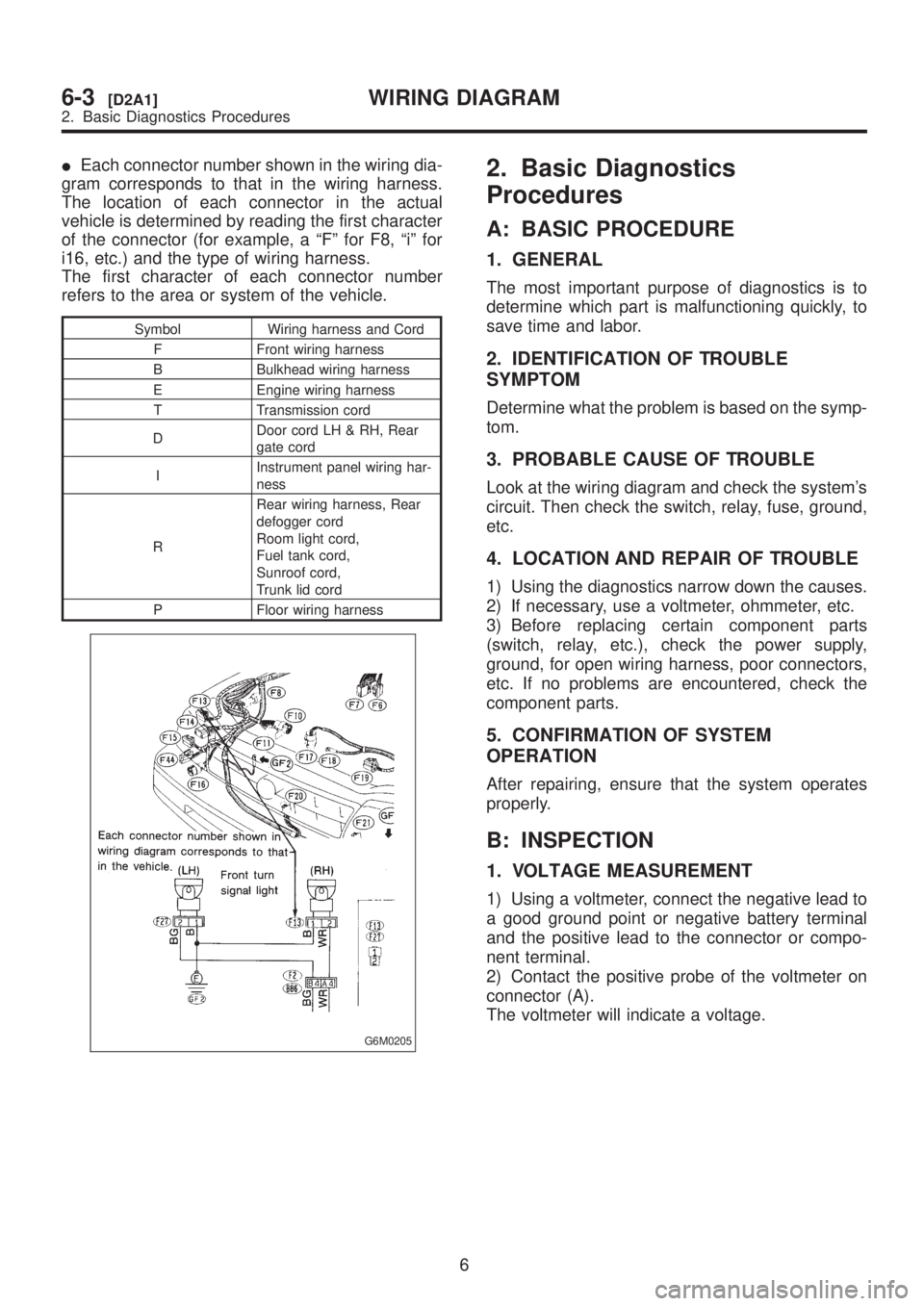
IEach connector number shown in the wiring dia-
gram corresponds to that in the wiring harness.
The location of each connector in the actual
vehicle is determined by reading the first character
of the connector (for example, a ªFº for F8, ªiº for
i16, etc.) and the type of wiring harness.
The first character of each connector number
refers to the area or system of the vehicle.
Symbol Wiring harness and Cord
F Front wiring harness
B Bulkhead wiring harness
E Engine wiring harness
T Transmission cord
DDoor cord LH & RH, Rear
gate cord
IInstrument panel wiring har-
ness
RRear wiring harness, Rear
defogger cord
Room light cord,
Fuel tank cord,
Sunroof cord,
Trunk lid cord
P Floor wiring harness
G6M0205
2. Basic Diagnostics
Procedures
A: BASIC PROCEDURE
1. GENERAL
The most important purpose of diagnostics is to
determine which part is malfunctioning quickly, to
save time and labor.
2. IDENTIFICATION OF TROUBLE
SYMPTOM
Determine what the problem is based on the symp-
tom.
3. PROBABLE CAUSE OF TROUBLE
Look at the wiring diagram and check the system's
circuit. Then check the switch, relay, fuse, ground,
etc.
4. LOCATION AND REPAIR OF TROUBLE
1) Using the diagnostics narrow down the causes.
2) If necessary, use a voltmeter, ohmmeter, etc.
3) Before replacing certain component parts
(switch, relay, etc.), check the power supply,
ground, for open wiring harness, poor connectors,
etc. If no problems are encountered, check the
component parts.
5. CONFIRMATION OF SYSTEM
OPERATION
After repairing, ensure that the system operates
properly.
B: INSPECTION
1. VOLTAGE MEASUREMENT
1) Using a voltmeter, connect the negative lead to
a good ground point or negative battery terminal
and the positive lead to the connector or compo-
nent terminal.
2) Contact the positive probe of the voltmeter on
connector (A).
The voltmeter will indicate a voltage.
6
6-3[D2A1]WIRING DIAGRAM
2. Basic Diagnostics Procedures
Page 1285 of 1456
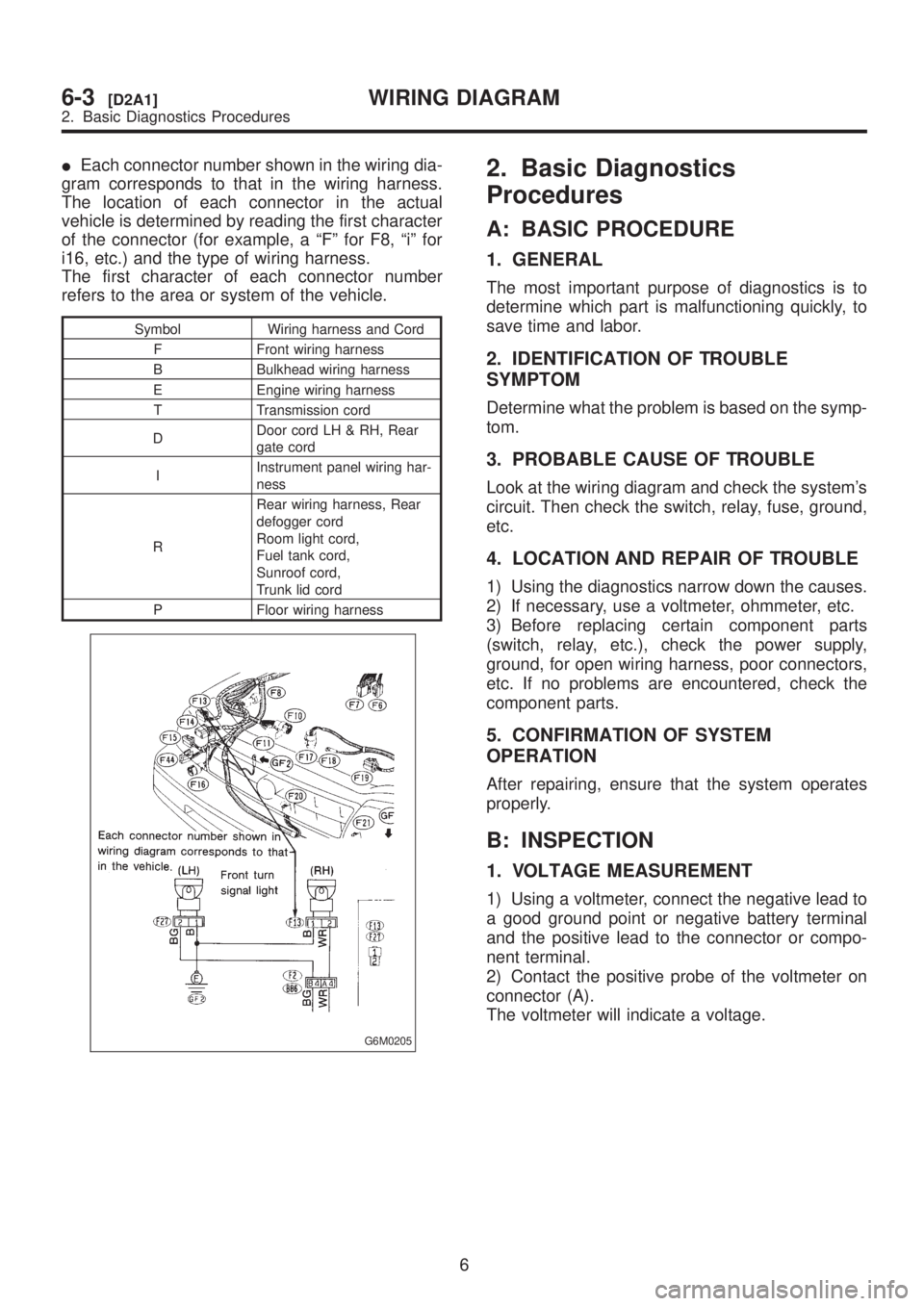
IEach connector number shown in the wiring dia-
gram corresponds to that in the wiring harness.
The location of each connector in the actual
vehicle is determined by reading the first character
of the connector (for example, a ªFº for F8, ªiº for
i16, etc.) and the type of wiring harness.
The first character of each connector number
refers to the area or system of the vehicle.
Symbol Wiring harness and Cord
F Front wiring harness
B Bulkhead wiring harness
E Engine wiring harness
T Transmission cord
DDoor cord LH & RH, Rear
gate cord
IInstrument panel wiring har-
ness
RRear wiring harness, Rear
defogger cord
Room light cord,
Fuel tank cord,
Sunroof cord,
Trunk lid cord
P Floor wiring harness
G6M0205
2. Basic Diagnostics
Procedures
A: BASIC PROCEDURE
1. GENERAL
The most important purpose of diagnostics is to
determine which part is malfunctioning quickly, to
save time and labor.
2. IDENTIFICATION OF TROUBLE
SYMPTOM
Determine what the problem is based on the symp-
tom.
3. PROBABLE CAUSE OF TROUBLE
Look at the wiring diagram and check the system's
circuit. Then check the switch, relay, fuse, ground,
etc.
4. LOCATION AND REPAIR OF TROUBLE
1) Using the diagnostics narrow down the causes.
2) If necessary, use a voltmeter, ohmmeter, etc.
3) Before replacing certain component parts
(switch, relay, etc.), check the power supply,
ground, for open wiring harness, poor connectors,
etc. If no problems are encountered, check the
component parts.
5. CONFIRMATION OF SYSTEM
OPERATION
After repairing, ensure that the system operates
properly.
B: INSPECTION
1. VOLTAGE MEASUREMENT
1) Using a voltmeter, connect the negative lead to
a good ground point or negative battery terminal
and the positive lead to the connector or compo-
nent terminal.
2) Contact the positive probe of the voltmeter on
connector (A).
The voltmeter will indicate a voltage.
6
6-3[D2A1]WIRING DIAGRAM
2. Basic Diagnostics Procedures
Page 1287 of 1456
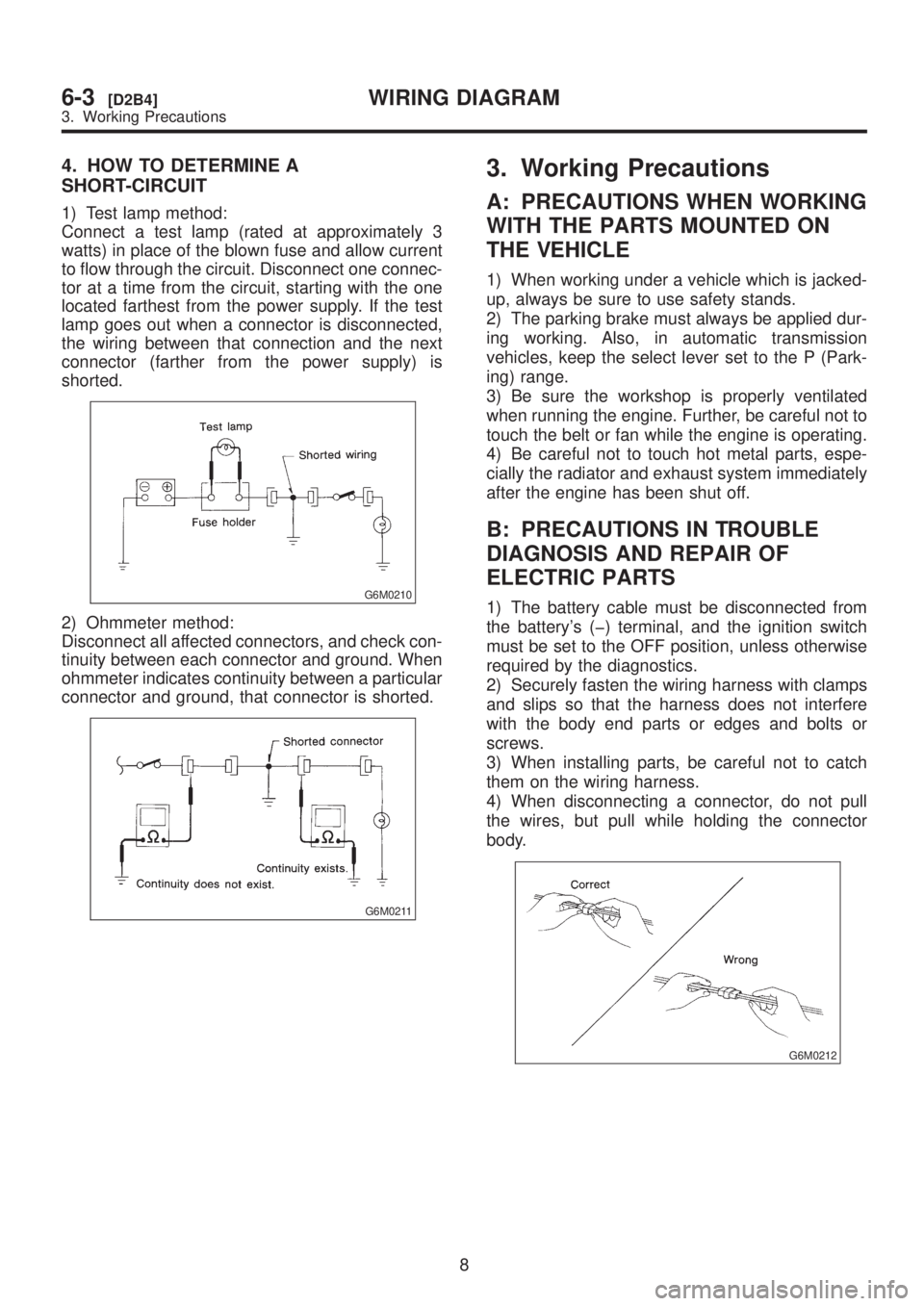
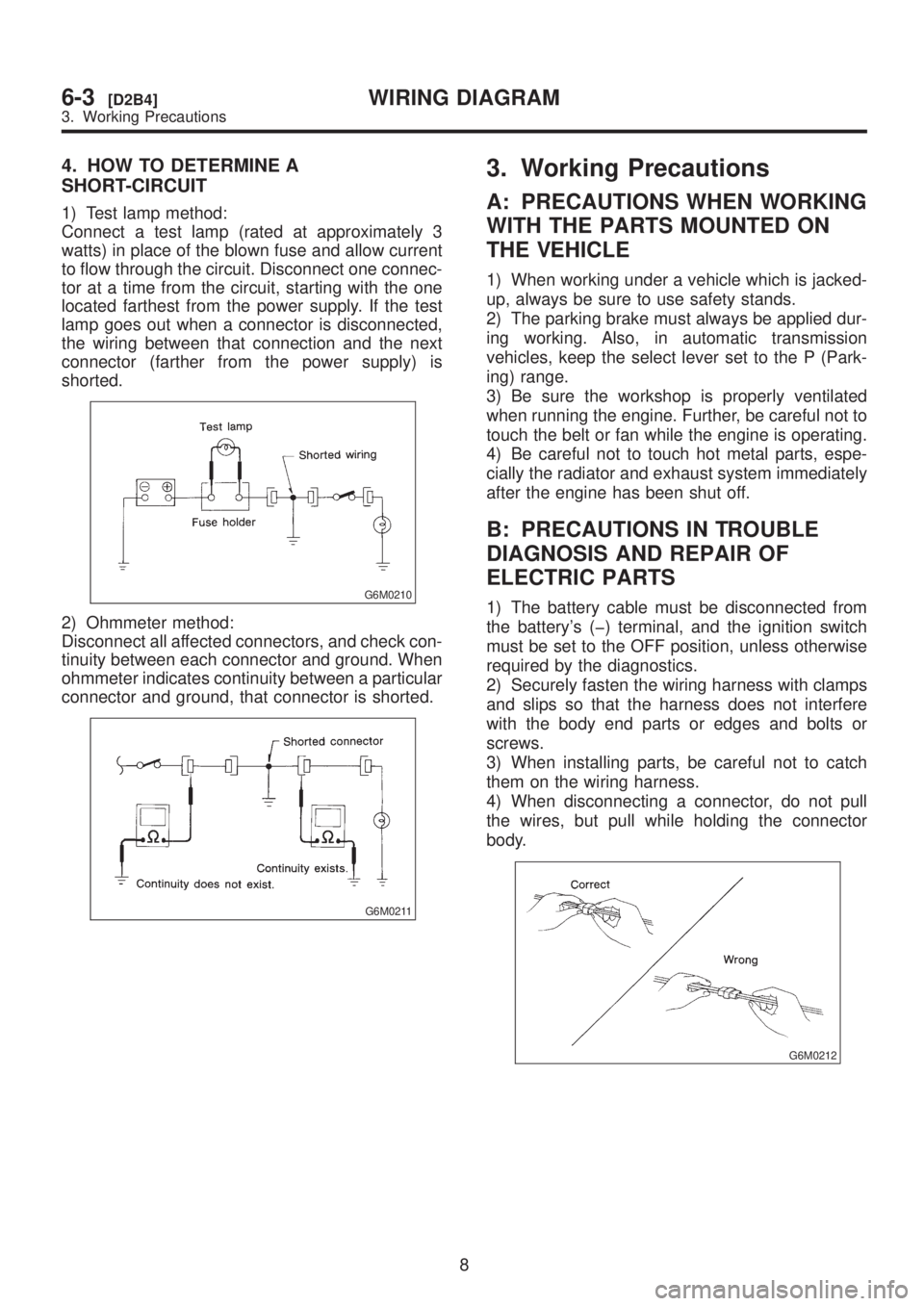
4. HOW TO DETERMINE A
SHORT-CIRCUIT
1) Test lamp method:
Connect a test lamp (rated at approximately 3
watts) in place of the blown fuse and allow current
to flow through the circuit. Disconnect one connec-
tor at a time from the circuit, starting with the one
located farthest from the power supply. If the test
lamp goes out when a connector is disconnected,
the wiring between that connection and the next
connector (farther from the power supply) is
shorted.
G6M0210
2) Ohmmeter method:
Disconnect all affected connectors, and check con-
tinuity between each connector and ground. When
ohmmeter indicates continuity between a particular
connector and ground, that connector is shorted.
G6M0211
3. Working Precautions
A: PRECAUTIONS WHEN WORKING
WITH THE PARTS MOUNTED ON
THE VEHICLE
1) When working under a vehicle which is jacked-
up, always be sure to use safety stands.
2) The parking brake must always be applied dur-
ing working. Also, in automatic transmission
vehicles, keep the select lever set to the P (Park-
ing) range.
3) Be sure the workshop is properly ventilated
when running the engine. Further, be careful not to
touch the belt or fan while the engine is operating.
4) Be careful not to touch hot metal parts, espe-
cially the radiator and exhaust system immediately
after the engine has been shut off.
B: PRECAUTIONS IN TROUBLE
DIAGNOSIS AND REPAIR OF
ELECTRIC PARTS
1) The battery cable must be disconnected from
the battery's (þ) terminal, and the ignition switch
must be set to the OFF position, unless otherwise
required by the diagnostics.
2) Securely fasten the wiring harness with clamps
and slips so that the harness does not interfere
with the body end parts or edges and bolts or
screws.
3) When installing parts, be careful not to catch
them on the wiring harness.
4) When disconnecting a connector, do not pull
the wires, but pull while holding the connector
body.
G6M0212
8
6-3[D2B4]WIRING DIAGRAM
3. Working Precautions
Page 1288 of 1456
4. HOW TO DETERMINE A
SHORT-CIRCUIT
1) Test lamp method:
Connect a test lamp (rated at approximately 3
watts) in place of the blown fuse and allow current
to flow through the circuit. Disconnect one connec-
tor at a time from the circuit, starting with the one
located farthest from the power supply. If the test
lamp goes out when a connector is disconnected,
the wiring between that connection and the next
connector (farther from the power supply) is
shorted.
G6M0210
2) Ohmmeter method:
Disconnect all affected connectors, and check con-
tinuity between each connector and ground. When
ohmmeter indicates continuity between a particular
connector and ground, that connector is shorted.
G6M0211
3. Working Precautions
A: PRECAUTIONS WHEN WORKING
WITH THE PARTS MOUNTED ON
THE VEHICLE
1) When working under a vehicle which is jacked-
up, always be sure to use safety stands.
2) The parking brake must always be applied dur-
ing working. Also, in automatic transmission
vehicles, keep the select lever set to the P (Park-
ing) range.
3) Be sure the workshop is properly ventilated
when running the engine. Further, be careful not to
touch the belt or fan while the engine is operating.
4) Be careful not to touch hot metal parts, espe-
cially the radiator and exhaust system immediately
after the engine has been shut off.
B: PRECAUTIONS IN TROUBLE
DIAGNOSIS AND REPAIR OF
ELECTRIC PARTS
1) The battery cable must be disconnected from
the battery's (þ) terminal, and the ignition switch
must be set to the OFF position, unless otherwise
required by the diagnostics.
2) Securely fasten the wiring harness with clamps
and slips so that the harness does not interfere
with the body end parts or edges and bolts or
screws.
3) When installing parts, be careful not to catch
them on the wiring harness.
4) When disconnecting a connector, do not pull
the wires, but pull while holding the connector
body.
G6M0212
8
6-3[D2B4]WIRING DIAGRAM
3. Working Precautions
Page 1290 of 1456

4. How to Use Wiring Diagram
B6M0213B
A: RELAY
A symbol used to indicate a relay.
B: CONNECTOR-1
The sketch of the connector indicates the one-pole
types.
C: WIRING CONNECTION
Some wiring diagrams are indicated in foldouts for
convenience. Wiring destinations are indicated
where necessary by corresponding symbols (as
when two pages are needed for clear indication).
D: FUSE No. & RATING
The ªFUSE No. & RATINGº corresponds that used
in the fuse box (main fuse box, and joint box).
E: CONNECTOR-2
IEach connector is indicated by a symbol.
IEach terminal number is indicated in the corre-
sponding wiring diagram in an abbreviated form.
IFor example, terminal number ªC2º refers to No.
2 terminal of connector (C: F41) shown in the con-
nector sketch.
10
6-3[D400]WIRING DIAGRAM
4. How to Use Wiring Diagram