front SUBARU OUTBACK 2016 6.G Owners Manual
[x] Cancel search | Manufacturer: SUBARU, Model Year: 2016, Model line: OUTBACK, Model: SUBARU OUTBACK 2016 6.GPages: 572, PDF Size: 21.79 MB
Page 487 of 572
Continuously variable trans-
mission fluid
There is no fluid level gauge. It is
unnecessary to check the continuously
variable transmission fluid level. However,
if necessary, consult your SUBARU dealer
for inspection.
Front differential gear oil
(CVT models) and rear differ-
ential gear oil
It is not necessary to check the gear oil
level. Check that there are no cracks,
damage or leakage. However, the oil
inspection should be performed according
to the maintenance schedule in the
“Warranty and Maintenance Booklet”.
Consult your SUBARU dealer for details.
&Recommended grade and
viscosity
Each oil manufacturer has its own base
oils and additives. Never use different
brands together. For details, refer to
“Manual transmission, front differential
and rear differential gear oil”F12-7.
CAUTION
Using a differential gear oil other
than the specified oil may cause a
decline in vehicle performance.
Brake fluid
&Checking the fluid level
WARNING
.Never let brake fluid contact your
eyes because brake fluid can be
harmful to your eyes. If brake
fluid gets in your eyes, immedi-
ately flush them thoroughly with
clean water. For safety, when
performing this work, wearing
eye protection is advisable.
.Brake fluid absorbs moisture
from the air. Any absorbed moist-
ure can cause a dangerous loss
of braking performance.
.If the vehicle requires frequent
refilling, there may be a leak. If
you suspect a problem, have the
vehicle checked at your SUBARU
dealer.
CAUTION
.When adding brake fluid, be care-
ful not to allow any dirt into the
reservoir.
.Never splash the brake fluid over
painted surfaces or rubber parts.
Maintenance and service/Continuously variable transmission fluid
–CONTINUED–11-19
Page 488 of 572
Maintenance and service/Brake fluid
Alcohol contained in the brake
fluid may damage them.
.Be careful not to spill brake fluid
when adding it. If brake fluid
touches the exhaust pipe, it may
cause a bad smell, smoke, and/or
a fire. If brake fluid gets on the
exhaust pipe, be sure to wipe it
off.
The reservoir has two chambers, one for
clutch fluid and the other for brake fluid.
Each fluid level must therefore be checked
in the appropriate chamber. Check the
fluid level on the outside of the reservoir
monthly.
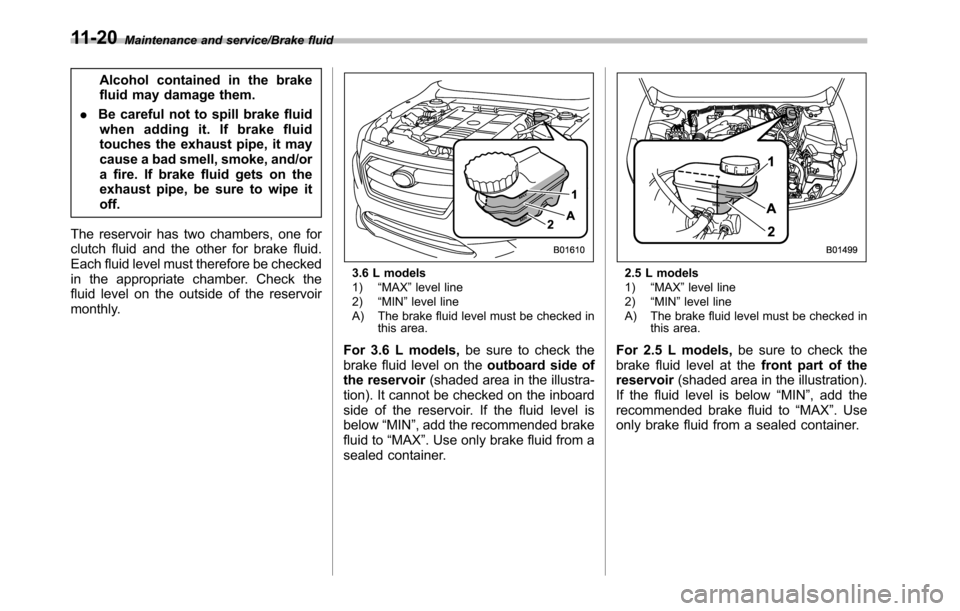
3.6 L models
1)“MAX”level line
2)“MIN”level line
A) The brake fluid level must be checked in
this area.
For 3.6 L models,be sure to check the
brake fluid level on theoutboard side of
the reservoir(shaded area in the illustra-
tion). It cannot be checked on the inboard
side of the reservoir. If the fluid level is
below“MIN”, add the recommended brake
fluid to“MAX”. Use only brake fluid from a
sealed container.
2.5 L models
1)“MAX”level line
2)“MIN”level line
A) The brake fluid level must be checked in
this area.
For 2.5 L models,be sure to check the
brake fluid level at thefront part of the
reservoir(shaded area in the illustration).
If the fluid level is below“MIN”, add the
recommended brake fluid to“MAX”. Use
only brake fluid from a sealed container.
11-20
Page 493 of 572
replace all four tires.
!Winter (snow) tires
Winter tires are best suited for driving on
snow-covered and icy roads. However
winter tires do not perform as well as
summer tires and all season tires on roads
other than snow-covered and icy roads.
&Tire pressure monitoring
system (TPMS) (if equipped)
The tire pressure monitoring system pro-
vides the driver with a warning message
by sending a signal from a sensor that is
installed in each wheel when tire pressure
is severely low. The tire pressure monitor-
ing system will activate only when the
vehicle is driven. Also, this system may
not react immediately to a sudden drop in
tire pressure (for example, a blow-out
caused by running over a sharp object).
If you adjust the tire pressures in a warm
garage and will then drive the vehicle in
cold outside air, the resulting drop in tire
pressures may cause the low tire pressure
warning light to illuminate. To avoid this
problem when adjusting the tire pressures
in a warm garage, inflate the tires to
pressures higher than those shown on the
tire placard. Specifically, inflate them by an
extra 1 psi (6.9 kPa, 0.07 kgf/cm
2) for
every difference of 108F (5.68C) betweenthe temperature in the garage and the
temperature outside. By way of example,
the following table shows the required tire
pressures that correspond to various out-
side temperatures when the temperature
in the garage is 608F (15.68C).
Example:
Tire size: 225/55R17 97V, 225/50R18 95H
Standard tire pressures:
Front: 33 psi (230 kPa, 2.3 kgf/cm
2)
Rear: 32 psi (220 kPa, 2.2 kgf/cm2)
Garage temperature: 608F (15.68C)
Outside
temperatureAdjusted pressure
[psi (kPa, kgf/cm2)]
Front
Rear
308F(−18C)36 (250, 2.5) 35 (240, 2.4)
108F(−128C)38 (265, 2.65) 37 (255, 2.55)
−108F(−238C) 40 (280, 2.8)39 (270, 2.7)
Example:
Tire size: 225/65R17 102H, 225/60R18
100H
Standard tire pressures:
Front: 35 psi (240 kPa, 2.4 kgf/cm
2)
Rear: 33 psi (230 kPa, 2.3 kgf/cm2)
Garage temperature: 608F (15.68C)
Outside
temperatureAdjusted pressure
[psi (kPa, kgf/cm2)]
Front
Rear
308F(−18C)38 (265, 2.65) 36 (250, 2.5)
108F(−128C)40 (280, 2.8) 38 (265, 2.65)
−108F(−238C) 42 (295, 2.95)40 (280, 2.8)
If the low tire pressure warning light
illuminates when you drive the vehicle in
cold outside air after adjusting the tire
pressures in a warm garage, re-adjust the
tire pressures using the method described
above. Then, increase the vehicle speed
to at least 20 mph (32 km/h) and check to
see that the low tire pressure warning light
goes off a few minutes later. If the low tire
pressure warning light does not go off, the
tire pressure monitoring system may not
be functioning normally. In this event, go
to a SUBARU dealer to have the system
inspected as soon as possible.
While the vehicle is driven, friction be-
tween tires and the road surface causes
the tires to warm up. After illumination of
the low tire pressure warning light, any
increase in the tire pressures caused by
an increase in the outside air temperature
or by an increase in the temperature in the
tires can cause the low tire pressure
warning light to go off.
Maintenance and service/Tires and wheels
–CONTINUED–11-25
Page 497 of 572
&Wear indicators
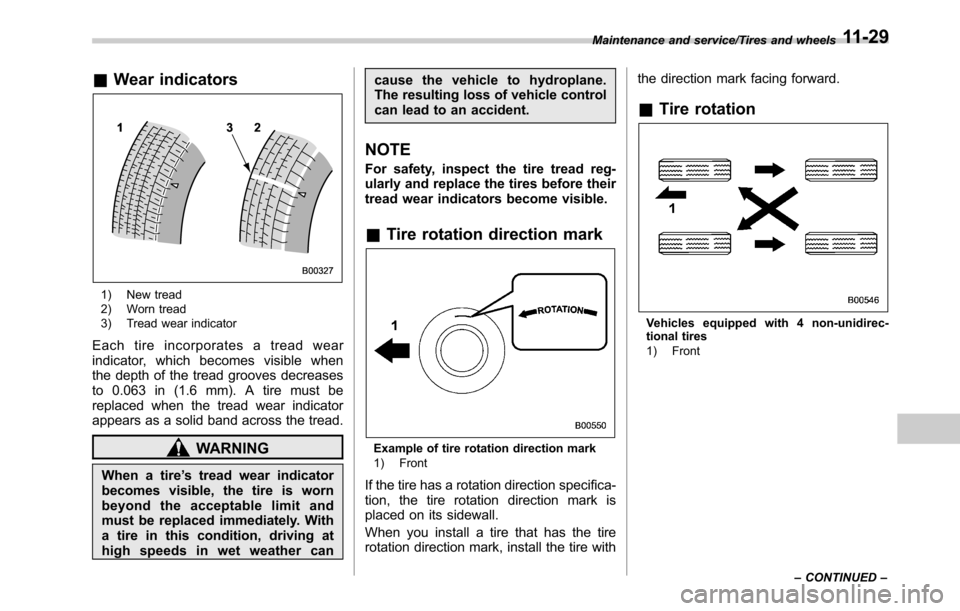
1) New tread
2) Worn tread
3) Tread wear indicator
Each tire incorporates a tread wear
indicator, which becomes visible when
the depth of the tread grooves decreases
to 0.063 in (1.6 mm). A tire must be
replaced when the tread wear indicator
appears as a solid band across the tread.
WARNING
When a tire’s tread wear indicator
becomes visible, the tire is worn
beyond the acceptable limit and
must be replaced immediately. With
a tire in this condition, driving at
high speeds in wet weather cancause the vehicle to hydroplane.
The resulting loss of vehicle control
can lead to an accident.
NOTE
For safety, inspect the tire tread reg-
ularly and replace the tires before their
tread wear indicators become visible.
&Tire rotation direction mark
Example of tire rotation direction mark
1) Front
If the tire has a rotation direction specifica-
tion, the tire rotation direction mark is
placed on its sidewall.
When you install a tire that has the tire
rotation direction mark, install the tire withthe direction mark facing forward.
&Tire rotation
Vehicles equipped with 4 non-unidirec-
tional tires
1) Front Maintenance and service/Tires and wheels
–CONTINUED–
11-29
Page 498 of 572
Maintenance and service/Tires and wheels
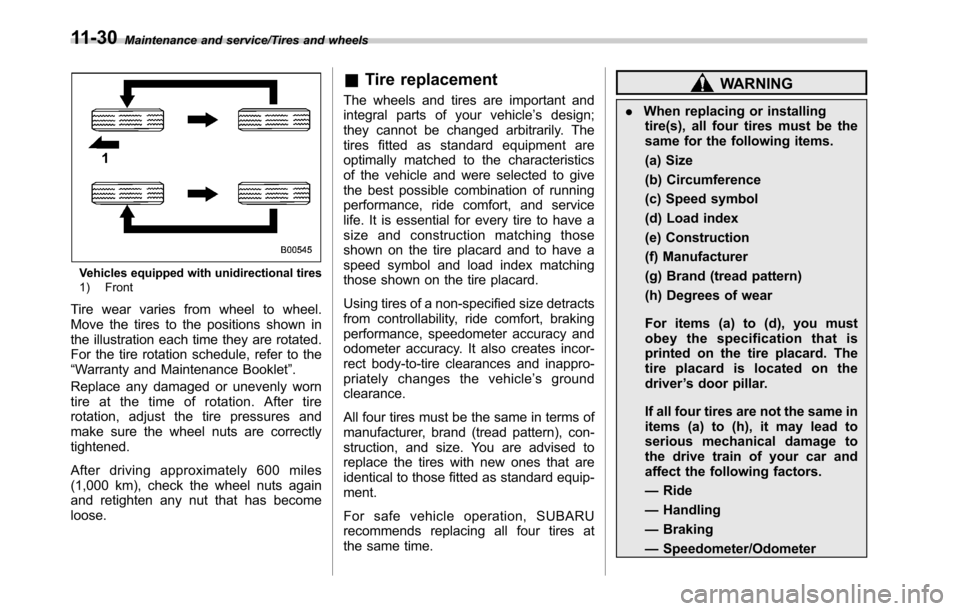
Vehicles equipped with unidirectional tires
1) Front
Tire wear varies from wheel to wheel.
Move the tires to the positions shown in
the illustration each time they are rotated.
For the tire rotation schedule, refer to the
“Warranty and Maintenance Booklet”.
Replace any damaged or unevenly worn
tire at the time of rotation. After tire
rotation, adjust the tire pressures and
make sure the wheel nuts are correctly
tightened.
After driving approximately 600 miles
(1,000 km), check the wheel nuts again
and retighten any nut that has become
loose.
&Tire replacement
The wheels and tires are important and
integral parts of your vehicle’s design;
they cannot be changed arbitrarily. The
tires fitted as standard equipment are
optimally matched to the characteristics
of the vehicle and were selected to give
the best possible combination of running
performance, ride comfort, and service
life. It is essential for every tire to have a
size and construction matching those
shown on the tire placard and to have a
speed symbol and load index matching
those shown on the tire placard.
Using tires of a non-specified size detracts
from controllability, ride comfort, braking
performance, speedometer accuracy and
odometer accuracy. It also creates incor-
rect body-to-tire clearances and inappro-
priately changes the vehicle’s ground
clearance.
All four tires must be the same in terms of
manufacturer, brand (tread pattern), con-
struction, and size. You are advised to
replace the tires with new ones that are
identical to those fitted as standard equip-
ment.
For safe vehicle operation, SUBARU
recommends replacing all four tires at
the same time.WARNING
.When replacing or installing
tire(s), all four tires must be the
same for the following items.
(a) Size
(b) Circumference
(c) Speed symbol
(d) Load index
(e) Construction
(f) Manufacturer
(g) Brand (tread pattern)
(h) Degrees of wear
For items (a) to (d), you must
obey the specification that is
printed on the tire placard. The
tire placard is located on the
driver’s door pillar.
If all four tires are not the same in
items (a) to (h), it may lead to
serious mechanical damage to
the drive train of your car and
affect the following factors.
—Ride
—Handling
—Braking
—Speedometer/Odometer
11-30
Page 502 of 572
Maintenance and service/Replacement of wiper blades
&Windshield wiper blade as-
sembly
NOTE
Do not lower the wiper arm while the
wiper blade assembly is removed.
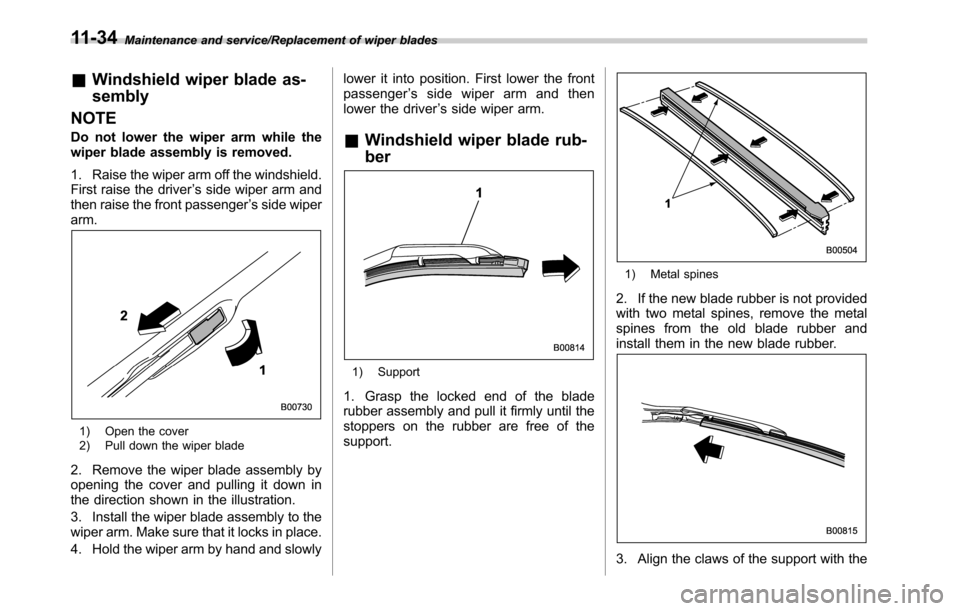
1. Raise the wiper arm off the windshield.
First raise the driver’s side wiper arm and
then raise the front passenger’s side wiper
arm.
1) Open the cover
2) Pull down the wiper blade
2. Remove the wiper blade assembly by
opening the cover and pulling it down in
the direction shown in the illustration.
3. Install the wiper blade assembly to the
wiper arm. Make sure that it locks in place.
4. Hold the wiper arm by hand and slowlylower it into position. First lower the front
passenger’s side wiper arm and then
lower the driver’s side wiper arm.
&Windshield wiper blade rub-
ber
1) Support
1. Grasp the locked end of the blade
rubber assembly and pull it firmly until the
stoppers on the rubber are free of the
support.
1) Metal spines
2. If the new blade rubber is not provided
with two metal spines, remove the metal
spines from the old blade rubber and
install them in the new blade rubber.
3. Align the claws of the support with the
11-34
Page 510 of 572
Maintenance and service/Replacing bulbs
surface.
4. To install the bulb to the headlight
assembly, turn it clockwise until it clicks.
5. Reconnect the electrical connector.
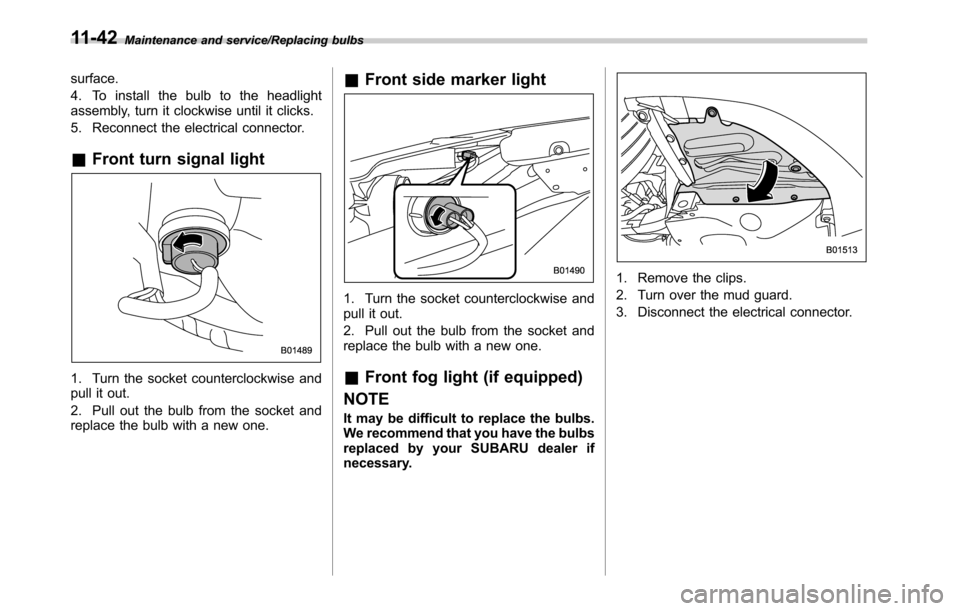
&Front turn signal light
1. Turn the socket counterclockwise and
pull it out.
2. Pull out the bulb from the socket and
replace the bulb with a new one.
&Front side marker light
1. Turn the socket counterclockwise and
pull it out.
2. Pull out the bulb from the socket and
replace the bulb with a new one.
&Front fog light (if equipped)
NOTE
It may be difficult to replace the bulbs.
We recommend that you have the bulbs
replaced by your SUBARU dealer if
necessary.
1. Remove the clips.
2. Turn over the mud guard.
3. Disconnect the electrical connector.
11-42
Page 521 of 572
Specifications..................................................... 12-2
Dimensions........................................................ 12-2
Engine............................................................... 12-3
Fuel................................................................... 12-3
Engine oil.......................................................... 12-4
Manual transmission, front differential and rear
differential gear oil........................................... 12-7
Fluids................................................................ 12-8
Engine coolant................................................... 12-8
Electrical system................................................ 12-9
Tires.................................................................. 12-9Brake disc......................................................... 12-9Fuses and circuits........................................... 12-10
Fuse panel located in the passenger
compartment................................................. 12-10
Fuse panel located in the engine
compartment................................................. 12-12
Bulb chart......................................................... 12-14Safety precautions........................................... 12-14
Bulb chart....................................................... 12-15
Vehicle identification....................................... 12-18
Specifications
12
Page 522 of 572
Specifications/Specifications
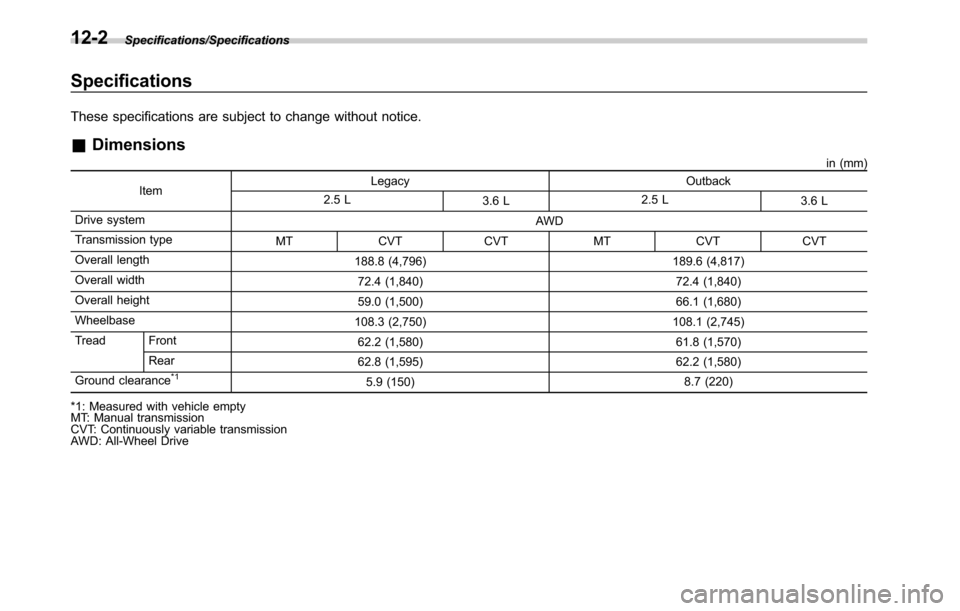
Specifications
These specifications are subject to change without notice.
&Dimensions
in (mm)
ItemLegacy Outback
2.5 L
3.6 L2.5 L
3.6 L
Drive system
AWD
Transmission type
MT CVT CVT MT CVT CVT
Overall length
188.8 (4,796) 189.6 (4,817)
Overall width
72.4 (1,840) 72.4 (1,840)
Overall height
59.0 (1,500) 66.1 (1,680)
Wheelbase
108.3 (2,750) 108.1 (2,745)
Tread Front
62.2 (1,580) 61.8 (1,570)
Rear
62.8 (1,595) 62.2 (1,580)
Ground clearance
*15.9 (150)8.7 (220)
*1: Measured with vehicle empty
MT: Manual transmission
CVT: Continuously variable transmission
AWD: All-Wheel Drive
12-2
Page 527 of 572
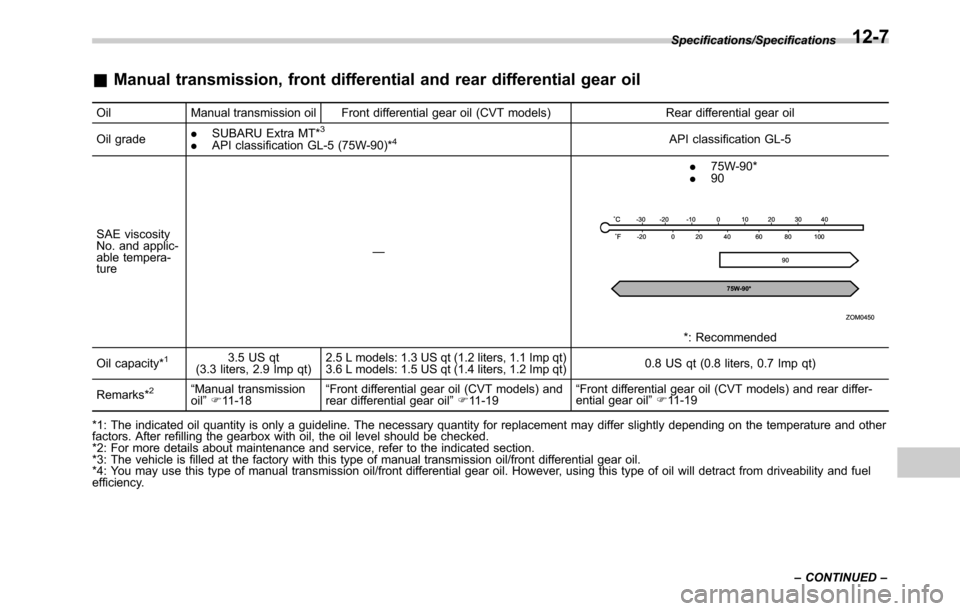
&Manual transmission, front differential and rear differential gear oil
Oil Manual transmission oil Front differential gear oil (CVT models) Rear differential gear oil
Oil grade.SUBARU Extra MT*3
.API classification GL-5 (75W-90)*4API classification GL-5
SAE viscosity
No. and applic-
able tempera-
ture—.75W-90*
.90
*: Recommended
Oil capacity*
13.5 US qt
(3.3 liters, 2.9 Imp qt)2.5 L models: 1.3 US qt (1.2 liters, 1.1 Imp qt)
3.6 L models: 1.5 US qt (1.4 liters, 1.2 Imp qt)0.8 US qt (0.8 liters, 0.7 Imp qt)
Remarks*
2“Manual transmission
oil”F11-18“Front differential gear oil (CVT models) and
rear differential gear oil”F11-19“Front differential gear oil (CVT models) and rear differ-
ential gear oil”F11-19
*1: The indicated oil quantity is only a guideline. The necessary quantity for replacement may differ slightly depending on the temperature and other
factors. After refilling the gearbox with oil, the oil level should be checked.
*2: For more details about maintenance and service, refer to the indicated section.
*3: The vehicle is filled at the factory with this type of manual transmission oil/front differential gear oil.
*4: You may use this type of manual transmission oil/front differential gear oil. However, using this type of oil will detract from driveability and fuel
efficiency.Specifications/Specifications
–CONTINUED–
12-7