front SUBARU OUTBACK 2016 6.G Owners Manual
[x] Cancel search | Manufacturer: SUBARU, Model Year: 2016, Model line: OUTBACK, Model: SUBARU OUTBACK 2016 6.GPages: 572, PDF Size: 21.79 MB
Page 451 of 572
Engine overheating
WARNING
Never attempt to remove the radia-
tor cap until the engine has been
shut off and has fully cooled down.
When the engine is hot, the coolant
is under pressure. Removing the
cap while the engine is still hot
could release a spray of boiling hot
coolant, which could burn you very
seriously.
If the engine overheats, pull off the road
safely and stop the vehicle in a safe place.
&If steam is coming from the
engine compartment
Turn off the engine and get everyone
away from the vehicle until it cools down.
&If no steam is coming from
the engine compartment
NOTE
For details about how to check the
coolant level or how to add coolant,
refer to“Engine coolant”F11-14.
1. Keep the engine running at idling
speed.2. Open the hood to ventilate the engine
compartment. Refer to“Engine hood”
F11-7.
Confirm that the cooling fan is turning. If
the fan is not turning, immediately turn off
the engine and contact your authorized
dealer for repair.
3. After the engine coolant temperature
has dropped, turn off the engine.
If the temperature gauge stays in the
overheated zone, turn off the engine.
4. After the engine has fully cooled down,
check the coolant level in the reserve
tank.
If the coolant level is below the“LOW”
mark, add coolant up to the“FULL”mark.
5. If there is no coolant in the reserve
tank, add coolant to the reserve tank.
Then remove the radiator cap and fill the
radiator with coolant.
If you remove the radiator cap from a hot
radiator, first wrap a thick cloth around the
radiator cap, then turn the cap counter-
clockwise slowly without pressing down
until it stops. Release the pressure from
the radiator. After the pressure has been
fully released, remove the cap by pressing
down and turning it.
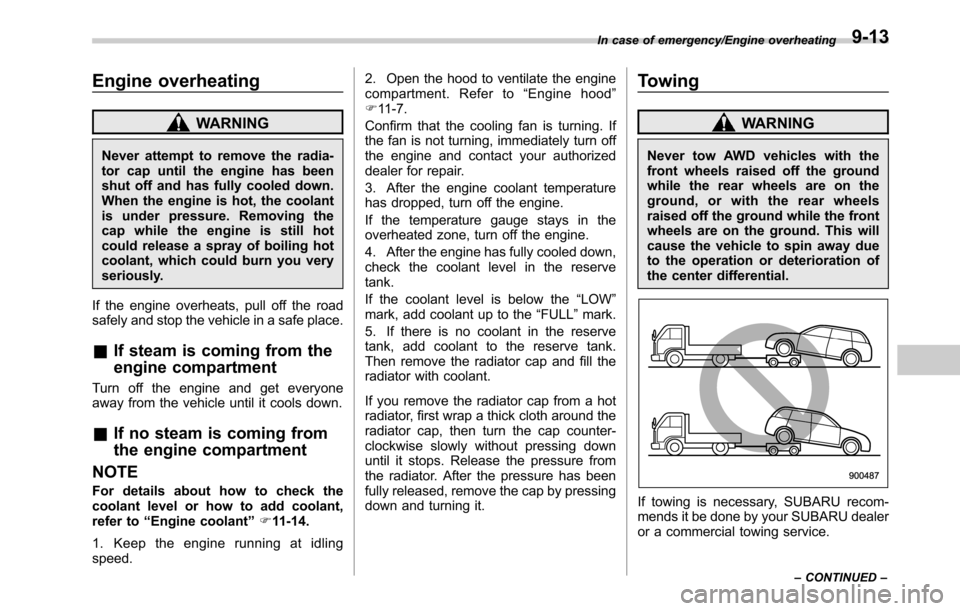
Towing
WARNING
Never tow AWD vehicles with the
front wheels raised off the ground
while the rear wheels are on the
ground, or with the rear wheels
raised off the ground while the front
wheels are on the ground. This will
cause the vehicle to spin away due
to the operation or deterioration of
the center differential.
If towing is necessary, SUBARU recom-
mends it be done by your SUBARU dealer
or a commercial towing service.
In case of emergency/Engine overheating
–CONTINUED–9-13
Page 452 of 572
In case of emergency/Towing
&Towing hooks and tie-down
hooks/holes
The towing hooks should be used only in
an emergency (e.g., to free a stuck vehicle
from mud, sand or snow).
A towing hook is supplied with Outback
only. Legacy is not supplied with a towing
hook (it is available as an accessory). On
Legacy, the towing access cover is on the
rear bumper only.
SUBARU recommends towing be done
by your SUBARU dealer or a commer-
cial towing service.
CAUTION
.Use only the specified towing
hooks and tie-down hooks/holes.
Never use suspension parts or
other parts of the body for towing
or tie-down purposes.
.Never use the tie-down hole clo-
sest to the muffler under the
vehicle for towing purposes.
.To prevent deformation to the
bumper and the towing hook, do
not apply excessive lateral load
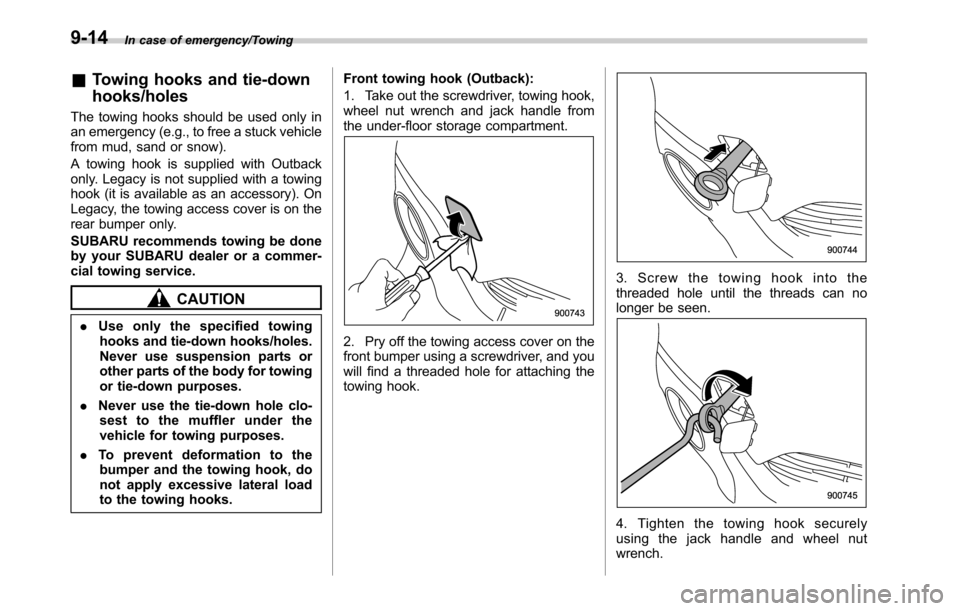
to the towing hooks.Front towing hook (Outback):
1. Take out the screwdriver, towing hook,
wheel nut wrench and jack handle from
the under-floor storage compartment.2. Pry off the towing access cover on the
front bumper using a screwdriver, and you
will find a threaded hole for attaching the
towing hook.
3. Screw the towing hook into the
threaded hole until the threads can no
longer be seen.
4. Tighten the towing hook securely
using the jack handle and wheel nut
wrench.
9-14
Page 453 of 572
After towing, remove the towing hook from
the vehicle and stow it in the under-floor
storage compartment.
Fit the towing hook cover on the bumper.
WARNING
.Do not use the towing hook
except when towing your vehicle.
.Be sure to remove the towing
hook after towing. Leaving the
towing hook mounted on the
vehicle could interfere with prop-
er operation of the SRS airbag
system in a frontal collision.
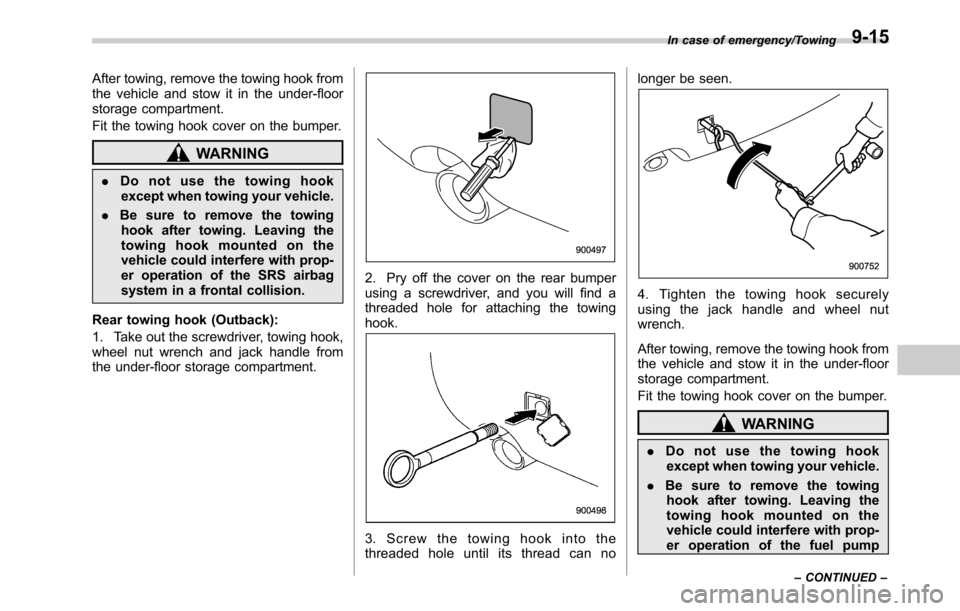
Rear towing hook (Outback):
1. Take out the screwdriver, towing hook,
wheel nut wrench and jack handle from
the under-floor storage compartment.
2. Pry off the cover on the rear bumper
using a screwdriver, and you will find a
threaded hole for attaching the towing
hook.
3. Screw the towing hook into the
threaded hole until its thread can nolonger be seen.
4. Tighten the towing hook securely
using the jack handle and wheel nut
wrench.
After towing, remove the towing hook from
the vehicle and stow it in the under-floor
storage compartment.
Fit the towing hook cover on the bumper.
WARNING
.Do not use the towing hook
except when towing your vehicle.
.Be sure to remove the towing
hook after towing. Leaving the
towing hook mounted on the
vehicle could interfere with prop-
er operation of the fuel pump
In case of emergency/Towing
–CONTINUED–9-15
Page 454 of 572
In case of emergency/Towing
shut off function when the vehi-
cle is struck from behind.
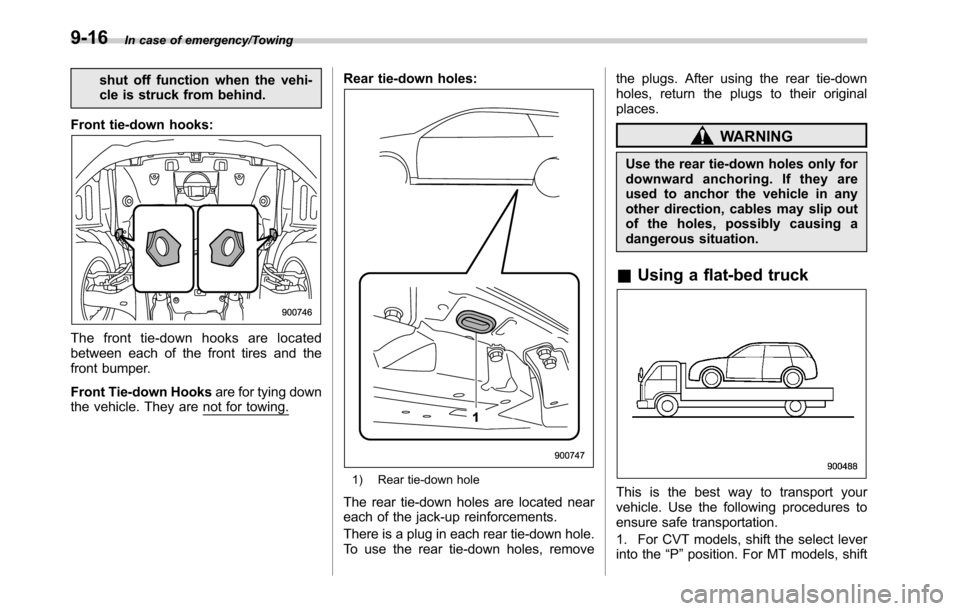
Front tie-down hooks:
The front tie-down hooks are located
between each of the front tires and the
front bumper.
Front Tie-down Hooksare for tying down
the vehicle. They are
not for towing.Rear tie-down holes:
1) Rear tie-down hole
The rear tie-down holes are located near
each of the jack-up reinforcements.
There is a plug in each rear tie-down hole.
To use the rear tie-down holes, removethe plugs. After using the rear tie-down
holes, return the plugs to their original
places.
WARNING
Use the rear tie-down holes only for
downward anchoring. If they are
used to anchor the vehicle in any
other direction, cables may slip out
of the holes, possibly causing a
dangerous situation.
&Using a flat-bed truck
This is the best way to transport your
vehicle. Use the following procedures to
ensure safe transportation.
1. For CVT models, shift the select lever
into the“P”position. For MT models, shift
9-16
Page 469 of 572
Maintenance schedule....................................... 11-3
Maintenance precautions................................... 11-3
Before checking or servicing in the engine
compartment.................................................... 11-4
When checking or servicing in the engine
compartment (2.5 L models)............................. 11-5
When checking or servicing in the engine
compartment while the engine is running.......... 11-5
Maintenance tips................................................ 11-5Removing and reinstalling clips.......................... 11-5
Engine hood....................................................... 11-7
Engine compartment overview.......................... 11-9
2.5 L models...................................................... 11-9
3.6 L models.................................................... 11-10
Engine oil.......................................................... 11-11Engine oil consumption.................................... 11-11
Checking the oil level....................................... 11-11
Changing the oil and oil filter............................ 11-13
Recommended grade and viscosity.................. 11-13
Synthetic oil..................................................... 11-13
Cooling system................................................ 11-14
Cooling fan, hose and connections................... 11-14
Engine coolant................................................. 11-14
Air cleaner element.......................................... 11-15Replacing the air cleaner element..................... 11-15
Spark plugs...................................................... 11-18Recommended spark plugs.............................. 11-18
Drive belts........................................................ 11-18
Manual transmission oil.................................. 11-18
Recommended grade and viscosity.................. 11-18
Continuously variable transmission fluid...... 11-19
Front differential gear oil (CVT models) and
rear differential gear oil................................ 11-19
Recommended grade and viscosity.................. 11-19
Brake fluid........................................................ 11-19Checking the fluid level.................................... 11-19
Recommended brake fluid............................... 11-21
Clutch fluid (MT models)................................. 11-21Checking the fluid level.................................... 11-21
Recommended clutch fluid............................... 11-22
Brake booster.................................................. 11-22
Brake pedal...................................................... 11-22
Checking the brake pedal free play.................. 11-22
Checking the brake pedal reserve distance....... 11-23
Clutch pedal (MT models)............................... 11-23Checking the clutch function............................ 11-23
Checking the clutch pedal free play.................. 11-23
Replacement of brake pad.............................. 11-24Breaking-in of new brake pads ......................... 11-24
Tires and wheels.............................................. 11-24Types of tires................................................... 11-24
Tire pressure monitoring system (TPMS) (if
equipped)...................................................... 11-25
Tire inspection................................................. 11-26
Tire pressures and wear.................................. 11-27
Wheel balance................................................. 11-28
Wear indicators............................................... 11-29
Tire rotation direction mark.............................. 11-29
Tire rotation..................................................... 11-29
Tire replacement.............................................. 11-30
Maintenance and service
11
Page 470 of 572

Maintenance and service
Wheel replacement........................................... 11-31
Aluminum wheels............................................. 11-31
Windshield washer fluid.................................. 11-32
Replacement of wiper blades.......................... 11-33
Windshield wiper blade assembly..................... 11-34
Windshield wiper blade rubber......................... 11-34
Rear window wiper blade assembly
(Outback)....................................................... 11-35
Rear window wiper blade rubber (Outback) ....... 11-36
Battery............................................................... 11-37
Fuses................................................................ 11-38
Installation of accessories............................... 11-40
Replacing bulbs............................................... 11-40
HID headlights (if equipped)............................. 11-40
Halogen headlights.......................................... 11-40Front turn signal light...................................... 11-42
Front side marker light..................................... 11-42
Front fog light (if equipped).............................. 11-42
Rear combination lights................................... 11-43
Backup light.................................................... 11-45
License plate light........................................... 11-47
Dome light....................................................... 11-48
Map light......................................................... 11-48
Door step light................................................. 11-48
Cargo area light (Outback)............................... 11-49
Trunk light (Legacy)......................................... 11-49
Other bulbs..................................................... 11-49
Replacing battery............................................. 11-49Replacing battery of access key....................... 11-50
Replacing battery of transmitter....................... 11-51
Page 476 of 572
Maintenance and service/Engine hood
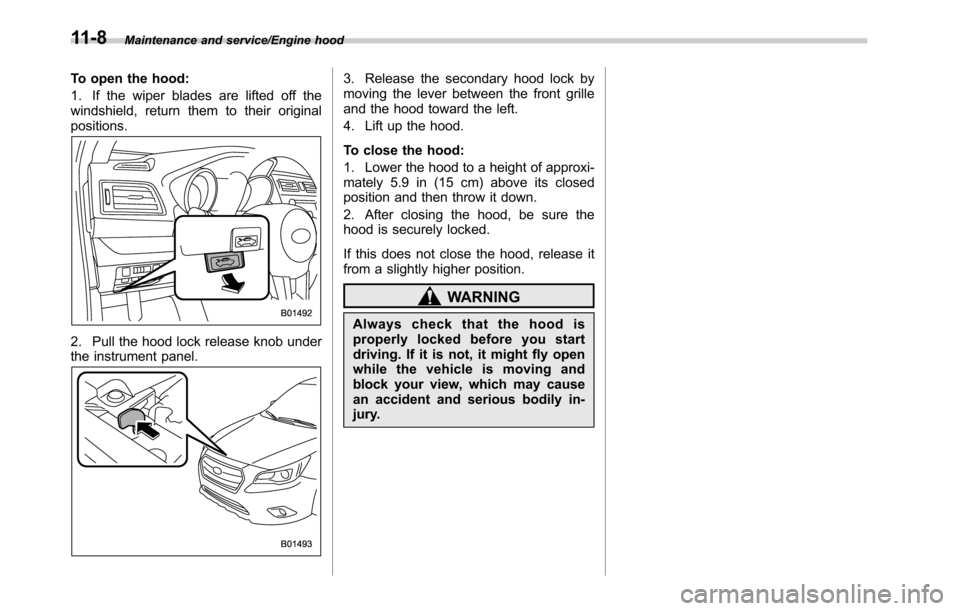
To open the hood:
1. If the wiper blades are lifted off the
windshield, return them to their original
positions.
2. Pull the hood lock release knob under
the instrument panel.
3. Release the secondary hood lock by
moving the lever between the front grille
and the hood toward the left.
4. Lift up the hood.
To close the hood:
1. Lower the hood to a height of approxi-
mately 5.9 in (15 cm) above its closed
position and then throw it down.
2. After closing the hood, be sure the
hood is securely locked.
If this does not close the hood, release it
from a slightly higher position.
WARNING
Always check that the hood is
properly locked before you start
driving. If it is not, it might fly open
while the vehicle is moving and
block your view, which may cause
an accident and serious bodily in-
jury.
11-8
Page 484 of 572
Maintenance and service/Air cleaner element
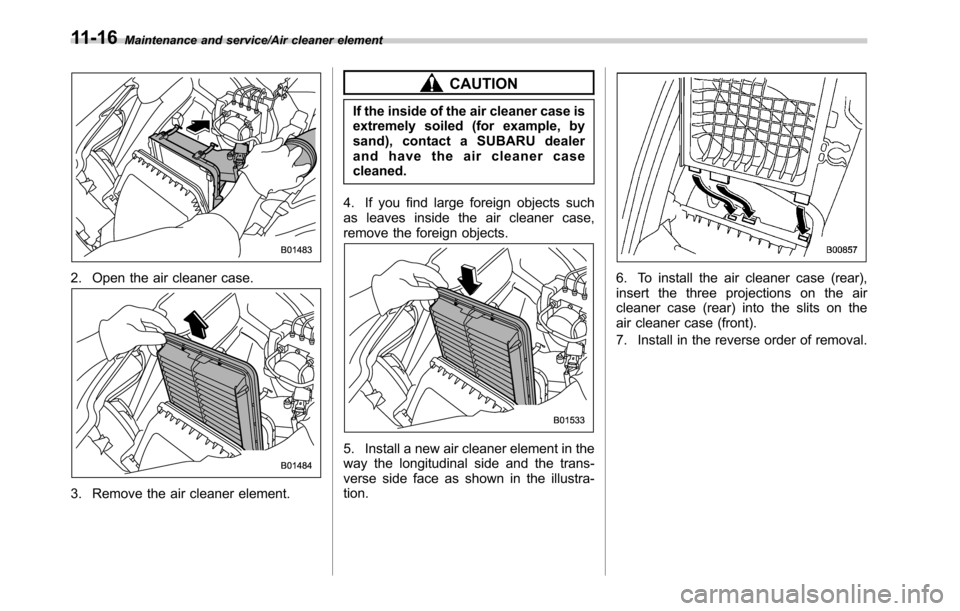
2. Open the air cleaner case.
3. Remove the air cleaner element.
CAUTION
If the inside of the air cleaner case is
extremely soiled (for example, by
sand), contact a SUBARU dealer
and have the air cleaner case
cleaned.
4. If you find large foreign objects such
as leaves inside the air cleaner case,
remove the foreign objects.
5. Install a new air cleaner element in the
way the longitudinal side and the trans-
verse side face as shown in the illustra-
tion.
6. To install the air cleaner case (rear),
insert the three projections on the air
cleaner case (rear) into the slits on the
air cleaner case (front).
7. Install in the reverse order of removal.
11-16
Page 485 of 572
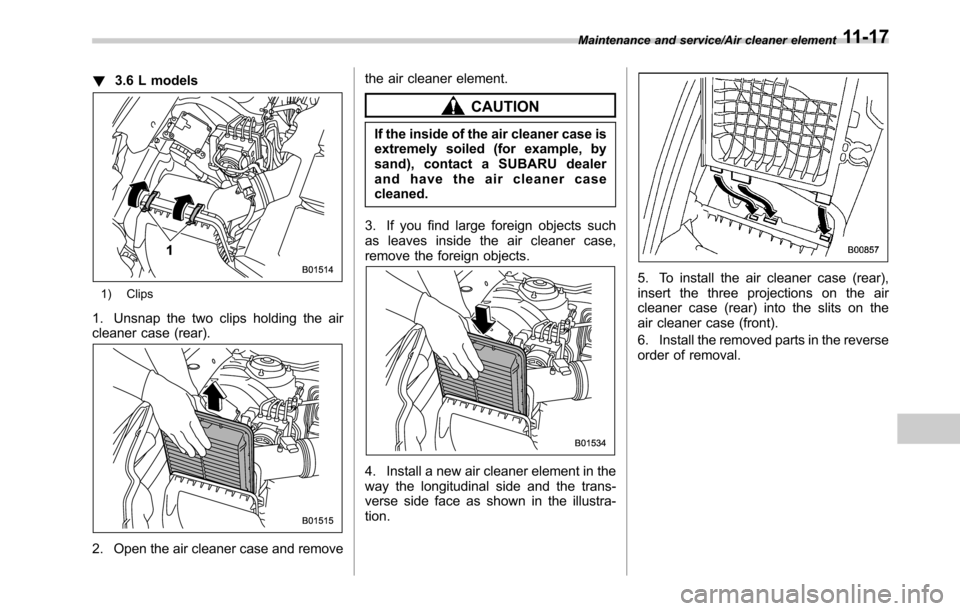
!3.6 L models
1) Clips
1. Unsnap the two clips holding the air
cleaner case (rear).
2. Open the air cleaner case and removethe air cleaner element.
CAUTION
If the inside of the air cleaner case is
extremely soiled (for example, by
sand), contact a SUBARU dealer
and have the air cleaner case
cleaned.
3. If you find large foreign objects such
as leaves inside the air cleaner case,
remove the foreign objects.
4. Install a new air cleaner element in the
way the longitudinal side and the trans-
verse side face as shown in the illustra-
tion.
5. To install the air cleaner case (rear),
insert the three projections on the air
cleaner case (rear) into the slits on the
air cleaner case (front).
6. Install the removed parts in the reverse
order of removal.
Maintenance and service/Air cleaner element11-17
Page 486 of 572

Maintenance and service/Spark plugs
Spark plugs
It may be difficult to replace the spark
plugs. It is recommended that you have
the spark plugs replaced by your
SUBARU dealer.
The spark plugs should be replaced
according to the maintenance schedule
in the“Warranty and Maintenance Book-
let”.
&Recommended spark plugs
Refer to“Electrical system”F12-9.
Drive belts
It is unnecessary to check the deflection of
the drive belt periodically because your
engine is equipped with an automatic belt
tension adjuster. However, replacement of
the belt should be done according to the
maintenance schedule in the“Warranty
and Maintenance Booklet”. Consult your
SUBARU dealer for replacement.
If the belt is loose, cracked or worn,
contact your SUBARU dealer.
Manual transmission oil
It is unnecessary to check the manual
transmission oil level. However, if neces-
sary, consult your SUBARU dealer for
inspection.
&Recommended grade and
viscosity
Each oil manufacturer has its own base
oils and additives. Never use different
brands together. For details, refer to
“Manual transmission, front differential
and rear differential gear oil”F12-7.
11-18