arm SUBARU OUTBACK 2016 6.G Owners Manual
[x] Cancel search | Manufacturer: SUBARU, Model Year: 2016, Model line: OUTBACK, Model: SUBARU OUTBACK 2016 6.GPages: 572, PDF Size: 21.79 MB
Page 8 of 572
Safety precautions when
driving
&Seatbelt and SRS airbag
WARNING
.All persons in the vehicle should
fasten their seatbelts BEFORE
the vehicle starts to move. Other-
wise, the possibility of serious
injury becomes greater in the
event of a sudden stop or acci-
dent.
.To obtain maximum protection in
the event of an accident, the
driver and all passengers in the
vehicle should always wear seat-
belts when the vehicle is moving.
The SRS (Supplemental Restraint
System) airbag does not do away
with the need to fasten seatbelts.
In combination with the seat-
belts, it offers the best combined
protection in case of a serious
accident.
Not wearing a seatbelt increases
the chance of severe injury or
death in a crash even when the
vehicle has the SRS airbag..The SRS airbags deploy with
considerable speed and force.
Occupants who are out of proper
position when the SRS airbag
deploys could suffer very serious
injuries. Because the SRS airbag
needs enough space for deploy-
ment, the driver should always
sit upright and well back in the
seat as far from the steering
wheel as practical while still
maintaining full vehicle control
and the front passenger should
move the seat as far back as
possible and sit upright and well
back in the seat.
For instructions and precautions, carefully
read the following sections.
.For the seatbelt system, refer to“Seat-
belts”F1-16.
.For the SRS airbag system, refer to
“*SRS airbag (Supplemental Restraint
System airbag)”F1-41.
&Child safety
WARNING
.Never hold a child on your lap or
in your arms while the vehicle is
moving. The passenger cannot
protect the child from injury in a
collision, because the child will
be caught between the passen-
ger and objects inside the vehi-
cle.
.While riding in the vehicle, in-
fants and small children should
always be placed in the REAR
seat in an infant or child restraint
system which is appropriate for
the child’s age, height and
weight. If a child is too big for a
child restraint system, the child
should sit in the REAR seat and
be restrained using the seatbelts.
According to accident statistics,
children are safer when properly
restrained in the rear seating
positions than in the front seat-
ing positions. Never allow a child
to stand up or kneel on the seat.
.Put children in the REAR seat
properly restrained at all times in
a child restraint device or in a
seatbelt. The SRS airbag deploys
4
Page 10 of 572
.If at any time you suspect that
exhaust fumes are entering the
vehicle, have the problem
checked and corrected as soon
as possible. If you must drive
under these conditions, drive
only with all windows fully open.
.Keep the trunk lid or rear gate
closed while driving to prevent
exhaust gas from entering the
vehicle.
&Drinking and driving
WARNING
Drinking and then driving is very
dangerous. Alcohol in the blood-
stream delays your reaction and
impairs your perception, judgment
and attentiveness. If you drive after
drinking–even if you drink just a
little–it will increase the risk of
being involved in a serious or fatal
accident, injuring or killing yourself,
your passengers and others. In
addition, if you are injured in the
accident, alcohol may increase the
severity of that injury.Please don’t drink and drive.
Drunken driving is one of the most
frequent causes of accidents. Since alco-
hol affects all people differently, you may
have consumed too much alcohol to drive
safely even if the level of alcohol in your
blood is below the legal limit. The safest
thing you can do is never drink and drive.
However if you have no choice but to
drive, stop drinking and sober up comple-
tely before getting behind the wheel.
&Drugs and driving
WARNING
There are some drugs (over the
counter and prescription) that can
delay your reaction time and impair
your perception, judgment and at-
tentiveness. If you drive after taking
them, it may increase your, your
passengers’and other persons’risk
of being involved in a serious or
fatal accident.
If you are taking any drugs, check with
your doctor or pharmacist or read the
literature that accompanies the medication
to determine if the drug you are taking can
impair your driving ability. Do not driveafter taking any medications that can
make you drowsy or otherwise affect your
ability to safely operate a motor vehicle. If
you have a medical condition that requires
you to take drugs, please consult with
your doctor.
Never drive if you are under the influence
of any illicit mind-altering drugs. For your
own health and well-being, we urge you
not to take illegal drugs in the first place
and to seek treatment if you are addicted
to those drugs.
&Driving when tired or sleepy
WARNING
When you are tired or sleepy, your
reaction will be delayed and your
perception, judgment and attentive-
ness will be impaired. If you drive
when tired or sleepy, your, your
passengers’and other persons’
chances of being involved in a
serious accident may increase.
Please do not continue to drive but
instead find a safe place to rest if you
are tired or sleepy. On long trips, you
should make periodic rest stops to refresh
yourself before continuing on your journey.
When possible, you should share the
6
Page 12 of 572
General information
&California proposition 65
warning
WARNING
Engine exhaust, some of its consti-
tuents, and certain vehicle compo-
nents contain or emit chemicals
known to the State of California to
cause cancer and birth defects or
other reproductive harm. In addi-
tion, certain fluids in vehicles and
certain components of product wear
contain or emit chemicals known to
the State of California to cause
cancer and birth defects or other
reproductive harm.
&California Perchlorate Advi-
sory
Certain vehicle components such as air-
bag modules, seatbelt pretensioners and
keyless entry transmitter batteries may
contain perchlorate material. Special
handling may apply for service or vehicle
end of life disposal. See www.dtsc.ca.gov/
hazardouswaste/perchlorate.
&Noise from under the vehicle
NOTE
You may hear a noise from under the
vehicle approximately 5 to 10 hours
after the engine is turned off. However,
this does not indicate a malfunction.
This noise is caused by the operation
of the fuel evaporation leakage check-
ing system and the operation is normal.
The noise will stop after approximately
15 minutes.
&Event data recorder
This vehicle is equipped with an event
data recorder (EDR). The main purpose of
an EDR is to record, in certain crash or
near crash-like situations, such as an air
bag deployment or hitting a road obstacle,
data that will assist in understanding how
a vehicle’s systems performed. The EDR
is designed to record data related to
vehicle dynamics and safety systems for
a short period of time, typically 30 seconds
or less. The EDR in this vehicle is
designed to record such data as:
.How various systems in your vehicle
were operating;
.Whether or not the driver and passen-
ger safety belts were buckled/fastened;
.How far (if at all) the driver was
depressing the accelerator and/or brakepedal; and,
.How fast the vehicle was traveling.
These data can help provide a better
understanding of the circumstances in
which crashes and injuries occur. NOTE:
EDR data are recorded by your vehicle
only if a non-trivial crash situation occurs;
no data are recorded by the EDR under
normal driving conditions and no personal
data (e.g., name, gender, age, and crash
location) are recorded. However, other
parties, such as law enforcement, could
combine the EDR data with the type of
personally identifying data routinely ac-
quired during a crash investigation.
To read data recorded by an EDR, special
equipment is required, and access to the
vehicle or the EDR is needed. In addition
to the vehicle manufacturer, other parties,
such as law enforcement, that have the
special equipment, can read the informa-
tion if they have access to the vehicle or
the EDR.
8
Page 29 of 572

Function settings
A SUBARU dealer can change the settings of the functions shown in the following table to meet your personal requirements. Contact
the nearest SUBARU dealer for details. Furthermore, some useful function settings are available using the multi information display.
For details, refer to“Menu screens”F3-38.
Item Function Possible settings Default setting Page
Alarm system Alarm system Operation/Non-operation Operation 2-28
Monitoring start delay time
(after closing doors)0 seconds/30 seconds 30 seconds 2-29
Impact sensor operation (only
models with shock sensors
(dealer option))Operation/Non-operation Non-operation 2-32
Map light/Dome light/Cargo
area light illuminationON/OFF OFF 2-28
Keyless access with push-
button start system
*1Audible signal*2ON/OFF ON 2-18, 2-47, 3-42
Audible signal volume*3Level 1 to 7 Level 5 2-18, 3-24, 3-42
Hazard warning flasher ON/OFF ON 2-18, 3-42
Door unlock selection (driver’s
door unlock)Driver’s door only/All doors Driver’s door only 2-17, 3-42
Door unlock selection (rear
gate unlock)Rear gate only, All doors Rear gate only
Remote keyless entry system Audible signal
*2ON/OFF ON 2-25, 2-26,
2-47, 3-42
Audible signal volume
*3Level 1 to 7 Level 5 2-25, 2-26, 3-42
Hazard warning flasher ON/OFF ON 2-25, 2-26, 3-42
Key lock-in prevention Key lock-in prevention Operation/Non-operation Operation 2-9
–CONTINUED–
25
Page 31 of 572

Front seats........................................................... 1-2
Manual seat (if equipped).................................... 1-4
Power seat (if equipped)...................................... 1-5
Head restraint adjustment.................................... 1-8
Seat heater (if equipped).................................... 1-9
Front seat heater (if equipped)............................ 1-10
Rear seat heater (if equipped)............................. 1-10
Rear seats........................................................... 1-11Reclining the seatback (Outback)........................ 1-11
Folding down the rear seatback.......................... 1-12
Head restraint adjustment................................... 1-14
Armrest............................................................. 1-15
Seatbelts............................................................. 1-16Seatbelt safety tips............................................. 1-16
Emergency Locking Retractor (ELR)................... 1-17
Automatic Locking Retractor/Emergency Locking
Retractor (ALR/ELR)......................................... 1-17
Seatbelt warning light and chime........................ 1-17
Fastening the seatbelt........................................ 1-17
Seatbelt maintenance......................................... 1-24
Front seatbelt pretensioners............................. 1-24System monitors................................................ 1-26
System servicing................................................ 1-26Precautions against vehicle modification............ 1-27
Child restraint systems..................................... 1-27Where to place a child restraint system.............. 1-28
Choosing a child restraint system...................... 1-30
Installing child restraint systems with ALR/ELR
seatbelt........................................................... 1-30
Installing a booster seat..................................... 1-34
Installation of child restraint systems by use of
lower and tether anchorages (LATCH).............. 1-35
Top tether anchorages....................................... 1-38
*SRS airbag (Supplemental Restraint
System airbag)................................................ 1-41
General precautions regarding SRS airbag
system............................................................ 1-41
Components...................................................... 1-48
SUBARU advanced frontal airbag system, SRS
seat cushion airbag, SRS side airbag and SRS
curtain airbag.................................................. 1-51
System operation............................................... 1-56
SRS airbag system monitors.............................. 1-68
SRS airbag system servicing ............................. 1-69
Precautions against vehicle modification............ 1-70
Seat, seatbelt and SRS airbags
1
Page 39 of 572
are located on the top of the seatback until
the head restraint locks. Press and hold
the release button to lower the head
restraint.
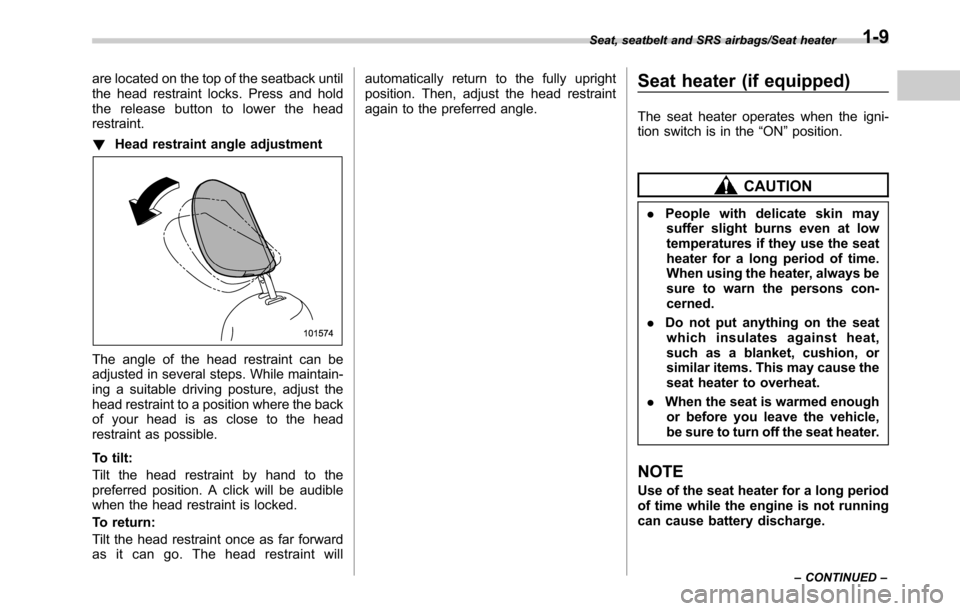
!Head restraint angle adjustment
The angle of the head restraint can be
adjusted in several steps. While maintain-
ing a suitable driving posture, adjust the
head restraint to a position where the back
of your head is as close to the head
restraint as possible.
To tilt:
Tilt the head restraint by hand to the
preferred position. A click will be audible
when the head restraint is locked.
To return:
Tilt the head restraint once as far forward
as it can go. The head restraint willautomatically return to the fully upright
position. Then, adjust the head restraint
again to the preferred angle.
Seat heater (if equipped)
The seat heater operates when the igni-
tion switch is in the“ON”position.
CAUTION
.People with delicate skin may
suffer slight burns even at low
temperatures if they use the seat
heater for a long period of time.
When using the heater, always be
sure to warn the persons con-
cerned.
.Do not put anything on the seat
which insulates against heat,
such as a blanket, cushion, or
similar items. This may cause the
seat heater to overheat.
.When the seat is warmed enough
or before you leave the vehicle,
be sure to turn off the seat heater.
NOTE
Use of the seat heater for a long period
of time while the engine is not running
can cause battery discharge.
Seat, seatbelt and SRS airbags/Seat heater
–CONTINUED–1-9
Page 45 of 572
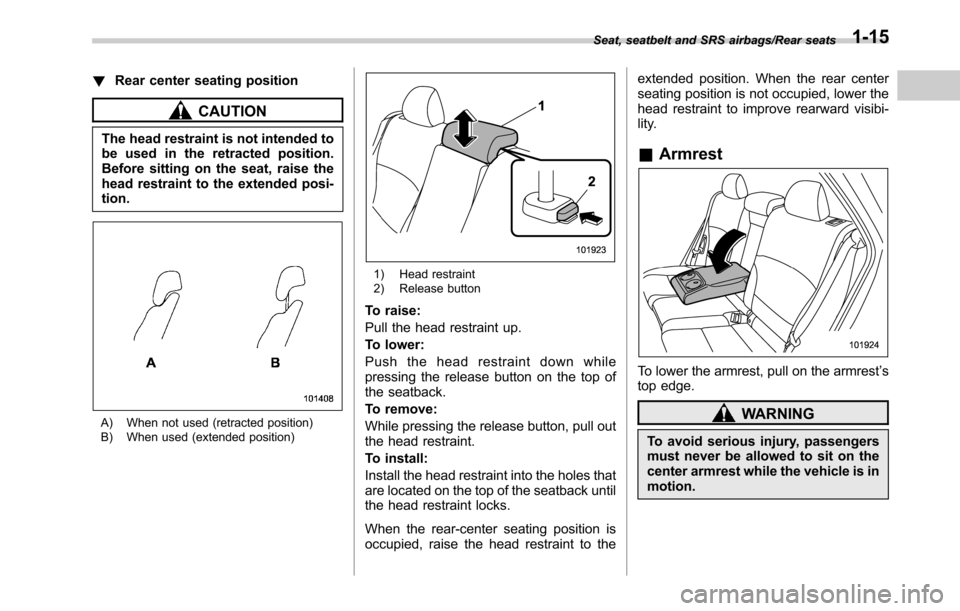
!Rear center seating position
CAUTION
The head restraint is not intended to
be used in the retracted position.
Before sitting on the seat, raise the
head restraint to the extended posi-
tion.
A) When not used (retracted position)
B) When used (extended position)
1) Head restraint
2) Release button
To raise:
Pull the head restraint up.
To lower:
Push the head restraint down while
pressing the release button on the top of
the seatback.
To remove:
While pressing the release button, pull out
the head restraint.
To install:
Install the head restraint into the holes that
are located on the top of the seatback until
the head restraint locks.
When the rear-center seating position is
occupied, raise the head restraint to theextended position. When the rear center
seating position is not occupied, lower the
head restraint to improve rearward visibi-
lity.
&Armrest
To lower the armrest, pull on the armrest’s
top edge.
WARNING
To avoid serious injury, passengers
must never be allowed to sit on the
center armrest while the vehicle is in
motion.
Seat, seatbelt and SRS airbags/Rear seats1-15
Page 47 of 572
shoulder belt fit. Care must be taken to
securely place the lap belt as low as
possible on the hips and not on the child’s
waist. If the shoulder portion of the belt
cannot be properly positioned, a child
restraint system should be used. Never
place the shoulder belt under the child’s
arm or behind the child’s back.
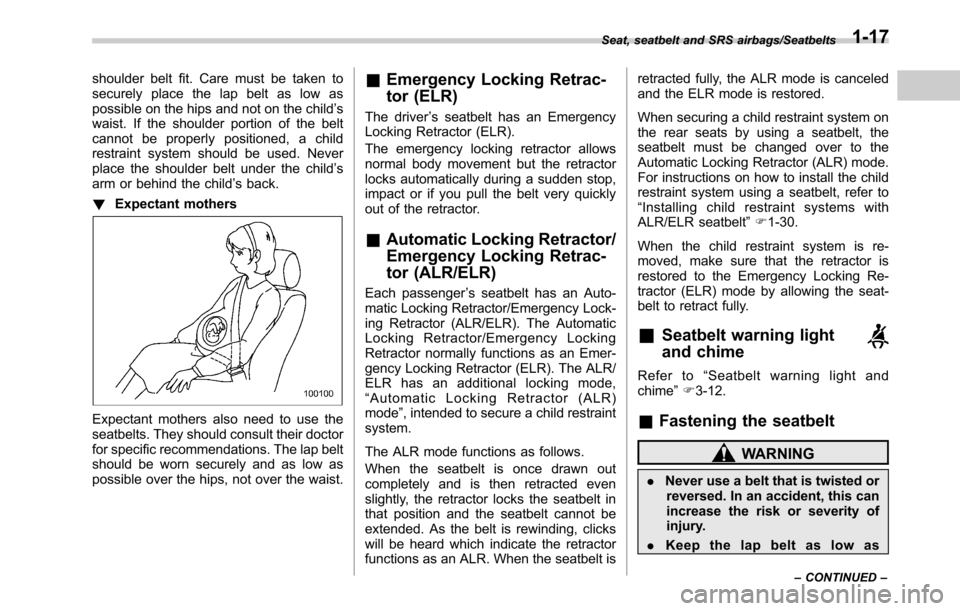
!Expectant mothers
Expectant mothers also need to use the
seatbelts. They should consult their doctor
for specific recommendations. The lap belt
should be worn securely and as low as
possible over the hips, not over the waist.
&Emergency Locking Retrac-
tor (ELR)
The driver’s seatbelt has an Emergency
Locking Retractor (ELR).
The emergency locking retractor allows
normal body movement but the retractor
locks automatically during a sudden stop,
impact or if you pull the belt very quickly
out of the retractor.
&Automatic Locking Retractor/
Emergency Locking Retrac-
tor (ALR/ELR)
Each passenger’s seatbelt has an Auto-
matic Locking Retractor/Emergency Lock-
ing Retractor (ALR/ELR). The Automatic
Locking Retractor/Emergency Locking
Retractor normally functions as an Emer-
gency Locking Retractor (ELR). The ALR/
ELR has an additional locking mode,
“Automatic Locking Retractor (ALR)
mode”, intended to secure a child restraint
system.
The ALR mode functions as follows.
When the seatbelt is once drawn out
completely and is then retracted even
slightly, the retractor locks the seatbelt in
that position and the seatbelt cannot be
extended. As the belt is rewinding, clicks
will be heard which indicate the retractor
functions as an ALR. When the seatbelt isretracted fully, the ALR mode is canceled
and the ELR mode is restored.
When securing a child restraint system on
the rear seats by using a seatbelt, the
seatbelt must be changed over to the
Automatic Locking Retractor (ALR) mode.
For instructions on how to install the child
restraint system using a seatbelt, refer to
“Installing child restraint systems with
ALR/ELR seatbelt”F1-30.
When the child restraint system is re-
moved, make sure that the retractor is
restored to the Emergency Locking Re-
tractor (ELR) mode by allowing the seat-
belt to retract fully.
&Seatbelt warning light
and chime
Refer to“Seatbelt warning light and
chime”F3-12.
&Fastening the seatbelt
WARNING
.Never use a belt that is twisted or
reversed. In an accident, this can
increase the risk or severity of
injury.
.Keep the lap belt as low as
Seat, seatbelt and SRS airbags/Seatbelts
–CONTINUED–1-17
Page 48 of 572
Seat, seatbelt and SRS airbags/Seatbelts
possible on your hips. In a colli-
sion, this spreads the force of the
lap belt over stronger hip bones
instead of across the weaker
abdomen.
.Seatbelts provide maximum re-
straint when the occupant sits
well back and upright in the seat.
To reduce the risk of sliding
under the seatbelt in a collision,
the front seatbacks should be
always used in the upright posi-
tion while the vehicle is running.
If the front seatbacks are not
used in the upright position in a
collision, the risk of sliding under
the lap belt and of the lap belt
sliding up over the abdomen will
increase, and both can result in
serious internal injury or death.
.Do not put cushions or any other
materials between occupants
and seatbacks or seat cushions.
If you do so, the risk of sliding
under the lap belt and of the lap
belt sliding up over the abdomen
will increase, and both can result
in serious internal injury or
death.
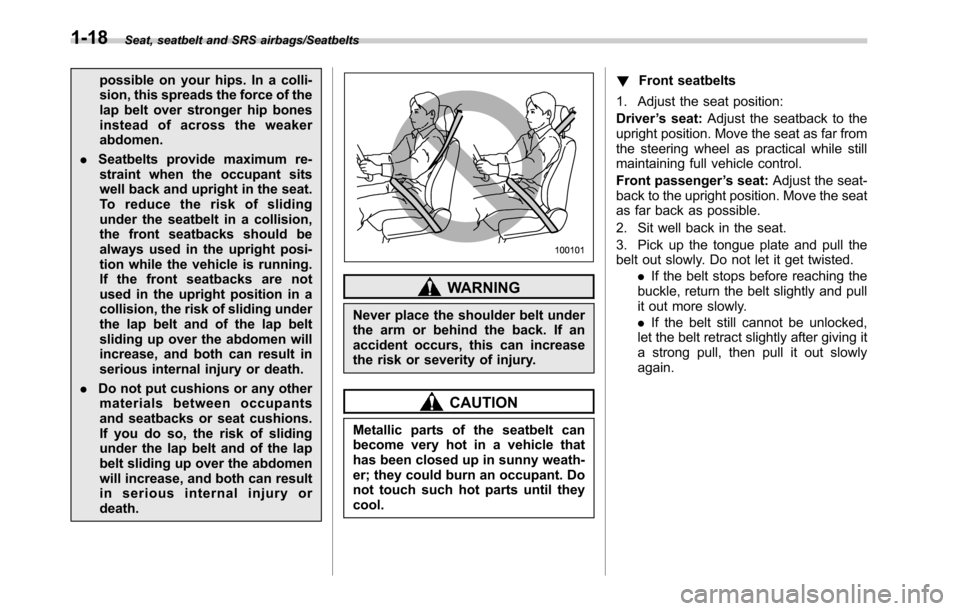
WARNING
Never place the shoulder belt under
the arm or behind the back. If an
accident occurs, this can increase
the risk or severity of injury.
CAUTION
Metallic parts of the seatbelt can
become very hot in a vehicle that
has been closed up in sunny weath-
er; they could burn an occupant. Do
not touch such hot parts until they
cool.!Front seatbelts
1. Adjust the seat position:
Driver’s seat:Adjust the seatback to the
upright position. Move the seat as far from
the steering wheel as practical while still
maintaining full vehicle control.
Front passenger’s seat:Adjust the seat-
back to the upright position. Move the seat
as far back as possible.
2. Sit well back in the seat.
3. Pick up the tongue plate and pull the
belt out slowly. Do not let it get twisted.
.If the belt stops before reaching the
buckle, return the belt slightly and pull
it out more slowly.
.If the belt still cannot be unlocked,
let the belt retract slightly after giving it
a strong pull, then pull it out slowly
again.
1-18
Page 54 of 572
Seat, seatbelt and SRS airbags/Front seatbelt pretensioners
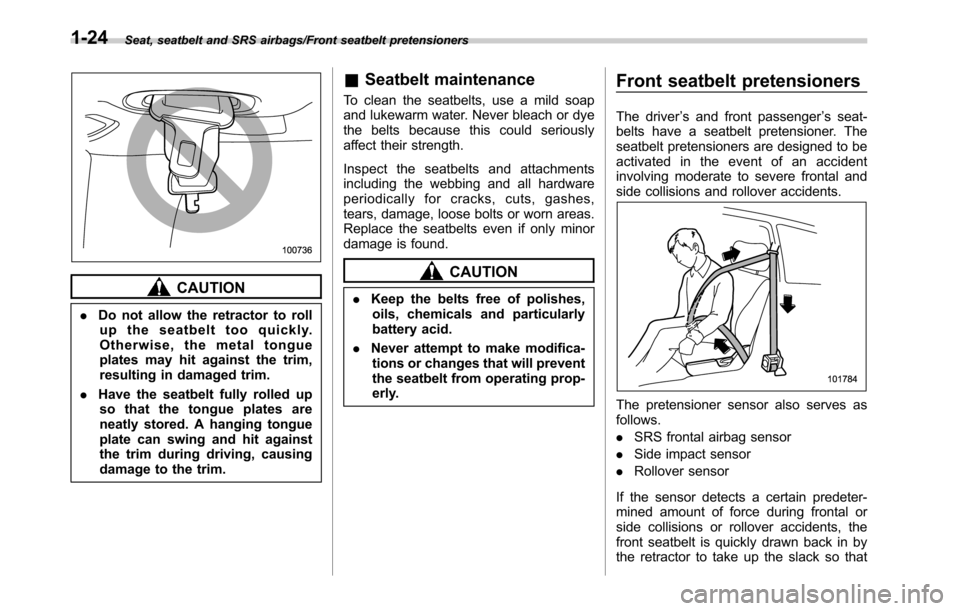
CAUTION
.Do not allow the retractor to roll
up the seatbelt too quickly.
Otherwise, the metal tongue
plates may hit against the trim,
resulting in damaged trim.
.Have the seatbelt fully rolled up
so that the tongue plates are
neatly stored. A hanging tongue
plate can swing and hit against
the trim during driving, causing
damage to the trim.
&Seatbelt maintenance
To clean the seatbelts, use a mild soap
and lukewarm water. Never bleach or dye
the belts because this could seriously
affect their strength.
Inspect the seatbelts and attachments
including the webbing and all hardware
periodically for cracks, cuts, gashes,
tears, damage, loose bolts or worn areas.
Replace the seatbelts even if only minor
damage is found.
CAUTION
.Keep the belts free of polishes,
oils, chemicals and particularly
battery acid.
.Never attempt to make modifica-
tions or changes that will prevent
the seatbelt from operating prop-
erly.
Front seatbelt pretensioners
The driver’s and front passenger’s seat-
belts have a seatbelt pretensioner. The
seatbelt pretensioners are designed to be
activated in the event of an accident
involving moderate to severe frontal and
side collisions and rollover accidents.
The pretensioner sensor also serves as
follows.
.SRS frontal airbag sensor
.Side impact sensor
.Rollover sensor
If the sensor detects a certain predeter-
mined amount of force during frontal or
side collisions or rollover accidents, the
front seatbelt is quickly drawn back in by
the retractor to take up the slack so that
1-24