si DRIVE SUBARU OUTBACK 2017 6.G Owner's Manual
[x] Cancel search | Manufacturer: SUBARU, Model Year: 2017, Model line: OUTBACK, Model: SUBARU OUTBACK 2017 6.GPages: 610, PDF Size: 10.28 MB
Page 58 of 610
the belt more effectively restrains the
driver.
When a seatbelt pretensioner is activated,
an operating noise will be heard and a
small amount of smoke will be released.
These occurrences are normal and not
harmful. This smoke does not indicate a
fire in the vehicle.
Once the seatbelt pretensioner has been
activated, the seatbelt retractor remains
locked. Consequently, the seatbelt cannot
be pulled out and retracted and therefore
must be replaced.
NOTE
.Seatbelt pretensioners are not de-
signed to activate in minor impacts.
. In cases of rollover accidents, as the
SRS curtain airbags deploy, the seat-
belt pretensioners are activated simul-
taneously.
. In cases of frontal collisions, the
following components will operate si-
multaneously.
–Seatbelt pretensioner for driver
– Seatbelt pretensioner for front
passenger
– SRS frontal airbag for driver
– SRS frontal airbag for front pas-
senger*
– SRS seat cushion airbag for driver
–
SRS seat cushion airbag for front
passenger*
– SRS curtain airbags (both sides)
(if an offset frontal collision occurs)
*: This does not operate if the occupant
detection system deactivates airbag op-
eration. For details, refer to “Front
passenger ’s SRS frontal airbag ”F 1-52.
. In cases of side collisions, the
following components will operate si-
multaneously.
–SRS curtain airbag (impacted
side)
– SRS side airbag (impacted side)
(when any of the center pillar im-
pact sensors/front door impact sen-
sors senses an impact force)
– Seatbelt pretensioner for driver
(when the driver ’s side front door
impact sensor senses an impact
force)
– Seatbelt pretensioner for front
passenger (when the front passen-
ger ’s side front door impact sensor
senses an impact force)
. Pretensioners are designed to func-
tion on a one-time-only basis. In the
event that a pretensioner is activated,
both the driver ’s and front passenger ’s
seatbelt retractor assemblies should
be replaced only by an authorized SUBARU dealer. When replacing seat-
belt retractor assemblies, use only
genuine SUBARU parts.
.
If either front seatbelt does not
retract or cannot be pulled out due to
a malfunction or activation of the
pretensioner, contact your SUBARU
dealer as soon as possible.
. If the front seatbelt retractor assem-
bly or surrounding area has been
damaged, contact your SUBARU dealer
as soon as possible.
. When you sell your vehicle, we urge
you to explain to the buyer that it has
seatbelt pretensioners by alerting the
buyer to the contents of this section.
WARNING
. To obtain maximum protection,
the occupants should sit in an
upright position with their seat-
belts properly fastened. Refer to
“ Seatbelts ”F 1-16.
. Do not modify, remove or strike
the front seatbelt retractor as-
semblies or surrounding area.
This could result in accidental
activation of the seatbelt preten-
sioners or could make the sys-
tem inoperative, possibly result-
ing in serious injury. Seatbelt
Seat, seatbelt and SRS airbags/Front seatbelt pretensioners
–CONTINUED –1-25
Page 59 of 610

Seat, seatbelt and SRS airbags/Front seatbelt pretensioners
pretensioners have no user-ser-
viceable parts. For required ser-
vicing of front seatbelt retractors
equipped with seatbelt preten-
sioners, consult your SUBARU
dealer.
. When discarding front seatbelt
retractor assemblies or scrap-
ping the entire vehicle due to
collision damage or for other
reasons, consult your SUBARU
dealer.
& System monitors
A diagnostic system continually monitors
the readiness of the seatbelt pretensioner
while the vehicle is being driven. The
seatbelt pretensioners share the control
modulewiththeSRSairbagsystem.
Therefore, if any malfunction occurs in a
seatbelt pretensioner, the SRS airbag
system warning light will illuminate. For
details, refer to “SRS airbag system
monitors ”F 1-68.
& System servicing
WARNING
. When discarding a seatbelt re-
tractor assembly or scrapping
the entire vehicle damaged by a
collision, consult your SUBARU
dealer.
. Tampering with or disconnecting
the system ’s wiring could result
in accidental activation of the
seatbelt pretensioner and/or
SRS airbag or could make the
system inoperative, which may
result in serious injury. Do not
use electrical test equipment on
any circuit related to the seatbelt
pretensioner and SRS airbag
systems. For required servicing
of the seatbelt pretensioner, con-
sult your nearest SUBARU deal-
er.
CAUTION
The sensors and SRS airbag control
module are located in the following
locations.
. Front sub sensors: on both sides
of the radiator panel
. Front door impact sensors: on
both front doors
. SRS airbag control module (in-
cluding the impact sensors and
rollover sensor): under the cen-
ter console
If you need service or repair in those
areas or near the front seatbelt
retractors, have the work performed
by your authorized SUBARU dealer.
NOTE
If the front part of the vehicle is
damaged in an accident to the extent
that the seatbelt pretensioner does not
operate, contact your SUBARU dealer
as soon as possible.
1-26
Page 74 of 610
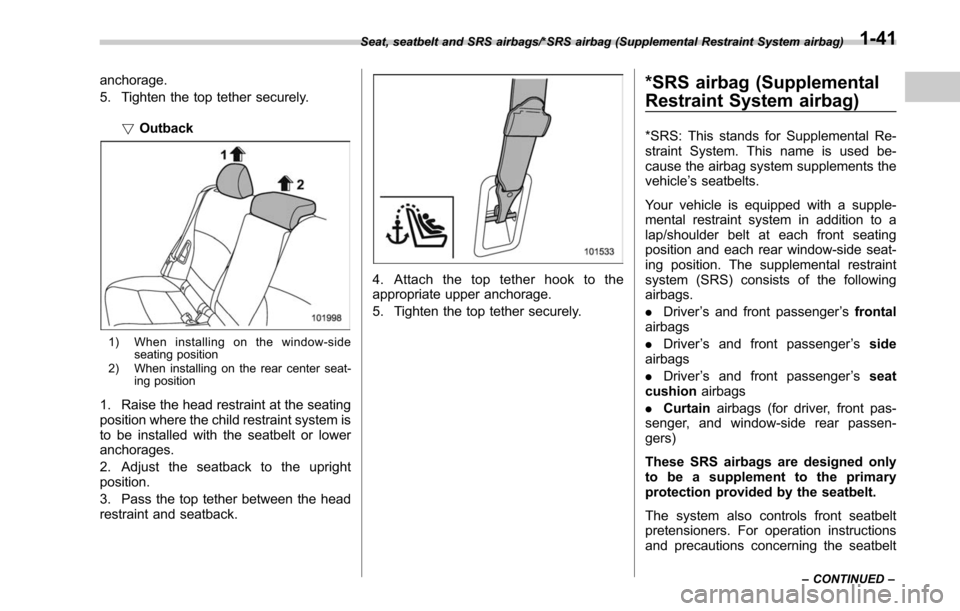
anchorage.
5. Tighten the top tether securely.!Outback
1) When installing on the window-side
seating position
2) When installing on the rear center seat- ing position
1. Raise the head restraint at the seating
position where the child restraint system is
to be installed with the seatbelt or lower
anchorages.
2. Adjust the seatback to the upright
position.
3. Pass the top tether between the head
restraint and seatback.
4. Attach the top tether hook to the
appropriate upper anchorage.
5. Tighten the top tether securely.
*SRS airbag (Supplemental
Restraint System airbag)
*SRS: This stands for Supplemental Re-
straint System. This name is used be-
cause the airbag system supplements the
vehicle ’s seatbelts.
Your vehicle is equipped with a supple-
mental restraint system in addition to a
lap/shoulder belt at each front seating
position and each rear window-side seat-
ing position. The supplemental restraint
system (SRS) consists of the following
airbags.
. Driver ’s and front passenger ’s frontal
airbags
. Driver ’s and front passenger ’s side
airbags
. Driver ’s and front passenger ’s seat
cushion airbags
. Curtain airbags (for driver, front pas-
senger, and window-side rear passen-
gers)
These SRS airbags are designed only
to be a supplement to the primary
protection provided by the seatbelt.
The system also controls front seatbelt
pretensioners. For operation instructions
and precautions concerning the seatbelt
Seat, seatbelt and SRS airbags/*SRS airbag (Supplemental Restraint System airbag)
–CONTINUED –1-41
Page 75 of 610
Seat, seatbelt and SRS airbags/*SRS airbag (Supplemental Restraint System airbag)
pretensioner, refer to“Front seatbelt pre-
tensioners ”F 1-24.
& General precautions regard-
ing SRS airbag system
WARNING
. To obtain maximum protection in
the event of an accident, the
driver and all passengers must
always wear seatbelts when in
the vehicle. The SRS airbag is
designed only to be a supple-
ment to the primary protection
provided by the seatbelt. It does
not eliminate the need to fasten
seatbelts. In combination with
the seatbelts, it offers the best
combined protection in case of a
serious accident.
Not wearing a seatbelt increases
the chance of severe injury or
death in a crash even when the
vehicle has the SRS airbag.
For instructions and precautions
concerning the seatbelt system,
refer to “Seatbelts ”F 1-16.
. The SRS side airbag and SRS
curtain airbag are designed only
to be a supplement to the primary
protection provided by the seat- belt. They do not eliminate the
need to fasten seatbelts. It is also
important to wear your seatbelt
to help avoid injuries that can
result when an occupant is not
seated in a proper upright posi-
tion.
WARNING
.
The SRS airbags deploy with
considerable speed and force.
Occupants who are out of proper
position when the SRS airbag
deploys could suffer very serious
injuries. Because the SRS airbag
needs enough space for deploy-
ment, the driver should always
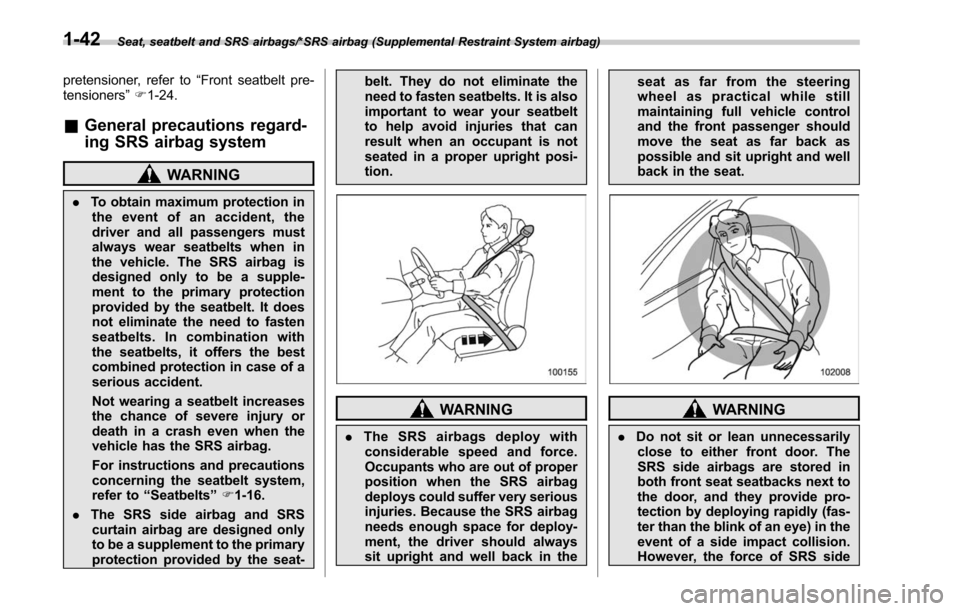
sit upright and well back in the seat as far from the steering
wheel as practical while still
maintaining full vehicle control
and the front passenger should
move the seat as far back as
possible and sit upright and well
back in the seat.
WARNING
.
Do not sit or lean unnecessarily
close to either front door. The
SRS side airbags are stored in
both front seat seatbacks next to
the door, and they provide pro-
tection by deploying rapidly (fas-
ter than the blink of an eye) in the
event of a side impact collision.
However, the force of SRS side
1-42
Page 81 of 610
Seat, seatbelt and SRS airbags/*SRS airbag (Supplemental Restraint System airbag)
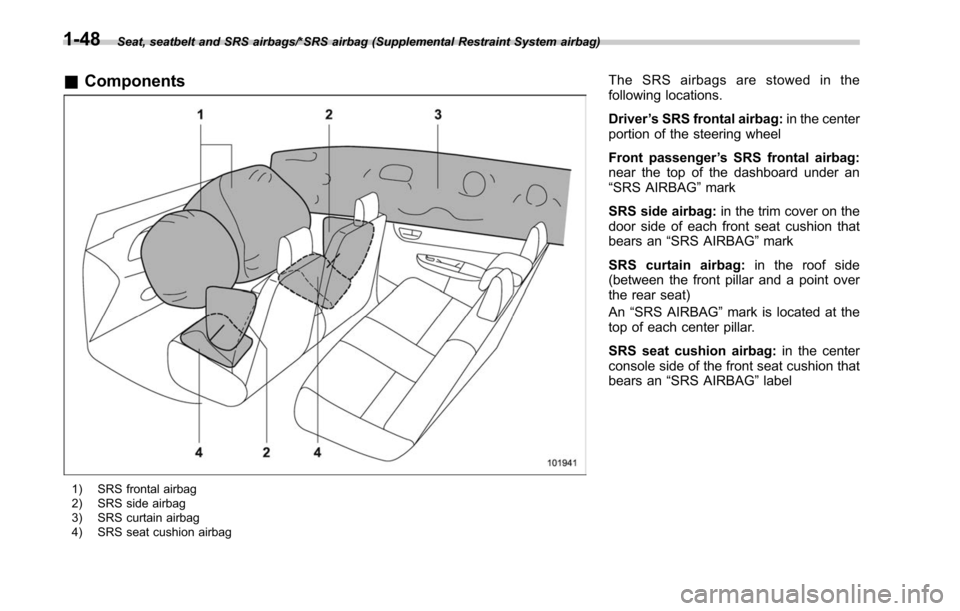
&Components
1) SRS frontal airbag
2) SRS side airbag
3) SRS curtain airbag
4) SRS seat cushion airbag
The SRS airbags are stowed in the
following locations.
Driver ’s SRS frontal airbag: in the center
portion of the steering wheel
Front passenger ’s SRS frontal airbag:
near the top of the dashboard under an
“SRS AIRBAG” mark
SRS side airbag: in the trim cover on the
door side of each front seat cushion that
bears an “SRS AIRBAG” mark
SRS curtain airbag: in the roof side
(between the front pillar and a point over
the rear seat)
An “SRS AIRBAG” mark is located at the
top of each center pillar.
SRS seat cushion airbag: in the center
console side of the front seat cushion that
bears an “SRS AIRBAG” label
1-48
Page 82 of 610
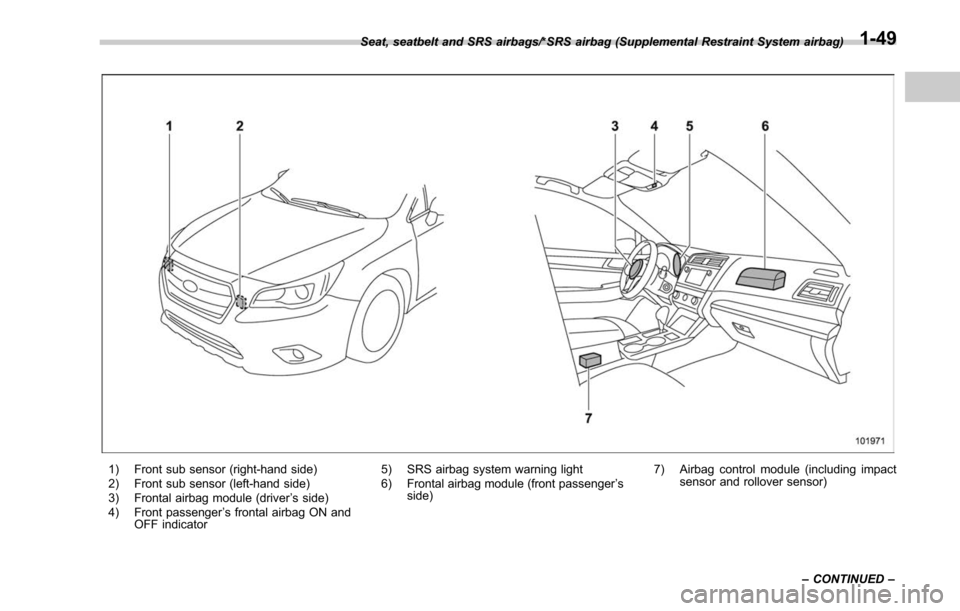
1) Front sub sensor (right-hand side)
2) Front sub sensor (left-hand side)
3) Frontal airbag module (driver’s side)
4) Front passenger ’s frontal airbag ON and
OFF indicator 5) SRS airbag system warning light
6) Frontal airbag module (front passenger
’s
side) 7) Airbag control module (including impact
sensor and rollover sensor)
Seat, seatbelt and SRS airbags/*SRS airbag (Supplemental Restraint System airbag)
–CONTINUED –
1-49
Page 84 of 610
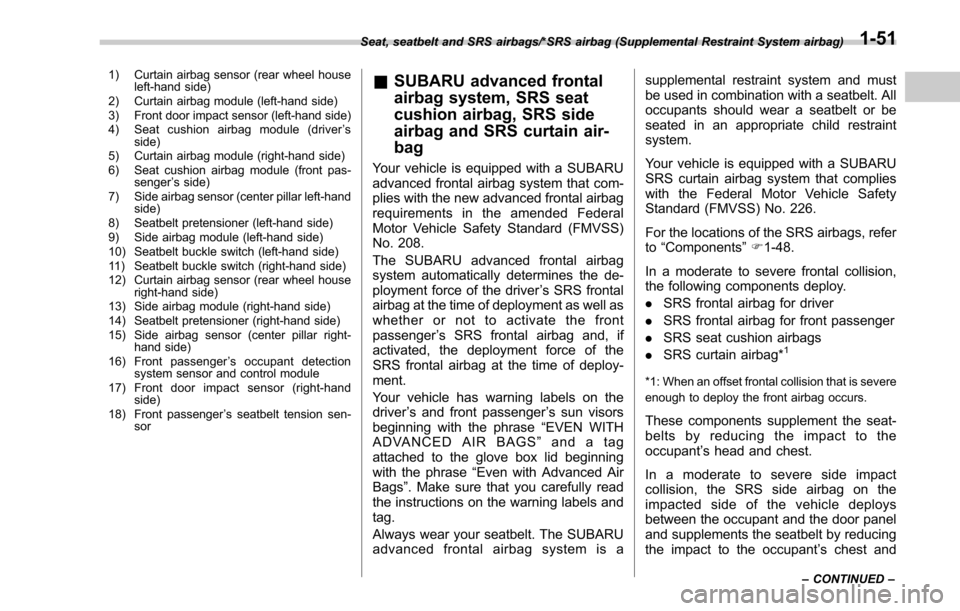
1) Curtain airbag sensor (rear wheel houseleft-hand side)
2) Curtain airbag module (left-hand side)
3) Front door impact sensor (left-hand side)
4) Seatcushionairbagmodule(driver ’s
side)
5) Curtain airbag module (right-hand side)
6) Seat cushion airbag module (front pas- senger ’s side)
7) Side airbag sensor (center pillar left-hand side)
8) Seatbelt pretensioner (left-hand side)
9) Side airbag module (left-hand side)
10) Seatbelt buckle switch (left-hand side)
11) Seatbelt buckle switch (right-hand side)
12) Curtain airbag sensor (rear wheel house right-hand side)
13) Side airbag module (right-hand side)
14) Seatbelt pretensioner (right-hand side)
15) Side airbag sensor (center pillar right- hand side)
16) Front passenger ’s occupant detection
system sensor and control module
17) Front door impact sensor (right-hand side)
18) Front passenger ’s seatbelt tension sen-
sor& SUBARU advanced frontal
airbag system, SRS seat
cushion airbag, SRS side
airbag and SRS curtain air-
bag
Your vehicle is equipped with a SUBARU
advanced frontal airbag system that com-
plies with the new advanced frontal airbag
requirements in the amended Federal
Motor Vehicle Safety Standard (FMVSS)
No. 208.
The SUBARU advanced frontal airbag
system automatically determines the de-
ployment force of the driver ’s SRS frontal
airbag at the time of deployment as well as
whether or not to activate the front
passenger ’s SRS frontal airbag and, if
activated, the deployment force of the
SRS frontal airbag at the time of deploy-
ment.
Your vehicle has warning labels on the
driver ’s and front passenger ’s sun visors
beginning with the phrase “EVEN WITH
ADVANCED AIR BAGS ”and a tag
attached to the glove box lid beginning
with the phrase “Even with Advanced Air
Bags”. Make sure that you carefully read
the instructions on the warning labels and
tag.
Always wear your seatbelt. The SUBARU
advanced frontal airbag system is a supplemental restraint system and must
be used in combination with a seatbelt. All
occupants should wear a seatbelt or be
seated in an appropriate child restraint
system.
Your vehicle is equipped with a SUBARU
SRS curtain airbag system that complies
with the Federal Motor Vehicle Safety
Standard (FMVSS) No. 226.
For the locations of the SRS airbags, refer
to
“Components ”F 1-48.
In a moderate to severe frontal collision,
the following components deploy.
. SRS frontal airbag for driver
. SRS frontal airbag for front passenger
. SRS seat cushion airbags
. SRS curtain airbag*
1
*1: When an offset frontal collision that is severe
enough to deploy the front airbag occurs.
These components supplement the seat-
belts by reducing the impact to the
occupant ’s head and chest.
Inamoderatetoseveresideimpact
collision, the SRS side airbag on the
impacted side of the vehicle deploys
between the occupant and the door panel
and supplements the seatbelt by reducing
the impact to the occupant ’s chest and
Seat, seatbelt and SRS airbags/*SRS airbag (Supplemental Restraint System airbag)
–CONTINUED –1-51
Page 85 of 610
Seat, seatbelt and SRS airbags/*SRS airbag (Supplemental Restraint System airbag)
waist.
In a moderate to severe side impact
collision, the SRS curtain airbag on the
impacted side of the vehicle deploys
between the occupant and the side
window and supplements the seatbelt by
reducing the impact to the occupant’s
head.
NOTE
The SRS side airbag and seatbelt
pretensioner are not controlled by the
SUBARU advanced frontal airbag sys-
tem.
! Driver ’s SRS frontal airbag
The driver ’s SRS frontal airbag uses a
dual stage inflator. The inflator operates in
different ways depending on the severity
of impact.
Have the system inspected by your
SUBARU dealer immediately if the SRS
airbag system warning light illuminates.
! Front passenger ’s SRS frontal air-
bag
The front passenger ’s SRS frontal airbag
uses a dual stage inflator. The inflator
operates in different ways depending on
the severity of impact.
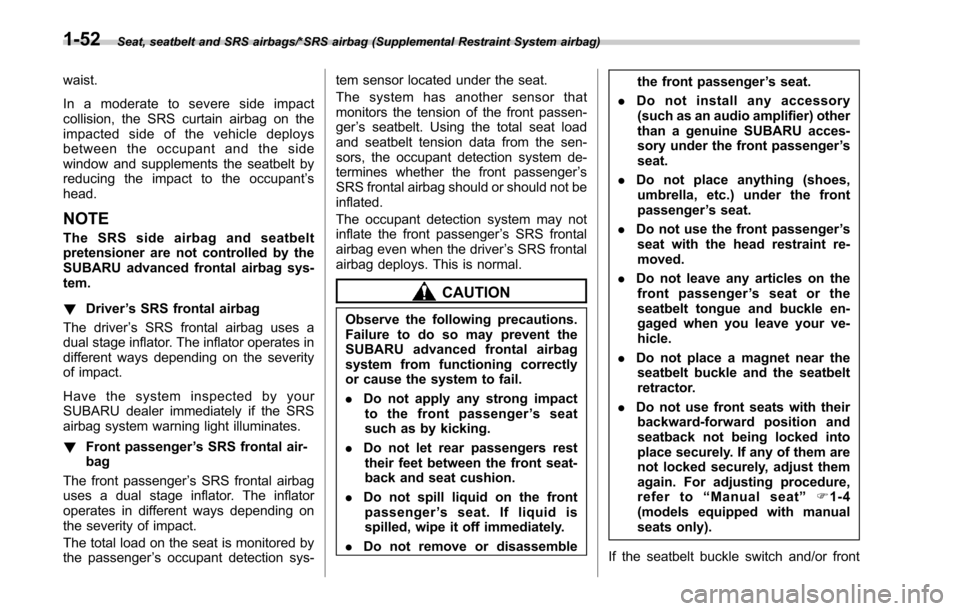
The total load on the seat is monitored by
the passenger ’s occupant detection sys- tem sensor located under the seat.
The system has another sensor that
monitors the tension of the front passen-
ger
’s seatbelt. Using the total seat load
and seatbelt tension data from the sen-
sors, the occupant detection system de-
termines whether the front passenger ’s
SRS frontal airbag should or should not be
inflated.
The occupant detection system may not
inflate the front passenger ’s SRS frontal
airbag even when the driver ’s SRS frontal
airbag deploys. This is normal.
CAUTION
Observe the following precautions.
Failure to do so may prevent the
SUBARU advanced frontal airbag
system from functioning correctly
or cause the system to fail.
. Do not apply any strong impact
to the front passenger ’sseat
such as by kicking.
. Do not let rear passengers rest
their feet between the front seat-
back and seat cushion.
. Do not spill liquid on the front
passenger ’s seat. If liquid is
spilled, wipe it off immediately.
. Do not remove or disassemble the front passenger
’s seat.
. Do not install any accessory
(such as an audio amplifier) other
than a genuine SUBARU acces-
sory under the front passenger ’s
seat.
. Do not place anything (shoes,
umbrella, etc.) under the front
passenger ’s seat.
. Do not use the front passenger ’s
seat with the head restraint re-
moved.
. Do not leave any articles on the
front passenger ’s seat or the
seatbelt tongue and buckle en-
gaged when you leave your ve-
hicle.
. Do not place a magnet near the
seatbelt buckle and the seatbelt
retractor.
. Do not use front seats with their
backward-forward position and
seatback not being locked into
place securely. If any of them are
not locked securely, adjust them
again. For adjusting procedure,
refer to “Manual seat ”F1-4
(models equipped with manual
seats only).
If the seatbelt buckle switch and/or front
1-52
Page 89 of 610
Seat, seatbelt and SRS airbags/*SRS airbag (Supplemental Restraint System airbag)
!How to contact the vehicle manu-
facturer concerning modifications
for persons with disabilities that
may affect the advanced airbag
system
Changing or moving any parts of the front
seats, seatbelts, front bumper, front side
frame, instrument panel, combination me-
ter, steering wheel, steering column, tire,
suspension or floor panel can affect the
operation of the SUBARU advanced air-
bag system. If you have any questions,
you may contact the following SUBARU
distributors:
Subaru of America, Inc.
Customer Dealer Services Department
P.O. Box 6000
Cherry Hill, NJ 08034-6000
1-800-SUBARU3 (1-800-782-2783)
Subaru Hawaii
2850 Pukoloa Street, Suite 202,
Honolulu, HI 96819-4467
808-839-2273
Shen
’s Corporation dba Prestige Automo-
bile
491, East Marine Corps Drive, Route 1
Dededo, Guam 96921-6255
671-633-2698
Trebol Motors
P.O. Box 11204, San Juan, Puerto Rico
00910
787-793-2828
Subaru Canada, Inc.
Consumer Support Department
560 Suffork Court, Mississauga, Ontario
L5R 4J7
1-800-894-4212
There are currently no SUBARU distribu-
tors in any other U.S. territories. If you are
in such an area, please contact the
SUBARU distributor or dealer from which
you bought your vehicle.& System operation
CAUTION
Do not touch the SRS airbag system
components with bare hands right
after deployment. Doing so can
cause burns because the compo-
nents can be very hot as a result of
deployment.
The SRS airbags can function only when
the ignition switch is in the “ON”position.
When the SRS airbag(s) deploy(s), a
sudden, fairly loud inflation noise will be
heard and some smoke will be released.
These occurrences are a normal result of
the deployment. This smoke does not
indicate a fire in the vehicle.
1-56
Page 90 of 610
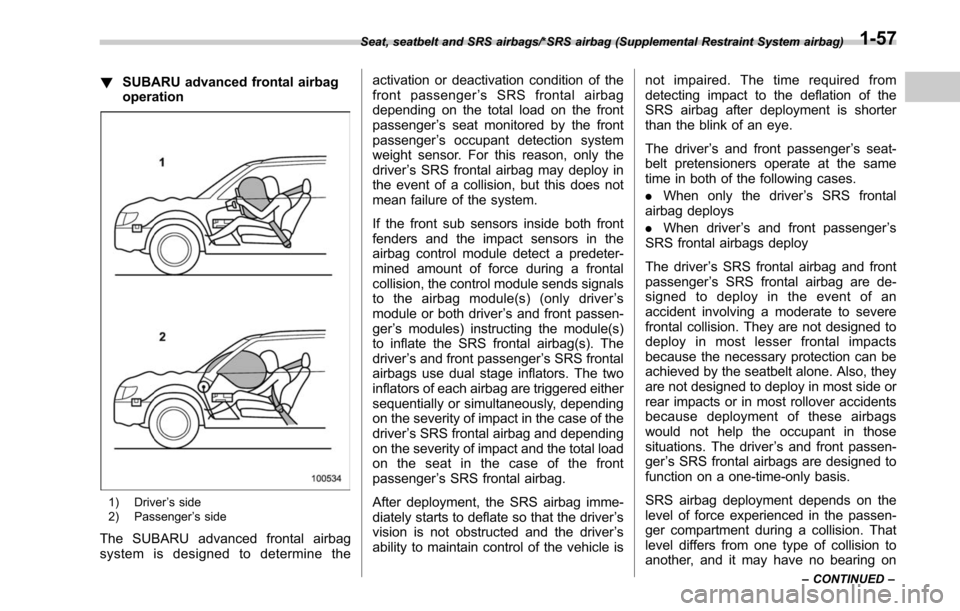
!SUBARU advanced frontal airbag
operation
1) Driver ’s side
2) Passenger ’s side
The SUBARU advanced frontal airbag
system is designed to determine the activation or deactivation condition of the
front passenger
’s SRS frontal airbag
depending on the total load on the front
passenger ’s seat monitored by the front
passenger ’s occupant detection system
weight sensor. For this reason, only the
driver ’s SRS frontal airbag may deploy in
the event of a collision, but this does not
mean failure of the system.
If the front sub sensors inside both front
fenders and the impact sensors in the
airbag control module detect a predeter-
mined amount of force during a frontal
collision, the control module sends signals
to the airbag module(s) (only driver ’s
module or both driver ’s and front passen-
ger ’s modules) instructing the module(s)
to inflate the SRS frontal airbag(s). The
driver ’s and front passenger ’s SRS frontal
airbags use dual stage inflators. The two
inflators of each airbag are triggered either
sequentially or simultaneously, depending
on the severity of impact in the case of the
driver ’s SRS frontal airbag and depending
on the severity of impact and the total load
on the seat in the case of the front
passenger ’s SRS frontal airbag.
After deployment, the SRS airbag imme-
diately starts to deflate so that the driver ’s
vision is not obstructed and the driver ’s
ability to maintain control of the vehicle is not impaired. The time required from
detecting impact to the deflation of the
SRS airbag after deployment is shorter
than the blink of an eye.
The driver
’s and front passenger ’s seat-
belt pretensioners operate at the same
time in both of the following cases.
. When only the driver ’s SRS frontal
airbag deploys
. When driver ’s and front passenger ’s
SRS frontal airbags deploy
The driver ’s SRS frontal airbag and front
passenger ’s SRS frontal airbag are de-
signed to deploy in the event of an
accident involving a moderate to severe
frontal collision. They are not designed to
deploy in most lesser frontal impacts
because the necessary protection can be
achieved by the seatbelt alone. Also, they
are not designed to deploy in most side or
rear impacts or in most rollover accidents
because deployment of these airbags
would not help the occupant in those
situations. The driver ’s and front passen-
ger ’s SRS frontal airbags are designed to
function on a one-time-only basis.
SRS airbag deployment depends on the
level of force experienced in the passen-
ger compartment during a collision. That
level differs from one type of collision to
another, and it may have no bearing on
Seat, seatbelt and SRS airbags/*SRS airbag (Supplemental Restraint System airbag)
–CONTINUED –1-57