si DRIVE SUBARU OUTBACK 2017 6.G Owner's Guide
[x] Cancel search | Manufacturer: SUBARU, Model Year: 2017, Model line: OUTBACK, Model: SUBARU OUTBACK 2017 6.GPages: 610, PDF Size: 10.28 MB
Page 91 of 610
Seat, seatbelt and SRS airbags/*SRS airbag (Supplemental Restraint System airbag)
the visible damage done to the vehicle
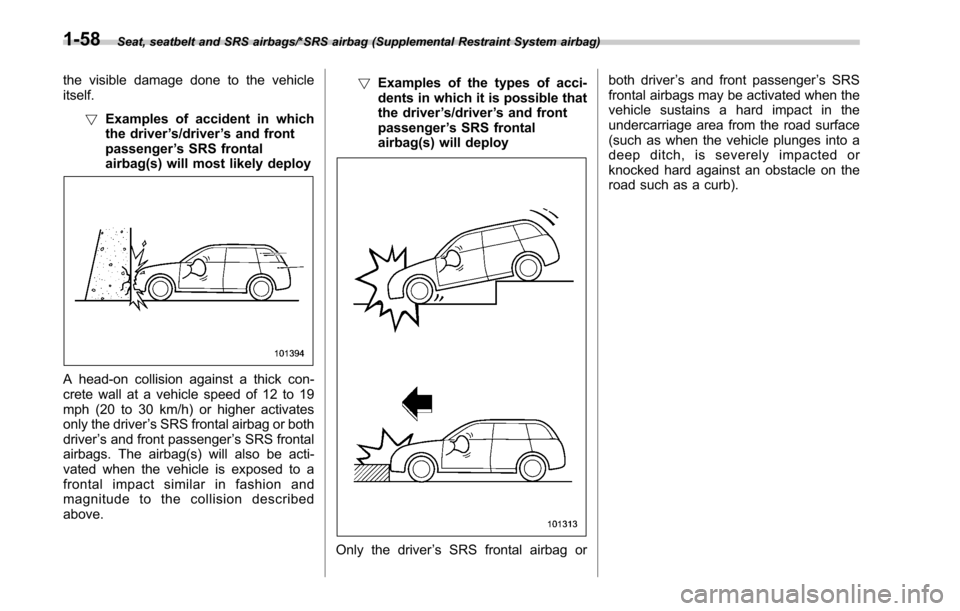
itself.!Examples of accident in which
the driver ’s/driver ’s and front
passenger ’s SRS frontal
airbag(s) will most likely deploy
A head-on collision against a thick con-
crete wall at a vehicle speed of 12 to 19
mph (20 to 30 km/h) or higher activates
only the driver ’s SRS frontal airbag or both
driver ’s and front passenger ’s SRS frontal
airbags. The airbag(s) will also be acti-
vated when the vehicle is exposed to a
frontal impact similar in fashion and
magnitude to the collision described
above. !
Examples of the types of acci-
dents in which it is possible that
the driver ’s/driver ’s and front
passenger ’s SRS frontal
airbag(s) will deploy
Only the driver ’s SRS frontal airbag or both driver
’s and front passenger ’s SRS
frontal airbags may be activated when the
vehicle sustains a hard impact in the
undercarriage area from the road surface
(such as when the vehicle plunges into a
deep ditch, is severely impacted or
knocked hard against an obstacle on the
road such as a curb).
1-58
Page 92 of 610
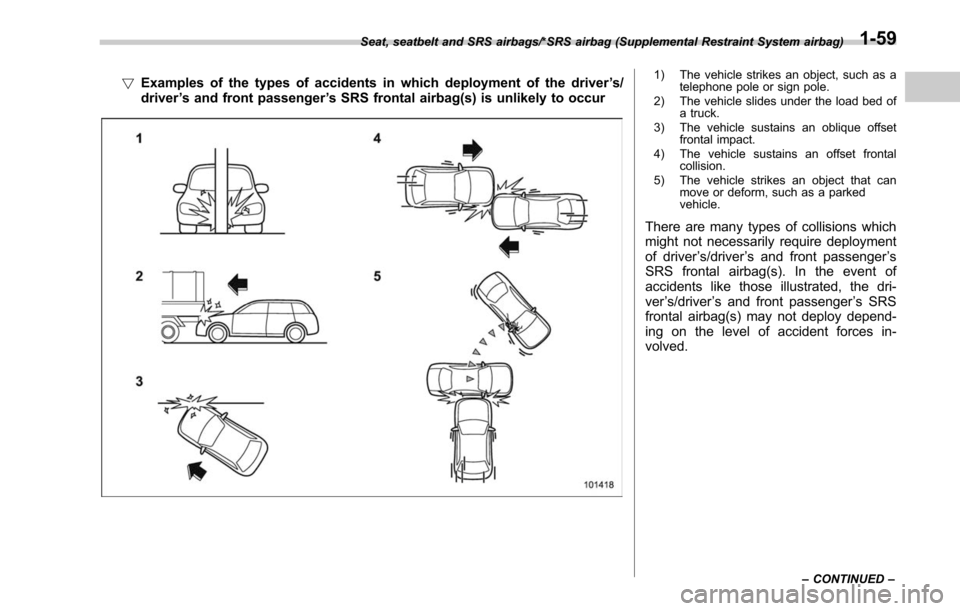
!Examples of the types of accidents in which deployment of the driver ’s/
driver ’s and front passenger ’s SRS frontal airbag(s) is unlikely to occur1) The vehicle strikes an object, such as a
telephone pole or sign pole.
2) The vehicle slides under the load bed of a truck.
3) The vehicle sustains an oblique offset frontal impact.
4) The vehicle sustains an offset frontal collision.
5) The vehicle strikes an object that can move or deform, such as a parked
vehicle.
There are many types of collisions which
might not necessarily require deployment
of driver ’s/driver ’s and front passenger ’s
SRS frontal airbag(s). In the event of
accidents like those illustrated, the dri-
ver ’s/driver ’s and front passenger ’s SRS
frontal airbag(s) may not deploy depend-
ing on the level of accident forces in-
volved.
Seat, seatbelt and SRS airbags/*SRS airbag (Supplemental Restraint System airbag)
–CONTINUED –1-59
Page 93 of 610
Seat, seatbelt and SRS airbags/*SRS airbag (Supplemental Restraint System airbag)
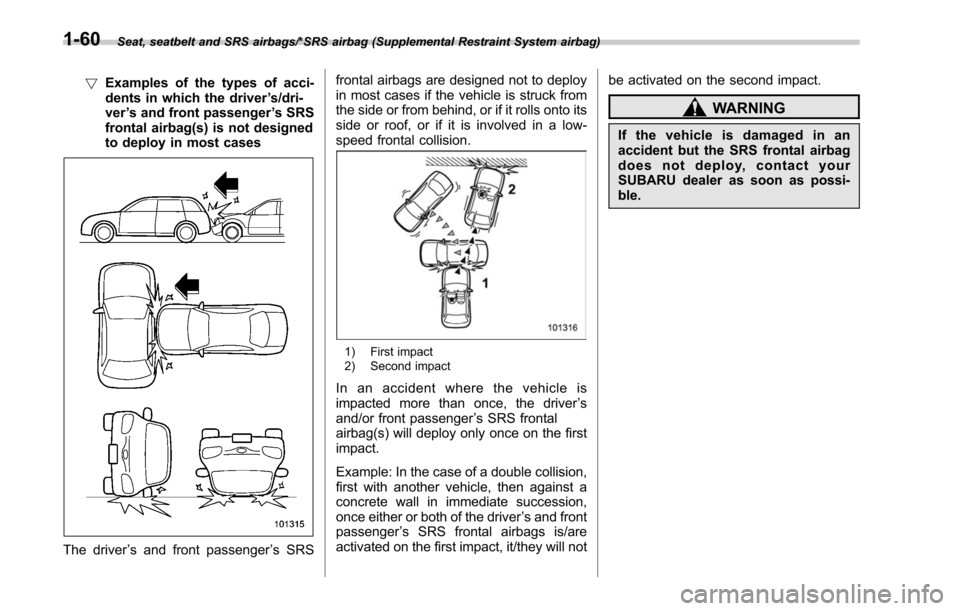
!Examples of the types of acci-
dents in which the driver ’s/dri-
ver ’s and front passenger ’s SRS
frontal airbag(s) is not designed
to deploy in most cases
The driver ’s and front passenger ’s SRS frontal airbags are designed not to deploy
in most cases if the vehicle is struck from
the side or from behind, or if it rolls onto its
side or roof, or if it is involved in a low-
speed frontal collision.
1) First impact
2) Second impact
In an accident where the vehicle is
impacted more than once, the driver
’s
and/or front passenger ’s SRS frontal
airbag(s) will deploy only once on the first
impact.
Example: In the case of a double collision,
first with another vehicle, then against a
concrete wall in immediate succession,
once either or both of the driver ’s and front
passenger ’s SRS frontal airbags is/are
activated on the first impact, it/they will not be activated on the second impact.
WARNING
If the vehicle is damaged in an
accident but the SRS frontal airbag
does not deploy, contact your
SUBARU dealer as soon as possi-
ble.
1-60
Page 94 of 610
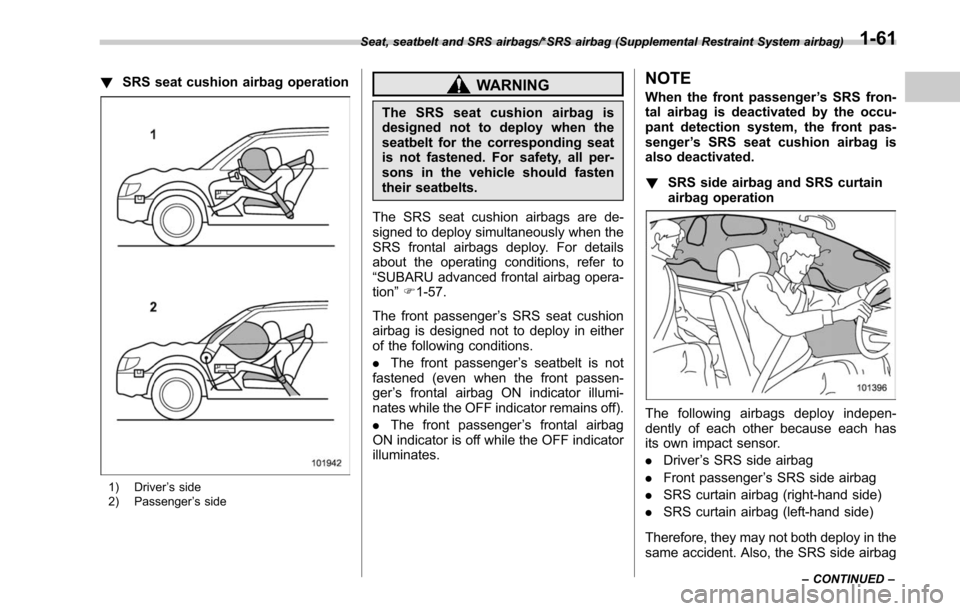
!SRS seat cushion airbag operation
1) Driver ’s side
2) Passenger ’s side
WARNING
The SRS seat cushion airbag is
designed not to deploy when the
seatbelt for the corresponding seat
is not fastened. For safety, all per-
sons in the vehicle should fasten
their seatbelts.
The SRS seat cushion airbags are de-
signed to deploy simultaneously when the
SRS frontal airbags deploy. For details
about the operating conditions, refer to
“SUBARU advanced frontal airbag opera-
tion ”F 1-57.
The front passenger ’s SRS seat cushion
airbag is designed not to deploy in either
of the following conditions.
. The front passenger ’s seatbelt is not
fastened (even when the front passen-
ger ’s frontal airbag ON indicator illumi-
nates while the OFF indicator remains off).
. The front passenger ’s frontal airbag
ON indicator is off while the OFF indicator
illuminates.
NOTE
When the front passenger ’s SRS fron-
tal airbag is deactivated by the occu-
pant detection system, the front pas-
senger ’s SRS seat cushion airbag is
also deactivated.
! SRS side airbag and SRS curtain
airbag operation
The following airbags deploy indepen-
dently of each other because each has
its own impact sensor.
.Driver ’s SRS side airbag
. Front passenger ’s SRS side airbag
. SRS curtain airbag (right-hand side)
. SRS curtain airbag (left-hand side)
Therefore, they may not both deploy in the
same accident. Also, the SRS side airbag
Seat, seatbelt and SRS airbags/*SRS airbag (Supplemental Restraint System airbag)
–CONTINUED –1-61
Page 95 of 610
Seat, seatbelt and SRS airbags/*SRS airbag (Supplemental Restraint System airbag)
deploys independently of the driver’s and
front passenger ’s SRS frontal airbags in
the steering wheel and instrument panel.
An impact sensor, which senses impact
force, is located in each of the following
locations.
. In the left and right front doors
. In the left and right center pillars
. In the left and right rear wheel houses
. In the airbag control module
. In the left and right front fenders (only
SRS curtain airbags are designed to
deploy when the front sub sensors sense
a severe impact.)
A rollover sensor is also located inside the
airbag control module.
If both of the following sensors together
sense an impact force above a predeter-
mined level in a side collision, the control
module causes both the SRS side airbag
and curtain airbag on the impacted side
to inflate regardless of whether the rear
wheel house impact sensor on the same
side senses an impact.
. the impact sensor that is located in the
airbag control module
. one of the center pillar impact sensors
or front door impact sensors
If both of the following sensors together sense an impact force above a predeter-
mined level in a side collision, the control
module causes
only the SRS curtain
airbag on the impacted side to inflate.
. the impact sensor that is located in the
airbag control module
. one of the rear wheel house impact
sensors
Even if a frontal collision occurs, both right
and left SRS curtain airbags will deploy
when the front sensor and the control unit
determine that the impact results from an
offset frontal collision.
The SRS curtain airbags are designed to
deploy under the following conditions.
. The driver ’s SRS frontal airbag deploys
or the driver ’s and passenger ’sSRS
frontal airbags deploy in a frontal collision.
. The system determines that the colli-
sion is an offset frontal collision.
. The vehicle is in an extremely inclined
state such as during a rollover.
The SRS curtain airbags are basically not
designed to deploy in the following cases.
. In a frontal collision when the SRS
frontal airbags do not deploy or the system
determines that the collision is other than
an offset frontal collision
. In most lesser inclined states If the rollover sensor detects rollover of the
vehicle, the control module inflates the
SRS curtain airbags
. At this time, the
driver ’s and front passenger ’s seatbelt
pretensioners also operate at the same
time.
After the deployment, the SRS side airbag
immediately starts to deflate. The time
required from detection of an impact to
deflation of an SRS side airbag after
deployment is shorter than the blink of
an eye.
The SRS curtain airbag remains inflated
for a while following deployment then
slowly deflates.
The SRS side airbag and SRS curtain
airbag deploy even when no one occupies
the seat on the side on which an impact is
applied.
The SRS side airbag and SRS curtain
airbag are designed as follows:
. to deploy in the event of an accident
involvingamoderatetosevereside
impact collision
. to function on a one-time-only basis.
The SRS side airbag and SRS curtain
airbag are not designed to deploy in the
following cases:
. in most lesser side impacts
1-62
Page 101 of 610
Seat, seatbelt and SRS airbags/*SRS airbag (Supplemental Restraint System airbag)
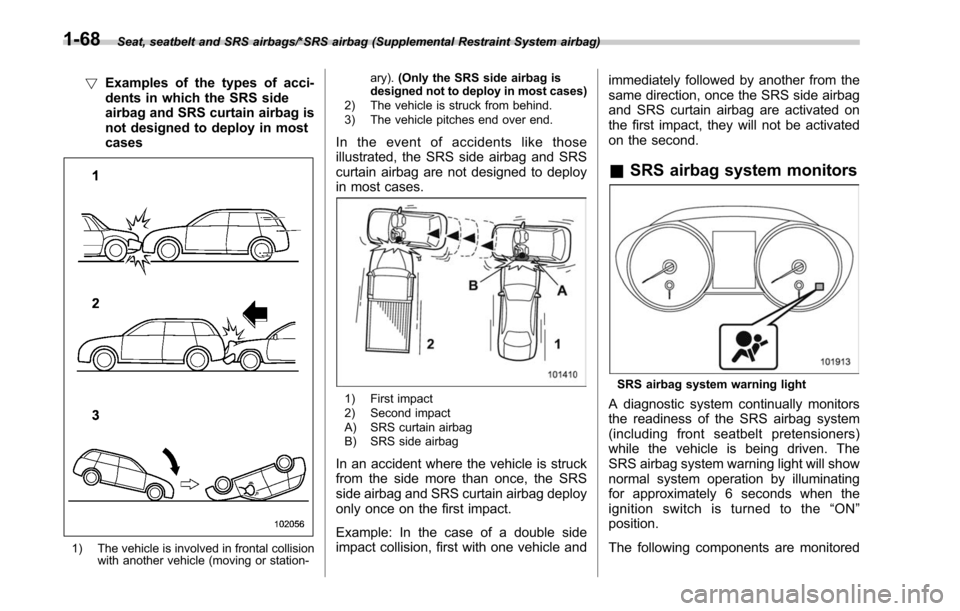
!Examples of the types of acci-
dents in which the SRS side
airbag and SRS curtain airbag is
not designed to deploy in most
cases
1) The vehicle is involved in frontal collision
with another vehicle (moving or station- ary).
(Only the SRS side airbag is
designed not to deploy in most cases)
2) The vehicle is struck from behind.
3) The vehicle pitches end over end.
In the event of accidents like those
illustrated, the SRS side airbag and SRS
curtain airbag are not designed to deploy
in most cases.
1) First impact
2) Second impact
A) SRS curtain airbag
B) SRS side airbag
In an accident where the vehicle is struck
from the side more than once, the SRS
side airbag and SRS curtain airbag deploy
only once on the first impact.
Example: In the case of a double side
impact collision, first with one vehicle and immediately followed by another from the
same direction, once the SRS side airbag
and SRS curtain airbag are activated on
the first impact, they will not be activated
on the second.
&
SRS airbag system monitors
SRS airbag system warning light
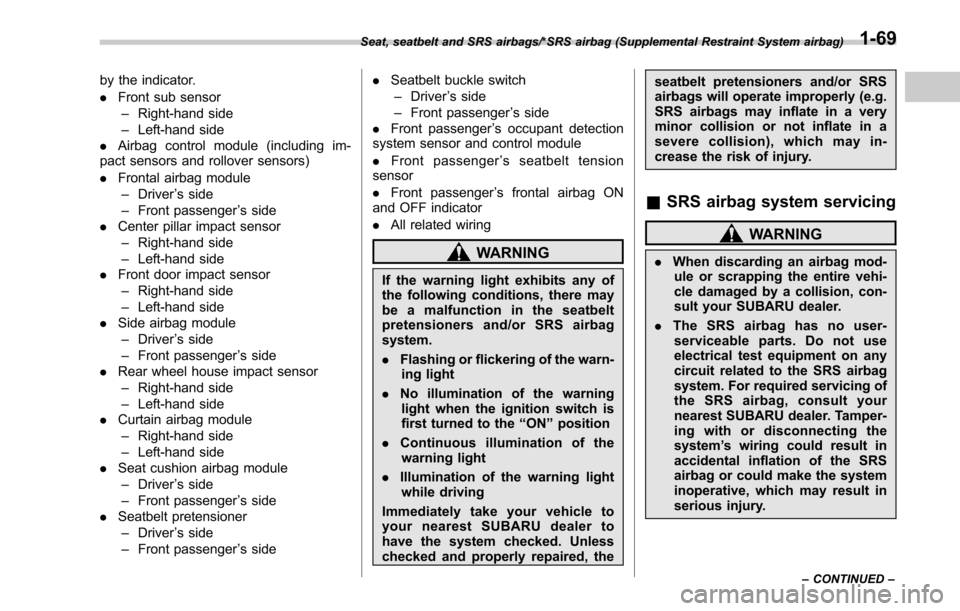
A diagnostic system continually monitors
the readiness of the SRS airbag system
(including front seatbelt pretensioners)
while the vehicle is being driven. The
SRS airbag system warning light will show
normal system operation by illuminating
for approximately 6 seconds when the
ignition switch is turned to the “ON ”
position.
The following components are monitored
1-68
Page 102 of 610
by the indicator.
.Front sub sensor
– Right-hand side
– Left-hand side
. Airbag control module (including im-
pact sensors and rollover sensors)
. Frontal airbag module
– Driver ’s side
– Front passenger ’s side
. Center pillar impact sensor
– Right-hand side
– Left-hand side
. Front door impact sensor
– Right-hand side
– Left-hand side
. Side airbag module
– Driver ’s side
– Front passenger ’s side
. Rear wheel house impact sensor
– Right-hand side
– Left-hand side
. Curtain airbag module
– Right-hand side
– Left-hand side
. Seat cushion airbag module
– Driver ’s side
– Front passenger ’s side
. Seatbelt pretensioner
– Driver ’s side
– Front passenger ’s side .
Seatbelt buckle switch
– Driver ’s side
– Front passenger ’s side
. Front passenger ’s occupant detection
system sensor and control module
. Front passenger ’s seatbelt tension
sensor
. Front passenger ’s frontal airbag ON
and OFF indicator
. All related wiring
WARNING
If the warning light exhibits any of
the following conditions, there may
be a malfunction in the seatbelt
pretensioners and/or SRS airbag
system.
.Flashing or flickering of the warn-
ing light
. No illumination of the warning
light when the ignition switch is
first turned to the “ON ”position
. Continuous illumination of the
warning light
. Illumination of the warning light
while driving
Immediatelytakeyourvehicleto
your nearest SUBARU dealer to
have the system checked. Unless
checked and properly repaired, the seatbelt pretensioners and/or SRS
airbags will operate improperly (e.g.
SRS airbags may inflate in a very
minor collision or not inflate in a
severe collision), which may in-
crease the risk of injury.
&
SRS airbag system servicing
WARNING
. When discarding an airbag mod-
ule or scrapping the entire vehi-
cle damaged by a collision, con-
sult your SUBARU dealer.
. The SRS airbag has no user-
serviceable parts. Do not use
electrical test equipment on any
circuit related to the SRS airbag
system. For required servicing of
the SRS airbag, consult your
nearest SUBARU dealer. Tamper-
ing with or disconnecting the
system ’s wiring could result in
accidental inflation of the SRS
airbag or could make the system
inoperative, which may result in
serious injury.
Seat, seatbelt and SRS airbags/*SRS airbag (Supplemental Restraint System airbag)
–CONTINUED –1-69
Page 103 of 610
Seat, seatbelt and SRS airbags/*SRS airbag (Supplemental Restraint System airbag)
CAUTION
If you need service or repair in areas
indicated in the following list, have
the work performed by an author-
ized SUBARU dealer. The SRS air-
bag control module, impact sensors
and airbag modules are stored in
these areas.
.Under the center console
. Inside each front fender
. Steering wheel and column and
nearby areas
. Top of the dashboard on front
passenger ’ssideandnearby
areas
. Each front seat and nearby area
. Inside each center pillar
. Inside each front door
. In each roof side (from the front
pillar to a point over the rear seat)
. Between the rear seat cushion
and rear wheel house on each
side
. Under the rear center seat
In the event that the SRS airbag is
deployed, replacement of the system
should be performed only by an author-
ized SUBARU dealer. When the compo- nents of the SRS airbag system are
replaced, use only genuine SUBARU
parts.
NOTE
In the following cases, contact your
SUBARU dealer as soon as possible.
.
The front part of the vehicle was
involved in an accident in which only
the driver ’s SRS frontal airbag or both
driver ’s and front passenger ’sSRS
frontal airbags did not deploy.
. The pad of the steering wheel, the
cover over the front passenger ’s SRS
frontal airbag, or either roof side (from
the front pillar to a point over the rear
seat) is scratched, cracked, or other-
wise damaged.
. The center pillar, front door, rear
wheel house or rear sub frame, or an
area near these parts, was involved in
an accident in which the SRS side
airbag and SRS curtain airbag did not
deploy.
. The fabric or leather of either front
seatback and seat cushion is cut,
frayed, or otherwise damaged.
. The rear part of the vehicle was
involved in an accident.
& Precautions against vehicle
modification
WARNING
. To avoid accidental activation of
the system or rendering the sys-
tem inoperative, which may re-
sult in serious injury, no modifi-
cations should be made to any
components or wiring of the SRS
airbag system.
This includes the following mod-
ifications.
– Installation of custom steering
wheels
– Attachment of additional trim
materials to the dashboard
– Installation of custom seats
– Replacement of seat fabric or
leather
– Installation of additional fabric
or leather on the front seat
– Attachment of a hands-free
microphone or any other ac-
cessory to a front pillar, a
center pillar, a rear pillar, the
windshield, a side window, an
assist grip, or any other cabin
surface that would be near a
1-70
Page 104 of 610
deploying SRS curtain airbag
– Installation of additional elec-
trical/electronic equipment
such as a mobile two-way
radio on or near the SRS
airbag system components
and/or wiring
– Modifications on or inside the
front door panels for the pur-
pose of a speaker replace-
ment or sound insulation
. The impact sensors, which detect
the pressure of an impact, are
located in the doors. Do not
modify any components of the
doors or door trims, such as the
addition of door speakers for
example. Any modifications to
the doors create a risk of the
airbag system becoming inop-
erative or unintended airbag de-
ployment.
CAUTION
Do not perform any of the following
modifications. Such modifications
can interfere with proper operation
of the SRS airbag system.
. Attachment of any equipment
(bush bar, bullbar, winches, snow plow, skid/sump plate, etc.) other
than genuine SUBARU acces-
sory parts.
. Modification of the suspension
system or front end structure.
. Installation of a tire of different
size and construction from the
tires specified on the vehicle
placard attached to the driver ’s
door pillar or specified for indivi-
dual vehicle models in this Own-
er ’s Manual.
. Attachment of any equipment
(side steps or side sill protectors,
etc.) other than genuine SUBARU
accessory parts to the side body.
Always consult your SUBARU dealer if
you want to install any accessory parts on
your vehicle.
Seat, seatbelt and SRS airbags/*SRS airbag (Supplemental Restraint System airbag)1-71
Page 106 of 610
Keys..................................................................... 2-3
Key number plate ................................................ 2-3
Immobilizer.......................................................... 2-4Certification for immobilizer system ..................... 2-4
Security indicator light ........................................ 2-5
Key replacement ................................................. 2-5
Door locks........................................................... 2-6Locking and unlocking from the outside . ............. 2-6
Locking and unlocking from the inside ................ 2-7
Battery drainage prevention function ................... 2-8
Power door locking switches............................. 2-9Key lock-in prevention function ........................... 2-9
Keyless access with push-button start
system (if equipped) ....................................... 2-10
Access key........................................................ 2-10
Safety precautions ............................................. 2-11
Locking and unlocking with “keyless access ”
entry function. .................................................. 2-14
Selecting audible signal operation ...................... 2-18
Selecting hazard warning flasher operation ......... 2-18
Warning chimes and warning indicator ............... 2-18
Disabling keyless access function ...................... 2-18
When access key does not operate properly ....... 2-20
Replacing battery of access key ......................... 2-20
Replacing access key ......................................... 2-20
Certification for keyless access with push-button start system ..................................................... 2-21
PIN Code Access (models with “keyless
access with push-button start system ”) ....... 2-22
Registering a PIN code ...................................... 2-22
Unlocking .......................................................... 2-23
Remote keyless entry system ........................... 2-24Operating the access key................................... 2-25
Operating the transmitter ................................... 2-26
Replacing the battery ......................................... 2-27
Replacing lost transmitters ................................ 2-27
Certification for remote keyless entry system ..... 2-27
Alarm system..................................................... 2-28System alarm operation ..................................... 2-29
Activating and deactivating the alarm system ..... 2-29
If you have accidentally triggered the alarm system ............................................................ 2-29
Arming the system ............................................ 2-30
Disarming the system ........................................ 2-32
Valet mode ........................................................ 2-33
Tripped sensor identification .............................. 2-33
Shock sensors (dealer option).. .......................... 2-33
Child safety locks.............................................. 2-34
Windows ............................................................. 2-34
Power window operation by driver ..................... 2-34
Power window operation by passengers ............. 2-37
Initialization of power window .. .......................... 2-38
Trunk lid (Legacy).............................................. 2-38
To open and close the trunk lid from outside . ..... 2-39
To open the trunk lid from inside. ....................... 2-39
Internal trunk lid release handle ......................... 2-39
Keys and doors
2