lock SUBARU TRIBECA 2009 1.G Service User Guide
[x] Cancel search | Manufacturer: SUBARU, Model Year: 2009, Model line: TRIBECA, Model: SUBARU TRIBECA 2009 1.GPages: 2453, PDF Size: 46.32 MB
Page 235 of 2453
EB-16
Front Door
EXTERIOR BODY PANELS
4. Front Door
A: REMOVAL
1) Disconnect the ground cable from battery.
2) Remove the front door trim.
3) Remove the outer mirror assembly.
4) Remove the front door speaker.
5) Remove the sealing cover.
6) Remove the front door glass.
7) Remove the door sash, and remove the front
door regulator and motor assemblies.
bly.>
8) Remove the front inner remote.
9) Remove the front door latch assembly.
Lock Actuator Assembly.>
10) Remove the front outer handle.
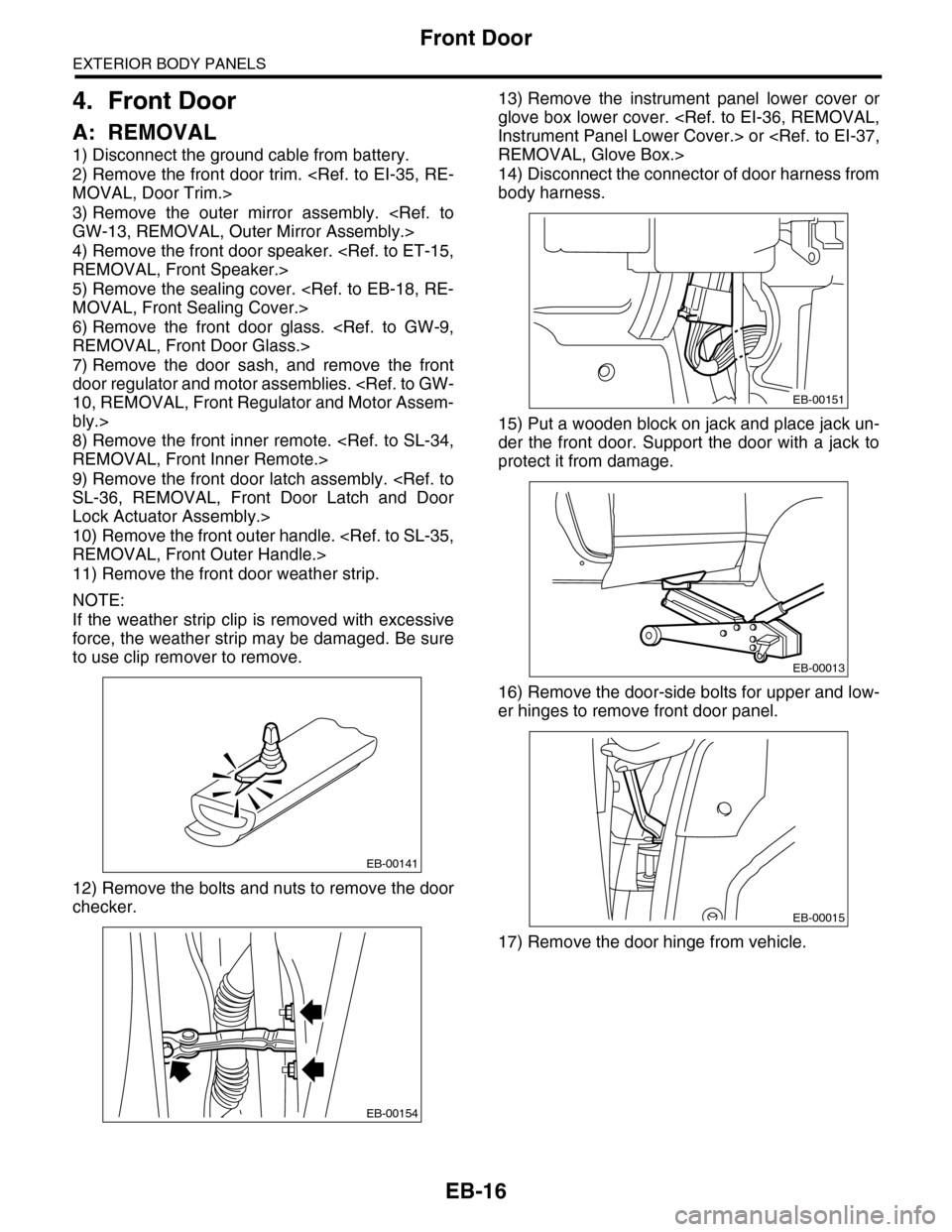
11) Remove the front door weather strip.
NOTE:
If the weather strip clip is removed with excessive
force, the weather strip may be damaged. Be sure
to use clip remover to remove.
12) Remove the bolts and nuts to remove the door
checker.
13) Remove the instrument panel lower cover or
glove box lower cover.
14) Disconnect the connector of door harness from
body harness.
15) Put a wooden block on jack and place jack un-
der the front door. Support the door with a jack to
protect it from damage.
16) Remove the door-side bolts for upper and low-
er hinges to remove front door panel.
17) Remove the door hinge from vehicle.
EB-00141
EB-00154
EB-00151
EB-00013
EB-00015
Page 236 of 2453
EB-17
Front Door
EXTERIOR BODY PANELS
B: INSTALLATION
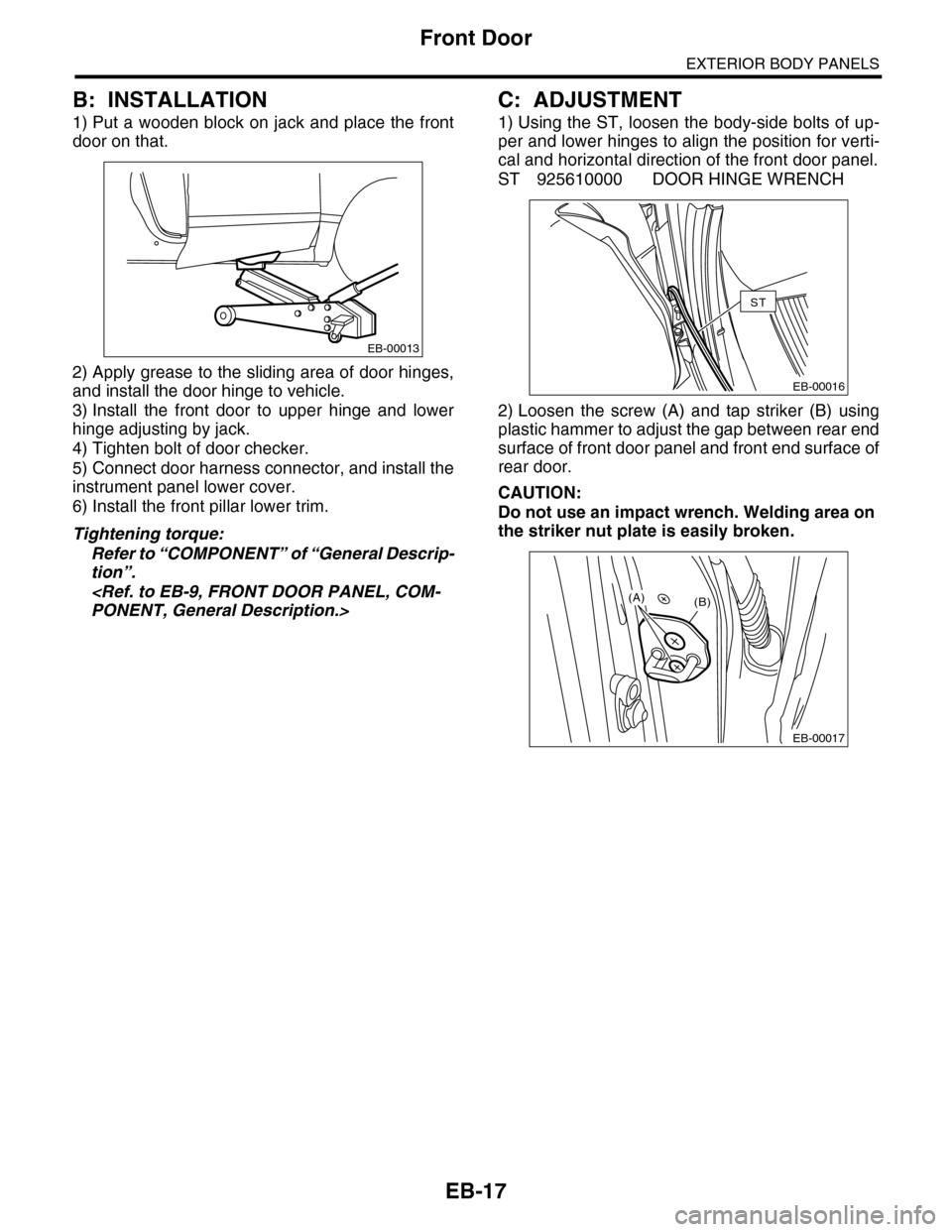
1) Put a wooden block on jack and place the front
door on that.
2) Apply grease to the sliding area of door hinges,
and install the door hinge to vehicle.
3) Install the front door to upper hinge and lower
hinge adjusting by jack.
4) Tighten bolt of door checker.
5) Connect door harness connector, and install the
instrument panel lower cover.
6) Install the front pillar lower trim.
Tightening torque:
Refer to “COMPONENT” of “General Descrip-
tion”.
C: ADJUSTMENT
1) Using the ST, loosen the body-side bolts of up-
per and lower hinges to align the position for verti-
cal and horizontal direction of the front door panel.
ST 925610000 DOOR HINGE WRENCH
2) Loosen the screw (A) and tap striker (B) using
plastic hammer to adjust the gap between rear end
surface of front door panel and front end surface of
rear door.
CAUTION:
Do not use an impact wrench. Welding area on
the striker nut plate is easily broken.
EB-00013
EB-00016
ST
EB-00017
(B)(A)
Page 238 of 2453
EB-19
Rear Door
EXTERIOR BODY PANELS
6. Rear Door
A: REMOVAL
1) Disconnect the ground cable from battery.
2) Remove the rear door trim.
3) Remove the rear speaker.
4) Remove the sealing cover.
5) Remove the rear door glass.
6) Remove the door sash and rear door regulator
and motor assemblies.
7) Remove the rear inner remote.
8) Remove the rear door latch.
Assembly.>
9) Remove the rear outer handle.
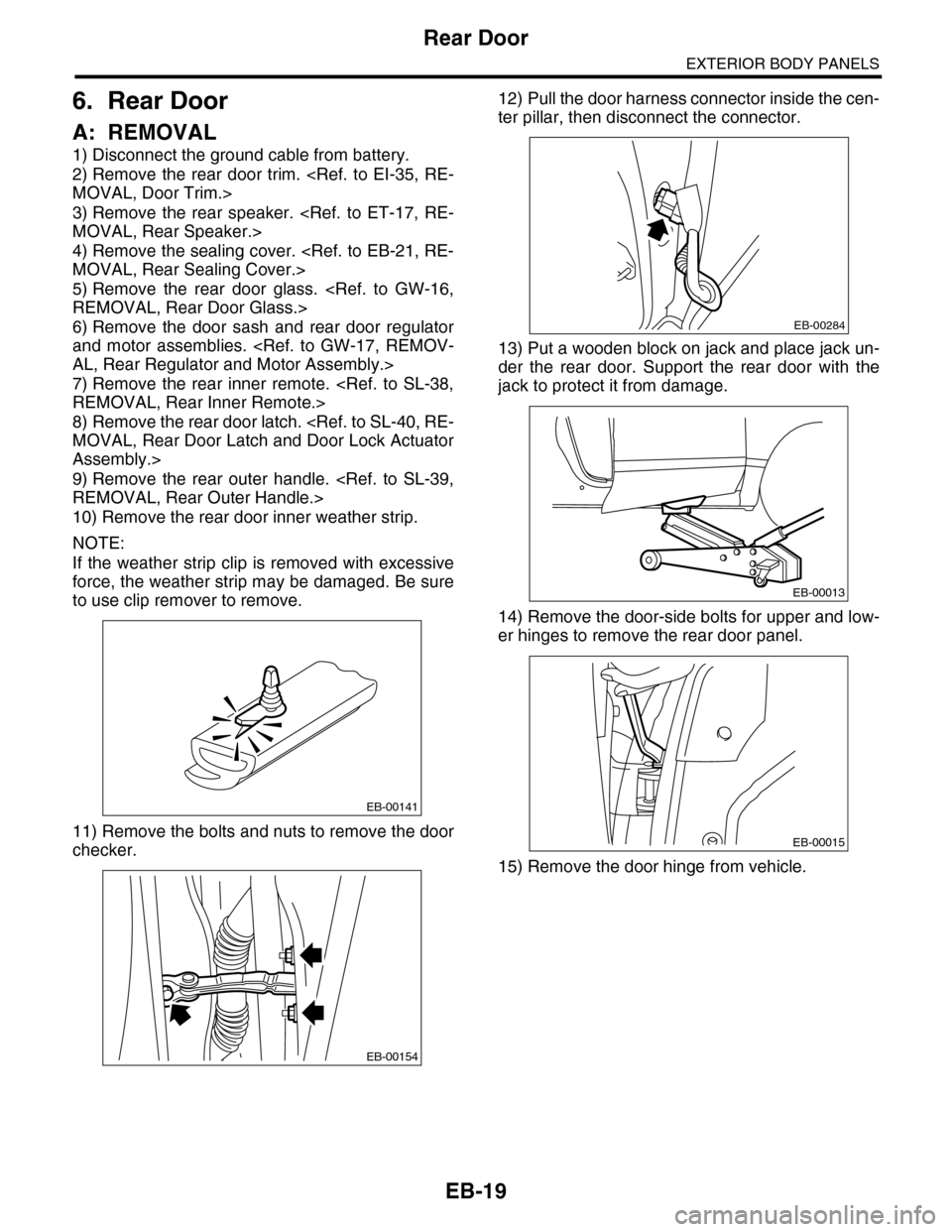
10) Remove the rear door inner weather strip.
NOTE:
If the weather strip clip is removed with excessive
force, the weather strip may be damaged. Be sure
to use clip remover to remove.
11) Remove the bolts and nuts to remove the door
checker.
12) Pull the door harness connector inside the cen-
ter pillar, then disconnect the connector.
13) Put a wooden block on jack and place jack un-
der the rear door. Support the rear door with the
jack to protect it from damage.
14) Remove the door-side bolts for upper and low-
er hinges to remove the rear door panel.
15) Remove the door hinge from vehicle.
EB-00141
EB-00154
EB-00284
EB-00013
EB-00015
Page 239 of 2453
EB-20
Rear Door
EXTERIOR BODY PANELS
B: INSTALLATION
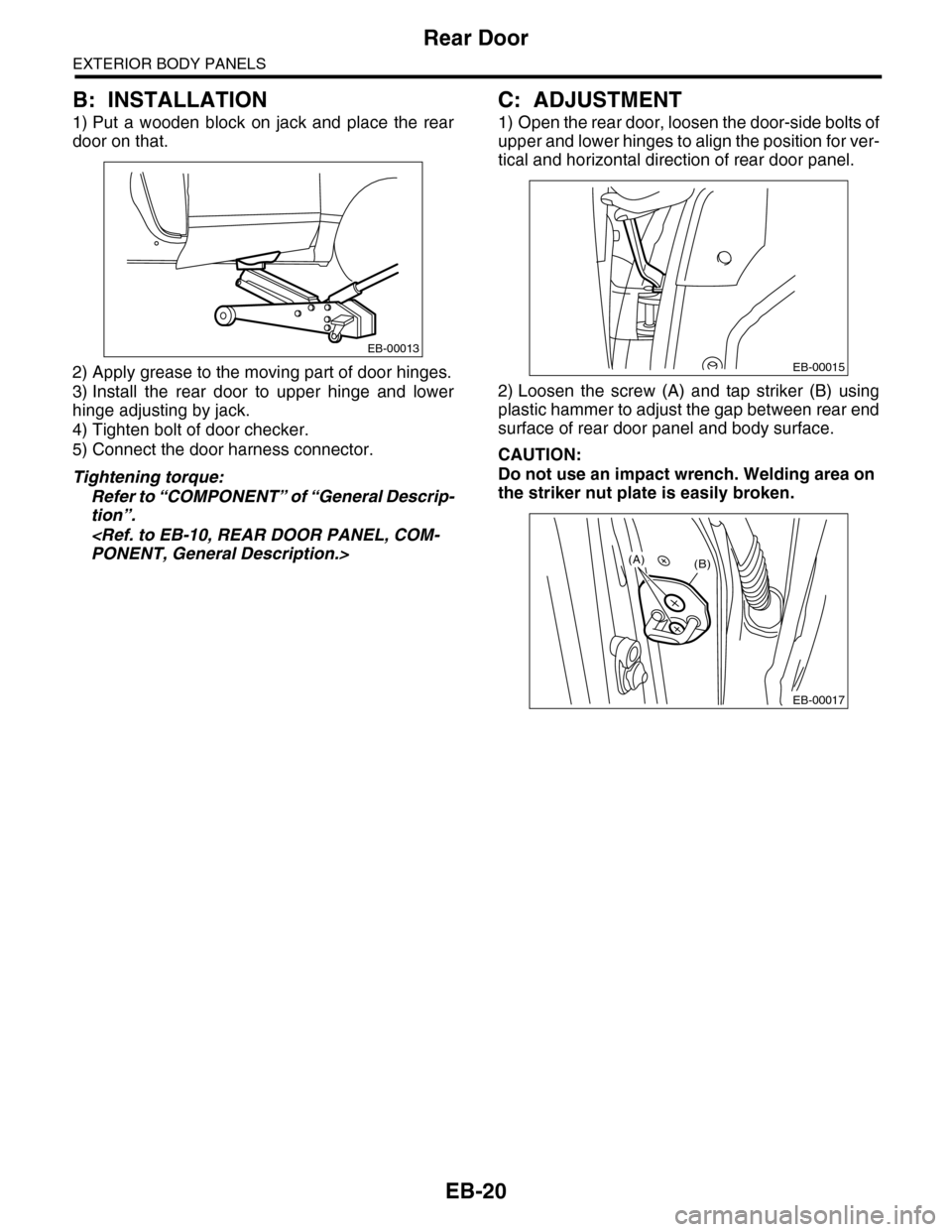
1) Put a wooden block on jack and place the rear
door on that.
2) Apply grease to the moving part of door hinges.
3) Install the rear door to upper hinge and lower
hinge adjusting by jack.
4) Tighten bolt of door checker.
5) Connect the door harness connector.
Tightening torque:
Refer to “COMPONENT” of “General Descrip-
tion”.
C: ADJUSTMENT
1) Open the rear door, loosen the door-side bolts of
upper and lower hinges to align the position for ver-
tical and horizontal direction of rear door panel.
2) Loosen the screw (A) and tap striker (B) using
plastic hammer to adjust the gap between rear end
surface of rear door panel and body surface.
CAUTION:
Do not use an impact wrench. Welding area on
the striker nut plate is easily broken.
EB-00013
EB-00015
EB-00017
(B)(A)
Page 265 of 2453
EI-23
Front Bumper
EXTERIOR/INTERIOR TRIM
C: REPAIR
1. COATING METHOD FOR PP BUMPER
Process
No.Process name Job contents
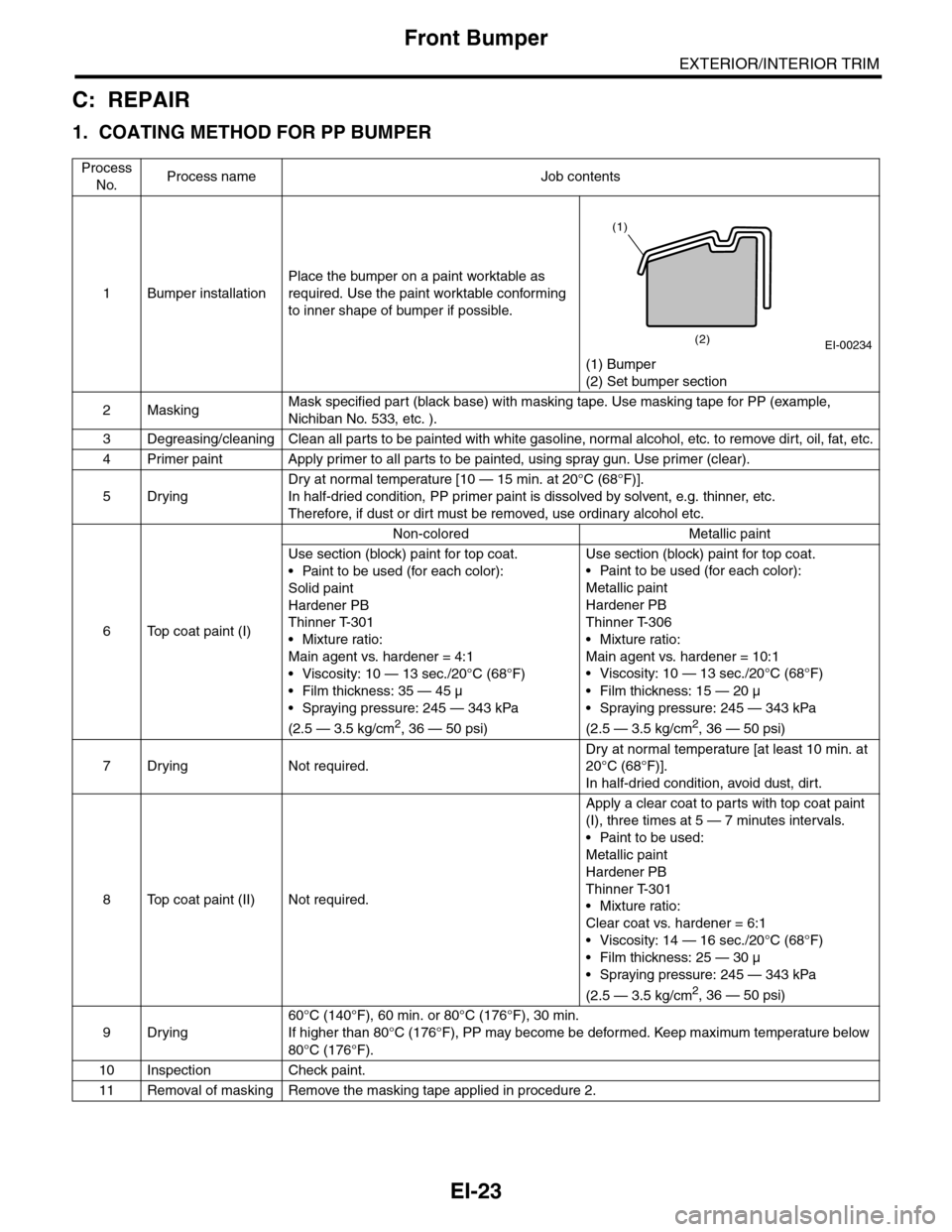
1Bumper installation
Place the bumper on a paint worktable as
required. Use the paint worktable conforming
to inner shape of bumper if possible.
(1) Bumper
(2) Set bumper section
2MaskingMask specified part (black base) with masking tape. Use masking tape for PP (example,
Nichiban No. 533, etc. ).
3Degreasing/cleaningClean all parts to be painted with white gasoline, normal alcohol, etc. to remove dirt, oil, fat, etc.
4Primer paint Apply primer to all parts to be painted, using spray gun. Use primer (clear).
5Drying
Dry at normal temperature [10 — 15 min. at 20°C (68°F)].
In half-dried condition, PP primer paint is dissolved by solvent, e.g. thinner, etc.
Therefore, if dust or dirt must be removed, use ordinary alcohol etc.
6Top coat paint (I)
Non-colored Metallic paint
Use section (block) paint for top coat.
•Paint to be used (for each color):
Solid paint
Hardener PB
Thinner T-301
•Mixture ratio:
Main agent vs. hardener = 4:1
• Viscosity: 10 — 13 sec./20°C (68°F)
•Film thickness: 35 — 45 µ
•Spraying pressure: 245 — 343 kPa
(2.5 — 3.5 kg/cm2, 36 — 50 psi)
Use section (block) paint for top coat.
•Paint to be used (for each color):
Metallic paint
Hardener PB
Thinner T-306
•Mixture ratio:
Main agent vs. hardener = 10:1
•Viscosity: 10 — 13 sec./20°C (68°F)
•Film thickness: 15 — 20 µ
•Spraying pressure: 245 — 343 kPa
(2.5 — 3.5 kg/cm2, 36 — 50 psi)
7Drying Not required.
Dry at normal temperature [at least 10 min. at
20°C (68°F)].
In half-dried condition, avoid dust, dirt.
8Top coat paint (II)Not required.
Apply a clear coat to parts with top coat paint
(I), three times at 5 — 7 minutes intervals.
•Paint to be used:
Metallic paint
Hardener PB
Thinner T-301
•Mixture ratio:
Clear coat vs. hardener = 6:1
•Viscosity: 14 — 16 sec./20°C (68°F)
•Film thickness: 25 — 30 µ
•Spraying pressure: 245 — 343 kPa
(2.5 — 3.5 kg/cm2, 36 — 50 psi)
9Drying
60°C (140°F), 60 min. or 80°C (176°F), 30 min.
If higher than 80°C (176°F), PP may become be deformed. Keep maximum temperature below
80°C (176°F).
10 Inspection Check paint.
11 Removal of masking Remove the masking tape applied in procedure 2.
EI-00234(2)
(1)
Page 269 of 2453
EI-27
Front Bumper
EXTERIOR/INTERIOR TRIM
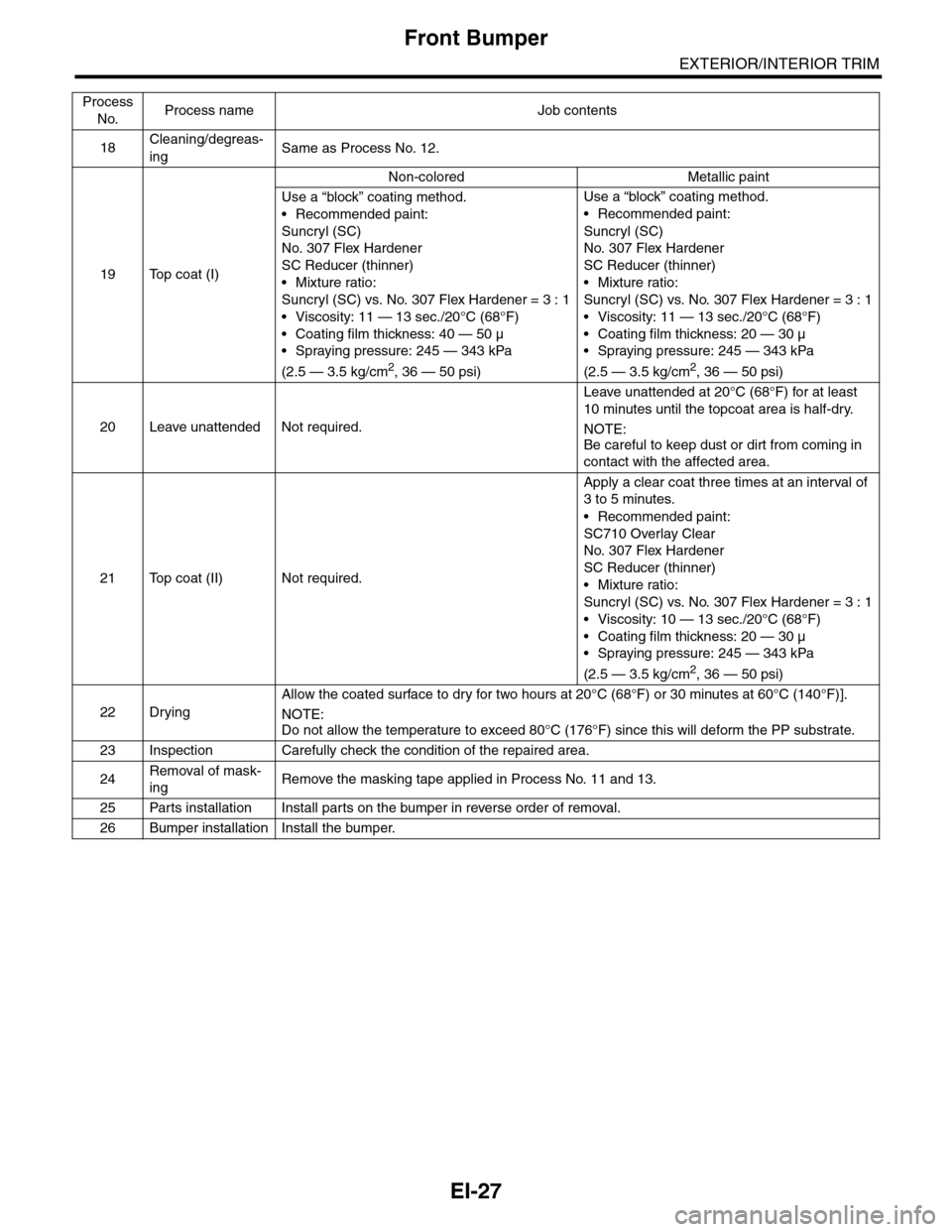
18Cleaning/degreas-
ingSame as Process No. 12.
19 Top coat (I)
Non-colored Metallic paint
Use a “block” coating method.
•Recommended paint:
Suncryl (SC)
No. 307 Flex Hardener
SC Reducer (thinner)
•Mixture ratio:
Suncryl (SC) vs. No. 307 Flex Hardener = 3 : 1
•Viscosity: 11 — 13 sec./20°C (68°F)
• Coating film thickness: 40 — 50 µ
•Spraying pressure: 245 — 343 kPa
(2.5 — 3.5 kg/cm2, 36 — 50 psi)
Use a “block” coating method.
•Recommended paint:
Suncryl (SC)
No. 307 Flex Hardener
SC Reducer (thinner)
•Mixture ratio:
Suncryl (SC) vs. No. 307 Flex Hardener = 3 : 1
•Viscosity: 11 — 13 sec./20°C (68°F)
•Coating film thickness: 20 — 30 µ
•Spraying pressure: 245 — 343 kPa
(2.5 — 3.5 kg/cm2, 36 — 50 psi)
20 Leave unattended Not required.
Leave unattended at 20°C (68°F) for at least
10 minutes until the topcoat area is half-dry.
NOTE:
Be careful to keep dust or dirt from coming in
contact with the affected area.
21 Top coat (II) Not required.
Apply a clear coat three times at an interval of
3 to 5 minutes.
•Recommended paint:
SC710 Overlay Clear
No. 307 Flex Hardener
SC Reducer (thinner)
•Mixture ratio:
Suncryl (SC) vs. No. 307 Flex Hardener = 3 : 1
•Viscosity: 10 — 13 sec./20°C (68°F)
•Coating film thickness: 20 — 30 µ
•Spraying pressure: 245 — 343 kPa
(2.5 — 3.5 kg/cm2, 36 — 50 psi)
22 Drying
Allow the coated surface to dry for two hours at 20°C (68°F) or 30 minutes at 60°C (140°F)].
NOTE:Do not allow the temperature to exceed 80°C (176°F) since this will deform the PP substrate.
23 Inspection Carefully check the condition of the repaired area.
24Removal of mask-
ingRemove the masking tape applied in Process No. 11 and 13.
25 Parts installation Install parts on the bumper in reverse order of removal.
26 Bumper installation Install the bumper.
Process
No.Process name Job contents
Page 291 of 2453
EI-49
Assist Grip
EXTERIOR/INTERIOR TRIM
22.Assist Grip
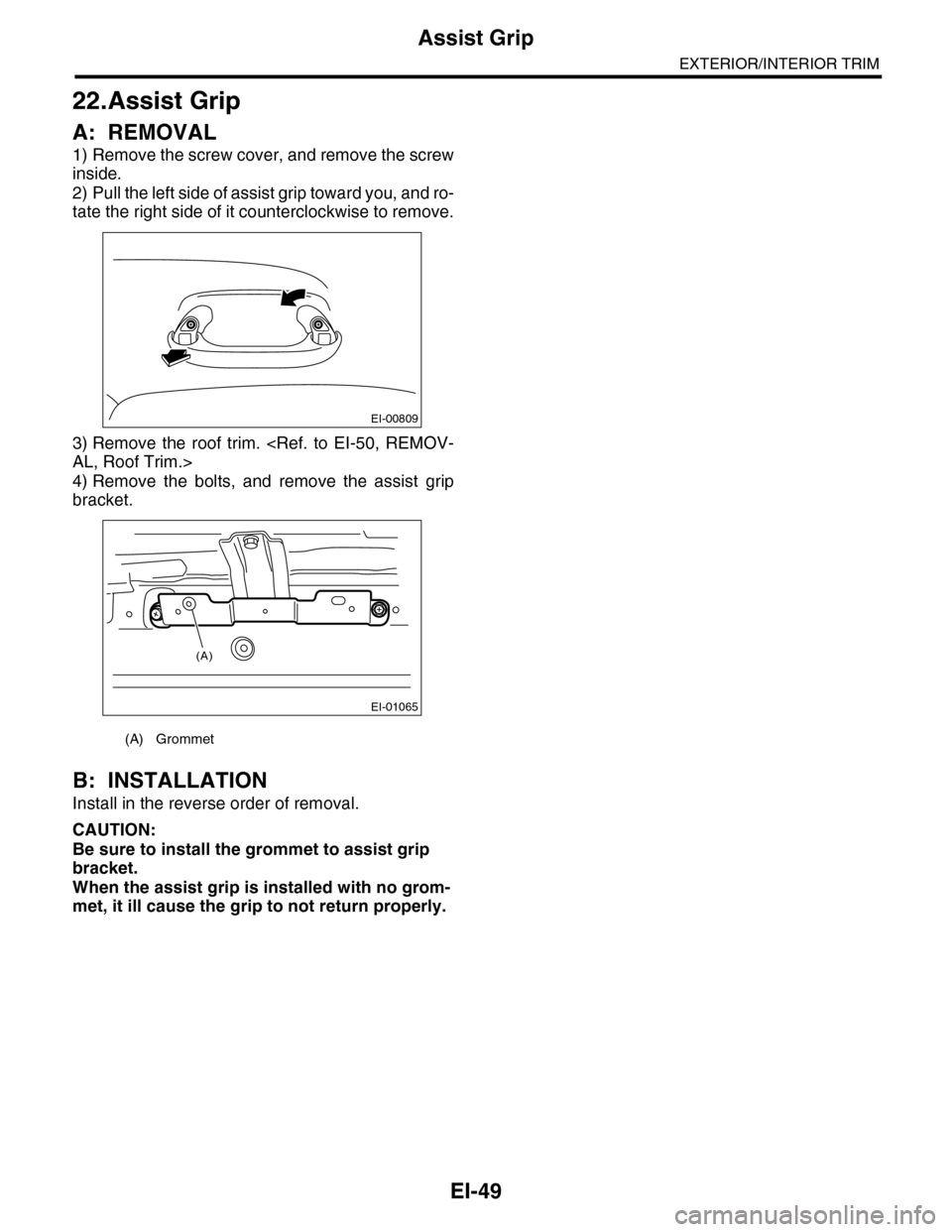
A: REMOVAL
1) Remove the screw cover, and remove the screw
inside.
2) Pull the left side of assist grip toward you, and ro-
tate the right side of it counterclockwise to remove.
3) Remove the roof trim.
4) Remove the bolts, and remove the assist grip
bracket.
B: INSTALLATION
Install in the reverse order of removal.
CAUTION:
Be sure to install the grommet to assist grip
bracket.
When the assist grip is installed with no grom-
met, it ill cause the grip to not return properly.
(A) Grommet
EI-00809
EI-01065
(A)
Page 301 of 2453
GW-6
Power Window System
GLASS/WINDOWS/MIRRORS
2. Power Window System
A: WIRING DIAGRAM
B: INSPECTION
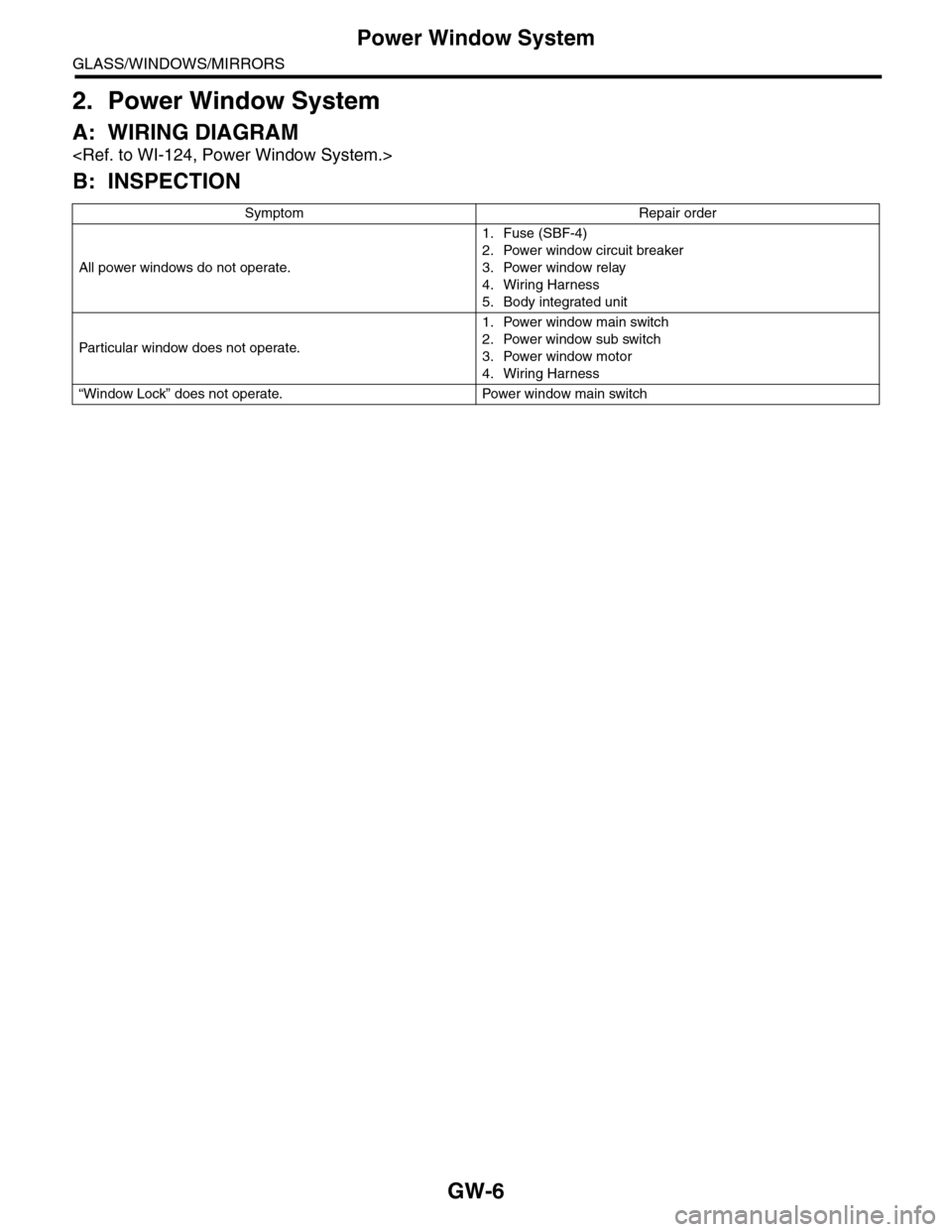
Symptom Repair order
All power windows do not operate.
1. Fuse (SBF-4)
2. Power window circuit breaker
3. Power window relay
4. Wiring Harness
5. Body integrated unit
Par ticular window does not operate.
1. Power window main switch
2. Power window sub switch
3. Power window motor
4. Wiring Harness
“Window Lock” does not operate. Power window main switch
Page 302 of 2453
GW-7
Power Window Control Switch
GLASS/WINDOWS/MIRRORS
3. Power Window Control
Switch
A: REMOVAL
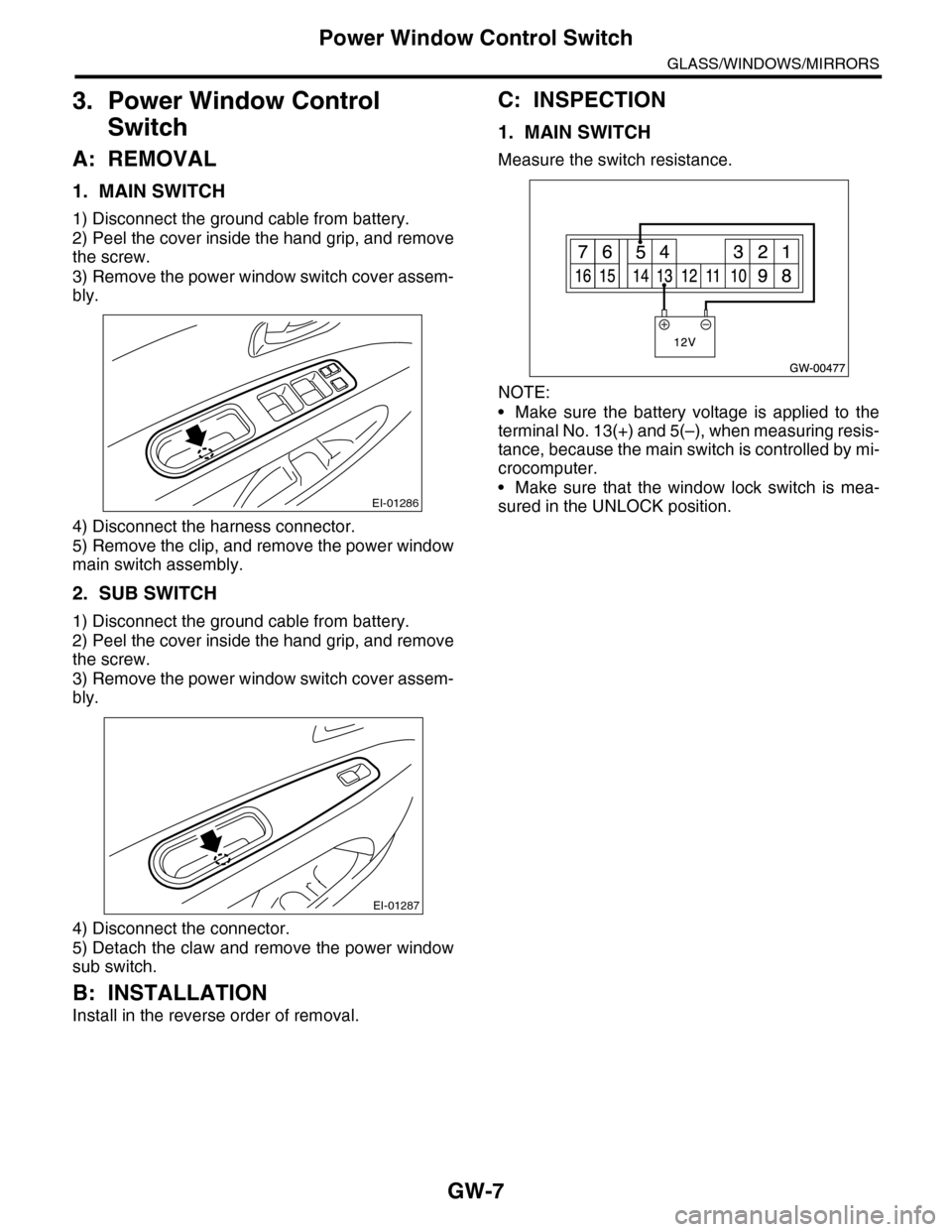
1. MAIN SWITCH
1) Disconnect the ground cable from battery.
2) Peel the cover inside the hand grip, and remove
the screw.
3) Remove the power window switch cover assem-
bly.
4) Disconnect the harness connector.
5) Remove the clip, and remove the power window
main switch assembly.
2. SUB SWITCH
1) Disconnect the ground cable from battery.
2) Peel the cover inside the hand grip, and remove
the screw.
3) Remove the power window switch cover assem-
bly.
4) Disconnect the connector.
5) Detach the claw and remove the power window
sub switch.
B: INSTALLATION
Install in the reverse order of removal.
C: INSPECTION
1. MAIN SWITCH
Measure the switch resistance.
NOTE:
•Make sure the battery voltage is applied to the
terminal No. 13(+) and 5(–), when measuring resis-
tance, because the main switch is controlled by mi-
crocomputer.
•Make sure that the window lock switch is mea-
sured in the UNLOCK position.EI-01286
EI-01287
Page 355 of 2453
AC-29
Blower Resistor (Dual A/C Model)
HVAC SYSTEM (HEATER, VENTILATOR AND A/C)
10.Blower Resistor (Dual A/C
Model)
A: REMOVAL
1) Remove the quarter trim.
2) Disconnect the blower resistor connector.
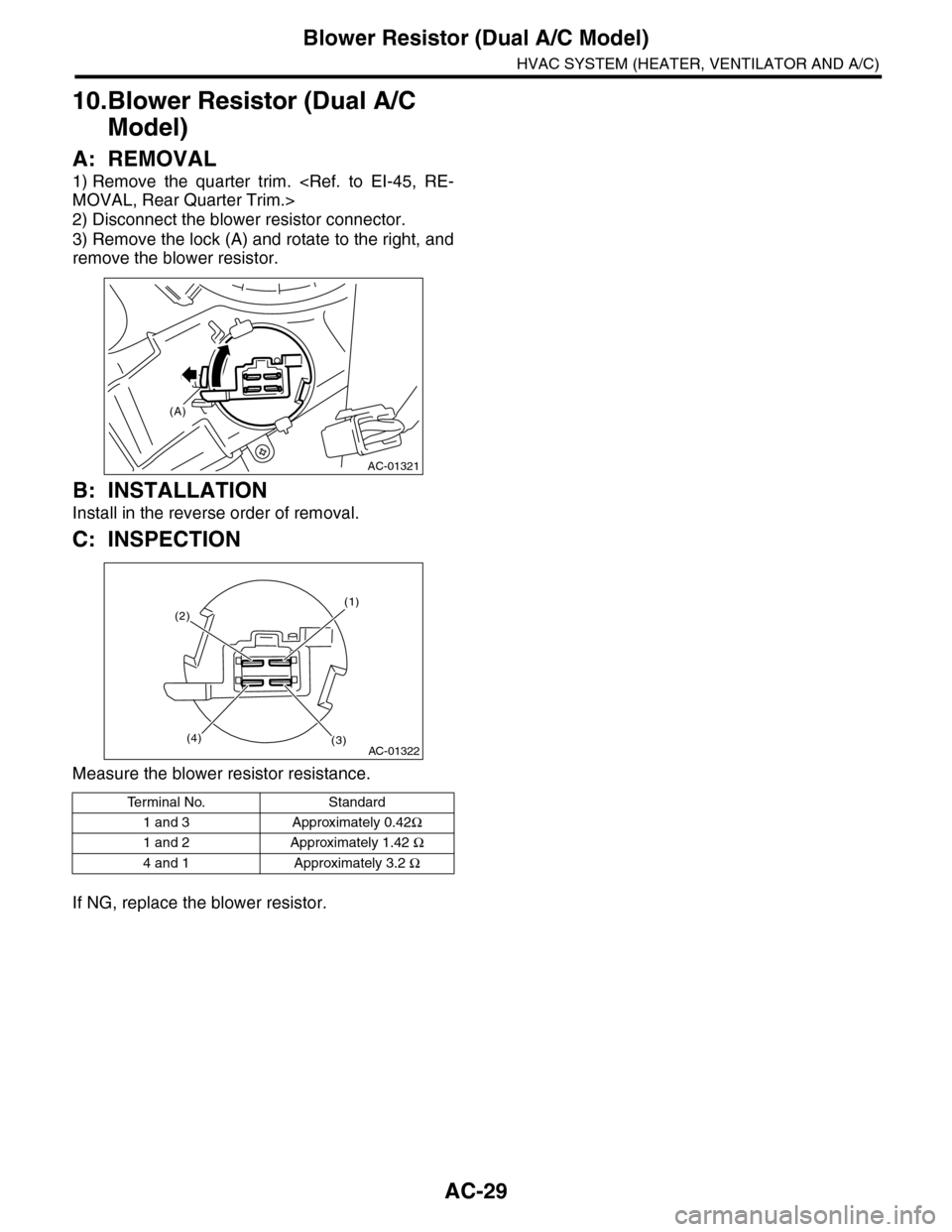
3) Remove the lock (A) and rotate to the right, and
remove the blower resistor.
B: INSTALLATION
Install in the reverse order of removal.
C: INSPECTION
Measure the blower resistor resistance.
If NG, replace the blower resistor.
Te r m i n a l N o . S t a n d a r d
1 and 3 Approximately 0.42Ω
1 and 2 Approximately 1.42 Ω
4 and 1 Approximately 3.2 Ω
AC-01321
(A)
AC-01322(4)(3)
(1)(2)